
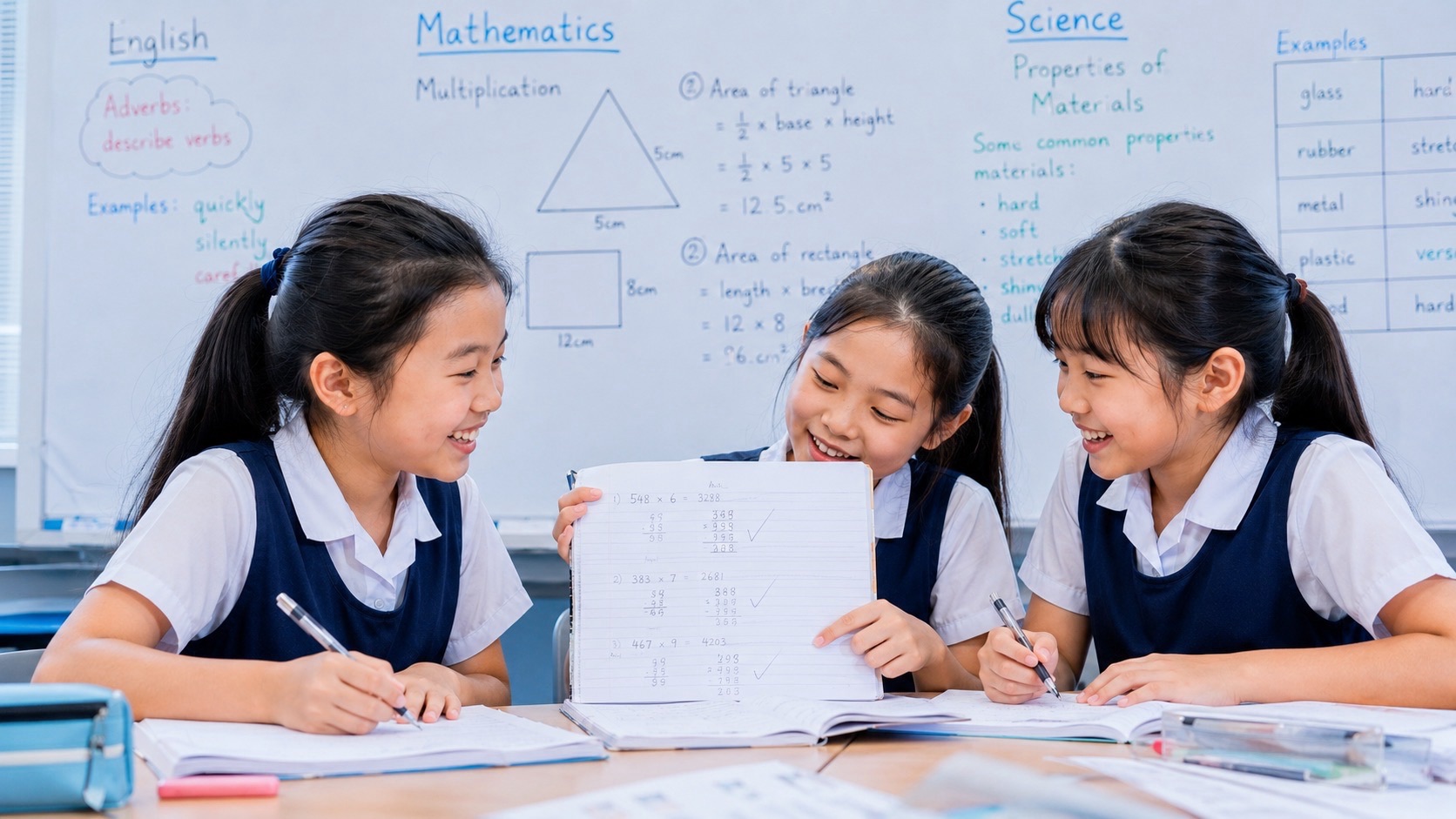
Primary 4 Mathematics tutor for Bartley students. Premium 3-pax tutorials near Sixth Avenue MRT, with whole numbers, factors and multiples, fractions, decimals, geometry, measurement and multi-step problem solving.
Primary 4 is the middle-primary integration year, where earlier skills must begin operating together as a connected system.
At eduKateSG, we provide premium 3-pax Primary 4 Mathematics tutorials for students travelling from Bartley to our centre at 8 Fourth Avenue, near Sixth Avenue MRT. Each lesson combines clear first-principles explanation, carefully sequenced practice, retrieval, correction and close tutor attention.
The purpose is not simply to complete more worksheets. It is to help the student understand the mathematical structure, recognise which method is appropriate, execute accurately, check the result and become progressively more independent.
Mathematics Learning Hub · How Mathematics Works
A Strong Primary 4 Mathematics Programme Begins With Meaning
A student can sometimes produce a correct answer without holding a secure mathematical model. Familiar wording, memorised procedures or repeated worksheet formats can hide that weakness.
The difficulty appears when the representation changes, the numbers become less friendly or two topics are combined in one problem.
We therefore teach the relationship beneath the method before increasing speed or complexity.
Why Bartley Parents Choose 3-Pax Mathematics Tutorials
A maximum class size of three keeps each student visible.
- Immediate feedback during practice
- Frequent opportunities to answer and explain
- Detailed checking of working
- Pacing responsive to the learner
- Targeted questions rather than generic volume
- Gradual removal of prompts
- Calm peer momentum without large-class noise
This matters because the same wrong answer can come from different causes. The tutor needs to see where the reasoning changed direction.
What We Teach in Primary 4 Mathematics Tutorials
Whole numbers and numerical control
- larger whole numbers;
- place value;
- rounding and estimation;
- multi-digit addition and subtraction;
- multiplication and division;
- inverse checking;
- reasonableness;
We teach whole numbers and numerical control as part of a connected mathematical system. Students are expected to understand what the quantities represent, why the method works and how the answer can be checked.
Factors and multiples
- factor relationships;
- multiple relationships;
- systematic factor listing;
- common factors;
- common multiples;
- links to multiplication and division;
- preparation for fraction reasoning;
We teach factors and multiples as part of a connected mathematical system. Students are expected to understand what the quantities represent, why the method works and how the answer can be checked.
Fractions and decimals
- equivalent fractions;
- comparing and ordering fractions;
- fractions of quantities;
- tenths, hundredths and thousandths;
- comparing and ordering decimals;
- rounding decimals;
- decimal addition and subtraction;
We teach fractions and decimals as part of a connected mathematical system. Students are expected to understand what the quantities represent, why the method works and how the answer can be checked.
Geometry, measurement and data
- angle and shape properties;
- perimeter;
- area;
- volume where appropriate;
- diagram interpretation;
- graphs and tables;
- accurate unit use;
We teach geometry, measurement and data as part of a connected mathematical system. Students are expected to understand what the quantities represent, why the method works and how the answer can be checked.
Our First-Principles Teaching Method
1. Diagnose the exact weakness
We avoid broad labels such as “weak in Mathematics.” We identify whether the instability lies in concept, recall, language, operation choice, representation, working memory, units, notation, organisation or checking.
2. Rebuild the first unstable dependency
If current work depends on an earlier skill that is not secure, we repair that dependency and reconnect it to the present topic.
3. Use the Fencing Method
We hold most variables steady while a new idea is being established. Once the structure is secure, numerical size, wording and representation become more varied.
4. Move from visible relationships to abstract notation
Where useful, students move through familiar quantities, diagrams, bar models, tables, number lines and formal symbolic working.
5. Ask the student to explain
- What is the question asking?
- What is known?
- What is unknown?
- How do the quantities relate?
- Why does this method fit?
- How can the answer be checked?
6. Retrieve and interleave
Earlier ideas return after the original lesson so knowledge remains available and the student must recognise the method without relying on a chapter heading.
7. Build assessment discipline
- clear working
- accurate copying
- one logical step per line
- appropriate units
- labelled diagrams
- reasonableness checks
- careful final answers
- time awareness
What Happens During a 90-Minute Lesson
Warm-up retrieval
A short opening set checks retention and reactivates knowledge needed for the lesson.
Concept instruction
The central idea is introduced or repaired with clear language and age-appropriate representations.
Guided practice
Students attempt selected questions while the tutor observes the method and corrects misconceptions immediately.
Independent application
Prompts are reduced so the tutor can see whether the student can carry the method independently.
Mixed problem solving
Earlier and current topics are combined so the student must identify the correct approach.
Error review
Mistakes are classified by cause rather than simply marked wrong.
Focused continuation work
Practice after the lesson is selected from the evidence of the lesson rather than assigned indiscriminately.
Three Primary 4 Student Pathways
Repair
The student has an earlier weakness affecting current Mathematics. We locate the first unstable point, rebuild it and reconnect it to schoolwork.
Stabilise
The student generally understands but results fluctuate. We strengthen retrieval, organisation, checking and independence.
Extend
The student is secure and ready for unfamiliar structures, multiple methods, stronger explanation and deeper connections.
Why Fractions and decimals Receives Special Attention
Fractions and decimals are different representations of quantity. Fractions connect a whole to equal parts, while decimals extend the base-ten place-value system. Understanding that structure makes later procedures more reliable.
The objective is not to create another isolated rule. It is to strengthen the network of ideas the student can draw upon when a question changes form.
Word Problems: Read the Relationship Before Choosing the Operation
Keyword hunting is unreliable. We teach students to identify the quantities, determine what is known and unknown, recognise the relationship and only then choose an operation or representation.
Where a bar model, diagram or table clarifies the structure, it is used as a reasoning tool rather than decoration.
How We Reduce Repeated Careless Mistakes
“Careless” is too broad to guide repair. We separate mistakes into reading, concept, recall, arithmetic, copying, notation, unit, organisation and checking patterns.
Once the pattern is known, the correction can be specific: a place-value error requires structural repair; a copying error requires a deliberate scan; a unit error requires a quantity–unit check; a reasoning error may require another representation.
Working With the School Programme
Schools may introduce topics in different orders and at different speeds. We coordinate with the student’s current school sequence while protecting the foundation underneath it.
When the student is ready, an upcoming idea may be introduced slightly early so the school lesson becomes a second exposure. When an earlier gap is blocking the current chapter, we repair the gap first.
What Progress Should Look Like
- starting questions with less prompting
- choosing methods more deliberately
- showing clearer working
- retrieving earlier skills more reliably
- checking units and reasonableness
- explaining intermediate answers
- recovering more calmly after mistakes
Marks become more dependable when understanding, retrieval, accuracy, organisation and checking begin working together.
When Should a Bartley Student Begin Primary 4 Mathematics Tuition?
- multiplication or division fluency remains weak;
- factors and multiples feel unrelated;
- fractions are procedural but poorly understood;
- decimal place value is unstable;
- perimeter and area are confused;
- multi-step questions break down;
- results remain inconsistent despite apparent understanding;
Parents do not need to wait for a major failure. Earlier repair is often simpler because fewer later topics have been built on top of the original gap.
Travelling from Bartley to Sixth Avenue
Students travelling by MRT can take the Circle Line from Bartley to Botanic Gardens, transfer to the Downtown Line and continue to Sixth Avenue.
Families should check current LTA or MyTransport journey information before the first lesson.
Location: eduKateSG, 8 Fourth Avenue, Singapore 268674
Nearest MRT: Sixth Avenue MRT, Downtown Line
Attendance: By appointment
Class Details
Format: Premium 3-pax small-group tutorials
Level: Primary 4 Mathematics
Duration: 1.5 hours weekly
Teaching approach: first-principles explanation, careful diagnosis, guided-to-independent practice, retrieval, interleaving, visual representation, error analysis and school-aligned preparation.
Materials: curated lesson notes, topic practice, mixed revision, word-problem work, retrieval sets and focused continuation practice.
What Parents Can Bring to the Consultation
- recent school worksheets
- marked classwork or test papers
- examples of questions the child avoids
- teacher comments where available
- the current school topic sequence
- a description of homework difficulties
- examples of recurring errors
We are not looking only at the final score. We are looking for the repeated pattern that explains why the score happened.
Frequently Asked Questions
Do you follow the school’s topic order?
We coordinate with the school sequence. If an earlier dependency is blocking the current topic, we repair it first.
Do you teach ahead?
Yes, when the student is ready. Pre-teaching is used to reduce novelty and improve classroom readiness rather than to race through the syllabus.
Do you use bar models and visual representations?
Yes, when they clarify the mathematical relationship. Students also learn when a direct symbolic method is more efficient.
How quickly should improvement appear?
Some students show better independence or clearer working within several lesson cycles. Larger foundation gaps require longer repair.
Can students join during the school term?
Yes, subject to a suitable 3-pax placement and a reasonable match with the current group pace.
Helpful Reading for Bartley Parents
Primary 4 Mathematics Tuition for Bartley Families
At eduKateSG, our 3-pax tutorials create the space to diagnose precisely, explain clearly, practise deliberately and build enough independent control for school Mathematics to become more manageable.
For students who are behind, we repair. For students who are inconsistent, we stabilise. For students who are ready, we deepen.
Arrange a Parent–Student Consultation
eduKateSG
8 Fourth Avenue
Singapore 268674
Near Sixth Avenue MRT
Premium 3-pax small-group tuition
By appointment
Properly taught kids shine a bright light into the future.