
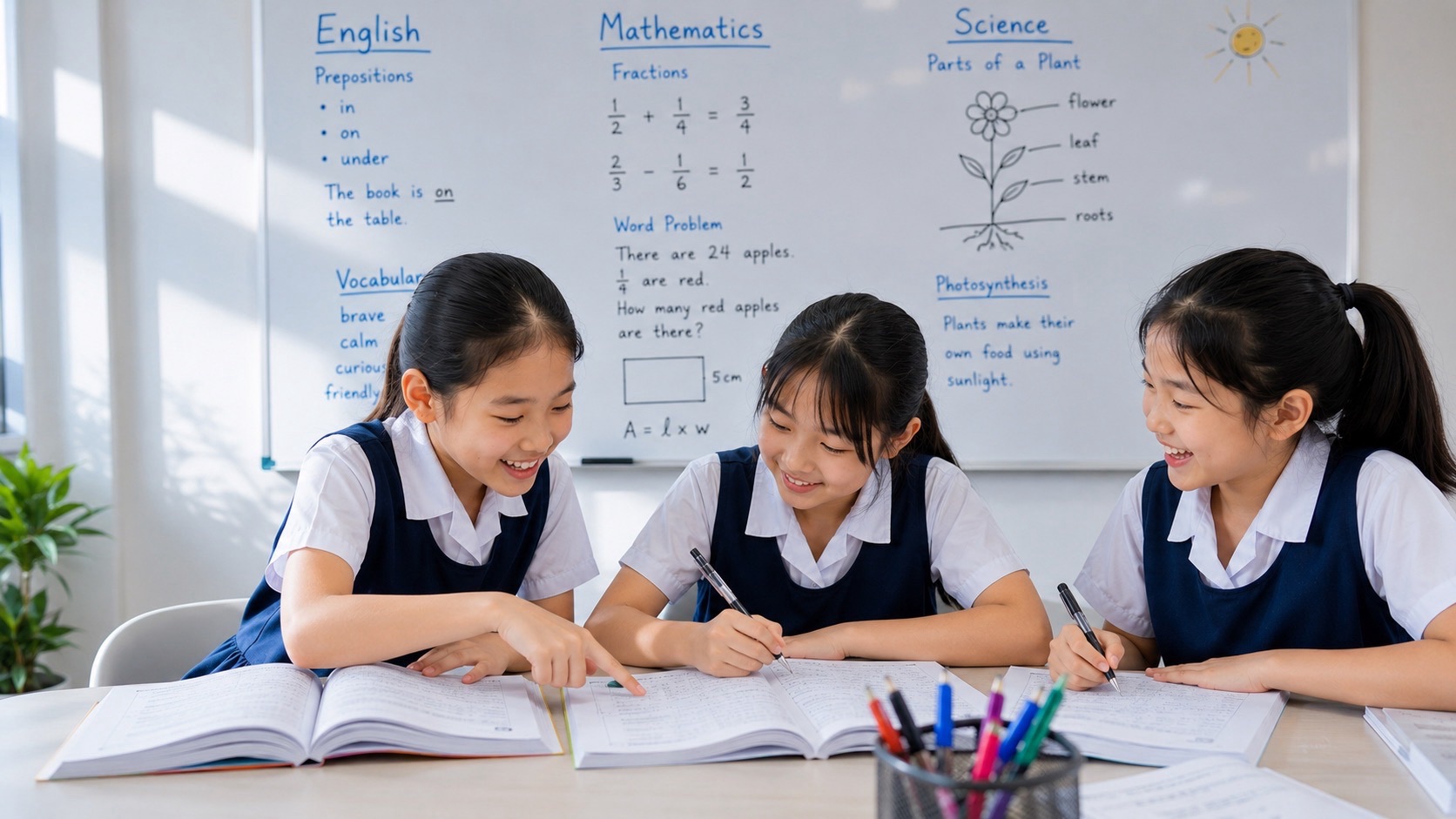
Primary 6 Science tuition for Kupang students. Focused three-student tutorials that connect earlier concepts, current learning and independent reasoning across unfamiliar questions.
The final primary year should make knowledge easier to use, not merely increase the number of pages to revise.
At eduKateSG, we help learners recognise the same scientific relationship when it appears in a different setting. Our human-led tutorials are limited to three students, with regular 1.5-hour lessons combining clear explanation, guided work, independent application and focused corrections.
One learner may need an earlier concept repaired. Another may know the concept but fail to identify it in a mixed question. A third may choose the correct idea and still write an incomplete explanation. We begin with those differences rather than prescribe the same revision packet for everyone.
This guide is for families around Kupang. The teaching venue, timetable, fees and suitable placement are confirmed directly; it does not announce a classroom in the neighbourhood.
Arrange a parent–student consultation · Ask about Primary 6 Science
A More Important Transition Than Finishing the Syllabus
By Primary 6, a child has encountered several years of Science. Some ideas are secure. Some can be recalled only after a reminder. Others were memorised as answers without their underlying relationship ever becoming clear.
The final year asks the learner to bring these ideas together while completing the current school programme. A question may use a new object, an unfamiliar diagram and an earlier concept in the same task. The child has to decide what matters without a chapter heading supplying the answer.
This explains why finishing a chapter is not always the same as securing it. A student may answer heat questions comfortably when every item follows a heat lesson, then overlook heat transfer in a question about a food container or an animal shelter.
The knowledge has not necessarily vanished. The learner may need help recognising its structure across different contexts. That is a distinct teaching task from memorising the definition again.
Our Primary 6 lessons connect current topics to their prerequisites and test that connection independently. When a learner becomes uncertain, we locate the first unstable decision rather than automatically restart the entire syllabus.
The goal is not that every examination question should look familiar. It is that the child can recognise enough familiar Science within an unfamiliar question to make a sound first step and carry the explanation through.
The Hidden Science Problem: A Concept Must Survive a Change of Context
Consider an insulating container. In one question, it helps a warm meal remain warm in cooler surroundings. In another, it helps a cold drink remain cool in warmer surroundings. The material property is relevant in both, but the direction of heat transfer differs.
A learner who memorised one sentence may write that the container prevents heat from escaping in both cases. The words sound familiar, but the second explanation does not describe the stated temperatures correctly.
The useful repair is to identify the warmer and cooler objects before writing. The learner then applies the relationship rather than replaying the original sentence. Understanding is shown by an appropriate change in the answer, not by keeping the wording identical.
This issue appears across Science. A food-web question may add an alternative food source. A spring question may ask for extension rather than final length. A plant question may concern respiration rather than photosynthesis. The child needs to notice which distinction controls the response.
We practise close contrasts deliberately. Two questions share most of their features, but one condition changes the appropriate explanation. Students identify that condition and explain why it matters.
This approach makes revision more connected. Instead of collecting a separate model answer for every object, the learner develops a smaller set of well-understood relationships that can be used in many situations.
Kupang and the Difference Between a Real Environment and a School Model
NParks identifies Kupang as an access station for parts of Sengkang Riverside Park. Its wetland and living environment offer a local reference for discussing how observations differ from the simplified information supplied in a Science question.
A family may notice an animal beside water without knowing what it has eaten, how long it has been there or which conditions affect its behaviour. A worksheet, by contrast, may explicitly provide a food web and state that other relevant conditions remain unchanged.
The learner should use the assumptions of the school model when answering that question, while recognising that an actual environment contains additional influences. We do not turn one sighting into a claim about a population or invent feeding relationships for the park.
This distinction is useful beyond ecology. A classroom heat comparison controls starting temperatures. An outdoor observation may not. A circuit diagram states idealised connections. A real device may contain components not shown in the question.
Students learn to ask which information the task provides and which assumptions are permitted. That protects them from both extremes: importing irrelevant real-world complications into a simple school question, or treating a simplified model as an unlimited statement about reality.
Why Three-Student Tutorials Help Us Find the Right Repair
The same lost mark can have different causes. One student may misunderstand a concept, another may choose the wrong table column and another may omit the last causal step in writing. Their next lessons should not be identical merely because their scores are similar.
In a three-student group, each learner makes an individual attempt before discussion. The tutor can inspect the first decision and compare the child’s spoken reasoning with the written answer.
The discussion then focuses on evidence. One learner identifies the condition that changed. Another explains why a tempting answer fails. A third improves an incomplete mechanism. Students learn from one another without allowing a confident speaker to do all the thinking.
A fresh individual question follows. That attempt tells us whether the discussion has become the learner’s own understanding or remains an explanation that can only be followed when someone else supplies it.
Support and question depth can vary around a shared concept, but placement still matters. A child requiring extensive foundational repair may not fit a group already working comfortably through demanding integrated tasks. We discuss compatibility before recommending a class.
The value of the small group should appear in more precise feedback and increasing independence. It is not a promise that class size alone produces a particular result.
Current Primary 6 Learning and the Examination Destination
Valour Primary’s 2026 Standard Science programme includes forces, photosynthesis, energy conversion and environmental interactions in Primary 6. Your child’s school materials establish the actual sequence and subject scope for tuition.
The SEAB specification applying from 2026 includes understanding and application through scientific inquiry. Learning therefore needs to remain connected to interpreting information and explaining reasoning.
This guide focuses on the year-long work of integration and repair. The companion PSLE Science Tuition | Kupang guide addresses the paper format and examination decisions more directly. Paper management supports learning; it cannot replace a missing concept.
Foundation Science requires appropriately matched content and support. The examples below describe possible teaching tasks, not a claim that every topic is required for every learner or assessed in the same school term.
What We Teach and Reconnect in Primary 6 Science
Photosynthesis and respiration: distinguish the process being explained
Students need to distinguish food production from the release of energy from food. At the required primary-school depth, photosynthesis connects light, water and carbon dioxide with food production in green plants. Respiration is a different process.
The distinction matters when conditions change. A plant without light does not carry out photosynthesis under the usual school model, but the absence of that process does not mean that every life process stops immediately. Stored food and the period being considered matter.
We ask which observation requires explanation and which process is relevant. A student should not select photosynthesis merely because a leaf appears in the diagram, or respiration merely because the word energy appears in an option.
Earlier plant-part and transport knowledge is reconnected where necessary. The learner follows the resources and functions that support the current explanation rather than revise the parts as an unrelated label list.
Forces: identify the interaction and its effect
A force explanation names what acts on what and describes the relevant effect. Starting motion, slowing, changing direction and changing shape are different outcomes. Saying that force is present does not yet explain the observation.
For motion comparisons, the learner inspects starting conditions. Was the same object used? Did it begin with the same motion? Which surface or interaction changed? The conclusion must use the conditions stated rather than a universal rule inferred from a rough-looking drawing.
Where spring questions fit the subject programme, students distinguish original length, loaded length and extension. The quantity requested determines the calculation. A neat subtraction is not useful if the question asks for the total length instead.
We connect the diagram to the words before increasing difficulty. A learner who cannot identify the object affected by a force needs that clarity before a longer explanation becomes manageable.
Energy: follow the particular change
Students identify the starting store or form, the device or process and the relevant output. A battery-powered fan and a battery-powered lamp share some features, but their useful outputs differ. The answer should follow the device actually described.
We avoid treating energy vocabulary as a list to insert into every explanation. The learner should know which object is moving, what is heating or where light is produced, according to the question.
When motion decreases, energy has not simply ceased to exist. A school-level explanation may describe relevant changes such as heating, without needing advanced calculations. The response should remain within the required content and the information supplied.
Practical examples do not require dismantling appliances. Prepared diagrams and measurements can reveal the energy relationship without exposing children to electrical or mechanical hazards.
Environmental interactions: read the complete model
A food web is a set of relationships. Students check what its arrows mean and identify both direct and indirect connections. They should not read only the three-organism chain they recognise while overlooking an additional food source or predator.
Predictions use the simplified assumptions provided. A reduction in a predator can reduce predation pressure on its prey, but the rest of the model still matters. A question about an initial effect is not necessarily asking for a guarantee about every future population.
The learner names the organisms and the mechanism. A vague sentence that the environment is affected does not explain which relationship changes and why.
We also distinguish model-based reasoning from unsupported claims about an actual park. A real sighting can prompt inquiry; it does not establish a complete food web on its own.
Adaptations: connect feature, function and challenge
An adaptation answer should explain how a feature helps under the stated conditions. Naming a body part or saying that the organism is adapted merely repeats the label unless the function is connected to the challenge.
An unfamiliar organism may come with all the information needed. Students learn to use a supplied feature description rather than assume that they must have memorised every species before answering.
We keep the explanation scientifically sensible. An individual animal should not be described as consciously deciding to grow a useful feature. The answer describes the relationship between a feature and its benefit without inventing intention.
Cumulative physical Science: retain the earlier relationships
Water, heat, light, materials and electricity continue to matter. The revision task is to make these ideas available inside changed questions, not simply recognise the notes from earlier years.
We revisit precise prerequisites. Heat-transfer direction, a complete circuit path, the distinction between volume and level, or the source of condensed water may each need a short repair. That is different from restarting every completed topic.
Our First-Principles Teaching Method
1. Establish what the learner can do without support
We review schoolwork and a selected independent set. The tutor notes the concept, representation, written explanation and amount of prompting. This gives a more realistic picture than a score alone.
A blank answer may reflect several different difficulties. The learner may not understand a term, may be unable to choose a concept or may not know how to begin the explanation. Short diagnostic questions distinguish those possibilities before more work is assigned.
2. Repair the smallest meaningful relationship
The repair should be narrow enough to teach clearly and complete enough to support the original question. For a spring table, that may mean identifying the baseline. For a plant explanation, it may mean separating two processes.
The student then attempts a fresh example. If the revised decision works, we reconnect it to mixed work. If it does not, we inspect the remaining uncertainty instead of simply adding more similar questions.
3. Increase complexity through the Fencing Method
One relationship is made clear inside a manageable boundary. We then add a changed condition, a new representation or a second relevant concept. Each addition has a purpose.
This distinguishes a weak basic concept from difficulty coordinating several steps. The tutor can respond to the actual new demand rather than label the whole topic difficult.
4. Ask for the reason behind the chosen concept
The learner identifies which condition or observation makes the concept relevant. This is especially useful when several plausible ideas appear in the same question.
We occasionally check a correct answer in the same way. A correct choice made for an unreliable reason may not survive the next variation.
5. Retrieve, mix and revisit
Earlier and newer ideas return after their original lessons. Chapter cues are removed so that the child must select the relevant relationship from the question.
A delayed changed task checks whether the correction remains usable. Independence and consistency matter alongside accuracy; a single successful repetition is only one part of the evidence.
A Diagnostic Table Parents Can Understand
| What the work shows | What we check | A useful next task |
|---|---|---|
| The right chapter, but the wrong direction | Whether the learner has identified the actual starting conditions | Contrast a warming example with a cooling example |
| The right explanation, but the wrong number | Whether the table asks for a final value or a change | Mark the baseline and calculate the requested quantity |
| A clear oral answer, but vague writing | Whether objects, quantities or causal links disappear in the sentence | Rewrite only the missing relationship, then try a new item |
| Success with a tutor, hesitation alone | Which first decision was previously supplied by a prompt | Remove that prompt gradually in unfamiliar questions |
This is an illustrative teaching guide, not a label permanently attached to a child. A learner can need one kind of support in one topic and a different kind elsewhere. The diagnosis should change when the evidence changes.
Worked Example: One Material Property, Two Different Explanations
The examples in this article use original, illustrative situations and values. They are not measurements from Kupang students, local wildlife studies or official marking schemes.
In the first situation, a warm drink at 58°C stands in a cooler room. An insulating sleeve reduces its rate of cooling. In the second, a cold drink at 10°C stands in a warmer room. A similar sleeve reduces its rate of warming.
The common relationship is reduced heat transfer. The explanation of direction changes. In the first case, heat moves from the warmer drink towards the cooler surroundings. In the second, heat moves from the warmer surroundings towards the colder drink.
A student who writes that the sleeve keeps cold inside has not named the relevant transfer clearly. A student who says that heat is prevented from escaping in both cases has reused a sentence without checking the temperatures.
We ask the learner to identify the two objects and draw a directional arrow before writing. The next task uses a different container and presents the temperatures in a table. The child should retain the relationship while changing the wording appropriately.
For extension, the data may show that the insulated drink still changes temperature. The learner should explain why reduced heat transfer is more accurate than no heat transfer. A small word can mark an important scientific boundary.
Worked Example: The Same Spring Pattern, a Different Requested Quantity
An unloaded spring is 9 centimetres long. With one stated load it is 12 centimetres long; with a second stated load it is 15 centimetres long. A question asks for the extension in the second case.
The extension is 6 centimetres, not 15 centimetres. The learner must compare the loaded length with the original length. The final reading and the change are different quantities.
Now the next question gives an extension of 4 centimetres and asks for the total length of the same spring. The answer is 13 centimetres. Automatically subtracting because subtraction worked in the earlier question would be inappropriate.
We connect this reasoning to other contexts: increase in plant height, decrease in water volume and change in temperature. The objects differ, but identifying a baseline and a change remains the same underlying task.
We do not infer unlimited behaviour from a short spring table. A pattern supports only a suitably qualified prediction within the stated assumptions. Any practical spring work uses appropriate supervised equipment rather than improvised heavy loads.
Worked Example: A Food Web Has More Than One Route
A simplified question states that an insect and a small mammal both eat seeds, while a bird eats the insect and also eats a second supplied food source. The insect population falls. The task asks why the bird can still obtain some food in this model.
The learner must identify the alternative food source explicitly provided. An answer based only on the remembered seed–insect–bird chain ignores part of the question.
The model does not prove that the bird population will remain unchanged forever. Availability, competition and other conditions may matter. The answer should address the requested food relationship rather than expand into an unsupported long-term prediction.
A follow-up removes the alternative food source. The learner should notice why the earlier explanation no longer works. Another variation asks about competition for seeds, requiring attention to a different pair of organisms.
These are fictional classroom relationships, not claims about the actual wildlife at Sengkang Riverside Park. The local environment gives context for asking questions; the information supplied in the model controls the answer.
What Happens During a 90-Minute Lesson
A regular lesson balances teaching with opportunities to use the teaching independently. The following is one illustrative sequence.
Ten minutes: retrieve an earlier concept and inspect a relevant representation. We check a prerequisite before adding current difficulty and revisit a previously repaired distinction.
Fifteen minutes: clarify the central relationship. A contrasting pair makes the important condition visible, and the learner explains why the answer changes.
Twenty minutes: guided applications add carefully chosen variations. Support is available, but the student still makes the important decisions rather than simply follow the tutor’s prompts.
Twenty minutes: independent mixed work removes chapter cues and familiar layouts. Timing may be used where the relevant understanding is already secure.
Twenty-five minutes: review the most useful errors, test one repaired decision and agree on focused continuation work. The task for home should have a clear purpose and a manageable stopping point.
Three Primary 6 Student Pathways
Repair: restore the connection current work needs
This learner has an earlier misconception that appears in several new contexts. We teach the missing relationship directly and use a changed question to check whether the repair works.
The child does not need to repeat every past chapter because one answer was wrong. A focused repair is followed by a return to current work so that the reason for revisiting the earlier concept remains clear.
Stabilise: make knowledge available without a cue
This student understands many concepts but needs help selecting them in mixed questions. We vary the surface while preserving the relationship, then contrast it with a case where that relationship does not apply in the same way.
A personal checking routine addresses recurring risks. The learner may need to identify starting conditions, read every relevant arrow or specify the measured quantity before finalising an answer.
Extend: improve the quality of judgment
A secure learner can evaluate a method, compare plausible explanations or identify additional information needed for a conclusion. The challenge lies in precision and evidence, not necessarily in learning advanced content early.
Extension can also mean writing less but explaining better. An unnecessary extra claim may weaken a sound answer. The student learns to stop when the required relationship has been communicated accurately.
How We Improve Structured Answers
The command determines the response. Describe asks for a different output from explain. Compare needs both sides on a common basis. Evaluate requires a reason that addresses the method or conclusion.
The learner then selects relevant evidence. A value, observation or condition should support the answer rather than appear as decoration. Copying a whole table is unnecessary, but ignoring it and writing a generic chapter explanation is also unhelpful.
The mechanism connects the evidence to the outcome. We locate the missing step when an answer stops early. A sentence about a temperature change needs the relevant heat-transfer direction; a feature needs its function and benefit under the stated conditions.
Finally, the learner checks for ambiguous references and contradictions. The answer should not describe two opposing processes merely because the child is unsure which one belongs. A complete, focused explanation is stronger than a collection of loosely related facts.
How We Reduce Repeated Errors
We separate reading, representation, concept selection and expression. Calling every mistake careless hides information the next lesson could use.
For reading errors, the child identifies the required output and changed condition before writing. For representation errors, we inspect units, scales, baselines and connections.
For conceptual confusion, closely related ideas are compared directly. Photosynthesis and respiration, final length and extension, or an observation and a cause should not remain interchangeable labels.
For expression errors, the learner repairs the missing relationship rather than replace the entire response. We preserve what was already correct so the child understands exactly what needed to change.
For checking errors, the student needs a reason before changing an answer. A missed condition or calculation error is new evidence. A general feeling that another option sounds more impressive is not.
A Practical Sequence Through the Final Primary Year
Begin by establishing which ideas are secure, fragile or missing through actual attempts. A child’s confidence rating is useful context, but it does not replace evidence of independent application.
Keep current learning moving while repairing the prerequisites it needs. Short retrieval tasks retain earlier relationships without turning each week into a complete restart of the syllabus.
Increase mixed work as separate concepts become usable. Remove familiar cues and ask why the selected relationship fits. When a repeated difficulty appears, isolate it briefly, repair it and return to integration.
Longer sets and papers then examine consistency, pacing and independent performance. Their value depends on the review that follows. A paper can reveal a gap without repairing it.
This sequence changes with the student’s evidence. A fixed paper quota cannot decide whether the next lesson needs conceptual teaching, representation practice or a more realistic independent task.
Home Learning for Kupang Families
A manageable routine should make the child’s knowledge easier to retrieve, not simply lengthen every evening. Choose one clear task and agree on what an honest attempt looks like.
One useful pattern is to explain a concept without notes, apply it to a changed question on another day and complete a short mixed review before the next lesson. The amount is adjusted around schoolwork and other commitments.
Parents can ask what remained the same between two questions and what changed. This helps the learner recognise a shared relationship while noticing the condition that requires different wording.
A park photograph or everyday object can supply a new context, but it should not become an unsupported scientific claim. Ask which information is visible and what a school question would need to specify before a cause could be established.
Record help accurately. If the child needed the concept named, note that. If only a unit reminder was required, note that too. Different levels of assistance tell the tutor different things about readiness.
Keep original errors visible and stop after the agreed attempt. A precise uncertainty brought to the next lesson is useful. Rewriting until every response sounds polished can conceal what still needs teaching.
What Progress Should Look Like
The student begins to recognise a familiar relationship inside a new context. A different container no longer causes the heat-transfer explanation to collapse. A changed food web is read completely. A spring answer uses the requested quantity.
We look for fewer repeated misconceptions across fresh questions and less dependence on prompts. The learner should increasingly supply the first decision, not only complete the steps after the tutor begins.
Confidence becomes practical: the child can state what is unknown, choose a reasonable first step and recover after an error. These actions are more informative than confidence described only as a feeling.
School results remain important, but are interpreted alongside content and error patterns. No tuition programme can guarantee AL1 or a fixed improvement after a set number of lessons. We can make the teaching priorities and evidence of growing independence clear.
When Should a Kupang Family Seek Primary 6 Science Support?
Support may be useful when earlier misconceptions keep appearing, the student works comfortably only by chapter, structured answers omit the mechanism or homework still requires frequent prompting.
A secure learner may need more demanding questions about evidence, limitations and unfamiliar applications. A child already learning confidently and using school feedback independently may not require another class.
For a late enquiry, the first priority should be realistic and specific. One recurring decision that can be repaired and retested is a more useful beginning than asking the student to redo the entire syllabus immediately.
Practical Access from Kupang
Consider the full journey from the child’s school or home, including food, walking and the return trip. A lesson should fit the learner’s week as well as the timetable.
Travel information checked on 30 September 2026: LTA lists Sengkang West Loop adjustments until 18 October 2026. Check the latest notice before travelling rather than assume both loop directions are available.
The eduKate contact page lists Punggol appointments at 83 Punggol Central. Confirm the Science venue, meeting instructions and available placement directly. This guide does not establish a Kupang branch.
Class Details and What to Bring
Format: human-led three-student tutorials. Regular duration: 1.5 hours. Focus: current Primary 6 learning, earlier prerequisites, scientific inquiry, structured explanations and independent integration.
Materials may include concept contrasts, different representations, investigation questions, worked examples and mixed practice. Current fees, timetable and any additional arrangements are confirmed directly.
Bring recent marked papers, current school topic information and examples of difficult work. Tell us which answers were independent and where assistance was provided. A genuine incorrect attempt is often more informative than a polished answer produced with substantial help.
Consultation should explain the first learning priorities and whether the available group fits the child. It is not an automatic recommendation to enrol or a guarantee of a particular examination result.
Frequently Asked Questions
Is Primary 6 Science tuition only examination drilling?
No. The year includes learning remaining content, reconnecting earlier concepts and building independent application. Examination rehearsal is useful when it tests skills the student has been taught. It should not replace conceptual teaching when the learner still cannot explain the relationship slowly and accurately.
Why does my child know the chapter but miss it in a mixed question?
The chapter heading may have been supplying the concept-selection step. We practise recognising the relationship from the conditions and evidence instead. Changed contexts help the learner separate the scientific structure from the familiar appearance of the original worksheet.
Will the child have to restart every earlier topic?
We return to the prerequisite that affects current work. A spring problem may need baseline reading repaired; a cooling question may need heat-transfer direction clarified. Neither automatically means that every past Science chapter needs to be taught again.
How do you help with incomplete explanations?
We inspect the command, evidence and mechanism. Some learners need a concept repaired; others need to name an object, specify a quantity or complete the final causal link. The original response tells us which correction is useful, and a fresh question tests it.
Are the food-web examples claims about local wildlife?
No. They are fictional classroom models with explicitly supplied relationships. The park provides a local context for discussing inquiry, not evidence for an invented food web. Students learn to distinguish a model’s assumptions from observations of an actual environment.
Should a disappointing paper be followed by more full papers?
First identify why the marks were lost. A recurring concept error may need focused teaching, while a pacing or integration difficulty may benefit from a carefully reviewed longer task. The score should guide diagnosis rather than trigger an automatic increase in volume.
What changes for Foundation Science?
The student’s actual subject requirements, language support and pace guide the work. Standard and Foundation materials are not interchangeable. Bring the school programme information so that content and suitable class placement can be considered properly.
Can strong students still benefit?
Possibly, when they need deeper investigations, closer feedback or more precise judgments about evidence. Extension should improve control rather than simply add advanced words. A student already receiving appropriate challenge elsewhere may not need additional tuition.
How much should parents help?
Encourage an honest attempt, ask why one important decision was made and record any prompts. Leave the original answer visible. Parents do not need to rewrite every response; accurate information about independence helps the tutor choose the next task.
What should improvement look like before the next test?
The learner identifies concepts with less help, reads changed representations more accurately and writes explanations that fit the conditions. Look for those changes across fresh questions and after a delay, not only on work corrected immediately with the tutor.
Helpful Reading for Kupang Parents
Earlier foundations are explained in Primary 4 Science Tuition | Kupang and Primary 5 Science Tuition | Kupang. Continue to PSLE Science Tuition | Kupang for examination preparation.
The Primary Science teaching guide gives the broader programme context. Families can also read Primary 6 Science Tuition | Farmway.
Primary 6 Science Tuition for Kupang Families
The final primary year should help a child recognise that different questions can share the same underlying Science, while a small change in conditions can require a different explanation.
We repair the missing connection, stabilise independent use and extend sound judgment. The objective is a learner who can approach unfamiliar work with a clear first step and use knowledge without waiting for someone else to identify the chapter.
Arrange a Parent–Student Consultation
Share your child’s current topic and a recent piece of Science work. We can discuss the first useful repair or extension and a suitable class arrangement.