
How to Improve With Tuition | Brickland
How to improve with tuition for Brickland students begins with a precise learning problem rather than a larger stack of worksheets. The central learning problem is using the wrong resource for the learning problem. Brickland students improve when tuition teaches them to choose among explanation, worked example, retrieval, drill, mixed practice, feedback, notes and full-paper practice according to what is actually failing.
At eduKateSG, we teach premium 3-pax small-group tutorials near Sixth Avenue MRT. Lessons are typically 1.5 hours weekly and combine first-principles explanation, close tutor observation, retrieval, mixed practice, error analysis, independent application and focused continuation work.
For Brickland families, tuition should not become a second school day built around worksheet volume. The purpose is to make the student more capable outside the lesson: better at reading the demand, retrieving relevant knowledge, choosing a method, monitoring progress, checking the result and recovering when the first attempt does not work.
- match the resource to the learning problem
- stop using notes when retrieval is weak
- stop using full papers when foundations are unstable
- use worked examples for structure rather than copying
- change resources when the bottleneck changes
Arrange a parent–student consultation with eduKate Singapore.
The Important Transition Is From “Study More” to “Use the Right Resource Next”
Students often have many materials but little strategy for selecting among them.
A worked example helps when structure is unclear. Closed-note retrieval helps when memory is weak. Blocked practice helps execution. Mixed practice helps selection. Timed papers help integration and pacing.
For Brickland students, tuition should make these resource functions explicit.
The Hidden Problem: A Good Resource Can Be Badly Timed
A past paper is useful, but not when the learner lacks prerequisites for half the paper.
Notes are useful, but not when the concept is understood and the real problem is independent recall.
A model answer is useful, but not when it remains visible during every attempt.
What This Looks Like in Real Schoolwork
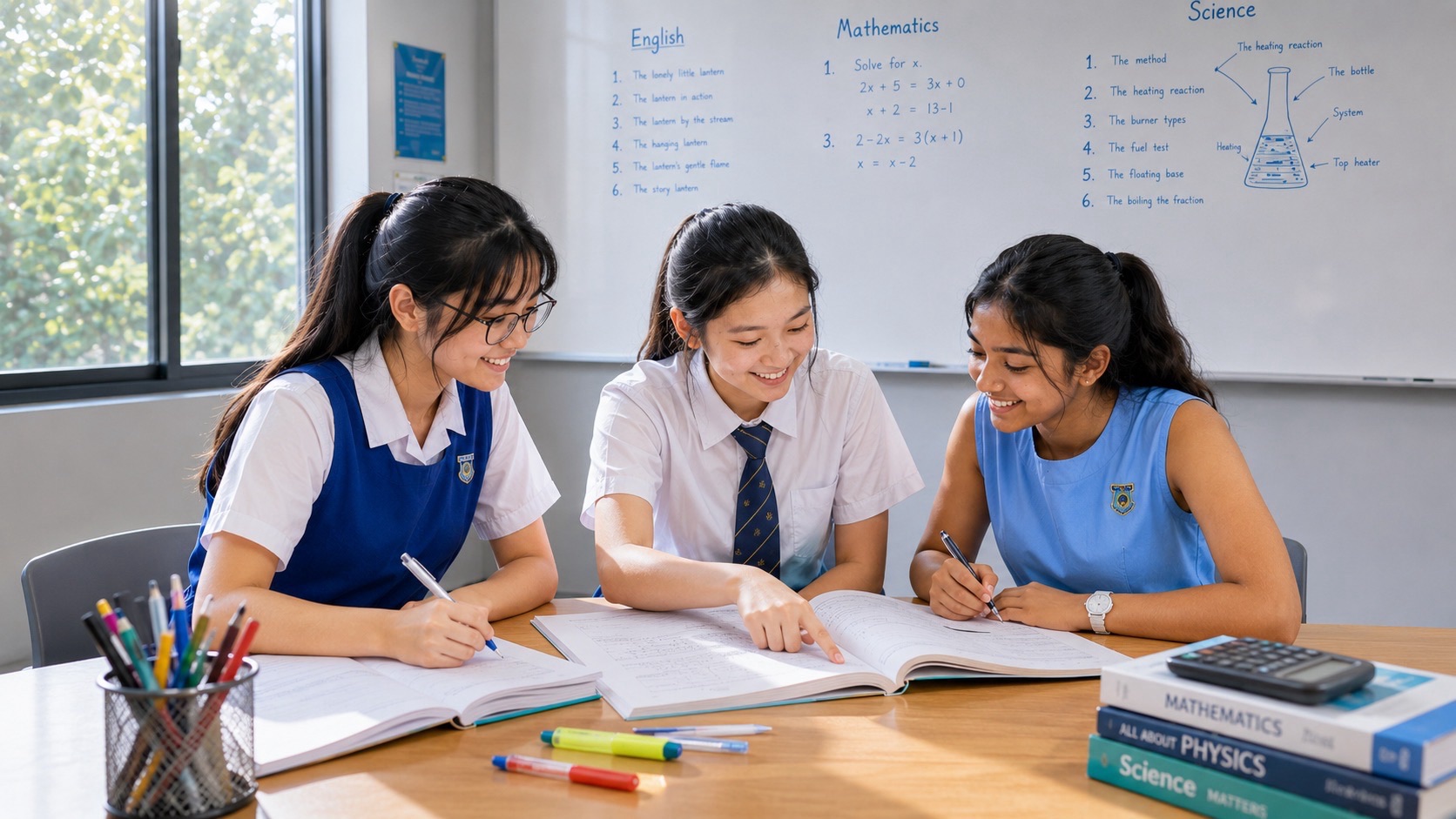
In English, model paragraphs can reveal structure but model-free generation is needed later.
In Mathematics, topical practice can stabilise a method while mixed practice is needed for selection.
In Science, notes can rebuild a mechanism but unfamiliar application is needed once the concept is secure.
Why a 3-Pax Tutorial Can Help Brickland Students Improve
In a 3-pax tutorial, the tutor can see how each Brickland student reaches an answer rather than only whether the final answer is right or wrong.
Three students studying the same broad topic may need completely different resources: one a worked example, another retrieval, another timed mixed practice.
- close inspection of individual working
- frequent opportunities to answer and explain
- pacing that can change when a hidden gap appears
- independent application after guided teaching
- comparison of different valid approaches
- clearer tracking of recurring error patterns
- more precise adjustment before school assessments
The class is small by design. Its value comes from better information about how each student is thinking, not merely from reducing the number of seats in the room.
Three Improvement Pathways
1. Repair
Repair is needed when the chosen resource does not address the actual failure.
- rereading for a retrieval problem
- full papers with major prerequisite gaps
- watching explanations instead of practising execution
- topical drills despite weak method selection
- copying model answers instead of generating independently
Repair should remain narrow. The tutor fixes the smallest foundation or decision genuinely blocking current work, then reconnects the student to the school topic as soon as possible.
2. Stabilise
Stabilisation links common learning states to suitable resources.
- concept gap → explanation and worked example
- memory gap → closed-note retrieval
- execution gap → focused practice
- selection gap → mixed practice
- timing gap → timed sections or full papers
Stabilisation turns a successful explanation into repeatable behaviour. The student should reproduce the reasoning with fewer prompts, after a delay and in a slightly changed question.
3. Extend
Extension develops independent resource choice.
- self-directed revision
- assessment preparation
- mixed subject planning
- error-driven practice selection
- long-term study routines
Extension is not simply harder work. It requires more independence, discrimination, transfer, explanation, endurance or efficiency while preserving accuracy.
A First-Principles Improvement Method
1. Diagnose the first unstable point
We ask what failed before choosing what to study next.
The same chapter can require different resources depending on whether the problem is understanding, recall, selection, execution or timing.
2. Rebuild only what is actually missing
The tutor models the resource decision and explains why another popular option would be lower value at that moment.
The student then makes the choice independently on fresh error cases.
3. Use the Fencing Method
We begin inside a clear practice boundary so the student can see the target relationship without too many competing demands. Once the method is secure, one new difficulty is introduced deliberately: changed wording, a different representation, mixed topics, an additional reasoning step or controlled time pressure.
This keeps errors informative. If several new demands arrive at once, the tutor may know that the answer is wrong without knowing which part of the thinking failed first.
4. Make the student explain
Students justify the resource in one sentence.
That sentence prevents vague studying and makes it clear what improvement the resource is supposed to produce.
5. Retrieve after a delay
Later revision begins with diagnosis rather than automatically opening notes.
6. Interleave and transfer
Mixed error cases require students to select the right study action as well as solve the academic problem.
This develops metacognitive resource control.
7. Add speed only after control
As the routine becomes familiar, resource selection should take minutes, not an entire planning session.
Why Immediate Success Is Not Enough
A student can look excellent immediately after an explanation because the worked example, vocabulary and tutor prompts are still active in working memory.
That performance is useful evidence, but it is incomplete evidence. The stronger test is whether the learner can restart later, retrieve the method without the model beside the page, recognise the same structure in different wording and explain why the method still applies.
This is why strong tuition contains delayed retrieval and cold-start work. Learning has to survive the distance between lessons, not only the final ten minutes of the current lesson.
What Happens During a 90-Minute Improvement Lesson
Warm-up retrieval
A short review presents several error patterns and asks which resource would be most useful next.
Current-school diagnosis
Recent schoolwork is checked for patterns. One or two high-value weaknesses are selected rather than trying to repair every marked error in the same lesson.
Concept instruction
The tutor teaches the content and also names the role of the resource being used.
Guided practice
The student attempts carefully selected questions while the tutor monitors the decision points. Prompts are reduced as control improves. A useful prompt directs attention; it does not replace the student’s reasoning.
Independent application
The student chooses the next practice format after reviewing their own performance.
Mixed or timed application
Different learning problems are interleaved so resource selection remains evidence-based.
Error review
Mistakes are classified rather than simply crossed out. Reading, recall, concept, selection, execution, notation, language, timing and checking errors require different repairs.
Focused continuation work
Continuation work states why each assigned resource is being used, not merely what page to complete.
How Tuition Should Improve English
Model essays help reveal structure, but model-free generation is needed once that structure is understood.
Vocabulary lists organise words, but closed-note retrieval and varied use are needed for memory.
Comprehension worksheets help practise reasoning, but feedback must target the actual error rather than simply add more passages.
How Tuition Should Improve Mathematics
Worked examples reveal method structure, blocked sets build execution, mixed sets train selection and timed papers test integration.
Students learn not to jump to full papers because examinations are approaching if the method still collapses.
The correct resource makes practice diagnostic rather than performative.
How Tuition Should Improve Science
Science notes are useful for rebuilding mechanisms and terminology, but notes alone cannot prove application.
Retrieval questions test memory, data questions test evidence use and unfamiliar scenarios test transfer.
Students select the resource that targets the current failure.
Why Resource Selection Is Part of Learning Strategy
A resource is not inherently effective. Its value depends on the problem it is being used to solve.
The same worked example that is excellent during first learning can become a crutch if it remains open during every later attempt.
The same full paper that is excellent for integration can be inefficient if half the underlying methods are unstable.
Strategic learners therefore select resources based on diagnosis and change resources as the learning state changes.
Three Practice Scenarios
English scenario
A student rereads model compositions every week but still cannot start a fresh prompt.
Diagnosis identifies a generation problem, so the resource changes from more models to model-free planning and drafting with feedback afterwards.
Mathematics scenario
A student keeps doing topical algebra worksheets with high accuracy but performs poorly on mixed tests.
The resource changes from blocked practice to interleaving because execution is secure while method selection is not.
Science scenario
A student completes many full Science papers but repeatedly loses marks on one mechanism they never understood.
The resource changes temporarily from full papers to a focused explanation, causal model and small transfer set before returning to integration.
Resource Fading and Handoffs
A strong resource should often become less visible as the learner becomes more capable. Notes may begin open, then move beside the page, then close. A worked example may become a completion problem and finally a cold-start question.
This fading matters because success with a resource is not the same as success without it. The tutor watches for the moment when the resource has taught what it was meant to teach and begins removing support.
A handoff occurs when the learning problem changes. Once concept understanding is stable, the next resource may be retrieval. Once retrieval is stable, the next resource may be mixed selection. Once selection is stable, timed integration may become appropriate.
Brickland students therefore learn that resources have life cycles. A tool can be exactly right on Monday and lower value two weeks later because the learner has changed.
What Good Practice Looks Like
Good resource selection begins with a named learning problem.
The resource is changed when evidence shows the learning state has changed.
- diagnose first
- choose one primary resource
- state its purpose
- measure whether the target improves
- switch when the bottleneck moves
Good practice creates a clean learning signal. The tutor should be able to tell what improved, what still failed and what the next question should test.
What Poor Practice Looks Like
Poor practice often feels productive because the student is busy. The warning sign is that the same weakness remains unchanged even after many pages.
- opening notes by habit
- doing past papers too early
- collecting resources instead of using them
- watching explanations without retrieval
- keeping model answers visible indefinitely
When this happens, another large worksheet is rarely the first answer. The task should become smaller and more diagnostic until the tutor can see exactly what needs to change.
A Diagnostic Matrix for Repeated Errors
Repeated errors become easier to repair when they are classified by the decision that failed rather than by the chapter in which the mark was lost.
- reading error — the demand or condition was misread
- retrieval error — relevant knowledge could not be accessed
- concept error — the underlying relationship is not understood
- selection error — the wrong method or evidence was chosen
- execution error — the method was correct but the work broke down
- checking error — the student had no reliable way to detect the result
- timing error — a secure process degraded under pressure
The category matters because the repair changes with it. A concept error is not solved by telling the student to slow down. A timing error should not be treated as laziness when untimed work is accurate.
Small-group tuition is useful because the tutor can identify the error category while the student is working, then change the next question to test the diagnosis.
The Improvement Ladder
- Level 1 — can follow a clear explanation
- Level 2 — can complete guided practice
- Level 3 — can perform independently in a familiar format
- Level 4 — can retrieve after a delay
- Level 5 — can recognise the skill inside mixed practice
- Level 6 — can transfer it to changed wording or representation
- Level 7 — can preserve the skill under realistic time pressure
The ladder prevents two common mistakes: declaring mastery too early because guided work looked easy, or adding pressure too early before the underlying process is stable.
How We Reduce Careless-Looking Mistakes
Some study failures persist because the resource never targeted the real weakness.
- forgetting despite hours of rereading
- selection errors after endless topical practice
- blank starts despite many model answers
- full-paper fatigue masking one foundation gap
- overreliance on solution keys
The tutor asks what failed first and chooses the resource that directly changes that failure.
Homework Should Continue the Lesson, Not Compete With It
Continuation work should preserve the logic of the lesson. If the lesson repaired one precise weakness, homework should first test that repair rather than immediately burying it inside a large quantity of unrelated work.
A useful sequence is one near-transfer question, one delayed retrieval question and one mixed question where the student must recognise the method independently.
This gives the tutor information at the next lesson: did the student remember, transfer and choose correctly without immediate support?
Four Contact Points Across the Week
Contact Point 1: Tuition lesson
Diagnose and use the selected resource.
Contact Point 2: Short reconstruction
Close the resource and retrieve independently.
Contact Point 3: Mixed return
Test whether the target survives in another format.
Contact Point 4: Pre-lesson cold start
Choose the next resource from evidence rather than habit.
These contacts do not need to be long. Their purpose is to keep the learning active enough that each lesson begins from a stronger starting point.
From Tuition Performance to School Transfer
The lesson is only one environment. School lessons, homework, weighted assessments and examinations present the same knowledge under different conditions.
For that reason, every repair should eventually leave its fenced practice area. The learner first succeeds with a clear target, then meets changed wording, then mixed practice, then a cold-start application.
Transfer also changes the role of the tutor. Early teaching may be explicit and close. Later teaching becomes more observational: the tutor watches whether the student recognises the structure, selects the method and checks independently before intervening.
This is where premium small-group tuition earns its value. Support can be reduced without abandoning the learner.
How to Know the Skill Has Become Portable
A skill is portable when the student can use it beyond the exact conditions in which it was taught. The wording, numbers, representation or context can change and the learner can still identify the underlying relationship.
Portability is stronger evidence than worksheet accuracy because it shows that learning has been organised around structure rather than surface familiarity.
For parents, portability appears when the student can decide what kind of study action is needed rather than asking only, “What worksheet should I do?”
School Alignment Without Becoming School-Dependent
Tuition should remain aware of the student’s current school sequence, assessment calendar and teacher feedback. That keeps support relevant.
At the same time, the learning system should not become dependent on one school’s exact worksheet order. Concepts need to be taught deeply enough that the student can cope when wording and representation change.
The balance is practical: align with school so the student can perform now, but teach for transfer so the learning remains useful after the current worksheet is gone.
Assessment Readiness Without Panic
Assessment preparation should compress a stable system, not invent a new one at the last minute.
The best revision question is often not “How many papers can we finish?” but “Which failure modes are still costing marks, and can the student now detect and repair them under timed conditions?”
A calm preparation cycle therefore moves from targeted repair to mixed sections, then to full-paper practice only when the learner is ready to benefit from it.
Different Students Need Different Versions of the Same Principle
A student rebuilding foundations needs lower complexity and clearer boundaries. A secure student needs less explanation and more transfer, discrimination and time pressure. A strong student may need fewer questions but more demanding choices.
This is why identical worksheets for every student can be inefficient. In a 3-pax group, the tutor can keep the class connected without pretending all three learners have the same bottleneck.
What Tuition Should Not Become
- a second school day built mainly from worksheet volume
- a place where the tutor makes every important decision
- a rescue service that prevents productive independent struggle
- a race to cover chapters while foundations remain unstable
- a performance where success exists only because prompts are perfectly timed
Good tuition should simplify the learning problem, not simplify the student’s responsibility.
Energy, Resources and Time
A workable tuition plan has to respect the student’s available energy, the resources needed for the current learning problem and the time left before the next meaningful school demand.
A tired student with a conceptual gap should not be given the same plan as a well-rested student who already understands the topic and only needs fluency.
Good tuition therefore adjusts the type of work, not only the amount.
Teaching Ahead Without Rushing
Pre-teaching also needs resource discipline. A short explanation and one worked example may be enough to reduce first-contact difficulty.
There is no need to complete an entire future chapter if the resource has already achieved its purpose.
Teaching ahead is useful only when it reduces future cognitive load. It should create familiarity and a clean first model, not pressure the student to accumulate content faster than it can be understood.
How Progress Should Be Measured
Progress should look like less wasted study time and faster movement from diagnosis to the right practice format.
- less passive rereading
- better independent generation
- stronger mixed selection
- more efficient use of full papers
- fewer resource-dependent starts
- clearer self-directed revision
The student begins to choose study tools because of what they need, not because the resource happens to be available.
Marks remain important, but responsible tuition does not promise a fixed grade after a fixed number of lessons. The size of the gap, attendance, school demands, practice quality and assessment timing all matter.
How This Skill Develops Across a School Term
In the first phase, the tutor makes the decision visible and slows the task enough for the student to understand what successful control looks like. The learner receives explicit language for the skill, sees contrasting examples and practises inside a clear boundary.
In the second phase, support is faded. The same decision returns after delays, inside changed wording and beside competing methods. The student has to recognise the need for the skill rather than wait for the tutor to announce it.
In the third phase, the skill is tested in realistic school conditions. Mixed practice, timed sections and unfamiliar contexts reveal whether the strategy remains useful when attention is divided.
Across the term, progress is judged by independence and transfer. A strategy that works only in tuition is not finished. It becomes useful when it survives homework, schoolwork and assessment conditions with progressively less external support.
What Parents Can Do Without Taking Over the Work
Parents can help most by creating conditions for independent practice rather than becoming the second tutor at home.
- provide a predictable time for short continuation work
- ask the student to explain the current target instead of asking only for marks
- notice recurring patterns without solving the question
- bring marked schoolwork when the same difficulty returns
- protect sleep and recovery
- let the student attempt before supplying hints
The useful question at home is often, “What are you trying to improve here?”
A Brickland Resource-Selection Routine
- name what failed
- classify the problem as concept, memory, execution, selection or timing
- choose the resource that targets that failure
- use it deliberately
- switch when evidence shows the bottleneck has changed
The routine turns studying from material consumption into targeted intervention.
The goal is not more resources. It is the right resource at the right learning moment.
Travelling From Brickland to Sixth Avenue
Brickland families can plan travel toward Sixth Avenue using current rail and bus connections from the student’s actual starting point.
The complete weekly arrangement should include school dismissal, transfers, meals, the lesson and the return home. Weekly travel should be sustainable enough that the student still has energy to learn.
This guide serves Brickland families considering the Fourth Avenue programme. It does not describe a Brickland branch.
Location: eduKateSG, 8 Fourth Avenue, Singapore 268674
Nearest MRT: Sixth Avenue MRT, Downtown Line
Attendance: By appointment
Class Details
Format: Premium 3-pax small-group tutorials
Duration: Approximately 1.5 hours weekly
- first-principles explanation
- diagnosis before volume
- guided and independent practice
- retrieval and interleaving
- error analysis
- school-assessment alignment
- carefully paced pre-teaching
What Parents Can Bring to the Consultation
- recent school test papers
- marked assignments
- the school’s current topic sequence
- teacher comments
- work completed only with heavy help
- questions the student repeatedly avoids
- examples of mistakes that returned after correction
Bring examples of what the student currently uses to study—notes, videos, worksheets and papers—along with the errors that remain despite that effort.
Frequently Asked Questions
How quickly should a Brickland student improve with tuition?
Resource selection can improve study efficiency immediately, but academic gain still depends on using the chosen resource well and consistently.
Should tuition begin with full examination papers?
Not always. Full papers are useful for integration, timing and diagnosis, but a missing foundation may need a smaller teaching task first.
Is more homework always better?
No. Practice volume should match the purpose. Homework should be small enough to complete carefully and diagnostic enough that the tutor can learn something from the result.
What if my child understands during tuition but cannot work alone?
Then the tutor may still be making the diagnosis. We ask the student to name the failure and justify the resource choice independently.
Can a strong student still benefit from tuition?
Yes. Strong students often benefit because they have many available materials and can waste time using low-value resources for already-secure skills.
How do you reduce repeated careless mistakes?
We check whether the visible error persisted because the study resource never targeted the real weakness.
Do you teach ahead of school?
Yes, when the foundation is stable. A calm first encounter can make the later school lesson easier to follow.
Is tuition necessary for every student?
No. Tuition should solve an identifiable learning problem or provide meaningful extension.
Helpful Reading
Read How Independent Learning Works, How Error Correction Works and How Interleaving Works for the wider learning system.
How to Improve With Tuition | Brickland
For Brickland students, studying harder is not always the next answer.
Diagnose the failure, choose the resource that actually addresses it and change tools when the learning problem changes.
eduKateSG
8 Fourth Avenue
Singapore 268674
Near Sixth Avenue MRT
Premium 3-pax small-group tuition
By appointment
Properly taught kids shine a bright light into the future.