
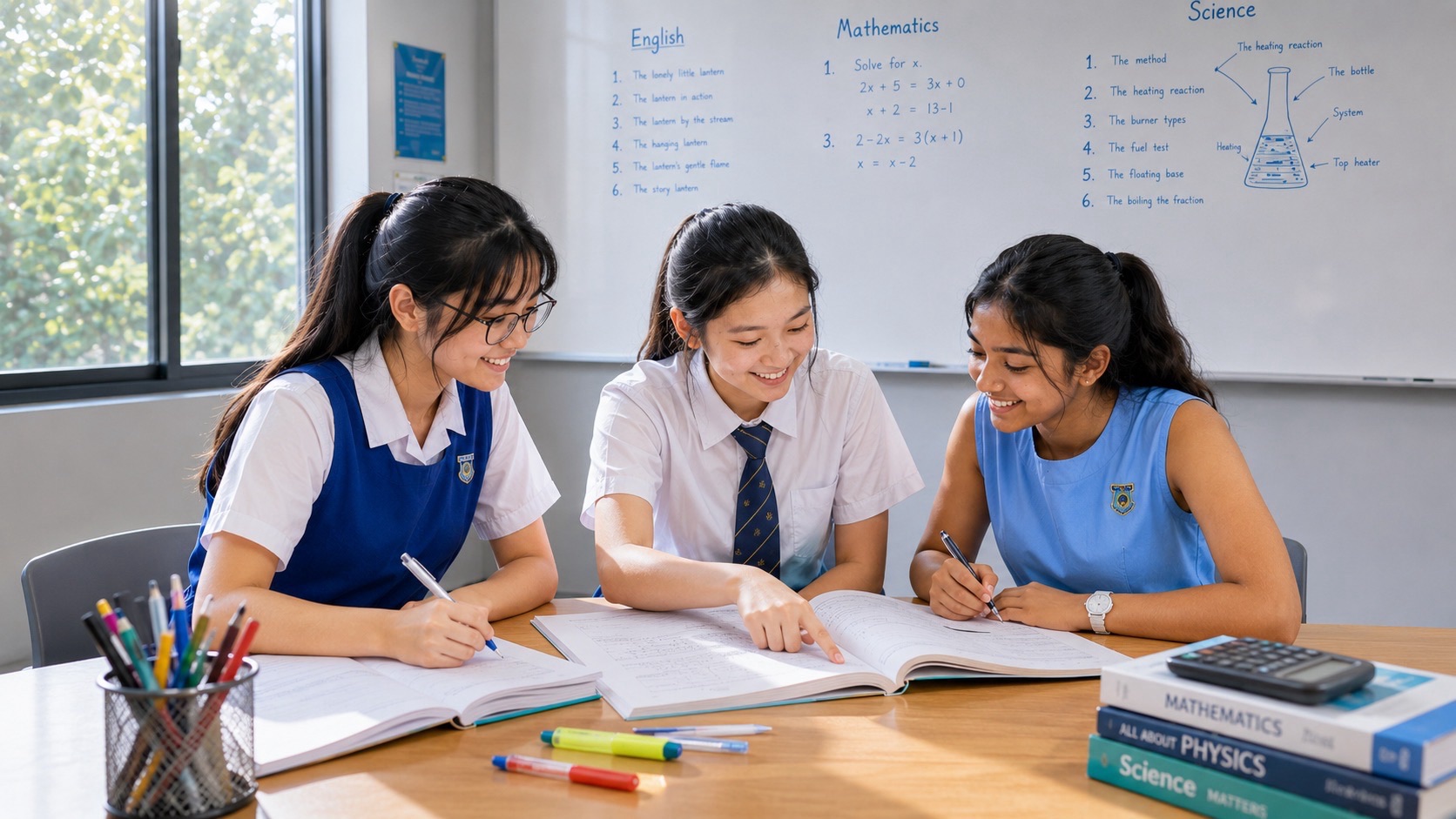
How to Improve With Tuition | Upper East Coast
Upper East Coast students can improve when tuition develops transfer: the ability to use a learned idea when the surface of the question changes. Mastery is not proved by repeating a method on ten near-identical examples; it is proved when the student can recognise the same underlying structure inside an unfamiliar task.
The aim is to move learning beyond worksheet pattern recognition and toward flexible application across wording, representations, topics and assessment contexts.
At eduKateSG, we teach in premium 3-pax small-group tutorials near Sixth Avenue MRT. Lessons are typically 1.5 hours weekly, with clear explanation, closely observed practice, retrieval, error analysis, independent application and focused continuation work.
The purpose is not simply to add another academic session. It is to make the student more capable outside the lesson: better at identifying what a question requires, retrieving the right knowledge, choosing a method, checking the result and recovering when the first attempt goes wrong.
- recognise deep structure beneath changed wording
- apply methods beyond the original example
- reduce dependence on worksheet patterns
- connect old knowledge to new problems
- build flexible exam-ready thinking
Arrange a parent–student consultation with eduKate Singapore.
The Important Transition Is From Repeating a Method to Recognising When the Method Applies
Blocked practice can make students look fluent because the same procedure is used again and again.
The difficult part often appears later, when the method is no longer announced by a chapter heading.
The student must first decide what kind of problem is present before any procedure can help.
For Upper East Coast students, improvement means training that recognition deliberately.
The Hidden Problem: Familiar Surface Features Can Carry the Student
A student may succeed because the worksheet order, diagram style or recent example reveals what to do.
When those cues disappear in an examination, the same learner can become unsure despite having practised the topic extensively.
Transfer requires attention to the underlying relationship rather than the appearance of the question.
Tuition should therefore vary surface features while preserving the concept being tested.
Why a 3-Pax Tutorial Can Help Upper East Coast Students Improve
In a 3-pax tutorial, the tutor can see whether each Upper East Coast student is recognising structure or merely following recent cues.
One learner may need a small wording change to become stuck; another may transfer across wording but fail when the representation changes from diagram to table; a third may need stronger mixed-topic discrimination.
- close inspection of individual working
- frequent opportunities to answer and explain
- pacing that can change when a hidden gap appears
- independent application after guided teaching
- comparison of different valid approaches
- clearer tracking of recurring error patterns
- more precise adjustment before school assessments
Those require different repairs.
The class is small by design. Its value comes from better information about how each student is thinking, not merely from reducing the number of seats in the room.
Three Improvement Pathways
1. Repair
Repair is needed when success depends heavily on familiar formats.
- method chosen from worksheet heading
- difficulty with paraphrased questions
- failure when diagrams change
- weak connection between old and new topics
- loss of confidence on unfamiliar-looking tasks
2. Stabilise
Stabilisation varies one surface feature at a time while keeping the core concept constant.
- change wording
- change numbers
- change representation
- change context
- delay the question and mix it with another topic
3. Extend
Extension develops transfer across multiple simultaneous changes.
- novel problem contexts
- cross-topic synthesis
- open-ended explanations
- multi-step unfamiliar tasks
- full-paper mixed conditions
A First-Principles Improvement Method
1. Diagnose the first unstable point
We compare performance on a familiar example with performance on a structurally similar but differently presented one.
The gap between those performances reveals how much the student depends on surface cues.
2. Rebuild only what is actually missing
The tutor names the invariant relationship: what stays the same even when the context changes.
The student then practises identifying that invariant before choosing a method.
3. Use the Fencing Method
We begin inside a clear practice boundary so the student can see the relationship clearly. Once the method is secure, one new difficulty is introduced deliberately: changed wording, a different representation, mixed topics, an additional reasoning step or controlled time pressure.
This keeps errors informative. If several new demands arrive at once, the tutor may know that the answer is wrong without knowing which part of the thinking failed first.
4. Make the student explain
Students explain why two apparently different questions are actually related.
This develops abstraction and helps the learner recognise the concept without relying on superficial similarity.
5. Retrieve after a delay
A later question returns with different wording or representation so the student must both retrieve the knowledge and recognise its relevance.
6. Interleave and transfer
Mixed practice forces students to choose among competing methods.
This builds discrimination: not only knowing a method, but knowing when it is the right method.
7. Add speed only after control
Timed work is added after transfer is reliable enough that unfamiliar surface features do not trigger panic or random method selection.
What Happens During a 90-Minute Improvement Lesson
Warm-up retrieval
A short pair of questions asks the student to identify what is structurally the same and what has changed.
Current-school diagnosis
Recent schoolwork is checked for patterns. One or two high-value weaknesses are selected rather than trying to repair every marked error in the same lesson.
Concept instruction
The tutor teaches the core relationship explicitly, then demonstrates several surface variations that preserve it.
Guided practice
The student attempts carefully selected questions while the tutor monitors the decision points. Prompts are reduced as control improves. A useful prompt directs attention; it does not replace the student’s reasoning.
Independent application
A fresh unfamiliar-looking task tests whether the student can identify the invariant and select the method without cues.
Mixed or timed application
The target concept appears among unrelated questions so the student must recognise it rather than expect it.
Error review
Mistakes are classified rather than simply crossed out. Reading, recall, concept, arithmetic, notation, language, organisation, timing and checking errors require different repairs.
Focused continuation work
Continuation work includes a transfer pair: one familiar example and one changed-context example that uses the same underlying idea.
How Tuition Should Improve English
English transfer appears when students can apply comprehension reasoning to a new passage rather than rely on familiar question wording.
Vocabulary mastery also requires using a word accurately in a different sentence and context.
Writing structures should support new topics without becoming rigid templates that produce the same essay every time.
Students learn the underlying function of a technique so they can adapt it instead of merely copying a model.
How Tuition Should Improve Mathematics
Mathematics transfer is central to problem solving.
A ratio relationship may appear in a table, diagram, word problem or geometry context; the surface changes while the underlying structure remains.
Students compare solved examples to identify what made a method appropriate, then practise recognising that feature in unfamiliar questions.
Mixed practice strengthens method selection because the correct procedure is no longer signalled by sequence.
How Tuition Should Improve Science
Science transfer requires applying known principles to unfamiliar organisms, materials, apparatus or scenarios.
Students identify the scientific relationship first, then map it onto the new context.
A strong learner can explain why the same principle still applies even when the nouns in the question are new.
Data interpretation also transfers when students recognise relationships across different graph and table formats.
Why Variation Creates Flexible Knowledge
If practice never changes, students can accidentally learn the example rather than the idea.
Purposeful variation exposes what is essential and what is incidental.
By comparing changed cases, learners discover the invariant structure that should guide method choice.
That is what makes knowledge portable.
How We Reduce Careless-Looking Mistakes
Some apparent exam-carelessness is actually a transfer failure under unfamiliar presentation.
- choosing the method that was practised most recently
- missing a familiar relationship because wording changed
- treating a new diagram as a new concept
- overfitting a writing template to the wrong task
- failing to use known Science principles in a novel scenario
- panicking when no chapter label is visible
The tutor varies presentation systematically so unfamiliarity becomes information to inspect rather than a reason to abandon known knowledge.
Teaching Ahead Without Rushing
Pre-teaching can create a stable core concept before school adds many examples and contexts.
Once the invariant is secure, later variations become opportunities to transfer rather than separate facts to memorise.
Pre-teaching should reduce surprise, not create a second syllabus that races ahead while current foundations remain unstable.
What Progress Should Look Like
Parents may notice that the student is less disturbed by questions that look different from homework.
- better performance on paraphrased questions
- more accurate method selection in mixed work
- stronger connection between chapters
- less dependence on templates
- better use of known Science principles in novel contexts
- greater calm on unfamiliar-looking examination items
The student begins to search for structure before reacting to appearance.
Marks remain important, but responsible tuition does not promise a fixed grade after a fixed number of lessons. The size of the gap, attendance, school demands, practice quality and assessment timing all matter.
An Upper East Coast Transfer Routine
A useful weekly routine can be brief.
- ask what relationship the question contains
- identify what has changed from familiar examples
- identify what has stayed the same
- choose the method from the invariant structure
- check the answer in the new context
The routine should become increasingly quick as the student gains experience with variation.
The goal is portable knowledge: learning that remains useful when the paper stops looking like the worksheet.
Travelling From Upper East Coast to Sixth Avenue
Upper East Coast families can plan travel toward Sixth Avenue using current east-side rail and bus connections from the student’s actual starting point.
The complete weekly arrangement should include school dismissal, transfers, meals, the lesson and the return home.
This guide serves Upper East Coast families considering the Fourth Avenue programme. It does not describe a Upper East Coast branch.
Location: eduKateSG, 8 Fourth Avenue, Singapore 268674
Nearest MRT: Sixth Avenue MRT, Downtown Line
Attendance: By appointment
Class Details
Format: Premium 3-pax small-group tutorials
Duration: Approximately 1.5 hours weekly
Teaching approach:
- first-principles explanation
- diagnosis before volume
- guided and independent practice
- retrieval and interleaving
- error analysis
- school-assessment alignment
- carefully paced pre-teaching
Materials may include:
- curated lesson notes
- topic practice
- mixed revision
- assessment-style questions
- micro-tests
- focused continuation work
What Parents Can Bring to the Consultation
- recent school test papers
- marked assignments
- the school’s current topic sequence
- teacher comments
- work completed only with heavy help
- questions the student repeatedly avoids
- examples of mistakes that returned after correction
Bring examples where the student can do standard practice but struggles when wording or format changes. These are especially useful for diagnosing weak transfer.
Frequently Asked Questions
How quickly should a Upper East Coast student improve with tuition?
Transfer can improve within several lesson cycles when the core concept is already stable. If the student does not yet understand the invariant relationship, that understanding must be repaired first.
Should tuition begin with full examination papers?
Not always. Full papers are useful for integration, timing and diagnosis, but a missing foundation may need a smaller teaching task first. The practice format should answer the current learning question.
Is more homework always better?
No. Practice volume should match the purpose. Fluency may need repetition. Concept repair may need fewer questions with slower reasoning and better correction.
What if my child understands during tuition but cannot work alone?
Then the student may still depend on tutor cues or familiar formats. We vary examples, remove labels and require the learner to explain why the method applies.
Can a strong student still benefit from tuition?
Yes. Strong students often benefit greatly from transfer training because difficult assessment questions deliberately alter surface features while preserving familiar concepts.
How do you reduce repeated careless mistakes?
We check whether the “careless” choice was actually caused by misrecognising the problem type. The repair is method discrimination, not simply slower calculation.
Do you teach ahead of school?
Yes, when the foundation is stable. A calm first encounter can make the later school lesson easier to follow. We do not rush ahead when earlier concepts remain insecure.
Is tuition necessary for every student?
No. A student who is learning confidently, completing work independently and progressing well may not need additional tuition. Tuition should solve an identifiable learning problem or provide meaningful extension.
Helpful Reading
Read How Independent Learning Works, How Error Correction Works and How Interleaving Works for the wider learning system.
How to Improve With Tuition | Upper East Coast
For Upper East Coast students, real mastery should travel with the learner.
Learn the structure, practise variation and make familiar knowledge work in unfamiliar places.
eduKateSG
8 Fourth Avenue
Singapore 268674
Near Sixth Avenue MRT
Premium 3-pax small-group tuition
By appointment
Properly taught kids shine a bright light into the future.