
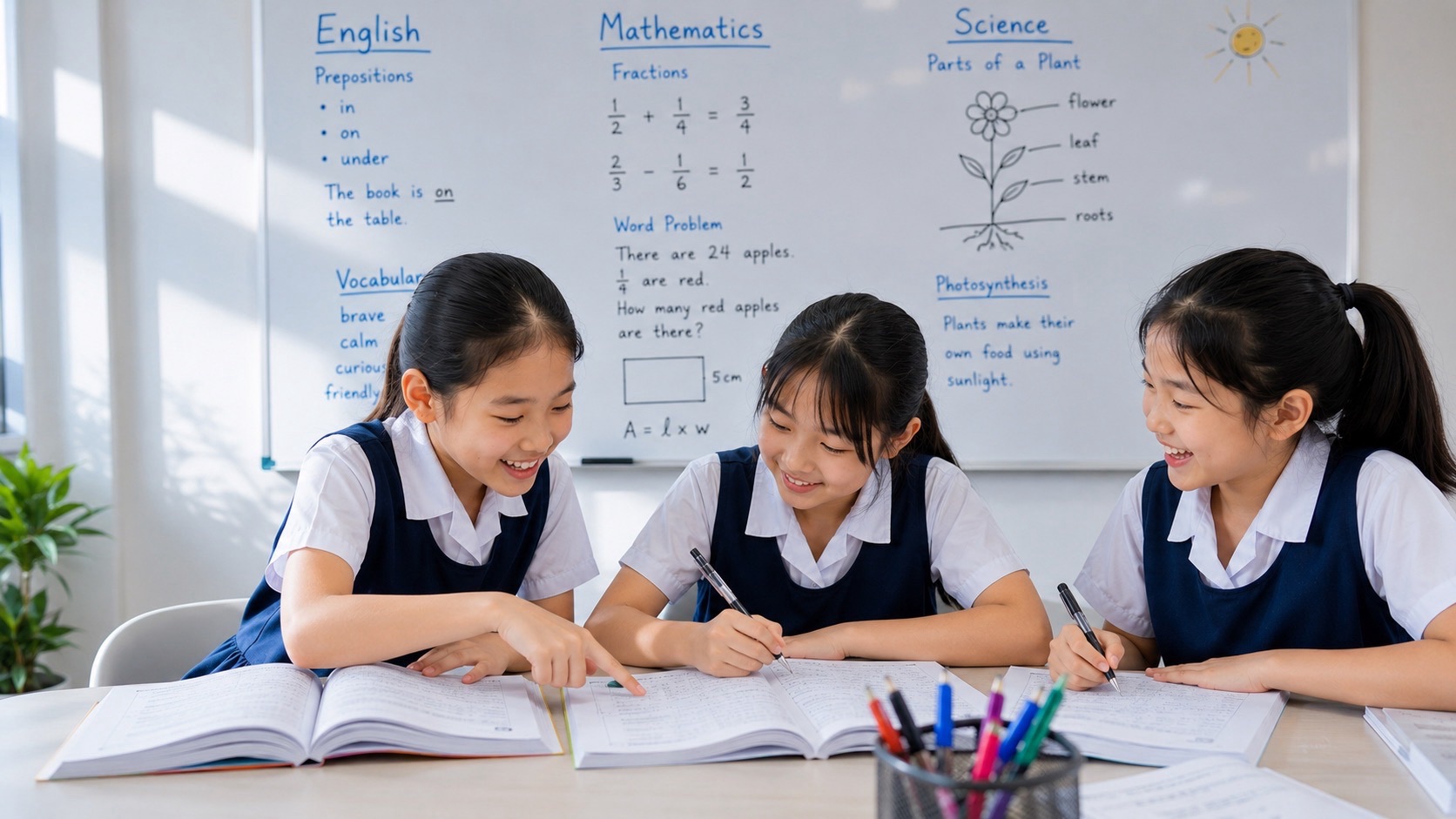
Primary 2 Mathematics Tuition | Buangkok for Buangkok families seeking premium 3-pax small-group Mathematics tuition at eduKateSG, 8 Fourth Avenue, Singapore 268674, near Sixth Avenue MRT.
Primary 2 is where early mathematical ideas must begin operating as a connected system. Numbers extend to 1000, regrouping becomes more demanding, multiplication and division become formal operations, fractions become more explicit, and practical topics such as money, time and measurement require increasingly careful reading.
At eduKateSG, the aim is not to push a child through more questions. The aim is to make the child’s mathematics reliable: understand the relationship, retrieve the required fact, choose the method, execute accurately, preserve the unit and check the result.
This page is for families travelling from Buangkok to our Sixth Avenue centre. eduKateSG does not operate a Buangkok branch.
- strengthen place value to 1000
- repair regrouping in addition and subtraction
- build multiplication-table meaning and recall
- connect multiplication and division
- develop secure early fraction understanding
- improve money, time and measurement accuracy
- read word problems structurally
- work more independently
Arrange a parent–student consultation with eduKate Singapore
Why Primary 2 Is More Complex Than It Looks
The visible change from Primary 1 to Primary 2 is larger numbers. The deeper change is coordination. A student may need to hold several pieces of information in mind while deciding what operation to use and which facts to retrieve.
This is why a child may appear comfortable on topical worksheets and still struggle on mixed work. A page titled “Addition” reveals the operation. A mixed worksheet removes that clue. The child must identify the structure independently.
Primary 2 tuition should therefore strengthen both content knowledge and method selection.
What Primary 2 Mathematics Covers in Singapore
The current MOE Primary Mathematics syllabus develops Primary 2 students through whole numbers to 1000, addition and subtraction, multiplication and division, fractions, money, measurement, geometry and data. Schools may arrange these topics in different orders, so tuition is coordinated with the student’s actual school programme.
Numbers up to 1000
Students work with hundreds, tens and ones, compare and order three-digit numbers and recognise number patterns. We make place value visible because later regrouping depends on it.
Three-digit addition and subtraction
Students extend written algorithms and mental calculation. The child learns that ten ones can be renamed as one ten and one hundred as ten tens. Regrouping becomes meaningful rather than a set of mysterious pencil marks.
Multiplication and division
Students work with key multiplication tables and formal division. Equal groups, arrays, sharing and grouping are connected so the child sees multiplication and division as related operations.
Fractions
Students learn fractions as equal parts of a whole, compare simple fractions and perform basic operations with like denominators. Visual meaning is protected before symbolic shortcuts are introduced.
Money, time, measurement, geometry and data
These strands require careful units and interpretation. They also expose whether arithmetic remains stable when it is embedded inside a real-world context.
Place Value Before Regrouping Procedure
A child who sees 372 as three hundreds, seven tens and two ones can understand what happens during regrouping. A child who sees only three digits may memorise “carry” and “borrow” without knowing what changed.
We use expanded notation and place-value charts when necessary, then return to the compact algorithm. The aim is fluency with understanding.
Addition with regrouping
Twelve ones can be renamed as one ten and two ones. The written algorithm records that exchange.
Subtraction with regrouping
When there are not enough ones to subtract, one ten can be renamed as ten ones. The student should understand the equivalence, particularly when zeros appear.
Multiplication Tables: Meaning and Automaticity
Multiplication facts become working-memory infrastructure. If every fact has to be reconstructed slowly, the child has less mental capacity for the word problem around it.
We build the meaning first through arrays, equal groups and repeated addition, then use spaced retrieval to make facts increasingly automatic.
Fact families
If 4 × 5 = 20, the student should eventually connect 5 × 4 = 20, 20 ÷ 4 = 5 and 20 ÷ 5 = 4. One relationship supports several facts.
Mixed retrieval
Facts are practised in mixed order and revisited after time has passed. The child must retrieve the fact without a table sequence as a cue.
Fractions: Equal Parts Matter
Primary 2 fractions are the first opportunity to build a strong part-whole model. The denominator describes how many equal parts make one whole; the numerator describes how many of those parts are being considered.
A larger denominator does not automatically mean a larger fraction. When the whole is fixed, more equal parts make each part smaller. Visual models help the child understand this before procedures become heavier in later years.
Why Buangkok Families Choose 3-Pax Mathematics Tutorials
Primary 2 errors can come from place value, fact recall, operation choice, reading, units, copying or checking. A class of three gives the tutor enough visibility to distinguish these causes rather than treating every wrong answer the same way.
- Immediate feedback during arithmetic
- Close inspection of digit alignment
- Frequent oral explanation
- Targeted multiplication retrieval
- Responsive pacing
- Mixed questions that test independent method choice
- Calm peer learning
- Gradual removal of scaffolds
The value is not simply the number three. The value is the teaching precision that the small group makes possible.
Our First-Principles Teaching Method
Diagnose the earliest unstable dependency
A child who struggles with three-digit subtraction may have a place-value problem, a fact-recall problem or a regrouping problem. We identify the first weak point.
Repair and reconnect
The prerequisite is repaired and immediately reconnected to current school work.
Separate concept load from calculation load
New ideas begin with manageable numbers so the student can see the relationship before arithmetic complexity is added.
Connect representations
Place-value charts, arrays, bar models, number lines, diagrams and symbols are used when they clarify structure.
Retrieve and interleave
Earlier topics return after delays and are mixed with newer work. This forces independent method selection.
Transfer
Wording, number size and context change while the underlying relationship remains the same.
Word Problems: Do Not Guess the Operation
A child may know how to add, subtract, multiply and divide but still fail because the relationship in the story is not understood.
- Read the whole problem
- Mark quantities and units
- State what must be found
- Describe the relationship
- Choose a representation if needed
- Select the operation
- Calculate
- Check the answer in context
Keywords are treated as clues rather than commands.
How We Reduce Repeated Careless Mistakes
- Place-value alignment errors
- Regrouping errors
- Multiplication-fact errors
- Division interpretation errors
- Fraction representation errors
- Reading errors
- Unit errors
- Copying errors
- Failure to check
Each pattern receives a specific correction routine instead of the broad instruction to “be more careful”.
What Happens During a 90-Minute Lesson
- Retrieval warm-up
- Short diagnostic probe
- Current topic or prerequisite repair
- Guided examples
- Independent practice
- Word-problem work
- Mixed review
- Error correction
- Focused continuation work
The balance changes according to the student’s needs and school calendar.
Three Primary 2 Student Pathways
Repair
Rebuild place value, number bonds, regrouping or operation meaning.
Stabilise
Strengthen retrieval, accuracy, working organisation and transfer.
Extend
Deepen reasoning through richer fraction comparisons, missing-number tasks, alternative methods and unfamiliar applications.
What Progress Should Look Like
- Three-digit numbers are handled with greater control
- Regrouping can be explained
- Multiplication facts are easier to retrieve
- Division is connected to multiplication
- Fractions are interpreted through equal parts
- Word problems begin with a relationship rather than a guess
- Units are preserved
- Mixed work causes less hesitation
- Homework needs less adult rescue
Stable improvement appears in independence as well as marks.
When Extra Support May Be Useful
- Place value beyond 100 remains uncertain
- Regrouping repeatedly breaks
- Multiplication tables are not becoming retrievable
- Division feels unrelated to multiplication
- Fractions are understood only from one familiar picture
- Money and measurement questions create unit errors
- Topical worksheets are manageable but mixed work is not
- Homework requires constant adult direction
Repair before Primary 3 can prevent a much larger accumulation of load.
Travelling from Buangkok to Sixth Avenue
eduKateSG is at 8 Fourth Avenue, Singapore 268674, near Sixth Avenue MRT. Families travelling from Buangkok can use Singapore’s rail, bus or road network towards Sixth Avenue. Check current LTA or MyTransport information before the first lesson.
This page serves Buangkok families attending our Sixth Avenue classes; it does not represent an eduKateSG branch in Buangkok.
Class Details
Format: Premium 3-pax small-group tutorials
Level: Primary 2 Mathematics
Duration: 1.5 hours weekly
Location: 8 Fourth Avenue, Singapore 268674
Nearest MRT: Sixth Avenue MRT
Attendance: By appointment
Teaching approach: first-principles explanation, prerequisite repair, retrieval, guided and independent practice, interleaving, problem solving and error analysis.
Frequently Asked Questions
Do you follow the school’s sequence?
We coordinate with school topics while repairing earlier dependencies where necessary.
Do you teach ahead?
Yes, when the foundation is ready. Pre-teaching should improve classroom readiness rather than create superficial acceleration.
How do you teach multiplication tables?
We build equal-group and array understanding, connect related facts, then use spaced retrieval for speed.
Do you use bar models?
Yes, when they genuinely clarify the relationship. Students also learn when another representation is more efficient.
What if my child is already strong?
We extend through reasoning, transfer and unfamiliar applications rather than simply jumping to later-year chapters.
Helpful Mathematics Reading
- Primary 2 Mathematics Tuition at eduKateSG
- Mathematics Learning Hub
- MOE Primary Mathematics Syllabus
Primary 2 Mathematics Tuition for Buangkok Families
Primary 2 is where early ideas begin operating as a connected system. Place value must support regrouping. Multiplication must connect to division. Fractions must represent genuine equal-part relationships.
For students who are behind, we repair. For students who are inconsistent, we stabilise. For students who are ready, we deepen.
The objective is a student who enters Primary 3 with stronger retrieval, clearer reasoning and more independence.
Arrange a Parent–Student Consultation
Chat with eduKateSG on WhatsApp
eduKateSG
8 Fourth Avenue
Singapore 268674
Near Sixth Avenue MRT
Premium 3-pax small-group tuition
By appointment
Properly taught kids shine a bright light into the future.