
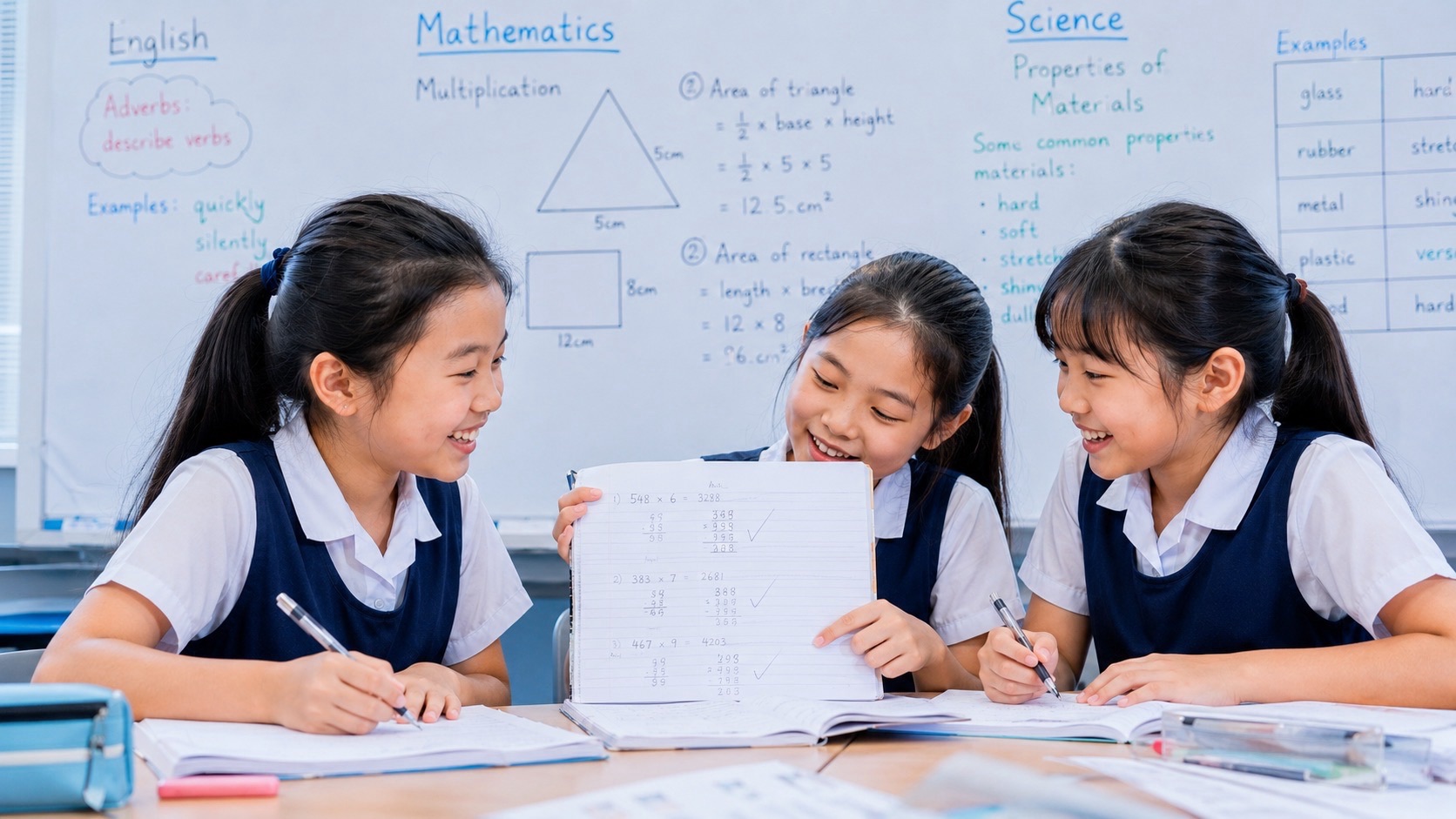
Primary 3 Mathematics Tuition | Rivervale for Rivervale families seeking premium 3-pax small-group Mathematics tuition at eduKateSG, 8 Fourth Avenue, Singapore 268674, near Sixth Avenue MRT.
Primary 3 is a real transition year. Four-digit numbers, the 6 to 9 multiplication tables, written multiplication and division, remainders, equivalent fractions and longer word problems all increase the amount of knowledge a child must coordinate at once.
At eduKateSG, the objective is mathematical control: recognise the structure, retrieve the required facts, choose the method, organise the working, calculate accurately and check the answer without constant prompting.
This page is for families travelling from Rivervale to our Sixth Avenue centre. eduKateSG does not operate a Rivervale branch.
- repair lower-primary arithmetic gaps
- build reliable 6, 7, 8 and 9 multiplication-table retrieval
- connect multiplication, division and remainder meaning
- strengthen written algorithms
- develop equivalent-fraction and comparison reasoning
- improve multi-step problem planning
- reduce repeated error patterns
- prepare a stable runway for Primary 4
Arrange a parent–student consultation with eduKate Singapore
Why Primary 3 Feels Like a Jump
The individual ideas are teachable, but more of them must now be held together. A child may need to retrieve a multiplication fact, apply a written algorithm, interpret a remainder, preserve a unit and complete another step before reaching the final answer.
If basic facts are slow, working memory is consumed. If place value is weak, the algorithm becomes fragile. If reading is imprecise, correct arithmetic can still be applied to the wrong relationship.
Good Primary 3 tuition therefore looks beneath the visible mistake and finds the dependency making the whole process unstable.
What Primary 3 Mathematics Covers in Singapore
The current MOE Primary Mathematics syllabus develops Primary 3 students through numbers to 10,000, the four operations, fractions, measurement, geometry, data and problem solving. Schools may sequence topics differently, so tuition is aligned with the student’s actual programme.
Numbers up to 10,000
Students read, write, compare and order four-digit numbers. Place value must remain clear because later written algorithms depend on the student knowing what each digit represents.
Addition and subtraction
Larger calculations make weak regrouping, alignment and fact recall more visible. We rebuild those dependencies where needed.
Multiplication and division
Primary 3 introduces the 6, 7, 8 and 9 tables, division with remainder and more demanding written procedures. Multiplication facts become infrastructure for division and later fraction work.
Fractions
Equivalent fractions, simplest form and comparison require the child to see a fraction as a number that can have several equivalent representations.
Measurement, geometry and data
These topics test whether arithmetic remains stable when transferred to diagrams, units, scales and practical situations.
Multiplication Facts Must Become Available
Knowing that a fact has been taught is not the same as being able to retrieve it when another problem depends on it. A child who spends several seconds reconstructing 7 × 8 has less attention available for division, fractions or multi-step reasoning.
We first connect facts structurally, then build speed through spaced retrieval.
Use known facts to build new facts
Six groups can be linked to five groups plus one more. Eight groups can be doubled from four groups. Nine groups can be connected to ten groups minus one. This reduces isolated memorisation.
Retrieve in mixed order
Facts are revisited after delays and mixed with other tables. The student learns to access the fact without relying on a chant or worksheet sequence.
Division With Remainders Needs Meaning
A remainder is not merely something written after the quotient. It represents what cannot be placed into a complete group.
In one question, the remainder may stay as leftover objects. In another, it may mean an extra box, bus or table is needed. The context determines the final interpretation.
We ask the student to explain what the quotient and remainder represent before writing the final answer.
Written Algorithms With Understanding
Algorithms are valuable because they compress reasoning. They become dangerous only when the child memorises the marks without understanding the place-value structure underneath them.
When needed, we reopen the algorithm using partial products, expanded notation or place-value language, then return to the compact method once the student understands what each line is doing.
Fractions: Equivalence Becomes Central
One-half, two-fourths and three-sixths can represent the same value. That idea is the foundation for later fraction comparison, simplification and operations.
We use fraction bars, number lines and symbolic notation to connect the representations.
Simplest form
A fraction is simplified by dividing numerator and denominator by a common factor. The value remains unchanged because both parts are scaled together.
Comparing fractions
Students learn to compare through equivalent fractions, benchmark values and visual reasoning rather than guessing from numerator or denominator alone.
Why Rivervale Families Choose 3-Pax Mathematics Tutorials
A Primary 3 wrong answer can come from a multiplication fact, a place-value slip, a remainder interpretation, a fraction misconception, a reading error or poor organisation. A class of three gives the tutor enough visibility to see where the reasoning changed direction.
- Detailed inspection of written algorithms
- Short multiplication-fact retrieval checks
- Immediate correction of fraction misconceptions
- Frequent explanation of quotient and remainder meaning
- Targeted multi-step questioning
- Responsive pacing
- Mixed practice that removes topical clues
- Peer explanation without large-class anonymity
The small group lets the tutor see process, not just product.
Our First-Principles Teaching Method
Find the first unstable prerequisite
If division is failing, we check place value, multiplication facts, subtraction and grouping meaning before assuming the child simply needs more long-division practice.
Repair only what is necessary
We revisit the earlier idea that is interfering with current work, then reconnect it quickly to the Primary 3 topic.
Control one source of difficulty at a time
When a concept is new, simpler numbers expose the structure. Calculation load is increased only after the idea is visible.
Connect representations
Arrays, number lines, fraction bars, place-value charts, tables and bar models are used where they clarify reasoning.
Retrieve after spacing
Earlier work returns after time has passed so the child must recover knowledge independently.
Interleave topics
Mixed questions force the student to identify which method is appropriate rather than rely on a chapter heading.
Transfer
We vary context, wording, diagrams and number size while preserving the underlying mathematical structure.
Multi-Step Word Problems Need a Plan
- Read the full problem
- Identify the final unknown
- Mark quantities and units
- State the relationships
- Identify intermediate unknowns
- Choose the first operation
- Record the intermediate answer clearly
- Complete the next step
- Check the final answer against the story
Bar models are used when they reduce cognitive load. Tables, equations or labelled diagrams are used when clearer.
How We Reduce Careless Mistakes
- Multiplication-fact errors
- Place-value alignment errors
- Remainder interpretation errors
- Fraction simplification errors
- Unit errors
- Intermediate-answer copying errors
- Wrong-operation errors
- Crowded working
- Failure to check reasonableness
Each pattern receives a specific correction routine instead of the generic instruction to be careful.
What Happens During a 90-Minute Lesson
- Mixed retrieval warm-up
- Arithmetic and multiplication-fact check
- Current topic or prerequisite repair
- Guided examples
- Independent application
- Multi-step problem solving
- Error review
- Mixed retrieval
- Focused continuation work
The balance changes according to the student’s profile and school schedule.
Three Primary 3 Student Pathways
Repair
Rebuild multiplication facts, place value, regrouping, division meaning or earlier fraction understanding.
Stabilise
Turn inconsistent knowledge into repeatable performance through retrieval, clearer working and checking.
Extend
Deepen reasoning through richer multi-step problems, missing-information tasks, alternative methods and explanation.
What Progress Should Look Like
- Multiplication facts are more readily available
- Division is connected to multiplication
- Remainders are interpreted in context
- Written algorithms are easier to audit
- Equivalent fractions make sense
- Multi-step problems are planned before calculation
- Units remain attached to quantities
- Mixed work causes less hesitation
- Methods can be explained without copying
- Homework needs less adult rescue
These changes build the control needed for Primary 4.
When Extra Support May Be Useful
- The 6 to 9 tables remain very slow
- Division repeatedly collapses
- Written algorithms are memorised without meaning
- Remainders are misinterpreted
- Equivalent fractions remain confusing
- Topical worksheets are manageable but mixed work is not
- Multi-step problems are started without a plan
- Homework takes disproportionately long
- Confidence has fallen since Primary 3 began
Primary 3 remains a strong repair window before upper-primary load increases further.
Travelling from Rivervale to Sixth Avenue
eduKateSG is at 8 Fourth Avenue, Singapore 268674, near Sixth Avenue MRT. Families from Rivervale can use Singapore’s rail, bus or road network towards Sixth Avenue. Check current LTA or MyTransport information before travelling.
This page serves Rivervale families attending our Sixth Avenue classes; it does not represent a Rivervale branch.
Class Details
Format: Premium 3-pax small-group tutorials
Level: Primary 3 Mathematics
Duration: 1.5 hours weekly
Location: 8 Fourth Avenue, Singapore 268674
Nearest MRT: Sixth Avenue MRT
Attendance: By appointment
Teaching approach: first-principles explanation, diagnostic repair, arithmetic fluency, retrieval, interleaving, multi-step problem solving and error analysis.
Frequently Asked Questions
Do you follow the school’s topic order?
We coordinate with school work while repairing prerequisite gaps where necessary.
Do you teach ahead?
Yes, when the foundation is ready. Pre-teaching should make the school lesson more intelligible, not simply make the child appear ahead.
How important are multiplication tables?
They are important because division, fractions and multi-step arithmetic all rely on quick fact access. We build both meaning and retrieval.
Do you use bar models?
Yes, when they clarify the relationship. Other representations are used when more efficient.
What if my child is already strong?
Extension focuses on transfer, explanation and unfamiliar structures rather than unnecessary acceleration.
Helpful Mathematics Reading
- Primary 3 Mathematics Tuition at eduKateSG
- Mathematics Learning Hub
- MOE Primary Mathematics Syllabus
Primary 3 Mathematics Tuition for Rivervale Families
Primary 3 is where arithmetic fluency, multiplication, division, fractions and multi-step problem solving begin carrying more of each other’s weight.
For students who are behind, we repair. For students who are inconsistent, we stabilise. For students who are ready, we deepen.
The objective is to enter Primary 4 with facts that are accessible, methods that are understood and working habits strong enough for larger problems.
Arrange a Parent–Student Consultation
Chat with eduKateSG on WhatsApp
eduKateSG
8 Fourth Avenue
Singapore 268674
Near Sixth Avenue MRT
Premium 3-pax small-group tuition
By appointment
Properly taught kids shine a bright light into the future.