
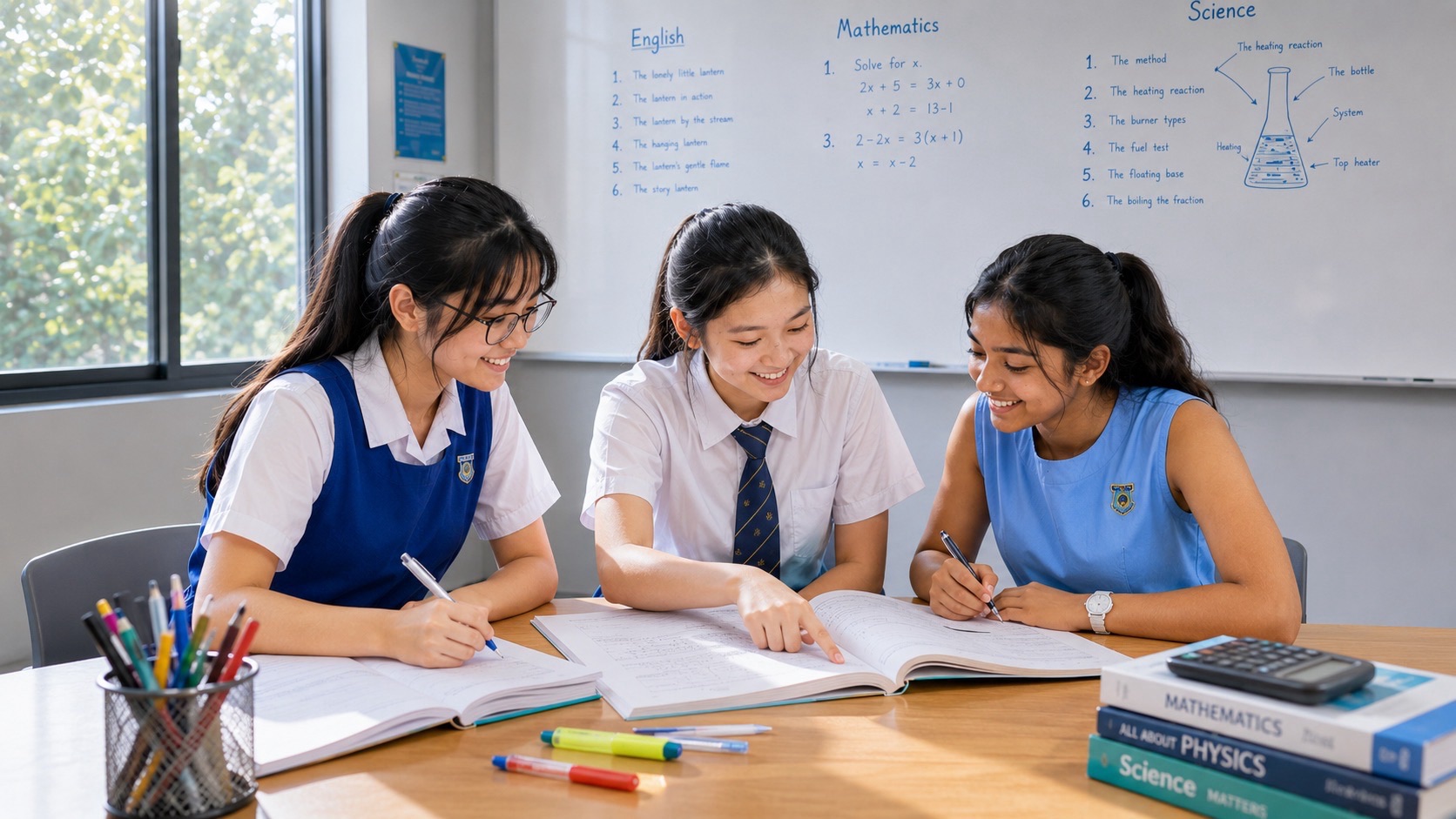
How to Improve With Tuition | Yew Tee Residences
How to improve with tuition for Yew Tee Residences students begins with worked-example completion. The central learning problem is moving directly from watching a fully worked solution to solving an entirely blank problem. Tuition should fade support progressively by removing selected steps and requiring the student to complete the missing reasoning.
At eduKateSG, premium 3-pax small-group tutorials near Sixth Avenue MRT combine diagnosis, first-principles teaching, retrieval, mixed practice, error analysis and independent application.
For Yew Tee Residences families, the goal is a smooth transition from model to independence: complete one missing step, then several, then reconstruct the whole solution without the model.
- bridge worked examples to independent problems
- remove support progressively
- make the learner generate missing steps
- identify which step still needs modelling
- avoid the cliff from full model to blank page
Arrange a parent–student consultation with eduKate Singapore.
The Important Transition Is From Studying a Full Model to Completing a Partial Model
A full worked example is useful because it shows a complete successful route.
The risk is that every next step is visible, making understanding appear stronger than independent production.
For Yew Tee Residences students, completion problems remove selected steps so the learner has to generate more of the route while still seeing enough structure to avoid random guessing.
The Hidden Problem: The Jump From Example to Blank Problem Can Be Too Large
Some students fail after a worked example not because the model was useless, but because the support disappeared all at once.
Progressive completion lets the tutor discover the exact step where independence becomes unstable.
What This Looks Like in Real Schoolwork
In English, a paragraph model can gradually lose the claim, evidence link or concluding sentence for the student to supply.
In Mathematics, a worked solution can omit one transformation, then several, then all but the setup.
In Science, a causal explanation can preserve observation and conclusion while the learner fills in the missing mechanism.
The Important Transition Is From “I’ve Seen This” to “I Can Reconstruct This”
Students often feel confident when notes, model answers or highlighted passages look familiar.
That feeling is real, but familiarity can be produced by repeated exposure without strong independent retrieval.
For Yew Tee Residences students, tuition should convert familiarity into evidence: close the notes, retrieve, apply and explain.
The Hidden Problem: Familiar Material Can Create an Illusion of Mastery
Rereading becomes easier each time because the page is recognised. That ease can be mistaken for learning.
A worked solution may look obvious while visible, yet the student may be unable to restart when the model is removed.
The gap between recognition and retrieval often appears only during tests unless tuition exposes it earlier.
What This Looks Like in Real Schoolwork
In English, a vocabulary list may look familiar while individual words remain difficult to use in fresh sentences.
In Mathematics, a worked example may feel obvious while a blank question produces no first step.
In Science, notes may read smoothly while the mechanism cannot be reconstructed without headings or diagrams.
Why a 3-Pax Tutorial Can Help Yew Tee Residences Students Improve
A small group lets the tutor fade support at different rates for each learner.
One student may be ready to complete the final step, another may need the setup preserved, and another may already be ready for a blank independent problem.
- step-level support fading
- completion problems
- independent generation
- precise breakpoint diagnosis
- smooth transition to cold starts
Three Improvement Pathways
1. Repair
Repair is needed when the student can follow a model but cannot generate the next step independently.
- waiting for every tutor prompt
- copying worked examples
- blank starts after model study
- understanding each line but not connecting lines
- failing when one familiar step is omitted
2. Stabilise
Stabilisation fades the worked example progressively.
- full model
- one missing step
- several missing steps
- setup only
- blank independent problem
3. Extend
Extension varies which steps are missing and changes the context.
- middle-step completion
- changed wording
- mixed-topic problems
- delayed reconstruction
- timed independent starts
A First-Principles Improvement Method
1. Diagnose the first unstable point
We remove one step from a worked example and watch whether the student can generate it.
The first failed omission shows where support is still carrying the reasoning.
2. Rebuild only what is actually missing
The tutor re-models that specific step, then removes it again on the next attempt.
Support is restored temporarily, not permanently.
3. Use the Fencing Method
The first completion task keeps most of the route visible. More blanks are added only after the student succeeds independently.
4. Make the student explain
Students explain why the missing step belongs there and what it accomplishes.
This prevents filling blanks by pattern alone.
5. Retrieve after a delay
The partial model returns later with different steps removed.
6. Interleave and transfer
Completion problems from different topics are mixed so the learner cannot predict which step will be missing.
Eventually the entire model disappears.
7. Add speed only after control
Timed independent starts are added after the student no longer depends on visible scaffolding.
Why Immediate Success Is Not Enough
A student can look excellent immediately after an explanation because the worked example, vocabulary and tutor prompts are still active in working memory.
That performance is useful evidence, but it is incomplete evidence. The stronger test is whether the learner can restart later, retrieve the method without the model beside the page, recognise the same structure in different wording and explain why the method still applies.
This is why strong tuition contains delayed retrieval and cold-start work. Learning has to survive the distance between lessons, not only the final ten minutes of the current lesson.
What Happens During a 90-Minute Improvement Lesson
Warm-up retrieval
A familiar worked example appears with one key step removed.
Current-school diagnosis
Recent work is checked for places where the student followed support but could not initiate alone.
Concept instruction
The tutor models the governing relationship and identifies the role of each step.
Guided practice
Selected steps are removed progressively.
Independent application
The student solves a fresh problem with no worked route visible.
Mixed or timed application
Different omission patterns and topics are interleaved.
Error review
The tutor records which step still depends on external structure.
Focused continuation work
Home practice contains one partial example followed by one blank transfer question.
How Tuition Should Improve English
English completion can bridge model paragraphs to independent writing.
Students may first supply the evidence explanation, then the claim, then the full paragraph from a prompt.
The goal is to internalise function, not memorise sentence frames.
How Tuition Should Improve Mathematics
Mathematics worked examples are powerful when support is faded deliberately.
One transformation, representation or checking step can be omitted at a time, revealing whether the learner can generate it.
Eventually the student sees only the problem and must build the entire route.
How Tuition Should Improve Science
Science explanations can be partially completed.
The learner might receive the observation and effect but supply the causal mechanism, or receive the variables and design the conclusion.
Progressive omission strengthens independent explanation.
Why Completion Problems Bridge Observation and Independence
A full example reduces cognitive load enough for the learner to study a correct route.
A blank problem increases generation demand sharply.
Completion problems create intermediate states between the two.
This lets support decrease at the rate the learner’s control increases.
Three Practice Scenarios
English scenario
A student can analyse a model paragraph but cannot write one from scratch.
The next task supplies the claim and quotation but removes the explanation; later the claim is removed too, then the whole paragraph is generated independently.
Mathematics scenario
A worked algebra solution is understood when complete.
The tutor removes the transformation where signs change, then removes multiple middle lines, then presents a fresh equation with no model.
Science scenario
A model answer contains observation, mechanism and effect.
The mechanism is blanked first; later the learner produces the whole chain from a new scenario.
Why the Missing Step Should Move
If the same final step is always removed, the student may learn only that local routine.
Changing the position of the blank forces the learner to understand the whole route and the dependency among steps.
This also reveals whether initiation, middle reasoning or conclusion is the true bottleneck.
Support fading therefore becomes diagnostic, not merely gradual.
Knowing When to Remove the Model Entirely
The model should disappear when the student can complete varied missing steps accurately, explain their purpose and retrieve the route after a delay.
Keeping a model visible after this point can slow independence.
Removing it too early can turn practice into guessing.
The tutor uses evidence, not a fixed lesson count, to decide when the scaffold leaves.
What Good Practice Looks Like
Good completion practice removes enough support to require generation without making the task random.
The missing step changes as control develops.
- model understood first
- one step removed
- different steps removed
- delay added
- blank problem follows
What Poor Practice Looks Like
- copying complete solutions repeatedly
- removing all support at once
- always blanking the same step
- accepting correct completion with no explanation
- keeping the model visible after independence is ready
A Diagnostic Matrix for Repeated Errors
Repeated errors become easier to repair when they are classified by the decision that failed rather than by the chapter in which the mark was lost.
- reading error — the demand, condition or key word was misread
- retrieval error — the relevant knowledge could not be brought back in time
- concept error — the underlying relationship is not yet understood
- selection error — the student knows several methods but chooses the wrong one
- execution error — the method is correct but calculation, notation or language breaks down
- checking error — the student has no reliable way to detect an implausible result
- timing error — the process is secure untimed but degrades under pressure
The category matters because the repair changes with it. A reading error does not need another concept lecture. A concept error is not solved by telling the student to slow down. A timing error should not be treated as laziness when untimed work is accurate.
Small-group tuition is useful here because the tutor can identify the error category while the student is working, then change the very next question to test the diagnosis.
The Improvement Ladder
A useful way to judge progress is to ask what level of support and complexity the student can currently handle.
- Level 1 — can follow a clear explanation
- Level 2 — can complete guided practice
- Level 3 — can perform independently in a familiar format
- Level 4 — can retrieve after a delay
- Level 5 — can recognise the skill inside mixed practice
- Level 6 — can transfer it to changed wording or representation
- Level 7 — can preserve the skill under realistic time pressure
The ladder prevents two common mistakes: declaring mastery too early because guided work looked easy, or adding pressure too early before the underlying process is stable.
How We Reduce Careless-Looking Mistakes
Some repeated mistakes appear only when a familiar support step disappears.
- sign change omitted
- evidence link missing
- Science mechanism skipped
- unit conversion forgotten
- checking step absent
The tutor isolates the missing step and fades support until the learner can generate it reliably.
Homework Should Continue the Lesson, Not Compete With It
Continuation work should preserve the logic of the lesson. If the lesson repaired one precise weakness, homework should first test that repair rather than immediately burying it inside a large quantity of unrelated work.
A useful sequence is one near-transfer question, one delayed retrieval question and one mixed question where the student must recognise the method independently.
This gives the tutor information at the next lesson: did the student remember, transfer and choose correctly without immediate support?
Four Contact Points Across the Week
Contact Point 1: Tuition lesson
Complete one partial worked example.
Contact Point 2: Short reconstruction
Return later with different steps removed.
Contact Point 3: Mixed return
Complete partial models from different topics.
Contact Point 4: Pre-lesson cold start
Attempt one fully blank problem before opening the model.
From Tuition Performance to School Transfer
The lesson is only one environment. School lessons, homework, weighted assessments and examinations present the same knowledge under different conditions. A student may succeed with familiar worksheet wording yet hesitate when the teacher changes the representation or combines two topics.
For that reason, every repair should eventually leave its fenced practice area. The learner first succeeds with a clear target, then meets changed wording, then mixed practice, then a cold-start application.
Transfer also changes the role of the tutor. Early teaching may be explicit and close. Later teaching becomes more observational: the tutor watches whether the student recognises the structure, selects the method and checks independently before intervening.
This is where premium small-group tuition earns its value. The tutor can preserve independence without abandoning the student, because support can be reintroduced precisely when the evidence shows it is still needed.
How to Know the Skill Has Become Portable
A skill is portable when the student can use it beyond the exact conditions in which it was taught. The wording can change, the numbers can change, the representation can change and the learner can still identify the underlying relationship.
Portability is stronger evidence than worksheet accuracy because it shows that learning has been organised around structure rather than surface familiarity.
For parents, portability appears when the student can demonstrate what is known without needing the familiar page, model or teacher cue.
School Alignment Without Becoming School-Dependent
Tuition should remain aware of the student’s current school sequence, assessment calendar and teacher feedback. That keeps support relevant and helps the tutor identify where today’s lesson can reduce tomorrow’s friction.
At the same time, the learning system should not become dependent on one school’s exact worksheet order. Concepts need to be taught deeply enough that the student can cope when another teacher phrases the idea differently or combines it with earlier content.
The balance is practical: align with school so the student can perform now, but teach for transfer so the learning remains useful after the current worksheet and current test are gone.
Assessment Readiness Without Panic
Assessment preparation should compress a stable system, not invent a new one at the last minute. When examinations approach, students need retrieval, mixed selection, realistic timing and error control more than a sudden mountain of unfamiliar material.
The best revision question is often not “How many papers can we finish?” but “Which failure modes are still costing marks, and can the student now detect and repair them under timed conditions?”
A calm preparation cycle therefore moves from targeted repair to mixed sections, then to full-paper practice only when the learner is ready to benefit from it.
Different Students Need Different Versions of the Same Principle
A student who is rebuilding foundations needs lower complexity and clearer boundaries. A student who is already secure needs less explanation and more transfer, discrimination and time pressure. A strong student may need fewer questions but more demanding choices between plausible methods.
This is why identical worksheets for every student can be inefficient. The principle can be shared while the task changes. In a 3-pax group, the tutor can keep the class intellectually connected without pretending that all three learners have the same bottleneck.
The standard remains the same: each student should leave the lesson more capable of working independently than when the lesson began.
What Tuition Should Not Become
- a second school day built mainly from worksheet volume
- a place where the tutor makes every important decision
- a rescue service that prevents productive independent struggle
- a race to cover chapters while foundations remain unstable
- a performance where the student appears successful only because prompts are perfectly timed
Good tuition should simplify the learning problem, not simplify the student’s responsibility. The tutor can clarify, diagnose and design better practice while still leaving the essential acts of retrieval, choice, reasoning and checking with the learner.
Energy, Resources and Time
A workable tuition plan has to respect three practical constraints: the student’s available energy, the resources needed for the current learning problem and the time left before the next meaningful school demand.
A tired student with a deep conceptual gap should not be given the same plan as a well-rested student who already understands the topic and only needs fluency. Likewise, an examination in two weeks creates a different priority from a chapter that will not be assessed for months.
Good tuition therefore adjusts the type of work, not only the amount. The question is always which intervention gives the best learning return under the student’s real conditions.
Teaching Ahead Without Rushing
Pre-teaching can use a full model initially.
Support is then faded so the student does not enter the school lesson dependent on the pre-teaching example.
Teaching ahead remains useful only when it reduces future cognitive load.
How Progress Should Be Measured
Progress should look like accurate generation with progressively less visible structure.
- fewer tutor prompts
- better missing-step completion
- stronger independent starts
- less model dependence
- better delayed reconstruction
- more successful blank transfer
The student begins to create the route rather than follow one.
Marks remain important, but responsible tuition does not promise a fixed grade after a fixed number of lessons.
How This Skill Develops Across a School Term
In the first phase, the tutor makes the target decision visible and slows the task enough for the student to understand what successful control looks like.
In the second phase, support is faded. The same decision returns after delays, inside changed wording and beside competing methods. The learner has to recognise the need for the skill rather than wait for the tutor to announce it.
In the third phase, the skill is tested in realistic school conditions. Mixed practice, timed sections and unfamiliar contexts reveal whether the strategy remains useful when attention is divided.
Across the term, progress is judged by independence and transfer. A strategy that works only in tuition is not finished. It becomes useful when it survives homework, schoolwork and assessment conditions with progressively less external support.
What Parents Can Do Without Taking Over the Work
Parents can help most by creating conditions for independent practice rather than becoming the second tutor at home.
- provide a predictable time and place for short continuation work
- ask the student to explain the current target instead of asking only for marks
- notice recurring patterns without solving the question for the child
- bring marked schoolwork to the tutor when the same difficulty returns
- protect sleep and recovery before demanding longer study blocks
- let the student attempt before supplying hints
The useful question at home is often, “What are you trying to improve here?” That keeps attention on the learning process without replacing the student’s responsibility.
A Yew Tee Residences Completion-Fading Routine
A useful weekly routine can be brief.
- study one full model
- remove one key step
- remove several different steps
- return after a delay
- finish with a blank independent problem
The routine reduces support as control grows.
The goal is a smooth bridge from seeing the method to generating it.
How Yew Tee Residences Students Can Build This Skill Across a School Term
During the first phase, the tutor makes the target decision visible and keeps unrelated difficulty low enough that the learner can understand what successful control looks like.
During the second phase, prompts are faded and the same skill returns after delays, inside changed wording and beside competing methods. The learner has to recognise when the skill is needed rather than wait for it to be announced.
During the third phase, the skill is tested under realistic school conditions. Mixed practice, unfamiliar contexts and appropriate time pressure reveal whether the learning remains available when attention is divided.
Across the term, progress is judged by independence and transfer. The skill is not finished because it worked once in tuition; it is finished when it reliably improves schoolwork, homework and assessment performance with progressively less external support.
Travelling From Yew Tee Residences to Sixth Avenue
Yew Tee Residences families can plan travel toward Sixth Avenue using current rail and bus connections from the student’s actual starting point.
The complete weekly arrangement should include school dismissal, transfers, meals, the lesson and the return home. Weekly travel should remain sustainable enough that the student still has energy to learn.
This guide serves Yew Tee Residences families considering the Fourth Avenue programme. It does not describe a Yew Tee Residences branch.
Location: eduKateSG, 8 Fourth Avenue, Singapore 268674
Nearest MRT: Sixth Avenue MRT, Downtown Line
Attendance: By appointment
Class Details
Format: Premium 3-pax small-group tutorials
Duration: Approximately 1.5 hours weekly
Teaching approach:
- first-principles explanation
- diagnosis before volume
- guided and independent practice
- retrieval and interleaving
- error analysis
- school-assessment alignment
- carefully paced pre-teaching
Materials may include:
- curated lesson notes
- topic practice
- mixed revision
- assessment-style questions
- micro-tests
- focused continuation work
What Parents Can Bring to the Consultation
- recent school test papers
- marked assignments
- the school’s current topic sequence
- teacher comments
- work completed only with heavy help
- questions the student repeatedly avoids
- examples of mistakes that returned after correction
Bring examples where the student performs well while following worked solutions but becomes blank or uncertain when asked to start a similar question independently.
Frequently Asked Questions
How quickly should a Yew Tee Residences student improve with tuition?
The first dependence point can become visible quickly; fading the whole model takes as long as independent control requires.
Should tuition begin with full examination papers?
Not always. Completion problems are more diagnostic when the learner is still transitioning from model to independence.
Is more homework always better?
No. One carefully faded example plus one blank application can teach more than repeated copying.
What if my child understands during tuition but cannot work alone?
That is exactly when completion fading is useful: remove support gradually instead of repeating full explanations.
Can a strong student still benefit from tuition?
Yes. Strong students can use completion tasks for sophisticated derivations, proofs and answer structures.
How do you reduce repeated careless mistakes?
We identify which step disappears when the model disappears and train generation at that exact point.
Do you teach ahead of school?
Yes, when the foundation is stable. The model is faded before dependence forms.
Is tuition necessary for every student?
No. Tuition should solve an identifiable learning problem or provide meaningful extension.
Helpful Reading
Read How Independent Learning Works, How Error Correction Works and How Interleaving Works for the wider learning system.
How to Improve With Tuition | Yew Tee Residences
For Yew Tee Residences students, a worked example should be a bridge, not a permanent rail.
Remove the steps progressively, make the learner generate the missing reasoning and let independence arrive before the model disappears completely.
eduKateSG
8 Fourth Avenue
Singapore 268674
Near Sixth Avenue MRT
Premium 3-pax small-group tuition
By appointment
Properly taught kids shine a bright light into the future.