
How to Improve With Tuition | Gul Street 2 is a practical guide for families who want tuition to improve how a student reads, reasons, chooses and checks rather than simply add more worksheets to the week.
For students around Gul Street 2, this article focuses on condition-to-consequence tracing: the learner checks whether several pieces of support come from genuinely different evidence streams or merely repeat the same underlying source, preventing duplicated evidence from being mistaken for stronger confirmation. The mechanism is deliberately narrow because durable improvement often begins when one repeated decision becomes visible, teachable and measurable.
At eduKateSG, the current working model is premium 3-pax small-group tuition at Fourth Avenue near Sixth Avenue MRT. The small group allows the tutor to inspect working, listen to explanations and identify the first unstable point before assigning more practice.
The purpose is not to make students dependent on the tutor’s timing or wording. The purpose is to make each learner increasingly able to interpret the task, choose a route, execute carefully, detect errors and recover independently.
This principle can support Primary, PSLE and Secondary learners. The content changes with age and syllabus, but the learning cycle remains familiar: diagnose, explain, practise, retrieve, vary, check and transfer.
The Important Transition Is From Noticing a Condition to Following What It Changes
Students often identify an important condition correctly but fail to carry its consequences through the rest of the answer.
They may notice that a value is negative, that a command asks for explanation, that a variable is controlled or that a restriction applies, yet later work proceeds as though the condition were irrelevant.
Condition-to-consequence tracing asks what this condition changes now and which later steps inherit that change.
The goal is to turn careful reading into operational control.
The Hidden Problem: Important Conditions Can Be Read Correctly and Then Forgotten
A learner can underline the key word and still fail to use it.
This creates a common pattern: good reading at the start, wrong execution later.
Tuition can bridge the gap by requiring one short consequence statement after a high-impact condition is identified.
The condition remains active until its consequence has been carried through the relevant part of the answer or the task explicitly changes the state.
What This Looks Like in Real Schoolwork
The mechanism becomes easier to see in ordinary schoolwork. The learner notices important conditions but does not propagate their consequences into later reasoning.
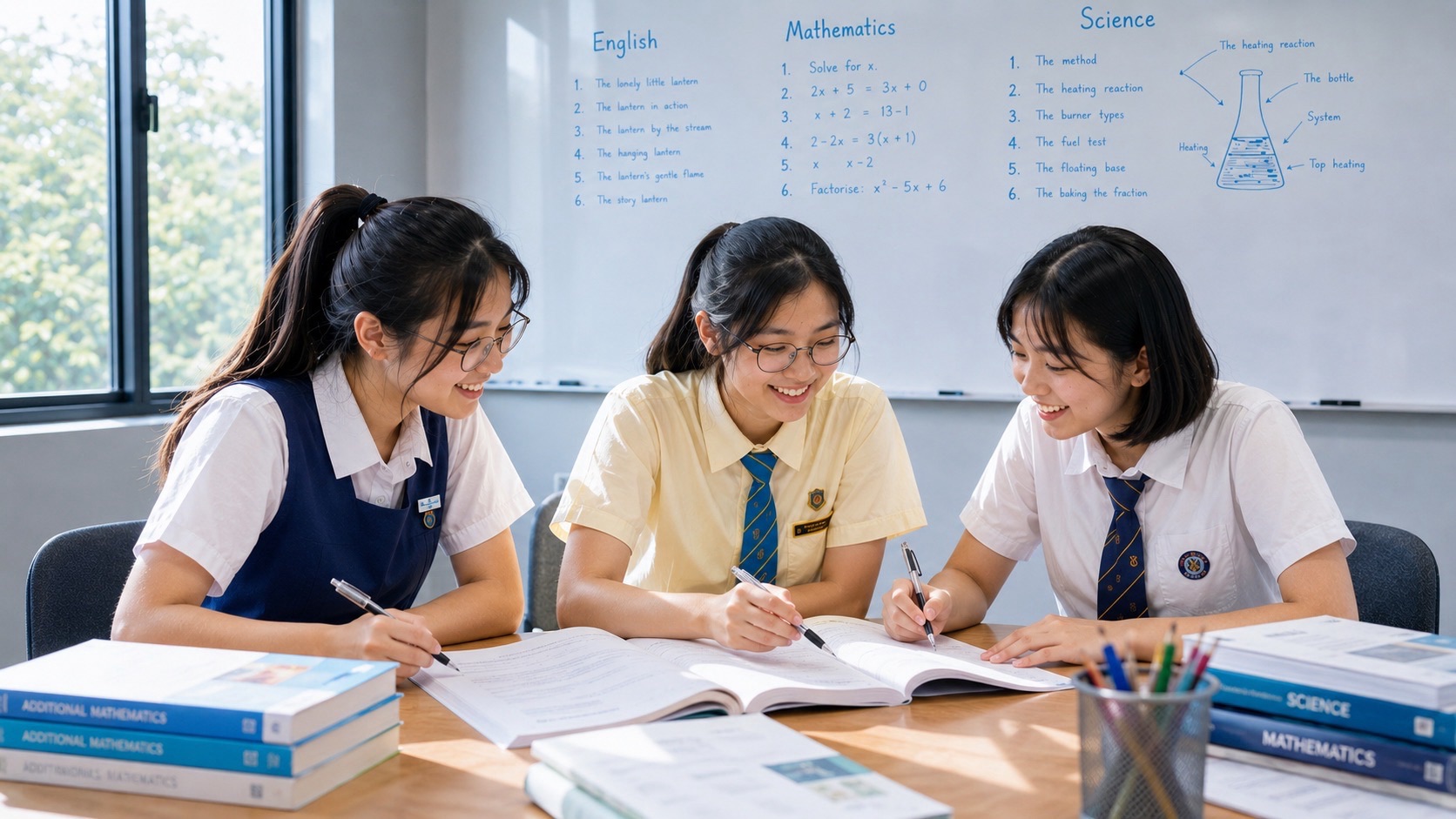
- English: “explain” changes the response from description to relationship-building.
- Mathematics: a negative sign, domain restriction or case condition changes later operations and validity.
- Science: a controlled variable limits which factor can reasonably explain the outcome.
- Writing: audience and purpose change tone, vocabulary and explanation depth.
- Multi-part work: a condition introduced earlier continues to constrain later parts unless the task changes it.
The visible error appears late, but the useful teaching target is the moment when a recognised condition stopped influencing the work.
A strong tutor therefore trains both recognition and propagation.
Why a 3-Pax Tutorial Can Help Gul Street 2 Students Improve
A 3-pax tutorial gives the tutor enough visibility to watch how each learner begins, what each one treats as important and where the process first diverges from the task.
One learner may highlight a condition but forget to apply it. Another may notice a restriction but lose it midway through the solution. A third may keep carrying a condition after its scope has ended.
The tutor can ask each learner for a short independent attempt before discussion. That prevents the strongest voice in the room from becoming the answer source for everyone else.
The small-group advantage therefore comes from better diagnostic resolution, faster adjustment and more individual retrieval opportunities.
Three Improvement Pathways
1. Repair
Repair begins when the learner cannot yet use the target process independently. The tutor makes the decision explicit, reduces unrelated difficulty and creates one clean success that can be explained.
Trace each supporting item to its origin and identify whether it contributes genuinely new information.
2. Stabilise
Stabilisation begins when the learner succeeds in familiar work but loses control when wording changes, time passes or another demand competes for attention.
Mix independent and dependent evidence so the learner must classify the relationship before counting support.
3. Extend
Extension is for learners whose basic process is secure. The tutor adds ambiguity, mixed topics, competing methods or realistic time pressure.
Handle complex evidence networks in which some sources are partly independent and some depend on shared assumptions or data.
A First-Principles Improvement Method
1. Diagnose the first unstable point
Use recent schoolwork or a short cold-start task. Trace the response until the first decision the learner cannot explain or reproduce reliably.
2. Rebuild only what is missing
If most of the work is secure, preserve it. Broad reteaching can waste time and hide genuine strengths.
3. Fence the target decision
Temporarily reduce unrelated complexity so the learner can see the rule, boundary or comparison clearly.
4. Make the student explain
Explanation reveals whether the learner understands the relationship or is following surface cues.
5. Retrieve after delay
A correct answer immediately after teaching is useful but incomplete evidence. Bring the skill back later without the worked model.
6. Interleave and transfer
Mix the target with plausible alternatives so the learner must recognise when it applies.
7. Add speed after control
Timing should compress a stable process rather than disguise an unstable one.
Why Immediate Success Is Not Enough
Students often finish a lesson successfully because the tutor’s explanation is still fresh and the worksheet sequence makes the method predictable.
Transfer is stronger evidence. Can the learner recognise the same structure after a delay, inside mixed work, with changed wording and without hidden prompting?
Tuition should keep returning to that question until the answer increasingly becomes yes.
What Happens During a 90-Minute Improvement Lesson
Warm-up retrieval
A short cold start brings back earlier learning without notes.
Current-school diagnosis
Recent work is inspected for repeated patterns so the lesson targets evidence rather than assumptions.
Concept instruction
The tutor teaches the smallest relationship that unlocks the current difficulty.
Guided practice
Prompts remain visible enough to prevent random guessing but light enough that the learner makes the key decisions.
Independent application
Prompts are removed and fresh tasks test whether the process now belongs to the student.
Mixed or timed application
The target appears among competing skills or under realistic timing.
Error review
Mistakes are classified and converted into better future actions rather than described vaguely as carelessness.
Focused continuation work
Homework continues the lesson logic with a small amount of useful practice.
How Tuition Should Improve English
English task words and qualifiers have consequences. “Compare” requires a common basis; “explain” requires a relationship; “only”, “except” and “unless” change logical scope.
The tutor asks students to state the operational consequence after identifying the condition.
This prevents accurate annotation from becoming disconnected from the final response.
How Tuition Should Improve Mathematics
Mathematics conditions such as sign, domain, parity, angle type or denominator restrictions change which operations or candidate solutions remain valid.
The learner should carry those consequences forward rather than recheck the condition only at the end.
A short consequence statement can protect several later steps and reduce error propagation.
How Tuition Should Improve Science
Science conditions control inference. If temperature is held constant, the explanation should not later treat temperature as the changing cause.
The tutor helps students trace variable roles from setup to observation to conclusion.
The condition becomes part of the reasoning chain, not merely a label written beside the diagram.
Why Recognising a Condition Is Only Half the Skill
Conditions matter because they constrain what can happen next.
Recognition without propagation creates the illusion of careful reading while leaving execution unchanged.
Condition-to-consequence tracing makes the link explicit: because this condition holds, these methods, claims or outcomes change.
The tutor should focus on high-impact conditions whose consequences persist across several steps.
The mature learner automatically carries those consequences through the solution state and lets them expire only when their scope ends.
Three Practice Scenarios
English scenario
A student underlines “explain why” but writes only what happened.
The tutor asks what consequence the word “explain” creates: the answer must connect evidence to reason or mechanism, not merely describe the event.
Mathematics scenario
A student notices a denominator restriction but later accepts a candidate value that makes the denominator zero.
The learner traces the restriction forward and rejects the invalid value before closing the problem.
Science scenario
A student identifies water volume as controlled, then later claims differing volumes caused the result.
The condition-to-consequence trace keeps the controlled status active through the conclusion and redirects the explanation to the variable that actually changed.
The Condition–Consequence–Carry Check
Use three prompts: Condition — what important fact or restriction applies? Consequence — what does it change about method, validity or answer form? Carry — which later steps must continue to respect that consequence?
The routine is useful when students read carefully but still execute as though the condition were absent.
Visible tracing should fade once consequences propagate automatically.
Do Not Carry a Condition Beyond Its Valid Scope
A condition may apply only to one sub-part, one branch or one stage of a task.
The learner should stop carrying it when the task explicitly changes the state.
The tutor therefore teaches both propagation and expiry so a useful condition does not become an obsolete constraint.
What Good Practice Looks Like
- identifies high-impact conditions
- states their operational consequence
- carries consequences through later steps
- knows when a condition expires
- links command words to answer form
- uses restrictions during final validation
Good practice turns reading into action and preserves the effect of important conditions for exactly as long as they apply.
What Poor Practice Looks Like
- highlights key words but ignores them later
- forgets a domain restriction
- treats controlled variables as causal
- carries expired conditions into new sub-parts
- cannot state what a condition changes
- re-reads conditions only after the answer is complete
Poor practice separates recognition from execution.
A Diagnostic Matrix for Repeated Errors
- recognition-execution gap — condition is seen but unused
- consequence gap — learner cannot state what changes
- carry failure — consequence disappears later
- scope failure — condition is carried too far
- validation failure — restriction is not applied to the final answer
- command disconnect — task word is noted but response function stays the same
The repair should identify whether the failure lies in recognition, consequence mapping, carrying or expiry.
The Improvement Ladder
- Level 1 — tutor names and models the target process
- Level 2 — student uses it with visible prompts
- Level 3 — student uses it independently in familiar work
- Level 4 — the process survives changed wording and mixed topics
- Level 5 — the process remains available under realistic timing
- Level 6 — the student adapts, explains and self-corrects without tutor rescue
The ladder prevents first success from being mistaken for mastery.
How We Reduce Careless-Looking Mistakes
Many careless-looking mistakes are predictable process failures: a rushed launch, a dropped condition, an unstable comparison, an unchecked assumption or a final answer that was never matched back to the question.
condition-to-consequence tracing gives those moments a visible place in the workflow. Once the learner can identify the failure point, correction becomes technical rather than vague.
The tutor then practises the countermeasure until the student can trigger it independently.
Homework Should Continue the Lesson, Not Compete With It
Continuation work should be small enough to complete honestly and specific enough to generate useful evidence.
A few carefully chosen questions can be more valuable than many repetitive ones when they require retrieval, selection and transfer.
The weekly plan should also respect school responsibilities, sleep and recovery.
Four Contact Points Across the Week
Contact Point 1: Tuition lesson
The skill is taught and practised while the tutor can observe the decision closely.
Contact Point 2: Short reconstruction
The learner recreates the process from memory without rereading the original explanation.
Contact Point 3: Mixed return
The skill appears among alternatives so the student must recognise when it is needed.
Contact Point 4: Pre-lesson cold start
A final independent attempt tests whether the learning remains available after delay.
A Seven-Day Training Cycle
A useful weekly cycle does not require seven long sessions. It requires several well-placed contacts with the same idea.
Day 1 is the main lesson. Day 2 uses a short reconstruction. Day 4 returns with a changed example. Day 5 uses one mixed question. Day 7 uses a cold start before the next lesson.
Spacing creates useful forgetting, forcing reconstruction rather than continuation of short-term memory.
The useful measure is not page count. It is whether the learner can retrieve, choose, execute and check with less support at each return.
From Tuition Performance to School Transfer
The purpose of tuition is not to create a private environment in which the student succeeds only with the tutor’s worksheet order and language.
Learning must survive school phrasing, unfamiliar examples, different representations, mixed topics and independent decision-making.
Practice therefore becomes progressively less signposted.
How to Know the Skill Has Become Portable
A portable skill survives changes in wording, numbers, topic order and context.
Portability is stronger evidence than repeated success on one familiar worksheet because it shows the learner is responding to structure rather than page familiarity.
Primary, PSLE and Secondary: The Same Logic at Different Depths
A Primary learner may use condition-to-consequence tracing to manage a word problem or comprehension task. A PSLE student may use the same principle across mixed-paper conditions. A Secondary learner may apply it in G1, G2 or G3 work where symbolic language and multi-step reasoning create heavier demands.
The sophistication changes, but the learning loop remains recognisable.
Full Subject-Based Banding and the 2027 SEC
Full Subject-Based Banding has been fully implemented in Singapore secondary schools since 2024, with subjects offered at G1, G2 or G3 according to students’ learning needs and strengths.
From 2027, graduating students will sit the Singapore-Cambridge Secondary Education Certificate at their respective subject levels. Parents can refer to MOE and the SEAB SEC information for the current official framework.
Tuition should align with the learner’s actual subject level, school sequence and current syllabus.
School Alignment Without Becoming School-Dependent
Tuition should remain aware of current school topics, assessment calendar and teacher feedback.
At the same time, the skill should be taught deeply enough to survive beyond one school’s exact worksheet design.
Assessment Readiness Without Panic
Near assessments, revision should compress a stable system rather than invent a new one.
Retrieval, mixed selection, timed sections and targeted repair provide more useful evidence than a sudden mountain of unfamiliar material.
Different Students Need Different Versions of the Same Principle
A rebuilding student may need a visible routine. A stable learner may need fewer prompts and more transfer. A strong student may need ambiguous tasks where several methods or interpretations are plausible.
The principle can be shared while the task changes.
What Tuition Should Not Become
- a second school day built mainly from worksheet volume
- a place where the tutor makes every important decision
- a rescue service that removes productive independent struggle
- a race to cover chapters while foundations remain unstable
- a performance where success depends on perfectly timed prompts
- a promise that a fixed number of lessons guarantees a fixed grade
Good tuition should simplify the learning problem without simplifying the student’s responsibility.
Energy, Resources and Time
A workable improvement plan respects available energy, the resources needed for the current problem and the time before the next meaningful school demand.
Good tuition adjusts the type of work, not merely the amount.
Teaching Ahead Without Rushing
Pre-teaching can reduce future cognitive load when it gives the learner a clean first structure.
The useful question is whether teaching ahead makes the next school lesson easier to understand and extend.
How Progress Should Be Measured
Progress appears when highlighted or identified conditions actually change subsequent work.
A second sign is fewer final answers that violate earlier restrictions.
A third sign is better alignment between command words and response form.
Strong students show progress when they can manage several active conditions without confusion.
How This Skill Develops Across a School Term
Early in the term, the tutor asks for explicit consequence statements after high-impact conditions.
Midway through the term, students carry those consequences independently across short chains.
Later, multi-part and timed tasks require both propagation and expiry without visible prompts.
By assessment time, important conditions should remain active automatically for exactly as long as they apply.
What Parents Can Do Without Taking Over the Work
- ask “What does that condition change?”
- ask “Which later step still has to respect it?”
- avoid praising highlighting alone
- bring work where restrictions were noticed but violated
- notice whether command words now affect answer form
- encourage the child to stop carrying a condition when the question changes it
Parents can prompt the consequence without supplying the academic method itself.
A Gul Street 2 Condition–Consequence–Carry Routine
- identify the condition
- state what it changes
- apply the consequence immediately
- mark which later steps inherit it
- check those steps for consistency
- expire the condition when the task changes
- validate the final answer against remaining active conditions
The routine turns careful reading into a state that controls later reasoning.
Advanced Use of the Same Skill
Advanced learners can track several simultaneous conditions and identify which consequence belongs to which restriction.
Another exercise is to change one condition halfway through a problem and ask which downstream steps must be recalculated and which can remain.
Under time pressure, high-impact conditions deserve the clearest propagation; low-impact details should not occupy the same amount of working memory.
How Gul Street 2 Students Can Build This Skill Across a School Term
In the first phase, the tutor makes the target process visible and keeps unrelated difficulty low.
In the second phase, prompts fade and the skill returns after delay and variation.
In the third phase, the process is tested under realistic school conditions with mixed work and appropriate time pressure.
Across the term, progress is judged by independence and transfer rather than worksheet volume alone.
Travelling From Gul Street 2 to Sixth Avenue
Gul Street 2 families can plan current public-transport connections toward Sixth Avenue from the student’s actual starting point. Weekly feasibility should include school dismissal, transfers, meals, lesson time and the return journey.
This guide serves Gul Street 2 families considering the Fourth Avenue programme. It does not describe a Gul Street 2 branch.
Location: eduKateSG, 8 Fourth Avenue, Singapore 268674
Nearest MRT: Sixth Avenue MRT, Downtown Line
Attendance: By appointment
Class Details
Format: Premium 3-pax small-group tutorials
Duration: Approximately 1.5 hours weekly
Teaching approach:
- first-principles explanation
- diagnosis before volume
- guided and independent practice
- retrieval and interleaving
- error analysis
- school-assessment alignment
- carefully paced pre-teaching
Materials may include:
- curated lesson notes
- topic practice
- mixed revision
- assessment-style questions
- micro-tests
- focused continuation work
What Parents Can Bring to the Consultation
- recent school test papers
- questions with ignored command words
- algebra containing domain restrictions
- Science variable questions
- the school’s current topic sequence
- teacher comments about careless reading
- examples where the child says “I saw that condition but forgot to use it”
These materials help the tutor locate whether the problem begins with reading, consequence mapping or carrying the condition through later work.
Frequently Asked Questions
How quickly should a Gul Street 2 student improve with tuition?
Students can learn the consequence step quickly, but automatic propagation across long work develops through varied tasks and delayed retrieval. We look for fewer restriction violations and stronger response alignment rather than promise a fixed grade after a fixed number of lessons.
What if there are many conditions in one question?
We rank them by consequence. Conditions that change method, validity or answer form stay active; lower-impact details remain available without occupying the same amount of attention.
Can a condition ever stop applying?
Yes. Scope matters. A condition can belong to one branch or sub-part, so the learner also practises recognising when it expires.
Can a strong student still benefit from this?
Yes. Strong students often recognise conditions quickly but can still lose them during long multi-step execution.
Depth Notes for Tutors and Parents
Conditions matter because they constrain later possibilities.
English command words create response obligations.
Mathematics restrictions create validity boundaries.
Science controlled and changed variables create inference boundaries.
For tutors, recognition-execution gaps can look like carelessness.
For parents, asking what the condition changes supports transfer without giving the method.
Strong learners may notice more conditions but still fail to propagate them consistently.
Conditions should expire when their scope ends.
Validation should return to active restrictions before closure.
Timed practice matters because condition tracking has working-memory cost.
Transfer appears when consequences carry automatically in unfamiliar tasks.
The final destination is operational reading: important conditions do not merely get noticed; they change what the learner does next.
Helpful Reading
Read How Independent Learning Works, How Error Correction Works and How Interleaving Works for the wider learning system.
How to Improve With Tuition | Gul Street 2
For Gul Street 2 students, improvement can come from turning important conditions into consequences that remain active throughout the work.
Notice the condition, state what it changes and carry that consequence until the task explicitly tells you it no longer applies.
eduKateSG
8 Fourth Avenue
Singapore 268674
Near Sixth Avenue MRT
Premium 3-pax small-group tuition
By appointment
Properly taught kids shine a bright light into the future.
Risk-Calibrated Practice Notes
A checking strategy becomes useful only when it changes where attention goes. The learner should be able to explain why one step deserves a substitution check, another deserves a source return, and a third can be left alone. This prevents checking from becoming a ritual performed after the thinking is already finished.
Across a school term, the tutor can compare the learner’s predicted high-risk points with the errors that actually occurred. When the two begin to align, calibration is improving. When a recurring error still feels completely secure, that mismatch becomes a specific training target.
Parents can support this process without becoming the checker. Ask which step is fragile and what test would settle it. Then let the child perform the verification and explain what the result means for the rest of the answer.
Condition Propagation Practice
A useful practice set contains questions where the same visible condition has different consequences depending on context. A negative sign may change an arithmetic result, a branch condition may change which formula applies, and a command word may change the entire response function. The learner has to state the consequence before execution begins.
The tutor can then extend the task by changing the condition halfway through. This tests whether the learner knows which earlier consequences remain active and which downstream steps must be updated. The exercise combines propagation with scope control rather than training blind persistence.
The mature learner does not need to write every condition in a separate box. The goal is an internal state in which important restrictions continue to influence decisions until their valid scope ends.