
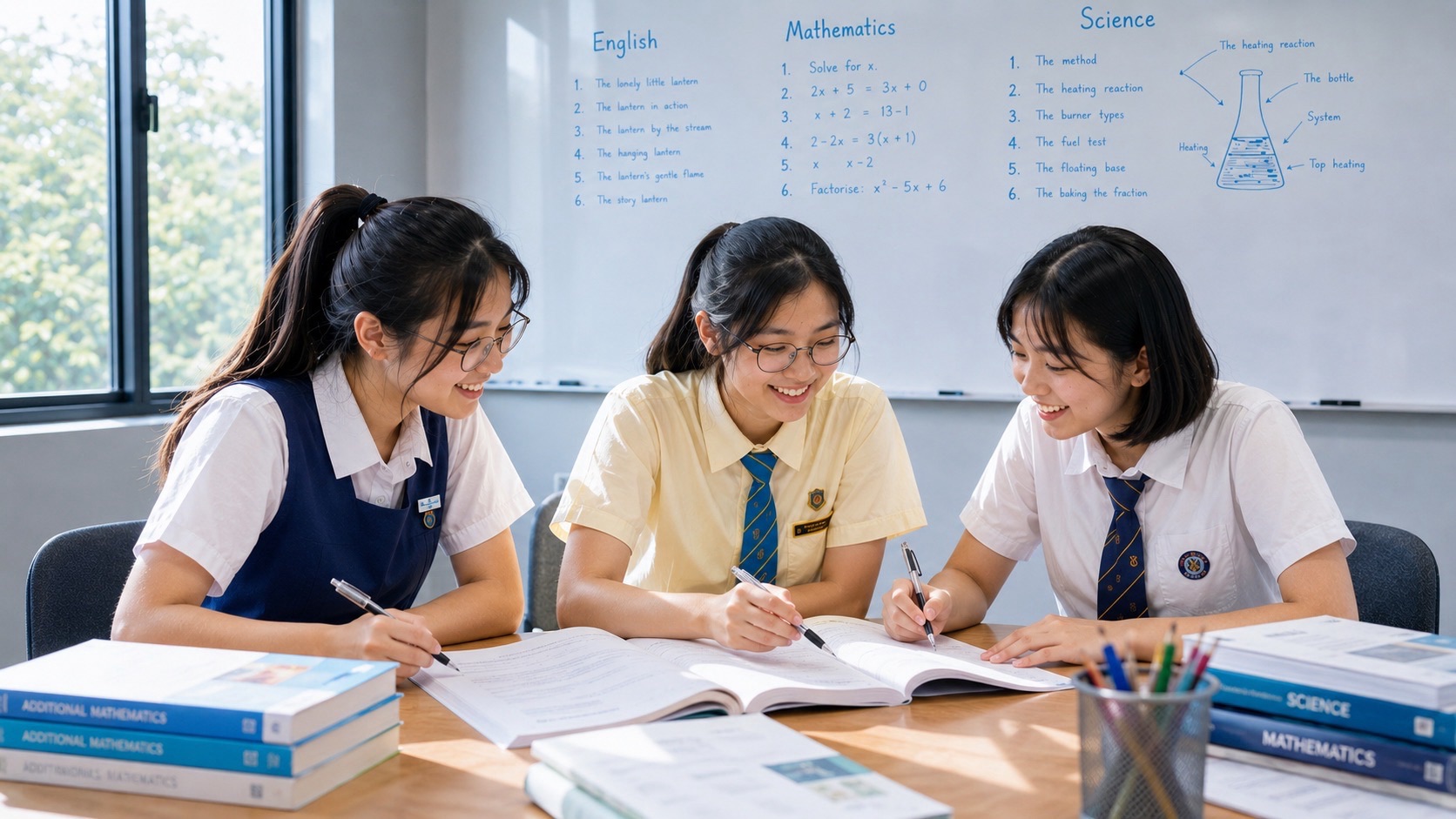
How to Improve With Tuition | West Coast Link is a practical guide for families who want tuition to improve the student’s decision-making, transfer and independence rather than simply add more worksheets to the week.
For students around West Coast Link, this article focuses on conditional branching: the learner recognises which condition is present and chooses the next action accordingly instead of forcing one memorised procedure onto every similar-looking task. The mechanism is deliberately narrow because durable improvement often begins when one repeated decision becomes visible, teachable and measurable.
At eduKateSG, the current working model is premium 3-pax small-group tuition at Fourth Avenue near Sixth Avenue MRT. The small group allows the tutor to inspect working, listen to explanations and identify the first unstable point before assigning more practice.
The purpose is not to make a learner successful only while the tutor is present. The purpose is to make the student increasingly capable of reading the task, choosing a route, executing carefully, checking intelligently and recovering independently.
This learning logic can support Primary, PSLE and Secondary students. The content changes with age and subject level, but the core cycle remains recognisable: diagnose, explain, practise, retrieve, vary, check and transfer.
The Important Transition Is From “What Formula Do I Use?” to “Which Condition Am I In?”
Students often memorise a procedure as one unbroken sequence. That works while every question looks like the examples used during practice.
The difficulty appears when one condition changes. A negative value appears, the command asks for explanation rather than description, or the evidence is insufficient for the usual conclusion.
Conditional branching teaches the learner to pause at the decision point: if this condition is present, take this route; if it is absent, choose another.
The aim is not to memorise a huge flowchart. It is to make the few high-value branches visible until they become part of the learner’s judgement.
The Hidden Problem: One Familiar Method Can Become a Default Even When the Conditions Change
A learner can know several methods and still behave as though only one exists because the first familiar cue launches the whole routine.
When the question changes slightly, the student notices the topic but not the branch condition that should alter the response.
This creates errors that look like weak knowledge even when the missing skill is actually method switching.
Tuition can isolate the branch condition and practise it with contrasting cases before returning to full questions.
What This Looks Like in Real Schoolwork
The mechanism becomes easier to see in ordinary schoolwork. A student can know most of the content and still lose marks because one decision is made too early, too late or for the wrong reason.
- English: if the command is “describe”, the response reports what is seen; if it is “explain”, the response adds the relationship that accounts for it.
- Mathematics: if a denominator could be zero, the learner checks the restriction before accepting an algebraic result.
- Science: if more than one variable changes, the learner avoids claiming that one factor alone caused the outcome.
- Writing: if the audience changes, the choice of tone and explanation changes with it.
- Timed papers: the student distinguishes the routine case from the exceptional case before committing several minutes to the wrong route.
Across these examples, the common issue is the learner is recognising the topic but not the condition that should switch the method or answer form. The final wrong answer is only the visible result; the useful teaching target usually appears earlier in the process.
A strong tutor therefore protects what the learner already knows and repairs the smallest meaningful bottleneck first.
Why a 3-Pax Tutorial Can Help West Coast Link Students Improve
A 3-pax tutorial gives each learner enough room to show working, explain a choice and attempt a fresh task before the tutor intervenes. This makes the student’s real process visible rather than hiding it behind smooth lesson momentum.
One learner may know the method but choose it at the wrong time. Another may understand the idea but need a prompt to begin. A third may execute accurately but fail to check whether the result still fits the question. Those are different problems and should not receive the same worksheet prescription.
The group also creates useful contrast. Students can hear different explanations and see alternative routes, but every important skill should return to an individual attempt so peer discussion does not become hidden answer supply.
The small-group advantage therefore comes from better diagnostic resolution and faster adjustment, not merely from having fewer seats.
Three Improvement Pathways
1. Repair
Repair is appropriate when the learner does not yet understand the target process. The tutor makes the decision explicit, reduces unrelated difficulty and creates a clean success that can be explained.
For conditional branching, repair means teach one clear branch point with two contrasting cases and require the learner to state which condition triggers which action. The student should know both what to do and why the action improves reliability.
2. Stabilise
Stabilisation is needed when the learner can use the process in familiar practice but loses it when wording changes, time passes or another demand competes for attention.
For this mechanism, stabilisation means remove the labels and mix the two cases so the learner must identify the branch independently before execution. Prompts are faded until the learner can trigger the process independently.
3. Extend
Extension is for learners whose basic process is already secure. The tutor adds ambiguity, mixed topics, competing methods or realistic time pressure.
With conditional branching, extension means coordinate several branch conditions and choose among multiple valid routes without turning the task into a rigid flowchart. Strong students should face richer judgement, not simply greater worksheet volume.
A First-Principles Improvement Method
1. Diagnose the first unstable point
Begin with evidence: a recent test, marked assignment, school worksheet or short cold-start task. Trace the work until the first decision the learner cannot explain or reproduce reliably.
2. Rebuild only what is actually missing
If most of the process is secure, preserve it. Re-teaching everything can create passivity and hide genuine strengths. Repair the smallest meaningful gap first.
3. Use the Fencing Method
Fence one decision tightly enough that its boundaries become clear. Keep unrelated difficulty temporarily low, practise the target deliberately, then reopen the fence with changed wording, mixed topics and unfamiliar contexts.
4. Make the student explain
Explanation exposes hidden shortcuts. A learner who can state why a step is valid is more likely to recognise when a similar-looking step is not valid.
5. Retrieve after a delay
A correct answer immediately after teaching is useful but incomplete evidence. The same idea should return later without the worked example or tutor language in view.
6. Interleave and transfer
Mix the target skill with plausible alternatives. The learner must decide when to use it rather than repeat a technique announced by a worksheet heading.
7. Add speed only after control
Timing should compress a reliable process, not hide an unreliable one. Once accuracy and control are stable, speed can be built without sacrificing judgement.
Why Immediate Success Is Not Enough
Students often leave a lesson feeling confident because the final few questions went well. That success may still depend on recent explanation, visible models or a predictable task sequence.
A stronger test comes later. Can the learner retrieve the idea after a delay? Can the learner recognise it inside mixed work? Can the learner execute without hidden prompting? Can the learner repair a small error independently?
Durable learning appears when those answers become increasingly positive across different school conditions.
What Happens During a 90-Minute Improvement Lesson
Warm-up retrieval
A short cold start brings back earlier learning without notes. The tutor watches both accuracy and how the learner begins.
Current-school diagnosis
Recent schoolwork is inspected for repeated patterns so the lesson targets the actual bottleneck rather than a guessed weakness.
Concept instruction
The tutor teaches the smallest concept or control that can unlock the current difficulty, using clear language and contrast between correct and incorrect reasoning.
Guided practice
Prompts remain visible enough to prevent random guessing but light enough that the learner still makes the important decisions.
Independent application
Prompts are removed. Fresh tasks reveal whether the student can reproduce the process without tutor rescue.
Mixed or timed application
The target appears among competing skills or under realistic timing so selection and control can be tested together.
Error review
Mistakes are classified and converted into better future actions. “Careless” is not accepted as a complete diagnosis.
Focused continuation work
Homework continues the lesson logic with a small amount of useful practice rather than unrelated volume.
How Tuition Should Improve English
English contains branch points in command words, evidence strength, text type and audience. A student who uses one response structure everywhere may know the content but still miss the task.
The tutor teaches the learner to ask which condition changes the answer: is evidence explicit or inferred, is the task asking for comparison or explanation, and does the wording require one point or several?
The branch should change the response function, not merely the sentence starter.
How Tuition Should Improve Mathematics
Mathematics contains branch conditions such as sign, domain, equality, geometric configuration and whether an exact or approximate result is required.
The learner can practise paired questions that look almost identical except for one condition. The purpose is to see which part changes the route.
Once the branch is recognised, ordinary execution should remain fluent; the decision should not create unnecessary hesitation.
How Tuition Should Improve Science
Science reasoning often changes when the experimental condition changes. A controlled comparison supports a different kind of conclusion from a comparison where several variables change together.
The tutor helps students link branch conditions to the strength of the claim they are allowed to make.
This reduces generic explanations that sound scientific but do not match the actual setup.
Why Conditional Branching Makes Knowledge More Flexible
A memorised procedure is useful when its conditions are stable. Flexibility appears when the learner also knows the boundary of that procedure.
Branching makes those boundaries explicit. It tells the student what feature deserves attention before the next move is chosen.
The best branch rules are small and structural: if the command changes, if the sign changes, if a variable is not controlled, if the evidence is insufficient.
Over time, the branch becomes recognition rather than conscious recitation. The learner sees the condition and the appropriate route becomes available.
The mature student therefore combines fluency with exception handling instead of choosing between them.
Three Practice Scenarios
English scenario
A question asks what happened in a scene. The student begins explaining why the character acted that way because explanation is the structure used most often in tuition.
The tutor contrasts “describe” and “explain” and makes the branch explicit. A fresh question then removes the labels from the lesson sequence so the learner must identify the operation from the command itself.
Mathematics scenario
A student solves an equation and obtains a value that makes an original denominator zero.
The branch condition is domain validity. The learner rejects the value even though the algebraic manipulation produced it, because the original expression does not permit that state.
Science scenario
Two plant setups differ in both light and water. The student starts writing that light caused the observed difference.
The learner identifies the branch condition—more than one factor changed—and switches from a single-cause conclusion to a more cautious statement about what the comparison can and cannot establish.
The Condition–Branch–Action Check
Use three short prompts: Condition — what feature changes the case? Branch — which route does that feature place me on? Action — what should I do next?
The tool is especially useful on paired questions where one detail changes the valid response.
As the learner improves, the spoken routine disappears and the branch becomes a fast internal decision.
Do Not Turn Every Question Into a Giant Decision Tree
Too many branches can overload the learner and slow routine work.
The tutor should teach only branch points that genuinely change method, validity or answer form.
If one route clearly applies, the student should proceed rather than invent alternatives for the sake of appearing analytical.
What Good Practice Looks Like
- identifies the condition that changes the case
- states the route that condition activates
- uses contrasting examples
- keeps routine cases fluent
- recognises exceptions without panic
- can explain why another branch would be wrong
Good practice becomes lighter as the learner improves. A visible routine is useful during training, but the destination is a fast internal process that survives without tutor prompting.
What Poor Practice Looks Like
- uses one method for every similar-looking question
- memorises a giant flowchart without understanding
- switches route because of superficial keywords
- creates unnecessary branches on routine work
- forgets the original condition halfway through
- cannot explain why the chosen branch applies
Poor practice creates activity without diagnostic value. The learner may work hard while repeating the same unstable decision.
A Diagnostic Matrix for Repeated Errors
- default-route error — the familiar method launches automatically
- branch blindness — the condition is not noticed
- branch mapping error — the condition is noticed but linked to the wrong action
- overbranching — too many alternatives create hesitation
- condition decay — the learner forgets the branch condition later in the solution
- transfer gap — the branch is recognised only in the tutor’s original examples
The repair should match the category. Memory problems need retrieval. Selection problems need discrimination. Representation problems need a clearer model. Checking problems need a reliable gate.
The Improvement Ladder
- Level 1 — the tutor names and models the target process
- Level 2 — the student uses it with visible prompts
- Level 3 — the student uses it independently in familiar work
- Level 4 — the process survives changed wording and mixed topics
- Level 5 — the process remains available under realistic timing
- Level 6 — the student can adapt, explain and self-correct without tutor rescue
The ladder prevents first success from being mistaken for mastery. Independence and transfer are later stages.
How We Reduce Careless-Looking Mistakes
Many careless-looking mistakes are predictable. They come from identifiable moments: a rushed launch, a dropped condition, an unsuitable representation, an unchecked assumption, a copied sign, an unsupported claim or a final answer that was never matched back to the question.
conditional branching gives those moments a visible place in the workflow. Once the learner can identify the failure point, correction becomes technical rather than vague.
The tutor can install a small countermeasure and practise it until the student can trigger it independently.
Homework Should Continue the Lesson, Not Compete With It
Continuation work should be small enough to complete honestly and specific enough to generate useful evidence. If homework requires constant adult help, it stops showing what the learner can do alone.
A few carefully chosen questions can be more valuable than many repetitive ones when they require retrieval, selection and transfer.
The weekly plan should also respect school responsibilities, sleep and recovery. Learning quality falls when every improvement strategy becomes a volume contest.
Four Contact Points Across the Week
Contact Point 1: Tuition lesson
The skill is taught and practised while the tutor can observe the decision closely.
Contact Point 2: Short reconstruction
The learner recreates the process from memory without rereading the original explanation.
Contact Point 3: Mixed return
The skill appears among alternatives so the learner must recognise when it is needed.
Contact Point 4: Pre-lesson cold start
A final independent attempt tests whether the learning remains available after delay.
A Seven-Day Training Cycle
A useful weekly cycle does not require seven long study sessions. It requires several well-placed contacts with the same idea so learning survives beyond tuition.
Day 1 is the main lesson. Day 2 uses a short reconstruction. Day 4 returns with a changed example. Day 5 uses one mixed question. Day 7 uses a cold start before the next lesson.
Spacing creates useful forgetting. The learner has to rebuild the idea rather than simply continue the short-term memory of the previous example.
The useful measure is not how many pages were completed. It is whether the learner can retrieve, choose, execute and check with less support at each return.
From Tuition Performance to School Transfer
The purpose of tuition is not to build a private environment in which the student succeeds only with the tutor’s exact wording, worksheet order and timing.
For transfer, learning must survive school phrasing, unfamiliar examples, different representations, mixed topics and the pressure of deciding independently.
Practice therefore becomes progressively less signposted. The tutor first makes the decision visible, then removes labels, changes surface features and introduces competing methods.
How to Know the Skill Has Become Portable
A portable skill survives changes in wording, numbers, topic order and context. The learner can still identify what matters, choose an appropriate action and recover from a small mistake.
Portability is stronger evidence than repeated success on one familiar worksheet because it shows that learning has been organised around structure rather than page familiarity.
Primary, PSLE and Secondary: The Same Logic at Different Depths
A Primary learner may use conditional branching to manage a word problem or comprehension task. A PSLE student may use the same principle to protect accuracy across mixed-paper conditions. A Secondary learner may apply it in G1, G2 or G3 work where symbolic language, explanation and multi-step reasoning create heavier demands.
The complexity changes, but the learning loop remains recognisable: diagnose, repair, retrieve, apply, check and transfer.
Full Subject-Based Banding and the 2027 SEC
Full Subject-Based Banding has been fully implemented in Singapore secondary schools since 2024, with subjects offered at G1, G2 or G3 according to students’ learning needs and strengths.
From 2027, graduating students will sit the Singapore-Cambridge Secondary Education Certificate at their respective subject levels. Parents can refer to MOE and the SEAB SEC information for the current official framework.
Tuition should align with the learner’s actual subject level, school sequence and current syllabus rather than assume a single generic secondary pathway.
School Alignment Without Becoming School-Dependent
Tuition should remain aware of the learner’s current school topics, assessment calendar and teacher feedback so support remains relevant.
At the same time, the skill must be taught deeply enough to survive beyond one school’s exact worksheet design.
Assessment Readiness Without Panic
Near assessment periods, revision should compress a stable system rather than invent a new one. Retrieval, mixed selection, timed sections and targeted error repair produce more useful evidence than a sudden mountain of unfamiliar material.
A useful preparation question is: Which failure modes are still costing marks, and can the learner now detect and repair them under realistic time?
Different Students Need Different Versions of the Same Principle
A rebuilding student may need low initial complexity and a visible routine. A stable learner may need fewer prompts and more transfer. A strong student may need ambiguous tasks where several methods or interpretations are plausible.
The principle can be shared while the task changes. A carefully managed 3-pax group can remain intellectually connected without pretending all three learners have the same bottleneck.
What Tuition Should Not Become
- a second school day built mainly from worksheet volume
- a place where the tutor makes every important decision
- a rescue service that removes productive independent struggle
- a race to cover chapters while foundations remain unstable
- a performance where success depends on perfectly timed prompts
- a promise that a fixed number of lessons guarantees a fixed grade
Good tuition should simplify the learning problem without simplifying the student’s responsibility.
Energy, Resources and Time
A workable improvement plan respects the learner’s available energy, the resources needed for the current problem and the time before the next meaningful school demand.
Good tuition adjusts the type of work, not merely the amount.
Teaching Ahead Without Rushing
Pre-teaching can reduce future cognitive load when it gives the learner a clean first structure.
The useful question is whether teaching ahead makes the next school lesson easier to understand, diagnose and extend.
How Progress Should Be Measured
Progress appears when false starts caused by changed conditions become less frequent.
A second sign is faster recognition of the few conditions that genuinely alter the response.
A third sign is better explanation of why one method applies and another does not.
Strong students show progress when several interacting conditions can be handled without losing fluency.
How This Skill Develops Across a School Term
Early in the term, the tutor uses paired examples with one obvious branch condition.
Midway through the term, labels are removed and the cases are mixed.
Later, several branch conditions appear inside longer tasks and timed work.
By assessment time, the learner should switch methods when the structure changes without needing a visible decision tree.
What Parents Can Do Without Taking Over the Work
- ask “What condition changes the method here?”
- avoid giving the branch before the child has read the task
- bring school examples where one changed detail caused a wrong route
- notice whether repeated false starts are decreasing
- encourage the child to explain why an exception matters
- keep routine work fast when no branch decision is needed
Parents help most by creating conditions for independent practice and asking process questions without becoming the second tutor at home.
A West Coast Link Condition–Branch–Action Routine
- read the whole task
- identify the condition that changes the case
- name the possible branch
- choose the action
- execute the route
- check that the condition still holds
- switch only if new information genuinely changes the branch
The routine is a training scaffold, not a permanent flowchart.
Its purpose is to make method boundaries visible until the learner can recognise them naturally.
Advanced Use of the Same Skill
Advanced learners can compare nested branch conditions, where one decision reveals a second condition that must be tested later. The challenge is to preserve the state without carrying unnecessary alternatives.
Another advanced exercise is to design a near-miss question that looks like the usual case but belongs to another branch. Creating the contrast can reveal whether the learner really understands the boundary.
Under time pressure, the branch check should become brief: identify the decisive condition, commit to the route and move on.
How West Coast Link Students Can Build This Skill Across a School Term
In the first phase, the tutor makes the target process visible and keeps unrelated difficulty low.
In the second phase, prompts fade and the skill returns after delay and variation.
In the third phase, the process is tested under realistic school conditions with mixed work and appropriate time pressure.
Across the term, progress is judged by independence and transfer rather than worksheet volume alone.
Travelling From West Coast Link to Sixth Avenue
West Coast Link families can plan current public-transport connections toward Sixth Avenue from the student’s actual starting point. Weekly feasibility should include school dismissal, transfers, meals, lesson time and the return journey.
This guide serves West Coast Link families considering the Fourth Avenue programme. It does not describe a West Coast Link branch.
Location: eduKateSG, 8 Fourth Avenue, Singapore 268674
Nearest MRT: Sixth Avenue MRT, Downtown Line
Attendance: By appointment
Class Details
Format: Premium 3-pax small-group tutorials
Duration: Approximately 1.5 hours weekly
Teaching approach:
- first-principles explanation
- diagnosis before volume
- guided and independent practice
- retrieval and interleaving
- error analysis
- school-assessment alignment
- carefully paced pre-teaching
Materials may include:
- curated lesson notes
- topic practice
- mixed revision
- assessment-style questions
- micro-tests
- focused continuation work
What Parents Can Bring to the Consultation
- recent school test papers
- questions where one changed condition caused a wrong method
- examples of repeated command-word errors
- work where an exception was missed
- the school’s current topic sequence
- teacher comments about applying methods appropriately
- one or two tasks the student says “looked the same” but were not
These materials help the tutor distinguish missing knowledge from an unstable learning process and plan the first lessons around evidence rather than assumptions.
Frequently Asked Questions
How quickly should a West Coast Link student improve with tuition?
Students can learn a branch point quickly, but reliable switching across subjects and timed work develops through contrasting practice. We look for fewer wrong-route starts and stronger explanation rather than promise a fixed grade after a fixed number of lessons.
Should tuition begin with full examination papers?
Not always. Full papers are valuable when the learner is ready for whole-paper integration. Earlier repair often works better with smaller tasks that expose the target process clearly.
Is more homework always better?
No. Homework should create retrieval, transfer or useful diagnostic evidence. Volume without a clear purpose can hide whether the process is improving.
What if my child starts overthinking every question?
We restrict branching to conditions that genuinely change method or validity. Once a routine case is recognised, the learner should execute fluently rather than keep searching for hidden exceptions.
Can a strong student still benefit from tuition?
Yes. Strong students can work on judgement, transfer, efficiency, checking and unfamiliar combinations rather than simply doing more elementary questions.
How do you reduce repeated careless mistakes?
We locate the decision that repeatedly fails, install a specific countermeasure and practise until the learner can trigger it independently.
Do you teach ahead of school?
Yes, when the foundation is stable and pre-teaching will reduce future cognitive load. We avoid rushing ahead simply for coverage.
Is tuition necessary for every student?
No. Tuition should solve an identifiable learning problem, support a difficult transition or provide meaningful extension.
Depth Notes for Tutors and Parents
Conditional branching is a method-selection skill, not a demand to make every task complicated.
The strongest branch rules are tied to structure rather than superficial words.
English branch points often involve command, scope, evidence and audience.
Mathematics branch points often involve domain, sign, representation and answer conditions.
Science branch points often involve variables, controls, evidence and causal strength.
For tutors, paired examples make branch boundaries easier to diagnose.
For parents, asking what changed helps without supplying the method.
Strong learners still need branch control because fluency can make a favourite method automatic.
Overbranching should be reduced once the correct boundary is learned.
Timed practice is essential because a useful branch decision must remain economical.
Transfer appears when changed wording no longer hides the condition that changes the route.
The final destination is selective flexibility: recognise the exception, switch correctly and preserve fluency everywhere else.
Helpful Reading
Read How Independent Learning Works, How Error Correction Works and How Interleaving Works for the wider learning system.
How to Improve With Tuition | West Coast Link
For West Coast Link students, improvement can come from learning that similar-looking questions do not always belong to the same route.
Find the condition that changes the case, choose the right branch and then execute with the confidence that comes from understanding why that route applies.
eduKateSG
8 Fourth Avenue
Singapore 268674
Near Sixth Avenue MRT
Premium 3-pax small-group tuition
By appointment
Properly taught kids shine a bright light into the future.