
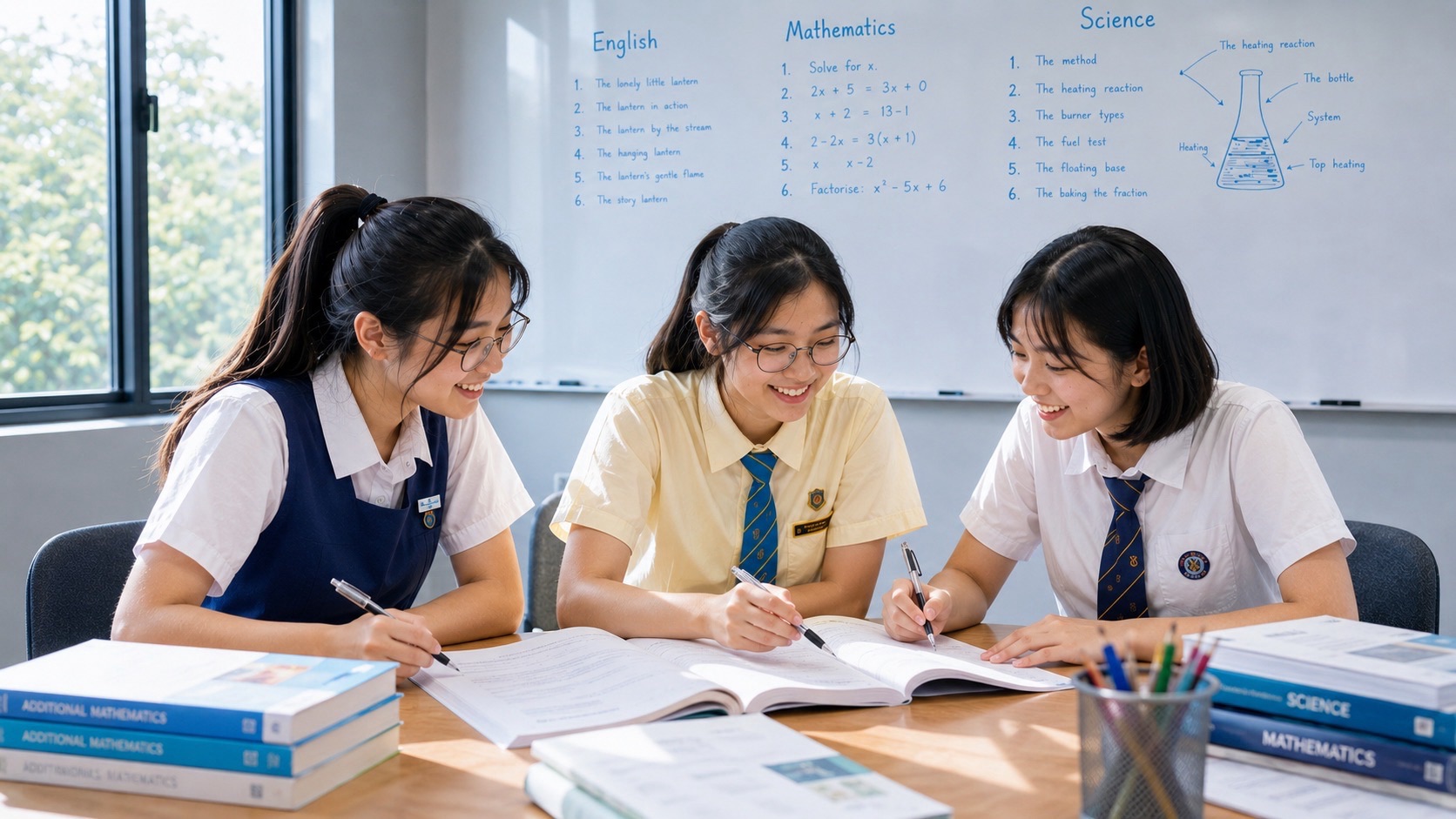
Secondary 2 English Tuition | Sunshine Place is for students who have already crossed the first Secondary-school bridge and now need their English to become more connected, more independent and more dependable. At eduKateSG, lessons are taught in premium three-student small groups near Sixth Avenue MRT, with approximately 1.5 hours of weekly teaching, close script review and deliberate practice across reading, vocabulary, grammar, writing and oral communication.
Secondary 2 is easy to underestimate. The first-year novelty has faded, yet upper-secondary pressure has not fully arrived. That makes this one of the best years to stabilise the systems a student will later need under denser reading, more mature writing and tighter assessment conditions.
For Sunshine Place families, we do not treat Secondary 2 as a holding year. We use it to turn “I can do this when I am reminded” into “I can recognise the problem and start correctly by myself.” That change—from knowing a method to selecting it independently—is the central purpose of the year.
Read the main eduKateSG Secondary 2 English Tuition guide · Explore How English Works · Arrange a parent–student consultation on WhatsApp
Secondary 2 Is the Consolidation Year Before Upper Secondary
By Secondary 2, most students understand what secondary-school English looks like. They have seen longer passages, more varied questions, situational writing, continuous writing and oral tasks. The problem is that familiarity can hide instability.
A learner may cope with a question when the teacher has just demonstrated the method, then forget what to do a week later. Another may write a strong paragraph when the topic is familiar but struggle to develop an unfamiliar idea. A student may know many vocabulary words but continue to use only a small comfortable set in actual writing.
These are not small issues. Upper-secondary English will ask the student to coordinate more skills at once. Secondary 2 is therefore the year to make the method repeatable before the workload becomes heavier.
The aim is not to rush into Secondary 3 worksheets. It is to ensure that the learner can carry Secondary 2 English without constantly needing the tutor to announce the next move.
The Hidden Secondary 2 Problem: Method Must Become Selection
Secondary 1 often rewards students for learning a clearer method. Secondary 2 increasingly asks them to choose among methods. A literal comprehension question, an inference question and a language-use question may sit next to one another. A writing prompt may require narration, explanation, persuasion or reflection. The student must recognise the job before beginning.
This is where some learners plateau. They have accumulated techniques but cannot decide which technique belongs to the present problem. The more techniques they collect, the more confusing the choice becomes.
We solve this by teaching the question beneath the question. What is the task asking the reader or writer to do? What relationship is being tested? What evidence would count? What would make the response complete?
An invented example: three questions, one paragraph, three different jobs
Imagine a passage describing a community garden. Residents initially ignore a new composting corner. After volunteers demonstrate what belongs in each bin, participation rises sharply.
One question asks what changed. The student retrieves the event. A second asks why participation rose. The student identifies the cause. A third asks what the volunteers’ action suggests about communication. The student must infer a broader relationship.
The source paragraph is the same, but the cognitive job is different. Secondary 2 students must become good at recognising that difference before they write.
Why Three Students Works Particularly Well in Secondary 2
Secondary 2 students benefit from comparison because they are beginning to have enough language to produce several plausible responses. At the same time, each learner still needs enough individual attention for personal error patterns to remain visible.
We often use a write–compare–revise cycle. Students first answer independently. Then the group compares wording, evidence and reasoning. Finally, each student revises his or her own answer rather than copying a single class model.
- the tutor sees the student’s first independent decision
- alternative interpretations can be tested against the text
- students can explain why one answer is more complete than another
- paragraph development can be reviewed before weak habits harden
- oral discussion becomes active rather than passive
- personal grammar and vocabulary risks remain visible
- stronger learners can be extended without losing the needs of the others
- students learn from peers without outsourcing the thinking to peers
The three-student structure gives us interaction without anonymity. Every learner still has to read, answer, explain and revise.
Secondary 2 English Under Full Subject-Based Banding
Students may take English at G1, G2 or G3 under Full Subject-Based Banding. The subject level matters because the expected language demand and school assessment may differ, but it should not become a fixed label that determines how far a learner can develop.
We use the student’s actual school materials, current subject level, teacher feedback and recent work. A student who is still building sentence stability needs a different first task from a student who already writes accurately but needs better inference and argument.
Parents can refer to MOE’s Full Subject-Based Banding information. The useful tuition question remains the same: what is the next language decision this learner needs to perform independently?
What We Teach in Secondary 2 English Tutorials
Connected reading across sentences and paragraphs
Students learn to see how meaning travels. A writer may introduce a claim, qualify it, give an example, contrast another position and then reach a conclusion. Reading one sentence at a time is not enough if the relationship between them is missed.
We track connectives, reference, repeated ideas, shifts in tone and paragraph purpose. Students learn to ask not only “What does this sentence say?” but also “Why is it here?”
Inference with evidence boundaries
Secondary 2 texts often allow several plausible interpretations. We teach students to choose the interpretation that best explains the evidence with the fewest unsupported additions.
The student identifies the clue, names the relationship and states the conclusion. If the conclusion requires information the passage never provides, it is revised. If the answer merely repeats the clue, it has not travelled far enough.
Vocabulary through contrast, collocation and retrieval
Vocabulary becomes more useful when students understand the boundaries between similar words. “Concerned”, “anxious”, “alarmed” and “terrified” may all refer to worry, but they differ in degree and context.
Students compare words inside sentences, notice natural word partnerships, test register and retrieve selected vocabulary after delays. The goal is not to recognise a word list; it is to make the word available when the student needs to transmit meaning.
The wider system is available in the eduKateSG Vocabulary Hub.
Grammar inside longer writing
As students write longer sentences, grammar errors can hide inside clause relationships. We work on agreement, tense, reference, conjunctions, modifiers, punctuation, sentence boundaries and word forms while protecting the intended meaning.
A long sentence is not automatically mature. Students learn when a short sentence is clearer, when a subordinate clause adds useful meaning, and when complexity merely creates risk.
Situational writing with information architecture
Students map the required content before drafting. They identify who they are, who the reader is, what the reader needs, what tone fits the relationship and what action should follow.
This prevents a common problem: polished language wrapped around missing content. We check completeness separately from style so students learn that both matter.
Continuous writing with development and selection
Secondary 2 writers usually have enough ideas. The challenge is selecting which ideas deserve development and which should be compressed or removed.
Narrative writing may move through cause, reaction, decision and consequence. Expository or reflective writing may move through claim, explanation, example and implication. Whatever the genre, paragraphs must add understanding rather than repeat the opening claim.
Oral communication with responsive thinking
Students practise direct answers, developed reasons, examples, comparisons and consequences. Follow-up questions are important because they reveal whether the learner is listening and adapting or simply delivering a prepared response.
The small group provides a natural environment for respectful disagreement and perspective-taking. Students may summarise a peer’s point before adding their own.
Our Secondary 2 First-Principles Learning Loop
1. Start from actual evidence
We look at recent school scripts, homework and teacher feedback. The overall score may be useful, but the pattern beneath it is more teachable.
2. Name the decision that failed
“Weak comprehension” is too broad. Did the student misread the question, choose the wrong evidence, ignore a qualifier, over-infer or know the idea but express it incompletely?
3. Fence the relationship
We reduce the task until the important decision becomes visible. One difficult paragraph may become three sentences to classify. One weak essay may become a single paragraph with one clear purpose.
4. Let the student explain
The learner states what the question is asking, why the evidence matters and what the paragraph is trying to do. Explanation reveals whether the method exists inside the student or only inside the tutor’s model.
5. Remove prompts
Guidance is useful only if it leads to independence. We reduce hints as soon as possible and ask the student to start the process without being told which technique to use.
6. Retrieve after delay
The skill returns later, often in a different component. A vocabulary distinction may reappear in oral work. A cause-and-effect structure may move from comprehension into writing.
7. Interleave and time
Older and newer skills are mixed so the student must select a method. Moderate timing is introduced after the method is stable enough to survive.
What Happens During a 90-Minute Secondary 2 English Lesson
Retrieval and error recall
A short opening task returns to earlier learning and one personal error cue. This prevents lessons from becoming a sequence of new material with no durable base.
Focused text or writing input
We choose a short passage, paragraph or task that contains the day’s key relationship. The text is challenging enough to teach something but controlled enough for the method to remain visible.
Explicit instruction
The tutor explains why one response is stronger, how a connective changes meaning, what a paragraph lacks or why a particular word does not fit the context.
Guided application
Students practise with support while the tutor observes how they begin. Prompts are reduced as control appears.
Independent transfer
A new passage or prompt changes the surface. The student must decide whether the same method applies and use it without step-by-step help.
Mixed or timed practice
We combine old and new skills and introduce timing where appropriate. This shows which part of the process disappears under pressure.
Review and continuation
Students correct their own work, update the error log only when a pattern is genuinely recurring, and receive focused practice that retests the lesson later.
Three Secondary 2 Student Pathways
Repair the hidden foundation
Some students have survived Secondary 1 through effort, memory or heavy prompting. We identify the earlier weakness that is now affecting Secondary 2 work—perhaps sentence completeness, reference tracking, vocabulary retrieval, question interpretation or paragraph structure—and repair it directly.
Stabilise inconsistent performance
This pathway is for students who can produce good work but cannot reproduce it reliably. We build retrieval, mixed practice and checking so success becomes less dependent on familiar topics or recent teacher demonstrations.
Extend towards upper-secondary depth
Strong learners work with denser texts, more subtle inference, sharper vocabulary boundaries, stronger paragraph architecture and more independent oral reasoning. The goal is not premature final-year drilling. It is a stronger language system before Secondary 3.
The Secondary 2 Writing Problem: Paragraphs Must Carry Relationships
A paragraph can be grammatically correct and still do very little. Students sometimes collect sentences that are all related to the topic but do not show how the ideas connect.
We teach paragraph movement. A useful paragraph may move from claim to explanation to example to consequence. A narrative paragraph may move from action to reaction to decision. A reflective paragraph may move from experience to interpretation to change.
The exact sequence varies. The principle does not: the reader should know why these sentences belong together.
The Secondary 2 Reading Problem: Meaning Lives Between Sentences
Students often read at sentence level but assessments increasingly require text-level understanding. A pronoun points backwards. A connective changes direction. A repeated phrase signals importance. A qualifier narrows the writer’s claim.
We teach learners to identify these links and explain what would change if the signal disappeared. This turns grammar and vocabulary into reading tools rather than separate workbook chapters.
How We Build an Error Log Without Building an Identity Around Mistakes
An error log is useful only when it leads to action. We keep recurring, high-value errors rather than recording every imperfection.
- name the error in simple language
- keep one original example
- write one corrected example
- state the check that would catch it next time
- retest the same decision later in a new context
- remove the item from active focus when it no longer recurs
A student may write, “Inference: I used a possible idea without enough evidence. Next time I must point to the clue before I decide.” Another may write, “Paragraph: I repeated the claim instead of explaining why it matters.”
Mistakes become information. Confusion is a signal. We resolve the signal and move forward.
Teaching Ahead Without Skipping the Learning
Where useful, we introduce a text type, language relationship or writing demand before it appears in school. A calm first encounter can make school lessons easier to absorb because the student already recognises the structure.
Teaching ahead only helps when the existing foundation can support it. We do not place denser material on top of weak reading or sentence control merely to say the class is ahead.
Preparing Quietly for Secondary 3
Secondary 2 is the right year to make several habits ordinary: accurate question reading, evidence discipline, paragraph purpose, vocabulary retrieval, grammar checks and a manageable error log.
Students should also become more comfortable with mixed work. If every practice page announces the technique in advance, the learner is not practising method selection. We gradually remove those labels.
By the end of the year, the student should have a workable English routine rather than a collection of disconnected tips.
What Progress Should Look Like
- the student identifies question type with less prompting
- answers state the relationship instead of only copying evidence
- paragraphs have clearer purpose and development
- vocabulary becomes more precise and context-sensitive
- grammar remains more stable in longer writing
- oral responses develop beyond one reason
- the student can explain recurring personal errors
- performance becomes less dependent on familiar topics
- mixed tasks feel more manageable
- the learner enters Secondary 3 with a usable correction process
A better score is welcome, but we also examine how it was produced. Was the task completed independently? Did the method transfer to a new passage? Did timing remain under control?
No responsible programme can guarantee a particular grade after a fixed number of lessons. We can, however, make the learning problem precise, teach it directly and keep testing whether the correction survives.
When Should a Sunshine Place Student Begin Secondary 2 English Tuition?
Support may be useful when a student has plateaued, when good work appears only with heavy prompting, when the same teacher comments recur, when writing remains underdeveloped despite substantial effort, or when the move towards upper-secondary work is exposing gaps.
A student already learning effectively may not need tuition. The decision should consider fit rather than fear. A programme should address a defined problem and still leave enough space for schoolwork, sleep, family life and independent English practice.
Access From Sunshine Place to Sixth Avenue
Sunshine Place is at 475 Choa Chu Kang Avenue 3 and functions as a recognised neighbourhood node in Choa Chu Kang. Students may start from the shopping area itself, nearby housing, school or CCA, so the practical route varies.
Families can use the existing Choa Chu Kang bus, LRT and MRT network, then connect towards the Downtown Line depending on the starting point. The future Choa Chu Kang West station on the Jurong Region Line is not yet an operating option.
As of October 2026, LTA’s current schedule places Jurong Region Line Stage 1 around mid-2028. Use the current rail network for weekly planning and the JRL project page for future updates.
eduKateSG is at 8 Fourth Avenue, Singapore 268674, near Sixth Avenue MRT. The full travel-and-learning system should remain sustainable: journey, meal, lesson, return home and the independent work that follows.
Secondary 2 English Tuition | Sunshine Place — Class Details
- Format: premium 3-pax small-group tutorial
- Level: Secondary 2 English
- Subject support: G1, G2 and G3 according to student readiness and school programme
- Duration: approximately 1.5 hours weekly
- Location: 8 Fourth Avenue, Singapore 268674
- Nearest MRT: Sixth Avenue MRT
- Teaching focus: connected reading, inference, vocabulary precision, grammar under writing load, situational writing, continuous writing, oral communication and independent correction
- Teaching approach: first principles, Fencing Method, retrieval, interleaving, guided practice, transfer and error analysis
- Placement: by parent–student consultation and suitable class fit
Current timetable, fees, materials and assessment-period arrangements should be confirmed directly. The usual first step is a consultation. Limited trial lessons may occasionally be possible when the three-student configuration permits.
What Parents Can Bring to the Consultation
- two recent English scripts if available
- a marked composition or situational-writing task
- teacher comments that have appeared repeatedly
- the student’s current subject level
- an ordinary homework sample
- one stronger and one weaker piece of work
- examples completed independently and examples completed with substantial help
Comparing a stronger and weaker attempt is useful because it lets us ask what changed: text type, time, topic familiarity, planning, vocabulary, fatigue or level of assistance.
Frequently Asked Questions
Why is Secondary 2 important if the national examination is still later?
Because this is a relatively quiet year in which methods can be consolidated before upper-secondary density increases. Repair is usually easier when fewer layers have accumulated.
My child is passing. Why consider tuition?
Passing alone does not decide the question. If the student works independently and is progressing, tuition may not add enough value. Support becomes more useful when results are inconsistent, effort is high but method is weak, or structured extension is needed.
Do you focus only on comprehension?
No. Reading, vocabulary, grammar, writing, listening and speaking are connected. The balance follows the student’s actual weakness and school programme.
Will you give harder vocabulary?
We increase precision before prestige. Students learn boundaries, collocations, register and retrieval. A harder word is useful only when it carries the intended meaning naturally.
How do you improve paragraph writing?
We make the paragraph’s job explicit, then check whether each sentence helps perform that job. Students learn development through cause, example, contrast, consequence and reflection.
Do you use model answers?
Yes, selectively. A model is analysed for decisions, not memorised as a script. Students should be able to explain why it works and then make an equivalent decision with different content.
How much homework is given?
Continuation work is focused on the teaching point and the student’s capacity. The purpose is transfer after the lesson, not volume for its own sake.
What if my child is already strong?
We extend through denser reading, more subtle interpretation, precise tone, stronger paragraph architecture and greater independence. Extension does not require rushing into inappropriate final-year papers.
What should be ready before Secondary 3?
The learner should have a dependable way to read the question, build an answer, plan and develop paragraphs, retrieve vocabulary and review personal error patterns. The next local page is Secondary 3 English Tuition | Sunshine Place.
Helpful Reading for Sunshine Place Parents
- Secondary 1 English Tuition | Sunshine Place
- Secondary 3 English Tuition | Sunshine Place
- Secondary 4 English Tuition | Sunshine Place
- Secondary 2 English Tuition at eduKateSG
- Secondary English Tuition in Singapore
- How English Works
- eduKateSG Vocabulary Hub
Secondary 2 English Tuition for Sunshine Place Families
Secondary 2 is the year when a method should stop being something the tutor demonstrates and become something the learner can select. Reading becomes connected across paragraphs. Writing must develop rather than decorate. Vocabulary must move from recognition to retrieval. Correction must become repeatable.
For students carrying hidden gaps, we repair. For students who are inconsistent, we stabilise. For students who are ready, we deepen the work so that Secondary 3 begins from strength rather than accumulated uncertainty.
The target is a student who enters upper secondary able to read deliberately, write with purpose, explain language choices and learn from marked work without waiting for someone else to translate every correction.
Arrange a Parent–Student Consultation
Bring current schoolwork and one or two examples that show the problem clearly. We will identify the repeated pattern, discuss the student’s subject level and timetable, and decide whether a premium three-student placement near Sixth Avenue is a sensible fit.
Chat with eduKateSG on WhatsApp: +65 8823 1234
eduKateSG
8 Fourth Avenue
Singapore 268674
Near Sixth Avenue MRT
Premium 3-pax small-group tuition
By appointment
Properly taught kids shine a bright light into the future.