
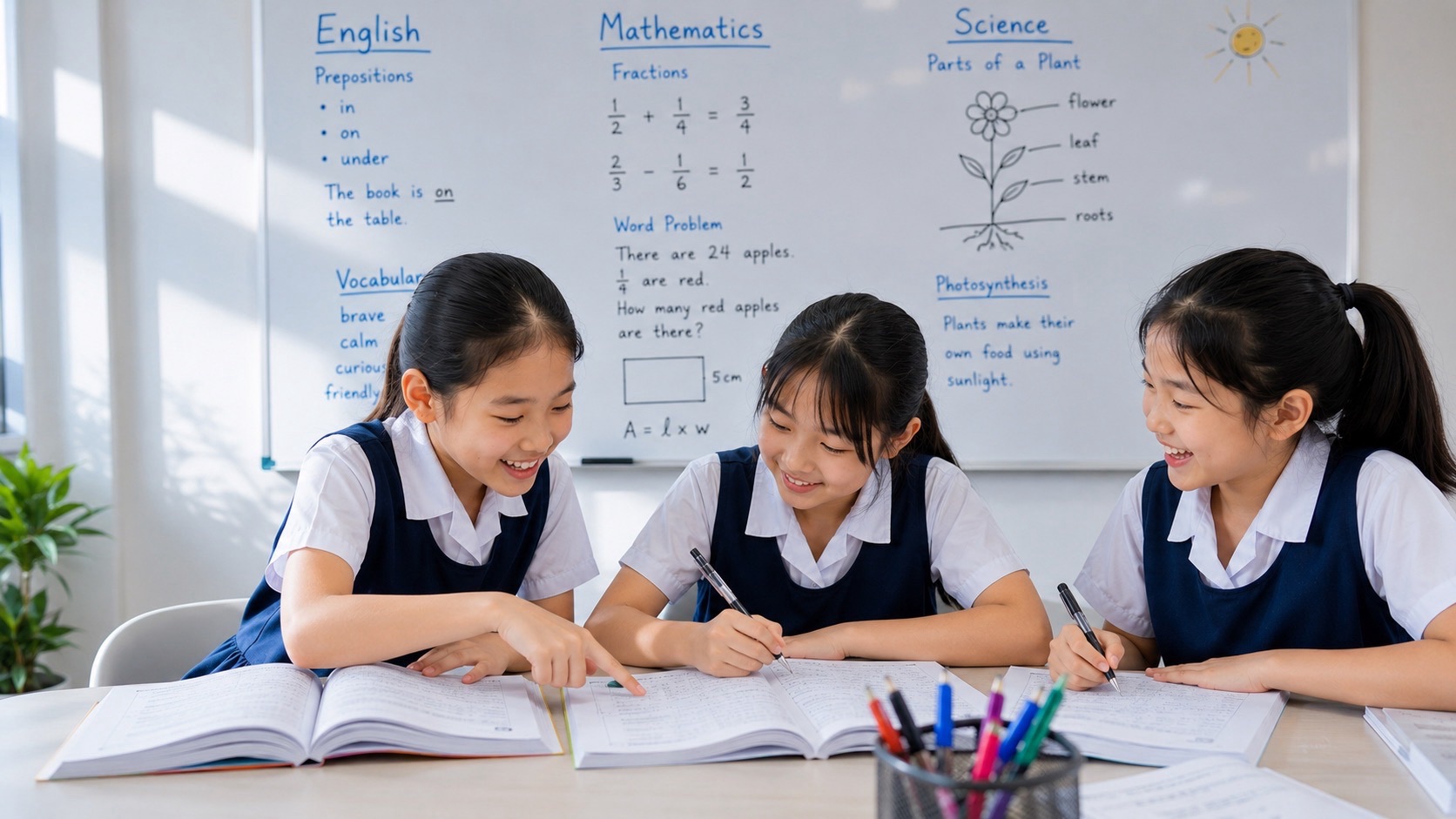
Primary 3 Science tuition in Novena should make a child curious in a disciplined way. Primary 3 is the first formal year of Science in the primary-school progression, so the most important job is not to race towards PSLE papers. It is to teach the child how Science thinks.
At eduKateSG, our premium 3-pax Primary 3 Science tutorials help students from Novena build concepts from first principles, observe carefully, classify with defensible rules, read diagrams, explain evidence and begin scientific inquiry without turning every lesson into memorisation.
Primary Science develops through connected ideas about diversity, cycles, systems, energy and interactions, with scientific practices woven through the content. A strong P3 foundation therefore matters because later upper-primary Science assumes that observation, comparison, classification and explanation are already becoming stable habits.
Our Primary 3 Science tutorials are suitable for students who need to:
- begin Science with clear concepts instead of disconnected facts;
- learn the difference between observation, inference and explanation;
- build precise Science vocabulary without memorising empty keywords;
- read diagrams, tables and simple experimental setups carefully;
- develop habits for classification, comparison and prediction;
- learn how evidence supports an answer;
- gain confidence asking and answering scientific questions; or
- prepare for Primary 4 without racing ahead of understanding.
Class size is limited to three students. Lessons are 1.5 hours weekly, with materials, retrieval, guided correction and focused continuation work.
Arrange a parent–student consultation with eduKate Singapore
Chat with eduKateSG on WhatsApp
Primary 3 Is Where a Science Learner Is Built
A child can arrive in Primary 3 already knowing many interesting facts.
Plants grow. Animals change. Materials have different properties. Magnets interact. Light produces observable effects.
Useful knowledge matters, but school Science asks for something more disciplined.
The student must learn to notice what the question actually shows, separate observation from assumption, compare objects using a valid property and explain why evidence supports a conclusion.
This is the beginning of scientific thinking.
A strong P3 programme protects curiosity while adding structure.
The Hidden P3 Problem: Everyday Thinking Is Not Always Scientific Thinking
Children naturally reason from appearances.
Something soft may seem not to be a solid. A larger object may seem heavier. An animal that flies may be grouped with every other flying animal. A result that happens once may feel like proof.
Science gradually replaces these surface shortcuts with more reliable criteria.
The tutor should not simply say, “Wrong.”
A better move is to present a counterexample, ask what property still holds and help the student reconstruct a rule that survives more cases.
Confusion is information. We resolve it.
A Novena Example: Start With What You Can Actually Observe
Consider an invented classroom investigation using everyday materials and observations familiar to Novena families, with students asked to separate evidence from explanation.
The student may notice colour, shape, number, position, movement or change.
Those are observations.
The student may then suggest a reason for what happened.
That is an explanation.
Keeping these layers separate is one of the most useful early Science habits because later structured questions often ask students to move from evidence to reasoning without confusing the two.
Why a 3-Pax Science Tutorial Can Suit Primary 3
Three students create enough variety for comparison while keeping every learner visible.
One child may notice a diagram detail another misses. One may choose the correct MCQ answer for the wrong reason. Another may explain well orally but leave out the key relationship in writing.
These differences are useful teaching information.
What the small group allows
- every student answers frequently;
- the tutor can inspect the reasoning behind an MCQ choice;
- misconceptions can be corrected immediately;
- students can compare classification rules;
- oral explanation can precede written explanation;
- diagrams and simple inquiry can be discussed without large-class anonymity;
- retrieval can be adjusted to each learner; and
- quiet students still have a clear turn to contribute.
What We Teach in Primary 3 Science
Observation before explanation
Students learn that an observation reports what can be seen, measured or detected. An explanation uses Science ideas to account for the observation.
Classification with a defensible rule
Students compare living things, non-living things and materials through properties that can be applied consistently.
A classification rule should still work when the example changes.
Cycles as ordered change
Students follow stages in sequence, identify what changes and reconstruct a cycle without depending on one familiar textbook diagram.
Interactions and simple cause-and-effect
Students describe what changes when two things interact and distinguish the visible result from the explanation for that result.
Scientific vocabulary
Science vocabulary should reduce ambiguity.
Words such as classify, observe, compare, stage, property, attract, repel, change and evidence are useful because they carry precise jobs.
Our First-Principles Method for P3 Science
1. Begin with the world
Students first encounter an object, situation, diagram or phenomenon they can reason about.
World first, word later.
2. Ask what is actually known
What can we observe? What is given? What is measured? What are we assuming?
3. Build the concept
The tutor helps the student identify the stable relationship behind several examples.
4. Represent it
Students may use a diagram, table, sequence, labelled sketch or short sentence to represent the idea.
5. Retrieve it
Notes are closed. The student reconstructs the idea from memory.
6. Transfer it
The surface changes. A different organism, object or setup tests whether the student learned the idea or only remembered the example.
The Fencing Method in Primary 3 Science
A new skill begins inside a narrow, clear boundary.
A child may classify four obvious examples before handling an unusual case. The next question may remove labels. The next may ask the student to justify the classification.
The fence widens one demand at a time.
This makes difficulty understandable rather than mysterious.
Diagrams Are Evidence
Primary Science increasingly communicates through pictures, labels and arrows.
Students should not glance at a diagram and jump immediately to a remembered sentence.
We build a routine: identify the objects, labels, direction, changed condition and question demand.
Tables Should Be Read Structurally
A child may read every number correctly and still compare the wrong pair.
Before looking for a value, students learn to ask what the rows mean, what the columns mean and what unit is being used.
Then they return to the question and identify the exact comparison required.
Prediction Is Not Guessing
A scientific prediction applies an understood relationship to a new condition.
Students learn to state what they expect and why.
When the observation disagrees with the prediction, the learner should update the explanation rather than defend the original answer.
Simple Inquiry: What Changed, What Was Observed, What Stayed Comparable?
P3 students do not need adult research terminology to begin inquiry.
They can learn three powerful questions: What changed? What did we observe or measure? What important things should stay comparable?
These questions prepare the logic that later appears in fair tests and experimental evaluation.
MCQ Should Reveal Reasoning
A correct option can hide a weak concept.
For selected MCQs, we ask why the chosen option fits and why the strongest distractor does not.
This catches lucky guesses before they become false confidence.
Structured Answers: Evidence → Science Idea → Connection
P3 students can begin using a simple reasoning frame without becoming formula-dependent.
First identify the evidence. Next identify the relevant Science idea. Then connect them in a complete sentence.
The scaffold is temporary. The long-term goal is independent explanation.
Retrieval Before Rereading
Rereading feels easy because the answer is visible.
A test asks the child to produce knowledge without the page.
We therefore close the notes regularly and ask students to reconstruct a diagram, state a property, explain a cycle or answer a short question from memory.
Forgetting becomes useful information for the next lesson.
Interleaving Starts Early
If every worksheet announces the chapter, the student can rely on the heading to select the concept.
Mixed practice removes that cue.
We introduce small mixed sets so students must identify whether the question concerns classification, a cycle, an interaction, evidence or another learned relationship.
Method selection becomes part of Science.
What Happens During a 90-Minute P3 Science Lesson
Warm-up retrieval
A short return to an older concept reveals what survived since the previous lesson.
New concept or repair
The tutor introduces one idea from first principles or repairs a misconception found in schoolwork.
Representation
Students use diagrams, comparisons, tables or short explanations to make the relationship visible.
Guided practice
The tutor questions the reasoning and reduces prompts gradually.
Independent transfer
A fresh example tests whether the concept survives a changed surface.
Correction
The student explains why the original answer failed and what signal should be noticed next time.
Continuation work
Follow-up practice is short enough to remain purposeful and varied enough to test retention.
Three P3 Student Pathways
Repair
The child may be uncertain with reading questions, basic vocabulary, classification or the difference between observation and explanation. We return to the first unstable dependency and rebuild.
Stabilise
The child understands during lessons but guesses when the diagram or story changes. We vary the surface until the concept becomes portable.
Extend
The child handles routine P3 work comfortably. We deepen reasoning through counterexamples, alternative classification rules, simple experiment design and stronger explanations rather than racing blindly into higher-level chapters.
Common P3 Science Error Families
- Observation error: the child adds an assumption to something that was merely seen.
- Classification error: the rule works for one example but fails on another.
- Vocabulary error: the student knows the idea but uses a vague everyday word.
- Diagram error: labels, arrows or positions are ignored.
- Question-reading error: the child explains when asked to describe, or describes when asked to explain.
- Retrieval error: the concept was understood during the lesson but cannot be produced later.
- Transfer error: a new picture makes an old concept look unfamiliar.
These are different mechanisms. They should not all be labelled careless.
Parents Can Support Science Without Becoming a Second Teacher
Parents do not need to run a second classroom at home.
Short prompts are often enough: What did you observe? What evidence supports that? Which part of the diagram matters? What changed? What stayed the same? Can you explain last week’s correction without looking?
These questions encourage retrieval and reasoning without taking ownership away from the child.
What Progress Should Look Like
- the student asks more precise questions;
- observations are separated from explanations;
- classification rules become more defensible;
- diagrams are read before answers are attempted;
- Science vocabulary becomes clearer and more accurate;
- the student can explain an MCQ choice;
- older concepts can be retrieved without immediate rereading;
- mistakes are corrected for a reason; and
- new contexts cause less panic.
P3 progress should look like stronger thinking, not merely a thicker file of completed worksheets.
How This Page Fits the Novena Science Ladder
Novena already has exact Primary 4, Primary 5 and Primary 6 Science pages. This P3 page closes the missing foundation-year gap so the town has a continuous P3→P6 Science route.
The P3 page owns the foundation-year intent. Later year pages should own their own level rather than compete for the same phrase.
The broader Science Learning Hub remains the subject-wide owner.
When Should a Novena Family Consider Primary 3 Science Tuition?
Support may be useful when the child is excited by Science but confused by school questions, remembers facts yet cannot explain them, loses marks through diagram reading, or has begun to believe Science is mainly about memorising keywords.
Not every P3 child needs tuition.
A child learning confidently at school with a sustainable home routine may already have enough support.
Tuition should solve a defined problem and protect curiosity rather than crowd the week.
Access for Novena Families
This is a Novena local-discovery page. eduKateSG does not claim a physical branch in Novena. Families who choose the programme travel to eduKateSG at 8 Fourth Avenue, Singapore 268674, near Sixth Avenue MRT.
For a young child, travel and energy matter. Families should consider school dismissal time, meals, rest and the complete weekly journey when choosing a suitable class slot.
Class Details
Format: Premium 3-pax small-group tutorials
Level: Primary 3 Science
Duration: 1.5 hours weekly
- first-principles Science;
- observation and explanation;
- classification and comparison;
- diagram and table reading;
- simple inquiry and fair-comparison thinking;
- active recall and interleaving;
- error analysis; and
- carefully paced preparation for Primary 4.
Materials may include concept notes, diagrams, tables, MCQ, structured questions, simple inquiry tasks, retrieval quizzes and focused continuation work.
The usual first step is a parent–student consultation. Limited trial lessons may occasionally be available when a suitable 3-pax slot exists.
What Parents Can Bring to the Consultation
- recent Science worksheets or tests;
- the school textbook or current topic list;
- marked structured questions;
- teacher comments;
- examples of diagrams the child finds confusing;
- homework completed independently; and
- the child’s own questions about Science.
We look for the first repeated reasoning pattern rather than judging the child by one mark.
Frequently Asked Questions About Primary 3 Science Tuition in Novena
Is Primary 3 too early for Science tuition?
Not every child needs tuition. It is useful when a defined learning problem needs more explanation, diagnosis or feedback. The work should remain developmental and curiosity-friendly.
Should P3 students do PSLE papers?
Not as the main learning method. P3 should build concepts, inquiry habits, retrieval, visual literacy and explanation. Selected questions can stretch a ready student without turning the year into premature exam drilling.
Are Science keywords important?
Yes, when they name the correct concept or relationship. A keyword cannot repair wrong reasoning. We teach meaning first and precise language with it.
How much homework is useful?
Enough to retrieve and transfer the lesson. A small corrected set can be more valuable than a large worksheet completed mechanically.
What if my child loves Science but dislikes Science tests?
That often means curiosity is present but the assessment process is unclear. We teach how questions encode evidence, concepts and required relationships.
Can strong P3 students be extended?
Yes. Extension can deepen reasoning through counterexamples, experiment thinking, explanation and transfer instead of simply rushing into older students’ content.
Helpful Reading for Novena Parents
- eduKateSG Science Learning Hub
- Primary Science Tuition Singapore
- Primary 4 Science Tuition | Novena
- Primary 5 Science Tuition | Novena
- Primary 6 Science Tuition | Novena
- Tutors and Tuition in Novena
- Education and Tuition | Novena
- History of Singapore | Novena
- Why Singaporeans Love Novena
- MOE Primary Science Syllabus
Primary 3 Science Tuition for Novena Families
Primary 3 should build a learner who can look closely, ask a useful question, classify by a defensible rule, connect evidence to an idea and change an explanation when the evidence changes.
At eduKateSG, our 3-pax tutorials teach those habits deliberately.
For students who are confused, we clarify.
For students who are inconsistent, we stabilise.
For students who are ready, we deepen.
The objective is a child who enters Primary 4 with curiosity still alive and a much stronger way of thinking.
Arrange a Parent–Student Consultation
eduKateSG
8 Fourth Avenue
Singapore 268674
Near Sixth Avenue MRT
Premium 3-pax small-group tuition
By appointment
Properly taught kids shine a bright light into the future.