
eduKateSG · Primary Education Around the World · Parents of children aged 6–12
Hong Kong: understand the primary years
A parent’s guide to Hong Kong Primary 1–6, curriculum renewal, balanced homework and assessment, language learning and the move to secondary school.
Choose your route: Grades and ages · Learning support · Parent action · Contents
Hong Kong’s primary years combine familiar P1–P6 labels with a curriculum that is still developing. A helpful parent guide should show the structure, explain what has changed and keep the child’s daily experience at the centre. We will look at learning, language, curiosity and confidence across approximately ages 6–12.
Section 1 of 8
Did You Know? The curriculum guide discusses homework balance
Hong Kong’s 2024 Primary Education Curriculum Guide announcement recommends coordinating assessment timing and homework quantity. It also recommends avoiding tests immediately after long holidays and using appropriate self-learning tasks during those holidays. The stated aim includes balanced physical and psychological development. Read the Education Bureau’s guide announcement.
These are recommendations, not a claim that every school has an identical homework timetable. They give parents a constructive question: how does this school coordinate the child’s workload, and how can the family raise a concern?
Our interpretation is that progress and wellbeing can be discussed together. Ask which task serves an important learning need and what a successful attempt looks like. If evenings are repeatedly difficult, bring examples of the workload and the child’s experience to the teacher rather than assuming the answer is always more practice.
Back to contents · Next section
Section 2 of 8
Primary 1–6, ages and international comparisons
The official Study in Hong Kong portal describes primary schooling as six years beginning around age six. Read the school-system overview. P1–P6 are therefore useful local search terms for this stage.
A Hong Kong P4 and Singapore Primary 4 share an ordinal position, but that does not establish identical teaching language, content or transfer readiness. Ask the receiving school to consider actual work and previous learning. An international school may follow a different programme, so identify the curriculum as well as the age group.
Use the table as orientation. A pupil’s birthday and schooling history still matter. For an incoming family, request the school’s current enrolment guidance and ask which authority handles a placement question.
| Local grade or stage | School-stage orientation | Parent comparison |
|---|---|---|
| Primary 1–2 / P1–P2 | Early primary | Often approximately ages 6–8 |
| Primary 3–4 / P3–P4 | Continuing primary learning | Often approximately ages 8–10 |
| Primary 5–6 / P5–P6 | Later primary | Often approximately ages 10–12 |
| Secondary 1 / S1 | After six primary years | Confirm placement arrangements |
Back to contents · Previous section · Next section
Section 3 of 8
Current curriculum: Humanities and Science deserve attention
The Education Bureau’s February 2026 reply says Primary Humanities began at P1 and P4 in 2025/26, with full extension to all primary levels by 2027/28. It identifies national history, geography and Chinese culture among the areas supported by teacher training. Read the official implementation explanation.
EDB also publishes a 2025 Science (Primary 1–6) Curriculum Guide and related resources. See the Primary Science curriculum page. Ask the school which current subjects and materials apply to the child’s cohort, rather than using an older General Studies description as a complete timetable.
For parents, the practical question is how the child learns to understand and explain the content. Request a recent example of an observation, discussion or written response and ask what the next learning goal is.
Back to contents · Previous section · Next section
Section 4 of 8
Language and literacy: ask what the child can explain
Ask the school about language of instruction and the role of Chinese, English and any other languages in the programme. Do not assume the language used in one subject describes every classroom task. A sample page or instruction makes the demands easier to understand.
For a reading conversation at home, choose a manageable passage and ask the child to retell it. Then ask for a detail supporting their interpretation. Notice whether the difficulty is recognising words, understanding vocabulary or making the explanation. These call for different next steps.
For writing, let the child discuss an idea before drafting. Demonstrate one revision and invite an independent attempt. These are optional family activities. Share a persistent difficulty with the teacher using the actual example and ask which support fits the child.
Back to contents · Previous section · Next section
Section 5 of 8
Mathematics and curiosity: show the reasoning
A simple home illustration might use sixteen counters arranged in equal groups. Ask the child to draw the situation and explain the calculation. Change the grouping and ask what stayed the same. The purpose is to connect a visible model with a reason, not rehearse a final answer only.
An incorrect response can reveal an unclear instruction, an insecure concept or a calculation slip. Follow the child’s explanation, model the missing step and check a new example after guided practice. Ask the teacher which diagrams and terms are being used in class.
For a curiosity conversation, invite the child to observe something ordinary and distinguish what they noticed from what they think caused it. This suggested activity helps parents listen to reasoning; it is not a statement about a prescribed local science lesson.
Back to contents · Previous section · Next section
Section 6 of 8
Assessment, interests and the whole person
The 2024 guide’s announcement places whole-person development within school curriculum planning. For a parent meeting, ask how academic feedback connects with a wider picture of participation and interests. A report and the child’s own account offer different kinds of information.
Ask the teacher for one concrete next step and an example of success. Keep an earlier and later attempt occasionally so improvement becomes visible. Also ask how a new pupil is welcomed and whom a child can approach when confused or left out.
A home routine can involve one manageable target, an independent attempt and a brief review. Leave room for movement, friendships and interests. If the child repeatedly struggles, investigate the particular obstacle and adjust support with the school.
Back to contents · Previous section · Next section
Section 7 of 8
P5–P6 and preparing for secondary school
Ask the school which current secondary-placement arrangements apply to the child’s cohort and where official information is provided. Admission procedures deserve their own current check; they should not be inferred from a general primary guide or another family’s older experience.
Alongside paperwork, discuss routines and confidence. Help the child practise recording a task, asking for clarification and identifying an adult who can help. Invite a question about something exciting as well as something worrying.
For an international move, collect reports, representative work, languages used and support already arranged. Our Singapore Primary 1–6 guide offers another six-year-primary comparison. Compare the actual curriculum and receiving requirements before translating P6 into a placement decision.
Back to contents · Previous section · Next section
Section 8 of 8
Parent questions and checked sources
Does every school have the same homework arrangement? No; the guide offers recommendations, and families should ask about school practice. Has Primary Humanities reached all levels already? The stated full-extension date is 2027/28. Does P6 equal a guaranteed overseas placement? The receiving school must assess the relevant information.
Sources checked on 6 October 2026: official system overview, 2024 guide announcement, Primary Humanities implementation explanation and Primary Science resources. Age bands are approximate, home activities are eduKate’s suggestions and individual arrangements require local confirmation.
Back to contents · Previous section
Continue exploring primary education
Singapore Primary 1–6 · Japan Grades 1–6 · South Korea Grades 1–6 · India Classes 1–5 and Class 6
Explore this set: China · Malaysia · Taiwan.
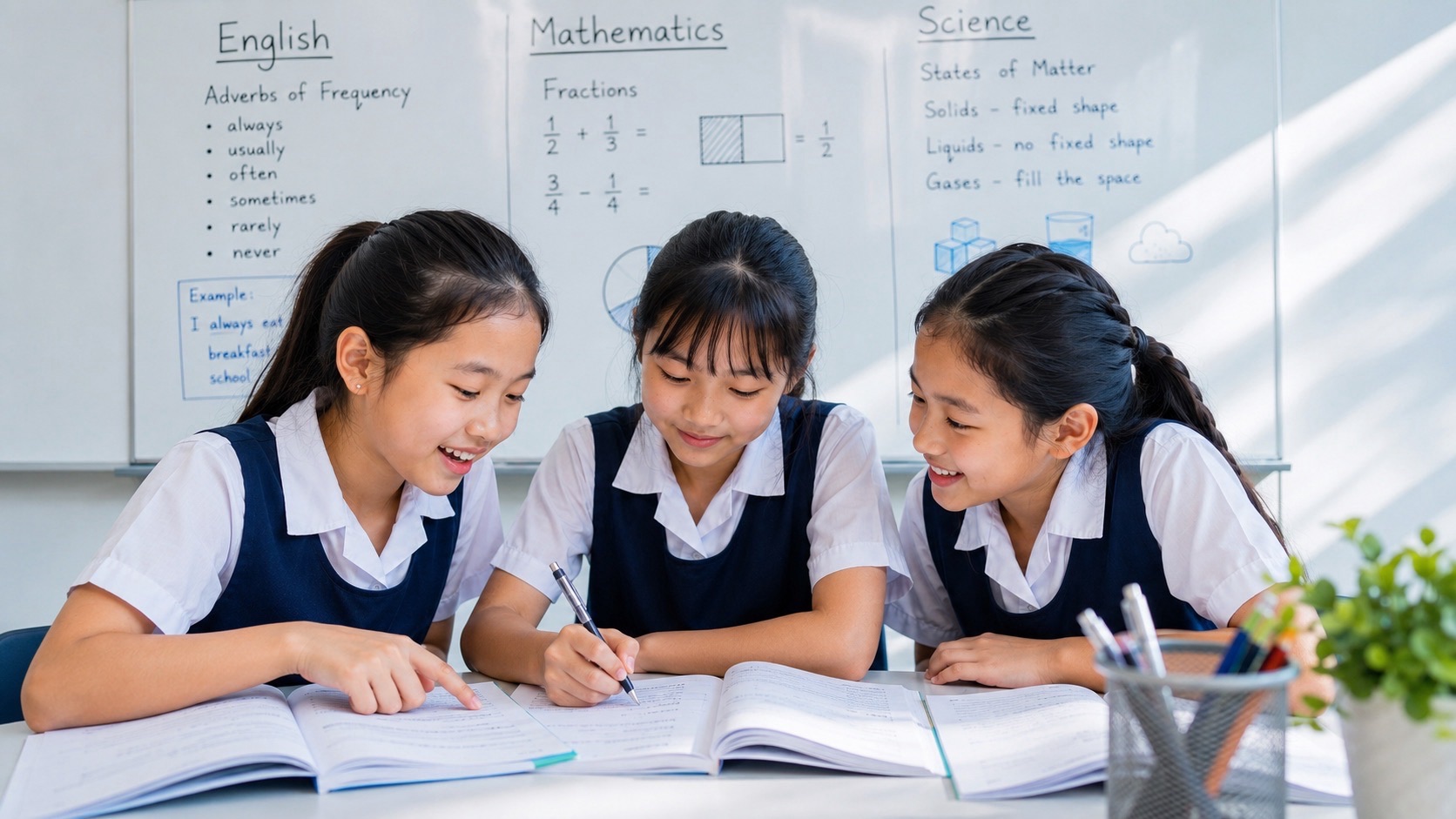
Classroom photograph: eduKate primary-learning illustration, not a photograph of a named overseas school.