
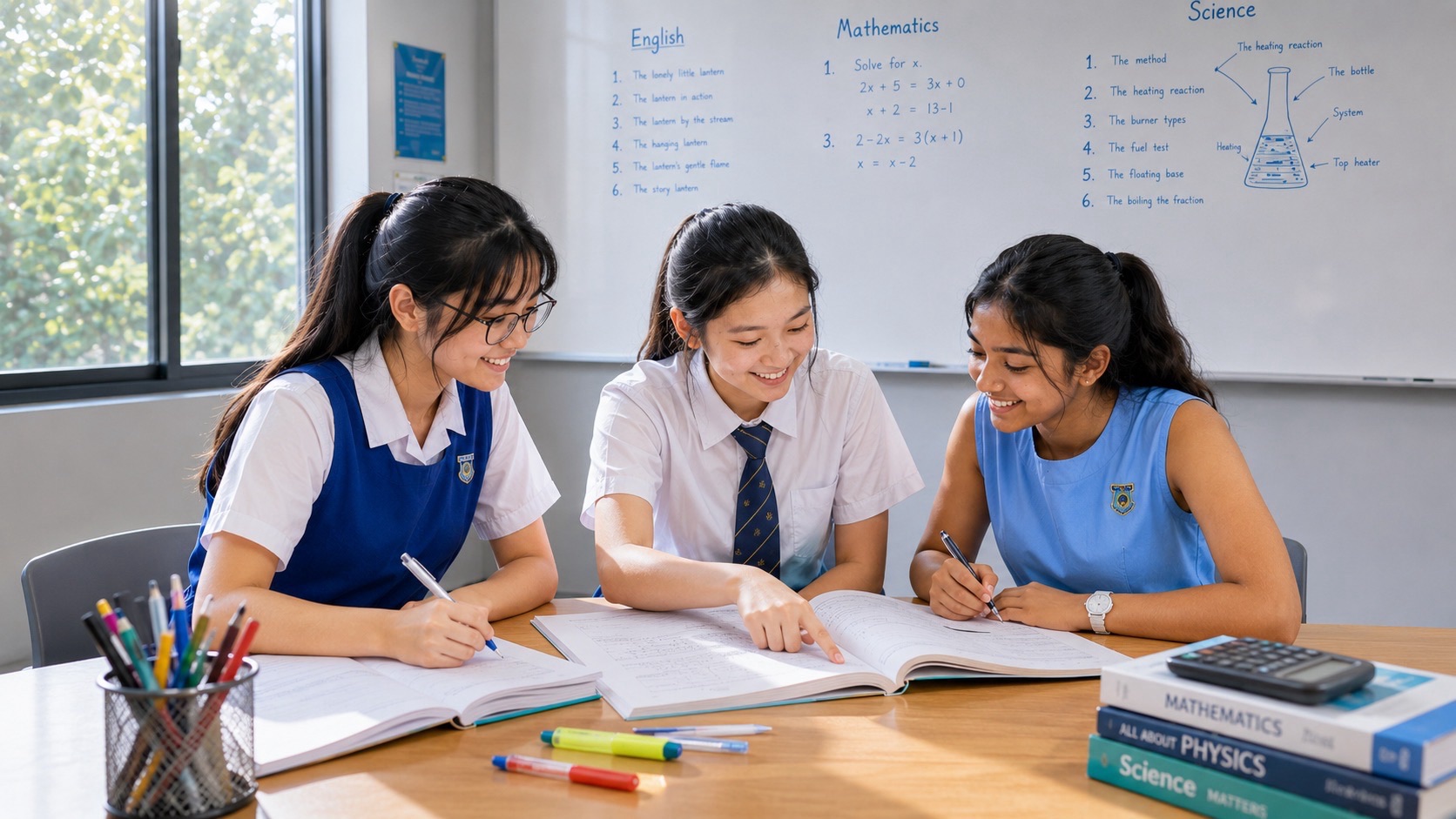
Small group tuition sits in an interesting middle ground. It can offer much of the visibility and responsiveness of individual tutoring while adding something one-to-one tuition cannot provide: other learners thinking aloud in the same room.
The core aim of small group tuition is to combine close tutor attention with productive peer learning. Students should receive targeted feedback, but they should also compare methods, explain ideas, hear alternative reasoning and learn to work independently while the tutor’s attention is briefly elsewhere.
For eduKateSG’s broader guide, see Primary English Small Group Tuition: A Comprehensive Guide. This article focuses on why the small-group model can be educationally powerful when it is designed well.
The Core Aim: Attention Plus Independence
A small group should not feel like a crowded private lesson.
Its advantage is that the tutor can move attention around the room while students continue thinking, writing and solving. That creates natural moments of independence.
Students learn an important skill: work continues even when the teacher is not looking directly at you.
Peer Thinking Is a Learning Resource
A second student can reveal a method, misconception or question that the first student would never have generated alone.
When learners explain, compare and challenge reasoning, the group creates additional examples of thinking.
The tutor’s job is to make that peer information useful rather than letting it become noise.
A Small Group Should Still Be Diagnostically Sharp
The tutor must know who understands, who is copying, who is guessing and who is ready to move on.
That means students need to produce visible work, not only call out answers.
- individual written attempts;
- mini whiteboards;
- short explanations;
- cold retrieval questions;
- paired comparison;
- independent correction;
- quick targeted checks.
The tutor should be able to say what each learner currently needs.
Why Small Groups Can Build Stronger Explanation
Explaining to a peer exposes gaps quickly.
A student who says “I know how to do it” may discover that the method is not yet clear enough to explain.
Peer explanation can strengthen vocabulary, sequencing and metacognition because the learner must turn an internal procedure into visible language.
Productive Comparison Matters
Students often assume there is only one correct route.
In Mathematics, different solution methods can reveal structure. In English, different interpretations or sentence choices can be compared for precision. In Science, different explanations can be tested against causal logic and evidence.
Small groups make those contrasts available in real time.
The Tutor Must Protect Thinking Time
A common failure in group tuition is speed.
One student answers first, the tutor confirms, and everyone else moves on before completing an independent attempt.
A stronger routine gives all students thinking time first, then compares answers.
- Pose the task.
- Require silent individual attempt.
- Sample different answers.
- Ask for reasoning.
- Compare approaches.
- Correct the key misconception.
- Retry independently.
This keeps the fastest voice from becoming the class brain.
Grouping Matters More Than Labels
Students do not need identical marks to learn together, but the gap cannot be so large that the tutor is effectively teaching several unrelated lessons at once.
Useful grouping considers:
- foundation level;
- pace;
- current school demands;
- ability to work independently;
- type of support required;
- whether the students can benefit from the same core task.
The right group has enough similarity for shared teaching and enough difference for useful discussion.
Small Groups Can Reduce Over-Prompting
One-to-one tuition sometimes makes it too easy for the tutor to rescue the learner immediately.
In a small group, the tutor naturally divides attention. That gives students brief windows to persist, check notes appropriately, compare methods and make decisions.
Used well, this is not neglect. It is structured independence.
Three Pathways in a Small Group
Repair
Students with a shared foundation gap rebuild the prerequisite through explicit teaching and repeated independent attempts.
Stabilisation
Students strengthen retrieval and accuracy through mixed practice, error discussion and repeated correction.
Extension
Stronger learners compare alternative methods, defend reasoning and tackle unfamiliar tasks that benefit from discussion.
What a Good Small-Group Lesson Looks Like
- brief retrieval from earlier work;
- one clear teaching focus;
- individual attempt before group discussion;
- tutor circulation and targeted feedback;
- peer explanation where it adds value;
- a second independent attempt;
- mixed or unfamiliar application;
- short correction and continuation plan.
The lesson has social energy, but learning remains individually accountable.
What Parents Should Look For
- The tutor can describe each student’s current need.
- Students produce their own work rather than copying a shared solution.
- Everyone is required to think before answers are discussed.
- Peer explanations are checked for accuracy.
- Recurring mistakes are revisited.
- Older topics return.
- Students become more capable of working while the tutor is helping someone else.
- The group pace is neither permanently too fast nor permanently too slow.
When Small Group Tuition May Not Be the Best Fit
A different format may be better when:
- the learner has a highly specific foundation gap requiring intensive individual repair;
- the student is so far ahead that shared tasks are consistently unchallenging;
- attention or behavioural needs make group learning unusually difficult;
- the learner cannot yet sustain any independent work while the tutor helps others;
- the group’s level spread is too wide for coherent teaching.
Format should follow the learning need, not habit.
Small Group Tuition vs Private Tuition
Private tuition maximises individual pacing and direct observation. Small-group tuition adds peer reasoning and built-in moments of independence.
Neither is universally superior.
A useful question is whether the learner currently needs maximum individual repair or close support plus productive peer interaction.
You can also compare formats in One-to-One and Small Group Tuition.
Frequently Asked Questions
What is small group tuition?
It is tuition taught to a limited number of students so the tutor can still observe individual work while students benefit from shared teaching and peer learning.
What is the best class size?
There is no single number that guarantees quality. The meaningful test is whether the tutor can still diagnose individual work, give specific feedback and maintain useful pacing for every learner.
Is small group tuition good for shy students?
It can be. A small group may feel safer than a large class while still giving opportunities to explain and participate. The tutor needs to structure participation so quieter students are not invisible.
Can students get enough attention in a small group?
Yes, when the class is genuinely manageable and the lesson is designed for individual attempts plus targeted tutor circulation.
Does small group tuition help independence?
It can do so especially well because students must continue working while the tutor’s attention rotates. That creates natural practice in self-starting and self-checking.
Helpful Reading in the eduKateSG Tuition Ecosystem
- Primary English Small Group Tuition: A Comprehensive Guide
- One-to-One and Small Group Tuition
- Tuition at eduKateSingapore
- Tuition | Strategies for Excellence in Education
- How Tuition Works | The Tutoring Process
The Core Aim
The core aim of small group tuition is to combine responsiveness with independence.
The tutor should still see the individual learner clearly, but students should also learn from one another, explain their reasoning and continue working when attention shifts elsewhere.
When the model works well, the group does not dilute teaching. It multiplies the number of useful ways students can think.