
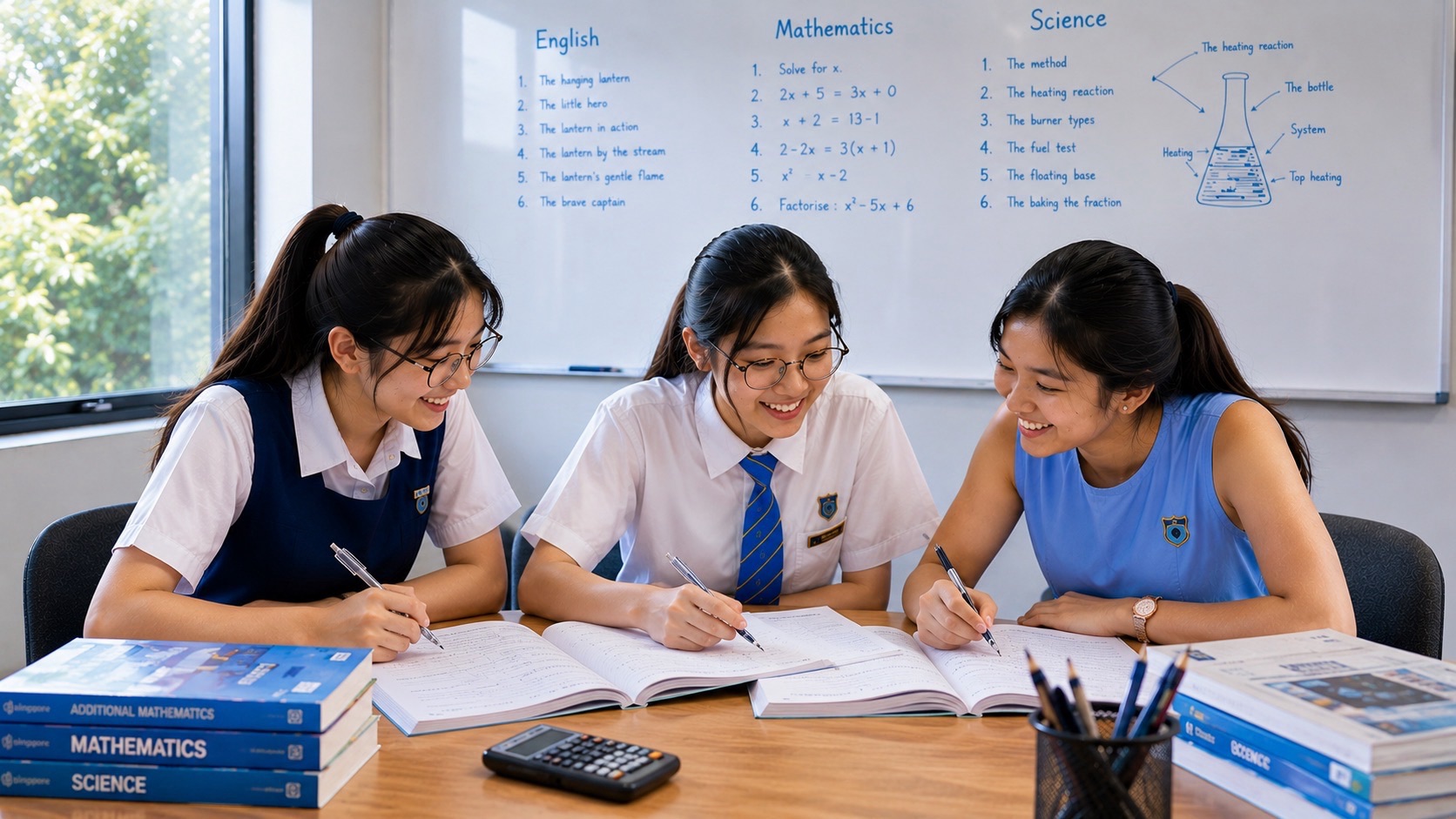
How an inner conversation and an outer listening task turn class discussion into something pupils can observe, evaluate and improve.
A teacher asks a thoughtful question. Six hands shoot up. One pupil gives a long answer; another agrees; the keenest student adds an example. The class seems lively. Yet twenty students have contributed nothing that the teacher can see, and even the speakers may not have listened closely to one another. When the bell rings, everyone remembers that a discussion happened, but few can explain what made it effective. A fishbowl discussion redesigns that familiar scene. Some learners talk while others listen with a specific intellectual task, and then the roles change. The conversation itself becomes material for learning.
The surprising part is the outer circle. It can seem as if those students are merely waiting their turn, but good fishbowl teaching makes listening an active assignment: track evidence, notice when a question changes the direction of the argument, identify how a speaker builds on another contribution, and record a claim that needs clarification. For educators, learners and Clementi parents, the central question is not “How do we get everyone talking at once?” It is “How can we make the quality of thinking visible while teaching both speaking and listening?”
The 50-second answer
A fishbowl discussion divides a class into an inner group of speakers and an outer group of observers. The inner group discusses an evidence-rich question using agreed norms, while the outer group has an explicit listening job—recording ideas, sources, questions, patterns of participation or useful discussion moves. After a timed interval, participants rotate so learners practise both roles. The class then debriefs not only what was learned but how the talk developed understanding. Fishbowls are useful for close reading, Humanities, Science explanation, class decisions and preparation for writing. They are not automatically fair or educational: without purposeful observation, preparation, access arrangements and teacher follow-through, they can become performance theatre for confident speakers. The design works when evidence from listening changes the next discussion or the next independent piece of work.
Try the short version: Four pupils discuss a paragraph or data display for five minutes. Everyone outside the circle notes one claim supported by evidence, one unanswered question and one moment when a speaker accurately built on another’s point. Rotate, then ask what made the second conversation better. That comparison is the mechanism.
Why ordinary whole-class talk can fool us
A busy-looking discussion can conceal three different conditions. First, a few skilled speakers may dominate the air while others never construct a complete response. Second, the class may drift toward agreeing quickly without examining why a claim is true. Third, there may be little evidence of listening: each pupil delivers a prepared opinion without changing the conversation in response to what anyone else said.
Teachers cannot solve this only by saying “Everyone must participate.” Forcing every child to produce one sentence may increase the count of voices without increasing understanding. The quiet pupil may offer a genuine inference in writing, while an outspoken pupil merely repeats. Fishbowl design creates roles that allow the teacher to observe the difference between contribution, comprehension and conversational skill.
It also slows a social process that usually happens too quickly. In a large discussion, learners must simultaneously listen, evaluate, prepare a response, manage turn-taking and attend to the teacher. That is a heavy load. Fishbowl participation separates some of these tasks temporarily. The inner group concentrates on developing a line of thought; the outer group studies the content and interaction. Later they exchange roles. That separation may make the invisible work of listening easier to teach.
A caveat appears immediately: separating groups is not a learning mechanism unless the observers have an actual job. If students outside simply watch, they may disengage. If observers become amateur judges rating personalities, they may create anxiety. The teacher must define an evidence-focused task and show why its output matters.
How the mechanism works from input to output
The input is a prompt rich enough to sustain inquiry and accessible enough for students to enter. The structure allocates a limited speaking space, gives the remaining learners a listening role and establishes a way to rotate. The activity makes claims, evidence, questions, responses and social patterns visible to observers. The feedback occurs when the outer group reports specific observations and the next group uses them. The output should be stronger understanding, clearer discussion norms or a better independent explanation.
Think of the discussion as a text being written aloud. The first speaker puts down a claim. Another offers evidence. A third asks whether the evidence fits. Someone qualifies the claim. These moves form a sequence that listeners can analyse in real time. The outer group might note that three speakers asserted a conclusion but nobody checked the diagram. The teacher can then invite the next round to ground each major claim in the source.
This is different from general encouragement to “listen carefully.” Listening has become measurable through notes such as “At 3:40, Mei said the map shows a longer route; Arjun asked whether distance or travel time was the relevant measure.” The observation connects a specific move to the problem under discussion. A pupil learns what good inquiry looks like by noticing its effects, not merely by memorising a list of politeness rules.
The role swap matters because speaking and observing offer different access to the same problem. A student who first notices weak evidence from outside the circle can later attempt a better evidence-based intervention inside it. Another who dominated the first round may discover, while observing, how hard it is for others to enter a conversation. Rotation permits practice and recalibration without defining anyone permanently as a speaker or listener.
Designing the question before arranging chairs
A fishbowl should be built around a curriculum purpose, not a seating photograph. If the goal is to interpret a story, give pupils a passage containing ambiguity and textual evidence. If the goal is to evaluate a science explanation, give them a diagram, observations or competing models that can be checked. If the goal is a decision, make its criteria and constraints visible. “Talk about kindness” may produce agreeable statements, but “Which character’s action in this passage changed the outcome, and what lines support your view?” offers something to investigate.
Some questions have correct factual answers. Students should not be asked to vote on whether 3/4 equals 6/8 or whether light can travel through an opaque object. A fishbowl can still be useful: students might explain contrasting solution methods, analyse a misleading diagram or compare how evidence supports the correct model. The teacher remains responsible for accuracy. Open discussion is a way to investigate knowledge, not an exemption from it.
The question should also be appropriately safe. Complex dilemmas can engage older learners, but a teacher should not turn a classmate’s personal history, religion, disability or dignity into a spectacle. Students can examine fictional cases, historical sources or school-design choices without demanding private disclosures. Agree on respectful norms and give routes for contribution that do not require discussing lived trauma in public.
A complete 35-minute fishbowl lesson
Minutes 0–5: Provide common evidence. Every student reads the same short text, data display or source packet. The teacher explains relevant vocabulary and the central question. The class distinguishes facts to check from interpretations to explore. Students have quiet time to form an initial claim and locate at least one relevant detail.
Minutes 5–8: Give both groups their responsibilities. The teacher selects a first inner group and assigns outer-circle listeners one or two observation prompts. For example: “Write one contribution that used evidence well and one question the speakers did not yet answer.” Avoid giving observers a long scoring sheet. The teacher models what a useful observation sounds like and makes the first round’s time limit visible.
Minutes 8–16: Run the first conversation. The teacher intervenes sparingly but can clarify a factual misconception, invite a speaker to cite the text or interrupt harmful talk. Inner participants are encouraged to respond to previous contributions rather than delivering prepared speeches in sequence. Outer participants write evidence-focused notes. The teacher records where the conversation became more precise or moved away from the question.
Minutes 16–20: Observe the observation. Ask the outer group for two or three specific findings. An observer might say, “We heard two explanations for the same sentence but only one quoted the passage.” Another might notice that every contribution responded to the teacher rather than to another pupil. These are descriptions, not character judgements. The teacher turns one into a target for round two: “This time, when you disagree, identify the exact evidence you read differently.”
Minutes 20–28: Rotate. The observers become discussants. The new outer group records whether the target behaviour appears and how it changes the discussion. Do not assume the second group must reach the same conclusion. Better talk can uncover a new uncertainty. If the teacher uses a tap-in format rather than a fixed switch, make the inclusion rules explicit so confident pupils cannot monopolise chairs.
Minutes 28–35: Debrief and transfer. Ask what the class learned about the topic and about the quality of the conversation. Each learner writes a short individual response to the core question, now with evidence and perhaps a limitation. This matters because observing better talk is not yet the same as demonstrating independent understanding.
The schedule is illustrative. Some classes need a prior lesson on evidence or respectful disagreement. A difficult reading may deserve a full separate preparation period. A very small group may use two speakers and one observer with rapid rotations. Preserve the intellectual function rather than following the timings mechanically.
Worked English example: what did the narrator actually know?
Imagine a short invented passage for a Secondary 1 English class. A pupil finds an envelope near the school gate. The narrator writes, “I looked at the name, hesitated, then pushed the envelope into my bag. The security guard was helping a younger child across the road. At home, I placed it on the table without opening it.” The passage does not say why the narrator hesitated. It invites inferences, but those inferences must remain tethered to the words.
The fishbowl prompt is “What can we reasonably infer about the narrator’s hesitation, and what remains unknown?” An inner speaker may infer uncertainty about whether to hand the envelope over immediately. Another may see curiosity or anxiety. A third might assert that the narrator intended theft. That is a stronger claim than the evidence supports; the text gives no definite motive. An observer can note where speakers moved from an observable action to an unverified psychological conclusion.
After the first round, the outer group reports: “We heard three motives, but only one speaker distinguished what the text says from what we guessed.” The second round can improve the conversation by using a clearer sequence: quotation, possible inference, alternative explanation, confidence limit. A student’s final paragraph may say that the hesitation indicates uncertainty, but the passage alone cannot establish whether the narrator intended to keep the envelope. That is a better reading response than confidently inventing the character’s private thoughts.
Notice the distinct roles. The inner group produces interpretations. The outer group inspects how interpretations were justified. The teacher checks textual fidelity. The final written response tests whether the reasoning transfers. A fishbowl is successful here not because everyone eventually agrees about the narrator, but because the class becomes more careful about the boundary between inference and invention.
Worked Science example: why does the shadow move?
A Primary 5 class examines a set of observations of a vertical stick’s shadow taken at the same location at different times on a clear day. The teacher supplies time labels, a compass direction and a scale. The core scientific topic includes the apparent movement of the Sun across the sky caused by Earth’s rotation; the observed shadow’s position and length depend on the Sun’s apparent position and local conditions. Pupils must not assume that one data set establishes every detail for every day.
The inner group discusses which features of the data support the explanation. A speaker might say, “The shadow changed direction, so the light source changed apparent direction.” Another may point out that the measurements were taken at different times, but ask whether the stick’s position was kept fixed. The first round may ignore the fact that a measurement can be unreliable if the apparatus moves.
The outer group is asked to track evidence moves, not simply count scientific terms. Did speakers point to a time and a measured direction? Did anyone ask about controls? Did someone distinguish observation from explanation? During debrief, observers might recommend marking the same reference position for each measurement and asking whether clouds affected the visibility of the shadow.
In round two, the conversation becomes more disciplined. The final pupil response includes a causal explanation and a limitation: the data are consistent with changing solar position, but the accuracy of the plotted shadow lengths depends on consistent measurement. The lesson remains science instruction; students do not vote on the mechanism. The fishbowl makes the quality of scientific reasoning more visible.
Worked Mathematics example: one answer, several methods
Consider this Secondary 1 problem: a price is reduced by 20% to $64. What was the original price? A learner might reason that $64 represents 80% of the original, so 10% is $8 and 100% is $80. Another could write 0.8p = 64, giving p = 80. Both methods are valid. A common incorrect response is to add 20% of $64 to $64, which gives $76.80; it treats the discounted price as the base for the percentage reduction.
The inner group examines how to explain the difference. One speaker says, “Reverse percentage means divide by 0.8.” Another asks why 0.8 represents the remaining share. A third draws a bar model with five equal parts and labels four parts as $64. The observers note which explanation makes the reference whole most visible and which would help a learner likely to confuse forward and reverse percentage.
The second round tests transfer with a new example: after a 25% reduction, a price is $90. One can reason that three quarters of the original is $90, so one quarter is $30 and the original is $120. Or use 0.75p = 90. The core truth stays fixed. The discussion investigates explanatory adequacy and representation choice, not competing mathematical facts.
This is a useful boundary for subject teachers. Fishbowls can expose why valid methods work or why a tempting wrong method fails. They should not turn an error into a legitimate alternative merely to create conversation. Teachers can pause and correct factual misunderstandings without destroying the spirit of inquiry.
What the outer circle should look for
Observation assignments need to be few, concrete and tied to learning. For the first session, try one evidence reference, one clarification question, one unresolved claim. In a more experienced class, observers can track whether participants paraphrase before disagreeing, whether a source is interpreted accurately and whether new evidence changes a conclusion. A simple grid might have three columns: “What I heard,” “What evidence supported it,” and “What would improve the reasoning?”
Avoid turning the outer group into a courtroom. A public tally of who interrupted most, who sounded hesitant or who used a filler word can embarrass learners and distort the activity. There are occasions for teaching turn-taking and equitable airtime, but feedback should name actions that the class can improve, not produce personality rankings. A student might be quiet because they are processing language or because the discussion topic requires more thought.
Teacher observation can be similarly selective. In one session, look at evidence citation; in the next, at responding to another speaker; later, at summarising disagreement accurately. Teaching three skills deliberately across several lessons is more realistic than expecting twenty-five behaviours to improve within one fishbowl.
The role of the teacher: less talk, greater responsibility
A teacher in a fishbowl may appear quieter than usual, but the work has moved upstream and downstream. Before the conversation, the teacher selects appropriate texts, anticipates misconceptions, teaches vocabulary, sets access arrangements and establishes safety boundaries. During the conversation, the teacher watches for factual error, exclusion, drift and distress. Afterwards, the teacher interprets the evidence and designs the next instructional step.
Silence can be helpful when pupils are working through an ambiguity, but silence is not a moral ideal. If students confidently misuse a historical source or endorse an unsafe claim, the teacher should intervene. Likewise, if the inner group is stuck repeating the same sentence, a well-placed question can restart analysis: “Which word in the passage supports that inference?” or “What counterexample would show whether this rule is too broad?” The goal is guided independence, not abandonment.
Think carefully about selection. Always choosing the strongest speakers creates a demonstration, not equitable practice. Random selection may be fair in one sense but can place unprepared pupils under avoidable stress. A better design may use advance preparation, predictable rotations and several ways to enter discussion. When students know they will eventually have a turn and have already written notes, participation is less dependent on improvisational confidence.
Fishbowl variations—and why they change the experience
A fixed-rotation fishbowl has a clear switch after a set interval. It is predictable and easier to manage for newer learners. Everyone knows when their role changes. The limitation is that a compelling line of reasoning can be interrupted before reaching resolution. Teachers can address this by asking the second group to build from the first rather than start over.
A tap-in fishbowl lets an observer replace an inner participant when a new contribution is ready. It can encourage responsiveness, but social dynamics matter. Popular or assertive pupils may tap in repeatedly while cautious learners remain outside. The teacher may need a minimum observation period, a one-entry-per-student rule or private note submission to preserve fairness.
A fishbowl with an empty chair keeps one place open for a listener who can bring in a specific new question or piece of evidence. This can be useful when an unexpected detail emerges. But a chair is not an access strategy by itself; some students need advance notice, written cues or supported entry. In virtual classrooms, a shared document can serve the outer group while a small video or audio group discusses. The teacher must ensure that observers have a meaningful task, not simply a muted screen to watch.
In a small-group tutorial, a miniature version could involve two discussants, one observer and rapid role changes. It will not reproduce the dynamics of a full-class fishbowl, and no claim is made that any particular eduKateSG class uses the technique. It may nevertheless be a helpful micro-routine for teaching evidence-based dialogue when carefully chosen.
Why it might improve learning: evidence and limits
Facing History & Ourselves describes fishbowl as a structured way for secondary students to alternate between contributing and listening, with guidance on questions, room setup, norms and debriefing. Its materials also show an example using historical documents. These are direct implementation references for the procedure, not proof of a universal attainment effect.
The Education Endowment Foundation’s broader research on oral language interventions reports positive average attainment effects for purposeful speaking and listening, while noting that its evidence covers varied approaches and the strongest outcomes often concern literacy. Its May 2025 review highlights the value of curriculum integration and warns that effect estimates should be read with context. The EEF’s collaborative learning approaches page also reports a positive average effect, but gives the evidence-security rating as low and stresses careful task design. None of these aggregate averages can honestly be attributed specifically to fishbowl seating arrangements.
A reasonable explanatory hypothesis is that fishbowls slow conversation enough for learners to inspect discourse, allow explicit modelling of evidence moves, and give a safe route to practise them later. But many conditions could account for improvement: pre-reading, stronger texts, teacher feedback, extra time for written reflection or increased opportunities to respond. The design should therefore be judged by observable learner work, not by a claim that the circle itself is scientifically proven to raise marks.
One especially important caveat is age and context. Facing History’s general fishbowl teaching strategy is presented for grades 6–12. Younger children can use simplified discussion circles, but the teacher should scaffold participation and not assume a secondary-school protocol transfers unchanged. Multilingual classrooms may need language preparation, and children with communication differences may require different but equally rigorous participation pathways.
Failure modes: the fishbowl that teaches very little
Failure: observers have no task. Pupils outside the circle stare at the inner group and wait. Repair: give one or two content-linked observation questions before discussion begins. Require a specific note, not a general “listen carefully.”
Failure: speakers perform for the audience. Students deliver polished mini-speeches but never respond to another idea. Repair: make the next turn depend on what came before. Invite speakers to summarise, extend, challenge or qualify a previous claim with evidence. Observers can record whether the conversation actually connected.
Failure: feedback becomes a popularity contest. Observers say who was smartest, funniest or most confident. Repair: ask for evidence of a discussion move and its effect on understanding. Focus on the quality of a claim, question, source connection or clarification—not the person’s social status.
Failure: stronger students remain inside. The teacher invites the same volunteers repeatedly. Repair: prepare predictable rotations, role support and alternative entry routes. Include written observations in assessment. Do not use public speaking speed as the only measure of competence.
Failure: the question is too broad. Pupils talk vaguely about “the environment,” “respect” or “education” without a defined issue. Repair: anchor the discussion in a text, data display, case, problem or clear decision. Relevance improves when the group can point to something beyond private opinion.
Failure: facts and viewpoints are conflated. An unsupported statement is praised as “another perspective.” Repair: identify what is empirically checkable, what is an inference and what is a value judgement. Allow reasonable interpretation while correcting factual error.
Failure: the teacher never uses what observers found. The outer group’s notes are collected and forgotten. Repair: choose one observable issue to improve in the next round, then check whether it changed. Without feedback, the procedure is theatre rather than a learning cycle.
Failure: there is no individual return. The group talk appears deep, but some pupils cannot write an answer alone. Repair: end with a short independent response or later transfer question. Shared conversation and individual understanding must be checked separately.
Failure: a sensitive topic becomes compulsory self-disclosure. Students are asked to explain personal experiences in public or represent a group to which they belong. Repair: use suitable fictional cases, content sources and voluntary forms of engagement; protect privacy and dignity.
A learner route: how to be excellent in either circle
When you are in the inner group, prepare a claim and at least one piece of evidence. Speak to the other students, not only to the teacher. A useful opening is, “The passage suggests X because line Y says…” A useful follow-up is, “I agree with the observation, but I interpret the cause differently because…” If you are unsure, ask a question that helps the group test its assumption. You do not need to dominate to make a valuable contribution.
When you are outside, resist the temptation to decide who sounded best. Write down the reasoning. Which point was supported? Which claim was repeated without proof? Did anyone revise a view after a question? Could a different reading of the evidence explain the same detail? Think of yourself as a careful researcher of the conversation, not a member of the audience at a competition.
After rotation, use what you observed. If the first group overlooked a quotation, bring it in. If the discussion became stuck between two labels, suggest a definition. If a question remained unanswered, ask it again with greater precision. Your aim is not to make the second group sound smoother; it is to make the thinking more accurate and useful.
A parent route: practise listening without staging a formal debate
At home, you can borrow the most valuable habit without arranging chairs. During a shared reading or family decision, ask the child to summarise someone else’s view before offering their own. Then ask which detail supports the summary. This is not an instruction to agree. It teaches that comprehension comes before reaction.
When watching a short educational video together, pause after a conversation and ask, “Who changed the direction of the discussion, and how?” For younger children, choose a fictional scene and ask what a character heard before replying. For older students, use a newspaper explainer, a school policy question or a sample comprehension dialogue. Avoid turning ordinary family disagreements into performance reviews. The point is to notice how good questions and attentive listening help understanding.
If your child is reluctant to speak in class, a fishbowl can be a bridge when used thoughtfully. The child may begin as an observer with written notes, then contribute a prepared question later. That is not a promise that the technique will eliminate anxiety. Teachers and families should value listening and writing as forms of intellectual work while offering supported opportunities to speak.
A teacher route: make the next round visibly better
Before running the first session, teach two or three norms and one evidence move. Model a weak exchange and a stronger version. For example, “I think the character is selfish” is an assertion; “The character refuses to help even after hearing the request, which may suggest self-interest, although the passage does not explain why” is a more qualified inference. Ask pupils to notice what changed: textual support and awareness of uncertainty.
During the fishbowl, collect just enough evidence to make feedback credible. A teacher might tally whether each main claim referred to the source or note two specific examples of productive questioning. Give students an observation sheet they can complete in the available time. Later, move from teacher-designed prompts towards students identifying the listening question most relevant to their own learning goal.
Compare outputs. Ask for a paragraph before the discussion and a revised paragraph afterwards, then inspect whether the revision uses more relevant evidence, clearer inference or a better limitation. In a later lesson, see if the same class can improve a discussion without a formal inner circle. This checks whether the skill has begun to transfer beyond the technique.
Finally, connect to adjacent forms of classroom talk without confusing owners. A hinge question gives the teacher a rapid diagnostic decision point; a fishbowl provides a longer observable conversation. Structured academic controversy centres on taking and reversing assigned positions before synthesis; fishbowl centres on alternating speaker and observer roles and studying the quality of discussion. Each has a different job.
Frequently asked questions
What is the difference between a fishbowl and ordinary discussion?
A fishbowl assigns different roles to speakers and observers and builds in rotation and reflection. Ordinary discussion can also be excellent, but it does not necessarily make listening an explicit assessed learning task. The distinguishing feature is the deliberate observation-and-feedback loop.
How many students should sit in the inner circle?
There is no single best number. Facing History describes versions with an inner group of roughly six to twelve, as well as different switching methods. Many teachers use fewer seats so participants have room to contribute. Group size depends on the class, task, talk length and learner needs; a smaller group is not automatically better.
Should the teacher stay completely silent?
No. The teacher can step back so pupils develop their own lines of reasoning, but remains responsible for accurate content, safe discussion and access. A short clarification or evidence-focused question may improve learning. Non-intervention is not a goal in itself.
What exactly should the outer circle write?
Start with one claim supported by evidence, one good clarification question and one point that needs checking. More advanced classes can examine how speakers respond to previous contributions. Avoid complicated forms that require so much writing the listener can no longer listen.
Does fishbowl mean students must disagree?
No. Disagreement can be productive when supported by evidence, but fishbowls can also explore a text, compare explanations or build a shared account. Students might agree on the answer yet differ on how to justify it. The goal is to inspect reasoning, not create conflict for entertainment.
Is it suitable for Science?
Yes, for explaining evidence, comparing models and examining the adequacy of claims. The teacher must protect factual accuracy and distinguish empirical questions from policy or value choices. Students can discuss why a model fits observations without pretending that any unsupported claim is equally valid.
Is it appropriate for shy pupils?
It can offer a structured observation role and predictable entry into talk, but results depend on facilitation. Advance preparation, a clear role, written contributions and supportive participation options may help. Public performance should not be the sole measure of learning.
Can it be used for examination preparation?
A discussion may improve the quality of an inference, explanation or evaluation that a student later writes. To make that transfer explicit, finish with a timed independent response and feedback using subject criteria. Talking well does not automatically produce an exam-ready paragraph.
How does the teacher prevent repeated speakers from dominating?
Use fixed rotations, brief turn guidance, facilitator prompts and individual preparation notes. In a tap-in model, set equitable rules and observe who has access to the inner seats. Dominance is partly a design issue; asking quieter pupils simply to be braver is not enough.
What if the observers give rude feedback?
Teach the difference between judging a person and describing a move. “You are bad at discussing” is neither useful nor respectful. “The group used one source twice but did not examine the second graph” is observable and improvable. Teachers should intervene when feedback becomes personal or humiliating.
Can a fishbowl happen online?
Yes. A small speaking group can meet in video or audio while observers use a structured shared document, then swap roles. Accessibility, platform controls and privacy deserve deliberate planning. Merely muting half the class is not equivalent to giving them an observation task.
What would show that the method worked?
Look for evidence-based turns, accurate summaries of others, more useful questions, participation opportunities and improved independent explanations. A pupil should be able to identify how a contribution changed the discussion. One lively lesson is not proof; look for learning across repeated and new contexts.
The final return: from listening to better independent judgement
When a fishbowl finishes, the most useful question is often not “Did you enjoy the discussion?” but “What did you notice from outside that you could not see as easily from inside?” One learner may realise that the group made claims without evidence. Another may notice that a good question helped everyone reconsider a text. A third may discover that paraphrasing an opposing view made the eventual response more accurate. These are visible gains in the craft of thinking together.
Then ask learners to apply those insights without the seating arrangement. Can they cite evidence when writing alone? Can they listen to an unfamiliar explanation and identify its missing premise? Can they build on a peer’s idea without simply agreeing? If those habits begin to appear outside the fishbowl, the protocol has done its best work: the students no longer need the circle to remember what good reasoning sounds like.
Canonical boundary and internal routes
This page owns the inner-speaker/outer-observer discussion mechanism, including observation prompts, rotation, evidence-based feedback and independent transfer. It complements but does not replace How X Works, broader How Education Works material or the Clementi tutorial reference. A teacher wanting a quick check for misunderstanding should follow the separate How Hinge Questions Work article rather than treating every assessment as a fishbowl.
Sources and further reading
- Facing History & Ourselves, “Fishbowl,” teaching strategy (published 17 June 2017): https://www.facinghistory.org/resource-library/fishbowl
- Facing History & Ourselves, “Fostering Active Engagement through Fishbowl Discussion,” classroom video and guide (updated 26 September 2022): https://www.facinghistory.org/resource-library/fostering-active-engagement-through-fishbowl-discussion
- University of Wisconsin–Madison KnowledgeBase, “Fishbowl Discussion (online),” teaching strategy: https://kb.wisc.edu/107982
- Education Endowment Foundation, “Oral language interventions,” Teaching and Learning Toolkit (evidence review last updated May 2025): https://educationendowmentfoundation.org.uk/education-evidence/teaching-learning-toolkit/oral-language-interventions
- Education Endowment Foundation, “Collaborative learning approaches,” Teaching and Learning Toolkit: https://educationendowmentfoundation.org.uk/education-evidence/teaching-learning-toolkit/collaborative-learning-approaches
The classroom cases are constructed illustrations rather than reported accounts of particular schools. Evidence on oral language and collaborative learning should not be mistaken for a controlled estimate of fishbowl discussions alone.