
How to Improve With Tuition | Bulim Drive
How to Improve With Tuition | Bulim Drive is for families looking for small-group tuition that improves independent school performance, exam readiness and durable learning rather than simply increasing supervised worksheet volume. For Bulim Drive students, the central focus here is premise-to-output conservation: students can transform information repeatedly and end with an answer that no longer preserves one of the original conditions, quantities or meanings.
A student can understand much of English, Mathematics or Science and still lose marks because the control around that knowledge is unstable. Retrieval, method selection, representation, evidence use, checking and transfer all become important once questions stop looking exactly like the worked example.
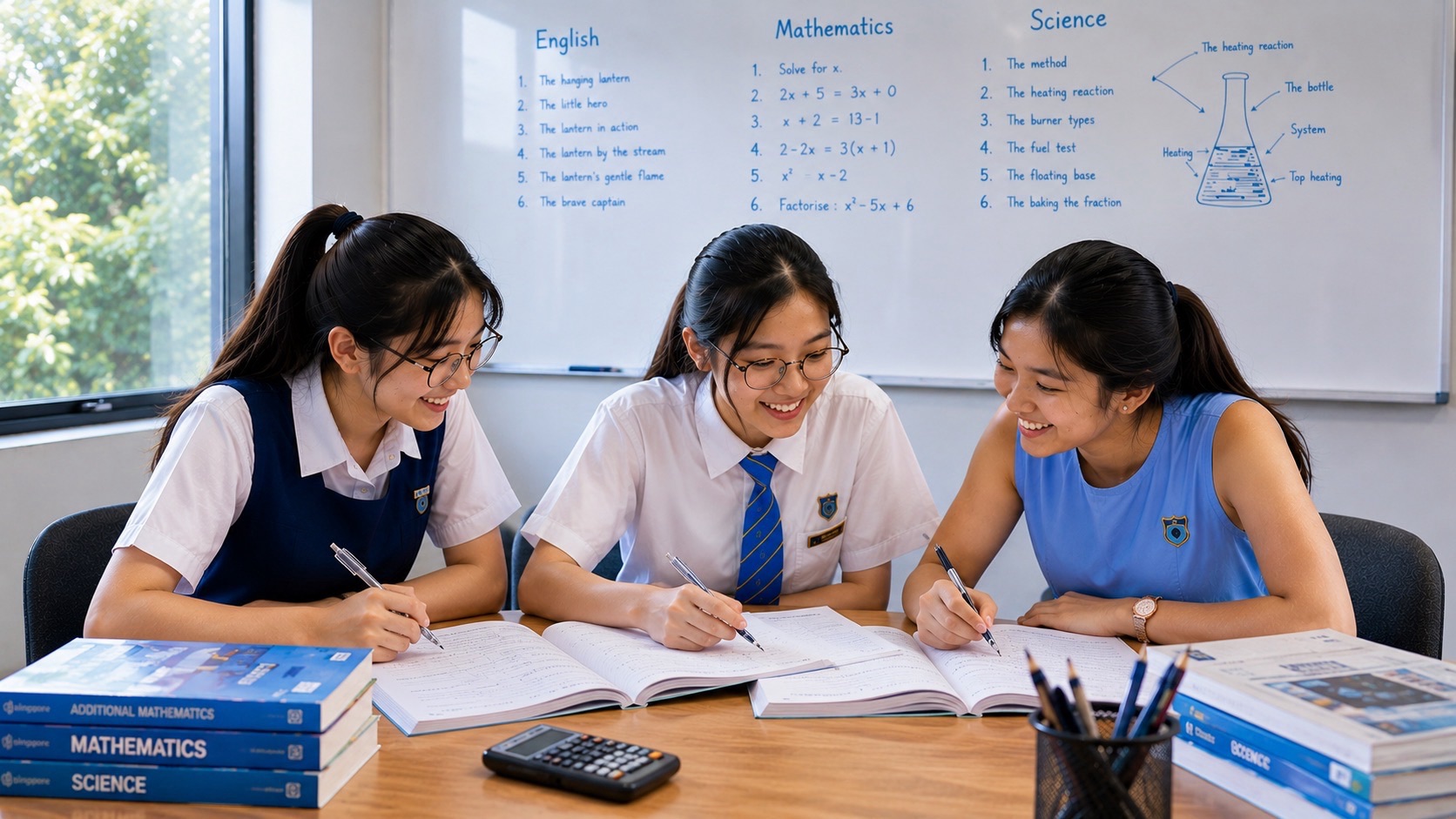
eduKateSG’s premium 3-pax tutorials at 8 Fourth Avenue near Sixth Avenue MRT use diagnosis, first-principles explanation, retrieval, spacing, interleaving, error analysis and independent application. The goal for Bulim Drive students is to teach the learner to verify that important premises survive every transformation and are still represented in the final answer.
- diagnose the first unstable decision
- separate missing knowledge from weak control
- practise the exact decision under manageable difficulty
- retrieve after a delay
- mix with competing methods
- transfer to changed wording
- fade tutor prompts as independence improves
Arrange a parent–student consultation with eduKate Singapore.
The Core Improvement Skill: Premise-to-output conservation
Premise-to-output conservation turns a hidden reasoning decision into something the learner can inspect. Instead of only marking a final answer right or wrong, tuition asks what evidence supported the decision, which condition mattered and what would make the route change.
This matters because school assessments remove many external supports. Topic headings disappear, tutor prompts disappear and familiar questions are mixed with unfamiliar ones. The learner has to recognise structure from the task itself.
A strategy is only useful when it survives outside the lesson. The student should be able to explain it, retrieve it later and use it when numbers, wording, representation or context change.
Transform the Work Without Losing the Original Problem
A student can perform several individually reasonable transformations and still arrive at a solution that no longer represents the question they started with.
Premise-to-output conservation keeps the original conditions visible. At important transitions, the learner asks what information entered the step, what changed form and what must remain true afterwards.
For Bulim Drive students, this creates a powerful integrity check across long answers because the finished work can be compared directly with the premises that were supposed to survive.
Why More Practice Is Not Always the First Answer
More practice is valuable when a skill is understood and needs fluency. It is less useful when the same decision is repeatedly wrong for the same reason.
Diagnosis comes first. The tutor distinguishes missing knowledge from weak retrieval, poor representation, wrong method choice, execution mistakes, incomplete checking and misunderstanding of the task.
Once the cause is visible, questions can be chosen to reveal whether the target process is improving instead of simply adding workload.
How This Works in English
In English, premise-to-output conservation means checking that a paragraph still preserves the question focus, the evidence, and the intended claim after paraphrasing or restructuring. A polished rewrite should not quietly lose the qualification that made the original interpretation accurate.
The learner is asked to justify why one interpretation, quotation, word or structure fits the task better than another. This replaces vague statements such as “it sounds right” with evidence about meaning, scope, tone, audience and purpose.
The same control process supports comprehension, composition, vocabulary and editing. Students learn to distinguish what the text establishes from what they have merely assumed.
How This Works in Mathematics
In Mathematics, each transformation should preserve the relationships established by the givens. Students learn to ask whether an equation, substitution or simplification still represents the same problem before building further steps on it.
Mathematics tuition should include method selection and verification, not only execution. A student who calculates accurately after being told the topic still has an independence gap if mixed questions cause hesitation.
By comparing methods, checking conditions and verifying final results against the original problem, the learner begins to see structure rather than worksheet labels.
How This Works in Science
In Science, the learner tracks whether the stated conditions, variables and causal direction remain present in the final explanation. A shorter answer is only better when the essential scientific relationships have survived compression.
Science improvement depends on connecting observations to concepts and concepts to mechanisms. Memorised vocabulary can sound strong while leaving the causal explanation incomplete.
Tuition therefore asks the learner to reconstruct the relationship, identify variables and explain why the selected concept actually accounts for the observed result.
Why a 3-Pax Tutorial Can Help Bulim Drive Students Improve
A three-student class allows the tutor to keep the lesson intellectually shared while observing each learner’s individual decision process. One student may need concept repair, another retrieval practice and another difficult transfer.
The group creates useful contrast. Students can compare valid routes and discuss why one is safer, clearer or more efficient under particular conditions.
The tutor can intervene at the first unstable point and then return responsibility quickly. Retrieval, choice, reasoning and checking stay with the learner.
- individual diagnostic checks
- short targeted explanations
- independent attempts before hints
- comparison of alternative routes
- delayed retrieval
- mixed-topic practice
- error analysis by cause
- transfer to fresh contexts
Three Improvement Pathways
1. Repair
Repair is used when the learner cannot yet perform the target decision reliably. Unnecessary complexity is reduced, the earliest unstable point is located and any missing prerequisite is taught explicitly.
A worked example can help, but it should not become a permanent crutch. The student restates the principle and applies it to a nearby question without the complete solution visible.
2. Stabilise
Stabilisation begins when the learner can perform the process with help but still needs reminders. The same decision returns after a delay, with changed numbers, wording or representation.
Prompts are reduced deliberately. The learner names the target, chooses the strategy and performs the first check before feedback.
3. Extend
Extension is appropriate when familiar work is secure. The tutor adds competing methods, longer tasks, unfamiliar contexts and appropriate time pressure.
The purpose is not simply greater difficulty. It is to test whether the target process remains stable when attention is divided.
A First-Principles Improvement Method
1. Diagnose the first unstable point
A final wrong answer may be several decisions downstream from the real cause. Trace backward until the earliest unstable choice appears.
2. Separate knowledge from control
A learner may know a concept but fail to retrieve or select it independently. Reteaching known content can leave the actual bottleneck untouched.
3. Fence the target
The Fencing Method keeps early practice inside a manageable concept family so the target decision can be trained without unrelated complexity hiding the evidence.
4. Make the learner explain
The student states what evidence is being used, why the move is justified and what condition would force a different choice.
5. Retrieve after a delay
The target returns after working memory has cleared. The learner reconstructs the route rather than recognising the tutor’s previous wording.
6. Interleave and transfer
The skill is mixed with other topics so the learner must decide whether it applies. Selection becomes part of learning.
7. Add speed after control
Timing is introduced after the process is stable enough to survive compression without becoming guessing.
Why Immediate Success Is Weak Evidence
Immediate success can be supported by recent explanation, visible notes and short-term familiarity. Those conditions do not necessarily exist in a school assessment.
A stronger test is whether the learner can restart later, recognise the structure under changed wording and choose the method without being told the topic.
This is why tuition includes cold starts, delayed retrieval and fresh transfer rather than treating one fluent guided attempt as mastery.
A Concrete Practice Scenario
Suppose a Bulim Drive student appears to understand the topic but produces a fragile answer. The tutor does not replace the route immediately. Instead, the learner uses premise-to-output conservation to inspect the point where the reasoning becomes unsafe.
The student identifies what was known, what decision was made and what evidence justified it. Only the unstable part is repaired rather than restarting every secure part of the task.
A second question changes the surface while preserving the underlying demand. If the learner recognises and applies the process without a prompt, the learning is beginning to transfer.
What Good Practice Looks Like
Good practice leaves the essential reasoning with the learner. The tutor provides enough structure to make learning possible and removes that structure when the learner can carry the process.
Explanation and genuine attempts alternate. Students see what successful control looks like and then reproduce it independently.
The amount of help is noted so a supported answer is not mistaken for an independent one.
What Poor Practice Looks Like
Poor practice gives complete solutions before an attempt, assigns many near-identical questions without diagnosis or adds speed before the method is stable.
It can create smooth tuition sessions that depend on tutor cues. The learner appears fluent because the environment supplies decisions that assessments later require the learner to make alone.
The solution is not abrupt removal of support. It is identifying the difficult decision, teaching it explicitly and fading prompts systematically.
Retrieval, Spacing and Interleaving
Retrieval strengthens access. Spacing creates enough distance for the learner to reconstruct an idea. Interleaving removes the chapter label and requires method selection.
For Bulim Drive students, these processes work together. The target is taught clearly, revisited after a delay and mixed with other topics so the student must recognise the need for premise-to-output conservation without a heading announcing it.
That is closer to real assessment conditions, where questions arrive mixed and the learner must determine what knowledge applies.
Error Analysis: Record the Cause
An error log is useful when it records something the learner can act on. “Question 7 wrong” gives little guidance. A useful entry names the decision that failed and the correction that should become the new default.
Across several weeks, repeated causes become visible. Tuition can then spend more time on the failure mode producing many lost marks instead of treating every wrong answer as a separate event.
Practice volume follows diagnosis instead of replacing it.
Transfer Is the Real Test
Transfer asks whether the learner can use the skill when the surface changes: different numbers, unfamiliar context, changed representation or a question combined with earlier topics.
A useful progression begins with a clear target, changes wording, mixes in competing methods and finally removes tutor reminders.
For parents, transfer becomes visible when the student can explain what is being improved and demonstrate the same decision quality in ordinary schoolwork without the tuition example beside them.
Metacognition Without Overthinking
Students do not need to narrate every thought. Metacognition is useful when it improves the next move. A compact checkpoint asks: what is the target, what evidence matters, what decision follows and what would make me reconsider?
During training these questions may be spoken or written. With practice they become fast and mostly internal.
The goal is better control, not slower work forever.
Confidence Should Follow Evidence
Confidence can rise before competence and fall even when the answer is correct. Familiarity is not a reliable indicator of mastery.
Tuition connects confidence to evidence: what has been retrieved, what has been checked, what remains uncertain and what would change the conclusion.
Over time, confidence becomes less dependent on whether the worksheet looks familiar and more dependent on the quality of the reasoning completed.
Why Fewer Better Questions Can Produce More Learning
High-volume practice is useful after the target process is stable enough to benefit from repetition. While the failure mode is unclear, a smaller number of carefully chosen questions can be more informative.
One question can expose the initial decision, another change the representation, a third add a competing method and a fourth test delayed transfer.
Volume becomes more valuable later for fluency, endurance and examination speed.
How to Increase Difficulty
Difficulty should rise when the learner can perform the target process accurately, explain it and reproduce it after a delay.
The next challenge may come from unfamiliar wording, interacting conditions, tighter time or a representation change.
Changing every source of difficulty at once makes diagnosis harder, so complexity should be increased deliberately.
School Alignment Without School Dependence
Tuition should remain aware of the student’s school sequence, assessment calendar and teacher feedback. That keeps the work relevant.
At the same time, concepts need to be taught deeply enough that the learner can cope when another teacher phrases the idea differently or combines it with earlier content.
The balance is practical: align for current performance, teach for future transfer.
Assessment Readiness Without Panic
Assessment preparation should compress a stable system, not invent a new one at the last minute.
When examinations approach, learners need retrieval, mixed selection, realistic timing and error control more than a sudden mountain of unfamiliar material.
The useful question is not only how many papers can be completed, but which failure modes still cost marks and whether the learner can detect and repair them under time pressure.
Different Students Need Different Versions of the Same Principle
A learner rebuilding foundations needs lower complexity and clearer boundaries. A learner who is already secure needs less explanation and more transfer, discrimination and time pressure.
A strong student may need fewer questions but more demanding choices between plausible methods.
In a 3-pax group, the principle can be shared while task difficulty and support differ.
Energy, Resources and Time
A workable tuition plan respects the learner’s available energy, the resources needed for the current problem and the time before the next meaningful school demand.
A tired student with a deep conceptual gap should not receive the same plan as a well-rested student who understands the topic and mainly needs fluency.
Good tuition adjusts the type of work, not only the amount.
Teaching Ahead Without Rushing
Pre-teaching can reduce future cognitive load by making the structure of a new topic visible before school reaches demanding applications.
It should not become a race through future chapters. If prerequisites are unstable, pushing ahead simply creates more fragile material.
Teaching ahead is useful when it creates familiarity and room for deeper school learning, not when it replaces consolidation.
How This Skill Develops Across a School Term
In the first phase, the tutor makes the target decision visible and slows the task enough for the learner to understand successful control.
In the second phase, support is faded and the same decision returns after delays, changed wording and competing methods.
In the third phase, mixed practice, timed sections and unfamiliar contexts test whether the strategy remains available when attention is divided.
Across the term, progress is judged by independence and transfer.
Why Changed Wording Matters
School assessments rarely reproduce tuition examples exactly. Wording, information order and context change.
For Bulim Drive students, surface features are deliberately varied while the underlying demand is preserved. The learner explains what stayed the same, what changed and why premise-to-output conservation remains relevant.
This strengthens recognition without treating every unfamiliar-looking question as a completely new problem.
Productive Struggle
A short period of independent struggle gives the tutor evidence that immediate prompting would erase. It reveals what the learner retrieves, which route is selected and how they respond when the first idea fails.
The tutor intervenes before frustration becomes unproductive, but not so early that the difficult decision is performed on the learner’s behalf.
The purpose of struggle is diagnostic and developmental, not punitive.
Reducing Tutor Dependence
Tutor dependence falls when the learner performs more of the diagnosis. Instead of asking what to do, the student identifies what is known, what is uncertain and what evidence would justify the next move.
The tutor can then answer a narrow question without taking over the wider task.
The end state is not a learner who never asks for help. It is a learner who asks precise questions, uses the answer and resumes independent work quickly.
What Mastery Looks Like
Mastery is not the absence of mistakes. It is the ability to recognise structure, recover after an error, explain why a method is justified and adapt when conditions change.
A mastered skill remains available after a delay and does not require the original worksheet, tutor wording or worked example to be present.
For Bulim Drive students, mastery of premise-to-output conservation means the process has become part of ordinary problem solving rather than a special tuition routine.
From Correction to a New Default
Correction is complete only when the repaired process becomes the learner’s new default.
After feedback, the same decision should reappear later in a fresh task without being announced. The learner must detect the risk independently and apply the improved process.
That delayed reappearance is where correction becomes learning.
When to Stop Checking
Good checking includes a stopping rule. The learner should know what evidence is sufficient to proceed and what new information would justify reopening the decision.
Without a stopping rule, careful students can spend too much time repeating checks that rarely change the answer.
The tutor therefore teaches not only how to check but when the current evidence is good enough to move on.
Why the Student Should Teach It Back
A useful final test is whether the learner can teach the central idea back in plain language. Teaching it back forces compression, sequencing and explanation.
The student does not need to perform like a teacher. The aim is to state the condition, relationship, method and check clearly enough that another learner could follow the logic.
If the learner cannot explain why the method works, apparent mastery may still depend on surface familiarity.
What Happens During a 90-Minute Improvement Lesson
Warm-up retrieval
Students attempt an older concept cold before any reminder is given.
Current-school diagnosis
Recent work is checked for the first unstable decision, repeated error pattern or dependency on prompts.
Concept instruction
The tutor repairs only the knowledge genuinely missing and connects it to the target control process.
Guided practice
A small number of examples make the decision rule visible without turning the lesson into answer copying.
Independent application
A fresh question is attempted with tutor support reduced.
Mixed or timed application
Other topics are interleaved so the learner must select the strategy rather than wait for it to be announced.
Error review
The student identifies whether failure came from concept, retrieval, selection, representation, execution or checking.
Focused continuation work
Home practice is short enough to complete carefully and specific enough to show whether the skill survives outside tuition.
How Progress Should Be Measured
- clearer identification of the real task
- better first method choice
- fewer unsupported steps
- more efficient checking
- faster recovery from mistakes
- stronger transfer to changed wording
- less tutor prompting
- more independent explanation
Marks remain important, but process evidence helps explain whether improvement is likely to survive the next topic and assessment.
Responsible tuition does not promise a fixed grade after a fixed number of lessons. It uses repeated evidence to show whether the learner is becoming more capable and independent.
What Parents Can Do Without Taking Over the Work
- provide a predictable time and place for short continuation work
- ask the learner to explain the current target instead of asking only for marks
- notice recurring patterns without solving the question
- bring marked schoolwork when the same difficulty returns
- protect sleep and recovery
- let the learner attempt before supplying hints
A useful question at home is, “What are you trying to improve here?” That keeps attention on learning without replacing the learner’s responsibility.
A Bulim Drive Weekly Routine
Choose one multi-step answer and list the original conditions at the top. After each major transformation, tick which conditions are still represented. Repair any step where an essential condition disappears.
Keep the routine small enough to repeat. A short task that exposes the target decision clearly is more useful than a long session completed on autopilot.
After a delayed retry, compare not only whether the answer is correct but whether it was reached with less prompting, clearer reasoning and more efficient checking.
- choose one target
- attempt cold
- apply the decision process
- complete the task
- check the result
- record the cause of any error
- retry later under changed wording
Travelling From Bulim Drive to Sixth Avenue
Bulim Drive families should plan the journey to the actual teaching address rather than assume this local guide represents a local branch.
Use a current journey planner from the learner’s real school-day starting point. Include walking, transfers, meals, the lesson and the return trip so the weekly routine remains sustainable.
This guide serves Bulim Drive families considering the Fourth Avenue programme. It does not describe a Bulim Drive branch.
Location: eduKateSG, 8 Fourth Avenue, Singapore 268674
Nearest MRT: Sixth Avenue MRT, Downtown Line
Attendance: By appointment
Class Details
Format: Premium 3-pax small-group tutorials
Duration: Approximately 1.5 hours weekly
Teaching approach:
- first-principles explanation
- diagnosis before volume
- guided and independent practice
- retrieval and interleaving
- error analysis
- school-assessment alignment
- carefully paced pre-teaching
Materials may include:
- curated lesson notes
- topic practice
- mixed revision
- assessment-style questions
- micro-tests
- focused continuation work
What Parents Can Bring to the Consultation
- recent school test papers
- marked assignments
- the school’s current topic sequence
- teacher comments
- work completed only with heavy help
- questions the learner repeatedly avoids
- examples of mistakes that returned after correction
Bring examples where the learner appears to know the topic but loses control over the decision process. Those examples are often more diagnostic than a list of marks alone.
Frequently Asked Questions
How quickly should a Bulim Drive student improve with tuition?
A strategy can become clear quickly, while reliable use across unfamiliar tasks develops through retrieval, spacing and repeated transfer.
Should tuition begin with full examination papers?
Not always. Moderate-length tasks make the target decision easier to teach before full-paper complexity is added.
Is more homework always better?
No. A smaller number of questions with clear diagnosis and delayed retry can produce stronger learning than high-volume repetition.
What if my child understands when the tutor explains but still cannot work alone?
That usually means support has to be faded more deliberately and the learner needs cold-start retrieval, not another identical explanation.
Can a strong student still benefit from tuition?
Yes. Strong students can improve discrimination, transfer, efficiency, verification and performance under unfamiliar conditions.
How do you reduce repeated careless mistakes?
Classify the error by cause and repair the decision that produced it rather than simply telling the learner to be more careful.
Do you teach ahead of school?
Yes, when the foundation is stable and pre-teaching will reduce future cognitive load rather than create fragile acceleration.
Is tuition necessary for every student?
No. Tuition should solve an identifiable learning problem, strengthen independence or provide meaningful extension.
Helpful Reading
Read How Independent Learning Works, How Error Correction Works and How Interleaving Works for the wider learning system.
The Clementi small-group guide explains the programme structure used as the quality floor for this series.
How to Improve With Tuition | Bulim Drive
For Bulim Drive students, strong improvement comes from more than doing extra work. The learner needs a better way to control the important decisions inside that work.
Premise-to-output conservation gives the learner a portable process that can be tested after a delay, challenged under unfamiliar conditions and gradually internalised.
eduKateSG
8 Fourth Avenue
Singapore 268674
Near Sixth Avenue MRT
Premium 3-pax small-group tuition
By appointment
Properly taught kids shine a bright light into the future.