
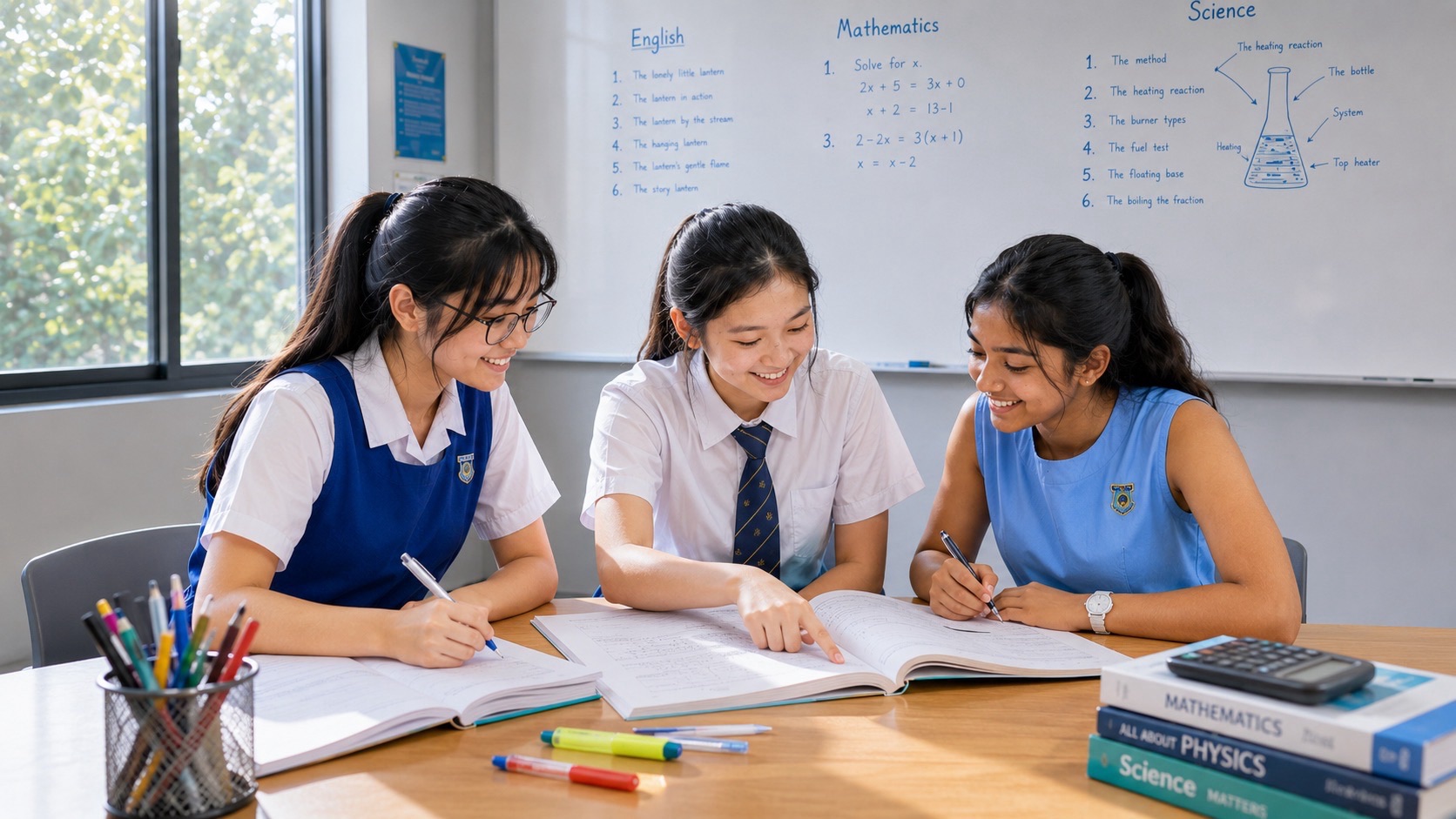
SEC Math Tuition Centre Singapore is an increasingly relevant question for Singapore parents preparing for the Singapore-Cambridge Secondary Education Certificate (SEC). From the 2027 graduating cohort, the certificate records individual subjects at G1, G2 or G3 levels, so a tuition centre should match the exact subject and level rather than rely on old stream labels.
The core aim of this tuition centre is conceptual understanding, mathematical fluency and independent method selection. A strong Mathematics centre should inspect individual workings, repair prerequisite gaps, use mixed-topic questions and teach students to estimate and check answers. A centre adds value when it can see individual errors, provide targeted feedback and help students become less dependent on external assistance.
Read the companion SEC subject tuition guide, SEC Tuition Centre Singapore and SEC Exam Preparation Singapore.
The Core Aim: conceptual understanding, mathematical fluency and independent method selection
A strong Mathematics centre should inspect individual workings, repair prerequisite gaps, use mixed-topic questions and teach students to estimate and check answers.
Use the Correct Subject-Level Syllabus
Ask which syllabus and subject level the centre teaches. Not every subject is offered at every level. Materials and examination practice should match the student’s actual school pathway.
Class Size Should Preserve Visibility
The question is not only how many students attend, but whether the tutor can inspect each learner’s working, writing or explanation and correct specific misunderstandings.
Diagnosis Comes Before More Worksheets
Begin with an independent attempt and identify the reason for the error: missing knowledge, weak retrieval, misunderstood wording, poor method selection or inaccurate execution. The next activity should target the cause.
Teach Concepts Before Shortcuts
Worked examples and efficient methods are useful, but the learner should know why they work and when they apply. A shortcut without understanding becomes fragile when the question changes.
Retrieval Should Be Cumulative
Older topics should return throughout the term through short retrieval, mixed practice and delayed retries. This makes examination preparation a process of refinement rather than last-minute relearning.
Corrections Must Lead to Independent Attempts
After feedback, close the solution and ask the student to try again. A second attempt after a delay reveals whether the correction lasted.
Three Centre Pathways
Repair
Identify and rebuild the earliest unstable prerequisite.
Stabilisation
Use retrieval, mixed questions and timed micro-practice to reduce repeated errors.
Extension
Introduce richer applications, alternative methods and unfamiliar contexts when foundations are secure.
What Parents Should Compare
- Correct subject and syllabus level
- Teacher expertise and continuity
- Actual class size
- Individual marking and feedback
- Retrieval and correction routines
- Homework load
- Lesson duration and total monthly fees
- Evidence of increasing student independence
A Four-Week Review
- Week one: record recurring errors and a baseline attempt.
- Week two: repair the highest-value prerequisites.
- Week three: mix old and new questions and require independent explanations.
- Week four: reassess with changed questions and review whether support can be reduced.
Frequently Asked Questions
Is a smaller class always better?
Smaller classes usually make individual observation easier, but tutor expertise, lesson design and feedback quality still matter.
Should the centre teach ahead?
Only when prerequisites are secure and previewing has a clear purpose. Consolidation often adds more value than acceleration.
How do parents know the centre is working?
Look for fewer repeated errors, stronger recall, clearer reasoning and less need for tutor prompting over several weeks.
Helpful Reading
- SEC Trial Class Singapore
- SEC Tuition Fees Singapore
- SEC Tuition vs Self-Study
- G3 Small Group Tuition Singapore
The Core Aim
The best SEC subject tuition centre gives students enough structure and feedback to become more capable, more accurate and increasingly independent.