
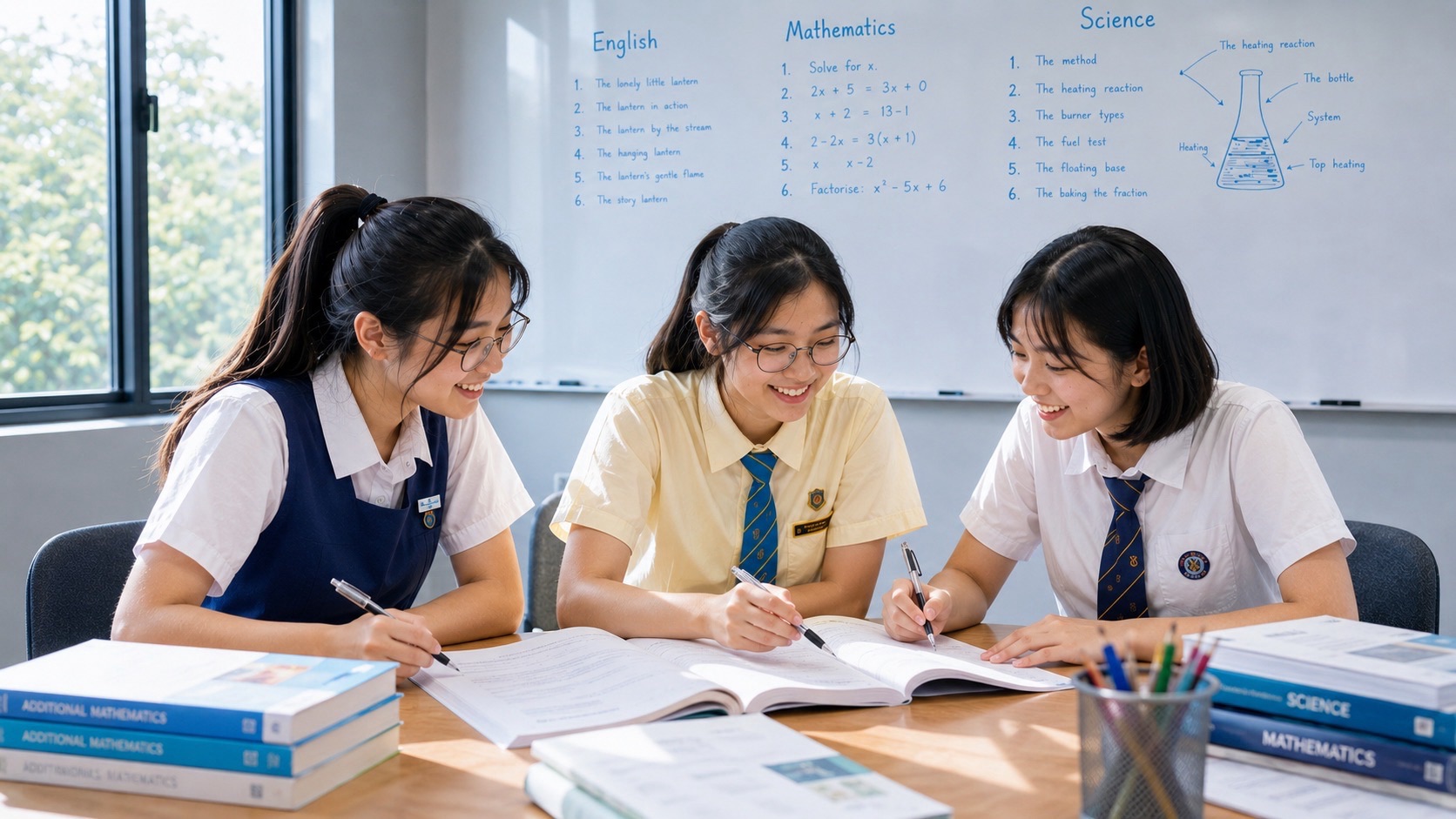
The December school holidays look wonderfully open on the family calendar. Then the reports arrive. One child has finished Primary 5 with a shaky understanding of fractions and ratio; another is about to enter Secondary 1 and is nervous about algebra; a third is doing well but wants more challenging Maths. Should everyone attend a school holiday Maths tuition programme in Bukit Timah? Or would a few carefully chosen tasks, genuine rest and a normal family holiday be more useful?
The core aim of Bukit Timah Mathematics tuition during the 2026 year-end school holidays is to decide whether the next school year requires catching up, consolidating, stretching ahead or simply maintaining secure skills. A well-designed holiday Maths plan begins with the student’s recent independent work, sets a small number of measurable learning goals and balances clear teaching, delayed practice and time to recover. Holiday tuition is useful only when it addresses an identifiable need; filling the timetable is not itself progress.
This gives parents a much calmer way to use the break. The holiday can be a buffer between school years rather than an extended examination season. A child may return in January more ready for Mathematics because one crucial concept finally makes sense, not because every day was spent completing worksheets.
The 2026 school holiday calendar: know the window, then plan the learning
For the 2026 mainstream school calendar, the year-end school vacation runs from 21 November to 31 December 2026, according to the published MOE school calendar information. Some schools may have special operational arrangements, and international schools may follow different calendars. Check your child’s own school notices before committing to travel or lessons.
The point is not to schedule every one of those days. It is to decide what small, worthwhile Mathematics objective can realistically be achieved alongside rest, family plans and other commitments.
Quick answer: should school holiday Maths tuition focus on catching up or getting ahead?
Choose catch-up tuition if a prerequisite is insecure and will make next year’s work unnecessarily difficult. Choose consolidation when concepts are understood but accuracy, recall or independent method choice is unreliable. Choose stretch or enrichment when the student already has secure foundations and genuinely enjoys deeper challenge. Choose rest with light maintenance when the child is progressing independently and has no pressing mathematical gap.
Some children need a combination. A Primary 5 learner may require one short burst of ratio repair followed by a gentler routine. A Secondary student may benefit from reviewing negative numbers before looking at new equations. The right choice follows evidence, not the age of the student alone.
The four holiday learning routes
- Catch up: identify the missing concept, explain it clearly, check independent accuracy and revisit it after several days.
- Keep up: strengthen recently taught skills with mixed, unlabelled questions and purposeful corrections.
- Get ahead: introduce one appropriate next-stage idea only after prerequisites are secure and the student can explain the new relationship.
- Rest and maintain: use occasional short activities so Mathematics remains familiar without turning the holiday into another school term.
These routes should not be treated as labels for children. A confident pupil may need catch-up work in one topic; a student rebuilding fractions may still enjoy an engaging puzzle. Teaching should target the particular mathematical task.
Before booking: carry out a useful ten-question learning review
Take a few original questions from recent school assessments and add a small set of new questions covering the prerequisites for the next stage. Ask the student to attempt them without model answers, hints or topic labels. Save the workings, including incomplete attempts, because the first uncertain step is often the most useful clue.
Sort the results into four groups: secure and independent; concept understood but inaccurate; cannot choose a method without a hint; and genuinely missing concept. Your holiday plan should spend the most effort where teaching will make a meaningful difference. It should not spend equal time on every chapter just because every chapter appears in an assessment book.
A tutor can help confirm whether the difficulty is mathematical understanding, question reading, execution or delayed recall. The Bukit Timah Maths learning-gap diagnostic explains why the distinction matters.
Primary 1–2: confidence in numbers matters more than an early syllabus race
For younger pupils, useful holiday learning includes place value, number bonds, addition and subtraction relationships, equal groups, measurement and mathematical language. Families can practise through cooking quantities, counting arrangements, board games or short discussions that make numbers meaningful. There is no need to transform every outing into a mathematics test.
If a pupil repeatedly misunderstands tens and ones or cannot explain why subtraction is appropriate, a tutor may help repair the concept. If the child handles school-level numbers independently, light maintenance and healthy rest may be entirely appropriate. Starting Primary 3 chapters early is not automatically more valuable than securing the current foundations.
Primary 3–4: strengthen the move into multi-step problem solving
At this stage, children increasingly need to translate written stories into mathematical representations. An arithmetic question may be easy; a word problem containing the same numbers can be difficult because the child must decide what is known and unknown. A useful holiday programme can revisit comparison, part–whole relationships, fractions and the choice between a model, table or calculation.
Ask children to explain what each unit in a bar model represents. Then change the story so the given number refers to a difference rather than a total. If the child cannot identify that difference without a hint, the next learning move is to teach relationship interpretation rather than demand faster calculation.
Primary 5 moving into Primary 6: repair the PSLE foundation now
For many families, the most useful school holiday investment before Primary 6 is securing the connections among fractions, ratio and percentage. A child who knows three procedures separately but cannot recognise the common part–whole relationship may struggle with PSLE-style mixed questions later.
Consider this example: red and blue counters are in the ratio 2:3, and there are 75 counters altogether. There are five equal units; one unit represents 15, so red counters number 30 and blue counters number 45. Red counters therefore make up two fifths, or 40%, of the total.
One question connects ratio, equivalent fractions and percentage. A tutor can make that relationship clear, then change the known quantity and ask the learner to choose the method independently. This is more valuable than finishing a large bundle of unrelated difficult sums without understanding why the methods apply.
For a detailed plan once Primary 6 revision becomes more focused, see the twelve-week PSLE Mathematics revision timetable. The school holiday is a good time to repair prerequisites; it does not have to imitate the final twelve weeks before an examination.
Primary 6 moving into Secondary 1: make the leap into algebra gentler
The PSLE is over and the new school year will bring different mathematical expectations. Secondary Mathematics introduces more formal symbolic language and demands greater control over signed numbers, algebraic expressions and equations. That transition can feel sudden to a student who has relied mainly on arithmetic or visual models.
A good introductory holiday task might connect a familiar story to an unknown quantity. Three equal packets contain 24 pencils. In arithmetic, 24 ÷ 3 = 8. In an equation, 3x = 24 and x = 8, where x represents pencils per packet. Show that dividing both sides of an equation by the same non-zero number preserves equality.
Only then move to brackets or more demanding equations, and only if the student is ready. A brief bridge that connects old understanding with new symbols is more useful than racing through a term’s syllabus without secure fraction or negative-number knowledge.
Parents can also read PSLE bar models versus algebra to see how diagram units correspond to variables, and the Secondary 1 phase-shift guide for the broader transition.
Secondary 1 moving into Secondary 2: secure algebra before complexity grows
The holiday can reveal whether basic equations, directed numbers, algebraic substitution and graph interpretation are stable. A student may have passed the year’s tests yet still rely heavily on the example in front of them. Test a few unfamiliar equations without cues, then examine whether the child can explain each transformation and check the answer.
A simple equation such as 2(x + 5) = 24 gives x + 5 = 12 and x = 7. The student should understand why dividing both sides by two is allowed and verify the result by substitution. Later, a variation with an unknown on both sides tests whether that understanding transfers.
If these skills remain insecure, catch-up is appropriate. If they are secure, an introduction to the next school’s relevant ideas can be considered without overloading the child.
Secondary 2 moving into Secondary 3: prepare for a more demanding pathway
The move into upper Secondary Mathematics may bring greater abstraction and, where applicable, a separate Additional Mathematics subject. The student’s enrolled level and school pathway matter. A G1, G2 or G3 learner should not receive a generic bundle of questions pitched at an unrelated level simply because the cover says “Secondary 3”.
A useful holiday review can check whether algebraic manipulation, ratios, graphs and geometry relationships are sufficiently secure for the next stage. Students taking Additional Mathematics need strong symbolic fluency, and a tutor may prioritise factorisation and equation control before introducing advanced functions. The purpose is readiness, not syllabus prestige.
Secondary 3 moving into Secondary 4: prepare without using the entire holiday for exam cramming
Students who will approach their graduating year in 2027 may need to balance revision for Mathematics, Additional Mathematics where offered and several other subjects. The holiday is an opportunity to repair high-impact prerequisites, establish a realistic revision routine and identify which question types repeatedly cause difficulty.
Under the 2027 SEC framework, subject levels matter. The G1, G2 and G3 SEC Mathematics readiness guide explains this distinction. Tuition should be matched to the student’s actual syllabus, not assume that all graduates sit identical papers.
When a holiday intensive Maths tuition course can help
An intensive can be worthwhile when a student has a clearly identified gap, enough energy for focused lessons and opportunities to practise between sessions. For example, a short block of teaching may stabilise ratio models or algebraic balance before the child returns to ordinary school practice.
Ask whether the intensive includes diagnosis, clear explanation, individually checked working, independent tasks and a final review. A timetable with many hours but little corrective feedback can be expensive repetition. If the child is exhausted or the programme crowds out all other activities, consider whether a lighter arrangement would produce better learning.
What an ordinary weekly holiday lesson might do better
Weekly small-group tuition can allow concepts to be explained, attempted independently and revisited after time has passed. The learner may bring back the first uncertain step from a home practice problem, allowing the tutor to decide whether the previous explanation was retained or needs changing.
The immutable eduKateSG Mathematics tutorial reference describes a premium three-student format, weekly 1.5-hour sessions and close feedback near Sixth Avenue MRT. Families should enquire about current holiday scheduling rather than assuming that an intensive, extra class or particular December slot is available.
A six-week school holiday learning plan
- Week 1 — recover and review: allow rest after the school term, then inspect recent original Mathematics work and select no more than two priority learning goals.
- Week 2 — teach the missing foundation: revisit the prerequisite concept with simple examples, clear representations and a new independent question.
- Week 3 — stabilise the method: practise several varied problems, check accuracy and correct the first unsupported step.
- Week 4 — test recall: revisit the skill after a delay and mix it with an older, related topic so the student must choose a method.
- Week 5 — bridge or stretch: connect secure knowledge to one suitable next-year idea, or use non-routine questions if the student is already strong.
- Week 6 — prepare for the new term: compare independent attempts against the baseline and design a manageable school-week practice rhythm.
This timetable is illustrative, not mandatory. Families travelling for part of December can compress the diagnostic and review tasks into a lighter rhythm. The point is to return to school with a few useful skills more secure, not to prove that no holiday day was left unused.
A small weekly routine for families who choose no holiday tuition
If the child’s mathematics is progressing well, you can maintain learning through brief independent practice and ordinary mathematical conversation. One session might revisit a previously difficult fraction problem; another might involve a challenging puzzle or diagram; another might ask the child to explain an answer in their own words.
Keep the tasks short enough to preserve family time and curiosity. If a genuine repeated misconception appears, that can become the next focused learning goal. There is no requirement that an academically successful child enrol in paid holiday tuition.
Five questions before booking a December Maths class
- What specific mathematical difficulty will the lesson address?
- Is the work catch-up, consolidation, enrichment or exam readiness?
- Will the tutor inspect original workings and give independent follow-up questions?
- How does the schedule fit travel, family plans, other subjects and rest?
- What evidence will show at the end of the holiday that the objective was achieved?
These questions help separate educational benefit from sales pressure. A clear answer should name a skill and a method for checking it, not simply list the number of hours or worksheets included.
Frequently asked questions
Should my child attend December 2026 Maths tuition every day?
Not by default. Daily teaching may be too intense for a child who needs rest or whose existing understanding is secure. Match frequency to the actual gap, learning capacity and opportunities for independent practice. More days do not automatically produce stronger reasoning.
Is it better to catch up or learn next year’s Maths topics?
Catch up first when missing prerequisites will undermine the next stage. If the foundations are secure, carefully chosen extension can be motivating. Avoid rushing ahead solely to say the next textbook has been completed.
Should a Primary 6 graduate start Secondary 1 algebra immediately?
A gentle bridge can be useful, particularly linking unknown quantities and equations to familiar arithmetic or models. But children also deserve recovery after major examinations. Begin with readiness and interest rather than a race to finish Secondary chapters.
Can school holidays fix a full year of weak Maths?
A holiday provides valuable time for targeted repair, but one break may not be enough to rebuild many insecure foundations. Choose the most important prerequisites and plan continued practice. A tutor should not guarantee a full-year transformation in a few sessions.
What if my child is already strong at Maths?
A strong learner may benefit from puzzles, varied problem-solving and depth, or may simply continue with school and independent exploration. The high-achieving Mathematics guide explores suitable stretch without unnecessary pressure.
Use the holiday to create a better January, not an exhausting December
The core aim of holiday Mathematics tuition is not to defeat the holiday. It is to give a student enough understanding, confidence and independent method control to enter the next stage with fewer preventable difficulties. A thoughtful balance of repair, practice, curiosity and rest is a stronger learning plan than a timetable filled only for appearance.
For further planning, read the national December 2026 Maths revision guide, the Bukit Timah lesson-timing guide and the Bukit Timah Mathematics tuition learning route. To enquire about current small-group teaching arrangements, contact eduKate Singapore with the child’s year, next-year pathway and one or two recent mathematical difficulties.