
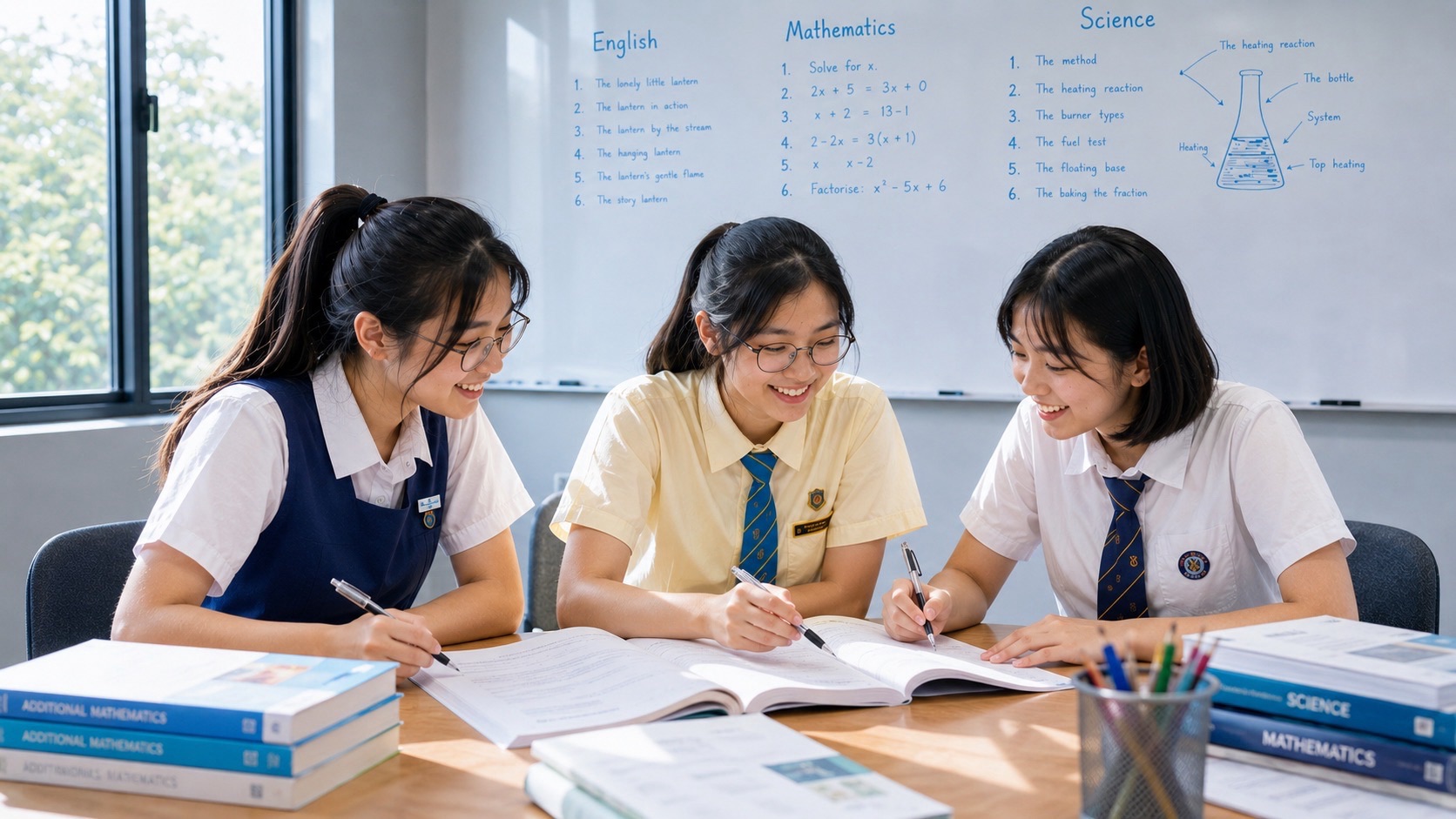
Does your child love Science experiments but still score poorly in Secondary 1 Science tests? Before booking Secondary 1 Science tuition in Hougang, compare what the child enjoys doing with what the school assessment asks them to do independently. A pupil may be fascinated by colourful reactions, videos and hands-on activities, yet struggle to interpret particle diagrams, distinguish elements and mixtures, identify a variable or explain an observation with scientific evidence. The quickest useful intervention is to examine one marked answer, identify where the reasoning breaks and practise a changed example without hints. Early Chemistry concepts are generally part of lower-secondary Science, so a suitable tutor needs to teach the correct Science subject level rather than simply offer older students’ Chemistry worksheets.
For Hougang parents comparing a Sec 1 Science tutor near Kovan or Buangkok, lower-secondary Science tuition, G1/G2/G3 Science help, private tutoring and three-student small-group lessons, ask how a teacher turns curiosity into scientific explanation. A productive lesson might begin with a familiar situation, ask for a prediction, separate the observation from its interpretation, build an accurate particle model and end with one unfamiliar school-style question. If the child becomes able to select and justify the relevant idea without prompting, learning is beginning to transfer. If a single test problem can be resolved with school feedback and independent practice, an additional tuition package may not be necessary.
An Enthusiastic Scientist Can Still Be an Uncertain Test-Taker
The child who enjoys Science is a delight to teach. They want to know why the sky changes colour, why bubbles appear in a drink and why a cold glass becomes wet on the outside. They have watched experiments and can describe every exciting moment. Then their Secondary 1 Science paper arrives, and the mark is unexpectedly low.
The family is confused. Surely being interested in a subject should make it easier? The student feels confused too: “But I know all about this.” What has happened is not necessarily a loss of interest or ability. It may be that watching a phenomenon and explaining it through a scientific model are different tasks.
A good parent decision begins by respecting the child’s curiosity while being precise about the missing academic capability. There is no reason to turn an enjoyable interest into a punishment of endless worksheets. The goal is to help an interested learner turn observations into explanations they can retrieve and use on an unfamiliar test.
Secondary 1 Science Is More Than Interesting Experiments
The MOE lower-secondary G2/G3 Science syllabus integrates scientific practices with knowledge about matter, models, interactions and systems. The G1 Science syllabus follows its own learning route. Schools decide their topic sequences and internal assessments, so a parent should begin with what the child’s class actually studied.
For many Secondary 1 pupils, the parts casually called “Chemistry” include the nature of matter, elements, compounds and mixtures. That is not the same thing as a separate upper-secondary Pure Chemistry examination subject. Searching for an advanced Chemistry specialist without checking the present syllabus can introduce content the pupil is not yet ready to understand.
The Hougang guide to Secondary 1 and 2 Chemistry classes gives families a curriculum reference. Use it alongside the child’s schoolwork to decide whether the present need is lower-secondary Science support, a writing adjustment or simply practice in applying familiar ideas.
The Difference Between Watching Bubbles and Explaining Them
Imagine a classroom demonstration in which bubbles appear. The student reports, “The chemical reaction made hydrogen.” That may be true in a particular experiment, but it is not automatically justified by the sight of bubbles alone. The visible observation is that bubbles formed; identifying the gas depends on the substances, conditions and suitable evidence.
That small distinction is the beginning of scientific reasoning. A pupil can be deeply interested in a demonstration and still need help separating observation from inference. A tutor might ask, “What did you actually see? What do you think it means? What evidence could distinguish one possibility from another?”
Now change the situation. Boiling water produces bubbles, but that does not necessarily imply that a new chemical substance formed. An air bubble and gas evolved from a reaction can also have different origins. The model must fit the context rather than the excitement of the demonstration.
A student who can explain that distinction independently is building a capability that will apply across Science. The Hougang observation-versus-inference guide explores the same foundation through school questions.
Five Reasons an Interested Student Can Still Lose Marks
They know what happened but not why
A pupil may describe salt disappearing from sight in water but believe that the salt has been destroyed. The relevant model is that dissolved salt remains present in a solution. Teaching should repair that understanding before adding more examples of dissolving.
They recognise a diagram but cannot explain it
Particle drawings represent chemical ideas; they are not simply pictures to remember. Ask what a symbol means, whether the particles are of the same type and whether substances are chemically combined or physically mixed. The child’s verbal description should match the model.
They confuse an observed result with an unsupported claim
A colour change or a temperature reading can be important evidence, but the pupil may need more context before making a specific chemical conclusion. A tutor should teach how to justify a statement and recognise its limits.
They misread the instruction in the assessment
Words such as describe, compare and explain ask for different work. The child may know the Science while answering the wrong task. Scientific language and question-reading can be taught together.
They need help recalling knowledge without visual cues
Watching a video gives the learner the phenomenon, relevant objects and often the explanation all at once. A test presents much less support. The student must recognise the topic and retrieve the reasoning independently. This gap can be reduced with carefully chosen changed-context questions and later recall.
One Salt-Water Question Can Reveal More Than a Long Quiz
Ask whether a glass of salt water contains a compound or a mixture. The clear appearance can tempt a pupil to say “compound”. But salt water is a mixture: the dissolved salt and water are present together rather than chemically combining to form one new compound.
Ask what happens if the water is removed by an appropriate separation process. The student should understand that dissolving does not destroy the salt. Then change the example: air also appears uniform, yet it consists of different gases in a mixture. The learner needs to apply the same chemical distinction without relying on the word “salt”.
A child who understands both examples has moved beyond memorising a favourite demonstration. They are using a general scientific model. If the child fails the changed example, a tutor has found a small and useful teaching target.
Turn Curiosity Into a Repeatable Learning Loop
- Observe: report what was seen or measured without inventing an explanation.
- Question: identify what remains uncertain and what the problem asks.
- Model: choose an age-appropriate scientific idea that accounts for the situation.
- Explain: connect the model with the observation using accurate words or diagrams.
- Test: try another context, preferably without naming the chapter first.
- Return: ask the learner to explain the idea again a few days later without the earlier worked answer.
These steps can take only a few minutes when the original gap is narrow. They are not a demand that parents recreate a science laboratory at home. Use school-provided observations and safe everyday examples. Unfamiliar chemical reactions, reagents and apparatus belong in properly supervised settings.
What a Three-Student Science Tutorial Can Add
Imagine three students each making a prediction before watching a school-provided demonstration. Afterward, one student states the observation, another offers a scientific explanation and the third asks what evidence would support or contradict it. The tutor inspects the reasoning of all three and asks for individual written answers.
That is the educational potential of a carefully managed three-student group: enough conversation for ideas to be challenged, with opportunities for the teacher to detect each learner’s misunderstanding. But the number alone is not proof of good instruction. A child who only watches the quickest student answer may remain as dependent as before.
Individual teaching may be more suitable for a significant prerequisite gap or a learner who needs a quieter starting point. For a narrow problem already addressed by the schoolteacher, extra tuition may be unnecessary.
The eduKate three-pax Mathematics tutorial reference illustrates diagnostic attention and individual participation in a small-group design. It describes an existing Mathematics programme in another area, not an available Hougang Science or Chemistry class.
A Two-Week Parent Test Before Buying Regular Tuition
Days 1–3: choose one surprising wrong answer
Find a Science question the child expected to answer correctly. Ask what they observed, what they inferred and which scientific model they used. Listen for the earliest missing connection instead of immediately presenting the answer key.
Days 4–7: make one concept reusable
Explain the scientific relationship using an appropriate everyday example. Ask the child to represent it in words or a simple diagram, then change the situation. A different example reveals whether the learner understands the idea or only recognises the original case.
Week two: retrieve without the demonstration
Give one school-style question without a video, experiment title or chapter cue. Does the pupil identify the relevant idea and justify the conclusion independently? Compare this with the original error. If the gap persists after feedback, consider a more targeted tutor consultation.
The objective is evidence, not a promised grade jump in fourteen days. Some pupils need longer support; others need only a corrected understanding and a more independent revision habit.
The Hougang Timetable Is Part of the Decision
A student who attends school, CCA and several other lessons may have little space left to enjoy Science outside tests. Parents living around Hougang Central, Kovan and Buangkok should measure the complete journey to any potential tutor, as well as the child’s capacity for independent practice afterward.
A class that turns an interested learner into an exhausted learner can be counterproductive. Select the shortest teaching intervention that plausibly repairs the difficulty, then reassess what the child can do alone.
Frequently Asked Questions
Why does a child who loves Science still do badly in tests?
Interest and assessed performance are different. The child may enjoy observations but need practice using particle models, reading question instructions, interpreting evidence or explaining unfamiliar situations.
Does this mean my Secondary 1 child needs Chemistry tuition?
Not necessarily. Chemistry-related foundations are generally taught within lower-secondary Science. Begin with the school’s subject level and a diagnosis of the actual learning error.
Should we let the child watch more educational videos?
Videos can stimulate curiosity and clarify an idea, but include opportunities to explain from memory and solve changed questions without the video. Passive viewing does not establish independent understanding.
Is a three-student tutorial better for curious pupils?
It can encourage discussion and allow regular individual checking when properly taught. The class must still match the learner’s readiness and provide clear feedback. Private or school-based help can be more appropriate in other cases.
How do we know when the support is working?
The student becomes able to explain the scientific relationship, apply it in an unfamiliar example and recognise an unsupported inference with less prompting. That evidence is more useful than simply counting completed pages.
Keep the Wonder. Build the Explanation.
A child who asks wonderful questions about the world already has something worth protecting. The next educational step is helping that curiosity become a reliable method: observe, choose a model, reason from evidence and explain. That is the kind of progress a good Science tutor should make visible.
Continue with whether Science tuition is needed after the first weighted assessment, the Science-versus-reading difficulty guide, the Hougang Science Learning Hub and the Chemistry Tuition and Tutor Library for the next appropriate resource.
This educational guide does not claim an eduKate Science or Chemistry tuition venue or a specific class vacancy in Hougang. School curriculum, subject level, provider location and current offerings must be confirmed directly.