
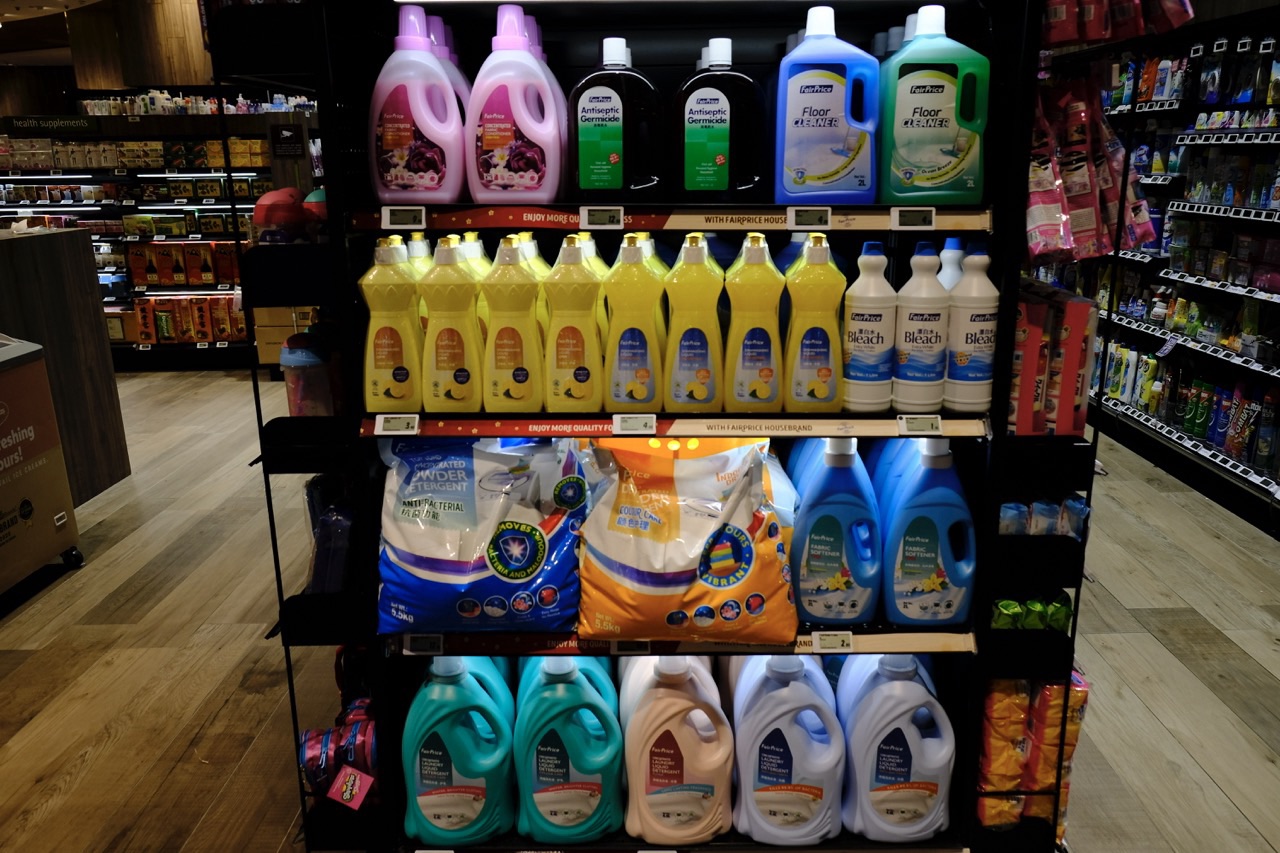
How do enzymes in laundry detergent help remove stains? Enzymes are biological catalysts—usually specialised proteins—that speed up chemical reactions without being consumed as fixed reactants. Modern biological laundry detergents can contain proteases to break down protein-rich stains such as egg or food residue, amylases to cut starch molecules into smaller fragments, and lipases to break down fats and oils. Other formulations may include cellulases, mannanases or pectate lyases for particular fabric-care and soil-removal jobs. Enzymes help break a large, stubborn stain into smaller or more removable substances; surfactants, water and washing action then help carry the material away. It is a combination of reactions and cleaning, not a detergent secretly containing living microbes. The American Cleaning Institute’s guide to enzymes in cleaners confirms these distinct enzyme families and their typical targets.
For Hougang parents and students looking for biological versus non-biological detergent, protease lipase and amylase stains, why enzyme detergents work in cold water, washing powder versus liquid, why hot water may reduce enzyme performance, cleaning oily school uniforms or Secondary Science enzymes as catalysts, the quickest answer is match the chemistry to the stain and follow the care labels and product instructions. Protein stains call for different enzymes from greasy stains; very high temperatures can reduce activity of some enzymes, and enzyme formulations are designed for particular wash temperatures and conditions. Wool and silk contain proteins and may be unsuitable for some enzyme detergents; delicate items need appropriate products. Household cleaners should not be mixed or handled as laboratory reagents. The American Cleaning Institute ingredient explanation makes the distinction between enzyme catalysts, surfactants and ordinary cleaning ingredients.
A school shirt that tells a Chemistry story
Imagine a Hougang student returning home with a school uniform stained by egg at breakfast, greasy lunch sauce and a little grass from outdoor activity. They look like three unrelated problems. On a molecular level they often involve different kinds of material: proteins, fats, polysaccharides and particles adhered to cloth. A detergent may need several methods to remove them effectively.
This is an excellent teaching problem because students have already learned that enzymes can assist biological reactions in living systems. The surprise is that the same principle can be placed inside a cleaning formulation, where carefully prepared enzymes break down certain stain components even though the cleaning product is not alive.
The household does not need to become a science lab. Parents need safe, effective cleaning according to garment and product instructions. Students need to know which molecules are present, which chemical bonds an enzyme targets and why water and mechanical movement remain important. Different goals, one connected explanation.
What does an enzyme actually do?
An enzyme is a catalyst whose specific structure enables it to accelerate a suitable chemical reaction. It usually binds particular molecular substrates within an active site and helps the reaction follow a more favourable pathway with a lower activation-energy barrier. The enzyme participates in the mechanism but can be released for another cycle rather than being consumed in a fixed stoichiometric ratio like a normal reactant.
Most common laundry detergent enzymes are proteins manufactured through controlled biotechnological processes. Selected microorganisms such as fungi or bacteria may be used to produce them, but the purified enzyme ingredient itself is not a living population of microorganisms growing in the washing machine.
The active site matters. One enzyme family acts on peptide linkages; another on starch chains; another on fat molecules. A product can combine several enzymes, but that does not turn them into interchangeable magic cleaning powders.
| Enzyme family | Typical target chemistry | Examples of suitable stain components |
|---|---|---|
| Protease | Peptide bonds in proteins | Egg, some food and biological protein residues |
| Amylase | Glycosidic bonds in starch | Rice, pasta, potato and starchy foods |
| Lipase | Ester bonds in many triglyceride fats | Butter, cooking oil, skin oils and greasy soils |
| Cellulase | Cellulose-associated fibre-surface processes | Fabric care and release of certain particulate residues from cotton |
| Mannanase | Mannan polysaccharide structures | Certain food-thickener and sauce residues |
| Pectate lyase | Pectin-related structures | Some fruit or jam-derived residues |
These associations follow the ACI enzyme reference. A stained shirt is often a mixture of proteins, oils, pigments and salts, so choosing one family alone does not ensure perfect removal. Enzyme performance also depends on detergent composition, fabric and wash conditions.
Protease: why a protein stain is different from grease
Proteins are made from amino acids linked by peptide bonds. Large or dried protein-rich residues may adhere strongly to fibres and become difficult to disperse. Protease enzymes catalyse the hydrolysis of suitable peptide linkages, breaking proteins into smaller peptides and related products. Once fragmented, the residue can be easier for the wash system to remove.
A common learner mistake is to describe protease as “an acid that dissolves the stain.” It is not an ordinary household acid. The enzyme is a selective catalyst, and it may operate within a detergent system of controlled alkalinity and other formulation ingredients. Product instructions, not a simplified classroom analogy, determine how it should be used.
Amylase: the starch left after a meal
Starch contains long chains of glucose units with glycosidic linkages. Amylase helps hydrolyse appropriate linkages in starch, generating shorter chains and smaller carbohydrates. If a food residue contains much starch, that biochemical reaction can make it easier to release from a textile in combination with water and surfactants.
This creates a crosswalk to digestion: human saliva and digestive enzymes also include amylases, but detergent enzymes are selected and formulated for laundry conditions rather than to function as food ingredients. A similarity in catalytic category does not imply every enzyme product is safe for consumption.
Lipase: fat molecules are not the same as starch molecules
Many edible and body fats include triglycerides, in which fatty-acid groups are connected to a glycerol backbone by ester bonds. Lipases can catalyse hydrolysis of those ester bonds into smaller lipid-derived species. The structure of oils and the washing system influence how readily the enzyme accesses a stain.
The Hougang oil-and-water guide explains why greasy material doesn’t simply dissolve into plain water. Surfactants help disperse oils, while lipases chemically transform some of the fat molecules. The two mechanisms can support one another but should not be collapsed into one definition.
Worked question 1: choose the right enzyme
Question: A student describes three stains: an egg-protein residue, a potato-starch residue and a butter-rich grease mark. Identify enzyme families that could be relevant and justify your choices.
Model answer: Protease can act on the protein-rich egg stain, amylase on the potato starch and lipase on the fat-rich butter stain. The justification refers to the major molecular substrate in each residue, rather than merely the colour of the stain. Real products may need surfactants or other components to complete cleaning.
A useful follow-up is to provide a mixed sauce stain. The student should recognise that it can contain oil, starch and protein at once and may therefore respond to more than one enzyme family. Real life rarely divides food neatly into textbook categories.
Worked question 2: are enzymes used up?
Question: Someone says that one enzyme molecule can remove exactly one molecule of stain and is then destroyed. Explain why that is wrong as a general statement.
Answer: An enzyme is a catalyst and can typically participate in multiple reaction cycles without being permanently consumed as a fixed reactant. It can nevertheless lose activity through unsuitable temperature, pH, chemical exposure or other denaturing/inactivating processes. Reusability in a reaction does not mean indefinite stability under all wash conditions.
Why temperature matters without being an absolute rule
Many enzyme-mediated reactions proceed more rapidly as temperature rises through an appropriate operating range. But enzymes are proteins whose functional structures can be disrupted under unsuitable conditions. Very high temperatures, adverse pH or incompatible chemistry may reduce or destroy the activity of a particular enzyme.
It would be misleading to say “all enzymes stop working at 40°C” or “all biological detergents must be washed cold.” Commercial laundry enzymes are engineered and formulated to work across different ranges. The actual wash instructions are set by the product and the garment, not by one generic classroom optimum-temperature number.
| Wash condition | Possible effect | What not to assume |
|---|---|---|
| Appropriately cool water | Some engineered enzymes remain effective | All stains disappear without other cleaning |
| Moderate warmth within formula range | Can improve suitable reaction rates | Every fabric tolerates that heat |
| Excessive heat for a given enzyme | May reduce activity or denature protein | Every enzyme has one identical failure temperature |
| Unsuitable pH | May affect active-site chemistry | The detergent is automatically safe for every garment |
| Very brief wash time | May limit catalytic action | Enzyme catalysis works instantaneously |
| Compatible surfactants and agitation | Can help release and carry fragments away | The enzyme alone does every cleaning job |
Why biological detergents can help at lower temperatures
The American Cleaning Institute’s explanation of cleaning distinguishes chemical action, mechanical action and thermal effects in washing. Enzymes can make particular stain-removal reactions effective under temperatures at which cleaning without them might require more energy or time. This can support lower-temperature washing when the product and care instructions permit it.
However, do not claim one packet of biological detergent cuts every home’s energy bill by a fixed amount. Savings depend on wash temperature, machine settings, load, cycle duration and detergent effectiveness. A 2021 industry factsheet discusses potential benefits, but a real household energy claim needs the specific wash comparison and measurements.
Biological versus non-biological laundry products
Biological detergent generally means a product containing enzymes intended to help break down certain soils. A non-biological detergent omits that enzyme system, though it may still use surfactants, builders and other cleaning agents. Both can clean; the right choice depends on the fabric, stain, product and user circumstances.
A parent may assume a product without enzymes is “chemical-free”. That is incorrect. All formulated detergents contain chemical substances, including surfactants. Biological is a description of the enzyme ingredient, not a distinction between chemistry and a substance with no chemistry.
Why wool and silk care matters
Wool and silk are protein-rich fibres, and some protease-containing products may damage certain delicate protein-based fabrics or finishes. Not every enzyme product is unsuitable for every fibre; the actual product directions and garment care label are the correct guides. A student should not take “protease breaks down proteins” as permission to soak a favourite silk shirt in a random biological washing agent.
Enzymes and detergent formulations may also be irritants or sensitising to some people, particularly in concentrated or aerosolised forms. Avoid breathing in powders or aerosols, use products as directed and consult appropriate healthcare guidance if irritation or allergic symptoms occur.
Worked question 3: why wool needs a different decision
Question: A woollen garment and a cotton T-shirt have similar food stains. Does the same protease-rich treatment automatically suit both?
Answer: No. Wool is a protein-based textile that may be affected by proteases, while cotton is predominantly cellulose. Cleaning performance and potential fibre damage depend on the exact formulation, fabric treatment and care instructions. Follow the garment and detergent specifications, rather than assuming the correct stain-targeting enzyme is always safe for every substrate.
What surfactants do when enzymes finish their chemical job
Enzymes help alter the structure of susceptible organic stains. Surfactants are amphiphilic compounds with water-compatible and oil-compatible regions. They help wet fabrics, loosen soil and keep residues dispersed so they can be carried away in wash water. Mechanical agitation, dilution and rinsing also contribute.
This is why “protease dissolves everything” is a weak answer. It can change particular peptide-containing materials; it does not explain how all pigments, mineral particles and oils are transported. The eduKateSingapore soap and micelle guide provides the accompanying surfactant mechanism.
Water hardness adds another layer. Calcium and magnesium ions can interfere with certain cleaning surfactants, and formulation builders help manage them. The Hougang hard-water and soap-scum guide covers this separate chemical issue. Three apparently similar laundry problems can therefore originate from different mechanisms: stain composition, fabric interactions or wash-water chemistry.
A fair-test exercise using supplied data
A student may be asked to compare cleaning performance with and without an enzyme at controlled temperature and mechanical conditions. For a paper-based task, the teacher can supply a table of percentage stain reduction and ask whether the results support an effect. This is safer and more precise than letting children handle concentrated enzyme powders or unknown biological stains.
Useful controls include fabric type, starting stain mass or optical intensity, stain age, water temperature, washing time, detergent concentration and agitation. One result cannot isolate “enzyme effect” if the products differ in ten other ingredients. Use a matched formulation or explain that uncontrolled differences are a limitation.
| Experiment aspect | Appropriate example | Why |
|---|---|---|
| Independent variable | Enzyme present versus absent, with otherwise matched formulation | Targets the proposed mechanism |
| Dependent measure | Consistently measured residual stain intensity | Makes comparison meaningful |
| Controlled factors | Fabric, stain, temperature, time, agitation | Reduces alternative explanations |
| Repeatability | Several identical samples | Checks reliability |
| Safety | Teacher-supplied images/data rather than exposure to powders | Avoids sensitisation and contamination risk |
Illustrative results: why correlation needs context
These numbers are fictional teaching data, not a product endorsement or a real laundry experiment.
| Test condition | Illustrative stain removed | Cautious interpretation |
|---|---|---|
| Non-enzyme matched detergent at 25°C | 55% | Baseline in hypothetical test |
| Enzyme-containing matched detergent at 25°C | 78% | Consistent with enzyme benefit for this stain |
| Enzyme-containing detergent at 70°C | 44% | Could reflect enzyme inactivation or other factors |
| Different fabric or mixed stain | Not supplied | Cannot predict a fixed benefit |
It is reasonable to say the 25°C comparison supports an effect under the hypothetical conditions. It is not justified to conclude that all real enzymes are damaged at 70°C or that every item washed at 25°C will improve by exactly 23 percentage points. Product chemistry and experimental controls determine what can be generalised.
Seven mistakes that reveal different learning gaps
| Student says | What is missing | Better explanation |
|---|---|---|
| “Enzymes are living bacteria in detergent.” | Catalyst versus organism confused | Enzymes are molecules, often produced by microorganisms |
| “Protease removes any stain, including oil.” | Substrate specificity ignored | Proteases target particular proteins |
| “Lipase and amylase do identical jobs.” | Chemical bond targets confused | Fats versus starches |
| “Enzymes must be used up after one reaction.” | Catalyst mechanism misunderstood | They can turn over repeatedly |
| “Hotter always improves cleaning.” | Temperature limit ignored | Optimum depends on enzyme, formula and fabric |
| “Detergent enzymes make surfactants unnecessary.” | Stain cleavage versus dispersion conflated | Both can contribute |
| “The best detergent for cotton must be best for wool.” | Fibre substrate ignored | Follow material-specific instructions |
Five Chemistry practice questions
- Which enzyme family is relevant to a starch-rich stain?
- Why is protease described as a catalyst?
- What does lipase do to appropriate fat molecules?
- Why might excessive heat reduce some enzyme activity?
- Why do detergent surfactants remain useful even after enzymes fragment a stain?
Answer key
1. Amylase. 2. It speeds up peptide-bond hydrolysis without being a fixed consumed reactant. 3. It catalyses hydrolysis of relevant ester bonds in fats. 4. Proteins may lose active structure under unsuitable conditions. 5. Surfactants help wet, disperse and carry away stain fragments in the washing liquid.
The Singapore school curriculum crosswalk
Lower-secondary Science can use enzyme detergents to connect biological catalysts to real materials and fair tests. Upper-secondary Chemistry adds polymer chemistry, catalysis, rate and the chemical structure of fats and carbohydrates. The complete industrial design of detergent enzyme mixtures is enrichment rather than a separately named SEC G3 Pure Chemistry syllabus chapter. A good lesson chooses the correct level instead of requiring every student to memorise six enzyme families.
The value lies in transfer: a student understands a biological principle and sees why a household product works. When they can explain substrate choice and the role of temperature, a later enzyme or reaction-rate question becomes less mysterious.
How a diagnosis-first Chemistry tutorial could teach this
One learner identifies starch correctly but says protease removes it; another knows enzyme specificity but thinks the enzyme is consumed; a third knows the mechanism yet ignores wool care and product safety. The tutor needs to correct different steps. The eduKate immutable 3-pax tuition reference describes the established small-group format near Sixth Avenue MRT, not a physical Chemistry centre in Hougang.
Frequently asked questions
Do all laundry detergents contain enzymes?
No. Some products include combinations of enzymes; others use non-biological systems without them. Read the specific product label.
What does protease remove?
It helps break down many protein-containing stain components such as egg and certain food residues.
Does amylase remove cooking oil?
Amylase targets starch. Lipase is the relevant enzyme family for many triglyceride-based fat stains.
Are detergent enzymes living microbes?
No. They are catalytic molecules, typically proteins, produced by appropriately controlled processes rather than growing organisms in the wash.
Can biological detergent damage silk or wool?
Some protease-containing products may be unsuitable for protein-based fabrics. Follow the clothing care label and specific detergent instructions.
Do enzymes still work in cold water?
Many modern detergents contain enzymes selected for lower-temperature performance. The effective range depends on the product and washing conditions.
Can I mix detergents or add extra bleach to improve enzyme action?
Do not mix products outside their approved instructions; incompatible ingredients can reduce performance or create health hazards. Follow the maker’s safety and use guidance.
The connected idea behind a clean shirt
A stain is made of molecules. Different enzymes recognise different structures and help break particular bonds; surfactants and washing action move the fragments off the cloth. That explains why a modern detergent is a designed system, not a single magic cleaning chemical. A student who understands that has learned catalysis, specificity, materials and evidence through something they can see every week.
Continue: Hougang Science Learning Hub · Hard Water and Soap Scum · Why Oil and Water Do Not Mix · How Soap Works · Fair Chemistry Experiments · ACI Guide to Cleaning Enzymes · ACI How Cleaning Works.