
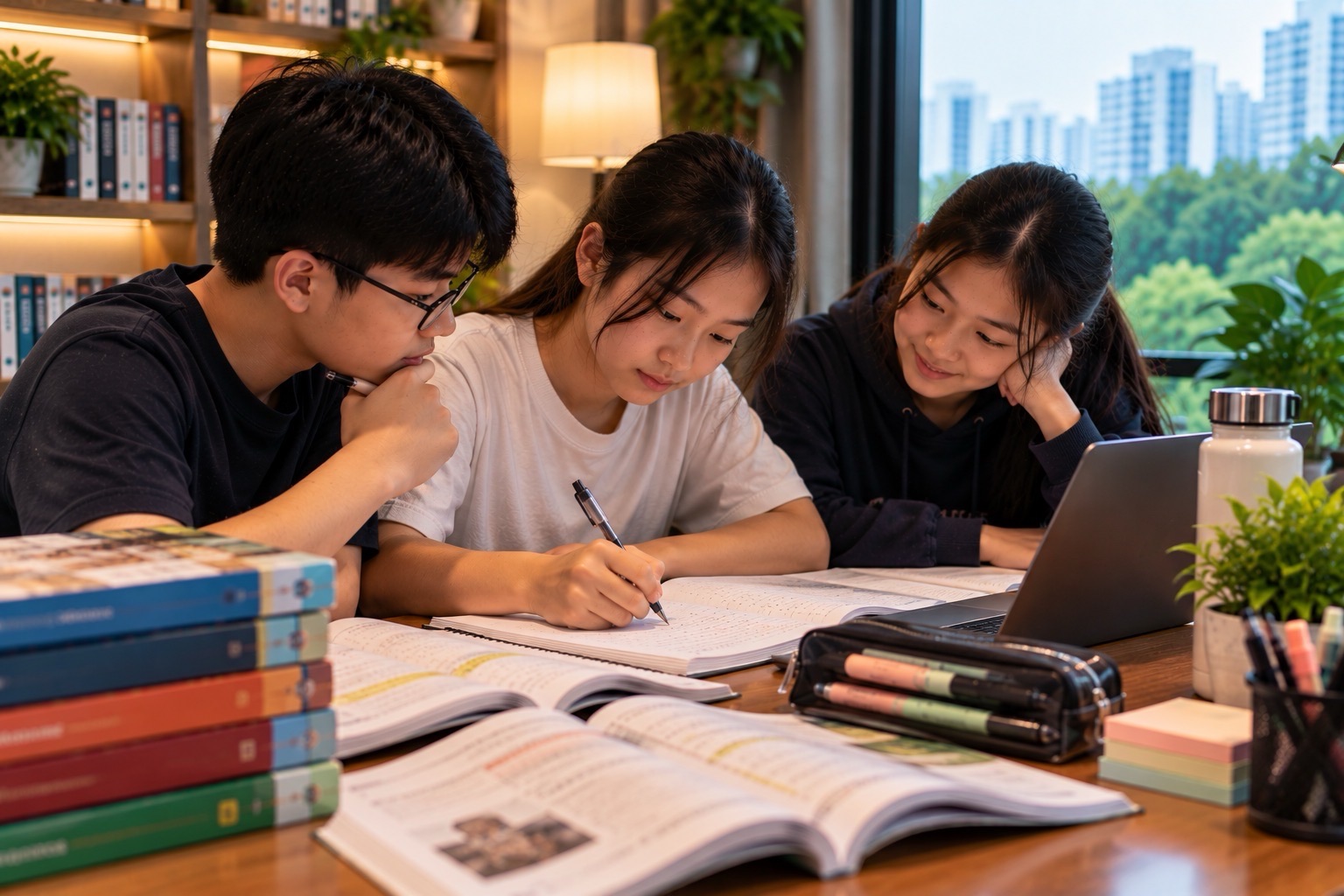
Finding a Physics tutor in Gabon should begin with the learner’s actual school year, baccalauréat series and first important misunderstanding. Students in série C or série D share scientific foundations, but a responsible tutor checks their own programme and current examination instructions before claiming that the two routes use exactly the same preparation.
Families in Libreville, Port-Gentil, Franceville, Oyem, Lambaréné, Mouila, Tchibanga or elsewhere can evaluate a prospective professeur particulier de physique-chimie by asking for one diagnostic lesson built around real schoolwork. This guide explains the current public baccalauréat context, offers an original momentum problem, and presents a four-week progress review. It is independent educational guidance, not a claim of an eduKate teaching centre or verified local tutor network in Gabon.
Quick answer: choose a tutor who verifies the série and examination year
The Gabonese Press Agency’s report from Mouila on 14 July 2026 records candidates registered across the baccalauréat general series, explicitly including A1, A2, B, C and D in the area. A separate Port-Gentil report for the 2026 session also lists those streams. These contemporary records establish the use of series labels; they do not establish one common Physics paper or the coefficient attached to each candidate.
A 15 July 2026 report from Tchibanga describes the national examination schedule including sciences physiques later that week. Its dates belong to the 2026 session, not a future-year syllabus. The learner’s own school and the Direction générale des examens et concours (DGEC) should supply the currently applicable subject entry and paper rules.
Parents should be careful with older revision handouts labelled ‘Bac C’ or ‘Bac D’ and with practice papers from foreign examinations. A teacher can use an international explanation of Newton’s laws or conservation of energy, but should not declare it a precise match for the Gabonese syllabus without checking the school programme.
The Gabonese Press Agency’s 5 September 2026 education report says the authorities published a 2026–2028 approved-textbook list covering school levels and vocational education. This gives parents an additional reason to ask whether the tutor is using approved, suitable materials rather than an unexamined commercial packet. A textbook approval list is not itself the examination mark scheme.
Original worked example: what happens when two model carts collide?
Imagine a completely fictional, idealised track problem. Cart A has mass 0.60 kg and moves horizontally to the right at 4.0 m/s. Cart B has mass 0.40 kg and is initially at rest. In the exercise the carts collide and stick together. Assume the collision is brief and that external horizontal forces can be neglected over that interval. The numerical model is not a physical experiment to carry out with improvised apparatus.
Step 1 — identify the conserved quantity. During the short collision the total horizontal momentum of this isolated two-cart system is conserved. Momentum equals mass × velocity and has unit kg·m/s. Velocity direction matters, so choose the rightward direction as positive.
Step 2 — calculate initial momentum. pbefore = (0.60 kg × 4.0 m/s) + (0.40 kg × 0) = 2.40 kg·m/s rightwards. The stationary cart contributes zero initial momentum, but its mass still matters after the collision.
Step 3 — calculate the common velocity after the carts stick. Total mass after collision is 0.60 + 0.40 = 1.00 kg. Conservation gives (1.00 kg)v = 2.40 kg·m/s, so v = 2.40 m/s to the right. A student who reports 4.0 m/s has overlooked the stationary mass that joins the moving system.
Step 4 — compare kinetic energy. Before collision, kinetic energy is ½ × 0.60 × 4.0² = 4.80 J. After the carts stick, kinetic energy is ½ × 1.00 × 2.40² = 2.88 J. The difference is 1.92 J. Kinetic energy is not conserved in a perfectly inelastic collision, even though total energy still is.
Where did the energy go? In a realistic collision, deformation, sound, internal heating and other transfers can account for the missing translational kinetic energy. The simplified problem does not specify what fraction enters each process. Saying ‘momentum is conserved’ does not mean ‘kinetic energy must stay constant’.
Step 5 — examine impulse. Cart B gains momentum 0.40 kg × 2.40 m/s = 0.96 kg·m/s rightwards. Its impulse is therefore +0.96 N·s. Cart A’s change is 0.60 × (2.40 − 4.0) = −0.96 N·s. Equal and opposite changes match Newton’s third-law picture within the model.
Step 6 — estimate average force. If the modelled collision contact lasts 0.080 s, average force magnitude is impulse divided by time: 0.96/0.080 = 12 N. The force on A acts leftwards and on B rightwards during contact under the chosen sign convention. The average is not a prediction of the maximum instantaneous force.
Transfer A — change the stationary cart. If Cart B has mass 0.80 kg instead of 0.40 kg, with the same initial 0.60 kg cart at 4.0 m/s and sticking outcome, final common speed becomes 2.40/(0.60 + 0.80) ≈ 1.71 m/s. Adding more stationary mass reduces the final speed while conserving total momentum.
Transfer B — consider an ideal elastic collision instead. If the original 0.60 kg and 0.40 kg carts collide elastically in one dimension, both momentum and kinetic energy are conserved. In that separate hypothetical model the familiar elastic-collision expressions give 0.80 m/s for Cart A and 4.80 m/s for Cart B, both rightwards. The kinetic energies then sum to approximately 4.80 J. This is a different physical assumption, not a correction to the earlier sticking result.
Check the elastic-case momentum: 0.60 × 0.80 + 0.40 × 4.80 = 0.48 + 1.92 = 2.40 kg·m/s. Checking both conservation laws makes it harder to confuse elastic and inelastic cases when a new question appears.
What this collision problem reveals about a student’s learning
One pupil may calculate momentum without direction signs. Another assumes that conservation of total energy means kinetic energy cannot change. A third uses a value of 2.4 but writes N instead of m/s. A fourth divides impulse by mass rather than time when finding average force. A good tutor does not merely underline an incorrect numerical answer; they identify the missing link.
Ask the student to draw the two carts before and after, choose one direction as positive, and name which physical law is being applied. Only then calculate. A stronger learner should explain why the assumption of negligible external impulse makes momentum conservation valid and when external forces would need to be included.
For earlier secondary years, it may be more appropriate to begin with force, motion and energy language without the full elastic-collision extension. A skilled tutor changes the difficulty to fit the student’s actual school programme instead of making every pupil learn a prestigious-looking advanced derivation.
Practical science must remain separate from unsafe demonstrations
Measurements of motion can be studied with school-approved low-mass equipment, simulation data or teacher-provided videos. The student can work on time measurement, velocity estimates, repeated trials and a force–time graph, identifying the impulse as the area under the graph when relevant.
Real collisions may include external friction, different contact durations, imperfect adhesion and measurement uncertainty. These should be discussed openly. If a trial does not match the idealised calculation, the learner should not invent numbers so that the final answer looks more like the textbook.
This guide is not permission to stage collisions involving bicycles, vehicles, uncontrolled rolling objects or public spaces. The safest approach to this question is a calculation, simulation or suitably supervised educational apparatus.
Choosing a tutor who fits the actual learning need
Ask to see how the teacher handles one uncorrected Physics answer from school. A student lacking algebra or sign conventions might need a small number of focused repair lessons. Another student may already understand momentum but need more consistent writing, cross-checking and timed questions. The tutor should explain why the plan will differ.
Private tutoring can provide intensive support for a specific gap. Carefully managed small groups can make reasoning visible if every learner still writes their own solution. Exam revision sessions are most helpful when the basic concepts are stable. In every arrangement, compare fees, marking, class size, location, travel or internet needs and the student’s overall workload.
Questions to ask before starting Physics tuition in Gabon
- Programme: Which current baccalauréat série or earlier class does this tutor actually teach?
- Year: Can the teacher distinguish the 2026 historical timetable from instructions for the student’s future sitting?
- Learning: Can the tutor explain why momentum conservation and kinetic-energy conservation are not identical claims?
- Diagrams: Will the student draw directions and state assumptions before calculation?
- Practical work: How are measurement, uncertainty, graphs and evidence taught with safe apparatus or data?
- Materials: Are current approved school books considered rather than relying exclusively on commercial photocopies?
- Arrangements: What are the exact fee, lesson duration, group size, marking practice, cancellation rules and communication channels?
- Evidence: What new problem should the student solve without hints by the fourth week?
Gabon: distinguish série C and D before selecting an advanced Physics teacher
A prospective professeur particulier de physique-chimie should first ask for the learner’s lycée level, actual série, 2026–2027 programme and the school assignment that triggered the request. Gabon’s July 2026 baccalauréat reporting establishes the presence of distinct examination series, while the 5 September 2026 homologated textbook notice records a curriculum-materials framework. Neither is a promise that every série C or D student has identical Physics questions or that an older revision book is the approved current text.
The Gabonese Press Agency’s 10 October 2026 report says education inspectors announced enforcement against schools presenting an unapproved French programme. This concerns the legitimacy of schools and curricular provision; it should not be used to accuse an individual tutor of an offence. It does give families a separate question if an institution claims French-curriculum status: what recognised programme does the pupil actually follow, and which school or authorised body supplies the relevant documents?
Choosing the learning target should come before choosing lesson count. A pupil struggling with scientific notation and diagrams may need a ten-minute Mathematics bridge before any advanced waves or mechanics task. An exam candidate with secure fundamentals may instead need course-aligned interpretation of unfamiliar evidence and timed explanations. A useful tutor can show exactly which ability was missing in a marked answer and set a specific independent retest.
Second original worked problem: a fictional acoustic echo
The original worked Gabon guide uses two carts that collide, teaching signed momentum and loss of translational kinetic energy. To check a different topic, consider a fictional, idealised sound-wave echo model inspired only by the idea of outdoor acoustics. A sound source and receiver are imagined at one position; a distant perfectly reflecting wall lies directly ahead along a straight line. Set the speed of sound uniformly to 340 m/s for the teaching problem and suppose a pulse’s echo returns after 0.80 second. This is not an environmental measurement in Gabon, a surveying technique or a procedure to create loud sound.
First ask the pupil to draw the path in two parts: the pulse travels from source to reflector and then returns from reflector to receiver. The total path is therefore twice the one-way separation d, assuming equal outbound and return lengths. That geometric distinction must be stated before the equation. A learner who multiplies 340 m/s by 0.80 s and calls 272 m the wall distance has calculated the total out-and-back path, not the one-way separation.
The model total path length is v × t = 340 m/s × 0.80 s = 272 metres. The reflector is at d = vt/2 = 272/2 = 136 metres from the imagined source. The answer carries metres, a distance unit. If it is labelled ‘136 m/s’, the child has not interpreted the requested physical quantity even though the arithmetic is correct.
Independent checks: which part of the travel took half the time?
With the reflector 136 m away, the outward travel time is 136/340 = 0.40 second, and the return travel time is another 0.40 second. Their sum is the given 0.80-second echo interval. This back-substitution makes it harder for a student to leave an unexplained factor of two in the result. Ask why the two one-way times match under the assumptions rather than simply marking the number correct.
The sound pulse emission and reception are events at different times; the pulse travels through a medium between them. The echo delay is not the period of a sound wave. Even when a sound has a repeating frequency, the time for one oscillation is a separate physical quantity. Conflating the delay of a returning signal with an oscillation period can mislead students in both waves and electrical signal chapters.
What if the echo arrives in 1.20 seconds?
Keep speed and ideal reflection conditions fixed, but change the invented echo interval to 1.20 seconds. Now d = 340 × 1.20/2 = 204 metres. The reflector is farther away. Because speed is constant, 1.20/0.80 = 1.5 times as much travel time implies 1.5 times as much one-way distance. Ask the pupil to predict ‘farther’ and the ratio before doing calculator operations.
What if the reflector is at 272 metres?
In a different variation, place the imaginary reflector 272 m from source, twice the original 136-m separation. The sound must cover 544 m out and back. Echo interval is 544/340 = 1.60 seconds, twice 0.80 s. A student who says 0.80 s after moving the reflector farther away has not tracked the geometry or controlled parameter.
Frequency and wavelength: a different wave question
Now specify that the invented sound pulse contains a repeating component of frequency f = 680 Hz. At the same assumed propagation speed of 340 m/s, the wavelength is λ = v/f = 340/680 = 0.50 metre. This is the distance between equivalent wave phases in the model, not the 136-m separation to the reflector. Frequency describes cycles per second, while wavelength describes spatial cycle spacing.
The corresponding oscillation period is T = 1/f = 1/680 s ≈ 0.00147 s = 1.47 milliseconds. Compare that 1.47-ms wave period with the 800-ms echo delay. One is the local cycle duration, the other the signal’s full travel interval. A tutor should insist that the learner name both concepts and convert units rather than treat all times as interchangeable.
The ideal out-and-back travel path contains 272 m / 0.50 m = 544 wavelengths. Alternatively, during the 0.80-s interval, a 680-Hz repeating component completes 680 cycles/s × 0.80 s = 544 cycles. The two checks agree because v = fλ. A child who understands this can connect distance, time and wave periodicity without reducing the chapter to isolated definitions.
Change pitch, but do not invent a change in sound speed
Double the invented source frequency from 680 to 1,360 Hz, keeping the same ideal material and assumed speed. The new wavelength is 340/1,360 = 0.25 m, half the original, and period becomes about 0.735 milliseconds. The echo from the same 136-m reflector still returns after 0.80 second under the unchanged propagation-speed assumption.
A common misconception is that a higher-pitched sound must travel faster through the same medium. Our non-dispersive teaching model assumes the speed stays fixed, while frequency and wavelength vary inversely. Real sound can be influenced by medium, temperature and other physical conditions; the student should not use the example to predict the speed of every sound in every environment.
Change propagation speed while the geometry remains fixed
Keep the source and imagined reflecting surface 136 m apart, but use a different hypothetical uniform sound speed of 344 m/s while preserving the straight path. Echo delay becomes t = 2 × 136/344 ≈ 0.791 seconds, a little shorter than 0.80 s. At a fixed 680-Hz frequency, the wavelength becomes 344/680 ≈ 0.506 m. The pupil should predict ‘shorter delay, slightly larger wavelength’ before calculation.
This is an ideal comparison with a stipulated speed change, not a quantitative forecast of a tropical forest temperature or humidity. The speed of sound depends on conditions and medium; if the task does not supply that relationship, the tutor should not manufacture a temperature or wind-speed estimate.
Two echoes can reveal a separation between reflectors
Imagine another fictional situation where a source hears two distinct echoes returning at 0.60 s and 1.00 s, both modelled along one straight line with v = 340 m/s. The corresponding one-way reflector distances are 340×0.60/2 = 102 m and 340×1.00/2 = 170 m. Their separation along the assumed direction is 170 − 102 = 68 metres.
These distances are inferable only under the particular straight-ray and constant-speed assumptions. Two real echoes might follow different paths or reflect in complex ways. An advanced pupil should be asked what additional evidence would be needed to locate two real reflectors; the model is an exercise in reasoning, not a geolocation or hazard-detection procedure.
The graph’s slope depends on which variable sits on which axis
Take the model echo-delay and reflector-distance pairs (0 m,0 s), (68 m,0.40 s), (136 m,0.80 s), (204 m,1.20 s). If reflector separation d is horizontal and round-trip time t vertical, the line is straight with gradient Δt/Δd = 2/v = 2/340 ≈ 0.00588 seconds per metre. The factor two appears because the echo travels in both directions.
| One-way separation | Total round-trip path | Predicted echo delay |
|---|---|---|
| 68 m | 136 m | 0.40 s |
| 136 m | 272 m | 0.80 s |
| 204 m | 408 m | 1.20 s |
| 272 m | 544 m | 1.60 s |
If the axes are reversed so distance is vertical and time horizontal, the gradient becomes v/2 = 170 m/s, not the actual sound speed of 340 m/s. The plotted distance is only one-way separation while elapsed time represents a round trip. A student who says the new gradient proves sound has slowed by half has forgotten what each variable represents.
The entries are calculated classroom values, not field data collected in Gabon. In a real supervised investigation, measured pulse delays would involve timing resolution, geometry, multiple reflections and uncertainty. A tutor should teach the learner to identify those limits rather than copy a perfect graph into an authentic lab report.
Combine the two Gabon worked problems without conflating physical laws
In the existing momentum example, a collision conserves total signed linear momentum under an isolated-system approximation while translational kinetic energy falls. In this echo example, a sound pulse propagates through a stipulated medium and can be represented using speed, wavelength and frequency. Both demand a labelled physical system and consistent units, but the correct equations and conservation questions differ.
A pupil might handle a collision diagram but misuse echo round-trip geometry. Another may be precise with v = fλ but confuse kinetic energy and momentum. The tutor should record the first error in each topic, identify shared Mathematics issues and choose one immediate target rather than assign all possible wave and force problems indiscriminately.
A 90-minute Gabon tutoring trial: turn the first mistake into an independent answer
Start with the pupil’s own assigned course and one marked response from série C, série D or a younger Science level. Give a short unseen problem and watch whether the student reads the quantities, diagram and requested output before calculating. The tutor should identify the first unreliable inference: an unclear coordinate direction, reciprocal, metric prefix, graph axis or misapplied physical rule.
Reserve part of the session for an explanation and an original worked model, then require the pupil to solve a changed case without the model solution visible. Finish with a graph or evidence question, an appropriate self-correction and one small practice task. If the student only watches the adult work, a polished tutorial has not yet demonstrated independent learning.
Ask the provider about verified subject training, fees, marking policy, group size, lesson duration, accessibility, travel and cancellation conditions. Where a school claims to teach a French programme, check the recognised school status as a separate institutional question; an individual tutor’s ability should be judged by the real course and teaching evidence.
Eight questions a Gabon parent can use immediately
1. Which current lycée year and baccalauréat series is the learner enrolled in? 2. Does the tutor use a suitable 2026–2028 homologated or otherwise school-approved book and verify assessment guidance? 3. Can the child distinguish one-way distance from an echo’s out-and-back path? 4. Does the teacher diagnose a marked error before prescribing a large question-bank package?
5. Does instruction include graphs, physical evidence, uncertainties and safe science habits? 6. Can the pupil predict the effect of changed speed, distance or frequency without copying a formula prompt? 7. Are provider credentials, cost, homework marking, scheduling and safeguarding arrangements clear? 8. Will a different unseen question after four weeks show whether the learner has become more independent?
A four-week science learning plan with a clear stopping rule
Week 1 — verify and diagnose. Obtain the actual lycée Physics-Chemistry unit, series and marked work. Ask for an unseen diagram and a short unit conversion. Record the first wrong decision, not only the total mark, and agree on one measurable learning target.
Week 2 — repair the target concept. For a waves unit, use the fictional 340-m/s echo model and ask the pupil to explain the factor of two and distinguish wave period from echo time. For mechanics, revisit the existing collision model and signed momentum. Provide a changed question without the original solution visible.
Week 3 — vary one condition and interpret evidence. Change echo distance, then speed or source frequency separately. Draw the appropriate graph and ask what its slope measures. Revisit one previously studied topic to check retention rather than performance immediately after the demonstration.
Week 4 — independent transfer. Use a new course-aligned wave or momentum question. Require a labelled representation, qualitative prediction, chosen law, correct units and one model limitation. A useful report specifies what is now secure and what remains weak. Further tuition should depend on that evidence, not a guaranteed bac mark.
Short Gabon Physics parent FAQ
Are série C and D always the same Physics examination?
No such universal claim follows from the official reporting. The educational series are distinct; the student’s subject, current syllabus and assessment arrangements must be confirmed through the school and examination authorities. An old foreign exercise can support a shared concept without being an exact paper specification.
Does a homologated textbook list guarantee an individual teacher is qualified?
No. The 2026–2028 textbook list concerns approved learning materials, not an individual’s teaching competence. A tutor should also demonstrate knowledge of the actual course and explain a marked problem accurately.
Does the fictional echo diagram describe a real Gabonese environment?
No. Its sound speeds, distances and timing values are invented for Physics learning. They do not locate a real reflecting surface, predict forest acoustics or provide safety guidance.
Official sources and connected eduKate Physics learning
Start with the 2026 baccalauréat reporting, the 2026–2028 educational textbook framework, and the October 2026 notice on French-programme school approvals. Each serves a different purpose; obtain the real student’s latest official course requirements before selecting preparation.
For prerequisite support see Mathematics Tutor | Gabon, Science Tutor | Gabon, How Science Works and the World Physics directory. eduKateSG’s teaching operates in Singapore; this article does not claim locally employed tutors or a Gabon tuition centre.
Four weeks of Physics learning that can be measured
Week 1 — check the syllabus and diagnose. Collect the student’s current school option and teacher outline. Ask for a simple before-and-after collision sketch and a short question on momentum. Record whether the first difficulty is direction, physical concepts, units or algebra.
Week 2 — rebuild conservation reasoning. Work from the two-cart diagram to initial and final momentum. Then compare kinetic energy and explain the difference between elastic and sticking collisions, only at a suitable student level. Review the idea after a short delay.
Week 3 — deliberately change the problem. Increase the stationary mass, change the direction of one cart and introduce a modest force–time data table. Ask the learner to predict trends without calculations first, then justify numerical answers.
Week 4 — test independent application. Give a new unfamiliar momentum problem that requires choosing an appropriate model, showing a directional sign, checking units and explaining an assumption. Compare performance with the first task and agree on the next precise objective.
A meaningful parent report might say: ‘The learner first assumed kinetic energy is conserved whenever momentum is conserved; now they distinguish elastic from inelastic collisions and solve an unseen two-cart problem with correct signs.’ That is better evidence than a guaranteed bac mark.
Frequently asked questions about Physics tutoring in Gabon
Are baccalauréat C and D the same Physics course?
Official 2026 reporting distinguishes C and D as separate candidate series. Their exact current Physique-Chimie scope and paper requirements must be checked through the student’s school and DGEC. Do not assume an identical paper based on the common word ‘science’.
Do approved textbooks automatically predict the examination?
No. A 2026–2028 approved-textbook list establishes an educational materials framework. It is not a paper blueprint and does not disclose future questions. The teacher should still use the current school learning outcomes and official examination guidance.
Can a tutor promise a pass after four weeks?
A responsible tutor can demonstrate improvement in diagrams, conservation reasoning, calculations and independent work. An examination result depends on many factors and should not be guaranteed.
Official references and connected eduKate guides
Use the Gabonese Press Agency’s July 2026 account of the C/D baccalauréat series, the 2026 examination session report, and its September 2026 report on 2026–2028 approved textbooks. Consult the learner’s school and relevant exam authority for live registration and syllabus information.
Complementary eduKateSG resources are Science Tutor | Gabon, Mathematics Tutor | Gabon, How Science Works and the World Physics Tutor Guides directory. They connect topic foundations to country-specific tutor selection.
Editorial note, 17 October 2026: The collision masses, velocities, contact time and calculated energy transfers are hypothetical school Physics data, not measurements from Gabon or plans for a physical experiment. Historic 2026 reports do not determine future paper formats. eduKate’s in-person small-group teaching is in Singapore; no Gabon branch or local tutoring availability is represented.
World Tuition navigation: World Tuition Master Hub. These educational country guides do not imply local eduKate tutors, fees or teaching-centre availability.