
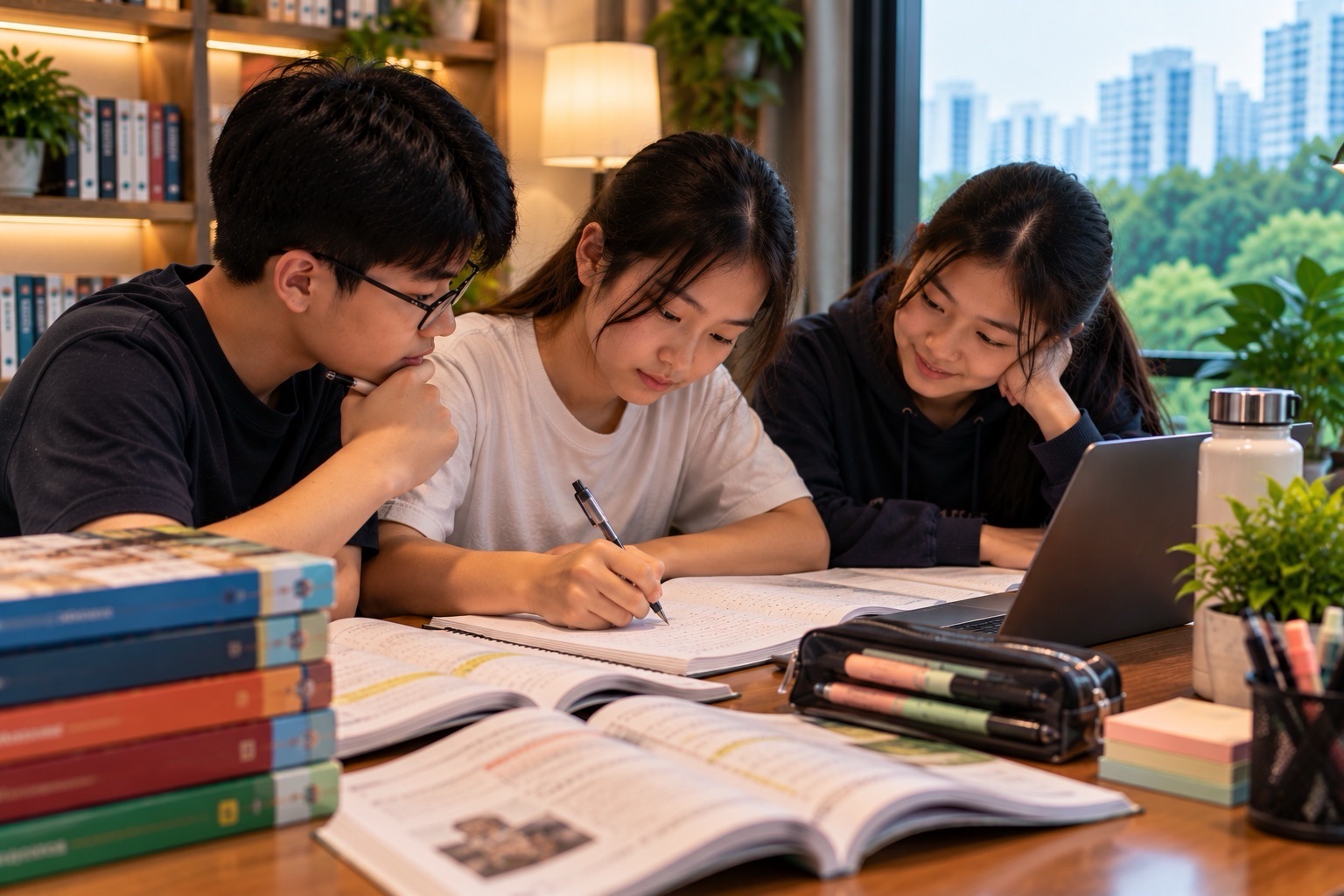
Choosing a Physics tutor in Venezuela becomes easier when a family starts with the learner’s real schoolwork, year of study and current Educación Media General or technical pathway. A search for clases particulares de física, profesor de física 4to año, física 5to año bachillerato or science support in Caracas, Maracaibo, Valencia, Barquisimeto or Mérida may describe quite different learning needs.
A strong tutor does not immediately sell a bundle of examination-style worksheets. The first conversation should identify whether the student is struggling with interpreting a force, measuring an angle, rearranging an equation, using a graph, or explaining a result in Spanish. These are different obstacles. The best teaching addresses the first incorrect step, then checks whether the learner can solve an unfamiliar version without hints.
This guide explains how to navigate Venezuela’s Ministry of Education information without inventing a national Physics paper, includes an original worked energy-and-motion example, and offers parent questions, practical learning advice and a four-week progress review. Its illustrations are hypothetical teaching problems, not measurements of Venezuelan schools or equipment.
Venezuela’s school-year and curriculum context: what parents should confirm
Venezuela’s Ministerio del Poder Popular para la Educación (MPPE) curriculum-management guidance describes the planning, organisation, teaching and assessment of school learning. Its published explanation names science, technology, Mathematics, languages and the environment among the central learning areas and emphasises competencies, investigation, critical thinking and the varied needs of students.
For a student in Educación Media General, it matters whether their present lessons are in an introductory year or the later years of bachillerato. Physics may be taught alongside Mathematics, Chemistry, Biology and broader natural-science work. However, schools can vary in teaching sequence and the practical activities assigned. Before buying tutoring, ask for the student’s actual school plan, the latest graded Physics work and the teacher’s expectations for that term.
An MPPE announcement dated 11 September 2025 described science-focused teacher professional development in natural sciences and teaching methods. That is evidence of a real governmental learning emphasis, but it is not a 2026–2027 Physics examination blueprint. Similarly, a school textbook labelled ‘Física 4to año’ or ‘Física 5to año’ needs to be matched to the current classroom’s actual programme, not treated as proof of a single nationwide final exam.
A learner in technical secondary study may benefit from applied electricity, measurement, mechanics and material behaviour, while a general secondary learner may need strong foundational modelling and Mathematics. Do not relabel a Venezuelan Bachillerato qualification as Singapore’s GCE, A-Level, ITE or polytechnic programme. If the family is planning university study, check the admission requirements of the particular Venezuelan or overseas institution directly.
The critical practical distinction is between a school assessment, a course grade, and a university selection process. A credible tutor should state which one their lessons actually prepare the student for. No tutor can guarantee a diploma, a university place or the format of an examination without an applicable official notice.
Original Physics diagnostic: a fictional cart rolling down a ramp
Imagine a fictional laboratory cart with mass 3.0 kilograms, released from rest on a smooth track. Its vertical starting height is 1.20 metres above the lowest reference point. Use g = 10 N/kg in this teaching model, assume the cart’s wheels contribute negligible rotational energy, and initially suppose there is no friction or air resistance. This is not a specification for a real roller coaster, school apparatus or transport system.
The first question is about gravitational potential energy, not horizontal distance. Relative to the lower point, the initial gravitational energy is E = mgh = 3.0 × 10 × 1.20 = 36 joules. A learner who substitutes the length of the slope for its vertical height has misidentified the quantity in the model, even if the multiplication is correct.
Under the ideal assumptions, the 36 joules are converted into translational kinetic energy at the bottom. Set ½mv² = mgh. Therefore ½ × 3.0 × v² = 36, giving v² = 24 and v ≈ 4.90 m/s. The answer is a speed, so it should not be labelled joules, newtons or metres per second squared.
A good tutor asks the child to predict before calculating: if the cart’s mass doubles but the start height stays the same, what happens to the bottom speed? In the ideal model, mass cancels from ½mv² = mgh, so the speed remains about 4.90 m/s. Initial gravitational energy doubles with mass, but so does the mass in the kinetic-energy expression. This makes the problem a useful test of proportional reasoning.
Next, change the model: imagine that, across the descent, 25% of the initial mechanical energy is transferred to thermal or other forms, with the remaining 75% becoming the cart’s translational kinetic energy. The useful final kinetic energy is 0.75 × 36 J = 27 J. Then ½ × 3.0 × v² = 27, so v² = 18 and v ≈ 4.24 m/s.
Notice that the speed has not fallen to 75% of the ideal speed. Because kinetic energy depends on v², the ratio of speeds is √0.75 ≈ 0.866. A learner who simply multiplies 4.90 m/s by 0.75 is treating speed and energy as though they had a linear relationship. That is the kind of error a tutor should explain, not merely mark incorrect.
The same fictional cart released from only 0.30 metre above the bottom would have an ideal bottom speed of √(2 × 10 × 0.30) ≈ 2.45 m/s. The height is one-quarter of 1.20 m, and the ideal speed is half of the former value. Ask the student to explain why a quarter of the energy produces half of the speed, rather than one-quarter.
A useful diagram should label the vertical height, motion direction, gravitational force, track and the selected zero-energy reference. This is not a question about an actual Caracas or Andean road, and the learner should not use the invented result to make real-world vehicle-safety claims. The physics lesson is about assumptions, model selection and dimensional reasoning.
How a Physics tutor can spot the hidden mistake
The ramp task contains several distinct diagnostic checkpoints. If a learner writes ’36 N’, they have confused energy with force. If they put 1.20 metres into an equation as a time, they have failed to identify the quantity. If they choose the square of 4.90 as an acceleration, they need a clearer understanding of the relation between kinetic energy and speed.
A student who can calculate the ideal speed but cannot explain why mass cancels may be following an algorithm rather than reasoning. In that case, ask them to compare a light and a heavy cart in the same hypothetical model before allowing any algebra. A student who mishandles the 75% energy share needs practice distinguishing output energy from the fraction lost.
The purpose of the diagnostic is to agree on one small, observable improvement. ‘The student can now draw the system and distinguish energy from speed in a fresh problem’ is a better goal than ‘Complete 100 numerical questions this week’. Repetition is useful after an idea is understood, but excessive repetition of a flawed method may reinforce the flaw.
Physics practicals and Mathematics need to work together
Practical understanding can be built with teacher-supervised small carts, animations or carefully documented data. The student could compare starting height and measured speed while discussing instrument uncertainty, possible friction and the limits of the ideal model. It is not necessary to improvise risky apparatus or use unsupervised ramps simply to recreate this example.
A graph of v² against height h in the ideal case would be straight, with gradient 2g, about 20 m/s² for the chosen value of g. A graph of v against h is not straight. Ask the student to explain why the first representation reveals the relationship more clearly.
Mathematics prerequisites often include decimals, scientific notation, squared and square-root relationships, rearranging formulas, interpreting a slope and checking units. The tutor should repair each skill inside a meaningful Physics question. An entire separate mathematics course may be unnecessary when the issue is a single unit conversion; it may be appropriate if the gap is broad.
For younger learners, the lesson can start with ideas about higher/lower positions, faster/slower motions, fair comparisons and simple recorded measurements. For a more advanced student, explain conservation and energy transfer precisely, then compare the model with measured data. The student’s current school programme determines how far to extend the task.
Eight questions to ask a Physics tutor in Venezuela
- Which grade and course? Can the teacher identify Educación Media General or the student’s actual technical course, subject year and school programme?
- Which learning evidence? Will the tutor inspect a recently marked problem and identify the first wrong inference rather than sell generic worksheets?
- Which current authority? Can the tutor distinguish the MPPE’s curriculum principles from an unverified social-media claim about a new national exam?
- Can the student draw the model? In the ramp problem, ask for a labelled height, force direction and chosen reference level before calculating.
- Can the teacher address Mathematics? Look for accurate explanations of units, energy, percentage loss and the square-root dependence of speed.
- How will practical skills be taught? Ask for safe investigations, measured data, uncertainty and clear treatment of the model’s assumptions.
- What does tuition include? Verify teaching language, fees, group size, homework correction, schedule, transport or connectivity and any missed-lesson policy.
- How will progress be tested? Request a four-week independent task with changed numbers and a simple report on capabilities gained.
Venezuela Physics tutoring: distinguish the school course from a future university route
A family choosing clases particulares de física should first confirm the learner’s present Educación Media General or technical-secondary year, actual school assessment and teaching language. The Ministerio del Poder Popular para la Educación’s curriculum management is a point of reference for institutional guidance, but the family’s immediate evidence should be a current school-issued course plan and a marked question. A tutor’s promise to prepare every fourth- or fifth-year student for the same imaginary nationwide Physics final is not a reliable way to choose help.
A useful teacher will write down one observable difficulty: perhaps understanding the meaning of acceleration, separating vertical height from sloping distance, resolving force direction or distinguishing a practical measurement from a calculated value. Each needs a different exercise. A larger pack of equations does not necessarily help a pupil who has not identified the physical system.
The original fictional ramp example already tests energy conservation and the possibility of friction. To add a distinct diagnostic, consider a topic in geometrical optics at the level appropriate to the student’s actual school curriculum. Optics demands a diagram, a model, inverse relationships and careful interpretation of a positive or negative image distance. A tutor should check prerequisites before using this more mathematically demanding exercise.
Second original diagnostic: image formation by an imaginary converging lens
Imagine a fictional thin converging lens in a classroom diagram, with focal length f = +0.20 metre. A small upright object of height 8.0 centimetres stands on the optical axis at an object distance of u = +0.60 metre. Assume a thin lens in air under the paraxial approximation, a real upright object, and a sign convention where a real image beyond the lens has positive image distance. These are invented teaching inputs, not measurements of real optical equipment.
First draw the optical axis, lens plane, focal points on either side and the object arrow. Since the object lies beyond twice the focal length, a learner should predict a real, inverted and smaller image on the far side of this ideal converging lens. The tutor should require that prediction before calculation. A correct number obtained from an unlabelled diagram is weaker evidence of physical understanding.
Use the stated thin-lens relation 1/f = 1/u + 1/v. Here 1/0.20 = 5.0 m⁻¹, and 1/0.60 ≈ 1.667 m⁻¹. Therefore 1/v = 5.0 − 1.667 ≈ 3.333 m⁻¹, giving v = +0.30 metre. The positive result describes a real model image on the opposite side of the lens.
The lateral magnification is m = −v/u = −0.30/0.60 = −0.50. The image’s signed height is h(image) = mh(object) = −0.50 × 8.0 cm = −4.0 cm. The magnitude is four centimetres, and the negative sign identifies an inverted image under the stated axis convention; it does not mean the physical length itself is an impossible negative amount.
A student who writes ‘−4.0 cm therefore no image exists’ is confusing a signed coordinate with a length magnitude. Another who adds 0.20 and 0.60 directly to find image distance has ignored the reciprocal form of the lens law. A tutor should locate which physical or mathematical interpretation failed before prescribing more questions.
Change object distance to make the real image larger
Move the same imaginary 8.0-cm object from 0.60 m to u = +0.30 metre while retaining f = 0.20 m. Then 1/v = 1/0.20 − 1/0.30 = 5.0 − 3.333 ≈ 1.667 m⁻¹, so v = +0.60 m. Magnification is −0.60/0.30 = −2.0, and signed image height is −16.0 cm.
The image is now real, inverted and larger. The object was brought closer to the lens while remaining outside the focal length; the real image forms farther away and is more magnified. The learner should predict that trend before seeing the reciprocal calculation. Repeating the old 0.30-m image distance would reveal dependence on memorised numbers rather than an understood relationship.
For a related numerical check, if u becomes +0.40 m, which is twice f, the image also forms at +0.40 m and magnification is −1.0. The object and image have equal magnitude heights but the image is inverted. The special case helps pupils connect the focal-point geometry with an algebraic result.
Place the object inside the focal length: the image becomes virtual
In a separate hypothetical configuration, set object distance u = +0.10 m, inside the lens’s +0.20-m focal length. The lens relation yields 1/v = 5.0 − 10.0 = −5.0 m⁻¹, so v = −0.20 m. Under our convention, the negative image distance indicates a virtual image on the object’s side of the lens, not a real image on a screen behind it.
Magnification becomes m = −(−0.20)/0.10 = +2.0, and image height is +16.0 cm. It is upright and enlarged in the ideal lens model. A learner who mechanically declares every converging-lens image inverted has failed to consider whether the object is outside or inside the focal distance.
At exactly u = f in the ideal thin-lens relation, 1/v = 0. Parallel emerging rays correspond to an ideal image at infinity; there is no finite screen position in the model. A tutor should teach that this is a limiting behaviour, not an instruction to divide by zero and report zero metres.
A ray diagram can check the calculation without a calculator
A useful ray construction begins with one ray through the lens centre in the ideal thin-lens drawing, which continues without angular deflection in the paraxial approximation, and a second ray initially parallel to the optical axis, which refracts through the far focal point. Their meeting point identifies a real-image location for the object outside f. For the object inside f, the emerging rays diverge and their backward extensions locate the virtual image.
The diagram need not be a perfect laboratory-scale drawing, but it must show the object, lens, axis, focal points and image orientation consistently. A pupil who writes the correct lens equation but draws an upright real image for u = 0.60 m should be asked to reconcile the physical claim rather than merely copy the numerical answer.
These classroom ray rules apply within an ideal thin-lens model. Real lenses have thickness, aberrations, imperfections and finite apertures. The exercise is suitable for learning physical reasoning and not a specification for optical instruments or any direct viewing of the Sun or concentrated light.
Use focal length and optical power carefully
For the first fictional lens, the optical power is P(optical) = 1/f, with focal length measured in metres. Thus P(optical) = 1/0.20 = +5.0 dioptres. The positive sign corresponds to a converging lens under the usual convention. Dioptres are reciprocal metres, not watts or joules; the same letter P may denote different physical quantities in different topics.
Now choose another imagined converging lens with f = +0.25 m. Optical power becomes +4.0 dioptres, lower than +5.0 D. A student who assumes a longer positive focal length means greater lens optical power has reversed an inverse relationship. Ask for a prediction before carrying out the division.
When real optical data are measured, uncertainty in focal distance and object alignment affects the result. An advanced student can discuss how small errors in u or f can produce large variations in v when the object lies close to the focal length. That is a lesson in sensitivity and model limitations, not proof that the lens formula is wrong.
A simple reciprocal graph reveals whether the learner understands optics
Rearrange the thin-lens model as 1/v = 1/f − 1/u. If a pupil plots 1/v vertically against 1/u horizontally for one fixed lens, the ideal relationship is a straight line of slope −1 and vertical intercept 1/f = +5.0 m⁻¹ for our original lens. A graph of the untransformed v against u is not generally a straight line.
Ask the learner to place the original real-image results into a table. For u = 0.60 m, 1/u ≈ 1.667 m⁻¹ and 1/v ≈ 3.333 m⁻¹. For u = 0.40 m, both reciprocals equal 2.50 m⁻¹. For u = 0.30 m, 1/u ≈ 3.333 m⁻¹ and 1/v ≈ 1.667 m⁻¹. Each ideal pair sums to 5.0 m⁻¹, confirming a consistent focal length.
The numbers are calculated from a mathematical model, not observations measured by a student in Venezuela. A real school practical needs a safe approved light source, sensible instrument resolution, repeated measurements and an honest record of uncertainty. The tutor must never pass off simulated values as measured evidence or demand unsafe optics experiments.
A second context: distinguish a force law from the lens law
The original article’s cart example uses gravitational potential energy, motion and perhaps friction. Our new lens example uses ratios of distances and ray geometry. Both involve a physical model and quantitative predictions, but there is no single universal ‘Physics substitution method’ that replaces identifying the system. The tutor should ask the student to decide why a force equation is appropriate to a cart but not directly to locating an image in a lens.
A learner who handles the cart’s mgh correctly yet struggles with reciprocal distances may need algebra rather than another energy lesson. Another who can manipulate reciprocals but cannot explain real versus virtual images needs conceptual optics. The diagnostic should locate the first error and select the next teaching activity accordingly.
Eight questions for a Venezuela parent–tutor consultation
1. What is the actual Educación Media General or technical-secondary year, present Physics subject and school-issued assessment? 2. Which current Ministry and school documents describe the correct course? 3. Does the tutor start with a genuine marked question to identify the first problem rather than sell a large workbook? 4. Can the learner predict where a converging-lens image forms before using the formula?
5. Are diagrams, SI units, graph transformations and evidence interpretation part of the lesson? 6. Can the pupil handle changed object distances and explain a virtual image with a negative signed v? 7. Are qualifications, fees, group size, homework feedback, language, travel and cancellation arrangements clear? 8. Will an unfamiliar school-aligned task after four weeks determine whether continuing tuition is necessary?
A meaningful ninety-minute Physics trial lesson
Begin with the actual school programme and let the child attempt a suitable diagram-based question independently. The tutor should classify the first wrong idea: confusing image orientation, placing focal points incorrectly, mishandling a reciprocal, or misreading the requested quantity. Repair only that target first with a small example.
Then ask for a changed case with the first answer hidden. The learner should sketch ray directions, choose the lens law, calculate image position and magnification with signed quantities, and explain why the result makes physical sense. Reserve a short part of the session for reading a measurement table or graph rather than turning the entire lesson into adult demonstration.
The session should conclude with one observable skill now performed correctly and a manageable home practice task. A tutor who finishes ten examples while the child only watches does not demonstrate that the learner can solve a new Physics situation independently.
Four weeks of progress rather than an indefinite paid commitment
Week 1: identify the real course and first conceptual or mathematical gap using a recent marked response. Week 2: practise a converging-lens diagram and the f = 0.20-m model, with a new object distance solved independently. Week 3: compare real and virtual images, transform a small reciprocal graph and revisit one earlier cart or motion question. Week 4: give a completely new course-aligned problem, without worked answers, requiring a diagram, prediction, calculation, units and one model limitation.
Useful progress might be described as: ‘The learner used to declare every image from a converging lens real; now distinguishes the object-inside-focal-length case and independently calculates and explains a changed image distance.’ This evidence may justify targeted continuation, reduced lesson frequency or a move back to school feedback and independent study. No tutor can guarantee an examination grade or university place.
Common questions about Venezuela Physics tuition
Does every secondary student follow one national Physics final paper?
Do not assume so. The family’s actual school-issued curriculum, assessment arrangement and any applicable current Ministry notice determine the learner’s task. A tutor’s generic nationwide examination promise requires verification.
Can a lens produce an upright image under an ideal converging-lens model?
Yes. With a real object closer to the lens than its focal length, the ideal image is virtual, upright and enlarged; with an object beyond the focal length, appropriate real inverted images can form. The sign convention and ray diagram matter.
What is the best sign of useful tuition?
The learner can independently draw and interpret an unfamiliar system, choose a law that fits the conditions, calculate with correct units and state what the ideal model omits. A longer question pack is not by itself proof of progress.
Official references and connected eduKate guides
Use the Venezuelan Ministry curriculum-management reference, the current learner’s school teaching plan and official school notices to establish what is studied and when. The Ministry’s earlier natural-sciences professional-development notice shows a subject emphasis, not a future examination-paper specification.
For related understanding use Mathematics Tutor | Venezuela, Science Tutor | Venezuela, How Science Works | Physics and the World Physics country directory. All lens and cart values are fictional educational inputs, not equipment or safety specifications. eduKateSG’s tuition operates in Singapore and does not claim a local Venezuela service.
A practical four-week improvement plan
Week 1 — map the school task and diagnose. Bring the current Physics unit, class exercises and a marked test. Have the learner interpret a short ramp problem without hints. Record whether the first mistake involves a diagram, choice of formula, physical quantity or arithmetic.
Week 2 — build one stable explanation. Teach gravitational and kinetic energy with clear pictures. Solve E = mgh and ½mv², make each unit explicit, and ask the learner to compare different masses at the same height. Check that a new task can be solved without seeing the model answer.
Week 3 — vary an assumption. Introduce the fictional 25% energy loss. Ask for the effect on kinetic energy and then speed. Have the learner interpret a graph of squared speed against starting height and distinguish data from an ideal physical prediction.
Week 4 — retest independently. Present an unfamiliar mechanical-energy question, including one changed height, mass or loss percentage. The student must draw the physical system, predict the result, calculate with correct units and explain at least one model limitation.
A helpful parent report is specific: ‘The learner previously calculated potential energy but treated speed as directly proportional to height. They now explain and solve a changed-height question unaided.’ It is reasonable to reduce tuition once a stable skill has been demonstrated; four weeks are a checkpoint, not an outcome guarantee.
Which tutoring arrangement offers useful value?
One-to-one lessons may help when a student has missed several foundational ideas or needs a specific teaching-language accommodation. A carefully managed small group can help students compare diagrams and explanations, provided the tutor checks each learner’s written solution. A large revision programme may help a well-prepared student with pacing, but can hide a persistent misunderstanding.
Ask about the full burden, not only the quoted hourly fee. Travel, internet access, study materials, homework-marking turnaround, scheduled schoolwork and family finances matter. The teacher should be prepared to recommend school support or independent practice if regular paid lessons are not necessary.
Quick answers for Venezuelan families
Is every Venezuelan Physics learner preparing for the same national paper?
No. The tutor should begin with the student’s current school assessment and subject programme. Do not assume a universal final Physics examination based only on the word bachillerato.
Should a student memorise formulas before drawing diagrams?
Formula familiarity helps, but physical meaning and a labelled representation usually need to come first. A correct equation applied to the wrong height or system can still produce the wrong answer.
Can a four-week tutoring plan guarantee a better school mark?
No. It can provide a measurable review of a defined skill, using an independently solved new question. School marks also depend on the wider assessment and the learner’s ongoing work.
Official sources and related eduKate learning guides
The most direct institutional references are the MPPE’s curriculum-management guidance and its 2025 natural-sciences teacher-training announcement. These resources inform a responsible educational approach but are not a substitute for the actual 2026–2027 teaching plan, school marking scheme or student registration.
For connected learning, use Mathematics Tutor | Venezuela, Science Tutor | Venezuela, How Science Works | Physics, the World Physics Tutor Guides directory and the World Tuition master hub.
Editorial check, 17 October 2026: This article avoids claiming an unverified nationwide 2027 Physics exam schedule. The cart example is entirely hypothetical, with invented inputs and simplified motion. eduKateSG’s premium three-student small-group lessons take place in Singapore; the article does not claim eduKate provides local tutoring in Venezuela.