
Secondary 3 English tuition for families around City Hall, Singapore should help teenagers solve a particular upper-secondary problem: a beautifully written proposal may still fail because it never gives its intended reader a decision to make. The student may describe National Gallery Singapore with enthusiasm yet omit the class activity, learning objective, practical arrangements or permission request. English maturity means making language useful, accurate and persuasive—not simply longer.
The weekday-versus-weekend question should therefore begin with attention for task fulfilment, audience and argument. A manageable weekday after school can support a clear planning-and-revision cycle; a weekend may suit a teenager with late CCA, provided it preserves rest and follow-up work. A tired learner who copies an elegant letter without understanding its purpose is not yet ready to write independently.
The eduKateSG format described is a premium group of up to three students, approximately 90 minutes weekly, at 8 Fourth Avenue, Singapore 268674, near Sixth Avenue MRT. City Hall is the family’s search and travel reference, not an advertised City Hall tuition classroom. Check the pupil’s current G1/G2/G3 English level and available group times before arranging transport.
The historic civic buildings around the Padang offer rich source-based material for practising an actual recommendation, supported judgement and audience-appropriate writing. This is an English learning guide, not an advertisement for a guided museum outing.
The quick answer for Secondary 3 parents
- Weekday: works when school commitments, food and travel leave genuine energy for writing and revision.
- Weekend: works when a busy weekday would impair reasoning and family recovery remains protected.
- Main learning target: purposeful situational writing, developed arguments and supported language-effect explanations.
- Assessment context: check the learner’s G1, G2 or G3 level and relevant 2027 SEC pathway.
- Actual venue: approximately 90-minute tutorials with up to three students at 8 Fourth Avenue near Sixth Avenue MRT.

Contents
- 1. The opening paragraph that sounds good but does not answer the brief
- 2. What changes in Secondary 3 English writing?
- 3. Civic District history: an excellent case for evidence and nuance
- 4. Planning around the SEC transition for a current Secondary 3 learner
- 5. Original practice letter: a relevant proposal rather than a tourism brochure
- 6. Argumentative writing: heritage visits versus classroom sources
- 7. Comprehension: explaining language effect without inventing an author’s feelings
- 8. The paragraph that moves beyond ‘heritage is important’
- 9. Weekday versus weekend when the schoolweek is becoming heavier
- 10. How a three-student tutorial should reveal the exact writing problem
- 11. A four-week programme for better task fulfilment and argument
- 12. Parent questions about Secondary 3 English from City Hall
1. The opening paragraph that sounds good but does not answer the brief
Imagine a fictional Secondary 3 student given this task: “Write to your English teacher proposing a classroom activity about the different past and present uses of National Gallery Singapore’s buildings. Explain the activity, why it will help English, how it can be organised and what permission you need.”
The student writes: “The magnificent columns and enchanting history of City Hall remind us that Singapore is a wonderful country. Heritage is precious, and all young people must treasure every building.” The language is expressive, but the teacher cannot tell what the student wants the class to do.
The problem is task fulfilment. An essay about the value of heritage is not automatically a proposal. The reader needs an action, resources, purpose and decision. A tutor should teach the pupil to extract each requirement before composing the introduction.
A clearer opening might be: “Dear Ms Tan, I would like to propose a one-period classroom source-comparison activity using the National Heritage Board’s description of the former City Hall and National Gallery Singapore’s present-day gallery overview.” This sentence gives the proposed task and source type immediately.
The following paragraph can explain why it belongs in an English lesson: comparing source purpose, tracking chronology, paraphrasing without changing claims and writing concise captions for a reader. These are teachable mechanisms rather than promises that every pupil will score a distinction.
The writer must then address practicality and permission. The task can be conducted with printed or projected public extracts in class, subject to the teacher’s approval. Claiming that the Gallery itself has confirmed a special visit would be an invented fact.
After revising, give the pupil a completely different proposal about the school library or reading corner. If the teenager identifies recipient, purpose and required action again, the technique is portable. A memorised City Hall opening alone is not enough.
2. What changes in Secondary 3 English writing?
Secondary 3 moves students towards more controlled continuous and situational writing. They need to produce content appropriate to the task, develop reasons, organise paragraphs, make claims their evidence can support and adapt register to different recipients.
For situational writing, audience is not just a salutation. A principal considering a proposal needs a clear recommendation, rationale and operational implications. A classmate receiving an invitation needs essential action details. The same topic cannot be sent unchanged to both readers.
For argumentative writing, a confident position requires development. “Heritage education is important because it is meaningful” merely repeats the claim. A fuller explanation names the learning process: comparing verified descriptions with visible architecture can support reading for fact, inference and historical time.
For discursive writing, an alternative viewpoint deserves fair treatment. Some pupils learn best when they can visit a place, while others may benefit from accessible texts and visual material without travel. The writing should explain circumstances rather than force every issue into an absolute yes-or-no.
For narrative writing, setting details should advance a character’s goal and choices. A page of Padang or Gallery description will not satisfy a prompt about making a difficult decision unless the scene develops a believable obstacle and consequence.
For comprehension, a student must explain how words contribute to meaning or effect, not simply quote a full sentence. A phrase such as “the hall stood silent” may suggest an atmosphere, but it does not prove the author’s private ideology or the feelings of everyone nearby.
Oral work also needs flexibility. A memorised introduction about historic sites will not answer every question about youth participation, responsibility or technology. The pupil should respond to what was asked and support a view with relevant examples.
English task demands differ across the student’s actual G1, G2 or G3 level under Full Subject-Based Banding. Check school instructions and the relevant syllabus rather than prescribing one set of upper-secondary paper drills to everyone.
3. Civic District history: an excellent case for evidence and nuance
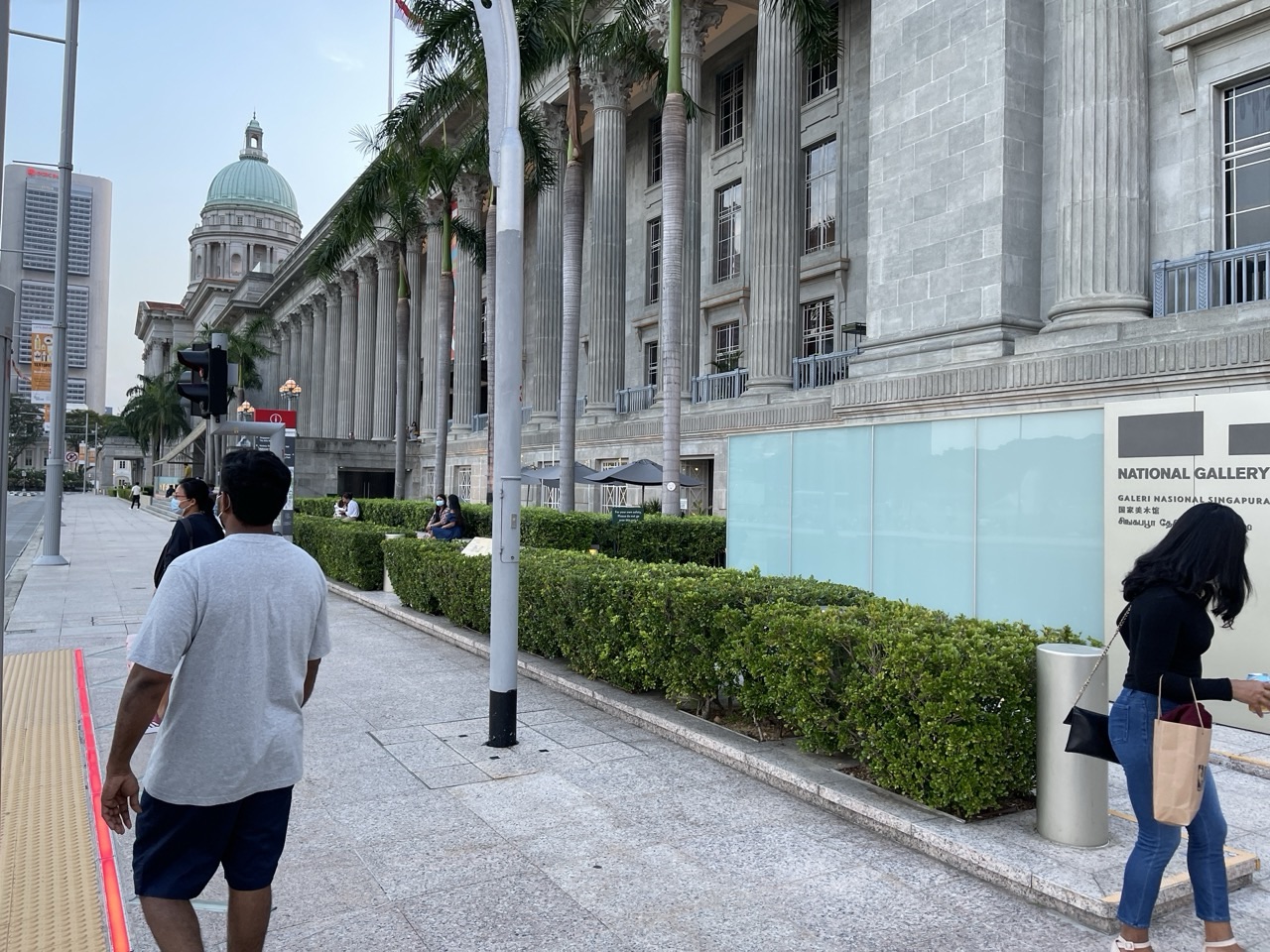
National Gallery Singapore occupies the former City Hall and former Supreme Court, two separate national monuments. According to the National Heritage Board’s Civic District account, the former City Hall was completed in 1929 and the former Supreme Court in 1939. The earlier Municipal Building took the City Hall name in 1951.
The National Gallery’s official architectural history describes the City Hall wing facing the Padang with Corinthian columns, while the court wing has a prominent dome and earlier legal functions. A teenager should not merge the two just because their façades appear in one photograph.
This setting offers a useful argumentative distinction. Preserving the physical structure of a historically significant building is not identical to preserving every former function. City Hall and the former Supreme Court have been restored and adapted for art, allowing the public to encounter them in a different institutional context.
A student might claim that adaptive reuse can help keep historic buildings part of public life. That is a plausible argument when supported by the Gallery example. It would be too strong to say that all reuse is successful, that every interior remains unchanged or that every visitor learns the same lesson.
A counterpoint could ask how much interpretive information visitors need to appreciate the buildings’ civic histories. Seeing a set of columns does not automatically explain a 1929 completion date or the building’s use in important national events. Texts, captions and education can complement observation.
The Padang itself adds a separate place. A pupil can compare a photo showing people on the Padang with one focusing on the City Hall façade, but should not pretend the two sites are interchangeable simply because they lie beside one another.
These sources can strengthen a classroom argument without becoming an invented history narrative. The objective is to say exactly what a record supports, which claim is a judgement and what more would need to be researched.
4. Planning around the SEC transition for a current Secondary 3 learner
Secondary 3 in 2026 may be an important year of preparation for the 2027 Singapore-Cambridge Secondary Education Certificate, particularly for pupils following a four-year secondary pathway. However, the student’s actual cohort, subject level and school arrangements must be checked.
The SEC begins in 2027 and brings the former GCE N(T), N(A) and O-Level certifications together under one certificate while subjects continue at G1, G2 and G3 levels. The certificate is common; the English paper is not automatically the same for everyone.
SEAB’s published 2027 listings identify English Language K100 at G1, K200 at G2 and K300 at G3. Students should use the relevant official syllabuses and their school’s guidance before beginning paper-specific practice.
The near-term teaching target should still come from the student’s actual work. A teenager struggling to fulfil an email brief may not benefit from another full paper until that error is repaired. Another who writes well but overstates source evidence requires a different sequence.
Timed practice becomes useful when foundational methods can be reproduced alone. The tutor should gradually remove supports, set fresh tasks and only then increase time pressure. Making a weak method faster is not the same as improving English.
Students can continue broader reading and discussion alongside exam preparation. An interest in civic history or visual art can enrich examples, but it should not replace the ability to answer an unfamiliar examination topic without prepared paragraphs.
Parents should ask the tutor to name the current skill gap and explain how the lessons connect to the child’s actual subject level. A general “SEC intensive” label is not a sufficient diagnostic.
5. Original practice letter: a relevant proposal rather than a tourism brochure
The fictional writing brief is: “As a member of your school’s English committee, propose an in-class activity exploring how the former City Hall and Supreme Court buildings have changed in use. Address a teacher, explain the learning value, describe how classmates will work, deal with one practical constraint and request permission.”
Begin with the reader’s decision. An appropriate sentence is: “Our committee would like permission to conduct a short English source-comparison activity during one lesson next term.” This identifies the aim without assuming that the timetable has been approved.
The next paragraph can describe materials: two publicly available extracts, one from the National Heritage Board and another from National Gallery Singapore, plus a blank timeline table. Students could compare events and write captions that distinguish verified facts from inferences.
Explain the educational value concretely: “The activity would help us notice how a building’s historical function and present use can be described accurately without mixing dates or evidence.” The statement identifies a language-learning goal without promising better grades for every participant.
Address the practical constraint. If lesson time is limited, groups can each analyse one short pair of excerpts and share findings. It would be misleading to invent gallery staff commitments, booked rooms or teacher permission.
Close with a clear request: “Would you be willing to consider this activity and suggest a suitable class period? We can adjust the plan if our proposed timing is inconvenient.” The teacher knows exactly what decision is being sought.
Now adapt the same information for classmates. A friendly message could invite volunteers to prepare material if the teacher approves. Notice that changes in audience must not change a pending proposal into a confirmed school event.
After practising, swap the topic to an environmental campaign or library event. A teenager who can re-create the same purposeful structure without a City Hall model has learned a genuine situational-writing strategy.
6. Argumentative writing: heritage visits versus classroom sources
Set this original question: “Should schools place greater emphasis on visiting historic places than on reading about them?” The words “greater emphasis” require a comparison; the question does not ask the student to declare one method completely useless.
A pupil may favour visits because architecture and physical scale become more tangible when seen directly. The Gallery’s historic buildings offer a concrete illustration of this possible benefit. But a convincing essay must explain why physical observation supports the particular learning objective.
A counterpoint is that a guided text may provide specific dates, political context and historical functions that a building’s exterior cannot communicate alone. The NHB record of former City Hall is an example of evidence that adds explanatory depth.
A strong argument can weigh the two: for certain learning goals, visiting helps observation, while reading helps source evaluation and factual precision. Their value depends on preparation, accessibility, time and what students are supposed to learn.
Avoid invented numerical findings such as “ninety-eight per cent of pupils learn better on visits”. A vivid example is not statistical proof. A writer can still develop a persuasive qualitative argument while making its boundaries clear.
A paragraph can follow this sequence: claim, mechanism, relevant example, limitation and return to the question. If every paragraph says “visits are fun”, the essay may be long but undeveloped. The goal is progressive reasoning, not decorative repetition.
A thoughtful conclusion can take a position: “Visits are valuable when carefully prepared, but they should not automatically receive more emphasis than source-based learning in every context.” This answers the comparative question without making an absolute claim.
For transfer, change the topic to whether practical science experiments should always replace textbook learning. Does the child still compare aims, conditions and reasonable alternatives? If so, the argument method travels.
7. Comprehension: explaining language effect without inventing an author’s feelings
Consider this original descriptive sentence: “The columns kept their silent watch while the city hurried around them.” It uses personification and contrast. A weak answer merely repeats that the columns were silent. Another weak answer says the writer hates everyone in the modern city, although the text does not justify such a private motive.
A defensible explanation is: “The personification presents the old columns as enduring and watchful, while the movement of the city suggests activity and change around the historic buildings.” The analysis identifies the language choice, meaning and effect.
Now compare a literal version: “The columns stand outside a historic building beside busy roads.” It gives information but lacks much of the figurative contrast. The student can explain why the original feels more atmospheric without claiming the columns are literally alive.
If the writer later describes the building as welcoming, the effect may shift. The pupil should update interpretation using the whole passage rather than relying on a memorised sentence that “personification creates sadness” in every context.
Give another original example about a school corridor empty after a celebration. A student should identify relevant imagery and explain its effect without importing the Civic District’s architecture into an unrelated story.
A three-student tutor can ask each learner to offer one interpretation, then identify the exact words supporting it. They may disagree within the evidence, but they should not replace textual analysis with unsupported biographical claims about an author.
These sentences are original English practice, not quotations from National Gallery signage or an official examination paper. The factual heritage links elsewhere in the article are separately attributed.
8. The paragraph that moves beyond ‘heritage is important’
Secondary 3 English improvement often occurs when a student learns to explain a claim rather than repeat it. Take “Learning about historic places helps us understand our society.” This is a reasonable starting view but remains broad until the writer identifies what is learned and how.
One mechanism is comparison across time. Studying the former City Hall’s municipal role and the Gallery’s present arts role can help a student see how institutions and public spaces acquire new functions. This is a teachable relationship rather than a universal promise that history creates good citizens.
Add a verified detail, such as the building’s completion in 1929 and later incorporation into National Gallery Singapore. These specifics illustrate continuity and change. Do not assign the former Supreme Court’s date to City Hall just to make the paragraph sound confident.
A limitation follows: understanding the buildings’ histories requires more than recognising a familiar façade. Pupils may need captions, readings or guided explanations. The writer should say this as a considered qualification rather than as a reason to reject observation entirely.
The final sentence returns to the claim: “A carefully prepared comparison therefore uses local heritage to develop source-reading and historical understanding rather than treating a visit as entertainment alone.” It explains why the original recommendation can make sense.
Ask the student to label every sentence’s job. Does each add a different part of reasoning? Is any example irrelevant? Does the conclusion follow? This line-by-line test reveals why longer is not always stronger.
Move to a different issue, such as teaching media literacy or encouraging reading for pleasure. If the learner can again develop claim, mechanism, evidence and judgement independently, paragraph organisation is becoming a transferable skill.
9. Weekday versus weekend when the schoolweek is becoming heavier
Secondary 3 brings changing subject demands, which may alter how much attention remains after school. A parent choosing tuition by City Hall should count the student’s real class and CCA commitments rather than rely on the previous year’s routine.
City Hall MRT is served by the North–South and East–West lines. Sixth Avenue MRT is on the Downtown Line; possible interchanges for a journey beginning at City Hall include Bugis or Newton. Check LTA’s rail network for real services and do not invent a door-to-door travel estimate.
If a parent works beside City Hall, the child may still start at school elsewhere. A school-to-parent collection leg, waiting for an adult and walking between stations may be more tiring than the final rail journey suggests.
A weekday can fit a student who finishes lessons early, eats before tuition and remains alert enough to plan a recommendation or critique an argument. Reserve a later independent writing attempt to test whether the method survives without a teacher nearby.
A weekend may offer a calmer study period for a student with late dismissal, but it can also collide with family meals, sports and much-needed recovery. A Saturday with three academic appointments can be as crowded as an ordinary weekday.
A practical readiness test is to give the pupil a short task asking for an audience-specific request. Can they name the recipient, purpose and action at the proposed class hour, or do they fall back on a generic introduction? The answer reveals whether the timing supports the educational goal.
Confirm the suitable three-student group and actual class day directly with the centre. This article does not guarantee that a weekday or weekend group has a vacancy, and it does not present City Hall as the location of a teaching branch.
10. How a three-student tutorial should reveal the exact writing problem
A small group of up to three learners can be valuable when each student produces an original first response. The tutor should inspect what the pupil was trying to communicate before replacing the paragraph with polished model prose.
One child may omit the request in a letter. Another may offer a view but no explanation. A third may understand the task but exaggerate a source claim. All three are capable of producing long passages, yet they need different next teaching decisions.
A useful session might begin with a short new writing prompt. Ask each learner to mark the reader and required action, draft a purpose sentence and outline two paragraph jobs. The tutor can then teach a common method with individual adjustments.
During guided practice, feedback should identify the exact effect of an error: “Your teacher cannot see what you are asking permission for”, or “This fact refers to the former City Hall, not the former Supreme Court.” Such comments make the revision teachable.
A group discussion can rotate three roles: writer, relevance checker and evidence checker. Each child must practise every role. The aim is not to have the strongest speaker dictate a common answer but to make independent editorial decisions visible.
After modelling, remove prompts and set a new topic. A pupil who independently produces a purposeful email or developed paragraph is showing more progress than one who memorises the first beautifully corrected version.
Homework should be focused and small enough for a real Secondary 3 week: perhaps one fresh paragraph, a short source analysis and a reflection on why the revised claim is supported. Parents can help protect time without supplying every answer.
11. A four-week programme for better task fulfilment and argument
Week one — diagnose task interpretation. Use a recent uncorrected school essay or situational writing script. Ask the learner to paraphrase the question, identify required points and compare the original response with the brief.
Choose the first consequential failure. If the pupil wrote a general essay instead of a proposal, repair the purpose sentence. If the audience was clear but the argument lacked explanation, teach claim and mechanism. Do not attempt twenty unrelated corrections in one lesson.
Week two — develop one complete argument. Use the museum-versus-classroom comparison to practise a position, distinct reasons, a credible example and a fair limitation. The student should be able to say why the conclusion follows.
Assign a new paragraph on a school issue after a few days. No gallery references should be needed. The delayed response shows whether the planning method has moved beyond the original prompt.
Week three — adapt for reader and purpose. Write a formal proposal to a teacher, then an informal update to classmates. Preserve factual status: a plan that has been proposed is not a confirmed event. Add a short comprehension task using a figurative sentence and require evidence-based explanation.
Practise speaking with an unfamiliar follow-up. Ask whether the student can defend a view, respond to a challenge and modify an overstrong claim. This supports flexible reasoning across the language modes.
Week four — test independent application. Give an unfamiliar situational-writing task and a short controlled argument. Record first attempts, compare with Week 1 and identify whether the learner now states purpose and develops reasons without tutor prompts.
If the method works while rested but disappears after a draining weekday journey, reconsider timing. If the method remains unstable even when alert, revisit scaffolding and task difficulty. A four-week cycle is a useful review, not a promise of a particular exam score.
12. Parent questions about Secondary 3 English from City Hall
Is there an eduKateSG City Hall branch? No such branch is advertised by this guide. The referenced teaching venue is 8 Fourth Avenue, near Sixth Avenue MRT. City Hall is the location from which the family is searching or planning travel.
What should a Secondary 3 pupil focus on first? Recent school work should reveal whether task interpretation, content development, comprehension inference, grammar or oral responsiveness is the real obstacle. Avoid choosing a lesson package purely by grade target.
Does the 2027 SEC matter for students who are in Secondary 3 in 2026? It can matter for pupils on the relevant four-year pathway. The SEAB syllabus listing gives G1, G2 and G3 English levels. Verify the actual cohort and school entry.
What if my child writes excellent descriptions but weak arguments? The tutor should teach a controlling position, explanation, relevant evidence and a reasoned conclusion. More adjectives or memorised openings may not address that problem.
Which day is better for writing lessons? Choose one that leaves the student rested enough to plan and revise independently, after counting full travel, food, sleep and other commitments. Both weekday and weekend have advantages in different households.
Can three students guarantee a distinction? No. The teaching format may enable close feedback, but progress depends on the student’s starting position, learning and consistent independent work.
How do we arrange a discussion? Bring uncorrected scripts, English subject-level information, school feedback and a realistic timetable to eduKate Singapore, or ask about a suitable Secondary 3 English group on WhatsApp. Confirm actual available times before planning the journey.
The school proposal, exercises and pupil situations in this article are fictional training examples. Historical facts are separately sourced, and no museum partnership, verified testimonial or timetable vacancy is claimed.
Weekday versus weekend: compare the entire learning routine
| Check | Weekday | Weekend |
|---|---|---|
| Journey origin | Usually school or CCA, not merely City Hall | Often home |
| Main risk | Fatigue after a full schoolday | Overloaded family timetable and lost recovery |
| Learning target | Relevant, supported writing for an audience | Relevant, supported writing for an audience |
| Transfer check | Unprompted new writing task after the lesson | Unprompted new writing task on another day |
| Availability | Confirm group and actual class day | Confirm group and actual class day |
Useful eduKateSG connections: SEC English Tutorials | City Hall; Surviving Tuition | City Hall; Secondary 2 English | City Hall; and English Situational Writing: Match Audience and Purpose.
Official educational and historical sources: National Gallery Singapore Architecture & History; NHB Civic District Heritage Trail; SEAB 2027 SEC syllabuses; and MOE Full Subject-Based Banding. Original sample letters and prompts are for learning, not authentic examination questions or real venue bookings.