
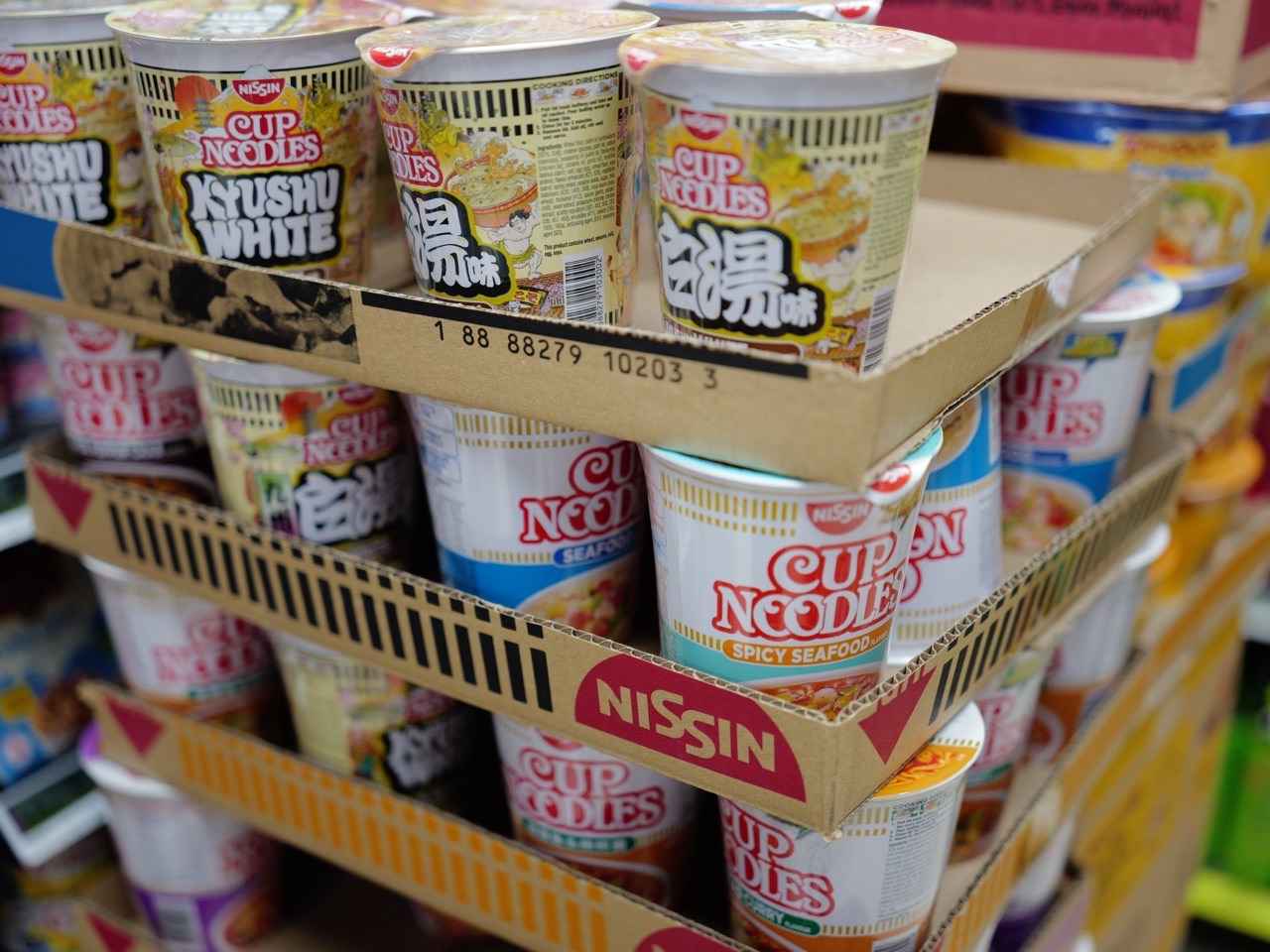
Why do instant noodles soften in only a few minutes when ordinary dried noodles may need longer cooking? Many instant noodles have already undergone a steam-cooking step during manufacture. Heat and moisture partly or substantially gelatinise the starch in their wheat-flour strands and change the surrounding protein network. The manufacturer then removes much of the water, usually by frying or hot-air drying, to make a lightweight, shelf-stable product. Frying can form a porous structure as water leaves rapidly, allowing hot water to penetrate again relatively quickly. During preparation, much of the work is therefore rehydrating an already heat-processed noodle, rather than cooking a completely raw flour strand from scratch. Actual preparation times depend on thickness, pre-processing and the product’s instructions. A 2022 peer-reviewed study of fried versus non-fried instant noodles documents how porosity and starch structure influence rehydration and cooking time.
For Hougang families searching for why instant noodles cook in three minutes, fried versus non-fried instant noodles, are cup noodles pre-cooked, what makes instant ramen porous, gelatinisation of starch, why dehydrated noodles rehydrate, instant noodle food chemistry, or Secondary 1–4 Chemistry food applications, the quick answer is industrial steaming + drying + rehydration-friendly structure. Instant does not mean every pack was fried, nor does “precooked” mean it should be eaten without following the package’s required preparation directions. Check its sodium, allergen and ingredient labels when making dietary decisions. Nissin Foods Singapore’s inventor history explains Momofuku Ando’s insight that frying could remove water while leaving pores, and the Smithsonian’s history of instant ramen describes why that changed preparation time.
Three minutes is a manufacturing achievement
Imagine a Hougang student arriving home hungry after school. The family puts a packet of instant noodles on the counter. Why is boiling water enough for this product while a batch of freshly rolled or traditionally dried noodles might need longer? The answer begins before the packet reaches the kitchen. Much of the important food processing has already taken place in a factory.
Instant noodles are engineered so that the strands have a useful mix of shape, strength, porosity and moisture level. The manufacturer must remove enough water for storage and then make it possible for a consumer to put that water back efficiently. That is a heat-transfer and materials problem, with starch and protein as the main edible polymers.
It is a strong lesson because “fast cooking” does not require a mysterious reaction that produces new food from hot water. The prepared noodle’s composition and microscopic structure largely determine how quickly it can take up water and regain a desirable texture.
What is a noodle strand actually made from?
Many instant noodles begin with wheat flour, which contains substantial starch and proteins capable of forming a gluten network. The dough also includes water and may include salt or alkaline salts, depending on product style. Manufacturers mix, sheet, cut and shape the dough before steam treatment and drying.
Starch is a mixture of glucose-based polymers, especially amylose and amylopectin. Wheat proteins form a supporting network around starch granules. The precise proportions and additives influence chewiness, structural stability and how hot water enters during preparation.
| Noodle component | Important role | What factory processing changes |
|---|---|---|
| Wheat starch | Major carbohydrate and texture contributor | Gelatinises under steam and water |
| Wheat proteins/gluten | Flexible structural network | Heat and processing influence strand strength |
| Added water | Hydrates flour and enables starch transformation | Most of it is removed for dry storage |
| Salt/alkaline salts where included | Influence taste and dough properties | Final formula varies with noodle type |
| Oil in fried versions | Medium for rapid high-temperature drying | Can contribute fat and a porous structure |
| Packaging | Protects processed noodles from moisture and contamination | Supports storage if packaging remains intact |
Why starch gelatinisation matters
Raw starch granules contain organised molecular regions. When sufficient water and heat are supplied, many granules swell and lose some of that order—a process known as starch gelatinisation. The transformed starch contributes to a texture that can be restored quickly when the dried food is rehydrated.
The 2022 food-processing review of starch gelatinisation explains how steaming, water conditions and food formulation influence the extent of this change. A student should not say that steam always converts every starch chain into individual sugar molecules; gelatinisation is largely a structural transformation involving water and heat, not complete enzymatic hydrolysis of starch.
This distinguishes an instant noodle from a dry piece of uncooked pasta. An instant noodle’s starch may have received important heat treatment before drying, while pasta often requires more substantial cooking during its final preparation. Neither category has one universal cooking time.
How drying makes a precooked noodle storable
Removing moisture reduces the water available to many microorganisms and slows numerous quality changes. Food manufacturers may use frying, hot air or other approved drying methods depending on the noodle product. The resulting low-moisture product can be packaged for longer storage, subject to its stated shelf-life and packaging requirements.
The Hougang water-activity and food-preservation guide explains the broader distinction between total water and the water available for growth or reactions. Drying helps preservation but does not mean the noodles have been chemically sterilised for eternity. Damaged packaging, unsuitable storage or an expired product require separate food-safety decisions.
| Manufacturing step | What occurs | Why it matters later |
|---|---|---|
| Dough formation | Flour, water and ingredients form workable strands | Creates structure |
| Steaming/precooking | Starch gelatinisation and protein changes | Partially cooks the noodle |
| Frying where used | Rapid moisture loss and pore creation | Can enhance rapid rehydration |
| Air drying where used | Water removed through heated air | Different fat and microstructure characteristics |
| Sealed packaging | Limits new moisture and contamination | Maintains intended storage quality |
| Adding hot water | Water penetrates and softens strand | Restores edible texture according to directions |
Fried versus non-fried instant noodles
A common misunderstanding is that all instant noodles are deep-fried. Modern products include air-dried and other non-fried versions. The 2022 Frontiers in Nutrition study on noodle frying found that its fried samples developed a more porous, honeycomb-like structure and shorter cooking times compared with selected non-fried samples. The exact outcome depends on the product and manufacturing conditions.
A non-fried label is also not a complete statement of nutrition or quality. Calories, fats, protein, fibre, sodium, seasoning and portion size vary across products. Follow the label rather than assuming every air-dried packet is the same or that a lower-fat noodle automatically has a low-sodium soup.
Why does porosity help water get inside?
Imagine water trying to enter two dry materials. One has small connected spaces or pores; another is relatively dense. Under comparable conditions, a porous structure can provide pathways for water to move inward faster. In many instant noodles, water escapes rapidly during frying and leaves an open microstructure that assists later penetration.
But bigger pores are not always better: the noodle must also remain strong enough not to break or turn mushy immediately. Food engineers therefore balance drying, microstructure, starch transformation and mechanical quality rather than maximise porosity without limit.
Worked question 1: is instant noodle preparation simply boiling raw flour?
Question: A student says, “Cup noodles need little time because the water somehow cooks raw wheat twice as fast.” Correct the explanation.
Model answer: Many instant noodle strands were already steamed and their starch partly gelatinised in the factory, then dried. Hot water mainly rehydrates that preprocessed structure and finishes the changes specified by the product. The time saving comes substantially from earlier industrial processing, not a special chemical property of the kettle.
Worked question 2: a drying mass balance
Question: A fictional 100 g noodle block before factory drying contains 35 g water. After processing, it contains 6 g water, and no non-water solids are lost. What is its final mass?
- Initial non-water solids = 100 − 35 = 65 g.
- Final water retained = 6 g.
- Final mass = 65 + 6 = 71 g.
- Water removed = 35 − 6 = 29 g.
These values are illustrative. A real fried noodle may absorb oil while water leaves, so the simple “only water is lost” assumption would not describe every commercial process. State the assumption rather than quietly treating a factory as an ideal school beaker.
Worked question 3: rehydration percentage
Question: A hypothetical dry noodle portion weighs 65 g and absorbs 90 g of water, with none of its original dry mass lost. What is its rehydrated mass?
Answer: 155 g. Adding water changes mass and texture without creating new carbon, hydrogen or oxygen elements. In reality, some substances may leave into the cooking water and some water may remain outside the noodles, so the given mass balance is a specified simplified model.
Worked question 4: frying versus air drying
Question: Two noodle products rehydrate at different rates. Can the student conclude the faster one must be more nutritious?
Answer: No. Faster water penetration describes processing structure under specific conditions. Nutrition depends on the complete ingredient composition and measured properties. Cooking performance and nutritional value are different questions.
How does this differ from yellow fresh noodles?
The Hougang yellow-noodle kansui and gluten guide explains why alkaline salts and gluten help create a characteristic springy texture in some fresh noodles. This article owns another question: why industrially precooked and dried strands become edible quickly when water returns. A fresh alkaline noodle and a dried instant noodle may share wheat ingredients yet have different processing histories.
Similarly, the Hougang pressure-cooker bean guide describes why greater cooking temperature accelerates starch and cell-wall changes in a wet food. Instant noodles often reduce final preparation time instead by moving some cooking into the manufacturing stage. These are separate engineering strategies for convenient food.
Does a three-minute label guarantee a safely cooked meal?
No. Packets and cups differ in required preparation method. Some specify standing in boiling water, some require stove cooking and some have separate ingredients needing special handling. The time printed on a package applies only to its instructions, including water amount and heating/standing conditions. Do not assume that every instant product is safe to eat dry or that adding lukewarm water always meets its intended preparation.
The seasoning may also contain allergens and substantial sodium; consumers with dietary concerns should rely on the package and qualified professional guidance rather than a generic claim that “instant noodles are healthy” or “all instant noodles are dangerous.” Food chemistry explains processing and composition, but it cannot evaluate an individual diet from one meal.
Why the noodles swell rather than simply melt
When hot water enters the dried noodle, it hydrates starch and proteins and softens the structure. The strands increase in mass and become more flexible. They do not melt into a pure liquid as if the noodle were an ice cube. Starch remains a polymer-rich food matrix, even though heat and moisture can continue modifying it.
This is a useful contrast with bread staling and starch retrogradation. Bread becomes firmer during storage partly because starch chains reassociate; instant noodles become tender during rehydration because water enters an engineered, precooked dry structure. The shared material is starch, but the driving processes and desirable outcomes differ.
A safe study of the processing chain
A teacher can use packaged-ingredient labels, schematic diagrams and supplied moisture measurements to study instant noodles. There is no reason to reproduce hot oil frying in a classroom or attempt experimental dehydration with unsafe kitchen equipment. A data-based investigation can compare noodle thickness, porosity and time to a specified hydration endpoint using pre-recorded results.
| Research design | An example | Why it matters |
|---|---|---|
| Independent variable | Specified factory drying method in provided data | Identifies the factor tested |
| Dependent variable | Water uptake after 3 minutes | Defines response |
| Controls | Noodle geometry, initial dry mass and water temperature | Reduces confounding |
| Limitation | Different brands also have different formulas | Avoid assigning every change to drying alone |
| Safety | Use published data and product directions | Avoid unsafe hot-oil processing |
Six misconceptions worth repairing
| Student says | Why it’s inaccurate | Better explanation |
|---|---|---|
| “All instant noodles are fried.” | Air-dried products exist | Read product manufacturing type |
| “Hot water creates the noodle starch.” | Matter balance ignored | Starch was already present |
| “Instant noodles are completely raw.” | Prior steam cooking omitted | Many products are preprocessed |
| “Porous always means more nutritious.” | Different outcomes confused | Porosity affects water penetration |
| “Three minutes applies to every brand.” | Instructions vary | Follow actual product |
| “Drying destroys every microbe or hazard.” | Shelf stability confused with sterilisation | Food safety still matters |
Five student revision questions
- What is starch gelatinisation?
- Why does steaming before drying make some instant noodles faster to prepare?
- How can frying create pores that assist rehydration?
- Why is a low-moisture product not necessarily sterile?
- What is the difference between the noodle’s rehydration rate and its nutritional composition?
Answer key
1. Heat- and water-driven changes in starch granule structure. 2. Much of the cooking transformation has occurred before packing. 3. Rapid water removal can leave channels in the strand. 4. Some hazards or organisms can persist despite low water activity. 5. One concerns water transport and texture; the other concerns ingredients and nutrients.
A short learning route from school to food engineering
| Stage | Concept | One useful question |
|---|---|---|
| Secondary 1–2 Science | Mixtures, water and physical changes | Where does water go during drying? |
| Secondary 3 Chemistry | Polymers and structure | Why do starch and proteins hold a strand together? |
| Secondary 4 Chemistry | Energy, mass and calculations | How much water was removed? |
| JC/Applied Science | Transport and material structure | How do pores change rehydration kinetics? |
Detailed instant noodle manufacturing is applied enrichment rather than a separate 2027 SEC G3 Pure Chemistry chapter. Students should prioritise their actual SEAB Chemistry syllabus and use noodles to make mass conservation, starch transformations and controlled experiments intuitive.
Three students can have three different wrong explanations
One learner may think factory frying is mandatory, another may know about drying yet confuse gelatinisation with sugar formation, and a third may calculate moisture loss correctly but forget that oil may enter during frying. An effective tutor identifies those separately and uses one new scenario to check whether the idea transfers. The eduKate three-pax tuition reference describes teaching near Sixth Avenue MRT; this Hougang article does not claim an eduKate Chemistry classroom exists physically in Hougang.
Frequently asked questions
Are instant noodles already cooked?
Many are heat-processed through steaming or related steps before drying. Follow the actual product’s directions for safe final preparation.
Why do instant noodles soften so quickly?
They are often partly precooked and dried into a structure that absorbs hot water relatively rapidly.
Do all instant noodles contain frying oil?
No. There are fried and non-fried, including air-dried, varieties.
Are instant noodles made only from flour and water?
Formulations vary and may include salt, alkaline additives, oil and other ingredients. Check the label.
Does pregelatinised starch mean the noodles contain pure glucose?
No. Gelatinisation is a structural transformation of starch, not complete conversion into individual glucose molecules.
Does rehydrating noodles mean adding mass?
Yes. Water entering the noodle increases the portion’s mass, subject to any ingredients moving into the surrounding water.
Why might two brands need different preparation times?
Strand thickness, starch state, drying method, porosity and formulation can differ.
The useful answer hiding in three minutes
A packet of instant noodles is evidence that food engineering has moved part of the cooking process from your kitchen into manufacturing. The strands have been heated, dried and structured so water can return quickly. Once a student can explain the chain starch processing → moisture removal → porosity → rehydration, the convenience becomes an understandable chemical and physical system rather than a mystery.
Continue: Hougang Science Learning Hub · Why Yellow Noodles Are Springy · Why Beans Cook Faster Under Pressure · Bread Starch and Ageing · Water Activity and Preservation · Nissin Singapore: How Instant Noodles Began · Research on Fried/Non-fried Instant Noodles.