
Start with the canonical Day 44 guide
This is additional companion reading, not a second numbered Day 44. The primary Top 100 Singapore Vocabulary Words | Day 44: Buddha Tooth Relic Temple, Chinatown and Buddhist Heritage holds the numbered series position. This page preserves an alternative explanation of the temple’s 2007 history, Buddhist traditions, Tang-inspired design and respectful visitor language. Return to the Touring Singapore Vocabulary hub for the full chronological directory.
Buddha Tooth Relic Temple & Museum is a modern Chinese Buddhist temple and museum at 288 South Bridge Road in Singapore’s Chinatown. It officially opened on Vesak Day, 31 May 2007, and is recognised for its red-and-gold Tang-inspired architecture, Buddhist art displays and a sacred relic revered by devotees. The temple’s official website lists daily 7am–5pm visiting hours and visitor rules requiring modest clothing; regular admission is free. This guide explains 100 Buddha Tooth Relic Temple vocabulary words with meanings, example sentences and their cultural context.
Why is the temple part of Singapore culture? It is a place of continuing worship, religious education, charity and museum learning within multicultural Chinatown. The temple’s own history credits Venerable Chao Khun Fa Zhao, religious donors and an extended design process combining Tang architectural ideas with a Buddhist mandala. The site is a 2007 building inspired by older traditions, not itself a surviving Tang Dynasty structure. The object enshrined there is revered by devotees as a tooth relic of the Buddha; a respectful guide identifies this religious attribution without claiming independent scientific authentication.
Use the 100-word finder, read the visitor facts or jump to primary sources. Temple and museum hours are not perfectly consistent between the temple’s website and Singapore Tourism Board’s visitor listing: the temple currently lists 7am–5pm for both, while STB lists 9am–5pm for the museum. Confirm a particular gallery or sacred-hall visit with the operator rather than relying on an undated travel post. This article is an educational explanation of a living religious place, not a guide to participating in rites.
Buddha Tooth Relic Temple in one minute
- Where: 288 South Bridge Road, Singapore 058840, in the Kreta Ayer area of Chinatown, near Maxwell MRT (TE18).
- When: opened 31 May 2007 on Vesak Day in a ceremony officiated by then President S. R. Nathan.
- Admission: Singapore Tourism Board lists free admission; ceremonies and particular spaces may have separate access conditions.
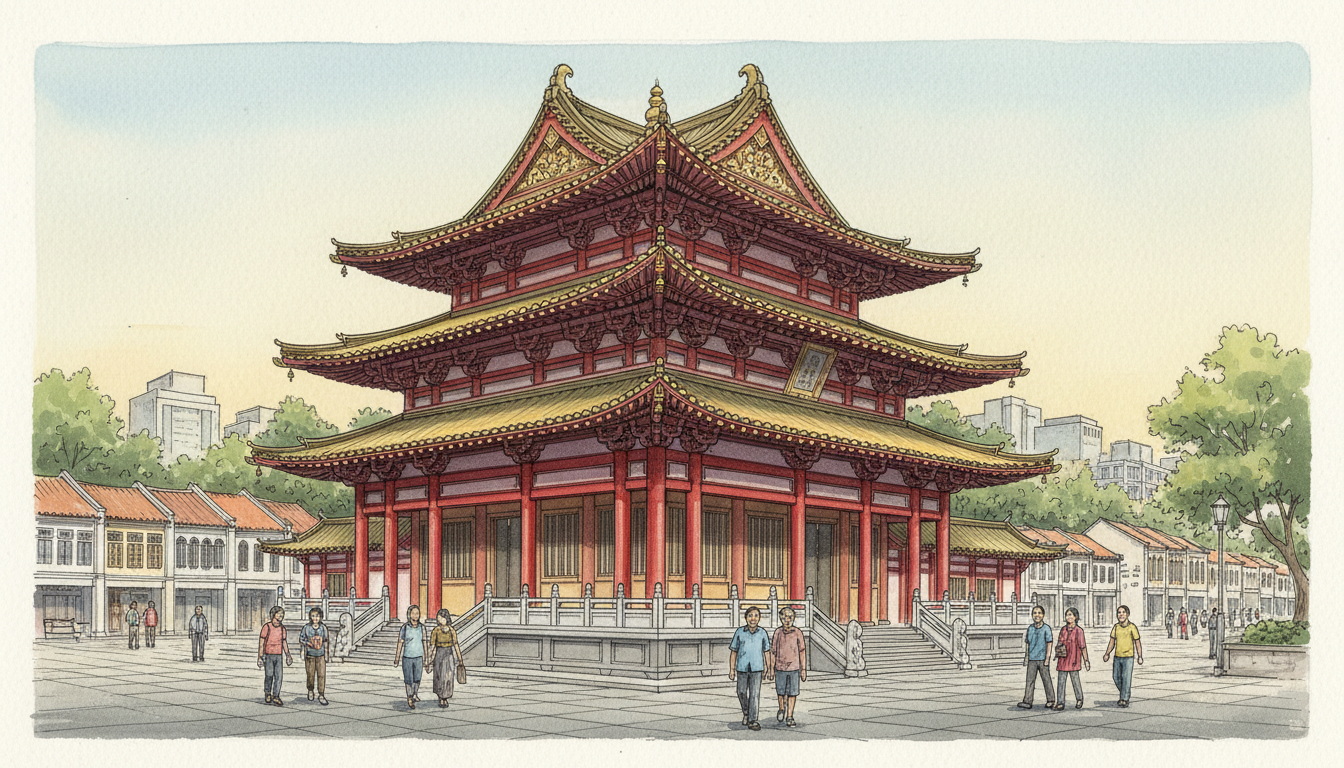
- Architecture: the operator documents numerous design revisions before adopting Tang-inspired eaves, red finish, green window frames, gold detailing and mandala principles.
- Ground level: Hundred Dragons Hall and Universal Wisdom Hall, including Buddhist devotional images.
- Museum: the temple directory locates Buddhas of the World Museum on the third storey, alongside other religious education and exhibition spaces.
- Relic: the fourth-floor Sacred Light Hall enshrines an object venerated as the Buddha’s tooth relic. Its religious attribution should be clearly identified as such.
- Dress: the operator prohibits revealing clothing, including shorts, miniskirts and low-cut or off-shoulder tops, under its published etiquette rules.
- Food and pets: the temple forbids non-vegetarian food and pets from its premises under ordinary rules.
- Important nuance: the operator lists 7am–5pm daily, while STB gives a later museum opening time. Check specific facilities before visiting.
2007: a new building designed around older traditions
The official architectural history explains that a temple proposal was considered in the late 1990s, then revised repeatedly before construction. The final design reflects Tang Dynasty building aesthetics, religious mandala principles and the constraints of an urban Chinatown site. Singaporean and overseas designers contributed, while donors helped finance the project. The date is worth emphasising: 2007 marks the modern complex, even though the religious texts and artistic forms it draws on have far longer histories.
A student can describe what is visible—tiered roofs, bracket forms, coloured window frames and an entrance hall—before explaining what the official designer says about those choices. The word Tang-inspired is more accurate than saying a temple built in Singapore in the twenty-first century is an untouched Tang Dynasty monument.
The spaces: active worship, museums and the rooftop
The temple directory lists the Hundred Dragons and Universal Wisdom halls on the ground floor; the Dharma Hall and Eminent Sangha Museum on the mezzanine; teaching areas and scriptural collections on the second floor; Buddhas of the World Museum on the third; Sacred Light Hall on the fourth; and religious pavilions and a garden at roof level. Some are places of active worship or remembrance. A current operator notice, staff member or onsite sign controls whether visitors may enter a particular space or photograph it.
This distinction changes how we write about culture. A museum object can be documented and discussed, while a person praying in a hall deserves privacy. The sacred relic is not an object offered for an unrestricted photography session. Visitors who do not share the beliefs can still read the art labels, learn the terms and behave considerately without participating in rites.
A relic’s religious significance is not a scientific certificate
The temple was developed to enshrine an object that its community honours as a tooth relic of the historical Buddha. The Singapore Tourism Board describes the reverence surrounding it, while the temple directory explains its placement in the fourth-floor Sacred Light Hall. A reader should distinguish veneration—the respect devotees show—from provenance—documented history that might support an object’s origin. The temple’s naming and devotional significance do not establish independent historical or scientific verification of the identity of the remains.
This careful wording protects everyone involved. It neither mocks sincere religious belief nor overstates evidence. In a multicultural place like Singapore, accurately describing what people believe is often more respectful than converting a faith claim into an apparently certain scientific statement.
Before entering: dress, quiet conduct, food and photography
The temple’s visitor etiquette requests appropriate clothing and gives concrete examples of disallowed attire, including short skirts, shorts, sleeveless or revealing tops. It also prohibits pets and non-vegetarian food. These are venue-specific religious conditions; visitors should follow staff instructions for shoes, photography and sacred spaces. A free visitor entrance is not permission to disrupt a ceremony or use devotional objects as props.
An easy visitor question is: “Could you please tell us whether the museum and rooftop are open now, and whether photography is permitted in this hall?” Asking once is better than relying on a social-media photograph taken during different arrangements. A parent or teacher can also choose a short learning visit instead of trying to cover every floor.
Chinatown has more than one religious and cultural tradition
The temple stands in an area where Chinese shophouses, regional foods and multiple faith institutions share streets. Nearby Sri Mariamman Temple is a Hindu temple with a much older history and a separate community, while other mosques, associations and markets contribute different stories to Chinatown. Understanding one Buddhist institution should not lead to the conclusion that every Chinatown resident is Buddhist or that all Chinese Singaporeans practise the same religion.
For a place-based introduction, pair the temple with the Singapore food-and-neighbourhood vocabulary guide. For another contemporary cultural institution compare the National Gallery Singapore article. Different venues have different founding dates, original purposes and visitor rules; nearby geography does not make them one organisation.
Ten reading routes through the full 100 words
- Part 1: Where the 2007 temple stands in Chinatown — words 1–10
- Part 2: Tang-inspired architecture and the mandala design — words 11–20
- Part 3: Ground-floor halls and forms of Buddhist imagery — words 21–30
- Part 4: Mezzanine, learning spaces and the role of the Sangha — words 31–40
- Part 5: Museum objects, collections and careful interpretation — words 41–50
- Part 6: Fourth-floor Sacred Light Hall: discussing the relic with care — words 51–60
- Part 7: Roof garden, prayer wheel and Buddhist cosmology — words 61–70
- Part 8: Buddhist teaching words explained neutrally — words 71–80
- Part 9: Ceremonies, learning and a shared Chinatown neighbourhood — words 81–90
- Part 10: Visitor etiquette and evidence-based temple writing — words 91–100
Quick finder: one hundred linked entries
1–10: 1. Buddha Tooth Relic Temple & Museum · 2. 288 South Bridge Road · 3. Kreta Ayer · 4. 31 May 2007 opening · 5. Vesak Day · 6. President S. R. Nathan · 7. Venerable Chao Khun Fa Zhao · 8. Temple community · 9. Temple donor · 10. Chinatown cultural landmark
11–20: 11. Tang Dynasty influence · 12. Buddhist mandala · 13. Red lacquer finish · 14. Upturned eaves · 15. Roof bracket · 16. Timber-style façade · 17. Green window frame · 18. Gold detailing · 19. Scale model · 20. Architectural revision
21–30: 21. Hundred Dragons Hall · 22. Maitreya Buddha image · 23. Universal Wisdom Hall · 24. Avalokitesvara · 25. Bodhisattva · 26. Lotus throne · 27. Heart Sutra · 28. Sutra · 29. Ceremonial altar · 30. Dragon motif
31–40: 31. Dharma Hall · 32. Eminent Sangha Museum · 33. Sangha · 34. Ancestral Memorial Hall · 35. Memorial tablet · 36. Ksitigarbha · 37. Aranya Hall · 38. Meditation class · 39. Manjusri · 40. Aranya Sutra Chamber
41–50: 41. Buddhas of the World Museum · 42. Buddhist artefact · 43. Museum collection · 44. Object provenance · 45. Exhibit label · 46. Conservation case · 47. Donor acknowledgment · 48. Sutra Chamber · 49. Samantabhadra · 50. Historical interpretation
51–60: 51. Sacred Light Hall · 52. Inner Chamber · 53. Buddha Tooth Relic · 54. Relic · 55. Reliquary · 56. Golden stupa · 57. Enshrinement · 58. Veneration · 59. Sacred attribution · 60. Photography restriction
61–70: 61. Rooftop garden · 62. Pagoda · 63. Prayer wheel · 64. Vairocana · 65. Mandala symbolism · 66. Cardinal direction · 67. Temple pavilion · 68. Roofline · 69. Contemplative space · 70. Roof-access notice
71–80: 71. Buddha · 72. Dharma · 73. Compassion · 74. Loving-kindness · 75. Four Noble Truths · 76. Noble Eightfold Path · 77. Mindfulness · 78. Meditation · 79. Generosity (dana) · 80. Sangha community
81–90: 81. Chanting · 82. Incense offering · 83. Prayer ceremony · 84. Religious observance · 85. Temple volunteer · 86. Community welfare · 87. Chinatown shophouse · 88. Sri Mariamman Temple · 89. Maxwell MRT · 90. Interfaith respect
91–100: 91. Free admission · 92. Modest attire · 93. Temple opening hours · 94. Museum-hours discrepancy · 95. Vegetarian-only food rule · 96. No-pets policy · 97. Quiet conduct · 98. Respectful observation · 99. Fact versus belief · 100. Source attribution
How to build vocabulary without memorising religious labels blindly
Try notice → name → explain → check → retrieve. First notice a place, image or sign; name it correctly; explain its use or cultural meaning; check the temple’s published description; then use the word in a new natural sentence. A learner can say that a bodhisattva is important in a Buddhist tradition without declaring what everyone in Singapore believes.
Younger learners may choose ten words about roofs, prayer halls and consideration for others. Secondary students can explore comparative architecture, how museums establish provenance and how belief differs from archaeological evidence. The aim is accurate understanding and respectful language, not an invitation to adopt particular religious practices.
Part 1 — Where the 2007 temple stands in Chinatown
The building’s identity matters immediately: it is a modern Buddhist temple and museum in an older neighbourhood. A reader should not confuse the temple’s 2007 opening with the centuries-old traditions it draws on.
1. Buddha Tooth Relic Temple & Museum
Meaning: The Buddhist worship and museum complex at 288 South Bridge Road in Singapore’s Chinatown. Example: “We visited Buddha Tooth Relic Temple & Museum for a cultural learning activity.” Why it matters in Singapore: The present institution combines religious life, architecture and museum learning rather than being merely a tourist backdrop.
2. 288 South Bridge Road
Meaning: The temple’s official street address, Singapore 058840. Example: “Our map showed 288 South Bridge Road.” Why it matters in Singapore: A precise location prevents confusion with other Chinatown religious buildings.
3. Kreta Ayer
Meaning: The Chinatown neighbourhood in which the temple stands. Example: “We explored Kreta Ayer and its historic streets.” Why it matters in Singapore: The local name recalls an older community geography around trades and daily life.
4. 31 May 2007 opening
Meaning: The date the present temple officially opened on Vesak Day. Example: “The temple opened on 31 May 2007.” Why it matters in Singapore: A modern opening date must not be used as the age of the Buddha’s teachings.
5. Vesak Day
Meaning: A major Buddhist occasion commemorating events associated with the Buddha’s life. Example: “The opening ceremony was held on Vesak Day.” Why it matters in Singapore: It connects the building’s first day to a living religious calendar.
6. President S. R. Nathan
Meaning: Singapore’s president who officiated at the 2007 opening. Example: “President S. R. Nathan opened the temple.” Why it matters in Singapore: An official ceremony helps date the building without implying state ownership of its religious beliefs.
7. Venerable Chao Khun Fa Zhao
Meaning: The Buddhist monk and temple leader associated with conceptualising its design and mission. Example: “Venerable Chao Khun Fa Zhao helped shape the building’s design.” Why it matters in Singapore: His role reflects religious leadership working alongside architects and donors.
8. Temple community
Meaning: People who worship, volunteer, learn or contribute to religious activities in a temple. Example: “The temple community gathered for a ceremony.” Why it matters in Singapore: A living faith community is more than the visitors in a photograph.
9. Temple donor
Meaning: A person or group providing resources for construction or activities. Example: “The temple donor contributed to its development.” Why it matters in Singapore: The official history acknowledges donations from Singapore and overseas Buddhist supporters.
10. Chinatown cultural landmark
Meaning: A recognisable place contributing to the neighbourhood’s cultural identity. Example: “The temple became a Chinatown cultural landmark.” Why it matters in Singapore: An important modern cultural landmark is not automatically a nineteenth-century National Monument.
Short retrieval for Part 1: Select three expressions and explain them using your own words. For one, identify whether it is an architectural observation, an operator fact, a religious term or a historical claim needing additional evidence. The distinction is more valuable than reciting ten terms quickly.
Part 2 — Tang-inspired architecture and the mandala design
The temple’s striking red and gold appearance was planned deliberately. Its leaders considered multiple designs before choosing Tang-inspired Chinese forms and a mandala-based arrangement.
11. Tang Dynasty influence
Meaning: Architectural inspiration associated with Chinese culture during the Tang period. Example: “The roof design shows Tang Dynasty influence.” Why it matters in Singapore: The 2007 building adapts historical styles; it is not an original Tang-era structure.
12. Buddhist mandala
Meaning: A symbolic geometric design used in some Buddhist traditions to represent spiritual order or a sacred universe. Example: “The architect studied Buddhist mandala principles.” Why it matters in Singapore: The temple’s planning joins an architectural idea with religious symbolism.
13. Red lacquer finish
Meaning: A red protective and decorative surface treatment inspired by traditional temple architecture. Example: “The red lacquer finish stood out on the façade.” Why it matters in Singapore: The temple’s own design account explains choosing red after reviewing earlier colour proposals.
14. Upturned eaves
Meaning: Roof edges curving upward at their corners. Example: “We observed the upturned eaves above the entrance.” Why it matters in Singapore: They help visitors identify elements of traditional East Asian architectural form.
15. Roof bracket
Meaning: A structural or decorative element supporting an overhanging roof. Example: “The roof bracket repeated along the upper storey.” Why it matters in Singapore: Brackets are architectural components, not only ornamental patterns.
16. Timber-style façade
Meaning: An outer building design visually recalling traditional timber construction. Example: “The timber-style façade framed the windows.” Why it matters in Singapore: A historical visual language can be used within a modern building.
17. Green window frame
Meaning: A window surround painted green as part of the temple’s design palette. Example: “The green window frames contrasted with the red exterior.” Why it matters in Singapore: Colour decisions help explain the building’s intentionally balanced appearance.
18. Gold detailing
Meaning: Gold-coloured decoration used to mark edges and sacred spaces. Example: “Gold detailing outlined the roof and columns.” Why it matters in Singapore: Visual richness communicates religious importance without proving a particular object is solid gold.
19. Scale model
Meaning: A smaller physical or digital representation used to evaluate a planned building. Example: “The designers tested a scale model before construction.” Why it matters in Singapore: Multiple models preceded the final approved exterior; design required revision.
20. Architectural revision
Meaning: A change made to a building proposal after study or review. Example: “One architectural revision replaced an overly modern glass façade.” Why it matters in Singapore: The temple’s planning history shows negotiation between contemporary needs and historical style.
Short retrieval for Part 2: Select three expressions and explain them using your own words. For one, identify whether it is an architectural observation, an operator fact, a religious term or a historical claim needing additional evidence. The distinction is more valuable than reciting ten terms quickly.
Part 3 — Ground-floor halls and forms of Buddhist imagery
The main floor’s Hundred Dragons and Universal Wisdom halls are spaces of worship and interpretation. A visitor can describe their objects respectfully without claiming every symbol means exactly the same thing across all Buddhist traditions.
21. Hundred Dragons Hall
Meaning: The large ground-floor hall near the temple entrance. Example: “We entered the Hundred Dragons Hall quietly.” Why it matters in Singapore: It is a worship space, not a hotel lobby or an all-day photography stage.
22. Maitreya Buddha image
Meaning: A statue representing Maitreya, understood in Buddhist tradition as a future Buddha. Example: “A Maitreya image stood within the hall.” Why it matters in Singapore: The statue has religious meaning for devotees and should be described accurately.
23. Universal Wisdom Hall
Meaning: A hall beyond the main entrance area with devotional Buddhist images. Example: “We read the Universal Wisdom Hall name before entering.” Why it matters in Singapore: Different halls have distinct devotional and architectural roles.
24. Avalokitesvara
Meaning: A bodhisattva strongly associated with compassion in Mahayana Buddhist traditions. Example: “The label identified an image of Avalokitesvara.” Why it matters in Singapore: A named figure should not be reduced to a generic gold statue.
25. Bodhisattva
Meaning: In many Buddhist traditions, a being committed to awakening and helping others. Example: “The museum label explained the term bodhisattva.” Why it matters in Singapore: The word belongs to a particular religious vocabulary and is not interchangeable with Buddha.
26. Lotus throne
Meaning: A sculpted seat using the lotus as a religious and artistic motif. Example: “The image rested above a lotus throne.” Why it matters in Singapore: Lotus imagery carries symbolic associations in Buddhist art.
27. Heart Sutra
Meaning: A short and influential Mahayana Buddhist scripture. Example: “We noticed a displayed copy of the Heart Sutra.” Why it matters in Singapore: A displayed scripture is a religious text, not an ordinary decorative banner.
28. Sutra
Meaning: A Buddhist scripture or discourse preserved through textual traditions. Example: “The teacher introduced a sutra during our museum visit.” Why it matters in Singapore: A sutra can be studied historically while its devotional role is respected.
29. Ceremonial altar
Meaning: A designated place for ritual offerings and religious objects. Example: “We kept a respectful distance from the ceremonial altar.” Why it matters in Singapore: A worship area is not a surface for visitors’ bags or food.
30. Dragon motif
Meaning: An image of a dragon used as a decorative or symbolic design element. Example: “We noticed a dragon motif above the hall.” Why it matters in Singapore: Mythical imagery has cultural meaning; it does not claim dragons are real animals.
Short retrieval for Part 3: Select three expressions and explain them using your own words. For one, identify whether it is an architectural observation, an operator fact, a religious term or a historical claim needing additional evidence. The distinction is more valuable than reciting ten terms quickly.
Part 4 — Mezzanine, learning spaces and the role of the Sangha
The temple directory describes a mezzanine for ceremonies and memory, and another level with study spaces. Learning about a living religious practice differs from merely collecting attractive architectural details.
31. Dharma Hall
Meaning: A temple space used for Buddhist activities, teachings or ceremonies. Example: “We checked whether the Dharma Hall was hosting a ceremony.” Why it matters in Singapore: An active hall’s access can vary with its religious schedule.
32. Eminent Sangha Museum
Meaning: An exhibition area honouring Buddhist monks and teachers. Example: “The Eminent Sangha Museum introduced religious biographies.” Why it matters in Singapore: People who taught and maintained traditions are part of Singapore’s cultural story.
33. Sangha
Meaning: A Buddhist term for the monastic community, and in some contexts the community of practitioners. Example: “The presentation explained the role of the Sangha.” Why it matters in Singapore: Religious education relies on people and shared practice, not only sacred buildings.
34. Ancestral Memorial Hall
Meaning: A dedicated temple space for remembrance of deceased family members and ancestors. Example: “We passed the Ancestral Memorial Hall respectfully.” Why it matters in Singapore: Remembering family and loved ones is one part of living devotional tradition.
35. Memorial tablet
Meaning: An inscribed object used in some traditions to commemorate an ancestor or deceased person. Example: “The memorial tablet carried a family name.” Why it matters in Singapore: A memorial is personal and should not be photographed or discussed carelessly.
36. Ksitigarbha
Meaning: A bodhisattva associated in several East Asian Buddhist traditions with compassionate vows. Example: “The guide identified an image of Ksitigarbha.” Why it matters in Singapore: Identifying the figure correctly respects the traditions associated with the shrine.
37. Aranya Hall
Meaning: The second-floor space used for Buddhist classes and meditation programmes. Example: “The Aranya Hall was used for a teaching session.” Why it matters in Singapore: A functioning classroom makes the site an education centre as well as a temple.
38. Meditation class
Meaning: A structured session guiding attention and contemplative practice. Example: “We read the meditation class timetable before considering attendance.” Why it matters in Singapore: A scheduled class is not automatically available to every walk-in visitor.
39. Manjusri
Meaning: A bodhisattva traditionally associated with wisdom. Example: “The museum displayed a Manjusri image.” Why it matters in Singapore: The name helps readers understand particular religious iconography.
40. Aranya Sutra Chamber
Meaning: A temple collection area associated with Buddhist texts and devotional imagery. Example: “The directory named the Aranya Sutra Chamber.” Why it matters in Singapore: Preserved scripture collections require care and religious respect.
Short retrieval for Part 4: Select three expressions and explain them using your own words. For one, identify whether it is an architectural observation, an operator fact, a religious term or a historical claim needing additional evidence. The distinction is more valuable than reciting ten terms quickly.
Part 5 — Museum objects, collections and careful interpretation
The Buddhas of the World Museum on the third storey holds Buddhist artefacts, while other galleries tell the history of the temple’s community. A museum is a place for both belief and evidence-based interpretation.
41. Buddhas of the World Museum
Meaning: The temple’s third-floor museum showcasing Buddhist images and artefacts. Example: “We read the Buddhas of the World Museum exhibit labels.” Why it matters in Singapore: The museum offers a route into Buddhist art beyond the main prayer hall.
42. Buddhist artefact
Meaning: An object associated with Buddhist art, practice or historical communities. Example: “The Buddhist artefact had a label naming its context.” Why it matters in Singapore: A physical object can be studied for its form and history while remaining sacred to some people.
43. Museum collection
Meaning: Objects held and documented by an institution for preservation or display. Example: “The museum collection included devotional works from several traditions.” Why it matters in Singapore: Collection history involves donors, care and attribution.
44. Object provenance
Meaning: The documented history of an artefact’s origin and movement. Example: “The curator discussed the object’s provenance.” Why it matters in Singapore: A story about an item’s source should be supported by records where possible.
45. Exhibit label
Meaning: Explanatory writing displayed beside an object or group of objects. Example: “We read the exhibit label before guessing the material.” Why it matters in Singapore: Labels can guide understanding but may not answer every historical question.
46. Conservation case
Meaning: A display enclosure protecting sensitive objects from damage or handling. Example: “The artefacts remained inside a conservation case.” Why it matters in Singapore: Protection matters even in a place that welcomes the public.
47. Donor acknowledgment
Meaning: Recognition of a person or group that contributed an object or resource. Example: “The display included donor acknowledgment.” Why it matters in Singapore: A museum’s holdings grow through relationships and documented contributions.
48. Sutra Chamber
Meaning: A designated place associated with Buddhist scriptural texts and representations. Example: “The museum directory listed a Sutra Chamber.” Why it matters in Singapore: A scripture space should not be treated like an ordinary gift-shop shelf.
49. Samantabhadra
Meaning: A bodhisattva associated with practice and vows in Buddhist traditions. Example: “A carved Samantabhadra image appeared in the directory.” Why it matters in Singapore: Careful naming respects the distinct figures represented in Buddhist art.
50. Historical interpretation
Meaning: An account explaining what evidence or cultural traditions suggest about an object. Example: “We separated historical interpretation from religious conviction.” Why it matters in Singapore: Religious meaning and documentary history can be discussed without pretending they are identical.
Short retrieval for Part 5: Select three expressions and explain them using your own words. For one, identify whether it is an architectural observation, an operator fact, a religious term or a historical claim needing additional evidence. The distinction is more valuable than reciting ten terms quickly.
Part 6 — Fourth-floor Sacred Light Hall: discussing the relic with care
The temple presents an object it reveres as a Buddha tooth relic in a golden stupa on the fourth floor. Its spiritual attribution is a belief of the community; visitors should not state that independent scientific identification has been established.
51. Sacred Light Hall
Meaning: The fourth-floor hall associated with the temple’s revered tooth relic. Example: “We checked the access rules for Sacred Light Hall.” Why it matters in Singapore: Its primary role is devotional, not simply another sightseeing balcony.
52. Inner Chamber
Meaning: The restricted or designated central area containing the reliquary structure. Example: “We stayed outside the Inner Chamber as directed.” Why it matters in Singapore: Sacred and controlled areas should not be entered without permission.
53. Buddha Tooth Relic
Meaning: An object revered by devotees as a tooth relic of the historical Buddha. Example: “The temple honours what devotees call the Buddha Tooth Relic.” Why it matters in Singapore: The sacred attribution should be described as a religious claim rather than independently proven identity.
54. Relic
Meaning: An object or remains believed to have a significant connection with a revered person or sacred history. Example: “The museum explained what a relic means to worshippers.” Why it matters in Singapore: Relics carry devotional value that should not be confused with general antiques.
55. Reliquary
Meaning: A container or structure made to house and protect a relic. Example: “The relic was placed within a reliquary.” Why it matters in Singapore: The term describes a housing function without itself proving historical authenticity.
56. Golden stupa
Meaning: A gold-adorned religious structure used to enshrine a sacred object. Example: “The hall’s centrepiece was a golden stupa.” Why it matters in Singapore: The devotional monument has a different purpose from a commercial jewellery display.
57. Enshrinement
Meaning: Placing a sacred object in a dedicated location for protection and veneration. Example: “The enshrinement formed the purpose of the hall.” Why it matters in Singapore: The term describes a religious action and should not be equated with scientific verification.
58. Veneration
Meaning: Deep respect shown toward a sacred person, image or object. Example: “Visitors observed veneration without interrupting it.” Why it matters in Singapore: One can respectfully describe others’ practices without taking part personally.
59. Sacred attribution
Meaning: The religious identification or meaning given to an object by a faith community. Example: “We stated the sacred attribution clearly in our report.” Why it matters in Singapore: Transparent wording avoids converting a contested historical claim into an unquestioned fact.
60. Photography restriction
Meaning: A rule that limits or prohibits image-making in particular areas. Example: “We followed the photography restriction in the sacred hall.” Why it matters in Singapore: Permission to enter a building is not permission to photograph every devotional object.
Short retrieval for Part 6: Select three expressions and explain them using your own words. For one, identify whether it is an architectural observation, an operator fact, a religious term or a historical claim needing additional evidence. The distinction is more valuable than reciting ten terms quickly.
Part 7 — Roof garden, prayer wheel and Buddhist cosmology
The temple’s roof features a garden and religious structures. It is a planned contemplative space rather than a generic publicly open observation tower, and access can depend on the current operator’s rules.
61. Rooftop garden
Meaning: A planted space on the upper level of a building. Example: “We looked for the rooftop garden in the official directory.” Why it matters in Singapore: A calm roof space can connect botanical design and contemplative use.
62. Pagoda
Meaning: A tiered religious structure associated with Buddhist architecture. Example: “The roof had a pagoda structure.” Why it matters in Singapore: A pagoda’s cultural function differs from a viewing platform or commercial pavilion.
63. Prayer wheel
Meaning: A rotating object containing or associated with Buddhist prayers or mantras. Example: “The temple features a prayer wheel on its roof.” Why it matters in Singapore: Devotees may use it with religious intention; visitors should observe instructions respectfully.
64. Vairocana
Meaning: A Buddha figure important in several Buddhist traditions and mandala systems. Example: “The guide mentioned Vairocana in the temple’s iconography.” Why it matters in Singapore: A specific figure’s name helps explain how the architecture relates to religious cosmology.
65. Mandala symbolism
Meaning: Meanings associated with an ordered sacred diagram in Buddhist traditions. Example: “We compared the roof’s arrangement with mandala symbolism.” Why it matters in Singapore: A mandala can guide design while not every shape has one universal translation.
66. Cardinal direction
Meaning: One of the four main directions: north, south, east and west. Example: “The display explained figures connected to cardinal directions.” Why it matters in Singapore: Direction can carry architectural and religious significance.
67. Temple pavilion
Meaning: A small roofed structure within a larger religious complex. Example: “We passed a temple pavilion without blocking worshippers.” Why it matters in Singapore: Pavilions can serve devotional, transitional or protective purposes.
68. Roofline
Meaning: The visible outline made by a building’s roofs and eaves. Example: “The roofline stood out against Chinatown’s modern towers.” Why it matters in Singapore: The skyline connects historic inspiration with Singapore’s current city setting.
69. Contemplative space
Meaning: A place suitable for quiet reflection or meditation. Example: “The rooftop garden felt like a contemplative space.” Why it matters in Singapore: The term describes a potential experience, not a compulsory religious activity.
70. Roof-access notice
Meaning: The operator’s information on whether and how visitors may reach a rooftop area. Example: “We checked the roof-access notice on arrival.” Why it matters in Singapore: A published rooftop description does not guarantee unrestricted opening on every date.
Short retrieval for Part 7: Select three expressions and explain them using your own words. For one, identify whether it is an architectural observation, an operator fact, a religious term or a historical claim needing additional evidence. The distinction is more valuable than reciting ten terms quickly.
Part 8 — Buddhist teaching words explained neutrally
These religious terms matter because visitors may see them in prayer halls, classes and museum labels. Explanations describe Buddhist traditions rather than telling the reader to adopt particular beliefs.
71. Buddha
Meaning: A title meaning awakened one, associated especially with Siddhartha Gautama in historical Buddhism. Example: “The exhibit discussed teachings associated with the Buddha.” Why it matters in Singapore: A religious title is not the same as the name of every temple image.
72. Dharma
Meaning: A term for the Buddha’s teachings in many Buddhist contexts. Example: “The class discussed Dharma and everyday conduct.” Why it matters in Singapore: The word has varied meanings in Asian traditions; identify its specific context.
73. Compassion
Meaning: Concern for suffering and a wish to alleviate it. Example: “Compassion was part of the temple’s educational message.” Why it matters in Singapore: The ethical theme can be explained without assuming all visitors are Buddhist.
74. Loving-kindness
Meaning: An attitude of goodwill toward oneself and others, often called metta in Pali. Example: “The workshop introduced loving-kindness meditation.” Why it matters in Singapore: The practice belongs to broader Buddhist traditions, not only this particular temple.
75. Four Noble Truths
Meaning: A core framework in Buddhist teaching concerning suffering and the path to its cessation. Example: “Our learner’s guide named the Four Noble Truths.” Why it matters in Singapore: A term for a body of doctrine should not be reduced to a decorative number.
76. Noble Eightfold Path
Meaning: A Buddhist framework of eight interrelated aspects of ethical practice and understanding. Example: “The teacher introduced the Noble Eightfold Path in broad terms.” Why it matters in Singapore: The phrase refers to practice and insight rather than eight places to walk inside the temple.
77. Mindfulness
Meaning: Attentive awareness of present experience, with meanings varying by tradition. Example: “Mindfulness was explained during a learning session.” Why it matters in Singapore: Popular wellness use and formal religious practice are not always identical.
78. Meditation
Meaning: A family of practices training attention or contemplation. Example: “A quiet meditation programme was listed at the temple.” Why it matters in Singapore: Meditation is an activity requiring appropriate guidance and consent, not a sightseeing requirement.
79. Generosity (dana)
Meaning: Giving or sharing resources, often treated as a virtue in Buddhist traditions. Example: “The event included a discussion of generosity or dana.” Why it matters in Singapore: The concept provides context for donations and community service.
80. Sangha community
Meaning: Buddhist monastics or practitioners understood as a community in a specified tradition. Example: “We asked how the Sangha community supports temple activities.” Why it matters in Singapore: Community practice helps sustain a temple beyond its architecture.
Short retrieval for Part 8: Select three expressions and explain them using your own words. For one, identify whether it is an architectural observation, an operator fact, a religious term or a historical claim needing additional evidence. The distinction is more valuable than reciting ten terms quickly.
Part 9 — Ceremonies, learning and a shared Chinatown neighbourhood
The temple participates in a living Chinatown where markets, homes and other religious institutions share streets. A culturally respectful account names both the temple’s practices and the people who use the area every day.
81. Chanting
Meaning: Reciting religious text or phrases aloud, sometimes rhythmically. Example: “We heard chanting from a permitted distance.” Why it matters in Singapore: The sound is part of worship and should not be interrupted for a recording.
82. Incense offering
Meaning: Burning incense as part of devotional practice in traditions where it is used. Example: “We noticed incense offerings near a designated area.” Why it matters in Singapore: Observe the temple’s fire and conduct rules rather than assuming visitors should copy a ritual.
83. Prayer ceremony
Meaning: A planned religious gathering involving prayers or recitations. Example: “We entered only after checking whether a prayer ceremony was underway.” Why it matters in Singapore: Sacred activities deserve a different level of consideration from a public concert.
84. Religious observance
Meaning: A practice carried out according to faith traditions or a calendar. Example: “Vesak Day is an important religious observance.” Why it matters in Singapore: Visitors can learn about it without being expected to participate.
85. Temple volunteer
Meaning: A person helping with temple activities and community service. Example: “A temple volunteer directed visitors to the museum.” Why it matters in Singapore: Volunteers contribute to religious and cultural life behind the scenes.
86. Community welfare
Meaning: Activities intended to support people facing practical needs. Example: “Our research looked at the temple’s community welfare work.” Why it matters in Singapore: Places of worship can contribute social services as well as ceremonies.
87. Chinatown shophouse
Meaning: A traditional narrow shop-and-residence building found in parts of Chinatown. Example: “Nearby Chinatown shophouses formed a lively streetscape.” Why it matters in Singapore: The temple’s modern form was designed to fit an older neighbourhood character.
88. Sri Mariamman Temple
Meaning: A nearby historic Hindu temple on South Bridge Road. Example: “We distinguished Sri Mariamman Temple from Buddha Tooth Relic Temple.” Why it matters in Singapore: Chinatown includes multiple religious traditions in a compact urban area.
89. Maxwell MRT
Meaning: A Thomson-East Coast Line station near the temple. Example: “We used Maxwell MRT before walking to South Bridge Road.” Why it matters in Singapore: The nearest station named by Singapore Tourism Board is Maxwell TE18.
90. Interfaith respect
Meaning: Consideration shown toward people holding beliefs different from one’s own. Example: “The school visit encouraged interfaith respect.” Why it matters in Singapore: Exploring Singapore’s religious landscape should not stereotype any faith community.
Short retrieval for Part 9: Select three expressions and explain them using your own words. For one, identify whether it is an architectural observation, an operator fact, a religious term or a historical claim needing additional evidence. The distinction is more valuable than reciting ten terms quickly.
Part 10 — Visitor etiquette and evidence-based temple writing
Admission is normally free, but the building remains a place of worship. Modest dress, quiet behaviour and respect for sacred objects matter more than rushing to collect photographs. Published museum times differ between sources, so readers should check.
91. Free admission
Meaning: Entry offered without a normal ticket price under the stated venue policy. Example: “We checked the temple’s free admission guidance.” Why it matters in Singapore: No admission charge does not make restricted halls or ceremonies open to interference.
92. Modest attire
Meaning: Clothing that covers the body appropriately under the venue’s religious rules. Example: “We chose modest attire before visiting.” Why it matters in Singapore: The operator’s guidance specifically discourages shorts, short skirts and revealing tops.
93. Temple opening hours
Meaning: The daily hours during which the operator generally admits visitors. Example: “The temple website lists 7am to 5pm daily.” Why it matters in Singapore: The operator and tourism sources list some different museum hours, so verify current access.
94. Museum-hours discrepancy
Meaning: A difference between published time listings for the museum spaces. Example: “We noted the museum-hours discrepancy before planning our visit.” Why it matters in Singapore: The temple website lists 7am–5pm while the tourism listing says 9am–5pm for the museum.
95. Vegetarian-only food rule
Meaning: The temple’s policy against bringing non-vegetarian food into its premises. Example: “We respected the vegetarian-only food rule.” Why it matters in Singapore: A religious dietary rule for premises is different from the contents of all nearby restaurants.
96. No-pets policy
Meaning: The rule not allowing pets into the temple premises under ordinary conditions. Example: “We read the no-pets policy on the operator’s website.” Why it matters in Singapore: Venue rules should be checked rather than guessed from an outdoor photograph.
97. Quiet conduct
Meaning: Behaving without avoidable noise or disruption in a sacred space. Example: “Our class maintained quiet conduct near the prayer hall.” Why it matters in Singapore: Courtesy matters when others are worshipping or meditating.
98. Respectful observation
Meaning: Watching practices without intruding or pressuring people to explain themselves. Example: “We practised respectful observation during the heritage visit.” Why it matters in Singapore: Not every worshipper wants to be photographed or treated as a tourist attraction.
99. Fact versus belief
Meaning: The distinction between a verifiable claim and a religiously held conviction. Example: “Our description separated fact versus belief about the relic’s identity.” Why it matters in Singapore: Historical writing can recognise sincere devotion without claiming scientific authentication.
100. Source attribution
Meaning: Naming a reliable source for an address, date, quote or cultural detail. Example: “We used source attribution for the 2007 opening date.” Why it matters in Singapore: Careful citations help readers distinguish official operator statements from legends and speculation.
Short retrieval for Part 10: Select three expressions and explain them using your own words. For one, identify whether it is an architectural observation, an operator fact, a religious term or a historical claim needing additional evidence. The distinction is more valuable than reciting ten terms quickly.
Worked example: describing the relic without overstating proof
Overstated wording: “Science confirmed that the object in this 2007 temple is unquestionably a tooth from the Buddha.” The temple and tourism descriptions support the object’s religious identification and its placement in the sacred hall. Those sources do not provide a scientific authentication establishing the certainty claimed in that sentence.
More accurate wording: “Buddha Tooth Relic Temple & Museum enshrines an object revered by devotees as a tooth relic of the Buddha. The temple opened in 2007 to house the object and support worship, education and museum activities.” This is respectful, clear and limited to what the cited sources establish.
Worked example: a 2007 temple is not an ancient Tang building
Misleading caption: “This original Tang Dynasty temple stood here for a thousand years before tourists discovered Chinatown.” The present building opened in 2007. Its designers studied historical Tang forms and used a mandala-informed plan, but did not create a time-travelled ancient structure.
Better caption: “The temple’s modern design incorporates Tang-inspired layered roofs, coloured wood-style exterior elements and mandala symbolism. It opened on 31 May 2007 in Singapore’s Chinatown.” The operator’s design history describes how that result was chosen after several alternatives.
Worked example: why the published museum hours need checking
Two listings: the temple’s current footer gives 7am–5pm for both temple and museum, while Singapore Tourism Board lists the museum from 9am–5pm. Rather than arbitrarily choosing a winner, the sensible guide reports the discrepancy and asks the visitor to confirm the museum and specific floor with the temple. The temple’s ordinary worship hours do not guarantee the same experience at every museum display or sacred hall.
A fictional visitor conversation that respects a place of worship
Visitor: “Is this temple older than the shophouses?” Guide: “The present temple opened in 2007, but its design reflects much older Buddhist traditions.” Visitor: “Can I photograph everything?” Guide: “Please follow the signs and ask staff about sacred areas or ceremonies.” Visitor: “I don’t follow Buddhism; may I still learn from the museum?” Guide: “The museum welcomes cultural learning, and everyone should follow the temple’s visitor rules.”
This conversation is written for education, not recorded with real visitors. It models accurate terminology, courtesy and the ability to ask instead of making assumptions.
A composition paragraph: a living temple in an old neighbourhood
“The red eaves of the temple rose above South Bridge Road, where the sounds of Chinatown’s busy streets continued below. Inside, the air felt quieter, and we paused at a hall used by people who had come to pray. Our teacher explained that the building opened in 2007, although its design drew on the older Tang Dynasty and Buddhist mandala traditions. I studied a museum label before describing a statue, and I put my camera away when we approached a sacred area. The visit reminded me that understanding a city’s culture also means respecting the lives and beliefs of people who share it.”
This is fictional creative-writing practice, not a report of a particular service or a claim that a restricted area was open. Precise writing pairs an observable detail with a verified date and a considerate action.
Ten quick questions and an answer key
- 1. What is the official address? 288 South Bridge Road, Singapore 058840.
- 2. When did the present temple open? 31 May 2007, on Vesak Day.
- 3. Is the building itself from the Tang Dynasty? No, it is a modern Tang-inspired design.
- 4. What is a mandala in this context? A symbolic sacred geometric design principle.
- 5. What is the Hundred Dragons Hall? A main ground-floor devotional hall.
- 6. Where is Buddhas of the World Museum? On the third storey under the temple’s directory.
- 7. What is enshrined in the Sacred Light Hall? An object venerated as the Buddha’s tooth relic.
- 8. Does a devotional attribution automatically establish scientific identity? No.
- 9. Is ordinary admission free? Singapore Tourism Board lists free admission, subject to access rules.
- 10. Why verify museum hours? Temple and tourism listings differ on the museum’s opening time.
Frequently asked questions
1. Where is Buddha Tooth Relic Temple & Museum?
At 288 South Bridge Road, Singapore 058840, in Chinatown’s Kreta Ayer area. Singapore Tourism Board identifies Maxwell MRT (TE18) as the nearest station.
2. When was the temple built?
The present temple opened on 31 May 2007 on Vesak Day. It incorporates older architectural inspirations but is not a surviving Tang Dynasty temple.
3. Is admission free?
Singapore Tourism Board lists admission as free. Opening hours, ceremonies and restricted areas may differ.
4. Is the object scientifically authenticated as the Buddha’s tooth?
The temple and its devotees identify and venerate it as a sacred tooth relic. The visitor sources do not establish independent scientific authentication of that identity; write the attribution clearly.
5. Why does the building look like an older Chinese temple?
Its design team deliberately chose Tang-inspired architecture, a Buddhist mandala-informed plan and a red, green and gold palette following several proposals.
6. What is the Sacred Light Hall?
A fourth-floor hall associated with the enshrined tooth relic. It is a place of worship, and visitors must follow current access and photography rules.
7. Where is the Buddhist art museum?
The official temple directory describes Buddhas of the World Museum on the third storey and other collections and learning areas on different levels.
8. What should visitors wear?
The temple’s etiquette rules call for modest clothing and specifically exclude shorts, miniskirts, off-shoulder and revealing tops. Follow its current notices.
9. Can visitors bring pets and meat-based food?
The temple’s stated policy forbids pets and non-vegetarian food inside its premises.
10. What time is the museum open?
The temple website currently gives 7am–5pm for the museum, whereas STB lists 9am–5pm. Confirm the specific museum or sacred space with the operator.
11. Is Buddha Tooth Relic Temple the same as Sri Mariamman Temple?
No. These are different Chinatown religious sites with distinct faith traditions, histories and visitor rules.
12. How should a student use the hundred words?
Choose one architectural word, one Buddhist art term and one word about source evidence. Write a paragraph identifying what is visible, what believers hold sacred and what the records actually prove.
Official sources, cultural records and visitor guidance
- Buddha Tooth Relic Temple & Museum — Official Website: opening on 31 May 2007, address, stated hours and etiquette.
- Buddha Tooth Relic Temple — Architecture and Design: multiple design proposals, Venerable Chao Khun Fa Zhao, Tang forms and the mandala concept.
- Buddha Tooth Relic Temple — Temple Directory: floor-by-floor layout, halls, museum, relic chamber and roof.
- Buddha Tooth Relic Temple — 2026 Calendar: current annual religious activities and temple’s visitor notices.
- Singapore Tourism Board — Buddha Tooth Relic Temple: location, free admission, visitor rules and separately stated museum hours.
- Chinatown Singapore — Temple Guide: neighbourhood context and the temple’s visitor identity.
- National Heritage Board — Singapore Symbols and Civic Education: distinguishes cultural or religious landmarks from official national emblems.
Other Singapore culture and heritage vocabulary
Use the Top 100 Singapore Vocabulary Words | Touring and Visiting series hub. Read Day 3 Food, Culture and Neighbourhoods for a broader Chinatown route; Day 17 Kampong Gelam and Living Heritage for another neighbourhood with its own religious and cultural story; and Day 40 National Gallery Singapore for an arts institution. The Vocabulary Learning Hub supports retrieval and careful writing.
The important lesson is respect supported by precise language
A temple is not only a beautiful façade. The people who worship, teach, volunteer and care for its artefacts give it contemporary meaning. A visitor need not hold the same beliefs to learn from the design and museum collections. Learn a few correct names, check the 2007 history, identify faith claims honestly and follow the posted rules. Those habits make Singapore vocabulary useful beyond a photograph.