
Companion reading — not a numbered Day 46 installment
This article explores Mustafa Centre and Little India shopping as an additional Singapore vocabulary companion. It is not the canonical numbered Day 46 of the Touring Singapore series, despite the older day-number text in this page’s URL. The main Top 100 Singapore Vocabulary Words | Day 46: River Wonders, Giant Pandas and Freshwater Wildlife covers a different destination. Use the Touring Singapore master hub for the complete numbered Day 1–49 directory and choose this companion when you want specialist reading on Mustafa Centre and Little India shopping. Existing article content is preserved below.
Mustafa Centre is Singapore’s famous 24-hour department store in Little India, at 145 Syed Alwi Road, known for shopping across groceries, clothing, electronics, household goods and jewellery. Its history reaches a 1971 shop in Campbell Lane and earlier family food trade; the larger shopping centre took shape by 1995 and is documented as moving to 24-hour opening in 2003. The official site advertises 24/7 operation. This guide covers 100 Mustafa Centre Singapore vocabulary words with short meanings, examples and cultural explanations.
Why is Mustafa Centre part of Singapore culture? Its growth reflects family enterprise, migration, Little India’s textile traditions, an evolving retail economy and the convenience of overnight shopping. National Heritage Board’s Little India Heritage Trail describes the people and earlier shops behind the business. The Centre is one retailer within a much richer neighbourhood of residents, places of worship, restaurants and other traders. Its reputation for choice does not guarantee the lowest price on every product or make every nearby café a 24-hour service.
Jump to the 100-word finder, the visitor facts, the family business timeline or the practical consumer checklist. Historical facts can be checked against named sources. Stock, prices, currency quotes and product-specific opening arrangements need current confirmation.
Mustafa Centre in one minute: the direct answers
- Where: the flagship is documented at 145 Syed Alwi Road, Singapore 207704 in Little India.
- Hours: the official site advertises opening 24 hours every day; check the individual counters and adjoining outlets.
- Transport: Farrer Park MRT is a common approach. Public train services do not run overnight simply because the store does.
- Origins: Haji Mohamed Mustafa’s arrival in the 1950s and family trade during the 1960s helped lay the foundation.
- Retail beginning: a Campbell Lane ready-made garment shop established in 1971.
- Growth: expansion to Serangoon Road in the 1970s, the larger Mustafa Centre by 1995, and 24-hour trading from 2003.
- Range: grocery products, textiles, clothes, personal care, electronics, housewares and jewellery, with product selection subject to current stock.
- Shop wisely: check the exact model, unit price, tax, warranty and return terms; keep an itemised receipt.
- Financial services: exchange and remittance quotations may change. A dated online rate is not a live offer.
Mustafa Centre’s history is not one opening date
The NHB heritage record traces the family history to Haji Mohamed Mustafa’s arrival from India in 1952. The family’s early activities included food retail, and Mustaq Ahmad experimented with selling handkerchiefs. The shift toward ready-made clothing brought a 1971 shop in Campbell Lane, then a larger Serangoon Road shop in 1973. Further expansion led to the familiar Mustafa Centre by 1995. NHB dates round-the-clock department-store trading to 2003. A reader should not mistakenly describe the entire modern building as having existed in 1971.
The business story also belongs to Singapore’s migrant and neighbourhood history. Little India has other textile traders, food establishments and cultural institutions that deserve attention in their own right. Successful cultural writing names people, acknowledges labour and avoids using the entire community as a backdrop for one brand.
Shopping, prices and a useful plan for finding products
- Look at the directory: find the likely department and ask a staff member for the exact item if needed.
- Compare the correct variation: model, size, quantity, voltage and warranty may distinguish similar products.
- Read the price: verify whether a promotion applies to the precise item and whether the advertised charge includes applicable tax.
- Keep receipts: return, exchange and warranty conditions depend on the written product and law.
- Check specialist counters: gold purity, foreign-exchange rates and remittance fees cannot be inferred from a general retail reputation.
- Plan transport and comfort: 24-hour store access does not imply 24-hour MRT, café services or uncrowded aisles.
Little India belongs to many people and trades
Mustafa Centre is one highly visible example of commercial continuity. The surrounding neighbourhood includes shophouses, garland makers, spice traders and multilingual communities whose work and everyday life have their own histories. The National Heritage Board’s trail is a useful companion because it avoids reducing Little India to a single product or shopping experience.
The quick finder and all ten themes
- Part 1: Mustafa Centre: the place and the 24-hour concept — words 1–10
- Part 2: The family story: from stalls to a growing company — words 11–20
- Part 3: What the departments sell: accurate product words — words 21–30
- Part 4: Finding goods and navigating the store — words 31–40
- Part 5: Price labels, discounts and consumer choices — words 41–50
- Part 6: Jewellery: metal purity, price and documentation — words 51–60
- Part 7: Foreign exchange, remittance and time-sensitive rates — words 61–70
- Part 8: Little India beyond one retailer — words 71–80
- Part 9: Visitor access, safety and overnight planning — words 81–90
- Part 10: Honest cultural research and consumer information — words 91–100
1–10: 1. Mustafa Centre · 2. 145 Syed Alwi Road · 3. Little India · 4. 24-hour department store · 5. Round-the-clock shopping · 6. Multilevel retail · 7. Department directory · 8. Farrer Park MRT · 9. Syed Alwi Road · 10. Retail entrance
11–20: 11. Haji Mohamed Mustafa · 12. Mustaq Ahmad · 13. Samsuddin · 14. Uttar Pradesh · 15. 1952 migration · 16. 1965 food stall · 17. Handkerchief trade · 18. 1971 garment shop · 19. Campbell Lane · 20. 1995 Mustafa Centre
21–30: 21. Department store · 22. Groceries · 23. Packaged spice · 24. Ready-made garment · 25. Textiles · 26. Cosmetics · 27. Electronics · 28. Home appliance · 29. Housewares · 30. Travel accessories
31–40: 31. Product aisle · 32. Shelf label · 33. Barcode · 34. Stock-keeping unit (SKU) · 35. Stock availability · 36. Product variant · 37. Checkout counter · 38. Cashier · 39. Shopping basket · 40. Queue courtesy
41–50: 41. Listed price · 42. Unit price · 43. Sale price · 44. Discount condition · 45. Price comparison · 46. GST · 47. Return policy · 48. Exchange policy · 49. Warranty · 50. Itemised receipt
51–60: 51. Gold jewellery · 52. Karat (gold) · 53. 22-karat gold · 54. 916 fineness · 55. 24-karat gold · 56. Hallmark · 57. Gram weight · 58. Workmanship charge · 59. Jewellery invoice · 60. Buyback condition
61–70: 61. Foreign exchange (FX) · 62. Exchange rate · 63. Buy rate · 64. Sell rate · 65. FX spread · 66. Currency denomination · 67. Remittance · 68. Transfer fee · 69. Identity verification · 70. Transaction reference
71–80: 71. Little India Heritage Trail · 72. Shophouse · 73. Five-foot way · 74. Tamil signage · 75. Spice shop · 76. Garland maker · 77. Migrant entrepreneurship · 78. Neighbourhood commerce · 79. Twenty-four-hour economy · 80. Respectful cultural observation
81–90: 81. Lift · 82. Escalator · 83. Step-free route · 84. Service counter · 85. Crowd flow · 86. Late-night transport · 87. Personal belongings · 88. Emergency exit · 89. Customer assistance · 90. Rest break
91–100: 91. Historical chronology · 92. Heritage record · 93. Operator website · 94. Time-stamped quotation · 95. Address distinction · 96. Product authenticity · 97. Consumer rights · 98. Source attribution · 99. Evidence-based comparison · 100. Cultural continuity
How to learn from a real retail situation
Use notice → name → explain → check → retrieve. Notice the packaging, shop directory or a local street name; choose a precise word; explain what it means; check a relevant price or historical source; then recall the word later in an unfamiliar setting. This builds comprehension and practical independence rather than just memorising a long list.
Part 1 — Mustafa Centre: the place and the 24-hour concept
Mustafa Centre is a major department store within Little India, not a name for the whole neighbourhood. Its long opening period is useful to visitors but does not determine the hours of every nearby business.
1. Mustafa Centre
Meaning: A multi-category Singapore department store in Little India known for around-the-clock opening. Natural sentence: “We visited Mustafa Centre to find everyday travel essentials.” Why it matters in Singapore: The centre combines commerce with the stories of Singapore’s migrant businesses.
2. 145 Syed Alwi Road
Meaning: The flagship store address recorded by Singapore’s National Heritage Board. Natural sentence: “Our map showed 145 Syed Alwi Road, Singapore 207704.” Why it matters in Singapore: Precise locations help distinguish a retail entrance from another online business address.
3. Little India
Meaning: A Singapore neighbourhood with longstanding South Asian community and trading traditions. Natural sentence: “We explored Little India before visiting the department store.” Why it matters in Singapore: Its history extends far beyond one famous retailer.
4. 24-hour department store
Meaning: A store that normally trades around the clock rather than closing each night. Natural sentence: “The 24-hour department store suited our late arrival.” Why it matters in Singapore: An unusual operating schedule became one part of the retailer’s identity.
5. Round-the-clock shopping
Meaning: The availability of retail services at different hours of the day and night. Natural sentence: “Round-the-clock shopping was useful after the flight.” Why it matters in Singapore: Store opening does not guarantee that all adjoining cafés and services are open.
6. Multilevel retail
Meaning: Shopping arranged across several floors rather than on one level. Natural sentence: “We used the directory in the multilevel retail building.” Why it matters in Singapore: A large assortment in dense urban space requires clear directions.
7. Department directory
Meaning: A listing of product sections and where they can be found. Natural sentence: “The department directory helped us find home appliances.” Why it matters in Singapore: Printed and online layouts can change as sections move.
8. Farrer Park MRT
Meaning: A North East Line train station commonly used to reach the store. Natural sentence: “We took the train to Farrer Park MRT.” Why it matters in Singapore: Public transport links Little India shopping with other Singapore neighbourhoods.
9. Syed Alwi Road
Meaning: The street on which the main Mustafa Centre site sits. Natural sentence: “We used the marked crossing on Syed Alwi Road.” Why it matters in Singapore: The street serves homes, businesses and people beyond the department store.
10. Retail entrance
Meaning: A designated way for customers to enter an operating shop. Natural sentence: “We chose a clearly signed retail entrance as our meeting point.” Why it matters in Singapore: Large complexes may have multiple doors; be precise when arranging to meet.
Retrieval after Part 1: Choose three words and explain them without reopening the list. Use one in a natural shopping or heritage sentence. Ask which claim requires current store information and which belongs to a historical record.
Part 2 — The family story: from stalls to a growing company
The National Heritage Board documents migration, modest retail experiments and repeated expansion. An early family food stall, a 1971 garment business and the much larger 1995 complex are not the same event.
11. Haji Mohamed Mustafa
Meaning: The father associated with Mustafa’s early family commerce in Singapore. Natural sentence: “The heritage account names Haji Mohamed Mustafa.” Why it matters in Singapore: It gives a human origin to a major commercial institution.
12. Mustaq Ahmad
Meaning: The entrepreneur closely associated with the business’s development and expansion. Natural sentence: “Mustaq Ahmad helped develop the shop’s retail operations.” Why it matters in Singapore: Family work and new decisions mattered to the company’s growth.
13. Samsuddin
Meaning: A family business participant associated with early Singapore operations. Natural sentence: “Samsuddin appears in the family’s early trading history.” Why it matters in Singapore: A family enterprise can depend on several people and partnerships.
14. Uttar Pradesh
Meaning: The northern Indian state associated with the family’s origins. Natural sentence: “Our timeline marked the family’s connection with Uttar Pradesh.” Why it matters in Singapore: Regional identity is more specific than treating all South Asian migrants as the same.
15. 1952 migration
Meaning: The period in which Haji Mohamed Mustafa came to Singapore according to NHB. Natural sentence: “The family history records migration in 1952.” Why it matters in Singapore: International movement helped create local retail businesses.
16. 1965 food stall
Meaning: An early small food operation associated with the Mustafa family. Natural sentence: “The family was running a food stall by 1965.” Why it matters in Singapore: The business did not begin as the large department store visitors know today.
17. Handkerchief trade
Meaning: The buying and selling of small textile items as everyday commerce. Natural sentence: “Mustaq Ahmad’s handkerchief trade was part of his early experience.” Why it matters in Singapore: Small merchandise experiments can teach practical enterprise.
18. 1971 garment shop
Meaning: The shop selling ready-made clothing established in Campbell Lane. Natural sentence: “The first garment shop opened in 1971.” Why it matters in Singapore: This is a retail milestone, not the construction date of the present building.
19. Campbell Lane
Meaning: The Little India street connected to the family’s first clothing shop. Natural sentence: “We located Campbell Lane on a neighbourhood history map.” Why it matters in Singapore: Street names preserve where commercial beginnings took place.
20. 1995 Mustafa Centre
Meaning: The larger department-store phase achieved after sustained expansion. Natural sentence: “The modern centre had emerged by 1995.” Why it matters in Singapore: A chronological account should separate the small shop and the later complex.
Retrieval after Part 2: Choose three words and explain them without reopening the list. Use one in a natural shopping or heritage sentence. Ask which claim requires current store information and which belongs to a historical record.
Part 3 — What the departments sell: accurate product words
The store is widely associated with a broad range of merchandise. That reputation should not become an unsupported promise that every brand, size or model remains in stock.
21. Department store
Meaning: A retailer selling many types of products under one broad operation. Natural sentence: “We compared a department store with a specialist shop.” Why it matters in Singapore: Wide choice creates convenience but makes navigation important.
22. Groceries
Meaning: Food and everyday consumable items commonly purchased for home use. Natural sentence: “We found groceries before looking for a gift.” Why it matters in Singapore: A department store can serve local households and visiting customers.
23. Packaged spice
Meaning: A sealed portion of a culinary flavouring ingredient. Natural sentence: “The grocery shelves displayed different packaged spices.” Why it matters in Singapore: Spice choices reflect diverse cooking practices without making every product Singapore-made.
24. Ready-made garment
Meaning: Clothing completed in standard sizes instead of tailored individually. Natural sentence: “We looked at a ready-made garment for the trip.” Why it matters in Singapore: This category connects present shopping with the firm’s earlier history.
25. Textiles
Meaning: Cloth and fabric products used for garments, furnishings and other goods. Natural sentence: “The textiles department carried several fabric types.” Why it matters in Singapore: Textile retail forms part of Little India’s wider commercial heritage.
26. Cosmetics
Meaning: Products used for appearance, skincare or personal grooming. Natural sentence: “We checked the cosmetics packaging for ingredients.” Why it matters in Singapore: A product label deserves closer reading than a general shop recommendation.
27. Electronics
Meaning: Goods using electronic circuits, such as devices or accessories. Natural sentence: “The electronics section offered several device types.” Why it matters in Singapore: The firm’s range expanded beyond early textiles.
28. Home appliance
Meaning: Equipment intended for routine household tasks. Natural sentence: “We compared two small home appliances.” Why it matters in Singapore: Electrical compatibility and warranty coverage can matter more than a sticker price.
29. Housewares
Meaning: Items used for storage, cooking and other household needs. Natural sentence: “We asked for the housewares department.” Why it matters in Singapore: Useful domestic merchandise supports the store’s local-customer role.
30. Travel accessories
Meaning: Products such as adapters and pouches used during a journey. Natural sentence: “The visitor sought travel accessories after arriving.” Why it matters in Singapore: Specific compatibility and availability must be checked, not assumed.
Retrieval after Part 3: Choose three words and explain them without reopening the list. Use one in a natural shopping or heritage sentence. Ask which claim requires current store information and which belongs to a historical record.
Part 4 — Finding goods and navigating the store
A store can have multiple floors, counters and merchandise variants. Navigation terms make an inquiry clear and prevent price comparisons between products that are not equivalent.
31. Product aisle
Meaning: A passage between shelves and merchandise displays. Natural sentence: “We searched the aisle with kitchen items.” Why it matters in Singapore: A specific aisle is often more helpful than a general floor suggestion.
32. Shelf label
Meaning: A nearby tag identifying a product or price. Natural sentence: “We matched the shelf label with the package.” Why it matters in Singapore: A displaced label can be misleading, so check the actual item.
33. Barcode
Meaning: A machine-readable marking associated with a product identifier. Natural sentence: “The cashier scanned the barcode on the box.” Why it matters in Singapore: Codes help distinguish similar-looking products and sizes.
34. Stock-keeping unit (SKU)
Meaning: A retailer’s reference for a distinct stocked variation. Natural sentence: “We asked whether that specific SKU was available.” Why it matters in Singapore: A model in another size or colour is not an identical product.
35. Stock availability
Meaning: Whether a named item is actually available at a given time. Natural sentence: “The staff checked stock availability for our model.” Why it matters in Singapore: Online product categories are not real-time shelf guarantees.
36. Product variant
Meaning: A version of an item with a different size, colour, capacity or configuration. Natural sentence: “The shop displayed three product variants.” Why it matters in Singapore: Comparing unlike variants can create a false bargain.
37. Checkout counter
Meaning: A place where selected purchases are scanned and paid for. Natural sentence: “We headed to the checkout counter after choosing an item.” Why it matters in Singapore: Browsing a product does not establish its final amount payable.
38. Cashier
Meaning: A staff member who processes retail purchases and customer payment. Natural sentence: “The cashier helped explain the receipt.” Why it matters in Singapore: Human retail skills remain important in a large automated store.
39. Shopping basket
Meaning: A portable container used for gathering purchases inside a store. Natural sentence: “We carried a shopping basket through the grocery section.” Why it matters in Singapore: The right container makes crowded shopping easier.
40. Queue courtesy
Meaning: Waiting patiently while giving other customers space and their turn. Natural sentence: “We practised queue courtesy at the register.” Why it matters in Singapore: Shared retail spaces work better when shoppers act considerately.
Retrieval after Part 4: Choose three words and explain them without reopening the list. Use one in a natural shopping or heritage sentence. Ask which claim requires current store information and which belongs to a historical record.
Part 5 — Price labels, discounts and consumer choices
The centre may be known for value, but a claim that every item is the lowest-priced in Singapore would require fresh matching comparisons. Read product specifications and policies before spending.
41. Listed price
Meaning: The amount displayed for a particular product under current conditions. Natural sentence: “We checked the listed price on the shelf.” Why it matters in Singapore: Yesterday’s label or screenshot need not match today’s checkout.
42. Unit price
Meaning: The cost per comparable measurement, such as a litre or kilogram. Natural sentence: “We calculated the unit price of two grocery packets.” Why it matters in Singapore: It can make different pack sizes easier to compare fairly.
43. Sale price
Meaning: A temporary amount charged during a particular offer. Natural sentence: “The sale price applied only to one model.” Why it matters in Singapore: Promotions may have exclusions or end dates.
44. Discount condition
Meaning: A stated requirement before a reduced price applies. Natural sentence: “We read the discount condition carefully.” Why it matters in Singapore: A large percentage on a sign is not enough to establish eligibility.
45. Price comparison
Meaning: Checking the costs of truly equivalent products or services. Natural sentence: “Our price comparison matched the model and capacity.” Why it matters in Singapore: Warranty, taxes and the actual date can affect the outcome.
46. GST
Meaning: Singapore’s Goods and Services Tax, applied under tax rules. Natural sentence: “We examined how GST appeared on the receipt.” Why it matters in Singapore: Foreign visitors should not assume every retail item is automatically tax-free.
47. Return policy
Meaning: A retailer’s terms for accepting an item back after purchase. Natural sentence: “We read the return policy before buying a gift.” Why it matters in Singapore: Company policy and rights under law should not be confused.
48. Exchange policy
Meaning: Rules for replacing a purchased product with another one. Natural sentence: “The exchange policy referred to packaging and time limits.” Why it matters in Singapore: An exchange may differ from a cash refund.
49. Warranty
Meaning: A promise covering defined product defects or service for a stated period. Natural sentence: “We checked the warranty on the appliance.” Why it matters in Singapore: An overseas warranty may differ from a Singapore-specific arrangement.
50. Itemised receipt
Meaning: A document recording individual goods and their transaction charges. Natural sentence: “We kept the itemised receipt for reference.” Why it matters in Singapore: It helps identify an actual purchase if something later goes wrong.
Retrieval after Part 5: Choose three words and explain them without reopening the list. Use one in a natural shopping or heritage sentence. Ask which claim requires current store information and which belongs to a historical record.
Part 6 — Jewellery: purity, total cost and product documentation
Gold jewellery descriptions use measures of metal purity, weight and workmanship. None of these terms by itself proves a retail price or guarantees a financial return.
51. Gold jewellery
Meaning: Ornaments made partly or mainly from gold, often sold by weight, design and purity. Natural sentence: “We asked for details before considering gold jewellery.” Why it matters in Singapore: Material and craftsmanship both matter to the cost.
52. Karat (gold)
Meaning: A measure describing gold content as parts out of twenty-four. Natural sentence: “We read the karat marking on the tag.” Why it matters in Singapore: Karat for gold purity is different from carat weight for gemstones.
53. 22-karat gold
Meaning: An alloy containing about twenty-two parts gold in twenty-four. Natural sentence: “The display included 22-karat gold jewellery.” Why it matters in Singapore: Its gold share is approximately 91.7 percent, not pure gold.
54. 916 fineness
Meaning: A mark denoting approximately 916 parts gold per thousand of alloy. Natural sentence: “The label showed 916 fineness beside the weight.” Why it matters in Singapore: The number describes stated purity, not a price in Singapore dollars.
55. 24-karat gold
Meaning: Gold with a very high level of purity compared with most jewellery alloys. Natural sentence: “We compared the 24-karat description with the 22-karat one.” Why it matters in Singapore: Higher purity is not a promise of a better consumer decision for every purpose.
56. Hallmark
Meaning: A formal mark giving specified information about a precious metal’s quality or origin. Natural sentence: “The customer examined the hallmark and supporting papers.” Why it matters in Singapore: A mark should be assessed in the context of a credible seller and documentation.
57. Gram weight
Meaning: Mass measured in grams, useful in pricing items containing valuable material. Natural sentence: “The quotation named the gram weight.” Why it matters in Singapore: Weight alone does not include all workmanship and retail costs.
58. Workmanship charge
Meaning: A fee for the labour and craft involved in producing or finishing an item. Natural sentence: “The invoice listed a workmanship charge separately.” Why it matters in Singapore: Skilled labour is distinct from the value of the underlying gold.
59. Jewellery invoice
Meaning: A transaction record identifying a purchased jewellery item and its details. Natural sentence: “We kept a jewellery invoice that described the article.” Why it matters in Singapore: Documentation is useful if terms, quality or identity are questioned later.
60. Buyback condition
Meaning: A retailer’s stated terms for accepting or repurchasing an item. Natural sentence: “We checked the written buyback condition rather than assuming it.” Why it matters in Singapore: A resale arrangement is not a guaranteed investment return.
Part 6 recall: Select three new terms and explain each to someone unfamiliar with Singapore. Use one term to correct a product, cost, transit or history misunderstanding, and identify a source worth checking.
Part 7 — Foreign exchange, remittances and time-sensitive information
Mustafa’s official website presents currency and remittance categories, sometimes with visibly dated quotations. Rates and charges must be verified for the actual service and transaction.
61. Foreign exchange (FX)
Meaning: Buying or selling one currency in return for another. Natural sentence: “We asked how the foreign-exchange counter worked.” Why it matters in Singapore: A currency service is different from choosing groceries at a normal retail checkout.
62. Exchange rate
Meaning: The quoted amount of one currency exchanged for another. Natural sentence: “We checked a live exchange rate before a transaction.” Why it matters in Singapore: An old screenshot cannot establish today’s quote.
63. Buy rate
Meaning: The rate at which a currency trader buys the currency from a customer. Natural sentence: “The buy rate was printed separately on the board.” Why it matters in Singapore: A rate must be interpreted from the dealer’s perspective.
64. Sell rate
Meaning: The rate used when the trader sells the currency to the customer. Natural sentence: “We confirmed the sell rate for the notes we needed.” Why it matters in Singapore: Buy and sell rates are not automatically the same.
65. FX spread
Meaning: The difference between quoted buying and selling rates. Natural sentence: “The two prices revealed an FX spread.” Why it matters in Singapore: A spread is one element of the cost of currency exchange.
66. Currency denomination
Meaning: The stated value of an individual banknote or coin. Natural sentence: “We asked which currency denominations were available.” Why it matters in Singapore: The total amount and the size of notes provided are different matters.
67. Remittance
Meaning: Transferring money to a person or account, often in another country. Natural sentence: “The visitor asked about the remittance service.” Why it matters in Singapore: Money transfers have identity, recipient and other requirements beyond a cash exchange.
68. Transfer fee
Meaning: A service charge for moving money through a payment or remittance provider. Natural sentence: “We requested the transfer fee in writing.” Why it matters in Singapore: An apparently attractive rate need not be the complete transaction cost.
69. Identity verification
Meaning: The process of confirming a person’s identity with suitable records. Natural sentence: “The provider required identity verification.” Why it matters in Singapore: Regulated financial transactions have their own privacy and verification rules.
70. Transaction reference
Meaning: A code associated with an individual transaction for tracking or questions. Natural sentence: “We saved the transaction reference privately.” Why it matters in Singapore: The reference should be protected rather than shared in a public travel post.
Part 7 recall: Select three new terms and explain each to someone unfamiliar with Singapore. Use one term to correct a product, cost, transit or history misunderstanding, and identify a source worth checking.
Part 8 — Little India beyond one successful retailer
This is a rich Singapore neighbourhood of crafts, languages, histories, homes and religious institutions. The Mustafa business is an important example of commerce but not a substitute for understanding residents and other shops.
71. Little India Heritage Trail
Meaning: National Heritage Board resources connecting local streets, people and trades. Natural sentence: “We studied the Little India Heritage Trail before our walk.” Why it matters in Singapore: It places a department store within a broader community history.
72. Shophouse
Meaning: A traditional narrow urban building serving commercial or residential roles. Natural sentence: “The restored shophouse stood beside a newer building.” Why it matters in Singapore: Older buildings help explain the area’s changing commercial fabric.
73. Five-foot way
Meaning: A covered pedestrian path commonly associated with historic shophouse frontages. Natural sentence: “We walked beneath the five-foot way to escape the sun.” Why it matters in Singapore: Sheltered public routes are useful in a tropical city.
74. Tamil signage
Meaning: Written Tamil visible on local signs or shopfronts. Natural sentence: “We noticed Tamil signage among other languages.” Why it matters in Singapore: Multilingual public life is part of Little India’s identity.
75. Spice shop
Meaning: A specialised retailer selling cooking spices and related ingredients. Natural sentence: “The trail passed a small spice shop.” Why it matters in Singapore: Specialist trades have histories separate from the main department store.
76. Garland maker
Meaning: A craftsperson arranging flowers into garlands for various uses. Natural sentence: “We respectfully watched a garland maker preparing flowers.” Why it matters in Singapore: Living craft and work should be described without intruding on people.
77. Migrant entrepreneurship
Meaning: Enterprise developed by people who moved across regions or national borders. Natural sentence: “The Mustafa story illustrates migrant entrepreneurship.” Why it matters in Singapore: The phrase gives credit to the family’s movement, skills and commercial decisions.
78. Neighbourhood commerce
Meaning: Buying, selling and service activities carried out in a local district. Natural sentence: “The street showed many kinds of neighbourhood commerce.” Why it matters in Singapore: A community economy consists of many businesses, workers and customers.
79. Twenty-four-hour economy
Meaning: Trade and services occurring outside ordinary daytime hours. Natural sentence: “The store contributed to Singapore’s twenty-four-hour economy.” Why it matters in Singapore: Late operations also involve employment, transport and neighbourhood considerations.
80. Respectful cultural observation
Meaning: Learning about a community without treating people as props or stereotypes. Natural sentence: “We practised respectful cultural observation while walking.” Why it matters in Singapore: A visitor’s curiosity should respect worshippers, shopkeepers and residents.
Part 8 recall: Select three new terms and explain each to someone unfamiliar with Singapore. Use one term to correct a product, cost, transit or history misunderstanding, and identify a source worth checking.
Part 9 — Visitor access, comfort and overnight movement
The store’s long timetable does not abolish the need for safe routes, practical accessibility or consideration for shoppers and nearby residents.
81. Lift
Meaning: A powered device transporting people vertically between floors. Natural sentence: “We used the lift to reach another department.” Why it matters in Singapore: Lift routes can make a large store more accessible for different visitors.
82. Escalator
Meaning: A moving stairway connecting levels in a building. Natural sentence: “We held the escalator handrail while carrying bags.” Why it matters in Singapore: Shoppers should respect signs and keep loose items clear of machinery.
83. Step-free route
Meaning: An accessible route without steps or stairs that block certain mobility needs. Natural sentence: “We asked staff for a step-free route.” Why it matters in Singapore: A wide entrance alone does not prove that every department is easy to reach.
84. Service counter
Meaning: A designated staffed point for visitor or product information. Natural sentence: “The service counter directed us to the correct section.” Why it matters in Singapore: Direct staff assistance can prevent wandering with incomplete floor information.
85. Crowd flow
Meaning: The movement of people through shared halls and passageways. Natural sentence: “Crowd flow slowed near the checkout counters.” Why it matters in Singapore: Patience and keeping passages clear help prevent congestion.
86. Late-night transport
Meaning: The options for travelling when most regular services operate less frequently or cease. Natural sentence: “We checked late-night transport before leaving home.” Why it matters in Singapore: A 24-hour store does not make the MRT a 24-hour railway.
87. Personal belongings
Meaning: A person’s carried or stored possessions. Natural sentence: “We watched our personal belongings in the crowded aisle.” Why it matters in Singapore: Ordinary care is sensible without claiming a whole neighbourhood is dangerous.
88. Emergency exit
Meaning: A marked way out of a building intended for emergency evacuation. Natural sentence: “We did not block the emergency exit with a trolley.” Why it matters in Singapore: Safety equipment and routes have to remain usable.
89. Customer assistance
Meaning: Help offered by staff with products, navigation or practical needs. Natural sentence: “The team provided customer assistance when we could not find a size.” Why it matters in Singapore: A polite clear question is usually more productive than guessing.
90. Rest break
Meaning: A short pause during a tiring activity. Natural sentence: “Our family took a rest break after visiting several sections.” Why it matters in Singapore: A sensible shopping visit can be shorter and more comfortable.
Part 9 recall: Select three new terms and explain each to someone unfamiliar with Singapore. Use one term to correct a product, cost, transit or history misunderstanding, and identify a source worth checking.
Part 10 — Write an accurate history and a useful shopping explanation
For this final cluster, the main lesson is source discipline: say what is dated, what a label means, and what must be checked live. Do not turn brand reputation into an unsupported promise.
91. Historical chronology
Meaning: Placing events in their actual order in time. Natural sentence: “We prepared a historical chronology for 1971, 1973, 1995 and 2003.” Why it matters in Singapore: It prevents the full 24-hour complex from being incorrectly dated to the first shop.
92. Heritage record
Meaning: An institutional source documenting a place or practice’s history. Natural sentence: “We consulted the NHB heritage record on the retailer.” Why it matters in Singapore: Independent research can add context to an operator’s own brand account.
93. Operator website
Meaning: The official site run by the business concerned. Natural sentence: “The operator website advertised 24-hour trading.” Why it matters in Singapore: Operator information helps with current conditions but may have stale individual rates.
94. Time-stamped quotation
Meaning: A published rate or amount associated with a stated date and time. Natural sentence: “The online foreign-exchange quotation was time-stamped.” Why it matters in Singapore: A rate without the correct current timing may mislead a reader.
95. Address distinction
Meaning: Recognising that a retailer or related service may list different contact locations. Natural sentence: “We checked the address distinction before choosing an entrance.” Why it matters in Singapore: An online shop’s contact address is not automatically the location of the flagship retail door.
96. Product authenticity
Meaning: Whether an item genuinely matches the described manufacturer, composition or identity. Natural sentence: “We asked for documentation about product authenticity.” Why it matters in Singapore: A familiar retailer’s name does not remove the need to inspect a specific product.
97. Consumer rights
Meaning: Legal protections relevant to goods and transactions. Natural sentence: “We looked up consumer rights before accepting a disputed return rule.” Why it matters in Singapore: Statutory rights and a seller’s optional goodwill exchange differ.
98. Source attribution
Meaning: Crediting the document or institution supporting a statement. Natural sentence: “Our report used source attribution for the family’s arrival year.” Why it matters in Singapore: It enables readers to check facts rather than repeat unsupported anecdotes.
99. Evidence-based comparison
Meaning: A comparison made using matching products, units and verified information. Natural sentence: “We made an evidence-based comparison of identical model numbers.” Why it matters in Singapore: A claim of universal cheapest pricing would require evidence beyond one visit.
100. Cultural continuity
Meaning: The survival and evolution of community practices and relationships across time. Natural sentence: “Mustafa’s growth illustrates cultural continuity through change.” Why it matters in Singapore: A business can adapt while retaining connections to earlier family and neighbourhood histories.
Part 10 recall: Select three new terms and explain each to someone unfamiliar with Singapore. Use one term to correct a product, cost, transit or history misunderstanding, and identify a source worth checking.
Worked example: 1971 is not the founding date of the full centre
Misleading caption: “Mustafa Centre opened in 1971 as a 24-hour multi-floor department store.” The business history is more gradual. A Campbell Lane garment shop dates to 1971; the larger Centre followed through expansions by 1995, and its widely recognised 24-hour operation is documented from 2003.
Better caption: “The Mustafa family developed its retail venture from a Campbell Lane shop in 1971, expanded around Serangoon Road and established the much larger Mustafa Centre by 1995. Singapore’s National Heritage Board records 24-hour department-store operation from 2003.” See the NHB history for the sequence.
Worked example: a sale label is not proof of the cheapest item
Claim: “Mustafa Centre must have the cheapest price on every electrical item because it is famous for value.” That is an opinion without evidence of current prices for matching models, taxes or warranties.
More useful question: “Is this the same item code, capacity and warranty as the one sold elsewhere, and what will I pay in total?” The relevant words are product variant, unit price, listed price, warranty and itemised receipt.
Worked example: 916 gold is not S$916
Common mistake: “916 is the jewellery’s price, and I will definitely get more than I paid when I resell it.” The number commonly describes fineness: 916 parts gold per thousand of alloy. Weight, craftsmanship, quoted pricing and the retailer’s written terms are separate matters.
Accurate explanation: “A 916 label is a purity description. Before any purchase, I should identify the item, stated fineness, weight, workmanship charges and complete invoice, without assuming a guaranteed future value.”
Worked example: the store’s hours and the train’s hours differ
The Mustafa homepage advertises 24-hour trading, but it does not operate Singapore’s rail service. A customer choosing a midnight visit should check how to travel there and home using the Land Transport Authority’s current services. The right question is, “Does the shop operate tonight, does the exact department operate, and what transport is actually available?”
An everyday visitor conversation for a busy store
Visitor: “Could you tell me where the travel accessories section is?” Staff: “Please check the directory or ask at the service counter.” Visitor: “Is this the exact model shown on the product label?” Staff: “Let’s check the stock-keeping code.” Visitor: “Thank you. I’ll read the warranty and return terms before deciding.”
This is an invented language exercise. It does not promise that a specific item or employee is currently available in the store.
A short composition about trade and Little India
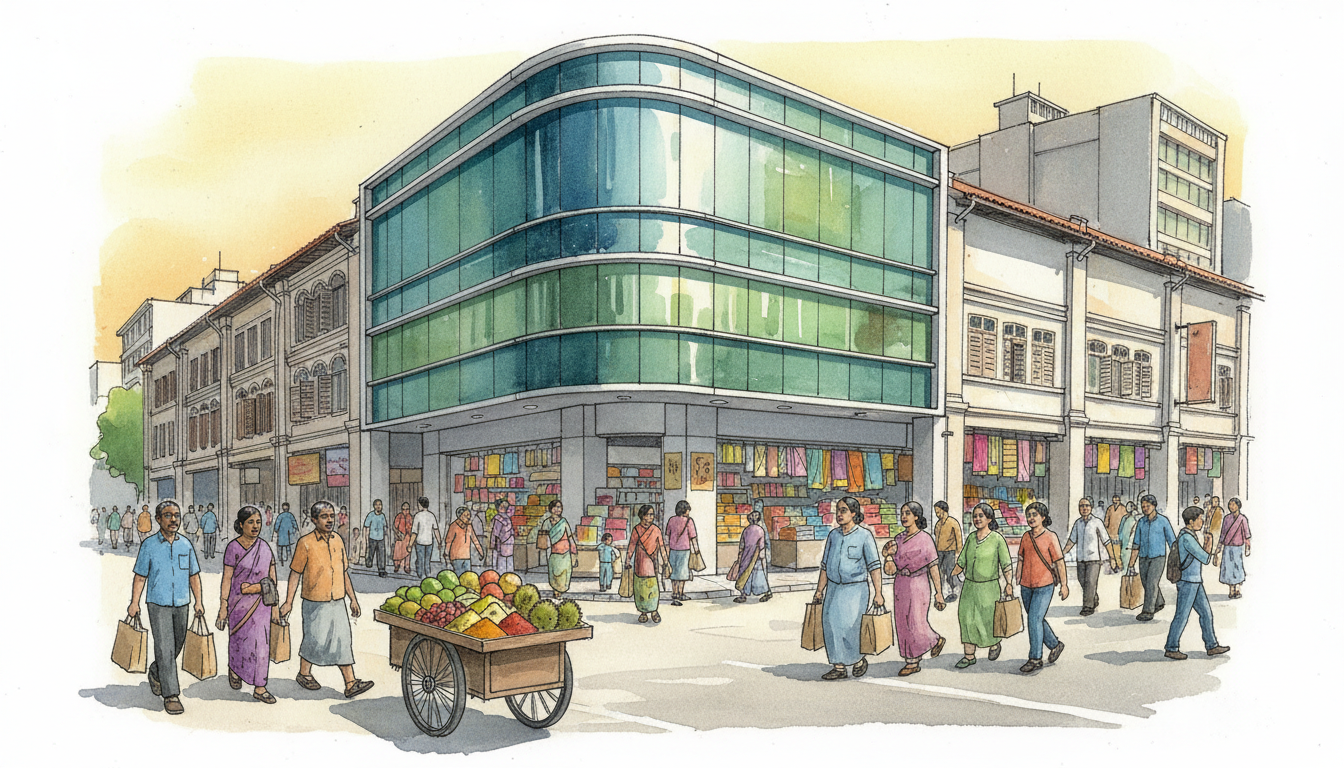
“Even after sunset, Syed Alwi Road was busy with people carrying shopping bags and finding their way between the old shophouses and larger buildings. Mustafa Centre stood among the bright shopfronts, with shelves of household goods and clothing drawing customers at different hours. My father told me that the famous store had grown from a modest family business in Campbell Lane. I looked at the old photographs later and understood that the neighbourhood’s story was made not only by buildings, but also by traders, workers, migrants and ordinary shoppers who kept changing what a city needed.”
This is a fictional model for composition, not a description of a verified visit. The cultural lesson comes from linking visible retail with documented migration and family business history.
Ten quick comprehension checks and answers
- 1. Where is the flagship Mustafa Centre? 145 Syed Alwi Road in Little India.
- 2. How does Mustafa describe its normal shopping hours? Open twenty-four hours, seven days a week.
- 3. Which earlier business stage belongs to 1971? The Campbell Lane garment shop.
- 4. What does the 1995 date represent? Expansion into the larger modern Mustafa Centre.
- 5. Why is 2003 important? The heritage record identifies the move to 24-hour department-store operation.
- 6. What is unit price useful for? Comparing the cost of equivalent amounts of similar goods.
- 7. What does 916 fineness describe? Approximately 916 parts gold per thousand of alloy.
- 8. Is a current currency exchange rate proven by an August screenshot? No, obtain the actual transaction quote.
- 9. Does a 24-hour store mean the MRT runs all night? No.
- 10. Why study Little India beyond Mustafa? It contains many communities, small trades, cultural institutions and histories.
Frequently asked questions
1. Where is Mustafa Centre?
The flagship is at 145 Syed Alwi Road, Singapore 207704, in Little India. Some online and related services may list different contact locations.
2. Is Mustafa Centre open 24 hours?
Its own website describes the main store as open 24/7. An adjoining café or specialised counter can have a different timetable.
3. Which MRT station is useful for visiting Mustafa Centre?
Farrer Park on the North East Line is one commonly used access point. Check a current map for the best exit and walking route.
4. When was the first Mustafa clothing shop opened?
The heritage and operator histories connect the Campbell Lane ready-made garment shop with 1971.
5. Who developed Mustafa Centre?
The family history includes Haji Mohamed Mustafa, Mustaq Ahmad and other relatives such as Samsuddin. The National Heritage Board documents their earlier operations.
6. When did Mustafa Centre become a larger multi-category store?
Expansion through multiple business stages led to the larger Centre by 1995. The opening of a small shop in 1971 was a different milestone.
7. Why is Mustafa Centre culturally significant?
It reflects migration, family enterprise, changing retail demand and long-running trade in Little India, one neighbourhood with many other businesses and cultural histories.
8. Are all products always cheaper there?
No guarantee follows from the store’s reputation. Prices, models, taxes, availability and warranties need current comparison.
9. What is a 916 gold label?
A gold fineness indication of about 91.6 percent gold content, not a retail price or guaranteed future value.
10. Are currency exchange rates on the website always current?
No. The displayed rate may include an earlier update time. Obtain a current quote and review relevant fees for any actual transaction.
11. Can shoppers rely on a universal return policy?
Read the seller’s policy for the particular product, and distinguish that policy from the consumer rights that may apply under Singapore law.
12. How can a student learn from the place without buying anything?
Read the NHB family-business history, compare past and current street use, understand ten words and create a sourced timeline of retail change.
Sources for business history, shopping and consumer information
- Mustafa Centre official website — current operator overview, 24-hour trading and dated service quotations.
- National Heritage Board — Mustafa Centre — the family history, migration, 1971 shop, 1995 centre and 2003 24-hour format.
- National Heritage Board — Little India Heritage Trail booklet — the wider neighbourhood and older retail traditions.
- 2026–27 JCB Mustafa Centre merchant listing — 145 Syed Alwi Road, 24-hour main store and separately stated café hours.
- ShopMustafa online storefront — a contemporary range of online categories, distinct from the main department-store entrance.
- Land Transport Authority — Singapore Rail Network — proper train planning instead of assuming overnight rail operations.
- Inland Revenue Authority of Singapore — GST — consumption-tax context for interpreting price claims.
- Consumers Association of Singapore — general purchasing rights and consumer help.
Continue to related Singapore vocabulary themes
The Top 100 Singapore Vocabulary Words | Touring and Visiting hub links the series. For the neighbourhood’s broader heritage, visit Day 16 Little India and Serangoon Road. Compare department-store shopping with Day 10 Orchard Road and Consumer Choices, use Day 32 Singapore MRT and SimplyGo for travel vocabulary, or explore Day 31 Lau Pa Sat for another model of local commerce. The Vocabulary Learning Hub provides further reading practice.
A famous shop can teach us more than a price comparison
Mustafa Centre is remembered for a broad selection and late-night opening, but its longer cultural story is about people who migrated, found customers, changed their products and built a lasting neighbourhood business. Understanding a few product and consumer terms makes a visit useful; checking a historical source makes the Singapore story more truthful. Those are good reasons to learn the words whether or not you intend to buy anything.