
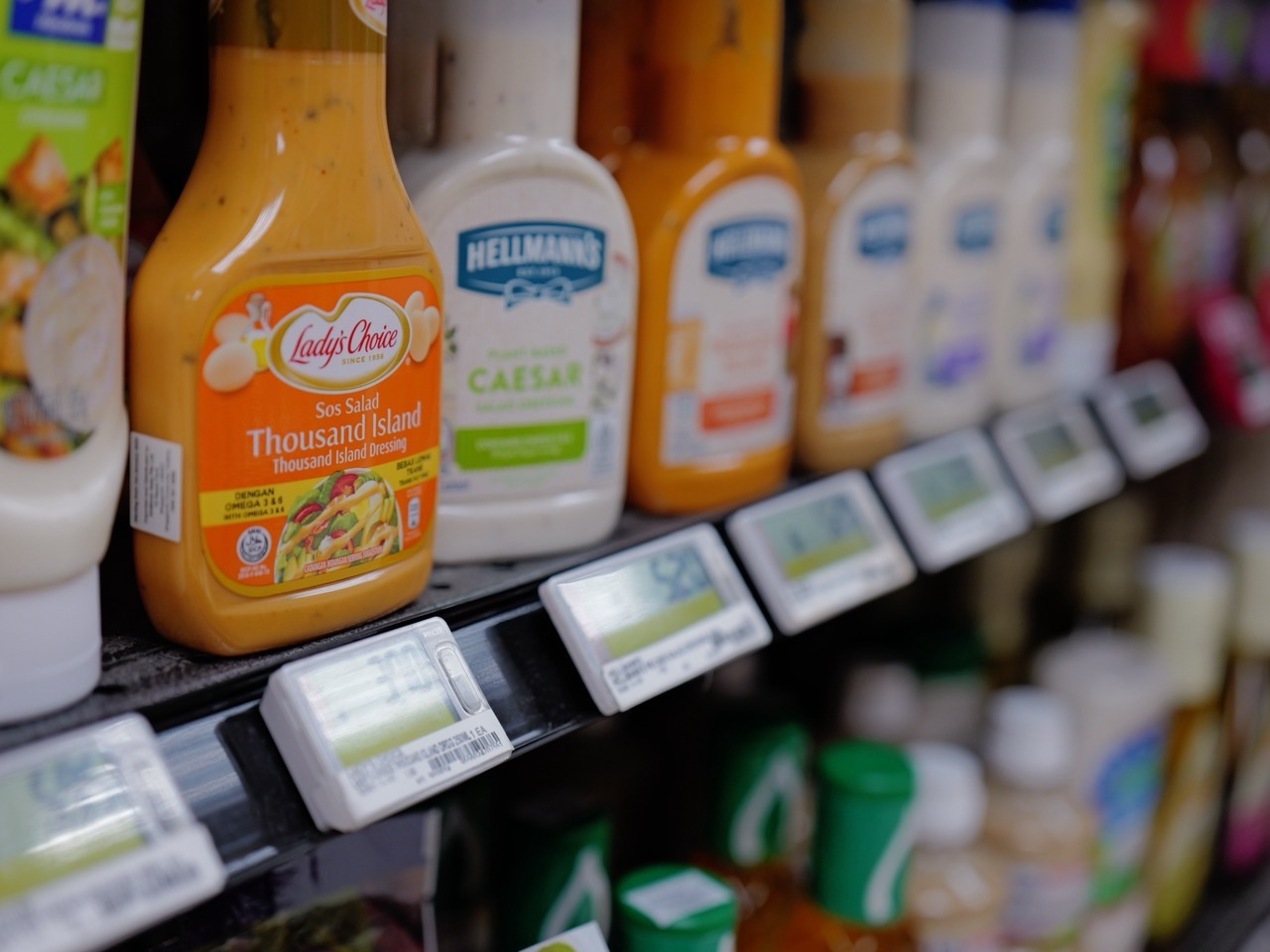
Why do oil and vinegar separate into layers after you stop shaking a salad dressing? Vinegar is mainly an aqueous mixture containing water and acetic acid, while cooking oils contain largely nonpolar fat molecules. Their molecular interactions make them poorly miscible with one another. Shaking can disperse oil into small droplets throughout the vinegar-rich liquid, creating a temporary emulsion. Without enough stabilisation, the droplets collide, merge and form larger regions of oil. Since many edible oils are less dense than the aqueous vinegar phase, the oil-rich layer commonly rises above it. Nothing has to be chemically decomposed for the separation to occur.
This Hougang Chemistry guide to oil and vinegar salad dressing, emulsions, emulsifiers, mustard, surface tension and oil-water polarity explains why some dressings quickly separate while others stay creamy for longer. Mustard, egg yolk and certain other ingredients can help stabilise an emulsion through interfacial activity, viscosity or related effects, but they do not make every oil molecule become permanently dissolved in water. The Institute of Food Science and Technology provides a classroom explanation of emulsification using oil, vinegar and common food ingredients. For Hougang families, a separated commercial dressing is not automatically spoiled, and a creamy one is not automatically safe indefinitely—follow labels, storage directions and food-safety advice. Secondary students can learn mixtures and density; Chemistry students can compare molecular interactions; JC learners can explore interfaces, droplet size and stability.
The Dressing That Looked Mixed a Minute Ago
A family prepares a simple salad after lunch in Hougang. Someone mixes oil and vinegar in a small container, shakes it and pours some over the vegetables. At first, the liquid looks reasonably uniform. By the time everyone sits down, the mixture in the container is beginning to form two distinct layers.
Did the ingredients react and change back? Did the vinegar push the oil away? Does the layer on top mean that the whole mixture was never mixed at all?
The real explanation is a lesson in how two liquids can temporarily share space without becoming one stable molecular solution. Shaking changes their physical arrangement. Chemistry and surface science determine whether that arrangement lasts.
Oil and Vinegar Are Different Types of Liquids
Common cooking oils are mixtures rich in triglycerides—molecules formed from glycerol and fatty-acid residues. Much of their structure is nonpolar. Vinegar, by contrast, is predominantly water containing a relatively small amount of acetic acid and other components depending on the product.
Water is polar and forms strong hydrogen-bonding networks. Edible oils have molecular structures that interact differently with water. Mixing them at ordinary kitchen conditions generally does not produce a single homogeneous liquid solution.
The shorthand phrase oil and water don’t mix captures the outcome, but not all its complexity. Their molecular interactions and the energy of the boundary between the phases help determine what happens.
What Does ‘Miscible’ Mean?
Miscible liquids can form a homogeneous liquid phase over the relevant composition range. In contrast, oil and a water-rich vinegar mixture are generally immiscible or poorly miscible with one another.
This does not mean no individual oil-related molecule ever enters the water-rich region or vice versa. It means the liquids do not spontaneously remain as one uniform phase throughout the mixture in the way two properly miscible liquids would.
For lower-secondary students, the useful observation is that two layers eventually return. For JC learners, it provides an introduction to phase behaviour and why molecular interactions matter.
Why Shaking Makes the Dressing Cloudy
A vigorous shake supplies mechanical energy that breaks the oil-rich phase into many small droplets distributed within the vinegar-rich phase. At that moment, light encounters a multitude of oil–water boundaries, and the dressing may appear cloudy or milky.
This is an emulsion: small droplets of one liquid dispersed in another. It is not the same as dissolving all the oil into individual molecules in water.
The Institute of Food Science and Technology’s teaching resource uses oil and vinegar to demonstrate the formation and breakdown of food emulsions. It also shows how adding suitable ingredients can alter their stability.
Why the Droplets Join Back Together
Creating many tiny droplets increases the total area of the oil–water interface. That arrangement is not always stable, particularly when nothing prevents the droplets from colliding and merging.
After the shaking stops, droplets can move, meet one another and coalesce, forming larger drops. Over time, much of the oil-rich liquid may gather into a continuous layer. This does not require a new chemical compound to form.
One reason the oil often ends up above the vinegar is density: many culinary oils are less dense than the aqueous phase. But the exact layering and the rate of separation also depend on droplet size, formulation and temperature.
It is important to distinguish coalescence from simple floating. Coalescence describes droplets merging; density-driven movement changes where the droplets tend to collect. Both can contribute to visible separation.
What Exactly Is an Emulsifier?
An emulsifier is a substance capable of helping stabilise droplets of one phase within another. Many emulsifier molecules have regions that interact differently with oil and water. By gathering at the oil–water interface, they can reduce interfacial tension and hinder droplet merging.
That does not mean an emulsifier destroys the oil or converts vinegar into an entirely new substance. Instead, it helps the two liquid phases remain dispersed for longer under suitable conditions.
The IFST resource describes the hydrophilic and hydrophobic portions of emulsifier molecules and illustrates how a more stable emulsion can form after the mixture is shaken.
Why Mustard Can Help
Mustard is a familiar ingredient that can affect how a vinaigrette behaves. Depending on the type of mustard and the formulation, its particles, proteins, polysaccharides and other constituents can influence the oil–water interface or change the mixture’s viscosity.
The result can be a dressing in which tiny oil droplets remain dispersed longer than in an otherwise similar unstabilised mixture.
A 2026 Yale National Initiative classroom resource identifies mustard as an accessible ingredient for teaching emulsions and describes its role in stabilising vinaigrettes.
The scientifically careful wording is that mustard can provide stabilising components. It is too broad to imply every mustard particle is a perfect one-ended-oil, one-ended-water molecule or that adding mustard makes all dressings permanently inseparable.
Why Egg Yolk Helps Some Dressings
Egg yolks contain molecules and other constituents that can contribute to emulsion formation and stability. Lecithin-related phospholipids are a familiar part of the explanation: their different molecular regions interact with the aqueous and oily phases.
In suitable formulations, this can help create a creamy dispersion of small droplets. Commercial mayonnaise illustrates a more structured, stabilised oil-in-water food emulsion than a simple shaken two-ingredient vinaigrette.
However, the ingredient’s physical stability is different from its food safety. Raw egg products and homemade dressings require appropriate handling, and families should follow relevant food-safety guidance rather than treating an emulsifier as a preservative.
Does the Oil Actually Dissolve in the Vinegar?
Not in the way salt dissolves in water to form a homogeneous solution. In a typical salad-dressing emulsion, many oil molecules remain in an oil-rich droplet phase.
Small droplets can make a mixture appear uniform to the naked eye even when it contains multiple microscopic phases. This is the key difference between a colloid or emulsion and a fully molecularly dissolved solution.
Students should avoid saying that a cloudy emulsion is necessarily a chemical reaction. The visible changes can result from the size and arrangement of droplets and the way they scatter light.
Why Some Creamy Dressings Stay Mixed Longer
A creamy dressing can differ from a simple vinaigrette in droplet size, emulsifier composition, viscosity and the manufacturing method. Commercial processing may create small, comparatively stable droplets throughout the product.
High viscosity can slow how quickly dispersed droplets move and meet, while suitable emulsifier systems can reduce their tendency to merge. These influences may work together.
That does not mean the dressing is stable forever. Product formulations have designed storage conditions and shelf lives. A food that looks smooth cannot be assumed safe merely because no separate oil layer is visible.
Oil-and-Water Chemistry Is Also the Science of Dish Soap
Dishwashing liquids use surfactants that help water interact with certain oily residues. Some cleaning formulations make oil easier to disperse or remove from a surface, although the details differ from creating an edible salad dressing.
The Hougang guide to why toothpaste foams is another materials example involving surface-active molecules. There, the focus is foam and oral-care formulation; here, the focus is droplet stability between two liquids.
A student who understands the broad structure of a surfactant can use it across several contexts while recognising that food-grade emulsifiers and cleaning detergents are not interchangeable substances.
A Safe Kitchen Science Comparison
This question can be explored through teacher-provided diagrams or ordinary, safe food ingredients, but there is no need to make a large experimental dressing or treat it as a preservation project. A useful small-scale classroom observation should be age-appropriate and follow food and school instructions.
- Control mixture: an oil-and-vinegar combination under the same conditions as a comparison.
- Changed variable: an appropriate amount of a specified food ingredient that may influence emulsion stability.
- Equal mixing: use the same mixing procedure for both test samples.
- Observation: describe whether the liquids appear cloudy immediately and how distinct the layers become later.
- Measurement: record the time and a defined separation measure rather than only saying one looks better.
- Limit: the appearance of a stable emulsion does not prove food safety or chemical purity.
IFST’s food-science teaching activity provides a framework for comparing oil, vinegar and common food ingredients. Parents and students should not use raw eggs or unapproved food-handling practices for an informal Science project.
Why Temperature Can Change What We See
Temperature can influence viscosity, molecular movement and the behaviour of a particular emulsion. Warmer oil may be less viscous than cooler oil, changing how droplets form or move under the same stirring conditions.
But no single temperature trend guarantees one vinaigrette will always separate faster than another. The formulation and mixing method matter, and a comparison should hold as many relevant variables constant as possible.
The correct science habit is to treat temperature as an experimental variable, not invent a universal rule from one salad bowl.
A Comparison with Peanut Butter
Natural peanut butter can release an oil-rich layer during storage. That is a different food system involving oil and finely dispersed solid particles, sometimes with stabilisers to reduce separation.
The existing Hougang guide to why peanut butter oil separates explains that distinctive suspension and oil-migration problem.
In vinaigrette, the main question is how two poorly miscible liquids form and break an emulsion. Similar-looking layers need not arise from identical microscopic structures.
How to Interpret a Separated Dressing Safely
The visible return of two layers is ordinary physical behaviour for some dressings. It does not, on its own, mean the product has spoiled. Conversely, a creamy dressing that remains uniform does not necessarily remain safe without refrigeration or after the labelled use-by period.
Follow the product’s storage instructions, use appropriate clean utensils and respect the stated shelf life. Home recipes containing perishable ingredients should be handled according to reliable food-safety advice.
If a product has unusual contamination, visible mould or other concerning signs, do not use a Science article to declare it safe from its emulsification behaviour.
School Chemistry Connections
Secondary 1–2: mixtures and separation
Learners can explain why the shaken dressing looks uniform for a time and why layers reappear. They distinguish dissolving from temporary dispersion.
Secondary 3–4: molecular interactions and material properties
Students can connect polar water-rich vinegar with nonpolar oil, and explain why surface-active ingredients influence droplet behaviour.
JC Chemistry and Physics: interfaces, stability and density
Advanced learners can investigate interfacial energy, droplet coalescence, viscosity, density-driven creaming and how an experimental emulsion is characterised.
Questions Hougang Readers Ask
Why does oil float on vinegar?
Many edible oils are less dense than the aqueous vinegar phase, so the oil-rich region often forms the upper layer after separation.
Does shaking make oil and vinegar dissolve into one liquid?
No. Shaking disperses small droplets, creating a temporary emulsion rather than a fully homogeneous molecular solution.
What does mustard do to dressing?
Mustard can supply components that influence the oil–water interface or viscosity, helping stabilise dispersed droplets in suitable formulations.
Why is mayonnaise thicker than a simple vinaigrette?
It has a different composition, droplet structure and emulsifier system. Its texture depends on more than the simple presence of oil and water.
Does a cloudy appearance mean a chemical reaction occurred?
Not necessarily. Light scattering from tiny droplets can make an emulsion look cloudy without formation of a new substance.
Does separating mean the salad dressing has spoiled?
Not by itself. Layering may be expected physical behaviour. Food safety depends on ingredients, preparation, storage and product guidance.
Can detergent replace mustard in edible dressing?
No. Household cleaning products are not edible food emulsifiers. Use only appropriate food ingredients and follow safe preparation guidance.
Two Layers, One Excellent Chemistry Lesson
The familiar oil-and-vinegar bottle shows that liquids are not always molecularly compatible, and that mixing is not the same as permanent dissolution. Shaking creates droplets; emulsifiers may help them remain dispersed; time and gravity can reveal the two original phases again.
Continue with Why Natural Peanut Butter Separates, How Toothpaste Surfactants Work, The Chemistry of Oily Curry Pigments, How Chemistry Works in Hougang and the Hougang Science Learning Hub. The Institute of Food Science and Technology’s emulsification guide and Yale’s food-science curriculum resource provide educational references. For school pathways, see the Hougang Chemistry Tuition and Tutor Library.
Food emulsions vary by formulation and storage. This article explains physical chemistry, not a recipe or a food-safety assessment of an individual product. Follow food labels and avoid using household cleaning chemicals in edible mixtures. No eduKate Chemistry tuition venue in Hougang is claimed.