
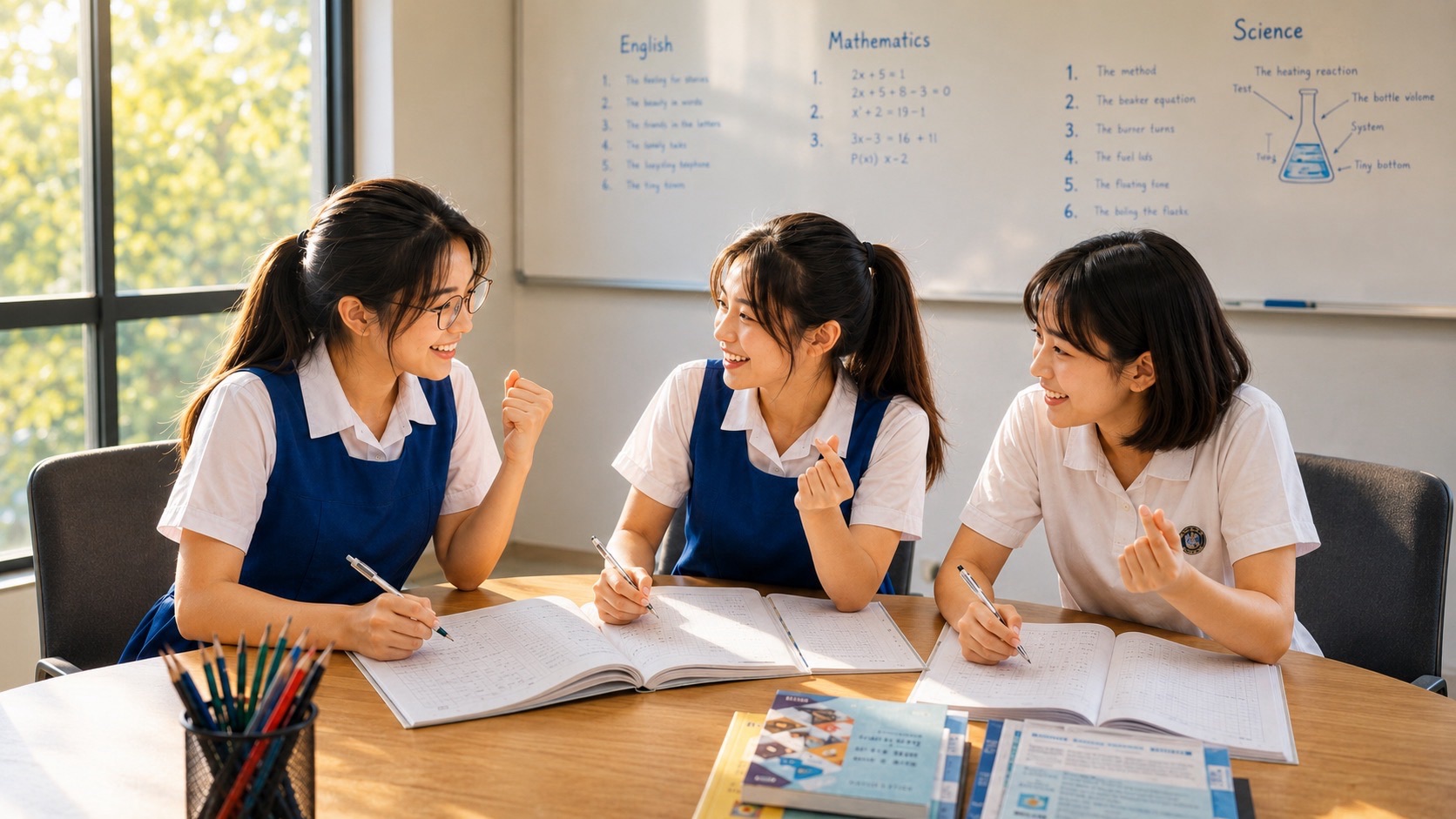
How do children learn vocabulary that helps them think, explain and answer questions rather than merely sound impressive? Teach language for real reasoning: identifying an observation, giving a reason, comparing possibilities, explaining a consequence and distinguishing evidence from an assumption. Parents can practise these vocabulary skills through stories, everyday decisions, small experiments and respectful conversations without turning every family discussion into a formal debate.
If a child knows the word evidence but cannot explain why a conclusion is reasonable, or uses because without a genuine reason, the next step is not another list of difficult words. The child needs opportunities to connect words to the thinking they represent. This volume offers practical parent examples, twenty useful thinking words, a complete worked family conversation, speaking and writing exercises, and a clear way to check that language is helping understanding.
The direct answer: teach a thinking action with its word
Let the child observe something, make a claim about it, give a reason, check the evidence and explain what might change their mind. Supply vocabulary when it gives an important idea a useful name. ‘The ground is wet’ is an observation; ‘It rained earlier’ is a possible inference; ‘I saw rain falling’ is direct evidence for that explanation.
- Ask your child what they noticed before asking what they believe.
- Name a useful thinking action: compare, infer, predict, explain.
- Invite a reason with a relevant detail rather than a memorised phrase.
- Show that a good explanation can be revised when information changes.
- Use the same reasoning word in another book, decision or subject.
Jump to: Twenty useful words · Worked example · Reasons and evidence · Family conversation · Writing activity · Home routine · FAQs.
1. Children need words for relationships between ideas
At first, children learn words for people, objects, qualities and actions. Later, they must explain how events are connected. Which detail supports an interpretation? Which event may have caused the outcome? How are two explanations similar or different? What is a reasonable conclusion?
These questions arise in reading comprehension, Mathematics, Science, family plans and daily disagreements. A rich vocabulary helps a child express the relationship accurately. The word because does not automatically make an explanation true, just as the word evidence does not automatically provide evidence. A child needs to see what the word is doing.
2. Twenty useful reasoning words for children
Choose two or three of these at a time when they naturally arise in a book, lesson or conversation. Model the action, give a child-friendly explanation and invite a fresh example. This table is a practical menu, not a list that every child must memorise.
| Word | Useful meaning | Parent prompt |
|---|---|---|
| observe | notice carefully | What did you actually observe? |
| describe | tell what something is like | Can you describe what happened? |
| compare | look for similarities and differences | How do these two plans compare? |
| contrast | point out differences | What contrasts with the first picture? |
| explain | make something understandable | Can you explain how that happened? |
| reason | an explanation offered for a choice or belief | What is your reason? |
| evidence | information supporting a claim | What evidence can we check? |
| infer | form a conclusion from clues | What can you infer from the details? |
| predict | say what may happen based on knowledge or clues | What do you predict? |
| conclude | reach a judgement after considering information | What can we conclude so far? |
| cause | make something happen; or what makes it happen | What caused the change? |
| effect | a result or consequence | What effect did the wind have? |
| justify | support a choice with reasons | Can you justify that answer? |
| evaluate | judge how good or suitable something is | How would you evaluate this plan? |
| suggest | offer an idea | What could you suggest instead? |
| estimate | make an approximate calculation or judgement | Can you estimate the time needed? |
| assume | take something as true without fully checking | What are we assuming? |
| possible | could be true or happen | Is another explanation possible? |
| certain | known to be true or sure to happen, in context | Are we certain, or do we need to check? |
| revise | change after reconsidering | What should we revise after the new clue? |
A child may demonstrate the idea in familiar language before they can use its formal English name. ‘You looked at both photographs and told me what was different—that is one way of comparing them.’ The child now has a word attached to something they understand.
3. A full example: why is the ground wet?
Start with an observation
You and your child look through the window and see wet pavement. Say: ‘We can observe that the ground is wet.’ Ask the child to describe only what is visible. Avoid immediately declaring why the ground is wet.
Consider several explanations
A child might suggest rain, a sprinkler or someone washing the pavement. Any of these could explain the observation. This teaches the difference between what we noticed and what we think caused it.
Collect additional evidence
If fresh raindrops remain on the windows and several umbrellas are wet, rain becomes a stronger explanation. If the sprinkler is currently running and only the path near it is wet, the sprinkler becomes more plausible. Ask what evidence supports or weakens each explanation.
Use the reasoning words naturally
Try ‘You inferred that it rained because you noticed three clues.’ Then ask ‘Does wet pavement prove it rained?’ The answer is no. Different causes can lead to the same visible result.
Change one fact and revise
Tell the child the sprinkler was on all morning. Ask whether the earlier conclusion needs changing. ‘I would revise my explanation’ teaches that responding to better information is a strength, not an embarrassment.
4. A good reason is more than the word ‘because’
Some children learn that school answers should contain because. But ‘I chose this route because it is the route’ does not explain a choice. ‘I chose this route because it has fewer road crossings’ offers a relevant reason if the route really does have fewer crossings.
| A child says… | What is missing? | A useful parent question |
|---|---|---|
| ‘The story is exciting because it is exciting.’ | Specific reason | Which event made it exciting? |
| ‘The story is exciting because a locked chest appeared.’ | A relevant reason | What might be inside? |
| ‘We should take the bus because buses are good.’ | The link to today’s decision | What makes it suitable today? |
| ‘We should take the bus because heavy rain is forecast.’ | A fact to verify | Where can we check that forecast? |
A reason tells us why someone believes or chooses something. Evidence gives information that can support a claim. ‘I want the blue bicycle because I like the colour’ is a reason for a preference. ‘I think the bicycle is damaged because its wheel does not turn normally’ is a claim supported by an observation. Not all situations need scientific proof, but children should learn which kinds of statements can be checked.
5. Four especially important distinctions
| Not the same | Practical difference | Example |
|---|---|---|
| Observe / infer | What was noticed versus what it might mean | The lamp went off / The power might be out |
| Predict / promise | What may happen versus what someone commits to do | I predict rain / I promise to bring an umbrella |
| Reason / evidence | An explanation versus information supporting a claim | I want to leave early / The ticket says doors close at five |
| Possible / certain | Plausible versus established in this context | The dog may be outside / We can see the dog outside |
Encourage proportional claims: ‘This might mean…’ is appropriate when only a clue is available. ‘This definitely proves…’ calls for much stronger evidence. Good vocabulary helps children distinguish uncertainty rather than covering it up with formal words.
6. A comparison needs a purpose
Invite your child to compare a bicycle and a scooter. The first answers may be that both have wheels and are different colours. Now say: ‘We need something suitable for a longer journey. What matters in the comparison?’ Depending on the rider and the route, comfort, safety, effort and storage may matter more than colour.
Introduce relevant, advantage, disadvantage and appropriate only when the child can explain what makes a feature useful for that particular decision. A polished comparison that ignores its purpose is not yet a strong explanation.
7. Let uncertainty be an acceptable answer
Suppose the story says, ‘The dog barked at the closed gate.’ A child declares that the dog was angry. Ask, ‘Could it also be excited, startled or alerting someone?’ None is certain from that single sentence. A careful reader may say ‘The dog may have been upset, but we need more information.’
Parents can model phrases such as ‘That suggests…’, ‘One possibility is…’, ‘The text does not tell us…’ and ‘I would need to check…’. These are useful because they match the amount of information available.
8. A natural parent–child conversation
Imagine your family is deciding whether to visit a park or museum. This short exchange shows how useful thinking words can arise in an ordinary choice.
| Parent | Possible child response | The thinking action |
|---|---|---|
| What are our options? | The park or museum. | Identify choices |
| What should we consider? | The weather and time. | Select relevant factors |
| What does the forecast suggest? | It might rain. | Use evidence without pretending certainty |
| Which would you recommend? | The museum, because it is indoors. | Give a reason |
| What is one advantage of the park? | We can play outside. | Consider another view |
| What might change your mind? | If it becomes sunny. | Revise a decision |
Children need not respond in polished textbook sentences. Accept a real thought first and model a clear expression afterward: ‘Yes, you are considering the weather. Let us compare our options.’

9. Stories turn vocabulary into explanations
Read a passage about a child who misses a train. Ask what caused the delay, which detail proves the departure time, and what the character might do next. Keep the observations, inferences and predictions distinct. When the story does not reveal a motive, let the child say they are unsure.
Ask a second question: ‘What new information would make you change your view?’ This teaches that comprehension involves checking the whole passage rather than matching a word to one convenient sentence.
10. Practical Science offers three different language tasks
Watch a small piece of ice melt on a plate. Before: ask for a prediction. During: describe what is actually observed. After: ask for an explanation based on what is known about heat transfer and melting. If a child says the water has ‘disappeared’ while it is plainly sitting on the plate, gently clarify the observation.
A word such as dissolve should not be substituted for melt: melting is a change of state, while dissolving involves a substance becoming dispersed in a solvent. Accurate vocabulary keeps Science explanations honest.
11. A strong writing revision begins with a genuine thought
A child writes: ‘I chose to help Ben. Furthermore, Ben was lonely. Nevertheless, I was kind.’ The connectors sound formal, but the ideas are not clearly related. First ask what the child actually saw and why the narrator helped.
A better paragraph could be: ‘I noticed Ben sitting alone, so I invited him to join our game. I thought he might feel lonely, but I did not know for certain.’ The revision now distinguishes observation from inference and connects the action to a reason.
| Useful frame | Purpose | Example |
|---|---|---|
| I noticed… | Report an observation | I noticed the leaf had turned yellow. |
| I think… because… | Give a reason | I think she is worried because she keeps checking her phone. |
| One difference is… | Specify a comparison | One difference is how much water each cup holds. |
| This suggests…, although… | State a qualified interpretation | This suggests rain, although the path may have been washed. |
| I would revise… | Change an explanation when evidence changes | I would revise our plan because the park is closed. |
Sentence frames are temporary scaffolds. Let children use natural language, and gradually remove the prompts. Do not reward a connector merely because it looks advanced.
12. A game: change the evidence
‘Nora found a broken vase beside the family cat. She concluded that the cat broke it.’ Ask whether that conclusion is certain. Now add that someone saw the cat jump onto the shelf. Does that strengthen the inference? Then change the scene: the cat had been outside all morning. What does that do to the conclusion? Finally, a sibling admits carrying the vase. What should Nora revise?
This little exercise teaches the difference between a clue, an assumption and justified confidence. Avoid making it a game of blaming people or animals; the point is examining the evidence fairly.
13. Adapt the challenge to your child
| Learning stage | Beginning task | Next challenge |
|---|---|---|
| Young speaker | Name what you see | Offer two explanations |
| Early reader | Use ‘because’ with a picture | Explain why one reason fits better |
| Growing primary reader | Compare characters with story details | Separate observation and inference |
| Older primary student | State a claim with evidence | Acknowledge alternative interpretations |
| Older student | Evaluate competing accounts | Identify assumptions and limits |
These stages describe tasks, not fixed ages. A multilingual child may already reason well in another language while learning the English expression. Treat that as a foundation to build on.
14. A gentle twelve-minute home routine
- Three minutes: describe something that happened without immediately interpreting it.
- Three minutes: propose a reason or explanation and identify a supporting detail.
- Three minutes: change one detail and reconsider the explanation.
- Three minutes: tell the story again using one or two fitting thinking words.
Twelve minutes is only an illustrative routine, not a research-prescribed dose. A single respectful exchange over dinner can be worthwhile. Revisit useful words in books, games and different school subjects.
15. What improvement should a parent notice?
- The child begins asking ‘How do we know?’ or ‘What is the reason?’
- Explanations become more specific than ‘because it is good’.
- The child recognises when something is possible rather than certain.
- New terms such as infer and compare are used appropriately in more than one setting.
- The child can change an interpretation when the evidence changes.
Progress need not look like sophisticated speech every day. Real understanding can be shown with ordinary words, drawings, pointing or accurate actions.
16. Avoid three common mistakes
- Rewarding formal vocabulary without accuracy: ‘Consequently’ must actually introduce a consequence.
- Demanding evidence for every personal preference: feelings and choices sometimes need listening, not cross-examination.
- Treating disagreement as disrespect: teach children to listen, question reasons politely and revise views when appropriate.
17. Connect the skill with the wider reading journey
Begin with Vol 1: understanding words, Vol 2: choosing precise meanings and Vol 3: using words in natural sentence patterns when these foundations need work. For vocabulary in passages, see Vol 5: investigating unfamiliar words while reading. The Core Aim of Vocabulary Mastery: Reading Comprehension explains the relationship between word knowledge and interpreting a text.
Frequently asked questions
When can my child learn words like ‘reason’ and ‘evidence’?
Children can practise the ideas from an early age by showing what they saw and giving a simple reason. Introduce more formal terms when they match the child’s experiences and learning needs.
Does every answer need evidence?
No. A personal preference does not always need proof. Evidence becomes especially important when a child is trying to establish a factual claim, explain a passage or defend an inference.
Why does my child misuse ‘because’?
The child may know the sentence structure before understanding the causal or explanatory relationship. Ask if the clause really provides a relevant reason.
What if my child interprets a story differently?
Ask for the specific details supporting each interpretation. Acknowledge genuine ambiguity and correct interpretations that contradict the text.
Does this encourage arguments at home?
The intention is thoughtful discussion, not competition. Model respect, listening, meaningful reasons and the willingness to change one’s mind.
Should children memorise the twenty words?
No. Select a few words that will actually be used, teach the ideas they name and revisit them in several contexts.
Research-informed reading for parents
The Education Endowment Foundation’s reading comprehension review includes questioning, inference, clarification and drawing conclusions. The Institute of Education Sciences adolescent literacy practice guide recommends explicit vocabulary teaching and extended discussion of text meaning. The family examples above are practical illustrations rather than validated timed interventions.
One small change worth trying tonight
Ask your child about one small decision they made. What did they notice? What was their reason? Could a new fact change their choice? Choose one vocabulary word that helps them answer more clearly. The next stage of vocabulary learning is often better thinking, not a longer list.
Continue reading: Vol 7: vocabulary across Mathematics, Science and other subjects · Vol 8: vocabulary in multilingual families · Vocabulary in Real English Hub.