
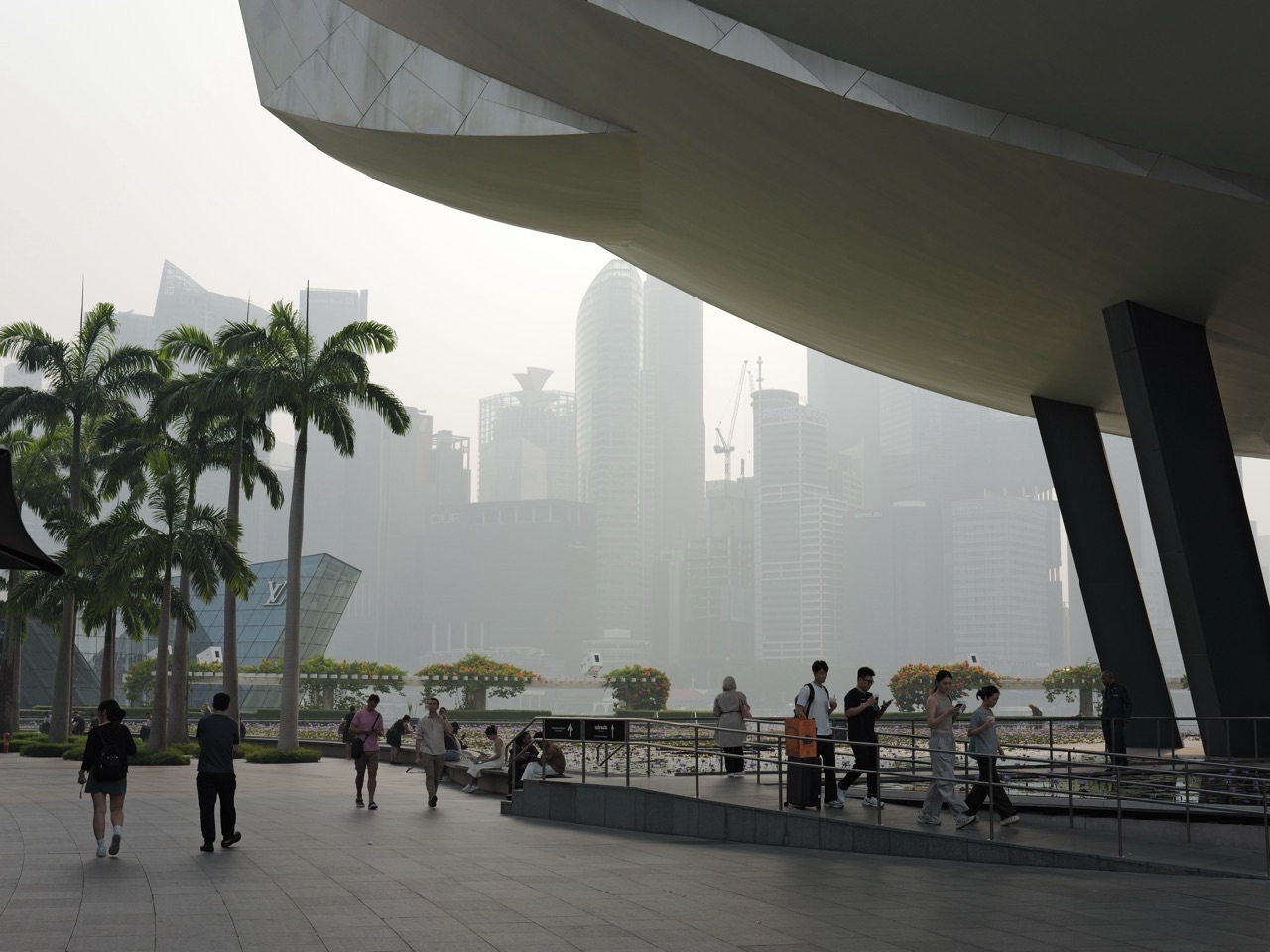
Singapore children may step outside on a hot afternoon and say, “The air feels bad.” That sentence can begin a useful conversation, but it does not tell us whether the child means temperature, humidity, smoke, dust or a personal sensation. In Singapore, a caregiver may check the latest haze information or a heat-stress map before a school outing. The child needs words to distinguish measured air quality, heat stress, forecast conditions and adult decisions about activities.
The child’s first language is an appropriate place to start. Families may speak English, Mandarin, Malay, Tamil or another home language when discussing outdoor plans. A child can explain in the strongest language what they noticed, then learn the accurate English terms appearing on official displays. When they understand the difference between “elevated PM2.5,” “unhealthy PSI” and “high heat stress,” they are less likely to pass along an exaggerated statement to a friend.
This twenty-ninth article in Singapore Children Vocabulary explores reading haze and heat-stress information while showing consideration for people with different needs, for approximately ages nine to twelve. It is not a medical guide, a live forecast or a substitute for school and public-health directions. It differs from Rainfall and Flood Alerts, which explains rain measurements, and Emergency Help-Seeking, which focuses on communicating urgent needs. Here the learning problem is interpreting two different kinds of environmental guidance without combining them into one unsupported claim.
Quick answer: check the indicator, the time and the audience
The child-friendly routine is identify the indicator → read its time window → check its location → understand who the guidance covers → let a responsible adult decide. A measurement of airborne particles is not a heat-stress measurement. And a map observation at one station does not describe every place in Singapore at all times.
The practical success test is a clear sentence: “The official page shows the latest measurement for this area. It does not by itself tell us what every person should do.” Children can learn the limits of an indicator before learning any technical formula. The appropriate response to a genuine health or safety concern is to tell a caregiver or teacher promptly, not to complete the activity independently.
- Age focus: upper primary, with simple picture-based sorting for younger learners.
- What to prepare: fictional screenshot cards, an adult-controlled view of the current official haze and heat-stress information, and a paper clock.
- What the child learns: distinguish particle readings, a longer-duration PSI and WBGT heat-stress categories from everyday air temperature.
- Safety boundary: never send children outdoors to check haze by smell, photograph smoke, test heat endurance or decide their own medical restrictions.
Singapore’s two official information systems
The National Environment Agency’s haze information portal shows the 1-hour PM2.5 concentration and 24-hour Pollutant Standards Index (PSI). PM2.5 describes fine airborne particulate matter; the one-hour reading is an indication of more immediate particle concentrations. The 24-hour PSI brings together pollutant sub-index information over a longer averaging period. They are not numbers measuring the same thing on the same scale.
NEA’s 10 September 2026 haze advisory explicitly distinguishes the purposes: members of the public can refer to the one-hour PM2.5 reading for immediate activity considerations and the 24-hour PSI forecast for planning ahead. Guidance differs according to the indicator, exposure, activity and population group; a child should not memorise one universal outdoor-exercise rule.
The Meteorological Service Singapore’s Heat Stress page maps Wet-Bulb Globe Temperature (WBGT) at monitored locations and provides low, moderate and high categories. WBGT considers air temperature together with humidity, wind and radiation. It is fundamentally different from air temperature alone. MSS explains that its displayed WBGT reflects an average of the preceding 15 minutes and can differ at shaded or more exposed locations.
The separate Learn about Heat Stress page explains that the WBGT index describes environmental factors; it does not measure each person’s hydration, health, acclimatisation or clothing. The public advisory shown with heat-stress information applies to prolonged outdoor activity in direct sunlight. A caregiver or school must apply appropriate current guidance to the actual circumstances.
These sources can be read together without being treated as interchangeable. A day can be hot without a haze event; a hazy morning can become cooler after rain; a particular region’s readings may differ from another. Children should learn to preserve that distinction when discussing an outing.
Twenty vocabulary words for accurate environmental messages
These are original educational explanations of terms used in public environmental information, not a clinical checklist or an official examinable vocabulary list. Choose five words at a time and use one reliable example with each.
- 1. Haze: reduced visibility associated with suspended particles or smoke in the air. “The skyline looks hazy, but we check official readings.”
- 2. Particle: a tiny piece of matter suspended or present in a material. “Airborne particles can be measured.”
- 3. PM2.5: fine particulate matter with an aerodynamic diameter of 2.5 micrometres or less. “The one-hour PM2.5 figure describes a particular air measurement.”
- 4. Concentration: the amount of a substance in a stated volume. “The concentration has units, not just a colour.”
- 5. PSI: the Pollutant Standards Index used in Singapore’s air-quality reporting. “Check the time period attached to PSI.”
- 6. Averaging period: the time interval used to calculate a reported measure. “The one-hour and 24-hour figures use different averaging periods.”
- 7. Region: a defined area used for reporting. “The reading refers to a region.”
- 8. Reading: a value reported by a measuring instrument or system. “An instrument reading may be updated.”
- 9. Forecast: information about what may happen later. “A forecast is not the same as an observed event.”
- 10. Advisory: guidance on a situation, usually issued by a responsible authority. “A caregiver reads the current advisory.”
- 11. Temperature: a measure of how hot or cold something is. “The air temperature alone is not the WBGT.”
- 12. Humidity: the amount of water vapour in the air. “Humidity influences heat stress.”
- 13. Radiation: energy transmitted as waves or particles, including heat and sunlight effects. “Solar radiation is a factor in WBGT.”
- 14. WBGT: Wet-Bulb Globe Temperature, an environmental heat-stress index. “WBGT is not simply the thermometer’s air temperature.”
- 15. Exposure: being subjected to a condition such as heat or polluted air. “Duration and activity can change exposure.”
- 16. Shade: a place shielded from direct sunlight. “A shaded area can have different heat conditions.”
- 17. Prolonged: continuing for a relatively long time. “The advisory discusses prolonged outdoor activities.”
- 18. Strenuous: requiring considerable physical effort. “Running hard is generally more strenuous than sitting.”
- 19. Vulnerable: more likely to be adversely affected in a particular situation. “Some people need greater care, but do not guess their conditions.”
- 20. Verify: check the source, time and meaning of information. “Verify the current map before repeating an older claim.”
The meaning boundaries are the main lesson. A reading is an observed measurement; a forecast concerns later conditions; an advisory explains what the responsible authority recommends. WBGT is not the temperature displayed on a phone’s general weather screen, and PSI is not a one-hour particle concentration expressed in micrograms per cubic metre.
Worked case one: the child treats every haze number as PSI
A fictional family message reads, “1-hour PM2.5 = 62 micrograms per cubic metre.” The child rewrites it as “PSI is 62, so everything is fine.” The parent asks where the number came from.
Parent: “Which indicator does the example display?”
Child: “One-hour PM2.5 concentration.”
Parent: “Is it labelled as 24-hour PSI?”
Child: “No. I changed the indicator.”
Parent: “Why does that matter?”
Child: “Because these are different measurements, even when both show numbers.”
Parent: “What would be an accurate report?”
Child: “The fictional reading says one-hour PM2.5 is 62 micrograms per cubic metre. We need the official context and current guidance.”
The fictional number is not a current Singapore reading. Its purpose is to teach indicator identity. A child who learns not to relabel a measurement has gained a transferable reading skill for charts, examination graphs and other public information. Do not ask the child to recommend outdoor exercise or masks from a single example number.
Use the NEA haze portal to show the different panels and labels in a safe adult-guided session. For decisions about health and activity, follow the latest official advisory and responsible adult or professional guidance.
Worked case two: the screenshot from yesterday
A caregiver receives a screenshot of the haze portal with a bold caption saying “The reading is dangerous right now!” The screenshot does not show when it was taken. A child wants to warn their classmates immediately.
Parent: “Do we know the original capture time?”
Child: “No. It may be an older reading.”
Parent: “What does the caption claim?”
Child: “That the condition applies now.”
Parent: “Can the screenshot alone prove that?”
Child: “Not without checking its time and the current source.”
Parent: “What is a sensible next step?”
Child: “Tell you and use the official current portal, rather than forwarding an unverified warning.”
NEA’s public data are updated and may be corrected. A number without a time label can easily mislead, especially when its corresponding advisory has changed. This scenario strengthens the separate skills in Trustworthy Online Messages without repeating its whole digital-information lesson.
A child can draft one careful sentence: “I saw a screenshot about air quality, but I have not confirmed that it is current.” It is accurate even when the child does not know the latest official level.
Worked case three: WBGT and thermometer temperature differ
An upper-primary class is looking at a fictional table. The air temperature is 32°C at two imaginary locations, but the WBGT values differ because the humidity, wind or solar radiation conditions differ. A child argues that both must have the same heat-stress level.
Teacher: “What does air temperature measure?”
Child: “One part of how hot the environment is.”
Teacher: “What additional factors does WBGT consider?”
Child: “Humidity, wind and radiation as well as temperature.”
Teacher: “Could two places with the same air temperature have different WBGT?”
Child: “Yes. Their other conditions may be different.”
MSS’s heat-stress explanation gives a real technical example of differing WBGT despite the same air temperature. The classroom task is to name the difference, not compute a personal medical risk. Children should not be asked to exercise under midday sun to demonstrate heat stress.
A near-miss question: “Can we always convert air temperature directly into WBGT with one simple fixed number?” No. The other environmental inputs matter. That is why the two labels appear separately.
Worked case four: changing the outdoor plan without blaming someone
A fictional school is considering an outdoor activity. A parent says a child has particular needs, but another learner calls that person “weak.” The teacher redirects the class to the fact that public guidance can differ by person and activity.
Teacher: “Is everybody affected by the same conditions in exactly the same way?”
Child: “No.”
Teacher: “Do we need to know a classmate’s private medical details?”
Child: “No. The responsible adults handle that respectfully.”
Teacher: “What words help us discuss the situation?”
Child: “Exposure, prolonged, strenuous and advisory.”
Teacher: “What is the appropriate decision process?”
Child: “The school checks current official guidance and makes a suitable safe arrangement.”
Children should not be required to disclose asthma, health concerns or medication to peers as part of vocabulary practice. The official haze and heat advisories are written for appropriate populations and conditions; a teacher or caregiver interprets them with safety in mind. A child can understand why arrangements vary without making or contesting medical decisions.
An extension asks whether moving a lesson indoors is necessarily evidence that the weather is dangerous everywhere. No. The change may be precautionary, location-specific or designed for particular participants. Avoid inventing the school’s reason.
Worked case five: two maps, two kinds of care
The parent shows a fictional version of the haze map beside a fictional WBGT map. One uses air-quality categories and the other uses heat-stress levels. The child merges them into a statement that “Singapore has the highest danger everywhere.”
Parent: “What does each map measure?”
Child: “The haze map reports air quality. The WBGT map reports environmental heat stress.”
Parent: “Do they use the same units?”
Child: “No.”
Parent: “Does one map cancel the other?”
Child: “No. They are different information sources.”
Parent: “How would we talk about a family outing?”
Child: “We would check the current relevant official guidance for the place and activity, and you would decide.”
This illustrates a civic-information principle: more data do not help if the reader mixes incompatible indicators. A child can be curious without being responsible for risk management. Learning the names of the measures makes the adult’s discussion more understandable.
Three things not to infer from a skyline photograph
First, a hazy-looking skyline does not provide a precise PM2.5 concentration or PSI. A photograph can be affected by time of day, lighting, humidity, distance and processing. The featured Singapore photograph is an example of an appearance, not a certified air-quality measurement.
Second, a bright sunny day does not prove the WBGT is high at every location. Shade, wind, humidity and other environmental factors matter, and MSS reports site-specific readings. Children should not invent a heat category from the colour of the sky.
Third, a photograph lacks an obvious time dimension unless its provenance is verified. “This looked hazy on a particular photographed occasion” is not equivalent to “It is hazy now.” For real decisions use the current official site, not a decorative image.
A practical child sentence frame is “I observe ___ in this photograph; it does not establish ___.” That can be applied to weather, public notices, scientific evidence and social-media claims.
First-language explanations: keep the units and uncertainty
A parent may translate “The one-hour PM2.5 reading is elevated” into a home language. A child might hear only “pollution” and later repeat “The 24-hour PSI is hazardous.” Those are not equivalent. Ask the child which measurement was mentioned, which time window it represents and whether the original wording included a specific band or level.
The same applies to heat. High heat stress does not necessarily mean the normal air-temperature reading is the highest one in the city. A home-language explanation should preserve WBGT’s nature as a composite measure. Where no one-word translation fits, use a clear phrase rather than inventing an exact term.
A child may also hear the phrase “the air is bad for you.” Rather than assigning a health conclusion, a parent can ask: “Which official advisory are we reading? Who is its stated audience? What activity does it discuss?” The adult remains responsible for health decisions and can obtain qualified advice where appropriate.
Do not make children act as interpreters for high-stakes health instructions between adults. Family bilingual practice is a learning opportunity, not a substitute for a professional medical conversation.
A ten-minute classroom sorting activity
Prepare four cards labelled FICTIONAL DATA: a one-hour PM2.5 reading with units, a 24-hour PSI value, a WBGT heat-stress category and an air-temperature observation. The figures should not be presented as actual current measurements. Ask the child to match each card to its indicator.
Next add three more cards: “Observed,” “Forecast,” and “Advisory.” Ask whether the first card is a measurement, the second a prediction and the third a direction or recommendation. Some real official displays may contain several pieces together. The child should learn to identify each component rather than assign one label to an entire page.
Now add a message that says “The reading was recorded yesterday.” Ask whether the current condition is established. A strong answer says no and explains that the timestamp does not support a present-tense claim.
Finally, introduce a person who prefers to avoid outdoor activity in a fictional story. Ask whether classmates have a right to demand private health details. The answer is no. Adults can make arrangements without using students as medical evidence in front of peers.
The activity can be completed at a desk with no device and no outdoor exposure. End by asking what additional information a responsible adult would need before arranging an activity. Do not give children a fictitious medical threshold chart to use as a real decision tool.
Repair, stabilisation and extension pathways
Repair pathway: a child confuses weather with air quality. Start with temperature, haze, reading, region and forecast. Use two labelled illustrations and one short sentence. Let the child express the distinction in a familiar language before English.
Stabilisation pathway: the child knows “PSI” but merges indicators. Teach PM2.5, concentration, averaging period, advisory and verify. Compare labels, units and timestamps without asking for health recommendations.
Extension pathway: a confident reader can analyse WBGT, humidity, radiation, exposure and strenuous. Ask why WBGT differs from thermometer temperature and why advisories depend on the intended audience and activity.
A child who can explain a difference in Malay or Mandarin but not yet in English is demonstrating useful concept knowledge. A child who pronounces every term beautifully but changes the measurement’s meaning needs more practice with precise reading. Match feedback to the actual gap.
Four weeks of child-level haze and heat vocabulary
- Week 1 — recognise the information type: haze, particle, PM2.5, concentration and PSI. Identify which official display contains each term.
- Week 2 — preserve time and location: averaging period, region, reading, forecast and advisory. Separate the current measurement from an older screenshot.
- Week 3 — understand environmental heat: temperature, humidity, radiation, WBGT and shade. Explain why air temperature alone does not determine WBGT.
- Week 4 — discuss considerate choices: exposure, prolonged, strenuous, vulnerable and verify. Read an adult-selected advisory without judging a person’s health or prescribing an activity.
Revisit the same terms in a new fictional example. A family can practise one distinction over dinner rather than making the child watch air-quality charts repeatedly. Repeated checking can be unnecessary or anxiety-provoking when there is no decision to make.
A progress record needs three prompts: “Which indicator is this?”, “What place and time does it cover?”, and “What do we still need to know?” If the child cannot answer a field from the card, “Not stated” is a correct answer.
Common mistakes that require careful correction
“One-hour PM2.5 and 24-hour PSI are the same number.” No. They report different things and use different averaging periods and units.
“Heat-stress WBGT is simply the day’s air temperature.” No. Humidity, wind and radiation contribute to WBGT.
“If the sky looks hazy, I can guess the exact PSI.” No. Visual appearance alone does not provide a verified numerical reading.
“A message from yesterday proves today’s conditions.” No. Check the original source, time and current update.
“An advisory means every person must do the same thing.” Not necessarily. Official guidance considers activities, exposure and different population groups. Adults handle individual needs.
“The child should test how long they can endure heat.” Never. Learning about heat stress is a paper- and source-reading task, not a physical trial.
“A classmate who needs a different arrangement is weak.” This is unfair and may expose private health information. Respect different needs.
“A 24-hour forecast gives the exact air quality everywhere at this moment.” No. Understand the time span, uncertainty and reporting region.
Frequently asked questions
What is the difference between PSI and PM2.5 in Singapore?
Why does NEA show one-hour PM2.5 readings?
What does WBGT mean?
Can two locations with the same air temperature have different WBGT?
Does a photograph prove whether the haze is unhealthy?
Should children decide whether to go outdoors during haze or high heat stress?
Can a child understand the advisory in a home language first?
What if official information appears different from a forwarded screenshot?
Why precise environmental language is part of shared care
Singapore’s public environmental information works only when people understand what it does and does not say. Sensors, official forecasts and advisories provide distinct types of information. Families and schools make decisions using those sources along with their actual responsibilities and needs. The child’s contribution is not to diagnose air quality or medical risk but to avoid confusing an indicator and to communicate uncertainties clearly.
For source-based learning, consult the NEA haze portal, the 10 September 2026 haze advisory, MSS Heat Stress map and MSS explanation of WBGT. Those pages establish the technical context; the conversations in this article are fictional educational examples.
A multilingual society benefits when people can explain an official environmental message without turning possibility into certainty or judging someone else’s needs. Twenty well-understood words cannot make every shared space safe, but they can support more accurate and considerate discussion.
Continue the Singapore Children Vocabulary learning network
For another public environmental-information problem, see Rainfall and Flood Alerts. For an ordinary community report, use Neighbourhood Problem Reporting. For checking old forwarded material, use Trustworthy Online Messages.
The companion topics in the present batch are Void Decks and Shared Facilities, Electricity and Energy-Saving Vocabulary, and Town Planning and Community Consultation. Each has a different civic communication task.
For the broader age-by-age progression, use the Vocabulary Learning Hub, Vocabulary Development and the Singapore Bilingual Education overview.
A final paper exercise that needs no bad weather
Draw four cards: PSI, PM2.5, WBGT and air temperature. Ask your child to name the kind of information each card represents and identify which cannot be directly compared. Then give an invented forecast with no date and ask which fact is missing. A child who says “We need the current official information and a responsible adult” has learned a reliable form of first-language-to-English civic communication.
Prepared on 23 October 2026 using NEA and MSS official guidance. Example readings and school conversations are fictional. The featured photo depicts a hazy-looking Singapore skyline but does not establish any official PSI or PM2.5 reading, nor the current conditions.