
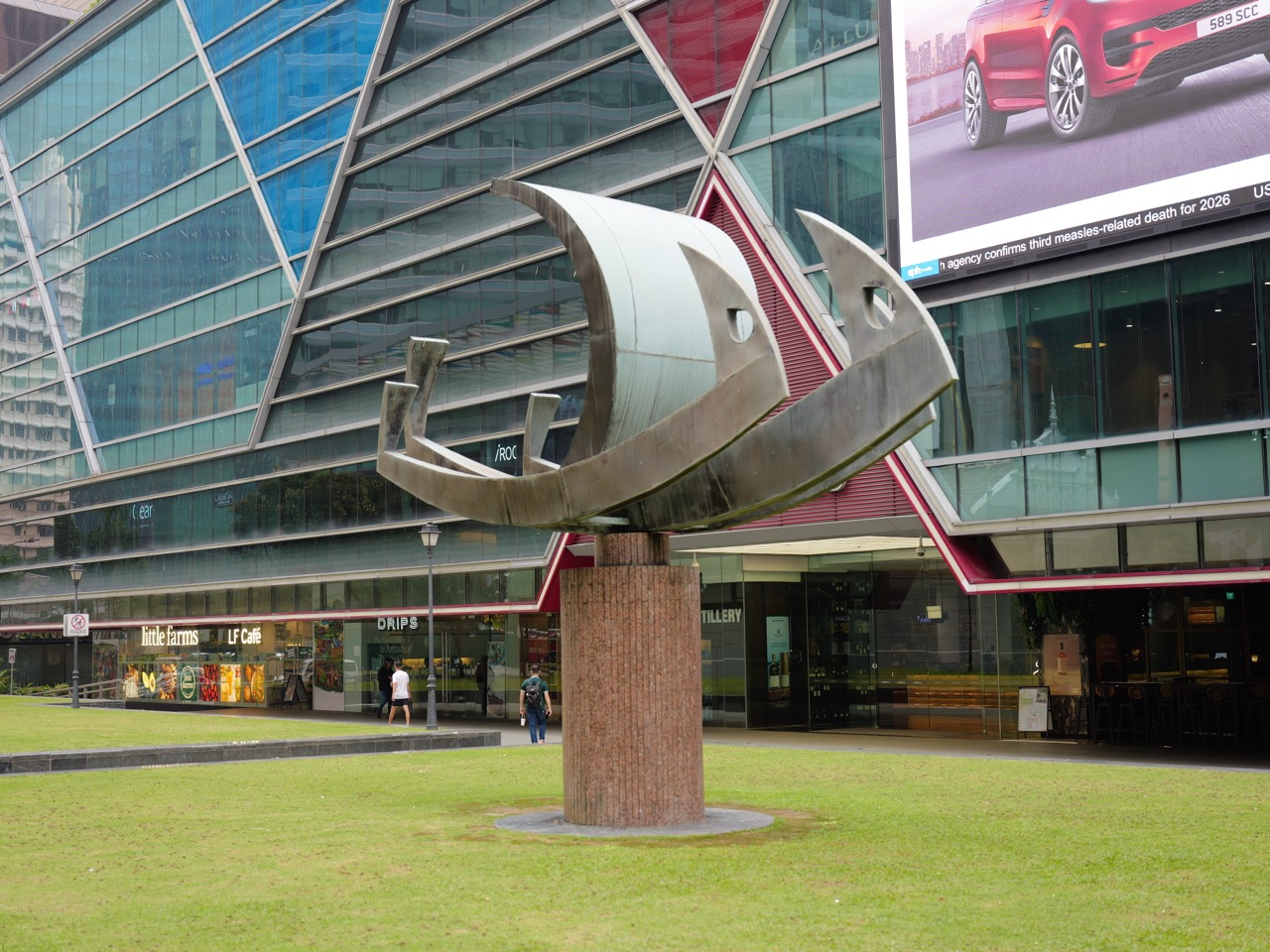
Singapore children may pass a mural or sculpture on the way to school and remember only its colour. But public art can also invite a question: “Why is this artwork here, and what does it mean to different people?” A child can learn to describe what is visible, distinguish personal interpretation from an artist’s stated intention and listen when another person notices something different.
The first language is a valuable starting place. Children may speak about a picture with family in English, Mandarin, Malay, Tamil or another home language. They may know how to say that a shape resembles a boat, a flower or a face before they know the English words motif, abstract, perspective or interpretation. Adults can accept the idea in a familiar language, then model a precise English sentence that others can understand. The aim is shared discussion, not forcing everyone to agree about a work of art.
This twenty-fourth article in Singapore Children Vocabulary focuses on looking carefully at public murals, sculptures and installations while respecting artists and public spaces. It is designed for roughly ages seven to twelve and works equally well with teacher-selected images at home. It differs from the First-Language Family Stories lesson, which records relatives’ memories, and the National Symbols lesson, which teaches established official meanings. Many public artworks invite interpretations that are not fixed in the same way as a national flag’s official symbolism.
Quick answer: describe what is visible before deciding what it means
Teach a five-part viewing routine: observe → describe → read the artist information → suggest an interpretation → compare respectfully. The first step is deliberately factual. “I see curved shapes in bronze” is an observation. “They remind me of waves” is an interpretation. “The artist intended to depict the sea” would require a source; the child’s impression alone cannot establish it.
Public art is made for viewing or experiencing in shared spaces, but “public” does not mean an artwork may be touched, climbed, repainted or photographed in every possible way. The site and event may have rules. If the child wants to create art in a shared location, a responsible adult or organisation must arrange permission from the relevant owner and follow appropriate processes.
- Best place to practise: a public artwork viewed safely with a caregiver, or an official image and caption selected by a teacher.
- Learning success: the child can state two observations, offer one interpretation as a possibility and identify a reliable source for the artwork’s title or artist.
- First-language bridge: allow the first explanation in the child’s strongest language, then practise the distinction between “I see” and “I think it represents” in English.
- Safety and rights: do not climb installations, alter walls, obstruct walkways, disclose strangers’ images or repost artwork without considering applicable rights and permissions.
Singapore’s public art and community arts framework
The National Arts Council (NAC) describes its Public Art Initiatives as an effort to integrate art into places where Singaporeans live, work and play. Its official Public Artworks catalogue includes murals, sculptures and other forms of publicly situated artwork, with artist information and context.
NAC’s Public Art Trails overview, updated on 26 September 2026, describes six self-guided public art trails in different parts of Singapore. It presents the artworks as ways to examine the stories and character of neighbourhoods. Parents should check current access and route information before an outing; a catalogue listing does not guarantee that a particular path is suitable for every child or that a work is always accessible.
The People’s Association describes PAssionArts, established in 2012, as a community arts movement that involves residents, artists and art champions in shared creative experiences. PA’s programme highlights participatory arts, belonging and shared memories. It is an example of how artistic expression can take place within organised community structures, not a general licence for anyone to paint a public wall.
For children, these official programmes offer two connected ideas: art can be encountered by people who do not own it, and shared creative spaces require care and coordination. Interpretation can differ across languages and backgrounds, while ownership, commissioning, site rules and the artist’s documented statements remain factual matters to check.
Twenty vocabulary words for public art and careful interpretation
These English meaning anchors are not a mandated school assessment list. Explain words using a picture or a safe visit. Some terms are advanced; start with five at a time and ask the child to apply them in a new example rather than repeating a definition alone.
- 1. Public artwork: art made or situated for people to encounter in a public setting. “We saw a public artwork near the plaza.”
- 2. Mural: an artwork made on a wall or similar large surface. “The mural shows several colourful shapes.”
- 3. Sculpture: three-dimensional art made by shaping or assembling materials. “The sculpture looks different from another angle.”
- 4. Installation: art arranged within or in relation to a particular space. “The installation includes several separate pieces.”
- 5. Artist: a person who creates or develops an artistic work. “The plaque names the artist.”
- 6. Medium: the material or method an artist uses. “The work uses a painted medium.”
- 7. Material: the substance from which something is made. “Metal is one of the sculpture’s materials.”
- 8. Subject: what an artwork depicts or explores. “The picture’s subject may be a neighbourhood scene.”
- 9. Abstract: not necessarily depicting recognisable objects in a realistic way. “The abstract shapes suggest movement to me.”
- 10. Motif: a recurring image, form or idea in a work. “The same curved motif appears several times.”
- 11. Symbol: a visual element used to represent an idea. “We need evidence before deciding what the symbol means to the artist.”
- 12. Context: information around the work that helps explain its setting and meaning. “The plaque provides historical context.”
- 13. Observation: a detail noticed directly. “My observation is that there are three circles.”
- 14. Interpretation: an explanation of possible meaning. “My interpretation is that the shapes suggest a journey.”
- 15. Perspective: a particular viewpoint or way of seeing. “Our perspectives on the mural are different.”
- 16. Caption: a short text identifying or explaining an artwork. “Read the caption before guessing the artist.”
- 17. Site-specific: designed in close relation to a particular place. “A site-specific work may respond to its surroundings.”
- 18. Commission: arrange for an artist to create a work under agreed terms. “An organiser may commission public art.”
- 19. Permission: approval to carry out a specified action. “We need permission before painting or changing any public surface.”
- 20. Stewardship: responsible care of something shared or entrusted to a community. “Public-art stewardship includes not damaging the work.”
Some words name facts about a work—artist, medium, material or commission. Others name a viewer’s response—interpretation or perspective. Do not merge these two groups. A child may see a wave in an abstract shape, but that does not prove the artist intended a wave. A plaque may name materials and artist but not explain every possible viewer response.
Worked case one: two children see different things in an abstract sculpture
Two fictional Primary 4 pupils view an abstract sculpture shown in a teacher-provided image. One says, “Those curves are waves.” The other says, “No, they’re ribbons.” The disagreement grows because both pupils speak as though their interpretation is a documented fact.
Teacher: “What shapes are both of you observing?”
Child A: “Several long curves.”
Child B: “The shapes overlap.”
Teacher: “Those are observations. What are your interpretations?”
Child A: “They remind me of waves.”
Child B: “They remind me of ribbons.”
Teacher: “Can both interpretations be honestly reported?”
Children: “Yes. We can explain what we see without claiming the artist said it.”
The teacher has protected room for multiple viewpoints while preserving accuracy. The exercise is not about declaring that every claim is equally supported. If a source documents the artist’s stated theme, students should learn that fact and distinguish it from personal response. Creative interpretation and evidence can coexist.
Ask a near-miss question: “If one pupil uses the word ‘wave’ with more confidence, does that prove the artist’s intention?” No. Confidence is not a source. The child learns the linguistic value of “resembles,” “suggests,” “reminds me of” and “according to the artist.”
Worked case two: a real artwork title is not a guessing competition
NAC’s official Public Artworks catalogue lists Points of View by Tony Cragg. Its description explains that the irregular stacked forms present different appearances from different angles, encouraging imaginative viewing.
A teacher can show the official image and caption, then ask the class to distinguish the artwork’s listed title and artist from a pupil’s invented nickname.
Child: “I call this the Melting Towers, so that must be the title.”
Teacher: “That is your descriptive nickname. What does the official listing say?”
Child: “The title is Points of View, and the artist is Tony Cragg.”
Teacher: “May you still say it reminds you of melting shapes?”
Child: “Yes, if I make clear that it is my interpretation.”
The source is a public catalogue, not a memory test of an unfamiliar name. The child can read the title, author, material and setting from the official description and use a careful phrase for personal impressions. This is a transferable reading skill: do not confuse what an artwork is called with what it reminds you of.
Do not assume the public listing guarantees unrestricted physical access or permission to climb, touch or perform beside the sculpture. A real visit should follow current site rules and be supervised.
Worked case three: the community wants a wall mural
A fictional school group decides to create a mural on a community wall because they want to brighten the neighbourhood. The students begin assigning paint colours without asking who owns or manages the wall.
Teacher: “Who has agreed that this wall can be painted?”
Child: “Nobody yet.”
Teacher: “What is our project at this stage?”
Child: “A proposal, not an approved public artwork.”
Teacher: “What would organisers need to arrange before a real commission?”
Child: “Permission, suitable artist and community involvement, safety and the relevant rules.”
Teacher: “What can we do for a classroom vocabulary activity now?”
Child: “Design a paper mural and explain its motifs without painting any public property.”
The difference between proposal, commission and permission is the central lesson. Public art depends on agreements and site management, not simply a good intention. NAC’s public-art commissioning resources identify planning and stakeholder considerations; PA’s PAssionArts programmes demonstrate organised resident participation.
A child should not be asked to spray-paint a wall, organise public works or negotiate permissions with strangers. The teacher can use an imagined mural to teach vocabulary, while any actual school or community project requires adult leadership and approvals.
Worked case four: a caption that invents the artist’s meaning
A child takes notes beside a public artwork. They see several figures standing close together and write, “The artist wanted to show that every Singapore family has the same traditions.” There is no source for that intention or universal claim.
Parent: “What do you actually observe?”
Child: “Figures grouped near one another.”
Parent: “Did the caption say what the artist intended?”
Child: “Not in the part I read.”
Parent: “Can we write a more careful interpretation?”
Child: “The figures make me think about people living close together. I do not know whether the artist meant that.”
The revised sentence avoids two mistakes: attributing an unverified motive to the artist and stereotyping Singapore families. It also leaves room for a later discovery of a published artist statement. The adult can model a source-aware sentence: “According to the gallery description, the artist explored…” only when a reliable description actually supports the claim.
This is useful for composition and oral language. Students can develop an interpretation with details instead of claiming invented historical or cultural facts. A work may have several layers of meaning; the exact artist’s statement is a different kind of evidence from the viewer’s response.
Worked case five: a mural is public, but another person’s photograph is private
A child wants to photograph a mural at a community arts event. Several children are playing in front of it. The child says, “The mural is in public, so I can share pictures of everybody.” The adult explains that a public setting does not erase privacy, safeguarding or reproduction concerns.
Parent: “What is the subject of your photograph?”
Child: “The artwork.”
Parent: “Do we need to include strangers’ faces or identifiable children?”
Child: “No. We can avoid filming or photographing people unnecessarily.”
Parent: “Does public display mean we may copy the artwork for any commercial purpose?”
Child: “Not automatically. We should check permissions and rights.”
The child is not expected to interpret copyright law or data protection regulations. A responsible adult checks venue rules, artwork rights and consent when relevant. A classroom can instead use images that have been provided for educational viewing under appropriate terms. Do not assume that open access to see a work equals unlimited permission to reproduce, alter or sell its image.
A near-miss question asks: “If I take a photograph from farther away, does that always remove every privacy issue?” No. The content and the intended sharing still matter. Parents and teachers manage actual use.
Site-specific art and why a place can change the interpretation
An artwork may be designed in response to its setting: a garden, an urban corridor, a transport interchange or a historically important district. The word site-specific captures that relationship. It does not mean that any object standing outside has been created with detailed reference to the site’s history.
To teach the distinction, draw a fictional sculpture shaped like a book. Put the same drawing on two paper backgrounds: a library courtyard and a sports field. Ask how the surroundings affect the story a viewer might tell. In the library scene, a reader might think about knowledge and learning. In the sports setting, they might find the connection less immediate or invent another possibility.
The child must not claim the fictional artist intended those meanings without a fictional artist statement. The background affects a viewer’s interpretation, but intention remains separate. Ask, “What did the place make you notice?” and “What information would tell us why the work was installed there?”
NAC’s 2026 Public Art Trails introduce works through neighbourhoods and civic contexts. Parents can use the official descriptions to explore how art and place relate without requiring a long walking route or a paid event.
A child who cannot visit an outdoor site can still learn from a lawful picture and written context. Accessibility and family schedules vary. Public art education should not be defined by the number of exhibitions visited or by the ability to travel across the island.
How first-language conversations improve descriptions
A grandparent might describe a mural as lively in a home language, while the child writes “happy” in English. The words overlap, but they are not always identical. “Lively” may describe movement, energy or activity; “happy” attributes an emotional quality. Ask which visible details led to the judgement.
Offer an observation first: “I see bright colours, people moving and curved lines.” The child can then say, “The scene feels lively to me.” If another family member says “busy” instead, ask what they noticed. Two responses can be respectfully compared using the same visual evidence.
Some artworks include writing in different languages or scripts. An English label may translate part of the text, but a translation may not capture every cultural nuance or play on words. Ask a knowledgeable speaker or consult the artist’s explanation when meaning matters. Avoid inventing definitions of symbols or script from their appearance.
A child’s first language may also give access to a relative’s memories of a neighbourhood. Such memories can enrich conversation, but they are still personal accounts. If the artwork makes someone remember a place that has changed, distinguish “Grandma remembers…” from “The official caption states…” Both can be meaningful without being interchangeable.
Do not treat a child as an unpaid interpreter for an adult’s art commission or contractual decision. The family-language practice here is informal discussion. Professional and legal matters require suitable adults and accurate documents.
A ten-minute visual-language lesson using an official image
Select a public artwork from NAC’s official catalogue or use an adult-approved classroom illustration. Do not copy protected artwork into a new commercial product simply because it is online. The family can view the authorised page together.
First ask the child for three observations: shape, colour and material as visible or listed. Encourage precise but accessible words, such as curved, stacked, shiny, metal or repeating, when supported by the image. Avoid guessing the material if it cannot be determined.
Second read the caption. Separate title, artist, material and stated theme. Ask the child which information the source confirms and which remains unclear. If there is no explanation of intention, say so rather than filling it with a story.
Third ask for a personal interpretation using a sentence frame: “This reminds me of ___ because I notice ___.” Then invite a second person to offer another view. Neither should insult the other’s response or pretend a personal association proves the artist’s intent.
Fourth imagine the artwork placed in a different setting. Ask whether the location changes the child’s reading and why. The child has learned context and site-specific as ideas, not merely as definitions.
Finally discuss care: what can visitors do to protect this work and the people who use the surrounding space? Keep paths clear, follow the site’s rules, avoid touching or damaging the work, and respect other viewers. The adult handles actual visiting arrangements.
Three teaching pathways for different learners
Repair pathway: a child says every work is “nice” or “ugly” without detail. Teach mural, sculpture, artist, material and observation. Ask for two visible features before a judgement. Allow a first-language description first.
Stabilisation pathway: a child uses descriptive words but reports every impression as a fact. Teach abstract, motif, symbol, interpretation and caption. Ask which claim comes from the official description and which comes from the viewer.
Extension pathway: a child can distinguish facts and impressions. Teach site-specific, perspective, commission, permission and stewardship. Discuss who agrees to place a work in a shared space and why interpretations can vary across backgrounds.
A child who prefers drawing may understand the material but struggle to explain it orally. Offer speaking, pointing and writing options as appropriate. A multilingual child may produce a nuanced first-language description before learning the English art term. Judge the concept and the language separately.
Four weeks of Singapore public-art vocabulary
- Week 1 — name what is visible: public artwork, mural, sculpture, installation and artist. Sort examples without making unsupported claims about artists.
- Week 2 — describe the work: medium, material, subject, abstract and motif. Identify repeated shapes and explain which qualities are observable.
- Week 3 — interpret carefully: symbol, context, observation, interpretation and perspective. Give two possible readings and name evidence supporting each.
- Week 4 — respect the setting: caption, site-specific, commission, permission and stewardship. Read a source label and explain why public art requires care and appropriate approval.
The schedule can be compressed to a few short conversations around one picture. No family must travel to an arts district or buy a ticket to complete the lesson. The goal is vocabulary and judgement, not counting events attended.
For a progress check, show an unfamiliar work and ask: “What do you see?”, “What do you think it means?”, “Who could tell us more?”, and “Which part of your answer is an interpretation?” A child who can make the difference explicit has learnt a transferable reading skill.
Mistakes that make public-art discussions less accurate
“My interpretation must be what the artist intended.” Not necessarily. Label your view as an interpretation and check a reliable artist statement before attributing intention.
“Abstract art has no subject or meaning.” Abstract work may use nonliteral form, rhythm or relationships. The child can describe visual features even when no recognisable object is depicted.
“Public art can be touched or climbed because it is outside.” No. Access to view does not imply permission to climb, alter or handle it. Follow site rules and supervise children.
“Every wall is a blank canvas for a community project.” Permission, commissioning, property arrangements and safety matter. A classroom paper mural is not authorisation to paint in public.
“A caption supports every statement I want to make.” A caption provides particular facts. Do not infer an artist’s motives or neighbourhood history beyond what it establishes.
“An official national symbol and a public sculpture have identical meaning rules.” No. National symbols have authorised interpretations and usage requirements; public artworks can have artist statements alongside varied viewer responses.
“Taking a photograph means it may be posted or sold freely.” Reproduction rights, venue conditions and other people’s privacy can matter. Adults should check before public or commercial use.
“A visitor who interprets a work differently is ignorant.” People bring different perspectives. Invite reasons grounded in observations without treating unsupported factual claims as automatically true.
Frequently asked questions
What is public art?
Is a mural the same as a sculpture?
Can two children interpret the same work differently?
Are there official Singapore public-art resources for families?
Can children paint a mural on a public wall for a school project?
Does an outdoor artwork automatically permit photography for advertising?
How can a first language help interpret Singapore art?
What if the artwork has no explanatory caption?
Public art, shared identity and the discipline of listening
Public artworks can become familiar points in a neighbourhood. People may pass them on the way to school, work or play; an artwork may invite a question about change, history or community memory. Singapore’s National Arts Council sees public art as a way to connect people with places, while PAssionArts involves residents and artists in shared creative experiences.
Those programmes do not require everyone to interpret a work identically. A healthy shared public space allows accurate facts about the artwork to coexist with different perspectives. The child-level nation-building lesson is to listen, give reasons, avoid inventing history and respect an artwork that many people can encounter.
Use the NAC Public Art Initiatives, September 2026 Public Art Trails and People’s Association Community Arts as official starting points. The examples in this article are fictional unless expressly identified as a named work from NAC’s catalogue. No single art conversation proves that a child has developed national identity; it offers a small practice in understanding public meaning across differences.
Connected reading across Singapore Children Vocabulary
This completes the four-part batch with Sportsmanship and Team Roles, Community Gardens and Biodiversity and Wet-Market Measurement and Fair Exchange. These guide children through distinct kinds of shared life: competition, living nature, economic measurement and public creativity.
For related foundations, return to Family Stories and Heritage for careful retelling, Cultural Celebrations and Respectful Questions for asking about another person’s traditions, and National Symbols and Shared Meaning for official symbolism.
The Vocabulary Learning Hub provides teaching and retention methods, while Vocabulary Development follows word learning over age and experience. The canonical Bilingual Education guide explains Singapore’s formal language policy without duplicating the art discussion.
A five-minute public-art conversation at home
Open an official NAC artwork page and ask your child for two observations and one interpretation. Then read the listed title and artist together. Ask whether the interpretation is supported, contradicted or simply not addressed by the caption. Let the child explain the distinction in their first language before writing a short English sentence. The learning outcome is not a perfect art review. It is a reader who can make meaning without inventing another person’s intention.
Prepared for Singapore families on 23 October 2026 using NAC’s public-art catalogue and current public-trail resources, together with the People’s Association’s PAssionArts information. The educational dialogues are fictional and do not authorise alteration or commercial reproduction of artworks.