
Did you know that a civilisation can inherit magnificent buildings and working machines but lose the ability to repair them if its people stop passing on knowledge? A bridge needs people who understand its condition. A farm needs environmental experience. A school needs teachers who can recognise misunderstanding and change an explanation. And a society facing a new problem needs people willing to ask whether an old answer still applies. These are educational achievements as much as technical ones.
Education is more than a classroom, a certificate or the memorisation of facts. People learn through families, observation, guided practice, language, shared work, books, research, cultural traditions and institutions. A society’s ability to keep learning determines how much knowledge survives, how widely opportunities are shared and whether complicated systems remain understandable to later generations. Yet famous centres of learning and large examination systems do not by themselves prove that everyone was included or treated fairly.
This chapter continues eduKate’s Components of a Civilisation progression: connected systems, tools and skilled production, governance, and writing, communication and archives. It explores what happens when recorded or remembered knowledge becomes something children and adults can actually understand, test, use and improve.
Parents can start with one conversation and one harmless paper activity. Tutors can use the inquiry steps, worked examples, vocabulary work, model assessments and historical comparisons to develop longer programmes. Primary learners may learn to state a reason for an answer; secondary learners can compare evidence, test a hypothesis, reflect on bias and evaluate the institutions supporting scientific research. No child needs to master every chapter in one reading.
Our fictional settlement, Tidal Reach, contains 240 imaginary residents organised as sixty model households. The figures, schools, teacher workloads, tests, scientific observations and educational outcomes in this article are invented to illustrate relationships. They are not real student performance data, professional curricular standards, psychological diagnoses, medical claims or historical measurements. Avoid assigning ability labels to children based on these simulations.
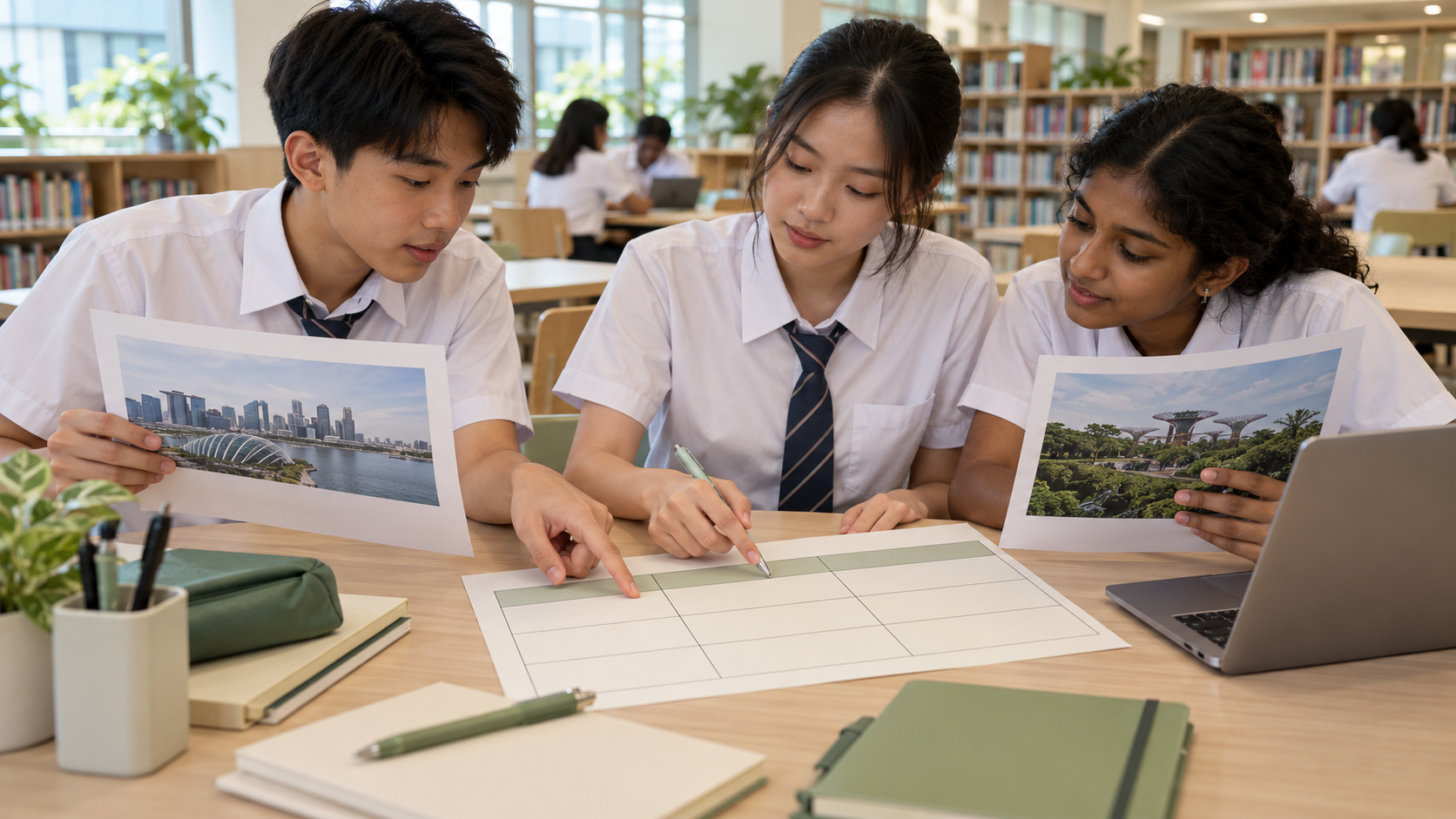
Featured visual: this article uses an existing eduKate educational image showing students comparing sources beside a structured evidence table in a library. It illustrates inquiry and cooperation. It is not a photograph of Tidal Reach or evidence about how a particular ancient society educated its children. The image’s descriptive text and the article’s historical sources should be kept distinct; conceptual or editorial visuals are not archaeological documentation.
Quick answer: what is the education component of civilisation?
It is the capability to help people learn what they need, evaluate what they hear, practise useful skills, understand one another and pass dependable knowledge forward. It includes language, numeracy, observation, specialist apprenticeship, teaching institutions, records, ethics, public access, research, critical discussion and the ability to adapt when better evidence appears. Education is not a luxury added after food and water; people must learn how to produce, maintain and govern those systems.
UNESCO’s education programme recognises learning across lives and the importance of equitable, inclusive and quality education. The 2003 Intangible Cultural Heritage Convention also identifies the transmission of living knowledge and skills. These frameworks are contemporary commitments, not claims that every historic society had identical schools or curricula.
Choose a learning route
classroom activity method · Components 1–8: inquiry and early learning · Components 9–16: subjects, teaching and feedback · Components 17–24: research and public knowledge · Components 25–32: equity and advanced education · Historical comparisons · Worked learning challenges · Parent and tutor sessions · Sources and further reading.
Inside the classroom activity: a learning civilisation is a questioning civilisation
The classroom activity is an imaginary study space, not a real automated institution. The assumption checker scouts the landscape and asks where a new observation originated. The evidence reviewer challenges unsupported claims, looks for excluded learners and requests fair evidence. The lesson facilitator displays how education connects to food, water, health, trade, government and technical maintenance. Children remain the investigators; these roles offer a structure for explaining and revising decisions.
Use five moves with every question: notice → describe → explain → test → revise. Notice a pattern or difficulty. Describe it clearly, with units when needed. Explain a possible reason. Test the explanation through safe observation, careful sources or a changed example. Revise if the evidence requires it. This sequence is accessible to a young child with blocks and to an older student analysing a scientific paper.
A child says: ‘Everyone in the town learns because we built a large school.’ the assumption checker maps the route from distant households. The evidence reviewer asks who can reach it and whether attendance equals understanding. The lesson facilitator shows connections to teachers, language, food, health and records. The learner then asks the better question: ‘What evidence would show that different children and adults can actually learn and use what the school offers?’
Every example must separate observation, interpretation, assumption and value choice. A toy test score is not evidence of a real student’s intelligence. An accessible classroom is not automatically an effective teaching method. A credible research claim requires relevant evidence, not a beautifully formatted slide. The habit of recognising these distinctions is itself part of education.
A first model: attendance is not understanding
The imaginary town sets up three learning groups of twenty people. In one session, eighteen people attend the first group, nineteen the second and seventeen the third: a total of 54 attendances out of 60 possible places, or 90% of that session’s notional capacity. This tells us the recorded attendance under those rules. It does not show how many participants understood, how accessible the teaching was, whether the content met their needs or why six were absent.
Now suppose the class gives a harmless five-item sorting exercise. Several learners complete it from memory but cannot adapt when a rule changes. A tutor might use the changed task to identify which explanation needs reinforcement. A single quiz, however, should not become a definitive judgement about a person’s capability or future. Ethical education uses assessment to improve learning, not to fix permanent labels on children.
Component 1: curiosity and the permission to ask questions
A child asking ‘Why?’ has begun an important civic and scientific process. Curiosity makes people notice gaps between what they expect and what they observe. But curiosity needs a safe social environment: learners should be able to pose sincere questions without humiliation. A classroom that rewards only quick answers may discourage the very inquiry needed to repair complex civilisational systems.
In Tidal Reach, an older learner asks why the granary ledger and the warehouse count disagree. A leader tells the learner to stop questioning because the ledger is official. The evidence reviewer asks whether authority guarantees factual accuracy. The student may respectfully request the record’s date and a properly conducted check without accusing anyone of bad faith.
Parents can encourage one question about an ordinary object and then ask what evidence would help answer it. Tutors may distinguish a factual question, a design question and a value question. Older pupils can practise changing a vague ‘why?’ into a testable inquiry and acknowledging the limits of available methods.
Advanced: inquiry must coexist with ethics and professional boundaries. Wanting to know something does not justify invading privacy, unsafe experimentation or the unauthorised use of equipment.
Component 2: family learning and everyday demonstrations
Much learning begins outside formal institutions. People observe adults and peers, imitate harmless routines, receive feedback and develop cultural knowledge through conversation. Different families organise these experiences in different ways. A school should not treat one household model as universal or deny the importance of caregivers whose work is unpaid or less visible.
Give a child a safe task involving organising books by subject. An adult explains the purpose, demonstrates one example, lets the child practise and invites a correction. Then change the arrangement and ask the learner to explain the sorting rule. The goal is transfer, not obedience to a single memorised sequence.
A town celebrates its new school while dismissing every other form of knowledge transfer. It might overlook traditional crafts, family languages, oral histories and the skills used by carers and workers. A stronger model connects these opportunities respectfully without pretending all families have equal time or material resources.
Advanced: equitable education recognises varied home circumstances and does not blame children for differences in access to quiet space, books, transport or care.
Component 3: play, imagination and harmless experimentation
Play can allow children to explore rules and relationships without the full risks of real activities. A paper city or model bridge can teach how a missing route affects a service. However, the toy is not a real engineering assessment, and the instructor must clearly mark the limits of the analogy. Good imaginative play supports explanation rather than making confident claims beyond the model.
Use coloured string to link a paper school, farm and market. Remove one link and ask what changes. A learner may invent a new route, but must also ask who would maintain it or be affected. The lesson facilitator can hold the dependency cards; the assumption checker inspects the geography and the evidence reviewer checks whose needs were not considered.
Parents may let a child design a different layout and explain one advantage. Tutors should ask which assumptions were supplied by the game and which facts would require actual evidence. Older learners can distinguish simulation, observation and real-world validation.
Advanced: even sophisticated simulations can fail when the model ignores people or physical processes that matter in reality.
Component 4: language, listening and developing explanations
Learning depends on meaningful communication. A student might understand an idea but struggle to express it in a language or format used by the assessor. Different languages can carry complex knowledge and cultural meaning. Inclusive teaching checks comprehension and offers appropriate support without equating unfamiliar vocabulary with low intelligence.
The imaginary school uses the word ‘reserve’ to describe materials kept for emergencies. Some learners hear the word as a booking rather than a stock. The tutor asks students to explain the term with an example and a diagram before scoring their understanding. This reduces avoidable confusion without pretending vocabulary never matters.
At home, ask a child to use ‘because’, ‘however’ and ‘therefore’ to explain a familiar observation. Tutors may model one clear paragraph, then invite pupils to rephrase it and identify its uncertainty. Older learners can compare exact scientific terms with accessible public communication.
Advanced: multilingual education, translation and respectful listening can widen access to civic information and scientific research.
Component 5: apprenticeship, craft and situated knowledge
Some expertise is developed through supervised practice with skilled people, not only written instructions. Crafts, farming, navigation and repair often involve noticing context and recognising when a task should stop. Apprentice learning can preserve valuable skills when suitable training and safety are provided. Historical labour structures require separate study; apprenticeship should not romanticise exploitation.
The town’s experienced record keeper teaches another child a harmless catalogue routine. First the learner copies the steps; next they explain why a document needs a date; finally they adapt when two documents share one title. A teacher watches for understanding rather than assuming participation proves competence.
Parents can teach an ordinary organisational skill, ask for a teach-back and provide helpful feedback. Tutors may use UNESCO’s documented craft traditions to discuss intergenerational transfer while respecting communities’ intellectual and cultural rights. Real hazardous trades are not safe classroom experiments.
Advanced: a civilisation needs successors able to use and question inherited methods, not just repeat them.
Component 6: access, inclusion and the right to learn
Educational opportunity can be limited by distance, disability barriers, language, cost, discrimination, family responsibilities or conflict. The presence of a prestigious school proves neither equal access nor good outcomes. A useful civic analysis asks which children or adults are missing, why, and how a fair institution learns about their needs. Avoid reducing a person to one category or presuming one representative speaks for an entire community.
Tidal Reach builds its only classroom on High Shelf, while a neighbourhood cannot use the steep route. A council boasts of excellent teaching materials but ignores the access problem. The assumption checker traces the journey; the evidence reviewer hears affected households; the lesson facilitator connects learning to transport, caregiving and public finance.
Parents can compare two imaginary routes to a learning place. Tutors can ask pupils how attendance figures could hide access barriers and how feedback from participants might improve planning. Older students can link education with social justice and responsible public budgeting.
Advanced: an apparently efficient school network may still be inequitable. Fairness must be assessed through real opportunities and appropriate safeguards, not averages alone.
Component 7: schools, libraries and places for shared inquiry
Formal learning places can coordinate books, teachers, safe facilities, laboratories, dialogue and access to different fields of knowledge. But a building becomes an educational service only when people can use it, understand the teaching and receive support. Libraries likewise require curation, preservation and the skills needed to evaluate sources.
Give Tidal Reach a school, community learning room and travelling collection of paper books. Ask which households use each and which services they rely on. When a fictional storm interrupts the main route, the children’s task is to propose an accessible learning arrangement rather than declare the school permanently failed.
A town spends all its tokens on a grand building but none on teaching resources or maintenance. The school exists physically and may still fail as a learning system. Parents can ask what lies behind a functioning lesson; tutors may create a dependency chart with teachers, learners, records, water, care and feedback.
Advanced: the educational value of a building depends on operation and access across time; architecture alone cannot establish success.
Component 8: wellbeing, rest and conditions that support learning
Learning occurs in the lives of real people. Health, sleep, safety, nutrition, caring responsibilities and emotional conditions can affect access and participation. These are multifactorial, and a teacher should not diagnose a child’s health from one score or absence. WHO’s health-determinants overview explains the importance of physical and social circumstances.
The imagined class performs worse on a paper task during a week when the route to school is unreliable. A careless official concludes the learners have become less intelligent. A thoughtful tutor recognises that the score alone does not establish the cause and asks what environmental or instructional factors may have changed. The solution is not an amateur medical diagnosis.
Parents can discuss how comfortable, accessible study routines help children participate without making rigid personal prescriptions. Tutors should interpret results in context and seek qualified support for real health concerns. Older students can examine how education, housing and public health are linked.
Advanced: a civilisation’s education system depends on wellbeing and accessible services as much as on its textbooks.
Part II: From basic literacy to scientific and civic learning
A civilisation needs people who can read situations, not only words. The skills of counting a stock, checking a route, caring for a neighbour and interpreting a historical source connect with one another. Their teaching can occur in schools and beyond them. These eight chapters introduce learning systems that support everyday judgement before the next section examines specialised research and advanced institutions.
Component 9: Number sense and mathematical explanations
Purpose. Numeracy gives people ways to compare quantities, describe patterns and communicate constraints. Yet correct operations do not prove that the measured quantity describes the intended service. A public budget can balance while failing essential needs, and a class can record high attendance without demonstrating learning.
Tidal Reach learning activity
Tidal Reach’s food store records forty counters, adds ten and distributes six. Pupils calculate forty-four but must explain what the count represents and what it cannot tell us about nutrition or access. Ask which units and dates belong beside every number.
Parent and tutor transfer
Parents can use harmless household counters. Tutors require the student to write the operation, units, a sentence interpreting the result and one limitation. Older learners can compare averages with unserved subgroups.
Where a seemingly good result goes wrong
The mayor announces universal food security from a correct inventory total. The failure is not arithmetic but the inference. A capable student can challenge the conclusion without discarding the useful calculation.
Bring it into the larger civilisation: Ask which other component becomes stronger when this kind of learning works well, and which would be endangered if the knowledge disappeared. Invite pupils to draw arrows to water, food, repair, public records or community care. Then ask what observation would demonstrate real benefit instead of relying on a proud claim from the fictional council.
Component 10: Reading for meaning and source criticism
Purpose. Reading involves interpreting purpose, argument, evidence and uncertainty as well as recognising letters. A document may contain a true number and still support an exaggerated conclusion. Strong readers distinguish a direct quote from someone else’s paraphrase and ask who authored an assertion.
Tidal Reach learning activity
The fictional council says ‘the bridge was repaired’ because a report reads ‘repairs proposed’. Learners underline the decisive words and explain the difference. They can then write a corrected claim rather than declaring every official statement untrustworthy.
Parent and tutor transfer
Give a younger student two short notices with different meanings. Ask an older student to identify the source and whether it describes observation, promise or outcome. Encourage the habit of opening original evidence where feasible.
Where a seemingly good result goes wrong
The town teaches everyone to memorise the council’s sentences but never asks what they mean. This may inflate recall scores while leaving people unable to recognise a misleading claim in an unfamiliar form.
Bring it into the larger civilisation: Ask which other component becomes stronger when this kind of learning works well, and which would be endangered if the knowledge disappeared. Invite pupils to draw arrows to water, food, repair, public records or community care. Then ask what observation would demonstrate real benefit instead of relying on a proud claim from the fictional council.
Component 11: Scientific observation and careful hypotheses
Purpose. Inquiry begins with observations and questions. A hypothesis proposes an explanation that can be evaluated with suitable evidence. One correlation or dramatic event rarely establishes causation, and children’s harmless models cannot verify safety-critical claims. Scientific literacy includes recognising uncertainty and changing an explanation when dependable evidence improves.
Tidal Reach learning activity
In the classroom activity, two paper routes are used at different rates during the toy week. A student hypothesises that distance caused the difference. The class lists other possible reasons such as the activity schedule or route availability before designing a harmless comparison.
Parent and tutor transfer
Parents can ask what was actually seen versus what was guessed. Tutors teach a prediction, observation, comparison and limitation statement. Older pupils can analyse confounding factors and selection bias conceptually.
Where a seemingly good result goes wrong
A leader forbids retesting because the first result supports an attractive plan. The institution loses an opportunity to identify an error. Responsible experimentation values transparent methods and correction.
Bring it into the larger civilisation: Ask which other component becomes stronger when this kind of learning works well, and which would be endangered if the knowledge disappeared. Invite pupils to draw arrows to water, food, repair, public records or community care. Then ask what observation would demonstrate real benefit instead of relying on a proud claim from the fictional council.
Component 12: Historical inquiry and respect for missing voices
Purpose. History reconstructs and interprets aspects of the past using material, documentary, oral and other evidence. Surviving sources are selective: rulers’ inscriptions, durable stone and official ledgers may be more visible than everyday lives. A civilisation’s learning system should teach how to question sources without inventing biographies for people whose experiences were not recorded.
Tidal Reach learning activity
Students compare a source about an ancient building with a statement that every resident enjoyed the building. Ask which part the source supports and what further evidence would be required. Use an appropriate UNESCO or museum description for the real case, keeping Tidal Reach wholly fictional.
Parent and tutor transfer
A tutor can make columns labelled evidence, interpretation and unknown. Parents may ask how a historical photograph can show one viewpoint while leaving other scenes outside its frame.
Where a seemingly good result goes wrong
A textbook awards civilisational worth solely by monumental size. This misses culture, care, rights and ordinary labour. A sound history lesson separates technical capacity from claims of moral superiority.
Bring it into the larger civilisation: Ask which other component becomes stronger when this kind of learning works well, and which would be endangered if the knowledge disappeared. Invite pupils to draw arrows to water, food, repair, public records or community care. Then ask what observation would demonstrate real benefit instead of relying on a proud claim from the fictional council.
Component 13: Writing, records and the habits of reflection
Purpose. Writing can clarify an explanation, preserve revisions and help a later learner understand why a choice changed. Yet fluent writing does not automatically mean deep understanding. Students need opportunities to make claims, support them with relevant evidence and explain limits, not only produce polished paragraphs.
Tidal Reach learning activity
At Tidal Reach, a learner writes that a new route is best. After receiving an access concern, the learner adds a counterargument and revises the conclusion. Both versions remain in a paper learning log. The improvement is visible in the reason, not simply the new wording.
Parent and tutor transfer
Parents can encourage a child to explain a change in two sentences. Tutors may use claim–evidence–reason–limitation and reward accurate revision. Older learners compare scientific note-taking with reflective writing.
Where a seemingly good result goes wrong
A school punishes every revised answer as indecision. The incentive may favour confident mistakes over careful learning. Feedback should distinguish unsupported changes from evidence-based correction.
Bring it into the larger civilisation: Ask which other component becomes stronger when this kind of learning works well, and which would be endangered if the knowledge disappeared. Invite pupils to draw arrows to water, food, repair, public records or community care. Then ask what observation would demonstrate real benefit instead of relying on a proud claim from the fictional council.
Component 14: Teachers as interpreters, not answer machines
Purpose. Teaching requires attention to the learner’s current understanding and context. A teacher may explain, model, ask questions, diagnose a misconception, select appropriate practice and reassess. A classroom filled with books cannot replace skilled human guidance. Likewise, enthusiasm without content accuracy may spread mistakes.
Tidal Reach learning activity
One Tidal Reach pupil completes a numerical problem but thinks the unit is kilograms when it represents toy tokens. The tutor identifies the precise misunderstanding and changes the explanation. The next question tests whether the pupil can use the right unit in an unfamiliar example.
Parent and tutor transfer
Parents can ask a child to teach back a harmless idea and listen for confusion. Tutors should avoid permanent ability labels based on one result and document a supportive next step.
Where a seemingly good result goes wrong
A leader counts teachers only by how many facts they recite. The measure ignores feedback, inclusive access, subject knowledge and whether pupils can apply what they learn.
Bring it into the larger civilisation: Ask which other component becomes stronger when this kind of learning works well, and which would be endangered if the knowledge disappeared. Invite pupils to draw arrows to water, food, repair, public records or community care. Then ask what observation would demonstrate real benefit instead of relying on a proud claim from the fictional council.
Component 15: Curricula, priorities and what a society chooses to teach
Purpose. A curriculum makes value choices about what knowledge and skills are important and how learning is sequenced. Some needs concern daily survival and public service; others concern arts, critical thinking, civic participation and cultural continuity. No single curriculum from one society can be assumed to suit every community or historical period.
Tidal Reach learning activity
The classroom activity school has limited paper lessons available. Students choose among water literacy, reading, art, map skills, history and scientific inquiry. They must explain why their selection meets varied needs and what will be missed. The class can propose a sequence rather than a single winning subject.
Parent and tutor transfer
Tutors can compare a narrow technical course with a broader programme and identify complementary benefits. Parents may ask why children need both useful skills and opportunities to explore ideas.
Where a seemingly good result goes wrong
A council funds only activities producing immediately countable goods and declares literature, art and history useless. It risks losing capacities that contribute to identity, communication, creativity and public judgement.
Bring it into the larger civilisation: Ask which other component becomes stronger when this kind of learning works well, and which would be endangered if the knowledge disappeared. Invite pupils to draw arrows to water, food, repair, public records or community care. Then ask what observation would demonstrate real benefit instead of relying on a proud claim from the fictional council.
Component 16: Assessment that helps rather than merely ranks
Purpose. Assessment can reveal what a learner knows, needs to practise and can transfer to a new situation. A raw score is shaped by task, timing, access and instructions; it must be interpreted appropriately. Using one performance to label a person’s permanent ability is an unwarranted leap. Fair assessment provides actionable feedback and a chance to improve.
Tidal Reach learning activity
In Tidal Reach, fifty-four of sixty learning places are occupied, and the council reports ninety percent mastery. Ask why attendance and mastery are different metrics. Later, a learner solves a familiar sorting task correctly but fails a changed version; the tutor plans targeted practice rather than a punitive classification.
Parent and tutor transfer
Parents can check how a child explains an answer and what happens after feedback. Tutors may compare initial and revised performance while respecting actual student privacy. Older pupils can evaluate validity and reliability of a simple measure.
Where a seemingly good result goes wrong
A school celebrates its score improvement by removing difficult questions from tests. The published percentage rises while the underlying capability may not. A thoughtful institution checks what was measured.
Bring it into the larger civilisation: Ask which other component becomes stronger when this kind of learning works well, and which would be endangered if the knowledge disappeared. Invite pupils to draw arrows to water, food, repair, public records or community care. Then ask what observation would demonstrate real benefit instead of relying on a proud claim from the fictional council.
Component 17: Vocational skills and competence to maintain services
Purpose. A society needs people who can perform specialised tasks responsibly. Apprenticeship, practical demonstration, theory, supervised practice and qualification may all matter, depending on the field. A course certificate does not automatically establish readiness to repair an actual water system or operate hazardous machinery.
Tidal Reach learning activity
The classroom workshop teaches a harmless paper inventory procedure. A student first watches, then practises, then explains the decision rule under a changed input. The instructor records learning needs. Real maintenance tasks remain with competent, authorised workers.
Parent and tutor transfer
Parents can demonstrate a safe daily organisation skill. Tutors should teach the difference between seeing, doing with guidance and being qualified for an independent task.
Where a seemingly good result goes wrong
A town appoints the only pupil who memorised the manual as its imaginary engineer. The game exposes why real professional competence requires much more than correct recall.
Bring it into the larger civilisation: Ask which other component becomes stronger when this kind of learning works well, and which would be endangered if the knowledge disappeared. Invite pupils to draw arrows to water, food, repair, public records or community care. Then ask what observation would demonstrate real benefit instead of relying on a proud claim from the fictional council.
Component 18: Civic literacy, rights and collective problem-solving
Purpose. Education supports participation when people can understand common decisions, ask questions, recognise unsupported claims and treat others respectfully. Civic learning does not demand that everyone agree. It can teach how laws, budgets and representation work while respecting plural viewpoints and legitimate rights.
Tidal Reach learning activity
Children review a fictional 100-token budget and notice the council omitted an inaccessible school route. They ask how the missing need was assessed rather than accuse classmates or attempt real political campaigning. The exercise focuses on public reasoning.
Parent and tutor transfer
Parents can use a harmless shared household decision. Tutors should ask students to restate a different perspective fairly and explain the limits of a majority vote for protecting rights.
Where a seemingly good result goes wrong
A town teaches children to repeat a leader’s decision but not how to examine its evidence. The resulting obedience may appear orderly while undermining informed participation and future correction.
Bring it into the larger civilisation: Ask which other component becomes stronger when this kind of learning works well, and which would be endangered if the knowledge disappeared. Invite pupils to draw arrows to water, food, repair, public records or community care. Then ask what observation would demonstrate real benefit instead of relying on a proud claim from the fictional council.
Component 19: Instruments, observation and the limits of precision
Purpose. Scientific tools extend what people can observe or measure, but they require appropriate calibration, interpretation and an understanding of uncertainty. A finely marked device can still produce misleading information when used outside its purpose. Children should learn concepts through safe observations and professional sources, not through hazardous or unapproved experiments.
Tidal Reach learning activity
The classroom activity gives pupils paper rulers with differently spaced marks and asks them to compare the size of toy cards. Their measurements conflict. Before choosing one, they investigate units, alignment and the intended measurement. They do not infer actual engineering standards.
Parent and tutor transfer
Parents can practise length measurement with a safe ruler. Tutors may teach accuracy, precision and what a unit means. Older learners can discuss why a repeated measurement may still share a systematic error.
Where a seemingly good result goes wrong
A mayor announces that a figure containing three decimal places is scientifically certain. The evidence reviewer asks what was measured, with what method and which uncertainty remains.
Bring it into the larger civilisation: Ask which other component becomes stronger when this kind of learning works well, and which would be endangered if the knowledge disappeared. Invite pupils to draw arrows to water, food, repair, public records or community care. Then ask what observation would demonstrate real benefit instead of relying on a proud claim from the fictional council.
Component 20: Libraries, archives and shared knowledge access
Purpose. Libraries and archives make learning across time possible by preserving and organising sources. A shelf or digital collection becomes useful when people can locate relevant materials and understand their context. Some records also require privacy or cultural access protections; public access does not mean indiscriminate disclosure of every document.
Tidal Reach learning activity
Create a small fictional archive for Tidal Reach’s school. Ask another learner to find the earliest bridge decision. If they cannot, improve the index and the description rather than adding more random paper cards.
Parent and tutor transfer
Tutors can integrate UNESCO’s Memory of the World framework with local source study. Parents can help label a harmless reading shelf. Older pupils discuss selection and missing voices in historical collections.
Where a seemingly good result goes wrong
A city opens a giant library but does not teach source evaluation or maintain its catalogues. The existence of documents does not ensure they form dependable public knowledge.
Bring it into the larger civilisation: Ask which other component becomes stronger when this kind of learning works well, and which would be endangered if the knowledge disappeared. Invite pupils to draw arrows to water, food, repair, public records or community care. Then ask what observation would demonstrate real benefit instead of relying on a proud claim from the fictional council.
Component 21: Exchange of ideas across places and languages
Purpose. People learn from neighbours, travellers, migrants and distant scholars. Knowledge can be adapted to new environments and may carry cultural meaning that should be respected. Similar ideas appearing in two places do not automatically prove a single historical journey; evidence of dates, contact and transmission matters.
Tidal Reach learning activity
In Tidal Reach, Harbourfield teaches a new paper sorting method. The town changes it to suit its own labels. Pupils should describe the adaptation and who taught whom, while keeping the story fictional and not inventing claims of cultural ownership.
Parent and tutor transfer
Parents can discuss a borrowed word or familiar practice with accurate context. Tutors may ask for source, date and uncertainty in any real historical example. Older students examine cooperation and unequal power in knowledge networks.
Where a seemingly good result goes wrong
A school credits only the final user of an idea and erases the communities who developed and transmitted it. Responsible scholarship recognises contributors and respects cultural rights.
Bring it into the larger civilisation: Ask which other component becomes stronger when this kind of learning works well, and which would be endangered if the knowledge disappeared. Invite pupils to draw arrows to water, food, repair, public records or community care. Then ask what observation would demonstrate real benefit instead of relying on a proud claim from the fictional council.
Component 22: Ethics of scientific and educational discovery
Purpose. Not everything that can be studied should be investigated without safeguards. Research involving people, personal data, animals, environmental resources or safety-critical equipment can have obligations beyond curiosity. A child’s willingness to ask a question does not grant permission to invade privacy or perform a hazardous experiment.
Tidal Reach learning activity
The imaginary council proposes publishing each pupil’s private learning difficulties to optimise teaching. The evidence reviewer asks if aggregate, anonymous feedback could meet the goal without exposing individuals. Adults retain responsibility for actual classroom policies and safeguarding.
Parent and tutor transfer
Tutors should use fictitious data and age-appropriate questions about consent. Parents can discuss why respect and kindness matter when observing someone else’s work.
Where a seemingly good result goes wrong
A society boasts that its laboratories are advanced because they can collect every possible detail about people. This confuses technical ability with legitimate, ethical use.
Bring it into the larger civilisation: Ask which other component becomes stronger when this kind of learning works well, and which would be endangered if the knowledge disappeared. Invite pupils to draw arrows to water, food, repair, public records or community care. Then ask what observation would demonstrate real benefit instead of relying on a proud claim from the fictional council.
Component 23: Failure, falsification and the right to correct research
Purpose. Knowledge advances through methods that permit error detection. A result that does not support a preferred hypothesis can still be valuable. Honest documentation helps others repeat or question a procedure. Hiding failed attempts creates a misleading picture of certainty and wastes learning opportunities.
Tidal Reach learning activity
The classroom activity tests two harmless paper routes and one fails the stated target. A leader suggests deleting its record. Children explain what future designers would lose. They revise the plan and preserve the test conditions rather than claiming the revised version was the only one attempted.
Parent and tutor transfer
Parents may celebrate a child who changes their mind after evidence. Tutors can assess a predicted outcome, observed outcome, limitation and specific revision. Older pupils compare a reproducible result with a persuasive story.
Where a seemingly good result goes wrong
An institution that punishes every unexpected finding may produce polished reports but weak knowledge. The long-term skill is honest correction.
Bring it into the larger civilisation: Ask which other component becomes stronger when this kind of learning works well, and which would be endangered if the knowledge disappeared. Invite pupils to draw arrows to water, food, repair, public records or community care. Then ask what observation would demonstrate real benefit instead of relying on a proud claim from the fictional council.
Component 24: Public investment, learning institutions and accountability
Purpose. Schools, teacher training, libraries and research facilities require resources over time. A building’s opening cost is only part of the commitment: staff, accessibility, maintenance, materials and review continue. Public education choices reflect social values and require accountable deliberation, not merely expenditure totals.
Tidal Reach learning activity
The town budgets 100 toy tokens among classrooms, teacher development, learning materials, accessible transport and a community archive. The student must state the purpose and one trade-off of a proposed distribution. The numbers do not represent actual school finance.
Parent and tutor transfer
Tutors can examine whether a high spending total proves an educational outcome. Parents can ask how people know a programme is useful. Older learners can distinguish investment from access, use and demonstrated understanding.
Where a seemingly good result goes wrong
The council constructs three grand halls but funds no instruction or upkeep. The publicity photograph cannot establish a functioning education system.
Bring it into the larger civilisation: Ask which other component becomes stronger when this kind of learning works well, and which would be endangered if the knowledge disappeared. Invite pupils to draw arrows to water, food, repair, public records or community care. Then ask what observation would demonstrate real benefit instead of relying on a proud claim from the fictional council.
Part III: Fair, adaptable education for advanced civilisations
When a community builds larger research institutions or digital learning networks, it acquires new opportunities and obligations. Fair access, privacy, culturally respectful teaching, reliable information and the ability to revise outdated methods remain crucial. The next eight components ask how knowledge systems can remain humane and understandable as their scale grows.
Component 25: Gender, exclusion and barriers to full participation
The historical opportunity to learn has often been shaped by gender, class, wealth, ethnicity and status. These exclusions can waste talent and reinforce social inequality. Today’s educational institutions must examine barriers and actual outcomes without assuming one national pattern applies to all people.
The model situation
In Tidal Reach, the council offers advanced science lessons only to children from three influential households. A student proposes that selection be explained and fair opportunities broadened. The exercise does not claim every historical culture had identical exclusions.
Teach the transferable idea
Parents can ask whose achievements are absent from an invented historical record. Tutors may compare formal eligibility with practical access. Older learners analyse the consequences of denying education without creating stereotypes.
Challenge the easy conclusion
A town celebrates its single famous scholar as evidence that every person may learn. An exceptional biography does not prove broad access.
Wider civilisational test: How does this component help people understand a changing world without excluding those most affected? Ask the learner to identify one source of evidence, one uncertainty and an accountable institution or trained person. An advanced civilisation needs these habits even as its machines, books and communications become more sophisticated.
Component 26: Multilingual learning and the freedom to understand
Education occurs through languages that carry identity, knowledge and meaning. A student may have strong ideas but limited familiarity with a particular teaching language. Effective instruction builds understanding and develops appropriate terminology while respecting speakers of different languages.
The model situation
The classroom activity teaches a map concept using an unfamiliar label. The tutor gives a diagram, explanation and checked glossary, then asks learners to explain the same relationship in their own words. This is not an excuse to teach inaccurate language.
Teach the transferable idea
Parents can help children compare clear examples rather than demand jargon. Tutors can check both concept and vocabulary separately when appropriate. Older pupils investigate the role of translation and language policy in educational access.
Challenge the easy conclusion
A school interprets every linguistic difference as a lack of intelligence. The judgement confuses medium with competence and may exclude learners unnecessarily.
Wider civilisational test: How does this component help people understand a changing world without excluding those most affected? Ask the learner to identify one source of evidence, one uncertainty and an accountable institution or trained person. An advanced civilisation needs these habits even as its machines, books and communications become more sophisticated.
Component 27: Intergenerational learning and cultural continuity
Children inherit not only textbooks but also practices, crafts, stories and ethical questions from earlier generations. Transmission need not mean keeping every practice unchanged. Living heritage adapts, and learners can examine it respectfully while recognising the rights of its knowledge holders.
The model situation
An experienced potter visits the fictional community to explain how a safe paper model reflects the idea of guided practice. The students do not recreate sacred designs or operate kilns. They ask what a written recipe misses about hands-on knowledge.
Teach the transferable idea
Tutors may use UNESCO’s living heritage framework to distinguish safeguarding from freezing a tradition. Parents can share age-appropriate family stories by choice and without compulsory personal disclosure.
Challenge the easy conclusion
A town calls a living culture obsolete because a factory makes similar-looking products. The decision ignores identity, apprenticeship and community meanings not captured by output figures.
Wider civilisational test: How does this component help people understand a changing world without excluding those most affected? Ask the learner to identify one source of evidence, one uncertainty and an accountable institution or trained person. An advanced civilisation needs these habits even as its machines, books and communications become more sophisticated.
Component 28: Media literacy and the spread of misleading claims
Information moves rapidly through social and digital networks, and persuasive design can give weak claims an appearance of certainty. Learners need to examine sources, dates, evidence, incentives and what has been omitted. Doubt should be proportionate: questioning a claim is not the same as denying all expert knowledge.
The model situation
The classroom activity receives a dramatic fictional poster saying its reservoir will dry up tomorrow without providing a source. The group asks which authority would know, what evidence exists and how to avoid amplifying the unsupported claim.
Teach the transferable idea
Parents can model checking a harmless fact against a reliable source. Tutors may contrast assertion, observation, inference and a transparent correction. Older students explore why multiple reposts are not independent evidence.
Challenge the easy conclusion
A council labels every critical question misinformation and refuses inspection. A trustworthy institution protects evidence-based inquiry while correcting demonstrably false statements.
Wider civilisational test: How does this component help people understand a changing world without excluding those most affected? Ask the learner to identify one source of evidence, one uncertainty and an accountable institution or trained person. An advanced civilisation needs these habits even as its machines, books and communications become more sophisticated.
Component 29: Digital access and the limits of educational technology
Digital tools can support access, practice, feedback and collaboration, but they depend on connectivity, devices, trained teachers, suitable content and privacy safeguards. A tablet count does not show that every student understands or benefits. Technology can widen inequality if its supporting conditions are not considered.
The model situation
Tidal Reach receives twenty fictional learning devices for sixty imaginary students. The council proposes that the device count guarantees modern education. Learners examine sharing, timetabling, access needs, teaching and maintenance before evaluating the proposal.
Teach the transferable idea
Tutors may use a paper analogue of a digital quiz to isolate what feedback actually accomplishes. Parents should ask whether a technology helps the child’s learning purpose rather than admire novelty.
Challenge the easy conclusion
A school buys advanced software but cannot maintain access or interpret its reports. Institutional capability remains a human and technical problem, not a purchase.
Wider civilisational test: How does this component help people understand a changing world without excluding those most affected? Ask the learner to identify one source of evidence, one uncertainty and an accountable institution or trained person. An advanced civilisation needs these habits even as its machines, books and communications become more sophisticated.
Component 30: AI tools, source checking and human judgement
AI may assist with drafting, explanation or organising knowledge, but outputs can contain errors, omit context or reproduce bias. Responsible educational use requires source inspection, transparency, privacy protection and teachers who can recognise when a claim exceeds the evidence. A model’s polished style is not validation.
The model situation
The classroom activity’s imaginary AI declares the bridge repaired after reading a proposal. Children consult the original and identify the word ‘proposed’. They revise the summary and document why human source checking was necessary.
Teach the transferable idea
Parents can ask children to compare a generated explanation with a known source. Tutors should require independent reasoning and protect pupils’ information. Older learners explore both assistive benefits and risks without uncritical fear or enthusiasm.
Challenge the easy conclusion
A civilisation replaces every teacher with an unexplained performance dashboard. It may lose professional judgement, relationships, feedback and accountability even if some administrative tasks become faster.
Wider civilisational test: How does this component help people understand a changing world without excluding those most affected? Ask the learner to identify one source of evidence, one uncertainty and an accountable institution or trained person. An advanced civilisation needs these habits even as its machines, books and communications become more sophisticated.
Component 31: Lifelong learning and the ability to adapt
Knowledge and work change across people’s lives. Adults may need to learn new skills when tools, rules or environmental conditions change. A civilisation that offers learning only in early childhood may lose the ability to adapt its services and industries responsibly.
The model situation
An imaginary bridge-maintenance team discovers that its manuals are outdated. Instead of blaming the workers, the council commissions appropriate qualified learning and review. Children can represent the training process with paper cards, not actual technical exercises.
Teach the transferable idea
Parents can share the experience of learning a harmless new skill. Tutors can invite older pupils to explain why a certificate earned long ago may require updating as fields change.
Challenge the easy conclusion
A town celebrates the number of historic qualifications its workforce holds while ignoring whether people can perform current tasks safely and appropriately.
Wider civilisational test: How does this component help people understand a changing world without excluding those most affected? Ask the learner to identify one source of evidence, one uncertainty and an accountable institution or trained person. An advanced civilisation needs these habits even as its machines, books and communications become more sophisticated.
Component 32: Advanced knowledge systems and self-correcting institutions
A civilisation becomes more capable when it can investigate difficult problems, share reliable knowledge, protect rights and change mistaken policies. Scale alone does not guarantee wisdom: universities, laboratories and archives need public trust, ethical safeguards and people who question evidence. The future depends on preserving the freedom to learn and revise.
The model situation
Tidal Reach’s imagined advanced research network publishes a confident forecast that later proves mistaken. The class documents the model’s assumptions, revises its conclusion and explains what citizens can now decide more wisely. No fictional prediction is treated as actual scientific advice.
Teach the transferable idea
Tutors can make a final portfolio combining source citation, simple analysis, fair participation and a correction log. Parents may ask the learner to teach another child how to detect a missing assumption.
Challenge the easy conclusion
A society that suppresses corrections to maintain an image of expertise risks becoming fragile. The deeper measure of advancement is dependable, accountable learning.
Wider civilisational test: How does this component help people understand a changing world without excluding those most affected? Ask the learner to identify one source of evidence, one uncertainty and an accountable institution or trained person. An advanced civilisation needs these habits even as its machines, books and communications become more sophisticated.
Part IV: Six evidence-led comparisons of learning in civilisation
A historic teaching institution should be studied through its sources, its cultural and geographical setting and the questions its surviving remains can actually answer. Famous names and impressive buildings may reveal long-lived intellectual traditions but do not prove that every child could attend or that every educational practice was humane. The six comparisons below combine UNESCO World Heritage and living-heritage sources with contemporary accounts of education. They illustrate diversity rather than a universal ladder of intelligence.
Historical study 01: Nalanda Mahavihara and the organisation of sustained learning
The UNESCO World Heritage description of Nalanda Mahavihara identifies a major monastic and scholastic site in Bihar, India, with remains including religious, residential and educational structures. UNESCO describes Nalanda’s long role in organising and transmitting knowledge and the influence of its planning on later institutions. The site is evidence of an extensive scholarly tradition rather than a claim that every contemporary inhabitant possessed the same educational access.
Ask a child why learning needs more than books: teachers, accommodation, spaces for exchange, records, patronage and daily services can all matter. The archaeological remains document selected built forms, but they do not reveal the complete experience of every person living or studying there. A strong student distinguishes surviving architecture from historical interpretation about pedagogy.
Try it in the classroom activity: The imaginary Tidal Reach model can compare a central learning campus with neighbourhood teaching spaces. Each arrangement has potential benefits and costs concerning access, specialisation and resources. Do not treat the comparison as a reconstruction of Nalanda. The source’s value lies in raising questions about institution-building and long-term transmission of knowledge.
Source limitation and advanced inquiry: Advanced learners can ask how conservation work preserves material evidence for future research. A heritage site no longer operating as the original institution can still teach people about educational history when records, professional stewardship and interpretive care are sustained.
Historical study 02: Taxila, routes and the movement of ideas
The UNESCO account of Taxila describes a series of historic settlements in the region of present-day Pakistan and an important Buddhist centre of learning. Its position near major routes shaped cultural connections with surrounding regions. The site demonstrates why scholarship, urban life and geography should not be studied as isolated subjects.
Ask where learners, texts and teachers might have travelled in a connected region. Then distinguish a general possibility of intellectual exchange from documented journeys. UNESCO’s site description does not allow pupils to invent named visitors’ motivations or assert that all members of the population accessed the same institutions.
Try it in the classroom activity: The classroom activity can model two imaginary schools connected by a road. One sends a teaching manual and the other adapts a harmless lesson to a different language. The children describe what moved and what changed, while clearly marking the analogy as fictional.
Source limitation and advanced inquiry: Advanced readers may compare the physical traces of settlements with evidence about religious, cultural and scholarly traditions. An archaeological site can reveal important aspects of learning yet leave significant uncertainties about social inclusion.
Historical study 03: Awajún pottery and learning through living practice
The UNESCO account of Awajún pottery explains a living Indigenous practice from northern Peru involving material knowledge, skilled making, oral traditions and intergenerational transmission. Elder knowledge holders teach complex techniques and meanings. This is a valuable counterexample to the idea that serious education takes place only when a formal school building is present.
Show the class a generic paper model of a teaching process: explain, demonstrate, try, observe and revise. Then ask what the paper diagram fails to represent about a living cultural practice. UNESCO’s description includes community meanings that cannot be recreated faithfully through an outsider’s classroom game.
Try it in the classroom activity: The goal is respectful recognition rather than copying culturally significant designs or claiming to teach an authentic Awajún method. Students can learn that knowledge may be transmitted within families and communities, that a tradition can evolve and that material and cultural expertise are closely linked.
Source limitation and advanced inquiry: Advanced learners may ask who should decide how such a practice is documented and safeguarded. Communities are participants and knowledge holders, not passive sources for someone else’s educational display.
Historical study 04: Documentary memory and the libraries behind learning
The UNESCO Memory of the World Programme emphasises preservation of documentary heritage and access to it. A document can help future readers only if it survives, can be found and is interpreted within its context. Libraries, archives and teaching are related but not interchangeable services.
Give Tidal Reach a hundred unsorted fictional learning cards and compare them with a smaller, indexed collection. Ask another student to find an earlier bridge plan. The exercise shows how cataloguing and access support understanding without claiming that a larger or smaller archive always works best.
Try it in the classroom activity: Discuss why records may be selective and why some living knowledge is not fully represented by surviving documents. A responsible learner cites the document’s author, date and scope, identifies unknowns and avoids claiming that one record speaks for an entire civilisation.
Source limitation and advanced inquiry: Modern educational technology may speed retrieval, but the same source-evaluation principles apply. The ability to question a record’s origin is as important as the speed of retrieving it.
Historical study 05: Singapore’s education system as a contemporary institutional case
Singapore’s Ministry of Education guidance on the education system describes contemporary pathways, learning stages and institutional purposes. These are modern public arrangements in a particular national context. They should not be presented as the template against which every ancient community must be judged.
A parent can trace the services behind one school day: teachers, buildings, transport, learning resources, digital systems, care, curriculum and administration. The question is not simply how many schools exist but which opportunities and support reach the learners who need them.
Try it in the classroom activity: Older children can compare formal pathways with the wider concept of lifelong learning. Ask what professional, familial, community and informal knowledge still matters beyond examinations. A school certificate has meaningful purposes but does not capture the whole of a person’s judgement or contributions.
Source limitation and advanced inquiry: Use official sources when describing contemporary Singapore policy. Changes to subjects, pathways or assessments should be checked against current MOE material rather than invented from a fictional classroom activity system.
Historical study 06: UNESCO education as an international public-good goal
UNESCO’s 2026 explanation of education connects the right to education with empowerment, inclusive communities and lifelong learning. The source offers a contemporary international perspective. It is a framework for present responsibilities rather than a statement that all past societies recognised the same rights.
Let pupils compare two fictional school plans. The first funds new classrooms but overlooks an inaccessible route; the second pays attention to transport, teaching, maintenance and opportunities for feedback. The student should defend a choice with evidence and a clear limitation, not treat a higher building count as proof of better education.
Try it in the classroom activity: Education policy also raises distributional questions. Who has the time, language support and resources to participate? Which barriers fall disproportionately on particular groups? The right to learn becomes practically meaningful through institutions and outcomes, not rhetoric alone.
Source limitation and advanced inquiry: Advanced learners can examine how research, civic participation and economic opportunity interact with schooling while recognising that correlations require careful interpretation and cannot be reduced to simplistic claims about one country’s worth.
Part V: Twenty-four worked challenges for learners and tutors
A good learning challenge has more than one answer-like detail. It also exposes the limits of the model and the people whose circumstances were omitted. Each of the following situations concerns Tidal Reach only and uses invented data. None should be used to diagnose a real child, evaluate a real teacher without evidence or make public-service decisions.
The answer method is simple: identify what the learner knows, state the proposed explanation, ask what evidence would test it and suggest a supportive next step. When a student’s answer is incomplete, the tutor should locate the missing reasoning move rather than turn the error into a judgement about character or intelligence.
Worked case 1: Attendance is mistaken for mastery
Situation: The school records 54 attendances from 60 places and reports 90 percent understanding.
Reasoning: Attendance describes participation in one period, not demonstrable understanding. A learning task and relevant feedback would be needed.
Supported teaching response: Students calculate the fraction correctly and then write a separate sentence explaining why the conclusion about mastery does not follow.
Change the situation: Imagine that the learner receives new information about access, language, timing or the original source. Does that information require revising the conclusion? State what changed, whose experience matters and what remains uncertain. This question develops the ability to transfer learning instead of copying the first answer.
For tutors: Assess understanding by asking the pupil to explain the step from evidence to conclusion. Avoid rewarding certainty over precision. A child who spots the missing assumption or requests a fairer check may be showing deeper learning than one who supplies a quick but ungrounded solution.
Worked case 2: The school is built beyond a difficult route
Situation: An imagined learning centre is attractive but the only path is unusable for some households.
Reasoning: A school building is not the same as accessible educational service. The town needs to understand affected journeys and possible arrangements.
Supported teaching response: Children redraw the access network and propose a change with both a benefit and a cost, without declaring a real route safe.
Change the situation: Imagine that the learner receives new information about access, language, timing or the original source. Does that information require revising the conclusion? State what changed, whose experience matters and what remains uncertain. This question develops the ability to transfer learning instead of copying the first answer.
For tutors: Assess understanding by asking the pupil to explain the step from evidence to conclusion. Avoid rewarding certainty over precision. A child who spots the missing assumption or requests a fairer check may be showing deeper learning than one who supplies a quick but ungrounded solution.
Worked case 3: A learner memorises but cannot adapt
Situation: A child solves the first paper sorting problem correctly, then becomes confused when the labels change.
Reasoning: The initial performance may reflect recall rather than flexible understanding. One changed example cannot define permanent ability.
Supported teaching response: The tutor models the concept, invites guided practice and checks transfer with a fresh harmless task.
Change the situation: Imagine that the learner receives new information about access, language, timing or the original source. Does that information require revising the conclusion? State what changed, whose experience matters and what remains uncertain. This question develops the ability to transfer learning instead of copying the first answer.
For tutors: Assess understanding by asking the pupil to explain the step from evidence to conclusion. Avoid rewarding certainty over precision. A child who spots the missing assumption or requests a fairer check may be showing deeper learning than one who supplies a quick but ungrounded solution.
Worked case 4: A historical photograph is treated as complete testimony
Situation: A textbook describes a famous scholarly building and claims all children in the region were educated there.
Reasoning: The visible building and historical source do not establish universal access. Additional evidence is needed about the society and learners.
Supported teaching response: Students separate observation, interpretation and an unknown question on a source-analysis card.
Change the situation: Imagine that the learner receives new information about access, language, timing or the original source. Does that information require revising the conclusion? State what changed, whose experience matters and what remains uncertain. This question develops the ability to transfer learning instead of copying the first answer.
For tutors: Assess understanding by asking the pupil to explain the step from evidence to conclusion. Avoid rewarding certainty over precision. A child who spots the missing assumption or requests a fairer check may be showing deeper learning than one who supplies a quick but ungrounded solution.
Worked case 5: A scientific graph contains no units
Situation: Tidal Reach’s research room publishes a comparison of two lines without axis labels or time periods.
Reasoning: The picture may look professional but the quantities cannot be interpreted confidently. Definitions matter to scientific communication.
Supported teaching response: Add labels and state the model’s assumptions before drawing a limited conclusion.
Change the situation: Imagine that the learner receives new information about access, language, timing or the original source. Does that information require revising the conclusion? State what changed, whose experience matters and what remains uncertain. This question develops the ability to transfer learning instead of copying the first answer.
For tutors: Assess understanding by asking the pupil to explain the step from evidence to conclusion. Avoid rewarding certainty over precision. A child who spots the missing assumption or requests a fairer check may be showing deeper learning than one who supplies a quick but ungrounded solution.
Worked case 6: A teacher changes a mark without giving feedback
Situation: The student receives a lower score but no information about the misunderstood concept.
Reasoning: A score without explanation may provide limited instructional guidance. Learning benefits from specific feedback and opportunity to practise.
Supported teaching response: The tutor writes one accurate observation and one targeted next step instead of assigning a permanent ability label.
Change the situation: Imagine that the learner receives new information about access, language, timing or the original source. Does that information require revising the conclusion? State what changed, whose experience matters and what remains uncertain. This question develops the ability to transfer learning instead of copying the first answer.
For tutors: Assess understanding by asking the pupil to explain the step from evidence to conclusion. Avoid rewarding certainty over precision. A child who spots the missing assumption or requests a fairer check may be showing deeper learning than one who supplies a quick but ungrounded solution.
Worked case 7: The school offers materials in one language only
Situation: Some fictional learners cannot understand the public notice announcing a new class schedule.
Reasoning: Availability of information is not identical to accessible comprehension. The response should respect language differences.
Supported teaching response: Groups revise a harmless notice and check its meaning with another learner rather than make assumptions about intelligence.
Change the situation: Imagine that the learner receives new information about access, language, timing or the original source. Does that information require revising the conclusion? State what changed, whose experience matters and what remains uncertain. This question develops the ability to transfer learning instead of copying the first answer.
For tutors: Assess understanding by asking the pupil to explain the step from evidence to conclusion. Avoid rewarding certainty over precision. A child who spots the missing assumption or requests a fairer check may be showing deeper learning than one who supplies a quick but ungrounded solution.
Worked case 8: A lab result is announced as eternal truth
Situation: One paper trial favours an imagined sorting method, and the council says it works everywhere.
Reasoning: A result within one setting is not universal proof. Users, tasks and conditions may differ.
Supported teaching response: Record procedure, observation and limitations, then conduct another safe comparison with a changed condition.
Change the situation: Imagine that the learner receives new information about access, language, timing or the original source. Does that information require revising the conclusion? State what changed, whose experience matters and what remains uncertain. This question develops the ability to transfer learning instead of copying the first answer.
For tutors: Assess understanding by asking the pupil to explain the step from evidence to conclusion. Avoid rewarding certainty over precision. A child who spots the missing assumption or requests a fairer check may be showing deeper learning than one who supplies a quick but ungrounded solution.
Worked case 9: An apprentice attends but cannot explain the task
Situation: A student watches a craft demonstration but cannot identify why the steps were chosen.
Reasoning: Attendance or imitation is not necessarily demonstrated competence. Appropriate practice and feedback are required.
Supported teaching response: Let the learner explain a safe procedure and identify the point where specialist supervision would be necessary in real life.
Change the situation: Imagine that the learner receives new information about access, language, timing or the original source. Does that information require revising the conclusion? State what changed, whose experience matters and what remains uncertain. This question develops the ability to transfer learning instead of copying the first answer.
For tutors: Assess understanding by asking the pupil to explain the step from evidence to conclusion. Avoid rewarding certainty over precision. A child who spots the missing assumption or requests a fairer check may be showing deeper learning than one who supplies a quick but ungrounded solution.
Worked case 10: A library keeps growing but nobody can find the right book
Situation: Tidal Reach celebrates 100 new records while its cataloguing system loses the older water manual.
Reasoning: Collection size and actual retrieval are distinct. The improvement should target findability and training.
Supported teaching response: Build a clear index and test whether a second group can locate a named document.
Change the situation: Imagine that the learner receives new information about access, language, timing or the original source. Does that information require revising the conclusion? State what changed, whose experience matters and what remains uncertain. This question develops the ability to transfer learning instead of copying the first answer.
For tutors: Assess understanding by asking the pupil to explain the step from evidence to conclusion. Avoid rewarding certainty over precision. A child who spots the missing assumption or requests a fairer check may be showing deeper learning than one who supplies a quick but ungrounded solution.
Worked case 11: A digital device count becomes a learning outcome
Situation: Twenty paper devices are purchased, and a leader claims all sixty learners will now be educated.
Reasoning: A device is an input, not evidence of access or comprehension. Connectivity, teaching, maintenance and inclusion matter.
Supported teaching response: Ask what must happen between receiving a tool and showing learning in a new context.
Change the situation: Imagine that the learner receives new information about access, language, timing or the original source. Does that information require revising the conclusion? State what changed, whose experience matters and what remains uncertain. This question develops the ability to transfer learning instead of copying the first answer.
For tutors: Assess understanding by asking the pupil to explain the step from evidence to conclusion. Avoid rewarding certainty over precision. A child who spots the missing assumption or requests a fairer check may be showing deeper learning than one who supplies a quick but ungrounded solution.
Worked case 12: Scientific correction is punished
Situation: A group learns its original measurement was wrong, but the council orders everyone to preserve the first result.
Reasoning: Suppressing corrections makes the knowledge system fragile. Transparent revision supports honest future learning.
Supported teaching response: Keep original and updated records with reasons and a corrected conclusion.
Change the situation: Imagine that the learner receives new information about access, language, timing or the original source. Does that information require revising the conclusion? State what changed, whose experience matters and what remains uncertain. This question develops the ability to transfer learning instead of copying the first answer.
For tutors: Assess understanding by asking the pupil to explain the step from evidence to conclusion. Avoid rewarding certainty over precision. A child who spots the missing assumption or requests a fairer check may be showing deeper learning than one who supplies a quick but ungrounded solution.
Worked case 13: A popular pupil speaks for all
Situation: The learning council consults one confident student and announces every learner is satisfied.
Reasoning: One voice cannot necessarily represent varied needs, especially among excluded or quieter pupils.
Supported teaching response: Design a respectful way to gather different fictional perspectives without collecting real sensitive data.
Change the situation: Imagine that the learner receives new information about access, language, timing or the original source. Does that information require revising the conclusion? State what changed, whose experience matters and what remains uncertain. This question develops the ability to transfer learning instead of copying the first answer.
For tutors: Assess understanding by asking the pupil to explain the step from evidence to conclusion. Avoid rewarding certainty over precision. A child who spots the missing assumption or requests a fairer check may be showing deeper learning than one who supplies a quick but ungrounded solution.
Worked case 14: An attractive archive omits ordinary workers
Situation: The town preserves rulers’ speeches and famous maps but not records of everyday craft or caregiving.
Reasoning: Surviving sources reflect selection and power. Their gaps limit what historians can conclude.
Supported teaching response: Students identify absent perspectives and propose responsible source research without fabricating biographies.
Change the situation: Imagine that the learner receives new information about access, language, timing or the original source. Does that information require revising the conclusion? State what changed, whose experience matters and what remains uncertain. This question develops the ability to transfer learning instead of copying the first answer.
For tutors: Assess understanding by asking the pupil to explain the step from evidence to conclusion. Avoid rewarding certainty over precision. A child who spots the missing assumption or requests a fairer check may be showing deeper learning than one who supplies a quick but ungrounded solution.
Worked case 15: An examination score is used as a health diagnosis
Situation: One learner performs poorly after a fictional illness-related absence, and a teacher declares a lasting medical condition.
Reasoning: A test score cannot diagnose health. Context may matter, and real concerns need appropriate professional assessment.
Supported teaching response: Write what the score actually measures and what cannot be inferred about the student.
Change the situation: Imagine that the learner receives new information about access, language, timing or the original source. Does that information require revising the conclusion? State what changed, whose experience matters and what remains uncertain. This question develops the ability to transfer learning instead of copying the first answer.
For tutors: Assess understanding by asking the pupil to explain the step from evidence to conclusion. Avoid rewarding certainty over precision. A child who spots the missing assumption or requests a fairer check may be showing deeper learning than one who supplies a quick but ungrounded solution.
Worked case 16: A trade school ignores workers’ safety
Situation: The programme praises rapid output but provides no responsible supervision for hazardous tasks.
Reasoning: Real specialist training has professional and legal safeguards. More products cannot justify unsafe practices.
Supported teaching response: Children use a paper-only model and state where adult qualifications and safety rules would be necessary.
Change the situation: Imagine that the learner receives new information about access, language, timing or the original source. Does that information require revising the conclusion? State what changed, whose experience matters and what remains uncertain. This question develops the ability to transfer learning instead of copying the first answer.
For tutors: Assess understanding by asking the pupil to explain the step from evidence to conclusion. Avoid rewarding certainty over precision. A child who spots the missing assumption or requests a fairer check may be showing deeper learning than one who supplies a quick but ungrounded solution.
Worked case 17: A craft’s cultural meaning disappears from the lesson
Situation: The school displays decorative patterns as interchangeable souvenirs without mentioning community knowledge holders.
Reasoning: A cultural object can embody living expertise, consent and meaning beyond its physical form.
Supported teaching response: Read a UNESCO living-heritage source and distinguish respectful description from unauthorised imitation.
Change the situation: Imagine that the learner receives new information about access, language, timing or the original source. Does that information require revising the conclusion? State what changed, whose experience matters and what remains uncertain. This question develops the ability to transfer learning instead of copying the first answer.
For tutors: Assess understanding by asking the pupil to explain the step from evidence to conclusion. Avoid rewarding certainty over precision. A child who spots the missing assumption or requests a fairer check may be showing deeper learning than one who supplies a quick but ungrounded solution.
Worked case 18: A budget favours new buildings over teachers
Situation: The council builds new school halls but allocates no fictional tokens for instructors or maintenance.
Reasoning: An impressive capital project is not sufficient for ongoing educational service. Lifecycle responsibilities matter.
Supported teaching response: Compare two model budget allocations, identifying whose access changes and what remains unverified.
Change the situation: Imagine that the learner receives new information about access, language, timing or the original source. Does that information require revising the conclusion? State what changed, whose experience matters and what remains uncertain. This question develops the ability to transfer learning instead of copying the first answer.
For tutors: Assess understanding by asking the pupil to explain the step from evidence to conclusion. Avoid rewarding certainty over precision. A child who spots the missing assumption or requests a fairer check may be showing deeper learning than one who supplies a quick but ungrounded solution.
Worked case 19: A student doubts a misleading official summary
Situation: An old council note says repairs were planned, but the new classroom summary calls them completed.
Reasoning: A careful reader should check the original source and distinguish proposal from outcome.
Supported teaching response: Rewrite the claim accurately and explain why respectful criticism can improve public knowledge.
Change the situation: Imagine that the learner receives new information about access, language, timing or the original source. Does that information require revising the conclusion? State what changed, whose experience matters and what remains uncertain. This question develops the ability to transfer learning instead of copying the first answer.
For tutors: Assess understanding by asking the pupil to explain the step from evidence to conclusion. Avoid rewarding certainty over precision. A child who spots the missing assumption or requests a fairer check may be showing deeper learning than one who supplies a quick but ungrounded solution.
Worked case 20: Two observations share the same error
Situation: Two teams copy the same incorrectly labelled ruler and report matching results.
Reasoning: Matching reports are not independent proof when the measurement method shares a systematic error.
Supported teaching response: Check the unit convention and compare using an appropriate independent reference in a harmless paper model.
Change the situation: Imagine that the learner receives new information about access, language, timing or the original source. Does that information require revising the conclusion? State what changed, whose experience matters and what remains uncertain. This question develops the ability to transfer learning instead of copying the first answer.
For tutors: Assess understanding by asking the pupil to explain the step from evidence to conclusion. Avoid rewarding certainty over precision. A child who spots the missing assumption or requests a fairer check may be showing deeper learning than one who supplies a quick but ungrounded solution.
Worked case 21: A research team hides failed experiments
Situation: Only successful paper trials enter the school archive, creating a perfect-looking record.
Reasoning: Selective reporting can distort the evidence available to later researchers. Honest methods preserve meaningful failures.
Supported teaching response: Make a dated experiment log showing prediction, outcome, unexpected result and revision.
Change the situation: Imagine that the learner receives new information about access, language, timing or the original source. Does that information require revising the conclusion? State what changed, whose experience matters and what remains uncertain. This question develops the ability to transfer learning instead of copying the first answer.
For tutors: Assess understanding by asking the pupil to explain the step from evidence to conclusion. Avoid rewarding certainty over precision. A child who spots the missing assumption or requests a fairer check may be showing deeper learning than one who supplies a quick but ungrounded solution.
Worked case 22: A learning algorithm excludes a remote household
Situation: The fictional digital tutor requires a connection that one neighbourhood cannot use, but the dashboard counts only connected students.
Reasoning: The performance average may be mathematically correct for a subset while omitting those without access.
Supported teaching response: Identify the denominator, document the excluded group and compare an accessible alternative under invented assumptions.
Change the situation: Imagine that the learner receives new information about access, language, timing or the original source. Does that information require revising the conclusion? State what changed, whose experience matters and what remains uncertain. This question develops the ability to transfer learning instead of copying the first answer.
For tutors: Assess understanding by asking the pupil to explain the step from evidence to conclusion. Avoid rewarding certainty over precision. A child who spots the missing assumption or requests a fairer check may be showing deeper learning than one who supplies a quick but ungrounded solution.
Worked case 23: An adult worker needs retraining after a system change
Situation: The town updates its paper inventory conventions, but only children receive instruction.
Reasoning: Lifelong learning includes workers and carers. A new rule is fragile if experienced users cannot understand it.
Supported teaching response: Design a concise training and feedback plan that respects adult expertise and provides help where necessary.
Change the situation: Imagine that the learner receives new information about access, language, timing or the original source. Does that information require revising the conclusion? State what changed, whose experience matters and what remains uncertain. This question develops the ability to transfer learning instead of copying the first answer.
For tutors: Assess understanding by asking the pupil to explain the step from evidence to conclusion. Avoid rewarding certainty over precision. A child who spots the missing assumption or requests a fairer check may be showing deeper learning than one who supplies a quick but ungrounded solution.
Worked case 24: The future civilisation has no human teachers
Situation: An imaginary advanced city runs every lesson through unexplained software and refuses to hear learner questions.
Reasoning: Automation may support some functions while weakening judgement and accountability if left unexamined.
Supported teaching response: Add teacher review, source checking, access support and a correction process to the model.
Change the situation: Imagine that the learner receives new information about access, language, timing or the original source. Does that information require revising the conclusion? State what changed, whose experience matters and what remains uncertain. This question develops the ability to transfer learning instead of copying the first answer.
For tutors: Assess understanding by asking the pupil to explain the step from evidence to conclusion. Avoid rewarding certainty over precision. A child who spots the missing assumption or requests a fairer check may be showing deeper learning than one who supplies a quick but ungrounded solution.
Part VI: Twenty-four practical parent-and-tutor lessons
This programme turns ideas into age-appropriate experience. Use paper, safe household objects, drawings and public reference sources. Avoid hazardous science experiments, real personal data collection, diagnoses or legal conclusions about children. The learner’s explanation is more informative than how impressive a miniature city looks.
For a younger child, use one illustration and a short conversation. For primary school pupils, add tables, units, reasons and a revised explanation. For secondary pupils, include competing interpretations, source citations, ethical considerations and limitations. The same lesson can be extended without treating different children as fixed levels of ability.
Lesson 1: Begin with a question that matters
Activity: Ask why an imaginary school path is long for one household. Draw it, identify an observation and ask what remains unknown.
Evidence of learning: Younger children describe the journey; older pupils list possible reasons and what evidence could test them.
Extension: Change the location and ask whether the original conclusion still holds.
A tutor can ask the child to explain the reason for the chosen action in plain language and name one uncertainty. Then give feedback on exactly one gap: an unlabelled unit, a hidden assumption, a missing perspective or an untested claim. A learner who revises the answer after finding relevant evidence demonstrates an important form of civilisational intelligence. Keep any records fictional and give extra time when needed rather than treating speed as mastery.
Lesson 2: Teach a harmless skill and invite a teach-back
Activity: Show the child how to organise a small pile of cards. Let them teach the method to someone else.
Evidence of learning: Check whether the learner understands the rule under one changed card, not only the copied sequence.
Extension: Discuss why supervised practice and feedback matter in real professional learning.
A tutor can ask the child to explain the reason for the chosen action in plain language and name one uncertainty. Then give feedback on exactly one gap: an unlabelled unit, a hidden assumption, a missing perspective or an untested claim. A learner who revises the answer after finding relevant evidence demonstrates an important form of civilisational intelligence. Keep any records fictional and give extra time when needed rather than treating speed as mastery.
Lesson 3: Move from seeing to explaining
Activity: Display two paper shapes that differ in one feature. Ask what is directly observed and what is inferred.
Evidence of learning: A strong answer describes the visible difference before proposing a cause or value judgement.
Extension: Connect the habit to reading a historical photograph without inventing its subjects’ inner thoughts.
A tutor can ask the child to explain the reason for the chosen action in plain language and name one uncertainty. Then give feedback on exactly one gap: an unlabelled unit, a hidden assumption, a missing perspective or an untested claim. A learner who revises the answer after finding relevant evidence demonstrates an important form of civilisational intelligence. Keep any records fictional and give extra time when needed rather than treating speed as mastery.
Lesson 4: Use ‘because’ and ‘however’ carefully
Activity: Give a claim that a route is faster, then introduce evidence that one traveller cannot use it.
Evidence of learning: The learner explains the first benefit and the second limitation using clear connectors.
Extension: Ask for a revised recommendation that respects the affected resident.
A tutor can ask the child to explain the reason for the chosen action in plain language and name one uncertainty. Then give feedback on exactly one gap: an unlabelled unit, a hidden assumption, a missing perspective or an untested claim. A learner who revises the answer after finding relevant evidence demonstrates an important form of civilisational intelligence. Keep any records fictional and give extra time when needed rather than treating speed as mastery.
Lesson 5: Count and interpret a toy inventory
Activity: Begin with thirty counters, add eight and remove five under one unit definition.
Evidence of learning: The result is thirty-three, but the learner should not claim it proves the town has a complete food supply.
Extension: Add a record from a different period and ask whether its number can be compared directly.
A tutor can ask the child to explain the reason for the chosen action in plain language and name one uncertainty. Then give feedback on exactly one gap: an unlabelled unit, a hidden assumption, a missing perspective or an untested claim. A learner who revises the answer after finding relevant evidence demonstrates an important form of civilisational intelligence. Keep any records fictional and give extra time when needed rather than treating speed as mastery.
Lesson 6: Explore what a library does
Activity: Make a tiny archive of fictional lesson cards and ask someone else to retrieve a named entry.
Evidence of learning: Success is understanding retrieval and provenance, not creating the largest collection.
Extension: Ask how a younger learner could access the same material in a usable format.
A tutor can ask the child to explain the reason for the chosen action in plain language and name one uncertainty. Then give feedback on exactly one gap: an unlabelled unit, a hidden assumption, a missing perspective or an untested claim. A learner who revises the answer after finding relevant evidence demonstrates an important form of civilisational intelligence. Keep any records fictional and give extra time when needed rather than treating speed as mastery.
Lesson 7: Compare a spoken and a written explanation
Activity: Give a safe paper-folding instruction orally, then in writing. Record what each version conveys.
Evidence of learning: The student should discuss differences without claiming one mode is universally superior.
Extension: Ask which parts of a real community’s living tradition would require consent before copying.
A tutor can ask the child to explain the reason for the chosen action in plain language and name one uncertainty. Then give feedback on exactly one gap: an unlabelled unit, a hidden assumption, a missing perspective or an untested claim. A learner who revises the answer after finding relevant evidence demonstrates an important form of civilisational intelligence. Keep any records fictional and give extra time when needed rather than treating speed as mastery.
Lesson 8: Challenge a confident answer
Activity: Present a polished paragraph claiming a planned service was completed. Show the original says planned.
Evidence of learning: The learner identifies the precise wording that changes the claim’s meaning.
Extension: Rewrite the paragraph with transparent attribution and a limitation.
A tutor can ask the child to explain the reason for the chosen action in plain language and name one uncertainty. Then give feedback on exactly one gap: an unlabelled unit, a hidden assumption, a missing perspective or an untested claim. A learner who revises the answer after finding relevant evidence demonstrates an important form of civilisational intelligence. Keep any records fictional and give extra time when needed rather than treating speed as mastery.
Lesson 9: Build a source comparison table
Activity: Use two public descriptions of a place with different purposes. Record author, date and question answered.
Evidence of learning: The learner recognises that a source can be useful without answering every historical question.
Extension: Introduce a third perspective and ask whether it changes the interpretation.
A tutor can ask the child to explain the reason for the chosen action in plain language and name one uncertainty. Then give feedback on exactly one gap: an unlabelled unit, a hidden assumption, a missing perspective or an untested claim. A learner who revises the answer after finding relevant evidence demonstrates an important form of civilisational intelligence. Keep any records fictional and give extra time when needed rather than treating speed as mastery.
Lesson 10: Observe how a tool changes work
Activity: Compare two harmless methods of moving counters and record results over repeated trials.
Evidence of learning: A strong answer identifies what was held constant and what the trial omitted.
Extension: Change the task and ask whether the earlier ratio still applies.
A tutor can ask the child to explain the reason for the chosen action in plain language and name one uncertainty. Then give feedback on exactly one gap: an unlabelled unit, a hidden assumption, a missing perspective or an untested claim. A learner who revises the answer after finding relevant evidence demonstrates an important form of civilisational intelligence. Keep any records fictional and give extra time when needed rather than treating speed as mastery.
Lesson 11: Practise explaining an error kindly
Activity: A fictional learner mislabels a unit. Give specific feedback without assigning an ability label.
Evidence of learning: The child should explain and correct the concept rather than simply copy the teacher’s answer.
Extension: Ask a new unit question to check whether understanding transfers.
A tutor can ask the child to explain the reason for the chosen action in plain language and name one uncertainty. Then give feedback on exactly one gap: an unlabelled unit, a hidden assumption, a missing perspective or an untested claim. A learner who revises the answer after finding relevant evidence demonstrates an important form of civilisational intelligence. Keep any records fictional and give extra time when needed rather than treating speed as mastery.
Lesson 12: Read a science chart with caution
Activity: Use invented bar values with clear axes and one deliberately ambiguous label.
Evidence of learning: Students should identify what the bars measure and any unsupported interpretation.
Extension: Add a missing sample or time period and discuss how conclusions may change.
A tutor can ask the child to explain the reason for the chosen action in plain language and name one uncertainty. Then give feedback on exactly one gap: an unlabelled unit, a hidden assumption, a missing perspective or an untested claim. A learner who revises the answer after finding relevant evidence demonstrates an important form of civilisational intelligence. Keep any records fictional and give extra time when needed rather than treating speed as mastery.
Lesson 13: Compare a famous learning site with a modern school
Activity: Read an age-appropriate part of UNESCO’s Nalanda account and a present educational source.
Evidence of learning: Separate archaeological evidence, historical interpretation and modern policy.
Extension: Ask whose everyday experience remains unknown in the historic source.
A tutor can ask the child to explain the reason for the chosen action in plain language and name one uncertainty. Then give feedback on exactly one gap: an unlabelled unit, a hidden assumption, a missing perspective or an untested claim. A learner who revises the answer after finding relevant evidence demonstrates an important form of civilisational intelligence. Keep any records fictional and give extra time when needed rather than treating speed as mastery.
Lesson 14: Learn a civic budget through questions
Activity: Give the council 100 imaginary tokens for learning, water and transport.
Evidence of learning: Pupils must present a balanced plan plus one trade-off and an affected resident’s need.
Extension: Introduce new evidence about accessibility and invite a responsible revision.
A tutor can ask the child to explain the reason for the chosen action in plain language and name one uncertainty. Then give feedback on exactly one gap: an unlabelled unit, a hidden assumption, a missing perspective or an untested claim. A learner who revises the answer after finding relevant evidence demonstrates an important form of civilisational intelligence. Keep any records fictional and give extra time when needed rather than treating speed as mastery.
Lesson 15: Practise multilingual explanation
Activity: Use two familiar names for an object and compare meaning with a drawing.
Evidence of learning: The learner recognises that vocabulary access and conceptual understanding differ.
Extension: Ask which additional information makes a public notice usable for different people.
A tutor can ask the child to explain the reason for the chosen action in plain language and name one uncertainty. Then give feedback on exactly one gap: an unlabelled unit, a hidden assumption, a missing perspective or an untested claim. A learner who revises the answer after finding relevant evidence demonstrates an important form of civilisational intelligence. Keep any records fictional and give extra time when needed rather than treating speed as mastery.
Lesson 16: Study the living transmission of craft knowledge
Activity: Read a short public excerpt about the UNESCO-recognised Awajún pottery tradition.
Evidence of learning: Students should describe intergenerational knowledge with respect and avoid claiming an invented model is authentic.
Extension: Discuss why documentary records cannot replace community participation or cultural rights.
A tutor can ask the child to explain the reason for the chosen action in plain language and name one uncertainty. Then give feedback on exactly one gap: an unlabelled unit, a hidden assumption, a missing perspective or an untested claim. A learner who revises the answer after finding relevant evidence demonstrates an important form of civilisational intelligence. Keep any records fictional and give extra time when needed rather than treating speed as mastery.
Lesson 17: Investigate a historical archive’s limits
Activity: Show a public historical image and ask what it documents and what it cannot reveal.
Evidence of learning: The child distinguishes visible evidence from speculation about absent people.
Extension: Ask what other credible sources could deepen understanding without inventing facts.
A tutor can ask the child to explain the reason for the chosen action in plain language and name one uncertainty. Then give feedback on exactly one gap: an unlabelled unit, a hidden assumption, a missing perspective or an untested claim. A learner who revises the answer after finding relevant evidence demonstrates an important form of civilisational intelligence. Keep any records fictional and give extra time when needed rather than treating speed as mastery.
Lesson 18: Explore the effects of an inaccessible school
Activity: Move a school card away from one household and close the only route in a fictional scenario.
Evidence of learning: A good response traces learning access through transport and care, not merely building size.
Extension: Consider whether a distributed learning arrangement could help and what it would cost.
A tutor can ask the child to explain the reason for the chosen action in plain language and name one uncertainty. Then give feedback on exactly one gap: an unlabelled unit, a hidden assumption, a missing perspective or an untested claim. A learner who revises the answer after finding relevant evidence demonstrates an important form of civilisational intelligence. Keep any records fictional and give extra time when needed rather than treating speed as mastery.
Lesson 19: Ask what a test really measures
Activity: Compare an attendance register with a safe concept-checking task.
Evidence of learning: The learner should avoid treating presence as mastery or a score as permanent intelligence.
Extension: Revise the instructional plan based on a concrete misunderstanding rather than a label.
A tutor can ask the child to explain the reason for the chosen action in plain language and name one uncertainty. Then give feedback on exactly one gap: an unlabelled unit, a hidden assumption, a missing perspective or an untested claim. A learner who revises the answer after finding relevant evidence demonstrates an important form of civilisational intelligence. Keep any records fictional and give extra time when needed rather than treating speed as mastery.
Lesson 20: Model a science correction
Activity: Record an imaginary forecast, then a different observation.
Evidence of learning: The pupil preserves both and explains why the prediction was revised.
Extension: Discuss how a council’s trust can improve through truthful changes instead of perfect-looking reports.
A tutor can ask the child to explain the reason for the chosen action in plain language and name one uncertainty. Then give feedback on exactly one gap: an unlabelled unit, a hidden assumption, a missing perspective or an untested claim. A learner who revises the answer after finding relevant evidence demonstrates an important form of civilisational intelligence. Keep any records fictional and give extra time when needed rather than treating speed as mastery.
Lesson 21: Assess a digital learning claim
Activity: Show a fictional dashboard that reports success while excluding an unconnected neighbourhood.
Evidence of learning: The student explains denominator, coverage and the difference between a device and educational service.
Extension: Add an appeals or feedback route so the missing learner can be heard.
A tutor can ask the child to explain the reason for the chosen action in plain language and name one uncertainty. Then give feedback on exactly one gap: an unlabelled unit, a hidden assumption, a missing perspective or an untested claim. A learner who revises the answer after finding relevant evidence demonstrates an important form of civilisational intelligence. Keep any records fictional and give extra time when needed rather than treating speed as mastery.
Lesson 22: Connect learning with care and health
Activity: The imagined town’s study room is inaccessible to a carer, and attendance falls.
Evidence of learning: Avoid diagnosing individual conditions; ask which services and constraints affect participation.
Extension: Students propose a supportive change with a stated limitation and a role for appropriate adults.
A tutor can ask the child to explain the reason for the chosen action in plain language and name one uncertainty. Then give feedback on exactly one gap: an unlabelled unit, a hidden assumption, a missing perspective or an untested claim. A learner who revises the answer after finding relevant evidence demonstrates an important form of civilisational intelligence. Keep any records fictional and give extra time when needed rather than treating speed as mastery.
Lesson 23: Create a learning archive for future children
Activity: Prepare a small notebook of observations, explanations and revisions from the Tidal Reach model.
Evidence of learning: A future learner should be able to see what was assumed, what was checked and what remains unknown.
Extension: Exchange portfolios and test whether an unfamiliar reader can use them.
A tutor can ask the child to explain the reason for the chosen action in plain language and name one uncertainty. Then give feedback on exactly one gap: an unlabelled unit, a hidden assumption, a missing perspective or an untested claim. A learner who revises the answer after finding relevant evidence demonstrates an important form of civilisational intelligence. Keep any records fictional and give extra time when needed rather than treating speed as mastery.
Lesson 24: Present a self-correcting civilisation school
Activity: Combine a source log, clear explanation, fair access map, toy calculation and one corrected error.
Evidence of learning: Assess reasoning, evidence, inclusion, ethical boundaries and transfer, not artwork or total word count.
Extension: Ask the child to explain how the same method would work in a different fictional civilisation.
A tutor can ask the child to explain the reason for the chosen action in plain language and name one uncertainty. Then give feedback on exactly one gap: an unlabelled unit, a hidden assumption, a missing perspective or an untested claim. A learner who revises the answer after finding relevant evidence demonstrates an important form of civilisational intelligence. Keep any records fictional and give extra time when needed rather than treating speed as mastery.
The complete education-and-science classroom activity portfolio
A strong final project includes a map of learning access; a simple mathematics question with units; a scientific or historical claim supported by an appropriate source; a practical teaching sequence; a fair participation consideration; and a dated explanation of an error that was corrected. Children may demonstrate these ideas orally, in drawings or in writing according to readiness. The value lies in understanding the relationships between the pieces.
Ask students to explain why their imaginary town’s school system should include both useful practical skills and opportunities for cultural, scientific and civic inquiry. No community can predict all future questions. A broadly capable education system helps people learn to ask better ones. It also provides safe institutions that protect learners and support teachers rather than treating every education challenge as a contest of devices.
Frequently asked questions about education and civilisation
Does a civilisation need formal schools to have knowledge?
No. People have transmitted complex skills and traditions through families, communities, mentorship, demonstration and many other arrangements. Formal schools can coordinate and expand opportunities, but should not be treated as the only place serious learning occurs. Study historical contexts rather than imposing one modern system on every culture.
Try the idea: Give the child a new fictional situation with one changed fact. Ask them to explain which parts of the answer still apply and which need further evidence. That small transfer task is a more dependable check of understanding than asking for the same sentence to be repeated.
Is literacy the same as intelligence?
No. Literacy enables particular forms of reading, writing and communication. Human capabilities also include reasoning, creativity, practical expertise, social understanding and knowledge transmitted through other media. Access to literacy instruction has varied historically, so judging peoples by script familiarity is misleading.
Try the idea: Give the child a new fictional situation with one changed fact. Ask them to explain which parts of the answer still apply and which need further evidence. That small transfer task is a more dependable check of understanding than asking for the same sentence to be repeated.
Why do children need critical thinking?
They encounter claims from teachers, leaders, media, friends and automated systems. Critical thinking helps them distinguish evidence from assumption, compare explanations and change their minds appropriately. It does not require rejecting all expertise; it involves evaluating reasons carefully and recognising the relevant competence of trained people.
Try the idea: Give the child a new fictional situation with one changed fact. Ask them to explain which parts of the answer still apply and which need further evidence. That small transfer task is a more dependable check of understanding than asking for the same sentence to be repeated.
Can a good examination result prove deep understanding?
It can provide useful evidence for what a particular assessment measured under specified conditions, but not a complete description of understanding or future potential. Tasks, access, marking and context matter. A changed example or explanation may help tutors see whether the learner can apply the idea beyond recall.
Try the idea: Give the child a new fictional situation with one changed fact. Ask them to explain which parts of the answer still apply and which need further evidence. That small transfer task is a more dependable check of understanding than asking for the same sentence to be repeated.
What is scientific inquiry for younger children?
Begin with safe observation, a clear question, a prediction and a comparison. Ask the child what was actually seen and what remains unknown. Harmless paper, sorting and measurement tasks work well; there is no need to handle chemicals, electricity or real safety-critical systems.
Try the idea: Give the child a new fictional situation with one changed fact. Ask them to explain which parts of the answer still apply and which need further evidence. That small transfer task is a more dependable check of understanding than asking for the same sentence to be repeated.
Why should a tutor celebrate mistakes?
A mistake can identify a misconception, unclear instruction or unsupported assumption. Encouraging explanation and correction supports learning. This does not mean accuracy is unimportant; rather, accuracy becomes stronger when pupils understand why an earlier answer was wrong and can transfer the corrected reasoning.
Try the idea: Give the child a new fictional situation with one changed fact. Ask them to explain which parts of the answer still apply and which need further evidence. That small transfer task is a more dependable check of understanding than asking for the same sentence to be repeated.
Does learning by doing replace books?
Not completely. Practical learning and documentary study can complement each other, depending on the subject. Some skills require qualified supervised practice, while records help preserve concepts and findings. In dangerous fields a written manual and an enthusiastic child are never substitutes for professional competence.
Try the idea: Give the child a new fictional situation with one changed fact. Ask them to explain which parts of the answer still apply and which need further evidence. That small transfer task is a more dependable check of understanding than asking for the same sentence to be repeated.
Are ancient learning institutions directly comparable to modern universities?
They may share functions such as teaching and scholarly exchange, but their social structures, beliefs, access and curricula varied. UNESCO’s Nalanda source supports specific historical observations about a monastic and scholastic institution. It does not mean students should project every feature of today’s universities onto it.
Try the idea: Give the child a new fictional situation with one changed fact. Ask them to explain which parts of the answer still apply and which need further evidence. That small transfer task is a more dependable check of understanding than asking for the same sentence to be repeated.
What can we learn from Nalanda?
Its documented remains illustrate long-term organisation of scholarship, residential life and cultural transmission. The source also helps students recognise that a teaching institution needs people, buildings, records and support. A responsible answer marks what archaeology records and what it cannot reveal about every person who lived nearby.
Try the idea: Give the child a new fictional situation with one changed fact. Ask them to explain which parts of the answer still apply and which need further evidence. That small transfer task is a more dependable check of understanding than asking for the same sentence to be repeated.
What can we learn from Taxila?
The UNESCO description connects an important Buddhist centre of learning with a complex urban and regional history. It invites questions about geography, cultural contact and preservation. Avoid reducing the whole site to one invented teacher or declaring that every resident had equal access.
Try the idea: Give the child a new fictional situation with one changed fact. Ask them to explain which parts of the answer still apply and which need further evidence. That small transfer task is a more dependable check of understanding than asking for the same sentence to be repeated.
How do traditional crafts teach science?
Crafts can involve careful material observation, patterned reasoning and knowledge transmitted through practice. Their meaning can also be cultural or spiritual, so one classroom cannot reduce the tradition to a single technical demonstration. Respect the knowledge holders and identify what the available source actually supports.
Try the idea: Give the child a new fictional situation with one changed fact. Ask them to explain which parts of the answer still apply and which need further evidence. That small transfer task is a more dependable check of understanding than asking for the same sentence to be repeated.
Why include civic education in the civilisation series?
Collective decisions depend on people being able to understand claims, discuss trade-offs, recognise rights and challenge mistakes. Civic literacy supports accountability. The goal in this workbook is evidence-based reasoning and fair participation rather than prescribing a partisan political position.
Try the idea: Give the child a new fictional situation with one changed fact. Ask them to explain which parts of the answer still apply and which need further evidence. That small transfer task is a more dependable check of understanding than asking for the same sentence to be repeated.
Why should learning systems care about health and housing?
People learn within social and physical environments. Safe homes, transport, care and other services can affect access and participation. These relationships need proper evidence, and a teacher must not diagnose a child from performance. The systems model helps identify dependencies without pretending to supply clinical explanations.
Try the idea: Give the child a new fictional situation with one changed fact. Ask them to explain which parts of the answer still apply and which need further evidence. That small transfer task is a more dependable check of understanding than asking for the same sentence to be repeated.
Can an advanced civilisation rely entirely on AI teachers?
AI tools may assist explanation and information access, but learning also involves human judgement, safeguarding, adaptation, relationships and accountability. Generated explanations require source checking and privacy care. A fictional city’s fully automated dashboard cannot by itself prove pupils learned or were treated fairly.
Try the idea: Give the child a new fictional situation with one changed fact. Ask them to explain which parts of the answer still apply and which need further evidence. That small transfer task is a more dependable check of understanding than asking for the same sentence to be repeated.
Why are girls and marginalised people mentioned?
Education opportunity is affected by social conditions and institutions. A high national average may conceal barriers for particular groups. Fair analysis asks whose learning needs are missed and considers rights, access and participation without treating any identity as a stereotype or a permanent limitation.
Try the idea: Give the child a new fictional situation with one changed fact. Ask them to explain which parts of the answer still apply and which need further evidence. That small transfer task is a more dependable check of understanding than asking for the same sentence to be repeated.
What should the child do when two sources disagree?
Compare the sources’ questions, definitions, dates and evidence. They may describe different contexts or one may contain an error. A strong learner states what can be concluded, identifies uncertainty and considers what additional credible information would help. Disagreement itself does not make every source worthless.
Try the idea: Give the child a new fictional situation with one changed fact. Ask them to explain which parts of the answer still apply and which need further evidence. That small transfer task is a more dependable check of understanding than asking for the same sentence to be repeated.
What is lifelong learning?
Learning that continues across life as people’s work, family responsibilities, interests and circumstances change. It includes formal programmes and varied informal opportunities. A civilisation needs it because technology, institutions and environmental knowledge change; competence is not guaranteed forever by a certificate earned years earlier.
Try the idea: Give the child a new fictional situation with one changed fact. Ask them to explain which parts of the answer still apply and which need further evidence. That small transfer task is a more dependable check of understanding than asking for the same sentence to be repeated.
How does education support technological resilience?
People must understand, operate, inspect and maintain systems rather than merely purchase equipment. A complex machine whose supporting skills have disappeared can become a vulnerability. Training and accountable knowledge transfer are therefore essential parts of infrastructure and production.
Try the idea: Give the child a new fictional situation with one changed fact. Ask them to explain which parts of the answer still apply and which need further evidence. That small transfer task is a more dependable check of understanding than asking for the same sentence to be repeated.
How can a parent use this article without overwhelming a child?
Choose one question, one safe example and one opportunity to revise an answer. Ask why a decision was made, what information supports it and what might change the result. A five-minute conversation can be a strong beginning; more formal tasks can follow as the child’s readiness grows.
Try the idea: Give the child a new fictional situation with one changed fact. Ask them to explain which parts of the answer still apply and which need further evidence. That small transfer task is a more dependable check of understanding than asking for the same sentence to be repeated.
What comes next in the civilisation progression?
Health, care, families and population bring the information, education, housing and food systems back to people’s everyday wellbeing. A capable civilisation needs more than learned specialists; it needs public-health competence, support for dependants, fair access to care and ways to adapt when the community changes.
Try the idea: Give the child a new fictional situation with one changed fact. Ask them to explain which parts of the answer still apply and which need further evidence. That small transfer task is a more dependable check of understanding than asking for the same sentence to be repeated.
Important language for education and inquiry
Education: supported development of knowledge, capabilities and understanding. Knowledge: what a person or community understands or can justify. Inquiry: investigation guided by questions and evidence. Observation: something recorded or noticed. Hypothesis: a proposed explanation. Evidence: information relevant to evaluating a claim. Inference: an interpretation from evidence. Uncertainty: the limits of what is known.
Apprenticeship: learning through supported practice. Curriculum: a structured plan for teaching and learning. Assessment: an activity to gather evidence of learning. Feedback: information helping a person improve. Transfer: applying understanding in another context. Literacy: capabilities for interpreting and using written language. Numeracy: capabilities for understanding quantities and relationships. Stewardship: responsible care over time.
Related eduKate civilisation studies and image context: Continue with how ancient people measured weights, lengths and time, how craftspeople turned materials into technology, and how seals supported records, goods and trust. These examples connect mathematics, vocational learning and source interpretation to documented historical objects and skills. The featured eduKate image showing learners comparing sources is an editorial educational visual, not archaeological evidence of any specific school or proof of learning outcomes.
Sources and related eduKate learning routes
Learning institutions and rights: UNESCO Education; UNESCO’s 2026 overview; Singapore Ministry of Education. Historical sites: Nalanda Mahavihara and Taxila. Living skills: Awajún pottery knowledge.
Knowledge preservation and context: UNESCO Memory of the World, WHO determinants of health and eduKate’s writing and records chapter. Explore Tools and Skilled Production and Governance and Rights to see how learning supports other components.
Editorial method: Tidal Reach is fictional and all numerical examples are teaching assumptions. Images illustrate source comparison but are not archaeological proof. Historical claims are linked to appropriate UNESCO and official sources, and the classroom activity’s named roles are teaching devices. Learning activities do not authorise unsafe experimentation, clinical judgement, real student diagnosis or legal action.
An advanced civilisation is one that can still learn
The measure of a learning civilisation is not the height of its university or the length of its textbook. It is whether people can understand essential systems, ask honest questions, teach successors, correct mistaken claims and use knowledge for worthwhile human purposes. Skills become fragile when their experts are isolated; records become fragile when nobody can interpret them; institutions become fragile when criticism is silenced.
Return to the classroom activity and give a young learner one piece of evidence, one unfamiliar question and a way to revise their answer. Let the assumption checker ask what is known, the evidence reviewer ask who is missing and the lesson facilitator show how the conclusion affects other systems. The child who can learn, explain and revise is practising the capabilities on which generations of civilisation depend.
Fourteen transfer questions that reveal genuine understanding
Use these as optional revision questions after the main lessons. A correct short answer is welcome, but a good tutor can always follow it with ‘Which part of the evidence supports that?’ and ‘What might make you change your mind?’ Each question focuses on a specific misconception that can reappear in history, science, mathematics or civic decisions.
Transfer question 1: A student copies a calculation perfectly but cannot say what its units mean
Ask for a plain-language description of the measured quantity and its role in the fictional service. The learner may need to draw the problem rather than repeat the algorithm. A correct operation without interpretation is useful progress, but it has not completed the reasoning.
Model reflection: Have the student identify one observation, one interpretation, one person affected and one change that could improve the plan. Ask whether the revised explanation relies on evidence or only a more confident tone. This repeated check makes the transfer process visible while allowing tutors to adapt the difficulty to different ages.
Transfer question 2: A learner thinks every historical school taught the same subjects
Present Nalanda and modern Singapore as different sourced contexts. Ask which claims the actual sources support and what remains unknown about participation, curriculum or daily experience. The goal is contextual understanding, not ranking societies by familiarity.
Model reflection: Have the student identify one observation, one interpretation, one person affected and one change that could improve the plan. Ask whether the revised explanation relies on evidence or only a more confident tone. This repeated check makes the transfer process visible while allowing tutors to adapt the difficulty to different ages.
Transfer question 3: A student says a large building proves good education
Ask them to draw the unseen services: teachers, books, water, care, access, supervision and fair assessment. Then remove one connection. A school can remain visible while parts of its educational service become unavailable.
Model reflection: Have the student identify one observation, one interpretation, one person affected and one change that could improve the plan. Ask whether the revised explanation relies on evidence or only a more confident tone. This repeated check makes the transfer process visible while allowing tutors to adapt the difficulty to different ages.
Transfer question 4: A child mistakes one negative result for complete failure
Explain that an unexpected observation can provide information. Let the learner revise a model after a harmless paper trial, record why the revision occurred and test it again. A second attempt is not evidence that the first learning was worthless.
Model reflection: Have the student identify one observation, one interpretation, one person affected and one change that could improve the plan. Ask whether the revised explanation relies on evidence or only a more confident tone. This repeated check makes the transfer process visible while allowing tutors to adapt the difficulty to different ages.
Transfer question 5: The classroom repeats a very impressive but unsourced online claim
Ask the children to identify where the claim originated and whether a credible source addresses the exact question. If no reliable evidence is available, state the uncertainty instead of manufacturing a citation. This develops intellectual honesty.
Model reflection: Have the student identify one observation, one interpretation, one person affected and one change that could improve the plan. Ask whether the revised explanation relies on evidence or only a more confident tone. This repeated check makes the transfer process visible while allowing tutors to adapt the difficulty to different ages.
Transfer question 6: The learner is quiet in a group discussion
Avoid concluding that silence means misunderstanding. Offer an appropriate alternative such as a drawing or individual explanation and observe the result. Students have different needs and opportunities to participate. Fair teaching should not reward only the loudest voice.
Model reflection: Have the student identify one observation, one interpretation, one person affected and one change that could improve the plan. Ask whether the revised explanation relies on evidence or only a more confident tone. This repeated check makes the transfer process visible while allowing tutors to adapt the difficulty to different ages.
Transfer question 7: A project leader treats all criticism as disobedience
Ask whether respectful questions can expose errors that help the group. Practise a phrase such as ‘I disagree because the record says…’ while keeping the discussion low-stakes. A group should learn to separate a claim about evidence from a personal attack.
Model reflection: Have the student identify one observation, one interpretation, one person affected and one change that could improve the plan. Ask whether the revised explanation relies on evidence or only a more confident tone. This repeated check makes the transfer process visible while allowing tutors to adapt the difficulty to different ages.
Transfer question 8: An automated quiz reports ninety-nine percent success
Ask whose work the denominator includes, what the question actually tested and which learners are absent from the data. An apparently exact number can still fail as a measure of the outcome the institution claims to provide.
Model reflection: Have the student identify one observation, one interpretation, one person affected and one change that could improve the plan. Ask whether the revised explanation relies on evidence or only a more confident tone. This repeated check makes the transfer process visible while allowing tutors to adapt the difficulty to different ages.
Transfer question 9: A beautiful archival display contains no source descriptions
Invite the student to add title, time, author, purpose and known limits. An image’s visual force does not explain its origin. Historical interpretation becomes stronger when another reader can investigate the same underlying evidence.
Model reflection: Have the student identify one observation, one interpretation, one person affected and one change that could improve the plan. Ask whether the revised explanation relies on evidence or only a more confident tone. This repeated check makes the transfer process visible while allowing tutors to adapt the difficulty to different ages.
Transfer question 10: A craft tradition is treated as a museum object without living experts
Use a UNESCO description of living heritage and ask how oral teaching, community meaning and material knowledge are transmitted. The class should not imitate restricted designs or claim competence merely from viewing photographs.
Model reflection: Have the student identify one observation, one interpretation, one person affected and one change that could improve the plan. Ask whether the revised explanation relies on evidence or only a more confident tone. This repeated check makes the transfer process visible while allowing tutors to adapt the difficulty to different ages.
Transfer question 11: A school budget counts devices but not maintenance
Ask what continuing services the new technology depends on, who will support teachers and how pupils’ access will be checked. Buying an input can be appropriate, but the decision is incomplete until its operating context is visible.
Model reflection: Have the student identify one observation, one interpretation, one person affected and one change that could improve the plan. Ask whether the revised explanation relies on evidence or only a more confident tone. This repeated check makes the transfer process visible while allowing tutors to adapt the difficulty to different ages.
Transfer question 12: A child gives an answer from memory and calls it a proof
Ask them to apply the same concept to a changed setting. A student who succeeds may demonstrate transfer; one who struggles has identified a useful next learning goal. The tutor should teach the missing reasoning rather than attach a permanent ability label.
Model reflection: Have the student identify one observation, one interpretation, one person affected and one change that could improve the plan. Ask whether the revised explanation relies on evidence or only a more confident tone. This repeated check makes the transfer process visible while allowing tutors to adapt the difficulty to different ages.
Transfer question 13: Two learners have different interpretations of a historical source
Invite each to show the relevant passage, distinguish observation from inference and compare the strength of their reasons. They need not immediately agree. An unresolved question is acceptable when the material cannot support certainty.
Model reflection: Have the student identify one observation, one interpretation, one person affected and one change that could improve the plan. Ask whether the revised explanation relies on evidence or only a more confident tone. This repeated check makes the transfer process visible while allowing tutors to adapt the difficulty to different ages.
Transfer question 14: A future settlement loses its last trained specialist
Have pupils design an ethical learning plan with documentation, appropriate apprenticeship, supervision and succession. The solution should not ask an unqualified child to perform a dangerous task. It illustrates why skill transmission and institutional resilience belong in civilisation design.
Model reflection: Have the student identify one observation, one interpretation, one person affected and one change that could improve the plan. Ask whether the revised explanation relies on evidence or only a more confident tone. This repeated check makes the transfer process visible while allowing tutors to adapt the difficulty to different ages.