
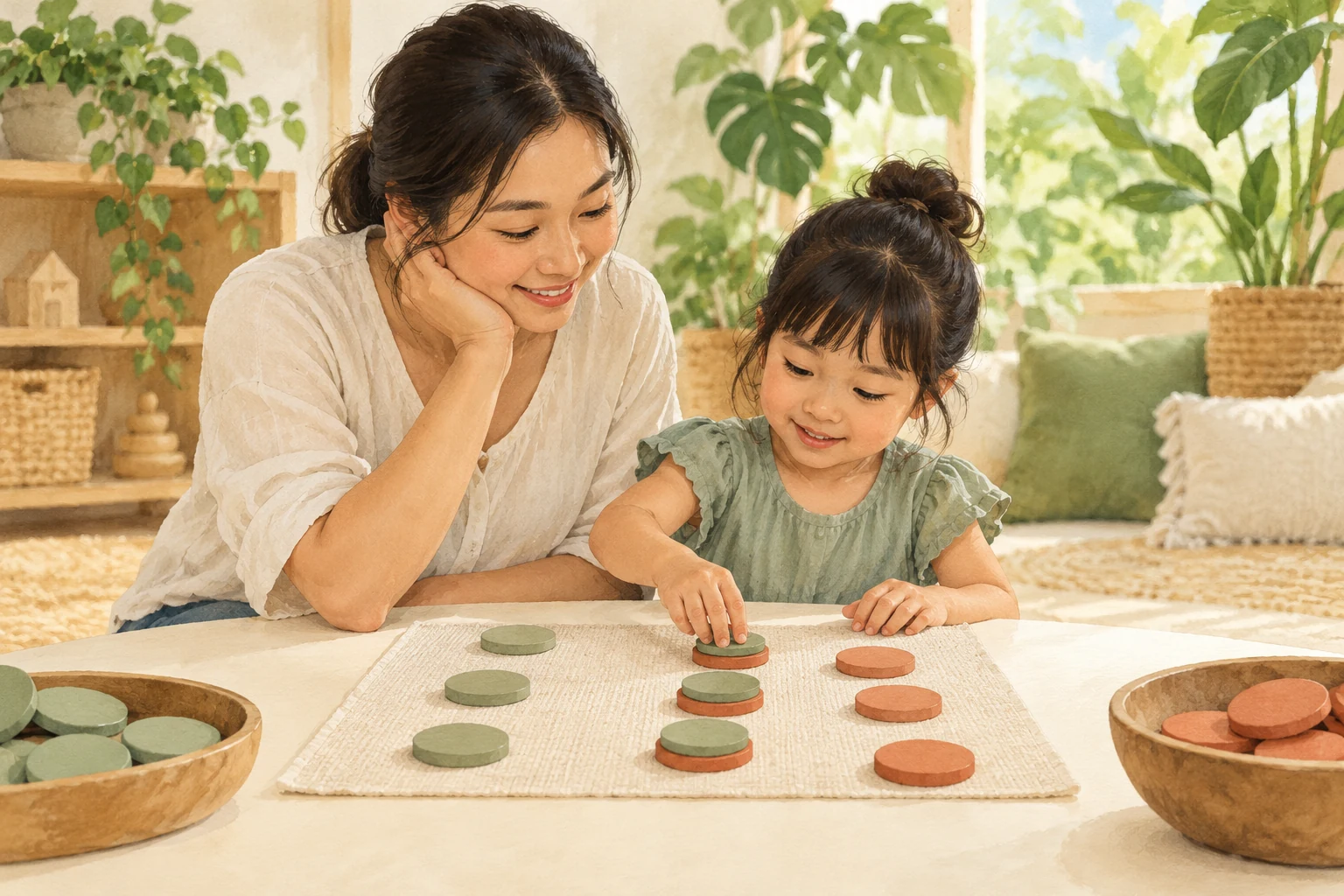
The question hiding under a pile of counters
Did you know that a child may chant every number from one to thirty and still not know how many counters are on the table? It happens when reciting the sequence has become easier than using it to control a collection. On a tuition-room table in Clementi, twelve buttons can become a surprisingly difficult problem. A learner touches the same blue button twice, misses the one concealed near the book, finishes with “twelve”, and looks certain. Another learner quietly moves every counted button to a new tray and reaches eleven. The useful teaching question is not “Which child is cleverer?” It is “Which child has a counting method that protects the total?”
Counting collections is a practical early-mathematics routine in which children count a meaningful set of objects, decide how to arrange it, record the result, and explain how they know the total is trustworthy. The central lesson is not simply the spoken count. It is the relationship between individual objects, a sequence of number words, a final quantity, a written numeral, and eventually groups that can be treated as new units. Children can show several kinds of competence on the same activity, and the teacher can see precisely where an error enters.
Parents often notice the symptom before they know the mechanism. A child counts thirteen sweets accurately when the sweets are in a row, then obtains fourteen when the same sweets are scattered. The quantity has not changed, yet the child’s answer has. The problem may be tracking, one-to-one correspondence, the cardinality principle, or an insecure method of recording groups. Counting collections offers a way to observe these differences instead of responding only with more pages of number sentences.
This article gives one clear owner to the practice of counting, rearranging, bundling, recording and checking physical collections. It is not a replacement for the separate lesson on instantly recognising small groups, called subitising. It is also not a complete course in place value: that neighbouring explanation belongs with teen numbers as tens and ones. Here our job is to make every counted object accountable, then decide when grouping improves the method.
The 50-second answer
Give the child a collection small enough to count successfully but complex enough to require a method. Ask, “How many are there, and how could someone else check?” Let the learner move, line up, circle, mark, or group the objects rather than insisting on one visual arrangement. Watch whether each object receives exactly one number word and whether the last number is understood as the total. After counting, change the arrangement without adding or removing anything, and ask whether the amount changed. Finally invite a second strategy: count in another order, make pairs, or bundle ten when that is developmentally appropriate.
A successful session ends with a justified quantity, not a fast answer. If there are twenty-three bottle tops, “two groups of ten and three extra” can express the same total as “twenty-three individually counted bottle tops”, provided the child knows why the groups are worth ten. A teacher should not race the child into bundling before the underlying one-to-one count is secure. The counting procedure is evidence; the total is the mathematical claim.
Stage one: identify what counts as one
Before anyone starts reciting number words, decide what the countable units are. Twelve loose buttons are easy to define: one button is one item. A packet containing ten buttons creates a new question: are we counting packets, buttons, or both? A row of paired socks can be counted as socks or as pairs, and those answers answer different questions. Adults frequently skip this step because the intended unit seems obvious. To a beginning mathematician, that apparently minor ambiguity can change the answer.
Try a small bowl holding six red counters, three green counters and one yellow counter. Ask the learner to count “all the counters” and then “the red counters”. The first total should be ten; the second should be six. If the learner answers ten to both, the issue may be selection, not counting. If the learner counts the green counters as two because two overlap, perception may be at fault. A good collection task names the unit and the membership rule before the fingers begin moving.
Once the unit is identified, model a boundary: a mat for objects that belong in the count and a separate area for objects that do not. This can prevent accidental counting of a nearby pencil, spare counter or decorative picture. The habit becomes useful later in word problems, science data, money and measurement, where an apparently simple total can mix incomparable kinds of thing. The early lesson is that a number answers a particular question about a specified collection.
Stage two: give every object one count and every count one object
One-to-one correspondence means pairing each spoken counting word with exactly one object. The words need a stable order, and the pointing or moving must keep pace. Children may know “one, two, three, four, five” perfectly but let their finger run ahead, hover over two items, or return to an item already counted. The child may notice that the answer feels wrong without knowing which action caused the error. Slow, observable movements help the teacher separate the number-word sequence from object tracking.
In the Clementi example, I place seven counters on a tray, leaving one near its edge. The learner moves each counted piece into a second tray while speaking. The emptying first tray is a visible ledger of what has already been counted. When all seven pieces have moved, both the final spoken number and the physical state support the answer. A different child may prefer to slide pieces along a straight edge or put a small mark beside each image on paper. The method matters less than its ability to prevent duplication and omission.
Do not treat touching each object as a permanent rule. It is a temporary support for children who need it. As skill develops, the child may scan arranged objects reliably, count on from a known subtotal, or recognise familiar groups. The teaching decision is whether the new method remains accurate and understandable. Efficiency is valuable only when accuracy survives. An apparently slower method that consistently works is the better starting point for a learner whose fast count still loses objects.
Stage three: teach the last-number-as-total principle
A child finishes counting five counters and, when asked “How many?”, begins counting them again. That replay is a useful clue. The child may not yet grasp cardinality: the final number word names the size of the whole collection, not merely the name attached to its last item. A teacher can point around the entire group after the fifth count and say, “Five altogether.” The motion distinguishes the group from the single object that happened to be counted last.
Test cardinality by counting a small set, then asking for the total immediately without permitting a second count. If the child answers confidently, change the order and ask the same question. Four objects should remain four whether counted left to right, right to left, or in a circular path, provided each is counted once. In another trial, let the learner count a set of six, close their eyes while the teacher simply rearranges the items, and ask whether there are still six. The question exposes a crucial idea: position changes do not automatically change quantity.
Children sometimes believe that spreading counters farther apart makes the total larger because the arrangement looks bigger. The gentle response is not “Obviously not.” Let the child recount, compare one-to-one, or move the pieces back without adding or subtracting. We want a reason that survives a visual change, not the adult’s authority. The relationship between counting and conservation begins to make sense when physical evidence can be revisited without embarrassment.
Stage four: let arrangement carry some of the memory
Loose collections place a tracking demand on attention. A learner must remember what has been counted, where the counting path will go, and how many items remain. Organising the collection changes the problem. A row turns a chaotic visual field into a route. A small grid makes omissions easier to spot. Two dishes, marked “counted” and “not yet”, turn attention into a visible physical state. None of these arrangements changes the actual quantity; each changes the reliability of the method.
Ask three children to count the same seventeen counters without suggesting a layout. One may make a line, another five groups of three with two left, and a third a rough circle. Invite each to describe the protection offered by the arrangement. “I know where I stopped” is better evidence of understanding than “because that is how you told me”. Then challenge the method with a longer set or a small interruption. A strategy that survives interruption is often more useful than one that works only under ideal concentration.
For drawings rather than movable counters, use a pencil dot, cross or tally after each item. If the printed picture contains intersecting lines, ask what counts as one separate object before marking anything. For children with vision or motor difficulties, choose larger high-contrast pieces, stable trays, tactile sorting zones or accessible digital counters. The principle is one-to-one accounting, not compliance with a particular hand movement or material.
Stage five: check a total without just repeating the same mistake
A second count can confirm the first, but it can also reproduce the same tracking error. If the child starts at the same point and follows the same confusing path, the matching answer offers weak reassurance. A stronger verification uses a changed route: line up the objects, count from the opposite end, make pairs or check the record against the collection. The point is independence of evidence, not ceremonial repetition.
For a set of fourteen blocks, invite two methods. Method A moves every block one by one into a tray and ends at fourteen. Method B makes two rows of seven and counts the items in each row. The second method still relies on counting, but the altered layout may expose a duplicated or overlooked piece. Older learners can construct a group of ten with four extras, check each group, and explain the sum. If one method yields fourteen and another fifteen, we have a mathematical investigation rather than a verdict.
Teach a three-part check: what was the defined collection; which objects were accounted for; and what alternative check could reveal an omission? These questions transfer later to reading tables, reconciling money, counting experiment results and checking the number of steps in a procedure. Young learners do not need formal language such as “independent verification”. They can understand “Can you show it another way without moving anything in or out?”
Stage six: make groups without pretending groups are magic
Bundling is powerful when a learner knows why a group can be treated as a single counting unit. Ten loose sticks can be tied into one bundle of ten sticks. That is not one stick; it is one bundle with a known value. Four such bundles and three loose sticks represent forty-three sticks, not seven sticks. The distinction between the count of groups and the total count of individual objects is the heart of unitising and a bridge towards place-value reasoning.
Start with pairs when a child is ready. Twelve counters can become six pairs. Ask whether making pairs has reduced the number of counters. It has not: only the organisation changed. Then use groups of five, because fingers and simple tally structures make them accessible. Later compare two tens and four ones with twenty-four single counters. Do not demand a leap to “two tens and four ones” from a learner who cannot reliably count a collection of ten individual objects.
Present regrouping as a trade with conservation. Ten single pieces are exchanged for one labelled ten-stick or an elastic-banded packet containing ten. The packet can be reopened to verify the contents. That reversibility is important: children see a relationship rather than a mysterious teacher-created symbol. When using pre-made blocks, occasionally pair them with loose pieces so “ten” remains a quantity, not merely the name of a long plastic bar.
Stage seven: move between objects, pictures, words and numerals
A collection should eventually be represented without keeping the objects permanently on the table. After a child has counted eighteen shells, ask for a drawing that helps another child reconstruct the amount. Eighteen individually drawn shells is one valid representation; a ten-frame plus eight extra marks is another. Write “18” alongside the drawing, then ask the child to explain which part of the writing refers to the same total. The learner should be able to travel in both directions: from collection to record and from record back to an equivalent collection.
A common trap appears when a teacher supplies the numeral too soon. The learner copies “18” beautifully without establishing that there are eighteen items. A second trap is assuming a neat drawing proves understanding. The child may have drawn three tidy rows because the teacher suggested them, while still believing that widening a row increases quantity. The record must be questioned: “What would happen if I moved these two shells to the other side? Would the number change?”
Encourage pupils to keep a small collection record: date, item counted, total, arrangement, alternative check and one sentence explaining certainty or doubt. Young children can use pictures and adult scribing. Older children can compare records across days, discuss why two methods agreed, and identify which strategy suits different sizes and layouts. A useful record makes the mathematical decision visible; it should not turn a ten-minute investigation into an exhausting handwriting exercise.
A complete Clementi-floor example: twenty-seven mixed objects
Imagine a learner arrives with a tray of twenty-seven large plastic counters. Some are circular, some square, and three are partly hidden under another piece. Before touching them, the tutor asks, “Are we counting shapes, colours or individual counters?” The learner chooses individual counters. This decision matters because visual categories may distract from the requested total. The learner first estimates “about thirty”. Estimation provides a sense-check, but it does not replace counting.
The first attempt reaches twenty-nine. The tutor does not erase the answer or announce the correct number. Instead, the learner explains the route and discovers that the three overlapping pieces were counted inconsistently. On the second attempt, the pupil moves each counted piece into a clear container and obtains twenty-seven. The tutor then suggests making one ten, another ten and leaving seven. The child opens both bundles to prove that each really contains ten and writes “10 + 10 + 7 = 27”.
Now the tutor spreads the same pieces over a larger tray. The learner initially says, “It looks like more.” Rather than rebuking this observation, the tutor asks what action would make it more. The child answers, “Adding a counter.” They recount and still get twenty-seven. The tutor records the learner’s explanation: “The tray is bigger, but no counters were added.” We have developed counting reliability, unitising and a conservation argument in one connected lesson.
The tutor’s final test changes the context. Twenty-seven picture stickers on paper cannot be moved into a tray. The pupil marks each image once, makes a circle around ten of them, another around ten, and leaves seven outside. This time they can explain the written number without rearranging the printed objects. The practice has transferred one level: from movable objects to a static picture. That is a stronger outcome than merely speeding up a familiar counter task.
Eight everyday collections that teach different decisions
Scenario 1: Socks that arrive as pairs. Place eight socks on a table, four matching pairs. Ask first for the number of socks and then for the number of pairs. If the answers are eight and four, discuss why both can be correct. If the learner says “four socks”, have them separate one pair into two objects and recount. This is an early lesson in unit choice and a useful warning against confusing how many packages there are with how many items each package contains.
Scenario 2: Mixed coins. Give a child three coins of one denomination and two coins of another. Ask how many coins there are and then what their total monetary value is. Five coins is a count of objects; the monetary sum is a different quantity. Do not turn the activity into a money-calculation test if the learner is still practising basic counting. Its distinctive value is the contrast between counting objects and aggregating their values.
Scenario 3: Fruit on two plates. Put five grapes on one plate and six on another. The child may count each plate separately and say “five and six” without knowing the combined amount. Invite a joining strategy: move all eleven onto a mat, or retain the groups and explain “five plus six gives eleven”. Then move one grape between plates. The two plate counts change, but the overall total remains eleven. This supports a composition idea without removing the concrete evidence.
Scenario 4: Trees in a drawing. In a picture of a park, some trees overlap. Ask whether a visible trunk behind another tree is a separate tree, and how the drawing signals this. The task is not to guess the illustrator’s intention. It is to identify each represented object and use a deliberate mark to avoid losing count. When the image is genuinely ambiguous, allow the child to say “I cannot tell for certain”, explain the ambiguity and request a clearer picture.
Scenario 5: Steps climbed. A child counts twelve steps while walking upstairs. Unlike counters, steps cannot be moved to a finished tray. The learner must coordinate movement and counting, and an interruption may cause a lost place. Try counting while touching the railing at each completed step, then discuss how to check from a new starting point. This extends tracking into sequential events, where the counted things pass by rather than remain visible together.
Scenario 6: Claps and beats. Clap seven times and ask the child to count the sounds. There is no permanent object to point at afterward. Repeat slowly, then vary the pauses. This tests the idea that an event can be counted just as a physical object can, but it should not replace concrete-object counting for children still struggling to match number words to things. Rhythm may help some learners, while rapid or uneven claps may add unnecessary attention demands.
Scenario 7: Coloured blocks in a bag. The learner counts fourteen blocks while sorting them into red and blue groups. Ask for the total and the two subtotals. Then swap one red block with one blue block, leaving the total unchanged. The challenge is to notice that classification and cardinality answer different questions. This becomes useful in data handling: categories may change while the count of all observations stays the same.
Scenario 8: A classroom tidy-up. Children need to know whether thirty craft sticks have been returned. Ask them to devise a trustworthy method, perhaps three bundles of ten. The context provides a real reason to count and verify rather than count only because an adult says so. The group must agree how to handle broken sticks or spare pieces. That definition-of-unit discussion is part of mathematics, not an inconvenient detour.
What the evidence supports—and what it does not
The US Institute of Education Sciences’ What Works Clearinghouse recommends teaching number and operations through a developmental progression, including recognition of small groups, accurate one-to-one counting, number comparisons and labelled quantities. Its guidance explicitly treats cardinality as the understanding that the final count word represents the quantity of the set. These are strong reasons to make counting observable and responsive to what a learner knows. They are not proof that one branded collection routine will automatically raise every child’s score.
The IES materials for families also describe the difference between memorising number words, pairing words with objects and understanding the last number as the whole total. Their advice includes modelling a count and writing a corresponding numeral. The Education Endowment Foundation has continued discussing how concrete manipulatives can make mathematical ideas accessible, including in its April 2025 evidence podcast. Our lesson design combines these ideas, but the exact sequence in this article is a practical synthesis, not a separately evaluated commercial intervention.
Research claims need scale. A child becoming more accurate at counting twenty counters during supported practice does not immediately establish durable place-value mastery, broader problem-solving transfer or future examination improvement. Progress should be checked with changed materials, changed layouts, delayed practice and independent explanations. If performance improves only with one favourite tray and a particular adult’s hints, the skill has not yet become flexible enough.
See the original sources in the source section. For the wider learning-method landscape, use eduKate’s How X Works hub rather than creating another competing directory. These research signals are used as evidence and boundary checks, not as titles or templates to copy.
Common failure mode: fast number words hide lost objects
A child can say the sequence rapidly while skipping one counter on the table. Adults sometimes praise speed before checking correspondence, accidentally reinforcing a performance that looks mathematical but is unreliable. Ask the learner to reduce the pace and give each object a visible action. Try seven objects, then nine; do not immediately increase the set to fifty as punishment for one error. A precise response names the bottleneck: “The number words were correct, but this piece did not get a count.”
When counting is accurate slowly and fails only at speed, train fluency by preserving the tracking method first. There is no reason to reward a quick incorrect total. Eventually the learner can adopt efficient patterns and count on from group totals. The transition happens when a new method earns trust through checking, not because the teacher wants the child to appear advanced.
Common failure mode: the child recounts because the total never formed
Another learner counts ten objects, says “ten”, and immediately recounts when asked how many there are. Recounting is not automatically harmful; children often want reassurance. But habitual inability to report the total without another count suggests the last number may not yet stand for the entire set. Model the concluding statement, “Ten altogether,” gesture around the group, and ask for a single response after a pause.
Test whether the idea transfers by counting a different ten objects and using a different order. If the child can name the total after counting but not after a one-second interruption, memory and attention may also be involved. It would be premature to diagnose a mathematics disorder from one interaction. Record the pattern over several low-pressure occasions and distinguish conceptual difficulty from ordinary distraction.
Common failure mode: grouping starts before groups have value
A learner sees three groups of five and announces “three”. That may be the correct number of groups but not the total number of individual objects. If the task asks for individual counters, invite the learner to open each group and count what it contains. Label a group clearly as “five counters”, then ask whether moving the group to another part of the table changes its value.
An adult may call bundling “place value practice” when it is actually only a sorting game. The crucial learning is a reversible equivalence: one bundle of ten corresponds to ten individuals. Do not rush straight from colour grouping to decimal notation. A learner must understand what a group represents before a written digit in the tens position carries secure meaning.
Common failure mode: beautiful arrays become memorised decoration
A neat rectangle of twelve counters makes a pleasing photograph. It can also hide weak understanding if the teacher assembled the rectangle and the child simply memorised “three rows of four”. Rearrange the same twelve pieces and request another representation. Ask whether four rows of three, two groups of six and twelve singles are different quantities. Let the child justify the equivalence using actual items before expecting multiplication language.
Likewise, a ten-frame is useful only when the learner knows that occupied positions represent counted objects and that unoccupied positions do not. Present occasional irregular arrangements and invite the learner to decide when a frame helps. The aim is to make structure available as a tool, not to train dependence on one picture format.
Common failure mode: correction erases information the teacher needed
When a learner says there are sixteen objects where the correct answer is fourteen, an adult may instantly remove two counters or write the correct numeral. That changes the evidence and can make the learner’s original strategy impossible to reconstruct. Better to freeze the collection and ask for a slow demonstration of the count. Watch for double counts, skipped items, unclear membership and mismatched number words.
After locating the failure point, invite a new attempt with one purposeful change. The feedback should be actionable: “Move each counted counter to the left so you do not revisit it,” not simply “be careful”. The difference matters because “careful” describes a desired attitude, while the move-left rule gives the child a working control method.
Common failure mode: counting tasks quietly become reading tests
A worksheet may ask a child to “circle exactly twelve objects that meet the following conditions”, then include unfamiliar written vocabulary. A wrong answer might reflect difficulty understanding the instructions rather than failure to count twelve objects. Separate the demands. Read or explain the criteria aloud, test whether the child knows which items belong, and only then observe counting.
For multilingual learners, include the mathematical meaning in clear language and check important terms such as total, pair, set, fewer and altogether. A child can be mathematically competent while still learning the language used to express the competence. Teachers should not interpret hesitation over a question word as proof that the concept of quantity is absent.
Common failure mode: the activity is too easy to reveal learning
If a child can instantly identify three dots, repeated three-dot practice may build confidence but tell us little about counting a larger, scattered collection. On the other hand, a chaotic tray of seventy pieces may create tracking demands well beyond the learner’s current reach. Select a collection just large enough to make a strategy necessary, then adjust after observing what happens.
A sensible staircase moves from familiar sets to less organised ones, then introduces new kinds of objects and recording formats. A pupil who counts twelve confidently in a row can try twelve scattered pieces, then twelve pictured pieces. A pupil who loses track at six needs a smaller set and a reliable movement routine before a harder challenge.
Common failure mode: external hints masquerade as independence
Some adults quietly steer a child’s finger, whisper the next number or move every counted piece themselves. The learner appears successful, but the adult is carrying the system. To judge independent skill, give one clear instruction and then observe without taking over. If a prompt becomes necessary, record what it was and whether the child could continue afterward.
A helpful sequence is: demonstrate once, count collaboratively once, let the learner try with a visible support, and revisit later with the support reduced. The goal is not to withhold assistance in the name of toughness. The goal is to know exactly which assistance remains necessary so that teaching can remove the right obstacle next.
A learner route: three questions to control your own count
First ask, “What am I counting?” A student who can name the unit has made the job less ambiguous. Second ask, “How will I keep track?” This may mean moving counters, drawing circles, marking a list or grouping items. Third ask, “What would convince another person?” The learner can recount by a different path, compare groups or make a written representation that someone else can inspect.
Students should be encouraged to say “I am not sure yet” when an item is hidden or a category is unclear. That uncertainty is a cue to investigate, not a character flaw. A good counter is not someone who never hesitates. It is someone who can explain a method, detect a contradiction and repair the total.
Try a personal challenge with eighteen paper clips. Count them once, write the result and then change the arrangement completely. Predict whether the answer will change and explain why. Later, bundle ten clips and leave eight loose; undo the bundle to verify. If the second route agrees without adult direction, you have stronger evidence that the method is becoming yours.
A parent route: use ordinary objects without staging an exam
At home, choose one small real collection: teaspoons for a meal, toy bricks before packing away, socks in the laundry, or pages left to read. Ask a genuine question rather than performing a surprise quiz. Keep the activity brief and allow the child to move the objects. If you know the total, resist supplying it immediately. Ask which count the child trusts and why.
Praise the protection of the method: “You moved each counted brick, so it was easy to see which ones were finished.” That is more informative than “You are a maths genius.” If an error appears, preserve the evidence and try another route together. Avoid linking everyday counting with threats about examinations, grades or speed. A five-minute investigation is successful when the child understands one mathematical relationship more clearly.
For a child who dislikes worksheets, a real collection may make the purpose easier to see. For a child with motor or visual needs, adapt the material, position and response method. If counting difficulties remain persistent across contexts despite careful teaching, share specific observations with the teacher and consider appropriate educational assessment; an article cannot determine the cause.
A teacher route: choose a progression rather than a pile of activities
Begin by diagnosing the component skill. Can the child recite the ordered number words? Pair one word with one object? State the total after the count? Recognise when rearrangement leaves quantity unchanged? Represent a group without recounting every item? Record these separately so an intervention targets the actual need. A single correct answer cannot show every component, and a single incorrect answer cannot reveal the cause.
Plan the next task by changing one important feature. If tracking is secure only in lines, scatter the objects. If the total is secure with counters but not with pictures, change the medium. If a child groups fives easily but not tens, examine whether the group value remains visible. Keep occasional fresh sets for independent transfer checks. Use the language of “What did you count? How do you know?” consistently without turning every count into a drawn-out interrogation.
For group teaching, let different pupils display their arrangements, including a failed route with permission. Compare why one layout protected against losing a piece. Close with a short record: set counted, method used, result, and one check. Over time the records can show not just increasing totals but increasing reliability. This is far more informative than recording only how many worksheets were completed.
A tutor route: five visits from concrete success to flexible number
Visit one: use five to ten movable counters to establish accurate one-to-one correspondence and last-number-as-total. The learner chooses a movement system and explains its purpose. Finish with a changed order rather than a harder arithmetic question. Visit two: use a larger scattered collection, invite the learner to design a layout, and compare two checking methods. Keep the total constant while changing the visible space occupied.
Visit three: introduce paired and five-grouped sets while carefully distinguishing the number of groups from the number of objects. Visit four: represent a collection using a drawing, ten-frame or tally record, and ask the learner to reconstruct an equivalent collection. Visit five: use an unfamiliar real-world set and record how independently the pupil identifies units, chooses a method, counts, groups when helpful and verifies the result.
The visits are a planning illustration, not a tested dosage or universal five-lesson cure. A pupil might need several sessions at one stage; another may complete several stages in one meeting. The tutor should alter the sequence using evidence from the actual learner, not insist on a schedule because the article presents one.
Frequently asked questions
Is counting collections the same as counting aloud? No. Reciting number words establishes one part of the skill, but collection counting requires the learner to connect each word to an item, preserve a path through the set, identify the total and often show another person how the count was checked. A child can recite to a hundred yet skip objects on a tray. Another child may not recite very far but count a small collection reliably. Diagnose the relevant part rather than assuming the skills rise together.
What age should children begin? Young children can begin with very small sets long before formal written arithmetic. The starting point is not a rigid birthday: choose objects, quantities and language that fit the child’s current knowledge and attention. A preschool learner may count three blocks; an older child with insecure tracking may revisit the same mechanism with respect and more age-appropriate materials. Progression matters more than the label on a year level.
Should I insist that my child lines objects up? No. Lining objects up is one reliable tracking strategy, not the mathematical goal. If a child can account for every object in another defensible way, invite an explanation. If their chosen route produces errors, compare it with a line or a counted/not-counted tray and let the evidence show the difference. Over time the learner should be able to select a method appropriate to the collection rather than depend exclusively on one adult-imposed layout.
When should groups of ten appear? Introduce groups of ten when the learner understands that each group contains ten individual items and can verify that relationship. A bundle should not become a mysterious symbol. Begin with real units and reversible trades; then connect bundles, drawings and written numerals. For younger pupils, pairs or groups of five may provide a more accessible bridge. The point is understanding value, not being first to use place-value vocabulary.
Does subitising replace counting? No. Instantly recognising a familiar small quantity can support number sense and sometimes help check a group, but larger irregular collections still need a reliable counting or grouping method. A learner who sees three dots instantly may be unable to count twenty scattered objects. Conversely, a child who counts slowly can still develop strategies for recognising structured groups. The two skills are neighbours with different tasks.
What if my child counts the same object twice? Freeze the collection so the path can be inspected. Ask the child to demonstrate their count and identify where the piece was revisited. Offer a specific tracking method such as moving completed objects or marking each printed item. Reduce quantity if needed; then retest with a fresh arrangement. Treat an occasional double count as information about a method, not as evidence that the child is inattentive or incapable.
Can everyday collections teach addition? They can provide concrete meaning for combining and separating quantities. Five shells joined with four shells can be counted as nine, and moving shells between groups can show that a combined total remains stable. But a counting activity is not automatically a complete addition lesson. Once the child’s count is reliable, explicitly connect the physical change with the number sentence and later check whether the relationship holds without the objects.
How do I tell accuracy from lucky guessing? Change the collection or representation without changing the target skill. Ask for an explanation of the tracking method, compare a second count in a different order, and revisit after a delay. One correct response could be a guess, a memorised visual pattern, or genuine understanding. Agreement across varied conditions offers better evidence. Record when an adult prompt was needed so assisted success is not mistaken for independent control.
Are ten-frames always the best representation? No. Ten-frames are useful because their fixed structure makes ten and missing spaces visible, but some learning goals call for loose objects, lines, arrays, tally marks or pictures. A representation earns its place when it illuminates the mathematical relationship at issue. If the frame becomes a worksheet routine disconnected from quantity, return to physical collections and invite the pupil to rebuild the structure.
What should a parent say after a wrong total? Try “Show me how you counted, so we can find the part that needs checking.” This makes the method observable and protects the child’s willingness to think aloud. Avoid “You never pay attention” or repeatedly announcing the correct numeral. Once the failure point is known, change one feature of the method and try a different collection. The repair, not the adult’s explanation, should do most of the teaching.
What counts as progress over a month? Look for fewer lost or double-counted objects, correct last-number-as-total answers, independent choice of a tracking strategy, better explanations of grouping, and successful performance with new materials or delayed practice. A bigger maximum number is only one possible sign. A learner who moves from an unreliable fast count of thirty to a reliable, independently checked count of twenty-five may have made substantial progress in mathematical control.
Sources and reading route
The What Works Clearinghouse practice guide, Teaching Math to Young Children (November 2013), describes developmental progressions for early number and operations. The IES family-and-caregiver counting resource gives practical examples of one-to-one counting, cardinality and numerical representation. The IES Teaching Math to Young Children Toolkit explains principles such as stable order, abstraction and keeping-track errors. The EEF’s April 2025 discussion of manipulatives provides broader context for using physical representations with mathematical purpose.
For related explanations on eduKateSG, continue to subitising small quantities when instant recognition is the question, or teen numbers and place value when tens-and-ones notation becomes the main topic. Return to the How X Works hub for the wider series. This article is educational guidance, not a diagnosis or a guarantee that one routine will produce a particular score.