
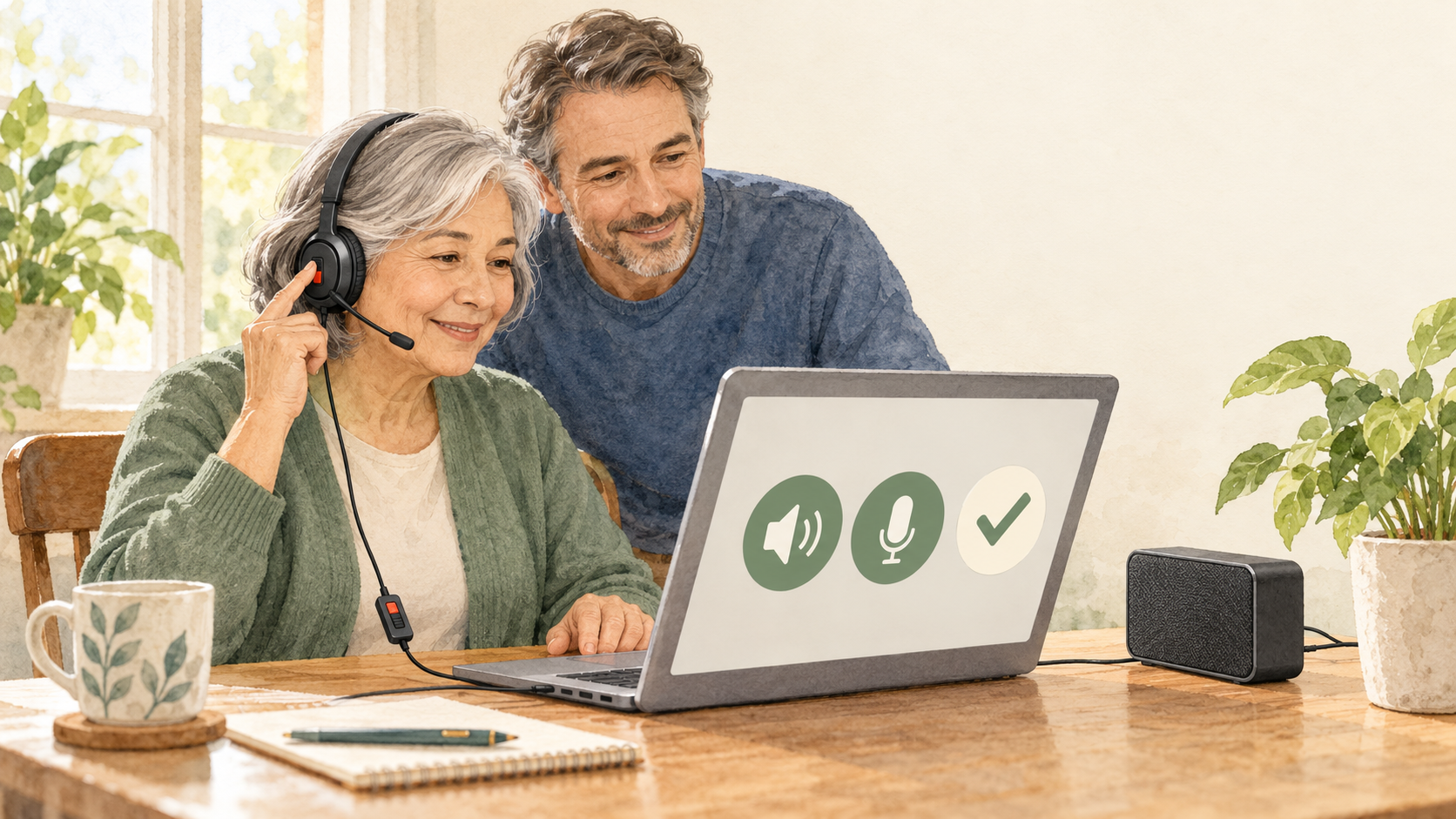
Did you know that a student can sound wonderfully confident in a practice speech while forgetting the one sentence that makes the whole argument understandable? When a child hears the recording again, that gap can become visible without anybody delivering a harsh criticism.
The useful way to practise an oral explanation is to record a short attempt, replay it for meaning rather than performance polish, identify one missing reasoning step, and then explain the same idea again without reading a script. A recording is a mirror for what the listener actually hears, not a score for sounding like a newsreader. The learner’s next independent explanation is the important check.
Diagnosis first: is the problem speaking or thinking?
An explanation needs a starting question, the relevant facts, the reason connecting them and an answer that returns to the question. A child may know those things but omit one under pressure. Alternatively, the child may pronounce every word clearly while not actually understanding how the facts fit together. Recordings help separate a missing spoken link from a missing conceptual link.
Suppose the student says ‘The answer is 48 because I multiplied.’ Their working may be right, but the listener does not know what was multiplied or why. Ask the child to supply the absent bridge: ‘What were the two quantities, and what did multiplication count?’ This is a reasoning repair rather than a demand for a more impressive opening.
Worked example: a classroom talk about reusable drink bottles
Imagine a fictional school project recording how many reusable bottles were brought to an event: 24 on Monday and 36 on Friday. The student gives a practice talk: ‘Friday was much better because the figure rose by 50, so the campaign worked.’ The speaker sounds confident, but the calculation and causal interpretation need checking. These numbers are invented for teaching; they are not observed school outcomes.
Replay that particular sentence and pause. The difference is 36 − 24 = 12 bottles. The change relative to Monday’s 24 is 12 ÷ 24 = 0.5, or 50%. The student said ‘rose by 50’, omitting the percent sign and its starting value. They also claimed the campaign caused the increase, even though the two counts by themselves cannot rule out other explanations.
- Original speech: ‘The figure rose by 50.’ The listener may mistake this for 50 additional bottles.
- Repair the quantity: ‘The count rose by 12 bottles, from 24 on Monday to 36 on Friday.’
- Repair the percentage: ‘That is a 50% increase relative to Monday’s starting count of 24.’
- Repair the evidence limit: ‘These two days alone do not prove why the count changed.’
- Independent retell: ask the child to explain the calculation and limitation without copying those sentences verbatim.
The purpose of listening again is not to catch a child out. It is to notice whether essential meaning escaped during speech. The numerical correction is specific and checkable. A more fluent second attempt matters only if it also preserves that meaning.
Three listening passes make feedback manageable
- First pass—listener’s view: put the script away. What did you actually understand? Write one sentence stating the student’s conclusion.
- Second pass—reasoning view: pause at the first leap between evidence and conclusion. Ask what step, unit or explanation is missing.
- Third pass—delivery view: once the ideas are correct, notice whether pace, pauses and emphasis make those ideas followable.
A child who tries to fix speed, posture, grammar, eye contact and every reasoning error at once may forget the central question. Make a single learning decision after each replay. The most consequential missing explanation usually deserves attention before style.
How long should the recording be?
For an early attempt, a short passage of about 45 to 90 seconds is enough to provide useful material without turning practice into a long performance. That is a teaching suggestion, not an official examination timing rule. Use the actual task and the learner’s comfort to choose a suitable length.
If the student is anxious about hearing their voice, begin with an audio-only practice or let them rehearse with a trusted adult. Do not demand a video or share recordings outside an agreed school or family context. A transcript written by the learner can also expose missing reasons if recording is unsuitable.
What an explanation sounds like when the reasoning is complete
A useful structure is question → evidence → reasoning → answer → limitation. It does not need to become five robotic sentences. A confident speaker may move naturally among these parts, but the listener should be able to locate each relevant idea. If a claim requires a number, state the unit and comparison. If a claim is interpretative, say why the evidence supports it.
Ask the learner to draw four small boxes before speaking: ‘What am I explaining?’, ‘What do I know?’, ‘How does that lead to the answer?’, and ‘What can’t this evidence tell me?’ After recording, tick only the boxes whose content a listener could actually hear. An empty box suggests a targeted repair rather than a general judgement about confidence.
The difference between a rehearsed script and a transferable skill
Memorising a beautiful paragraph can improve the next recording while concealing uncertainty. To check independent understanding, change the question slightly. After the bottles example, ask about a fictional count rising from 30 to 39. The increase is 9, and 9 ÷ 30 = 30%. A student who now explains both the absolute change and relative percentage has carried the reasoning across examples.
If the child merely repeats ‘a 50% increase’ from the first script, the gap persists. It is better to discover the misunderstanding in a gentle practice setting than let a polished recording create false confidence.
Teacher actions: model one small repair aloud
A teacher can make a deliberately incomplete explanation of an ordinary calculation, replay or read it, and invite the class to name the first missing connection. Then demonstrate a precise repair without rewriting the entire talk. The lesson is not that every pause is bad. Pauses can help an audience think. The aim is to restore the bridge from evidence to conclusion.
The Education Endowment Foundation’s 2026 discussion of metacognitive talk recommends focusing on planning, monitoring and evaluating what worked. The recording routine here is a practical classroom application of that idea, not a claim that the source tested this exact recording exercise or guarantees improved marks.
Parent actions: respond as a genuine listener
Ask your child to play one section and then tell them what you understood, not simply whether you liked the voice. For example: ‘I understood that 36 was higher than 24, but I couldn’t tell why you called it 50. Can you show me?’ This identifies a repair without doing the thinking for the learner.
Try not to compare a child’s voice with a professional speaker’s. Focus first on the clarity of the idea. If the child already knows the explanation but speaks very softly, a delivery practice task may be appropriate; if the explanation is wrong, volume is not the priority.
An observation log that does not become another test
Keep a two-column record: ‘What the listener could understand’ and ‘What I changed for the second attempt’. Avoid dozens of numerical ratings. A useful entry could read: ‘First attempt omitted the starting value for the percentage. Second attempt named the starting value and calculated the change correctly.’ The specific difference reveals progress.
For a more reliable check, return to the skill after a few days with a new problem and no reminder. Ask the student to name the baseline before calculating a percentage. Progress is more convincing when the learner catches the issue without being told where to pause the recording.
Common mistakes and their targeted repairs
- Mistake: treating every ‘um’ as a disaster. Repair: distinguish harmless hesitation from a missing idea.
- Mistake: correcting the accent instead of the explanation. Repair: prioritise intelligibility and meaningful content; respect language varieties.
- Mistake: relying on automatic transcription as the only evidence. Repair: listen to the audio and check any transcription errors.
- Mistake: giving ten improvements at once. Repair: select the one that most affects understanding.
- Mistake: recording the same prepared script repeatedly without transfer. Repair: change the question and explain independently.
- Mistake: sharing a recording of classmates without permission. Repair: follow the school’s relevant consent and privacy rules.
When a recording is not the right tool
Some learners may have speech differences, anxiety, hearing difficulties or personal reasons not to be recorded. A supportive alternative might involve live explanation to a trusted partner, written notes, text-to-speech or a drawing accompanied by an account of reasoning. The assessment should match the lesson’s learning objective and legitimate access needs.
Do not use a casual practice recording to diagnose a speech or learning disorder. Seek the student’s teacher and qualified professionals when specialised help is indicated. A learner’s ability to perform on camera is not a comprehensive measure of understanding.
A small independent practice question with a checked answer
Ask the child to explain this fictional result aloud: 15 pupils chose a nature club in one poll and 21 chose it in a second. The count changed by 6, and relative to 15 the increase is 6 ÷ 15 = 0.4, or 40%. The sentence ‘more pupils were interested’ may need caution if the sample or participation changed. A complete explanation names what was counted, the two periods, the difference and why the comparison is limited.
Play the recording once. Ask the child to find an omitted unit, baseline or limitation. Then offer new numbers—20 and 25—for an independent attempt. A 5-count increase relative to 20 equals 25%. The child should not simply repeat the first sentence with new numbers if the reasoning changes.
Frequently asked questions
Should my child practise until the recording has no pauses?
No. The priority is reasoning that a listener can follow. Natural pauses may make an explanation clearer. Aim for meaningful communication, not a perfectly edited performance.
Can a child read a full script during every attempt?
A script can help at first, especially when organising unfamiliar ideas. Later, reduce prompts so the learner has to reconstruct the reasoning and respond to a changed question.
Is video better than audio?
Not necessarily. Audio is often enough to detect missing spoken steps and carries fewer visual privacy considerations. Use video only when gestures, diagrams or another visual element genuinely matter to the learning goal.
What if listening back makes my child upset?
Stop the replay, reduce the task and use a supportive live explanation instead. Feedback is helpful only when it remains proportionate and workable for the learner.
How do we measure progress?
Track a specific reasoning repair on a fresh question: naming the baseline, explaining a causal limit, or connecting facts to the claim. Repeating a rehearsed paragraph faster is weak evidence of independent understanding.
Continue through eduKate
The Core Aim guide to checking conclusions against graphs develops the numerical evidence skill in the bottles example. For broader learning transfer, see the eduKate Education library and the protected Clementi teaching reference for diagnosis-first explanation, progressive practice and independent checking.
The recording’s job is finished when the learner has noticed a missing bridge and can build it for someone else. That is much more valuable than hearing the same polished script one more time.