
Did you know? A storm or other disaster damages physical things, but its longer social consequences depend in part on whether families, enterprises and public institutions can fund a fair recovery. Insurance and public support can help distribute losses; neither prevents hazards or guarantees every person will receive assistance. That is why the phrase “how a civilisation might end” should start a thoughtful investigation rather than a frightening prediction.
How a Civilisation Might End | When Insurance and Risk-Sharing Protection Gaps Grow is Part 21 of the eduKate civilisation learning series. The chapters use the completely fictional community of Shelter Quay to make insurance, collective risk sharing and recovery finance understandable to parents, tutors and students. The guide separates an isolated problem, a persistent loss of capability, institutional transformation, and the social and cultural continuity that may survive changes in political or technical structures.
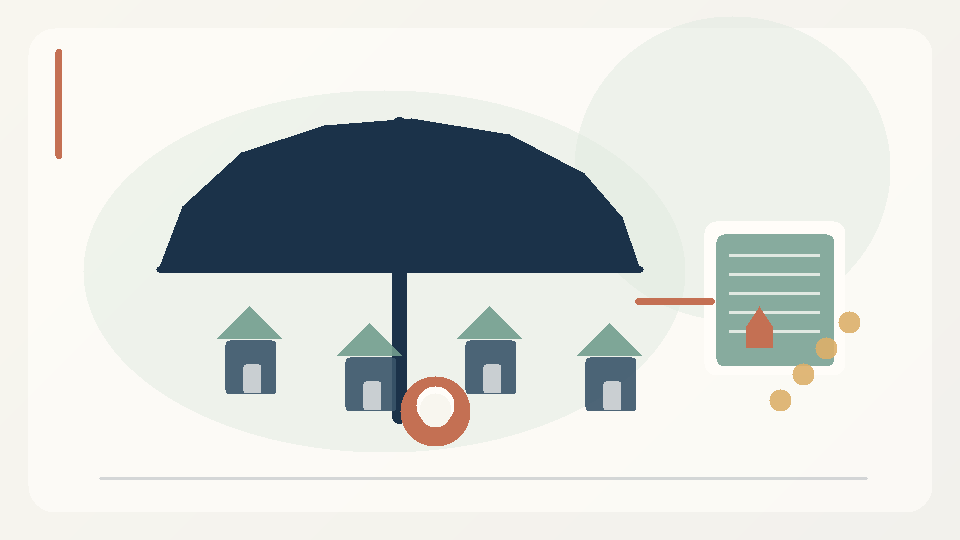
Featured-image disclosure: Existing 2026 original eduKate illustration of an umbrella covering fictional homes and records, with a broken link between claims and reserves. This is a conceptual image, not a real insurer or catastrophe. The cover is explanatory artwork, not photographic, historical or scientific proof of a real incident.
Scope and safeguarding: No personal financial, insurance, legal or borrowing advice. Real insurance depends on the written contract and applicable jurisdiction. Every claim, premium, risk amount and payout used in lessons is an invented stationery example. Never ask children to share family financial or insurance information. The fictional people, places and numerical exercises do not describe actual individuals or institutions, and all exercises require ordinary stationery only.
Quick answer: what can actually go wrong?
A storm or other disaster damages physical things, but its longer social consequences depend in part on whether families, enterprises and public institutions can fund a fair recovery. Insurance and public support can help distribute losses; neither prevents hazards or guarantees every person will receive assistance. The mechanism may involve people, records, resources, lawful authority, learned skills or service access failing to connect as intended. However, an interruption in one place does not demonstrate that every other part of a society is broken. Communities can repair services, preserve traditions, change institutional arrangements and transfer knowledge to successors. Responsible analysis identifies actual observations, the conditions that caused them, alternative pathways and who could or could not use the available remedy.
- What has changed? Name the specific service, right, resource or capability rather than declaring society has ended.
- Whom does it affect? Include users whose needs may be concealed by an average.
- How do we know? Seek a dated authoritative source, appropriate definitions and a serious alternative explanation.
- What continues? Look for viable replacements, trained people, legal protections and remaining social relationships.
- What would repair look like? Name the accountable professional process and a measurable outcome, not merely an announcement.
- What is still uncertain? Make the missing evidence explicit rather than inventing certainty.
Evidence and research context
The IAIS 2025 special-topic edition studies the potential financial-stability implications of uninsured natural-catastrophe losses. On 22 October 2026, the IAIS launched a public library of initiatives addressing such protection gaps, emphasising that solutions must reflect jurisdiction-specific circumstances. Neither document guarantees the suitability or availability of a particular insurance policy. The original source links and their institutional descriptions appear at the end of the guide. Their findings do not validate the fictional Shelter Quay story or the invented calculations. A source publication date may differ from the year it measures; projections, observed results and educational analogies must not be conflated.
Complete 29-chapter contents
- 1. Insurance does not prevent physical damage
- 2. What the protection gap means
- 3. Why some people cannot obtain coverage
- 4. Public assets and uninsured costs
- 5. Premiums and deductibles
- 6. Policy limits and exclusions
- 7. Claims intake and verification
- 8. Reserves and insurer resilience
- 9. Reinsurance and transferred layers
- 10. Catastrophe concentration
- 11. Protection gaps and business continuity
- 12. Affordability under changing risk
- 13. Underinsurance despite policy ownership
- 14. Parametric triggers and basis risk
- 15. Environmental data quality
- 16. Communicating uncertain losses
- 17. Banks, credit and uninsured exposure
- 18. Public assistance after disasters
- 19. Mutual aid and its boundaries
- 20. Physical mitigation before loss
- 21. Unequal access to recovery
- 22. Modelling catastrophe losses
- 23. Simultaneous claims and bottlenecks
- 24. Consumer understanding and dispute routes
- 25. Public schools, clinics and recovery
- 26. Evidence from the IAIS 2025 report
- 27. The October 2026 initiatives library
- 28. Teaching risk-sharing mathematics safely
- 29. Long-term resilience beyond a policy
Each chapter begins with the idea, explains a possible dependency, identifies evidence and uncertainties, considers people affected, suggests a fair hypothetical response and provides safe paper-based lessons. Readers can follow the sequence or open a particular question. Parents can use the concise explanations; tutors can adapt the numerical and source-evaluation work to different age levels.
1. Insurance does not prevent physical damage
What this means. Cover can help finance eligible losses, but it cannot make a building resistant to every hazard. This issue belongs to the wider study of insurance, collective risk sharing and recovery finance. Students should not assume that one malfunction proves a civilisation has ended or that an unhappy result inevitably spreads to every part of society. Human communities contain overlapping organisations, skills and relationships; some may decline while others adapt. The chapter looks closely at a particular function so that adults and children can distinguish loss of access, poor quality, a temporary delay and a deeper failure of institutional capability.
The mechanism in everyday life
Confusing financial protection with physical prevention may worsen preparedness. Begin by separating a visible symptom from the hidden function that produced it. The invented community of Shelter Quay provides a simple setting. A resident needs a service; an organisation has agreed to provide it; staff, records, materials and a lawful process are needed to complete the task. Suppose one element is unavailable or misunderstood. The user may see only a delay or an incomplete notice. A professional might identify a different, more precise problem. This difference between appearance and cause is why source checking matters.
Make the dependency visible in five stages: a legitimate need, a suitable input, a person or office responsible, the action undertaken, and the outcome experienced by the user. Put arrows only where one part genuinely depends on another in the hypothetical story. If the input changes, ask whether a substitute exists. If the responsible person changes, ask whether a handover has preserved the knowledge. If an outcome looks satisfactory, ask whether all intended users could reach it. The lesson builds a habit of tracing functions rather than treating a label as a complete explanation.
The difficulty may be limited and reversible, or it may last longer because several dependencies reinforce one another. A school can remain a community institution while its timetable changes. A civic office may reopen while some services still have backlogs. A technological replacement can preserve a task while changing the way that task is performed. These examples illustrate transformation as well as failure; do not flatten them into the same conclusion. In historical research, evidence of disruption and evidence of continuity should both be considered.
What evidence could support the claim?
Distinguish verified hazard measures from contract benefits. An evidence card should name the responsible source, publication date, period observed, place, definition of the phenomenon, and what remains unknown. Be alert to the difference between a policy, the implementation of a policy, and a measured outcome. A report announcing the launch of a service does not automatically tell us whether everybody could use it. A research paper may study aggregate patterns but not predict what happens to a particular person. A model may estimate a possible future scenario without recording a future event as fact.
Ask whether two rival explanations could both account for the observation. Perhaps demand increased; perhaps the reporting system improved and identified more cases; perhaps a service moved to an alternative route; perhaps the intended action was actually delayed. Choose a record that could separate those possibilities. This is the spirit of a careful investigation. It does not require an expert child or a technical instrument. It requires an honest distinction between a measurement, an inference and a question for which we do not yet have adequate evidence.
A useful source comparison places a primary document beside a more readable interpretation. Check whether the interpretation preserves the original qualification or has exaggerated it. Global research may be important for background, yet not sufficient to judge one fictional community or real neighbourhood. Where the subject involves legal duties, financial products, public safety, medical services or complex technology, leave real decisions to competent authorities and qualified professionals. The chapter’s illustrations never certify that an actual institution is safe, lawful or financially sound.
The people affected are not interchangeable
Imagine a student trying to use the service in our fictional school library. A public report may give a favourable average, yet this person might face a missing accessible route, language difficulty, unsuitable timing or confusing information. Another person may experience no problem at all. Both accounts may be true, because access varies. Instead of choosing a single stereotype, record the relevant conditions and ask what evidence might show whether a particular difference is systematic. A fair society makes space for people to explain their actual experience.
This comparison is not an invitation to ask learners about their own family’s circumstances. Keep all names and scenarios fictional. Do not require students to disclose disability, citizenship, legal disputes, household income, insurance, personal medical details or political views. An evidence-focused lesson should make understanding possible without exposing anyone’s private life. If a real concern comes to light, the tutor’s role is to follow appropriate safeguarding and professional channels rather than use it as a classroom example.
How a functioning institution might respond
Combine risk reduction, qualified planning and appropriate financial protection. Begin with the smallest well-defined task that competent people can verify. Who has lawful or professional responsibility? What part of the service still works? Which people are unable to use it? What is the proposed improvement and how can its effect be measured? A new policy statement, budget announcement or purchase is not the same as a completed and usable service. The meaningful evidence lies in results that reach the intended user while preserving fair process and safety.
Use a four-stage correction loop. Identify the specific problem without assigning unsupported motives. Validate the cause with dated relevant evidence and a competing hypothesis. Improve the process by qualified means that respect people’s rights and practical needs. Recheck the outcome after the agreed interval, recording what was fixed and what remains unresolved. If the repair helps the average user but excludes a minority, the case cannot be considered fully understood. Document the limitation rather than quietly changing the definition of success.
Good institutions also make a repair maintainable. Record why the decision was made, who owns the next step, which version of the rules applies and how future workers could verify it. If a solution is understood by only one person, its success may vanish when that person leaves. If paperwork is kept but incomprehensible, the records have not preserved useful knowledge. A proper handover allows the next team to question assumptions and improve the result. That is a general principle of civilisational continuity, even though exact procedures vary across fields.
A parent-and-tutor paper exercise
Divide imaginary repair and prevention tokens between two paper projects. Use only harmless paper, pencils and colour cards. First, let a learner describe what a fictional resident actually needs. Next, another learner identifies the enabling resources and responsibilities. A third demands an evidence source and a date before accepting the explanation. The fourth looks for a person who might have been excluded by the proposed solution. This activity is an educational model, not a real audit, election exercise, financial recommendation, engineering procedure or emergency plan.
Add one deliberate ambiguity to the paper case. The service might have been moved, the count might include an extra category or the source could be two years old. Students must decide which new information would be most helpful. They can also identify a counterexample where the same disruption does not produce the predicted result. Children should be allowed to write “uncertain” and explain why. Older students can create a short research question with the relevant units and a plausible alternative explanation. The goal is to turn curiosity into rigorous, respectful judgement.
Worked mathematics: a denominator matters
The following numbers are completely invented stationery counts. Place 47 request cards in the fictional school library. Suppose 6 require an additional check. The flagged proportion is 6/47 × 100 = 12.8% to one decimal place. If a careful fictional review resolves 3 of these cards, 3 flagged cards remain open. This calculation is not a probability of political upheaval, an actual insurance statistic, an estimate of individual economic mobility or a technical safety assessment. It teaches how clearly defined counts are compared.
A tutor should now double the number of requests and ask whether a larger raw count of flagged cards means worse underlying performance. Not necessarily: if the rate stays approximately the same, the higher count may simply reflect greater activity. A second question is whether the cards represent everyone who needed the service or only those who managed to apply. If some people did not appear in the process, the denominator may conceal a barrier to access. A third question is whether the fictional clerk recorded a genuine resolution or merely ticked a box. These distinctions belong in every responsible public statistic.
Five checks for deep learning
- Explain it: Cover can help finance eligible losses, but it cannot make a building resistant to every hazard.
- Trace the risk: Confusing financial protection with physical prevention may worsen preparedness.
- Identify evidence: Distinguish verified hazard measures from contract benefits.
- Propose a remedy: Combine risk reduction, qualified planning and appropriate financial protection.
- Transfer the idea: describe one way the fictional example could be misleading if it were treated as an actual event.
A younger pupil can work with three cards and one practical distinction. An upper-primary pupil can state two possible explanations and ask which source would settle the question. A secondary learner can calculate a rate with the correct denominator, compare two observation dates and explain an ethical access concern. Advanced learners can test how a changed assumption affects the prediction. The tutor’s assessment should reward precise reasoning and willingness to revise, not confidence alone or an exaggerated account of disaster.
To finish, write a short handover: “The important function is …; the suspected weakness is …; what I know is …; another possibility is …; what I would check is …; a responsible improvement is …; and I would know it helped when … .” A well-written answer makes room for both resilience and legitimate uncertainty. It gives the next reader a way to continue the investigation instead of having to believe an unsupported conclusion.
2. What the protection gap means
What this means. A gap may describe losses or exposure not covered by available insurance under a stated definition. This issue belongs to the wider study of insurance, collective risk sharing and recovery finance. Students should not assume that one malfunction proves a civilisation has ended or that an unhappy result inevitably spreads to every part of society. Human communities contain overlapping organisations, skills and relationships; some may decline while others adapt. The chapter looks closely at a particular function so that adults and children can distinguish loss of access, poor quality, a temporary delay and a deeper failure of institutional capability.
The mechanism in everyday life
Readers can confuse policy count with total economic protection. An impressive institutional label can hide a very ordinary practical question. The invented community of Shelter Quay provides a simple setting. A resident needs a service; an organisation has agreed to provide it; staff, records, materials and a lawful process are needed to complete the task. Suppose one element is unavailable or misunderstood. The user may see only a delay or an incomplete notice. A professional might identify a different, more precise problem. This difference between appearance and cause is why source checking matters.
Make the dependency visible in five stages: a legitimate need, a suitable input, a person or office responsible, the action undertaken, and the outcome experienced by the user. Put arrows only where one part genuinely depends on another in the hypothetical story. If the input changes, ask whether a substitute exists. If the responsible person changes, ask whether a handover has preserved the knowledge. If an outcome looks satisfactory, ask whether all intended users could reach it. The lesson builds a habit of tracing functions rather than treating a label as a complete explanation.
The difficulty may be limited and reversible, or it may last longer because several dependencies reinforce one another. A school can remain a community institution while its timetable changes. A civic office may reopen while some services still have backlogs. A technological replacement can preserve a task while changing the way that task is performed. These examples illustrate transformation as well as failure; do not flatten them into the same conclusion. In historical research, evidence of disruption and evidence of continuity should both be considered.
What evidence could support the claim?
Check precisely what was measured and its denominator. An evidence card should name the responsible source, publication date, period observed, place, definition of the phenomenon, and what remains unknown. Be alert to the difference between a policy, the implementation of a policy, and a measured outcome. A report announcing the launch of a service does not automatically tell us whether everybody could use it. A research paper may study aggregate patterns but not predict what happens to a particular person. A model may estimate a possible future scenario without recording a future event as fact.
Ask whether two rival explanations could both account for the observation. Perhaps demand increased; perhaps the reporting system improved and identified more cases; perhaps a service moved to an alternative route; perhaps the intended action was actually delayed. Choose a record that could separate those possibilities. This is the spirit of a careful investigation. It does not require an expert child or a technical instrument. It requires an honest distinction between a measurement, an inference and a question for which we do not yet have adequate evidence.
A useful source comparison places a primary document beside a more readable interpretation. Check whether the interpretation preserves the original qualification or has exaggerated it. Global research may be important for background, yet not sufficient to judge one fictional community or real neighbourhood. Where the subject involves legal duties, financial products, public safety, medical services or complex technology, leave real decisions to competent authorities and qualified professionals. The chapter’s illustrations never certify that an actual institution is safe, lawful or financially sound.
The people affected are not interchangeable
Imagine a caregiver trying to use the service in our imaginary community hall. A public report may give a favourable average, yet this person might face a missing accessible route, language difficulty, unsuitable timing or confusing information. Another person may experience no problem at all. Both accounts may be true, because access varies. Instead of choosing a single stereotype, record the relevant conditions and ask what evidence might show whether a particular difference is systematic. A fair society makes space for people to explain their actual experience.
This comparison is not an invitation to ask learners about their own family’s circumstances. Keep all names and scenarios fictional. Do not require students to disclose disability, citizenship, legal disputes, household income, insurance, personal medical details or political views. An evidence-focused lesson should make understanding possible without exposing anyone’s private life. If a real concern comes to light, the tutor’s role is to follow appropriate safeguarding and professional channels rather than use it as a classroom example.
How a functioning institution might respond
Make coverage accounting transparent rather than blaming uninsured people. Begin with the smallest well-defined task that competent people can verify. Who has lawful or professional responsibility? What part of the service still works? Which people are unable to use it? What is the proposed improvement and how can its effect be measured? A new policy statement, budget announcement or purchase is not the same as a completed and usable service. The meaningful evidence lies in results that reach the intended user while preserving fair process and safety.
Use a four-stage correction loop. Identify the specific problem without assigning unsupported motives. Validate the cause with dated relevant evidence and a competing hypothesis. Improve the process by qualified means that respect people’s rights and practical needs. Recheck the outcome after the agreed interval, recording what was fixed and what remains unresolved. If the repair helps the average user but excludes a minority, the case cannot be considered fully understood. Document the limitation rather than quietly changing the definition of success.
Good institutions also make a repair maintainable. Record why the decision was made, who owns the next step, which version of the rules applies and how future workers could verify it. If a solution is understood by only one person, its success may vanish when that person leaves. If paperwork is kept but incomprehensible, the records have not preserved useful knowledge. A proper handover allows the next team to question assumptions and improve the result. That is a general principle of civilisational continuity, even though exact procedures vary across fields.
A parent-and-tutor paper exercise
Separate invented loss cards into insured and uninsured groups. Use only harmless paper, pencils and colour cards. First, let a learner describe what a fictional resident actually needs. Next, another learner identifies the enabling resources and responsibilities. A third demands an evidence source and a date before accepting the explanation. The fourth looks for a person who might have been excluded by the proposed solution. This activity is an educational model, not a real audit, election exercise, financial recommendation, engineering procedure or emergency plan.
Add one deliberate ambiguity to the paper case. The service might have been moved, the count might include an extra category or the source could be two years old. Students must decide which new information would be most helpful. They can also identify a counterexample where the same disruption does not produce the predicted result. Children should be allowed to write “uncertain” and explain why. Older students can create a short research question with the relevant units and a plausible alternative explanation. The goal is to turn curiosity into rigorous, respectful judgement.
Worked mathematics: a denominator matters
The following numbers are completely invented stationery counts. Place 54 request cards in the imaginary community hall. Suppose 11 require an additional check. The flagged proportion is 11/54 × 100 = 20.4% to one decimal place. If a careful fictional review resolves 6 of these cards, 5 flagged cards remain open. This calculation is not a probability of political upheaval, an actual insurance statistic, an estimate of individual economic mobility or a technical safety assessment. It teaches how clearly defined counts are compared.
A tutor should now double the number of requests and ask whether a larger raw count of flagged cards means worse underlying performance. Not necessarily: if the rate stays approximately the same, the higher count may simply reflect greater activity. A second question is whether the cards represent everyone who needed the service or only those who managed to apply. If some people did not appear in the process, the denominator may conceal a barrier to access. A third question is whether the fictional clerk recorded a genuine resolution or merely ticked a box. These distinctions belong in every responsible public statistic.
Five checks for deep learning
- Explain it: A gap may describe losses or exposure not covered by available insurance under a stated definition.
- Trace the risk: Readers can confuse policy count with total economic protection.
- Identify evidence: Check precisely what was measured and its denominator.
- Propose a remedy: Make coverage accounting transparent rather than blaming uninsured people.
- Transfer the idea: describe one way the fictional example could be misleading if it were treated as an actual event.
A younger pupil can work with three cards and one practical distinction. An upper-primary pupil can state two possible explanations and ask which source would settle the question. A secondary learner can calculate a rate with the correct denominator, compare two observation dates and explain an ethical access concern. Advanced learners can test how a changed assumption affects the prediction. The tutor’s assessment should reward precise reasoning and willingness to revise, not confidence alone or an exaggerated account of disaster.
To finish, write a short handover: “The important function is …; the suspected weakness is …; what I know is …; another possibility is …; what I would check is …; a responsible improvement is …; and I would know it helped when … .” A well-written answer makes room for both resilience and legitimate uncertainty. It gives the next reader a way to continue the investigation instead of having to believe an unsupported conclusion.
3. Why some people cannot obtain coverage
What this means. Affordability, exclusions, eligibility and local availability shape options. This issue belongs to the wider study of insurance, collective risk sharing and recovery finance. Students should not assume that one malfunction proves a civilisation has ended or that an unhappy result inevitably spreads to every part of society. Human communities contain overlapping organisations, skills and relationships; some may decline while others adapt. The chapter looks closely at a particular function so that adults and children can distinguish loss of access, poor quality, a temporary delay and a deeper failure of institutional capability.
The mechanism in everyday life
High-risk households may face few workable choices. A useful comparison starts with what people can do, not what a headline implies. The invented community of Shelter Quay provides a simple setting. A resident needs a service; an organisation has agreed to provide it; staff, records, materials and a lawful process are needed to complete the task. Suppose one element is unavailable or misunderstood. The user may see only a delay or an incomplete notice. A professional might identify a different, more precise problem. This difference between appearance and cause is why source checking matters.
Make the dependency visible in five stages: a legitimate need, a suitable input, a person or office responsible, the action undertaken, and the outcome experienced by the user. Put arrows only where one part genuinely depends on another in the hypothetical story. If the input changes, ask whether a substitute exists. If the responsible person changes, ask whether a handover has preserved the knowledge. If an outcome looks satisfactory, ask whether all intended users could reach it. The lesson builds a habit of tracing functions rather than treating a label as a complete explanation.
The difficulty may be limited and reversible, or it may last longer because several dependencies reinforce one another. A school can remain a community institution while its timetable changes. A civic office may reopen while some services still have backlogs. A technological replacement can preserve a task while changing the way that task is performed. These examples illustrate transformation as well as failure; do not flatten them into the same conclusion. In historical research, evidence of disruption and evidence of continuity should both be considered.
What evidence could support the claim?
Compare offers and constraints conceptually without recommending products. An evidence card should name the responsible source, publication date, period observed, place, definition of the phenomenon, and what remains unknown. Be alert to the difference between a policy, the implementation of a policy, and a measured outcome. A report announcing the launch of a service does not automatically tell us whether everybody could use it. A research paper may study aggregate patterns but not predict what happens to a particular person. A model may estimate a possible future scenario without recording a future event as fact.
Ask whether two rival explanations could both account for the observation. Perhaps demand increased; perhaps the reporting system improved and identified more cases; perhaps a service moved to an alternative route; perhaps the intended action was actually delayed. Choose a record that could separate those possibilities. This is the spirit of a careful investigation. It does not require an expert child or a technical instrument. It requires an honest distinction between a measurement, an inference and a question for which we do not yet have adequate evidence.
A useful source comparison places a primary document beside a more readable interpretation. Check whether the interpretation preserves the original qualification or has exaggerated it. Global research may be important for background, yet not sufficient to judge one fictional community or real neighbourhood. Where the subject involves legal duties, financial products, public safety, medical services or complex technology, leave real decisions to competent authorities and qualified professionals. The chapter’s illustrations never certify that an actual institution is safe, lawful or financially sound.
The people affected are not interchangeable
Imagine a trained employee trying to use the service in our paper town service desk. A public report may give a favourable average, yet this person might face a missing accessible route, language difficulty, unsuitable timing or confusing information. Another person may experience no problem at all. Both accounts may be true, because access varies. Instead of choosing a single stereotype, record the relevant conditions and ask what evidence might show whether a particular difference is systematic. A fair society makes space for people to explain their actual experience.
This comparison is not an invitation to ask learners about their own family’s circumstances. Keep all names and scenarios fictional. Do not require students to disclose disability, citizenship, legal disputes, household income, insurance, personal medical details or political views. An evidence-focused lesson should make understanding possible without exposing anyone’s private life. If a real concern comes to light, the tutor’s role is to follow appropriate safeguarding and professional channels rather than use it as a classroom example.
How a functioning institution might respond
Develop fair information and appropriate jurisdiction-specific measures. Begin with the smallest well-defined task that competent people can verify. Who has lawful or professional responsibility? What part of the service still works? Which people are unable to use it? What is the proposed improvement and how can its effect be measured? A new policy statement, budget announcement or purchase is not the same as a completed and usable service. The meaningful evidence lies in results that reach the intended user while preserving fair process and safety.
Use a four-stage correction loop. Identify the specific problem without assigning unsupported motives. Validate the cause with dated relevant evidence and a competing hypothesis. Improve the process by qualified means that respect people’s rights and practical needs. Recheck the outcome after the agreed interval, recording what was fixed and what remains unresolved. If the repair helps the average user but excludes a minority, the case cannot be considered fully understood. Document the limitation rather than quietly changing the definition of success.
Good institutions also make a repair maintainable. Record why the decision was made, who owns the next step, which version of the rules applies and how future workers could verify it. If a solution is understood by only one person, its success may vanish when that person leaves. If paperwork is kept but incomprehensible, the records have not preserved useful knowledge. A proper handover allows the next team to question assumptions and improve the result. That is a general principle of civilisational continuity, even though exact procedures vary across fields.
A parent-and-tutor paper exercise
Give fictional families different access needs without private details. Use only harmless paper, pencils and colour cards. First, let a learner describe what a fictional resident actually needs. Next, another learner identifies the enabling resources and responsibilities. A third demands an evidence source and a date before accepting the explanation. The fourth looks for a person who might have been excluded by the proposed solution. This activity is an educational model, not a real audit, election exercise, financial recommendation, engineering procedure or emergency plan.
Add one deliberate ambiguity to the paper case. The service might have been moved, the count might include an extra category or the source could be two years old. Students must decide which new information would be most helpful. They can also identify a counterexample where the same disruption does not produce the predicted result. Children should be allowed to write “uncertain” and explain why. Older students can create a short research question with the relevant units and a plausible alternative explanation. The goal is to turn curiosity into rigorous, respectful judgement.
Worked mathematics: a denominator matters
The following numbers are completely invented stationery counts. Place 61 request cards in the paper town service desk. Suppose 16 require an additional check. The flagged proportion is 16/61 × 100 = 26.2% to one decimal place. If a careful fictional review resolves 9 of these cards, 7 flagged cards remain open. This calculation is not a probability of political upheaval, an actual insurance statistic, an estimate of individual economic mobility or a technical safety assessment. It teaches how clearly defined counts are compared.
A tutor should now double the number of requests and ask whether a larger raw count of flagged cards means worse underlying performance. Not necessarily: if the rate stays approximately the same, the higher count may simply reflect greater activity. A second question is whether the cards represent everyone who needed the service or only those who managed to apply. If some people did not appear in the process, the denominator may conceal a barrier to access. A third question is whether the fictional clerk recorded a genuine resolution or merely ticked a box. These distinctions belong in every responsible public statistic.
Five checks for deep learning
- Explain it: Affordability, exclusions, eligibility and local availability shape options.
- Trace the risk: High-risk households may face few workable choices.
- Identify evidence: Compare offers and constraints conceptually without recommending products.
- Propose a remedy: Develop fair information and appropriate jurisdiction-specific measures.
- Transfer the idea: describe one way the fictional example could be misleading if it were treated as an actual event.
A younger pupil can work with three cards and one practical distinction. An upper-primary pupil can state two possible explanations and ask which source would settle the question. A secondary learner can calculate a rate with the correct denominator, compare two observation dates and explain an ethical access concern. Advanced learners can test how a changed assumption affects the prediction. The tutor’s assessment should reward precise reasoning and willingness to revise, not confidence alone or an exaggerated account of disaster.
To finish, write a short handover: “The important function is …; the suspected weakness is …; what I know is …; another possibility is …; what I would check is …; a responsible improvement is …; and I would know it helped when … .” A well-written answer makes room for both resilience and legitimate uncertainty. It gives the next reader a way to continue the investigation instead of having to believe an unsupported conclusion.
4. Public assets and uninsured costs
What this means. Roads, public buildings and shared utilities may produce losses beyond private property. This issue belongs to the wider study of insurance, collective risk sharing and recovery finance. Students should not assume that one malfunction proves a civilisation has ended or that an unhappy result inevitably spreads to every part of society. Human communities contain overlapping organisations, skills and relationships; some may decline while others adapt. The chapter looks closely at a particular function so that adults and children can distinguish loss of access, poor quality, a temporary delay and a deeper failure of institutional capability.
The mechanism in everyday life
Repair gaps can continue affecting ordinary services after a hazard has passed. It is worth looking for a functioning alternative before assuming a cascade of failure. The invented community of Shelter Quay provides a simple setting. A resident needs a service; an organisation has agreed to provide it; staff, records, materials and a lawful process are needed to complete the task. Suppose one element is unavailable or misunderstood. The user may see only a delay or an incomplete notice. A professional might identify a different, more precise problem. This difference between appearance and cause is why source checking matters.
Make the dependency visible in five stages: a legitimate need, a suitable input, a person or office responsible, the action undertaken, and the outcome experienced by the user. Put arrows only where one part genuinely depends on another in the hypothetical story. If the input changes, ask whether a substitute exists. If the responsible person changes, ask whether a handover has preserved the knowledge. If an outcome looks satisfactory, ask whether all intended users could reach it. The lesson builds a habit of tracing functions rather than treating a label as a complete explanation.
The difficulty may be limited and reversible, or it may last longer because several dependencies reinforce one another. A school can remain a community institution while its timetable changes. A civic office may reopen while some services still have backlogs. A technological replacement can preserve a task while changing the way that task is performed. These examples illustrate transformation as well as failure; do not flatten them into the same conclusion. In historical research, evidence of disruption and evidence of continuity should both be considered.
What evidence could support the claim?
Identify actual asset owner and public financing rules. An evidence card should name the responsible source, publication date, period observed, place, definition of the phenomenon, and what remains unknown. Be alert to the difference between a policy, the implementation of a policy, and a measured outcome. A report announcing the launch of a service does not automatically tell us whether everybody could use it. A research paper may study aggregate patterns but not predict what happens to a particular person. A model may estimate a possible future scenario without recording a future event as fact.
Ask whether two rival explanations could both account for the observation. Perhaps demand increased; perhaps the reporting system improved and identified more cases; perhaps a service moved to an alternative route; perhaps the intended action was actually delayed. Choose a record that could separate those possibilities. This is the spirit of a careful investigation. It does not require an expert child or a technical instrument. It requires an honest distinction between a measurement, an inference and a question for which we do not yet have adequate evidence.
A useful source comparison places a primary document beside a more readable interpretation. Check whether the interpretation preserves the original qualification or has exaggerated it. Global research may be important for background, yet not sufficient to judge one fictional community or real neighbourhood. Where the subject involves legal duties, financial products, public safety, medical services or complex technology, leave real decisions to competent authorities and qualified professionals. The chapter’s illustrations never certify that an actual institution is safe, lawful or financially sound.
The people affected are not interchangeable
Imagine an older resident trying to use the service in our cardboard town square. A public report may give a favourable average, yet this person might face a missing accessible route, language difficulty, unsuitable timing or confusing information. Another person may experience no problem at all. Both accounts may be true, because access varies. Instead of choosing a single stereotype, record the relevant conditions and ask what evidence might show whether a particular difference is systematic. A fair society makes space for people to explain their actual experience.
This comparison is not an invitation to ask learners about their own family’s circumstances. Keep all names and scenarios fictional. Do not require students to disclose disability, citizenship, legal disputes, household income, insurance, personal medical details or political views. An evidence-focused lesson should make understanding possible without exposing anyone’s private life. If a real concern comes to light, the tutor’s role is to follow appropriate safeguarding and professional channels rather than use it as a classroom example.
How a functioning institution might respond
Plan professional restoration and accountable public budgets. Begin with the smallest well-defined task that competent people can verify. Who has lawful or professional responsibility? What part of the service still works? Which people are unable to use it? What is the proposed improvement and how can its effect be measured? A new policy statement, budget announcement or purchase is not the same as a completed and usable service. The meaningful evidence lies in results that reach the intended user while preserving fair process and safety.
Use a four-stage correction loop. Identify the specific problem without assigning unsupported motives. Validate the cause with dated relevant evidence and a competing hypothesis. Improve the process by qualified means that respect people’s rights and practical needs. Recheck the outcome after the agreed interval, recording what was fixed and what remains unresolved. If the repair helps the average user but excludes a minority, the case cannot be considered fully understood. Document the limitation rather than quietly changing the definition of success.
Good institutions also make a repair maintainable. Record why the decision was made, who owns the next step, which version of the rules applies and how future workers could verify it. If a solution is understood by only one person, its success may vanish when that person leaves. If paperwork is kept but incomprehensible, the records have not preserved useful knowledge. A proper handover allows the next team to question assumptions and improve the result. That is a general principle of civilisational continuity, even though exact procedures vary across fields.
A parent-and-tutor paper exercise
Track invented repair priorities on a model-town map. Use only harmless paper, pencils and colour cards. First, let a learner describe what a fictional resident actually needs. Next, another learner identifies the enabling resources and responsibilities. A third demands an evidence source and a date before accepting the explanation. The fourth looks for a person who might have been excluded by the proposed solution. This activity is an educational model, not a real audit, election exercise, financial recommendation, engineering procedure or emergency plan.
Add one deliberate ambiguity to the paper case. The service might have been moved, the count might include an extra category or the source could be two years old. Students must decide which new information would be most helpful. They can also identify a counterexample where the same disruption does not produce the predicted result. Children should be allowed to write “uncertain” and explain why. Older students can create a short research question with the relevant units and a plausible alternative explanation. The goal is to turn curiosity into rigorous, respectful judgement.
Worked mathematics: a denominator matters
The following numbers are completely invented stationery counts. Place 68 request cards in the cardboard town square. Suppose 21 require an additional check. The flagged proportion is 21/68 × 100 = 30.9% to one decimal place. If a careful fictional review resolves 12 of these cards, 9 flagged cards remain open. This calculation is not a probability of political upheaval, an actual insurance statistic, an estimate of individual economic mobility or a technical safety assessment. It teaches how clearly defined counts are compared.
A tutor should now double the number of requests and ask whether a larger raw count of flagged cards means worse underlying performance. Not necessarily: if the rate stays approximately the same, the higher count may simply reflect greater activity. A second question is whether the cards represent everyone who needed the service or only those who managed to apply. If some people did not appear in the process, the denominator may conceal a barrier to access. A third question is whether the fictional clerk recorded a genuine resolution or merely ticked a box. These distinctions belong in every responsible public statistic.
Five checks for deep learning
- Explain it: Roads, public buildings and shared utilities may produce losses beyond private property.
- Trace the risk: Repair gaps can continue affecting ordinary services after a hazard has passed.
- Identify evidence: Identify actual asset owner and public financing rules.
- Propose a remedy: Plan professional restoration and accountable public budgets.
- Transfer the idea: describe one way the fictional example could be misleading if it were treated as an actual event.
A younger pupil can work with three cards and one practical distinction. An upper-primary pupil can state two possible explanations and ask which source would settle the question. A secondary learner can calculate a rate with the correct denominator, compare two observation dates and explain an ethical access concern. Advanced learners can test how a changed assumption affects the prediction. The tutor’s assessment should reward precise reasoning and willingness to revise, not confidence alone or an exaggerated account of disaster.
To finish, write a short handover: “The important function is …; the suspected weakness is …; what I know is …; another possibility is …; what I would check is …; a responsible improvement is …; and I would know it helped when … .” A well-written answer makes room for both resilience and legitimate uncertainty. It gives the next reader a way to continue the investigation instead of having to believe an unsupported conclusion.
5. Premiums and deductibles
What this means. A premium differs from a deductible and the amount ultimately payable after an eligible loss. This issue belongs to the wider study of insurance, collective risk sharing and recovery finance. Students should not assume that one malfunction proves a civilisation has ended or that an unhappy result inevitably spreads to every part of society. Human communities contain overlapping organisations, skills and relationships; some may decline while others adapt. The chapter looks closely at a particular function so that adults and children can distinguish loss of access, poor quality, a temporary delay and a deeper failure of institutional capability.
The mechanism in everyday life
Misunderstanding these terms can produce unrealistic expectations. Reliable civic reasoning is often quieter and more precise than a dramatic prediction. The invented community of Shelter Quay provides a simple setting. A resident needs a service; an organisation has agreed to provide it; staff, records, materials and a lawful process are needed to complete the task. Suppose one element is unavailable or misunderstood. The user may see only a delay or an incomplete notice. A professional might identify a different, more precise problem. This difference between appearance and cause is why source checking matters.
Make the dependency visible in five stages: a legitimate need, a suitable input, a person or office responsible, the action undertaken, and the outcome experienced by the user. Put arrows only where one part genuinely depends on another in the hypothetical story. If the input changes, ask whether a substitute exists. If the responsible person changes, ask whether a handover has preserved the knowledge. If an outcome looks satisfactory, ask whether all intended users could reach it. The lesson builds a habit of tracing functions rather than treating a label as a complete explanation.
The difficulty may be limited and reversible, or it may last longer because several dependencies reinforce one another. A school can remain a community institution while its timetable changes. A civic office may reopen while some services still have backlogs. A technological replacement can preserve a task while changing the way that task is performed. These examples illustrate transformation as well as failure; do not flatten them into the same conclusion. In historical research, evidence of disruption and evidence of continuity should both be considered.
What evidence could support the claim?
Read a hypothetical contract’s clear numerical definitions. An evidence card should name the responsible source, publication date, period observed, place, definition of the phenomenon, and what remains unknown. Be alert to the difference between a policy, the implementation of a policy, and a measured outcome. A report announcing the launch of a service does not automatically tell us whether everybody could use it. A research paper may study aggregate patterns but not predict what happens to a particular person. A model may estimate a possible future scenario without recording a future event as fact.
Ask whether two rival explanations could both account for the observation. Perhaps demand increased; perhaps the reporting system improved and identified more cases; perhaps a service moved to an alternative route; perhaps the intended action was actually delayed. Choose a record that could separate those possibilities. This is the spirit of a careful investigation. It does not require an expert child or a technical instrument. It requires an honest distinction between a measurement, an inference and a question for which we do not yet have adequate evidence.
A useful source comparison places a primary document beside a more readable interpretation. Check whether the interpretation preserves the original qualification or has exaggerated it. Global research may be important for background, yet not sufficient to judge one fictional community or real neighbourhood. Where the subject involves legal duties, financial products, public safety, medical services or complex technology, leave real decisions to competent authorities and qualified professionals. The chapter’s illustrations never certify that an actual institution is safe, lawful or financially sound.
The people affected are not interchangeable
Imagine a newcomer trying to use the service in our pretend public reading room. A public report may give a favourable average, yet this person might face a missing accessible route, language difficulty, unsuitable timing or confusing information. Another person may experience no problem at all. Both accounts may be true, because access varies. Instead of choosing a single stereotype, record the relevant conditions and ask what evidence might show whether a particular difference is systematic. A fair society makes space for people to explain their actual experience.
This comparison is not an invitation to ask learners about their own family’s circumstances. Keep all names and scenarios fictional. Do not require students to disclose disability, citizenship, legal disputes, household income, insurance, personal medical details or political views. An evidence-focused lesson should make understanding possible without exposing anyone’s private life. If a real concern comes to light, the tutor’s role is to follow appropriate safeguarding and professional channels rather than use it as a classroom example.
How a functioning institution might respond
Teach precise financial literacy and qualified professional referral. Begin with the smallest well-defined task that competent people can verify. Who has lawful or professional responsibility? What part of the service still works? Which people are unable to use it? What is the proposed improvement and how can its effect be measured? A new policy statement, budget announcement or purchase is not the same as a completed and usable service. The meaningful evidence lies in results that reach the intended user while preserving fair process and safety.
Use a four-stage correction loop. Identify the specific problem without assigning unsupported motives. Validate the cause with dated relevant evidence and a competing hypothesis. Improve the process by qualified means that respect people’s rights and practical needs. Recheck the outcome after the agreed interval, recording what was fixed and what remains unresolved. If the repair helps the average user but excludes a minority, the case cannot be considered fully understood. Document the limitation rather than quietly changing the definition of success.
Good institutions also make a repair maintainable. Record why the decision was made, who owns the next step, which version of the rules applies and how future workers could verify it. If a solution is understood by only one person, its success may vanish when that person leaves. If paperwork is kept but incomprehensible, the records have not preserved useful knowledge. A proper handover allows the next team to question assumptions and improve the result. That is a general principle of civilisational continuity, even though exact procedures vary across fields.
A parent-and-tutor paper exercise
Compute a fake deductible using paper counters. Use only harmless paper, pencils and colour cards. First, let a learner describe what a fictional resident actually needs. Next, another learner identifies the enabling resources and responsibilities. A third demands an evidence source and a date before accepting the explanation. The fourth looks for a person who might have been excluded by the proposed solution. This activity is an educational model, not a real audit, election exercise, financial recommendation, engineering procedure or emergency plan.
Add one deliberate ambiguity to the paper case. The service might have been moved, the count might include an extra category or the source could be two years old. Students must decide which new information would be most helpful. They can also identify a counterexample where the same disruption does not produce the predicted result. Children should be allowed to write “uncertain” and explain why. Older students can create a short research question with the relevant units and a plausible alternative explanation. The goal is to turn curiosity into rigorous, respectful judgement.
Worked mathematics: a denominator matters
The following numbers are completely invented stationery counts. Place 75 request cards in the pretend public reading room. Suppose 8 require an additional check. The flagged proportion is 8/75 × 100 = 10.7% to one decimal place. If a careful fictional review resolves 3 of these cards, 5 flagged cards remain open. This calculation is not a probability of political upheaval, an actual insurance statistic, an estimate of individual economic mobility or a technical safety assessment. It teaches how clearly defined counts are compared.
A tutor should now double the number of requests and ask whether a larger raw count of flagged cards means worse underlying performance. Not necessarily: if the rate stays approximately the same, the higher count may simply reflect greater activity. A second question is whether the cards represent everyone who needed the service or only those who managed to apply. If some people did not appear in the process, the denominator may conceal a barrier to access. A third question is whether the fictional clerk recorded a genuine resolution or merely ticked a box. These distinctions belong in every responsible public statistic.
Five checks for deep learning
- Explain it: A premium differs from a deductible and the amount ultimately payable after an eligible loss.
- Trace the risk: Misunderstanding these terms can produce unrealistic expectations.
- Identify evidence: Read a hypothetical contract’s clear numerical definitions.
- Propose a remedy: Teach precise financial literacy and qualified professional referral.
- Transfer the idea: describe one way the fictional example could be misleading if it were treated as an actual event.
A younger pupil can work with three cards and one practical distinction. An upper-primary pupil can state two possible explanations and ask which source would settle the question. A secondary learner can calculate a rate with the correct denominator, compare two observation dates and explain an ethical access concern. Advanced learners can test how a changed assumption affects the prediction. The tutor’s assessment should reward precise reasoning and willingness to revise, not confidence alone or an exaggerated account of disaster.
To finish, write a short handover: “The important function is …; the suspected weakness is …; what I know is …; another possibility is …; what I would check is …; a responsible improvement is …; and I would know it helped when … .” A well-written answer makes room for both resilience and legitimate uncertainty. It gives the next reader a way to continue the investigation instead of having to believe an unsupported conclusion.
6. Policy limits and exclusions
What this means. Coverage may have upper limits and defined excluded events. This issue belongs to the wider study of insurance, collective risk sharing and recovery finance. Students should not assume that one malfunction proves a civilisation has ended or that an unhappy result inevitably spreads to every part of society. Human communities contain overlapping organisations, skills and relationships; some may decline while others adapt. The chapter looks closely at a particular function so that adults and children can distinguish loss of access, poor quality, a temporary delay and a deeper failure of institutional capability.
The mechanism in everyday life
A large policy headline does not establish that every loss qualifies. Begin by separating a visible symptom from the hidden function that produced it. The invented community of Shelter Quay provides a simple setting. A resident needs a service; an organisation has agreed to provide it; staff, records, materials and a lawful process are needed to complete the task. Suppose one element is unavailable or misunderstood. The user may see only a delay or an incomplete notice. A professional might identify a different, more precise problem. This difference between appearance and cause is why source checking matters.
Make the dependency visible in five stages: a legitimate need, a suitable input, a person or office responsible, the action undertaken, and the outcome experienced by the user. Put arrows only where one part genuinely depends on another in the hypothetical story. If the input changes, ask whether a substitute exists. If the responsible person changes, ask whether a handover has preserved the knowledge. If an outcome looks satisfactory, ask whether all intended users could reach it. The lesson builds a habit of tracing functions rather than treating a label as a complete explanation.
The difficulty may be limited and reversible, or it may last longer because several dependencies reinforce one another. A school can remain a community institution while its timetable changes. A civic office may reopen while some services still have backlogs. A technological replacement can preserve a task while changing the way that task is performed. These examples illustrate transformation as well as failure; do not flatten them into the same conclusion. In historical research, evidence of disruption and evidence of continuity should both be considered.
What evidence could support the claim?
Identify the operative terms and circumstances. An evidence card should name the responsible source, publication date, period observed, place, definition of the phenomenon, and what remains unknown. Be alert to the difference between a policy, the implementation of a policy, and a measured outcome. A report announcing the launch of a service does not automatically tell us whether everybody could use it. A research paper may study aggregate patterns but not predict what happens to a particular person. A model may estimate a possible future scenario without recording a future event as fact.
Ask whether two rival explanations could both account for the observation. Perhaps demand increased; perhaps the reporting system improved and identified more cases; perhaps a service moved to an alternative route; perhaps the intended action was actually delayed. Choose a record that could separate those possibilities. This is the spirit of a careful investigation. It does not require an expert child or a technical instrument. It requires an honest distinction between a measurement, an inference and a question for which we do not yet have adequate evidence.
A useful source comparison places a primary document beside a more readable interpretation. Check whether the interpretation preserves the original qualification or has exaggerated it. Global research may be important for background, yet not sufficient to judge one fictional community or real neighbourhood. Where the subject involves legal duties, financial products, public safety, medical services or complex technology, leave real decisions to competent authorities and qualified professionals. The chapter’s illustrations never certify that an actual institution is safe, lawful or financially sound.
The people affected are not interchangeable
Imagine someone needing an alternative information format trying to use the service in our invented local workshop. A public report may give a favourable average, yet this person might face a missing accessible route, language difficulty, unsuitable timing or confusing information. Another person may experience no problem at all. Both accounts may be true, because access varies. Instead of choosing a single stereotype, record the relevant conditions and ask what evidence might show whether a particular difference is systematic. A fair society makes space for people to explain their actual experience.
This comparison is not an invitation to ask learners about their own family’s circumstances. Keep all names and scenarios fictional. Do not require students to disclose disability, citizenship, legal disputes, household income, insurance, personal medical details or political views. An evidence-focused lesson should make understanding possible without exposing anyone’s private life. If a real concern comes to light, the tutor’s role is to follow appropriate safeguarding and professional channels rather than use it as a classroom example.
How a functioning institution might respond
Encourage understanding and fair authorised review. Begin with the smallest well-defined task that competent people can verify. Who has lawful or professional responsibility? What part of the service still works? Which people are unable to use it? What is the proposed improvement and how can its effect be measured? A new policy statement, budget announcement or purchase is not the same as a completed and usable service. The meaningful evidence lies in results that reach the intended user while preserving fair process and safety.
Use a four-stage correction loop. Identify the specific problem without assigning unsupported motives. Validate the cause with dated relevant evidence and a competing hypothesis. Improve the process by qualified means that respect people’s rights and practical needs. Recheck the outcome after the agreed interval, recording what was fixed and what remains unresolved. If the repair helps the average user but excludes a minority, the case cannot be considered fully understood. Document the limitation rather than quietly changing the definition of success.
Good institutions also make a repair maintainable. Record why the decision was made, who owns the next step, which version of the rules applies and how future workers could verify it. If a solution is understood by only one person, its success may vanish when that person leaves. If paperwork is kept but incomprehensible, the records have not preserved useful knowledge. A proper handover allows the next team to question assumptions and improve the result. That is a general principle of civilisational continuity, even though exact procedures vary across fields.
A parent-and-tutor paper exercise
Classify made-up events under a toy policy. Use only harmless paper, pencils and colour cards. First, let a learner describe what a fictional resident actually needs. Next, another learner identifies the enabling resources and responsibilities. A third demands an evidence source and a date before accepting the explanation. The fourth looks for a person who might have been excluded by the proposed solution. This activity is an educational model, not a real audit, election exercise, financial recommendation, engineering procedure or emergency plan.
Add one deliberate ambiguity to the paper case. The service might have been moved, the count might include an extra category or the source could be two years old. Students must decide which new information would be most helpful. They can also identify a counterexample where the same disruption does not produce the predicted result. Children should be allowed to write “uncertain” and explain why. Older students can create a short research question with the relevant units and a plausible alternative explanation. The goal is to turn curiosity into rigorous, respectful judgement.
Worked mathematics: a denominator matters
The following numbers are completely invented stationery counts. Place 82 request cards in the invented local workshop. Suppose 13 require an additional check. The flagged proportion is 13/82 × 100 = 15.9% to one decimal place. If a careful fictional review resolves 6 of these cards, 7 flagged cards remain open. This calculation is not a probability of political upheaval, an actual insurance statistic, an estimate of individual economic mobility or a technical safety assessment. It teaches how clearly defined counts are compared.
A tutor should now double the number of requests and ask whether a larger raw count of flagged cards means worse underlying performance. Not necessarily: if the rate stays approximately the same, the higher count may simply reflect greater activity. A second question is whether the cards represent everyone who needed the service or only those who managed to apply. If some people did not appear in the process, the denominator may conceal a barrier to access. A third question is whether the fictional clerk recorded a genuine resolution or merely ticked a box. These distinctions belong in every responsible public statistic.
Five checks for deep learning
- Explain it: Coverage may have upper limits and defined excluded events.
- Trace the risk: A large policy headline does not establish that every loss qualifies.
- Identify evidence: Identify the operative terms and circumstances.
- Propose a remedy: Encourage understanding and fair authorised review.
- Transfer the idea: describe one way the fictional example could be misleading if it were treated as an actual event.
A younger pupil can work with three cards and one practical distinction. An upper-primary pupil can state two possible explanations and ask which source would settle the question. A secondary learner can calculate a rate with the correct denominator, compare two observation dates and explain an ethical access concern. Advanced learners can test how a changed assumption affects the prediction. The tutor’s assessment should reward precise reasoning and willingness to revise, not confidence alone or an exaggerated account of disaster.
To finish, write a short handover: “The important function is …; the suspected weakness is …; what I know is …; another possibility is …; what I would check is …; a responsible improvement is …; and I would know it helped when … .” A well-written answer makes room for both resilience and legitimate uncertainty. It gives the next reader a way to continue the investigation instead of having to believe an unsupported conclusion.
7. Claims intake and verification
What this means. A claim may require appropriate records and formal assessment before payment. This issue belongs to the wider study of insurance, collective risk sharing and recovery finance. Students should not assume that one malfunction proves a civilisation has ended or that an unhappy result inevitably spreads to every part of society. Human communities contain overlapping organisations, skills and relationships; some may decline while others adapt. The chapter looks closely at a particular function so that adults and children can distinguish loss of access, poor quality, a temporary delay and a deeper failure of institutional capability.
The mechanism in everyday life
Processing delays can affect rebuilding plans even without implying insurer insolvency. An impressive institutional label can hide a very ordinary practical question. The invented community of Shelter Quay provides a simple setting. A resident needs a service; an organisation has agreed to provide it; staff, records, materials and a lawful process are needed to complete the task. Suppose one element is unavailable or misunderstood. The user may see only a delay or an incomplete notice. A professional might identify a different, more precise problem. This difference between appearance and cause is why source checking matters.
Make the dependency visible in five stages: a legitimate need, a suitable input, a person or office responsible, the action undertaken, and the outcome experienced by the user. Put arrows only where one part genuinely depends on another in the hypothetical story. If the input changes, ask whether a substitute exists. If the responsible person changes, ask whether a handover has preserved the knowledge. If an outcome looks satisfactory, ask whether all intended users could reach it. The lesson builds a habit of tracing functions rather than treating a label as a complete explanation.
The difficulty may be limited and reversible, or it may last longer because several dependencies reinforce one another. A school can remain a community institution while its timetable changes. A civic office may reopen while some services still have backlogs. A technological replacement can preserve a task while changing the way that task is performed. These examples illustrate transformation as well as failure; do not flatten them into the same conclusion. In historical research, evidence of disruption and evidence of continuity should both be considered.
What evidence could support the claim?
Separate submitted, accepted, paid and disputed claims. An evidence card should name the responsible source, publication date, period observed, place, definition of the phenomenon, and what remains unknown. Be alert to the difference between a policy, the implementation of a policy, and a measured outcome. A report announcing the launch of a service does not automatically tell us whether everybody could use it. A research paper may study aggregate patterns but not predict what happens to a particular person. A model may estimate a possible future scenario without recording a future event as fact.
Ask whether two rival explanations could both account for the observation. Perhaps demand increased; perhaps the reporting system improved and identified more cases; perhaps a service moved to an alternative route; perhaps the intended action was actually delayed. Choose a record that could separate those possibilities. This is the spirit of a careful investigation. It does not require an expert child or a technical instrument. It requires an honest distinction between a measurement, an inference and a question for which we do not yet have adequate evidence.
A useful source comparison places a primary document beside a more readable interpretation. Check whether the interpretation preserves the original qualification or has exaggerated it. Global research may be important for background, yet not sufficient to judge one fictional community or real neighbourhood. Where the subject involves legal duties, financial products, public safety, medical services or complex technology, leave real decisions to competent authorities and qualified professionals. The chapter’s illustrations never certify that an actual institution is safe, lawful or financially sound.
The people affected are not interchangeable
Imagine a student trying to use the service in our fictional school library. A public report may give a favourable average, yet this person might face a missing accessible route, language difficulty, unsuitable timing or confusing information. Another person may experience no problem at all. Both accounts may be true, because access varies. Instead of choosing a single stereotype, record the relevant conditions and ask what evidence might show whether a particular difference is systematic. A fair society makes space for people to explain their actual experience.
This comparison is not an invitation to ask learners about their own family’s circumstances. Keep all names and scenarios fictional. Do not require students to disclose disability, citizenship, legal disputes, household income, insurance, personal medical details or political views. An evidence-focused lesson should make understanding possible without exposing anyone’s private life. If a real concern comes to light, the tutor’s role is to follow appropriate safeguarding and professional channels rather than use it as a classroom example.
How a functioning institution might respond
Build accountable and understandable claim procedures. Begin with the smallest well-defined task that competent people can verify. Who has lawful or professional responsibility? What part of the service still works? Which people are unable to use it? What is the proposed improvement and how can its effect be measured? A new policy statement, budget announcement or purchase is not the same as a completed and usable service. The meaningful evidence lies in results that reach the intended user while preserving fair process and safety.
Use a four-stage correction loop. Identify the specific problem without assigning unsupported motives. Validate the cause with dated relevant evidence and a competing hypothesis. Improve the process by qualified means that respect people’s rights and practical needs. Recheck the outcome after the agreed interval, recording what was fixed and what remains unresolved. If the repair helps the average user but excludes a minority, the case cannot be considered fully understood. Document the limitation rather than quietly changing the definition of success.
Good institutions also make a repair maintainable. Record why the decision was made, who owns the next step, which version of the rules applies and how future workers could verify it. If a solution is understood by only one person, its success may vanish when that person leaves. If paperwork is kept but incomprehensible, the records have not preserved useful knowledge. A proper handover allows the next team to question assumptions and improve the result. That is a general principle of civilisational continuity, even though exact procedures vary across fields.
A parent-and-tutor paper exercise
Route fictional paper claim forms through four stages. Use only harmless paper, pencils and colour cards. First, let a learner describe what a fictional resident actually needs. Next, another learner identifies the enabling resources and responsibilities. A third demands an evidence source and a date before accepting the explanation. The fourth looks for a person who might have been excluded by the proposed solution. This activity is an educational model, not a real audit, election exercise, financial recommendation, engineering procedure or emergency plan.
Add one deliberate ambiguity to the paper case. The service might have been moved, the count might include an extra category or the source could be two years old. Students must decide which new information would be most helpful. They can also identify a counterexample where the same disruption does not produce the predicted result. Children should be allowed to write “uncertain” and explain why. Older students can create a short research question with the relevant units and a plausible alternative explanation. The goal is to turn curiosity into rigorous, respectful judgement.
Worked mathematics: a denominator matters
The following numbers are completely invented stationery counts. Place 50 request cards in the fictional school library. Suppose 18 require an additional check. The flagged proportion is 18/50 × 100 = 36.0% to one decimal place. If a careful fictional review resolves 9 of these cards, 9 flagged cards remain open. This calculation is not a probability of political upheaval, an actual insurance statistic, an estimate of individual economic mobility or a technical safety assessment. It teaches how clearly defined counts are compared.
A tutor should now double the number of requests and ask whether a larger raw count of flagged cards means worse underlying performance. Not necessarily: if the rate stays approximately the same, the higher count may simply reflect greater activity. A second question is whether the cards represent everyone who needed the service or only those who managed to apply. If some people did not appear in the process, the denominator may conceal a barrier to access. A third question is whether the fictional clerk recorded a genuine resolution or merely ticked a box. These distinctions belong in every responsible public statistic.
Five checks for deep learning
- Explain it: A claim may require appropriate records and formal assessment before payment.
- Trace the risk: Processing delays can affect rebuilding plans even without implying insurer insolvency.
- Identify evidence: Separate submitted, accepted, paid and disputed claims.
- Propose a remedy: Build accountable and understandable claim procedures.
- Transfer the idea: describe one way the fictional example could be misleading if it were treated as an actual event.
A younger pupil can work with three cards and one practical distinction. An upper-primary pupil can state two possible explanations and ask which source would settle the question. A secondary learner can calculate a rate with the correct denominator, compare two observation dates and explain an ethical access concern. Advanced learners can test how a changed assumption affects the prediction. The tutor’s assessment should reward precise reasoning and willingness to revise, not confidence alone or an exaggerated account of disaster.
To finish, write a short handover: “The important function is …; the suspected weakness is …; what I know is …; another possibility is …; what I would check is …; a responsible improvement is …; and I would know it helped when … .” A well-written answer makes room for both resilience and legitimate uncertainty. It gives the next reader a way to continue the investigation instead of having to believe an unsupported conclusion.
8. Reserves and insurer resilience
What this means. Insurers need appropriate financial and supervisory arrangements to meet lawful obligations. This issue belongs to the wider study of insurance, collective risk sharing and recovery finance. Students should not assume that one malfunction proves a civilisation has ended or that an unhappy result inevitably spreads to every part of society. Human communities contain overlapping organisations, skills and relationships; some may decline while others adapt. The chapter looks closely at a particular function so that adults and children can distinguish loss of access, poor quality, a temporary delay and a deeper failure of institutional capability.
The mechanism in everyday life
Severe correlated losses may test arrangements differently than frequent small incidents. A useful comparison starts with what people can do, not what a headline implies. The invented community of Shelter Quay provides a simple setting. A resident needs a service; an organisation has agreed to provide it; staff, records, materials and a lawful process are needed to complete the task. Suppose one element is unavailable or misunderstood. The user may see only a delay or an incomplete notice. A professional might identify a different, more precise problem. This difference between appearance and cause is why source checking matters.
Make the dependency visible in five stages: a legitimate need, a suitable input, a person or office responsible, the action undertaken, and the outcome experienced by the user. Put arrows only where one part genuinely depends on another in the hypothetical story. If the input changes, ask whether a substitute exists. If the responsible person changes, ask whether a handover has preserved the knowledge. If an outcome looks satisfactory, ask whether all intended users could reach it. The lesson builds a habit of tracing functions rather than treating a label as a complete explanation.
The difficulty may be limited and reversible, or it may last longer because several dependencies reinforce one another. A school can remain a community institution while its timetable changes. A civic office may reopen while some services still have backlogs. A technological replacement can preserve a task while changing the way that task is performed. These examples illustrate transformation as well as failure; do not flatten them into the same conclusion. In historical research, evidence of disruption and evidence of continuity should both be considered.
What evidence could support the claim?
Use qualified supervisory research, not speculation about a named insurer. An evidence card should name the responsible source, publication date, period observed, place, definition of the phenomenon, and what remains unknown. Be alert to the difference between a policy, the implementation of a policy, and a measured outcome. A report announcing the launch of a service does not automatically tell us whether everybody could use it. A research paper may study aggregate patterns but not predict what happens to a particular person. A model may estimate a possible future scenario without recording a future event as fact.
Ask whether two rival explanations could both account for the observation. Perhaps demand increased; perhaps the reporting system improved and identified more cases; perhaps a service moved to an alternative route; perhaps the intended action was actually delayed. Choose a record that could separate those possibilities. This is the spirit of a careful investigation. It does not require an expert child or a technical instrument. It requires an honest distinction between a measurement, an inference and a question for which we do not yet have adequate evidence.
A useful source comparison places a primary document beside a more readable interpretation. Check whether the interpretation preserves the original qualification or has exaggerated it. Global research may be important for background, yet not sufficient to judge one fictional community or real neighbourhood. Where the subject involves legal duties, financial products, public safety, medical services or complex technology, leave real decisions to competent authorities and qualified professionals. The chapter’s illustrations never certify that an actual institution is safe, lawful or financially sound.
The people affected are not interchangeable
Imagine a caregiver trying to use the service in our imaginary community hall. A public report may give a favourable average, yet this person might face a missing accessible route, language difficulty, unsuitable timing or confusing information. Another person may experience no problem at all. Both accounts may be true, because access varies. Instead of choosing a single stereotype, record the relevant conditions and ask what evidence might show whether a particular difference is systematic. A fair society makes space for people to explain their actual experience.
This comparison is not an invitation to ask learners about their own family’s circumstances. Keep all names and scenarios fictional. Do not require students to disclose disability, citizenship, legal disputes, household income, insurance, personal medical details or political views. An evidence-focused lesson should make understanding possible without exposing anyone’s private life. If a real concern comes to light, the tutor’s role is to follow appropriate safeguarding and professional channels rather than use it as a classroom example.
How a functioning institution might respond
Support prudent institutional risk governance. Begin with the smallest well-defined task that competent people can verify. Who has lawful or professional responsibility? What part of the service still works? Which people are unable to use it? What is the proposed improvement and how can its effect be measured? A new policy statement, budget announcement or purchase is not the same as a completed and usable service. The meaningful evidence lies in results that reach the intended user while preserving fair process and safety.
Use a four-stage correction loop. Identify the specific problem without assigning unsupported motives. Validate the cause with dated relevant evidence and a competing hypothesis. Improve the process by qualified means that respect people’s rights and practical needs. Recheck the outcome after the agreed interval, recording what was fixed and what remains unresolved. If the repair helps the average user but excludes a minority, the case cannot be considered fully understood. Document the limitation rather than quietly changing the definition of success.
Good institutions also make a repair maintainable. Record why the decision was made, who owns the next step, which version of the rules applies and how future workers could verify it. If a solution is understood by only one person, its success may vanish when that person leaves. If paperwork is kept but incomprehensible, the records have not preserved useful knowledge. A proper handover allows the next team to question assumptions and improve the result. That is a general principle of civilisational continuity, even though exact procedures vary across fields.
A parent-and-tutor paper exercise
Balance an imaginary reserve pool of classroom tokens. Use only harmless paper, pencils and colour cards. First, let a learner describe what a fictional resident actually needs. Next, another learner identifies the enabling resources and responsibilities. A third demands an evidence source and a date before accepting the explanation. The fourth looks for a person who might have been excluded by the proposed solution. This activity is an educational model, not a real audit, election exercise, financial recommendation, engineering procedure or emergency plan.
Add one deliberate ambiguity to the paper case. The service might have been moved, the count might include an extra category or the source could be two years old. Students must decide which new information would be most helpful. They can also identify a counterexample where the same disruption does not produce the predicted result. Children should be allowed to write “uncertain” and explain why. Older students can create a short research question with the relevant units and a plausible alternative explanation. The goal is to turn curiosity into rigorous, respectful judgement.
Worked mathematics: a denominator matters
The following numbers are completely invented stationery counts. Place 57 request cards in the imaginary community hall. Suppose 23 require an additional check. The flagged proportion is 23/57 × 100 = 40.4% to one decimal place. If a careful fictional review resolves 12 of these cards, 11 flagged cards remain open. This calculation is not a probability of political upheaval, an actual insurance statistic, an estimate of individual economic mobility or a technical safety assessment. It teaches how clearly defined counts are compared.
A tutor should now double the number of requests and ask whether a larger raw count of flagged cards means worse underlying performance. Not necessarily: if the rate stays approximately the same, the higher count may simply reflect greater activity. A second question is whether the cards represent everyone who needed the service or only those who managed to apply. If some people did not appear in the process, the denominator may conceal a barrier to access. A third question is whether the fictional clerk recorded a genuine resolution or merely ticked a box. These distinctions belong in every responsible public statistic.
Five checks for deep learning
- Explain it: Insurers need appropriate financial and supervisory arrangements to meet lawful obligations.
- Trace the risk: Severe correlated losses may test arrangements differently than frequent small incidents.
- Identify evidence: Use qualified supervisory research, not speculation about a named insurer.
- Propose a remedy: Support prudent institutional risk governance.
- Transfer the idea: describe one way the fictional example could be misleading if it were treated as an actual event.
A younger pupil can work with three cards and one practical distinction. An upper-primary pupil can state two possible explanations and ask which source would settle the question. A secondary learner can calculate a rate with the correct denominator, compare two observation dates and explain an ethical access concern. Advanced learners can test how a changed assumption affects the prediction. The tutor’s assessment should reward precise reasoning and willingness to revise, not confidence alone or an exaggerated account of disaster.
To finish, write a short handover: “The important function is …; the suspected weakness is …; what I know is …; another possibility is …; what I would check is …; a responsible improvement is …; and I would know it helped when … .” A well-written answer makes room for both resilience and legitimate uncertainty. It gives the next reader a way to continue the investigation instead of having to believe an unsupported conclusion.
9. Reinsurance and transferred layers
What this means. Reinsurance may distribute specified contractual exposure across insurers and other parties. This issue belongs to the wider study of insurance, collective risk sharing and recovery finance. Students should not assume that one malfunction proves a civilisation has ended or that an unhappy result inevitably spreads to every part of society. Human communities contain overlapping organisations, skills and relationships; some may decline while others adapt. The chapter looks closely at a particular function so that adults and children can distinguish loss of access, poor quality, a temporary delay and a deeper failure of institutional capability.
The mechanism in everyday life
Transfer can reduce concentration for one participant without erasing aggregate risk. It is worth looking for a functioning alternative before assuming a cascade of failure. The invented community of Shelter Quay provides a simple setting. A resident needs a service; an organisation has agreed to provide it; staff, records, materials and a lawful process are needed to complete the task. Suppose one element is unavailable or misunderstood. The user may see only a delay or an incomplete notice. A professional might identify a different, more precise problem. This difference between appearance and cause is why source checking matters.
Make the dependency visible in five stages: a legitimate need, a suitable input, a person or office responsible, the action undertaken, and the outcome experienced by the user. Put arrows only where one part genuinely depends on another in the hypothetical story. If the input changes, ask whether a substitute exists. If the responsible person changes, ask whether a handover has preserved the knowledge. If an outcome looks satisfactory, ask whether all intended users could reach it. The lesson builds a habit of tracing functions rather than treating a label as a complete explanation.
The difficulty may be limited and reversible, or it may last longer because several dependencies reinforce one another. A school can remain a community institution while its timetable changes. A civic office may reopen while some services still have backlogs. A technological replacement can preserve a task while changing the way that task is performed. These examples illustrate transformation as well as failure; do not flatten them into the same conclusion. In historical research, evidence of disruption and evidence of continuity should both be considered.
What evidence could support the claim?
Distinguish policy, reinsurer obligation and underlying economic loss. An evidence card should name the responsible source, publication date, period observed, place, definition of the phenomenon, and what remains unknown. Be alert to the difference between a policy, the implementation of a policy, and a measured outcome. A report announcing the launch of a service does not automatically tell us whether everybody could use it. A research paper may study aggregate patterns but not predict what happens to a particular person. A model may estimate a possible future scenario without recording a future event as fact.
Ask whether two rival explanations could both account for the observation. Perhaps demand increased; perhaps the reporting system improved and identified more cases; perhaps a service moved to an alternative route; perhaps the intended action was actually delayed. Choose a record that could separate those possibilities. This is the spirit of a careful investigation. It does not require an expert child or a technical instrument. It requires an honest distinction between a measurement, an inference and a question for which we do not yet have adequate evidence.
A useful source comparison places a primary document beside a more readable interpretation. Check whether the interpretation preserves the original qualification or has exaggerated it. Global research may be important for background, yet not sufficient to judge one fictional community or real neighbourhood. Where the subject involves legal duties, financial products, public safety, medical services or complex technology, leave real decisions to competent authorities and qualified professionals. The chapter’s illustrations never certify that an actual institution is safe, lawful or financially sound.
The people affected are not interchangeable
Imagine a trained employee trying to use the service in our paper town service desk. A public report may give a favourable average, yet this person might face a missing accessible route, language difficulty, unsuitable timing or confusing information. Another person may experience no problem at all. Both accounts may be true, because access varies. Instead of choosing a single stereotype, record the relevant conditions and ask what evidence might show whether a particular difference is systematic. A fair society makes space for people to explain their actual experience.
This comparison is not an invitation to ask learners about their own family’s circumstances. Keep all names and scenarios fictional. Do not require students to disclose disability, citizenship, legal disputes, household income, insurance, personal medical details or political views. An evidence-focused lesson should make understanding possible without exposing anyone’s private life. If a real concern comes to light, the tutor’s role is to follow appropriate safeguarding and professional channels rather than use it as a classroom example.
How a functioning institution might respond
Use professional actuarial modelling and transparent oversight. Begin with the smallest well-defined task that competent people can verify. Who has lawful or professional responsibility? What part of the service still works? Which people are unable to use it? What is the proposed improvement and how can its effect be measured? A new policy statement, budget announcement or purchase is not the same as a completed and usable service. The meaningful evidence lies in results that reach the intended user while preserving fair process and safety.
Use a four-stage correction loop. Identify the specific problem without assigning unsupported motives. Validate the cause with dated relevant evidence and a competing hypothesis. Improve the process by qualified means that respect people’s rights and practical needs. Recheck the outcome after the agreed interval, recording what was fixed and what remains unresolved. If the repair helps the average user but excludes a minority, the case cannot be considered fully understood. Document the limitation rather than quietly changing the definition of success.
Good institutions also make a repair maintainable. Record why the decision was made, who owns the next step, which version of the rules applies and how future workers could verify it. If a solution is understood by only one person, its success may vanish when that person leaves. If paperwork is kept but incomprehensible, the records have not preserved useful knowledge. A proper handover allows the next team to question assumptions and improve the result. That is a general principle of civilisational continuity, even though exact procedures vary across fields.
A parent-and-tutor paper exercise
Route pretend covered losses across three toy layers. Use only harmless paper, pencils and colour cards. First, let a learner describe what a fictional resident actually needs. Next, another learner identifies the enabling resources and responsibilities. A third demands an evidence source and a date before accepting the explanation. The fourth looks for a person who might have been excluded by the proposed solution. This activity is an educational model, not a real audit, election exercise, financial recommendation, engineering procedure or emergency plan.
Add one deliberate ambiguity to the paper case. The service might have been moved, the count might include an extra category or the source could be two years old. Students must decide which new information would be most helpful. They can also identify a counterexample where the same disruption does not produce the predicted result. Children should be allowed to write “uncertain” and explain why. Older students can create a short research question with the relevant units and a plausible alternative explanation. The goal is to turn curiosity into rigorous, respectful judgement.
Worked mathematics: a denominator matters
The following numbers are completely invented stationery counts. Place 64 request cards in the paper town service desk. Suppose 10 require an additional check. The flagged proportion is 10/64 × 100 = 15.6% to one decimal place. If a careful fictional review resolves 3 of these cards, 7 flagged cards remain open. This calculation is not a probability of political upheaval, an actual insurance statistic, an estimate of individual economic mobility or a technical safety assessment. It teaches how clearly defined counts are compared.
A tutor should now double the number of requests and ask whether a larger raw count of flagged cards means worse underlying performance. Not necessarily: if the rate stays approximately the same, the higher count may simply reflect greater activity. A second question is whether the cards represent everyone who needed the service or only those who managed to apply. If some people did not appear in the process, the denominator may conceal a barrier to access. A third question is whether the fictional clerk recorded a genuine resolution or merely ticked a box. These distinctions belong in every responsible public statistic.
Five checks for deep learning
- Explain it: Reinsurance may distribute specified contractual exposure across insurers and other parties.
- Trace the risk: Transfer can reduce concentration for one participant without erasing aggregate risk.
- Identify evidence: Distinguish policy, reinsurer obligation and underlying economic loss.
- Propose a remedy: Use professional actuarial modelling and transparent oversight.
- Transfer the idea: describe one way the fictional example could be misleading if it were treated as an actual event.
A younger pupil can work with three cards and one practical distinction. An upper-primary pupil can state two possible explanations and ask which source would settle the question. A secondary learner can calculate a rate with the correct denominator, compare two observation dates and explain an ethical access concern. Advanced learners can test how a changed assumption affects the prediction. The tutor’s assessment should reward precise reasoning and willingness to revise, not confidence alone or an exaggerated account of disaster.
To finish, write a short handover: “The important function is …; the suspected weakness is …; what I know is …; another possibility is …; what I would check is …; a responsible improvement is …; and I would know it helped when … .” A well-written answer makes room for both resilience and legitimate uncertainty. It gives the next reader a way to continue the investigation instead of having to believe an unsupported conclusion.
10. Catastrophe concentration
What this means. A single regional event can affect many contracts at once. This issue belongs to the wider study of insurance, collective risk sharing and recovery finance. Students should not assume that one malfunction proves a civilisation has ended or that an unhappy result inevitably spreads to every part of society. Human communities contain overlapping organisations, skills and relationships; some may decline while others adapt. The chapter looks closely at a particular function so that adults and children can distinguish loss of access, poor quality, a temporary delay and a deeper failure of institutional capability.
The mechanism in everyday life
Assuming every household loss is independent may understate correlated pressure. Reliable civic reasoning is often quieter and more precise than a dramatic prediction. The invented community of Shelter Quay provides a simple setting. A resident needs a service; an organisation has agreed to provide it; staff, records, materials and a lawful process are needed to complete the task. Suppose one element is unavailable or misunderstood. The user may see only a delay or an incomplete notice. A professional might identify a different, more precise problem. This difference between appearance and cause is why source checking matters.
Make the dependency visible in five stages: a legitimate need, a suitable input, a person or office responsible, the action undertaken, and the outcome experienced by the user. Put arrows only where one part genuinely depends on another in the hypothetical story. If the input changes, ask whether a substitute exists. If the responsible person changes, ask whether a handover has preserved the knowledge. If an outcome looks satisfactory, ask whether all intended users could reach it. The lesson builds a habit of tracing functions rather than treating a label as a complete explanation.
The difficulty may be limited and reversible, or it may last longer because several dependencies reinforce one another. A school can remain a community institution while its timetable changes. A civic office may reopen while some services still have backlogs. A technological replacement can preserve a task while changing the way that task is performed. These examples illustrate transformation as well as failure; do not flatten them into the same conclusion. In historical research, evidence of disruption and evidence of continuity should both be considered.
What evidence could support the claim?
Identify common geographic events and model assumptions. An evidence card should name the responsible source, publication date, period observed, place, definition of the phenomenon, and what remains unknown. Be alert to the difference between a policy, the implementation of a policy, and a measured outcome. A report announcing the launch of a service does not automatically tell us whether everybody could use it. A research paper may study aggregate patterns but not predict what happens to a particular person. A model may estimate a possible future scenario without recording a future event as fact.
Ask whether two rival explanations could both account for the observation. Perhaps demand increased; perhaps the reporting system improved and identified more cases; perhaps a service moved to an alternative route; perhaps the intended action was actually delayed. Choose a record that could separate those possibilities. This is the spirit of a careful investigation. It does not require an expert child or a technical instrument. It requires an honest distinction between a measurement, an inference and a question for which we do not yet have adequate evidence.
A useful source comparison places a primary document beside a more readable interpretation. Check whether the interpretation preserves the original qualification or has exaggerated it. Global research may be important for background, yet not sufficient to judge one fictional community or real neighbourhood. Where the subject involves legal duties, financial products, public safety, medical services or complex technology, leave real decisions to competent authorities and qualified professionals. The chapter’s illustrations never certify that an actual institution is safe, lawful or financially sound.
The people affected are not interchangeable
Imagine an older resident trying to use the service in our cardboard town square. A public report may give a favourable average, yet this person might face a missing accessible route, language difficulty, unsuitable timing or confusing information. Another person may experience no problem at all. Both accounts may be true, because access varies. Instead of choosing a single stereotype, record the relevant conditions and ask what evidence might show whether a particular difference is systematic. A fair society makes space for people to explain their actual experience.
This comparison is not an invitation to ask learners about their own family’s circumstances. Keep all names and scenarios fictional. Do not require students to disclose disability, citizenship, legal disputes, household income, insurance, personal medical details or political views. An evidence-focused lesson should make understanding possible without exposing anyone’s private life. If a real concern comes to light, the tutor’s role is to follow appropriate safeguarding and professional channels rather than use it as a classroom example.
How a functioning institution might respond
Build diversified, appropriately supervised resilience strategies. Begin with the smallest well-defined task that competent people can verify. Who has lawful or professional responsibility? What part of the service still works? Which people are unable to use it? What is the proposed improvement and how can its effect be measured? A new policy statement, budget announcement or purchase is not the same as a completed and usable service. The meaningful evidence lies in results that reach the intended user while preserving fair process and safety.
Use a four-stage correction loop. Identify the specific problem without assigning unsupported motives. Validate the cause with dated relevant evidence and a competing hypothesis. Improve the process by qualified means that respect people’s rights and practical needs. Recheck the outcome after the agreed interval, recording what was fixed and what remains unresolved. If the repair helps the average user but excludes a minority, the case cannot be considered fully understood. Document the limitation rather than quietly changing the definition of success.
Good institutions also make a repair maintainable. Record why the decision was made, who owns the next step, which version of the rules applies and how future workers could verify it. If a solution is understood by only one person, its success may vanish when that person leaves. If paperwork is kept but incomprehensible, the records have not preserved useful knowledge. A proper handover allows the next team to question assumptions and improve the result. That is a general principle of civilisational continuity, even though exact procedures vary across fields.
A parent-and-tutor paper exercise
Compare a single-event card with multiple unrelated incident cards. Use only harmless paper, pencils and colour cards. First, let a learner describe what a fictional resident actually needs. Next, another learner identifies the enabling resources and responsibilities. A third demands an evidence source and a date before accepting the explanation. The fourth looks for a person who might have been excluded by the proposed solution. This activity is an educational model, not a real audit, election exercise, financial recommendation, engineering procedure or emergency plan.
Add one deliberate ambiguity to the paper case. The service might have been moved, the count might include an extra category or the source could be two years old. Students must decide which new information would be most helpful. They can also identify a counterexample where the same disruption does not produce the predicted result. Children should be allowed to write “uncertain” and explain why. Older students can create a short research question with the relevant units and a plausible alternative explanation. The goal is to turn curiosity into rigorous, respectful judgement.
Worked mathematics: a denominator matters
The following numbers are completely invented stationery counts. Place 71 request cards in the cardboard town square. Suppose 15 require an additional check. The flagged proportion is 15/71 × 100 = 21.1% to one decimal place. If a careful fictional review resolves 6 of these cards, 9 flagged cards remain open. This calculation is not a probability of political upheaval, an actual insurance statistic, an estimate of individual economic mobility or a technical safety assessment. It teaches how clearly defined counts are compared.
A tutor should now double the number of requests and ask whether a larger raw count of flagged cards means worse underlying performance. Not necessarily: if the rate stays approximately the same, the higher count may simply reflect greater activity. A second question is whether the cards represent everyone who needed the service or only those who managed to apply. If some people did not appear in the process, the denominator may conceal a barrier to access. A third question is whether the fictional clerk recorded a genuine resolution or merely ticked a box. These distinctions belong in every responsible public statistic.
Five checks for deep learning
- Explain it: A single regional event can affect many contracts at once.
- Trace the risk: Assuming every household loss is independent may understate correlated pressure.
- Identify evidence: Identify common geographic events and model assumptions.
- Propose a remedy: Build diversified, appropriately supervised resilience strategies.
- Transfer the idea: describe one way the fictional example could be misleading if it were treated as an actual event.
A younger pupil can work with three cards and one practical distinction. An upper-primary pupil can state two possible explanations and ask which source would settle the question. A secondary learner can calculate a rate with the correct denominator, compare two observation dates and explain an ethical access concern. Advanced learners can test how a changed assumption affects the prediction. The tutor’s assessment should reward precise reasoning and willingness to revise, not confidence alone or an exaggerated account of disaster.
To finish, write a short handover: “The important function is …; the suspected weakness is …; what I know is …; another possibility is …; what I would check is …; a responsible improvement is …; and I would know it helped when … .” A well-written answer makes room for both resilience and legitimate uncertainty. It gives the next reader a way to continue the investigation instead of having to believe an unsupported conclusion.
11. Protection gaps and business continuity
What this means. Small businesses need employees, supplies, premises and customers in addition to asset recovery. This issue belongs to the wider study of insurance, collective risk sharing and recovery finance. Students should not assume that one malfunction proves a civilisation has ended or that an unhappy result inevitably spreads to every part of society. Human communities contain overlapping organisations, skills and relationships; some may decline while others adapt. The chapter looks closely at a particular function so that adults and children can distinguish loss of access, poor quality, a temporary delay and a deeper failure of institutional capability.
The mechanism in everyday life
Replacing damaged equipment does not guarantee the business can reopen immediately. Begin by separating a visible symptom from the hidden function that produced it. The invented community of Shelter Quay provides a simple setting. A resident needs a service; an organisation has agreed to provide it; staff, records, materials and a lawful process are needed to complete the task. Suppose one element is unavailable or misunderstood. The user may see only a delay or an incomplete notice. A professional might identify a different, more precise problem. This difference between appearance and cause is why source checking matters.
Make the dependency visible in five stages: a legitimate need, a suitable input, a person or office responsible, the action undertaken, and the outcome experienced by the user. Put arrows only where one part genuinely depends on another in the hypothetical story. If the input changes, ask whether a substitute exists. If the responsible person changes, ask whether a handover has preserved the knowledge. If an outcome looks satisfactory, ask whether all intended users could reach it. The lesson builds a habit of tracing functions rather than treating a label as a complete explanation.
The difficulty may be limited and reversible, or it may last longer because several dependencies reinforce one another. A school can remain a community institution while its timetable changes. A civic office may reopen while some services still have backlogs. A technological replacement can preserve a task while changing the way that task is performed. These examples illustrate transformation as well as failure; do not flatten them into the same conclusion. In historical research, evidence of disruption and evidence of continuity should both be considered.
What evidence could support the claim?
Study contractual coverage separately from operational capacity. An evidence card should name the responsible source, publication date, period observed, place, definition of the phenomenon, and what remains unknown. Be alert to the difference between a policy, the implementation of a policy, and a measured outcome. A report announcing the launch of a service does not automatically tell us whether everybody could use it. A research paper may study aggregate patterns but not predict what happens to a particular person. A model may estimate a possible future scenario without recording a future event as fact.
Ask whether two rival explanations could both account for the observation. Perhaps demand increased; perhaps the reporting system improved and identified more cases; perhaps a service moved to an alternative route; perhaps the intended action was actually delayed. Choose a record that could separate those possibilities. This is the spirit of a careful investigation. It does not require an expert child or a technical instrument. It requires an honest distinction between a measurement, an inference and a question for which we do not yet have adequate evidence.
A useful source comparison places a primary document beside a more readable interpretation. Check whether the interpretation preserves the original qualification or has exaggerated it. Global research may be important for background, yet not sufficient to judge one fictional community or real neighbourhood. Where the subject involves legal duties, financial products, public safety, medical services or complex technology, leave real decisions to competent authorities and qualified professionals. The chapter’s illustrations never certify that an actual institution is safe, lawful or financially sound.
The people affected are not interchangeable
Imagine a newcomer trying to use the service in our pretend public reading room. A public report may give a favourable average, yet this person might face a missing accessible route, language difficulty, unsuitable timing or confusing information. Another person may experience no problem at all. Both accounts may be true, because access varies. Instead of choosing a single stereotype, record the relevant conditions and ask what evidence might show whether a particular difference is systematic. A fair society makes space for people to explain their actual experience.
This comparison is not an invitation to ask learners about their own family’s circumstances. Keep all names and scenarios fictional. Do not require students to disclose disability, citizenship, legal disputes, household income, insurance, personal medical details or political views. An evidence-focused lesson should make understanding possible without exposing anyone’s private life. If a real concern comes to light, the tutor’s role is to follow appropriate safeguarding and professional channels rather than use it as a classroom example.
How a functioning institution might respond
Support professional continuity and suitable recovery planning. Begin with the smallest well-defined task that competent people can verify. Who has lawful or professional responsibility? What part of the service still works? Which people are unable to use it? What is the proposed improvement and how can its effect be measured? A new policy statement, budget announcement or purchase is not the same as a completed and usable service. The meaningful evidence lies in results that reach the intended user while preserving fair process and safety.
Use a four-stage correction loop. Identify the specific problem without assigning unsupported motives. Validate the cause with dated relevant evidence and a competing hypothesis. Improve the process by qualified means that respect people’s rights and practical needs. Recheck the outcome after the agreed interval, recording what was fixed and what remains unresolved. If the repair helps the average user but excludes a minority, the case cannot be considered fully understood. Document the limitation rather than quietly changing the definition of success.
Good institutions also make a repair maintainable. Record why the decision was made, who owns the next step, which version of the rules applies and how future workers could verify it. If a solution is understood by only one person, its success may vanish when that person leaves. If paperwork is kept but incomprehensible, the records have not preserved useful knowledge. A proper handover allows the next team to question assumptions and improve the result. That is a general principle of civilisational continuity, even though exact procedures vary across fields.
A parent-and-tutor paper exercise
Rebuild an imaginary stationery shop with staff and stock cards. Use only harmless paper, pencils and colour cards. First, let a learner describe what a fictional resident actually needs. Next, another learner identifies the enabling resources and responsibilities. A third demands an evidence source and a date before accepting the explanation. The fourth looks for a person who might have been excluded by the proposed solution. This activity is an educational model, not a real audit, election exercise, financial recommendation, engineering procedure or emergency plan.
Add one deliberate ambiguity to the paper case. The service might have been moved, the count might include an extra category or the source could be two years old. Students must decide which new information would be most helpful. They can also identify a counterexample where the same disruption does not produce the predicted result. Children should be allowed to write “uncertain” and explain why. Older students can create a short research question with the relevant units and a plausible alternative explanation. The goal is to turn curiosity into rigorous, respectful judgement.
Worked mathematics: a denominator matters
The following numbers are completely invented stationery counts. Place 78 request cards in the pretend public reading room. Suppose 20 require an additional check. The flagged proportion is 20/78 × 100 = 25.6% to one decimal place. If a careful fictional review resolves 9 of these cards, 11 flagged cards remain open. This calculation is not a probability of political upheaval, an actual insurance statistic, an estimate of individual economic mobility or a technical safety assessment. It teaches how clearly defined counts are compared.
A tutor should now double the number of requests and ask whether a larger raw count of flagged cards means worse underlying performance. Not necessarily: if the rate stays approximately the same, the higher count may simply reflect greater activity. A second question is whether the cards represent everyone who needed the service or only those who managed to apply. If some people did not appear in the process, the denominator may conceal a barrier to access. A third question is whether the fictional clerk recorded a genuine resolution or merely ticked a box. These distinctions belong in every responsible public statistic.
Five checks for deep learning
- Explain it: Small businesses need employees, supplies, premises and customers in addition to asset recovery.
- Trace the risk: Replacing damaged equipment does not guarantee the business can reopen immediately.
- Identify evidence: Study contractual coverage separately from operational capacity.
- Propose a remedy: Support professional continuity and suitable recovery planning.
- Transfer the idea: describe one way the fictional example could be misleading if it were treated as an actual event.
A younger pupil can work with three cards and one practical distinction. An upper-primary pupil can state two possible explanations and ask which source would settle the question. A secondary learner can calculate a rate with the correct denominator, compare two observation dates and explain an ethical access concern. Advanced learners can test how a changed assumption affects the prediction. The tutor’s assessment should reward precise reasoning and willingness to revise, not confidence alone or an exaggerated account of disaster.
To finish, write a short handover: “The important function is …; the suspected weakness is …; what I know is …; another possibility is …; what I would check is …; a responsible improvement is …; and I would know it helped when … .” A well-written answer makes room for both resilience and legitimate uncertainty. It gives the next reader a way to continue the investigation instead of having to believe an unsupported conclusion.
12. Affordability under changing risk
What this means. Expected losses and market conditions can influence the price and availability of products. This issue belongs to the wider study of insurance, collective risk sharing and recovery finance. Students should not assume that one malfunction proves a civilisation has ended or that an unhappy result inevitably spreads to every part of society. Human communities contain overlapping organisations, skills and relationships; some may decline while others adapt. The chapter looks closely at a particular function so that adults and children can distinguish loss of access, poor quality, a temporary delay and a deeper failure of institutional capability.
The mechanism in everyday life
Rising costs may leave households with less coverage. An impressive institutional label can hide a very ordinary practical question. The invented community of Shelter Quay provides a simple setting. A resident needs a service; an organisation has agreed to provide it; staff, records, materials and a lawful process are needed to complete the task. Suppose one element is unavailable or misunderstood. The user may see only a delay or an incomplete notice. A professional might identify a different, more precise problem. This difference between appearance and cause is why source checking matters.
Make the dependency visible in five stages: a legitimate need, a suitable input, a person or office responsible, the action undertaken, and the outcome experienced by the user. Put arrows only where one part genuinely depends on another in the hypothetical story. If the input changes, ask whether a substitute exists. If the responsible person changes, ask whether a handover has preserved the knowledge. If an outcome looks satisfactory, ask whether all intended users could reach it. The lesson builds a habit of tracing functions rather than treating a label as a complete explanation.
The difficulty may be limited and reversible, or it may last longer because several dependencies reinforce one another. A school can remain a community institution while its timetable changes. A civic office may reopen while some services still have backlogs. A technological replacement can preserve a task while changing the way that task is performed. These examples illustrate transformation as well as failure; do not flatten them into the same conclusion. In historical research, evidence of disruption and evidence of continuity should both be considered.
What evidence could support the claim?
Distinguish observed offers from speculative future predictions. An evidence card should name the responsible source, publication date, period observed, place, definition of the phenomenon, and what remains unknown. Be alert to the difference between a policy, the implementation of a policy, and a measured outcome. A report announcing the launch of a service does not automatically tell us whether everybody could use it. A research paper may study aggregate patterns but not predict what happens to a particular person. A model may estimate a possible future scenario without recording a future event as fact.
Ask whether two rival explanations could both account for the observation. Perhaps demand increased; perhaps the reporting system improved and identified more cases; perhaps a service moved to an alternative route; perhaps the intended action was actually delayed. Choose a record that could separate those possibilities. This is the spirit of a careful investigation. It does not require an expert child or a technical instrument. It requires an honest distinction between a measurement, an inference and a question for which we do not yet have adequate evidence.
A useful source comparison places a primary document beside a more readable interpretation. Check whether the interpretation preserves the original qualification or has exaggerated it. Global research may be important for background, yet not sufficient to judge one fictional community or real neighbourhood. Where the subject involves legal duties, financial products, public safety, medical services or complex technology, leave real decisions to competent authorities and qualified professionals. The chapter’s illustrations never certify that an actual institution is safe, lawful or financially sound.
The people affected are not interchangeable
Imagine someone needing an alternative information format trying to use the service in our invented local workshop. A public report may give a favourable average, yet this person might face a missing accessible route, language difficulty, unsuitable timing or confusing information. Another person may experience no problem at all. Both accounts may be true, because access varies. Instead of choosing a single stereotype, record the relevant conditions and ask what evidence might show whether a particular difference is systematic. A fair society makes space for people to explain their actual experience.
This comparison is not an invitation to ask learners about their own family’s circumstances. Keep all names and scenarios fictional. Do not require students to disclose disability, citizenship, legal disputes, household income, insurance, personal medical details or political views. An evidence-focused lesson should make understanding possible without exposing anyone’s private life. If a real concern comes to light, the tutor’s role is to follow appropriate safeguarding and professional channels rather than use it as a classroom example.
How a functioning institution might respond
Examine preventative design and locally appropriate access mechanisms. Begin with the smallest well-defined task that competent people can verify. Who has lawful or professional responsibility? What part of the service still works? Which people are unable to use it? What is the proposed improvement and how can its effect be measured? A new policy statement, budget announcement or purchase is not the same as a completed and usable service. The meaningful evidence lies in results that reach the intended user while preserving fair process and safety.
Use a four-stage correction loop. Identify the specific problem without assigning unsupported motives. Validate the cause with dated relevant evidence and a competing hypothesis. Improve the process by qualified means that respect people’s rights and practical needs. Recheck the outcome after the agreed interval, recording what was fixed and what remains unresolved. If the repair helps the average user but excludes a minority, the case cannot be considered fully understood. Document the limitation rather than quietly changing the definition of success.
Good institutions also make a repair maintainable. Record why the decision was made, who owns the next step, which version of the rules applies and how future workers could verify it. If a solution is understood by only one person, its success may vanish when that person leaves. If paperwork is kept but incomprehensible, the records have not preserved useful knowledge. A proper handover allows the next team to question assumptions and improve the result. That is a general principle of civilisational continuity, even though exact procedures vary across fields.
A parent-and-tutor paper exercise
Compare fake premiums and household budgets without recommendations. Use only harmless paper, pencils and colour cards. First, let a learner describe what a fictional resident actually needs. Next, another learner identifies the enabling resources and responsibilities. A third demands an evidence source and a date before accepting the explanation. The fourth looks for a person who might have been excluded by the proposed solution. This activity is an educational model, not a real audit, election exercise, financial recommendation, engineering procedure or emergency plan.
Add one deliberate ambiguity to the paper case. The service might have been moved, the count might include an extra category or the source could be two years old. Students must decide which new information would be most helpful. They can also identify a counterexample where the same disruption does not produce the predicted result. Children should be allowed to write “uncertain” and explain why. Older students can create a short research question with the relevant units and a plausible alternative explanation. The goal is to turn curiosity into rigorous, respectful judgement.
Worked mathematics: a denominator matters
The following numbers are completely invented stationery counts. Place 85 request cards in the invented local workshop. Suppose 7 require an additional check. The flagged proportion is 7/85 × 100 = 8.2% to one decimal place. If a careful fictional review resolves 6 of these cards, 1 flagged cards remain open. This calculation is not a probability of political upheaval, an actual insurance statistic, an estimate of individual economic mobility or a technical safety assessment. It teaches how clearly defined counts are compared.
A tutor should now double the number of requests and ask whether a larger raw count of flagged cards means worse underlying performance. Not necessarily: if the rate stays approximately the same, the higher count may simply reflect greater activity. A second question is whether the cards represent everyone who needed the service or only those who managed to apply. If some people did not appear in the process, the denominator may conceal a barrier to access. A third question is whether the fictional clerk recorded a genuine resolution or merely ticked a box. These distinctions belong in every responsible public statistic.
Five checks for deep learning
- Explain it: Expected losses and market conditions can influence the price and availability of products.
- Trace the risk: Rising costs may leave households with less coverage.
- Identify evidence: Distinguish observed offers from speculative future predictions.
- Propose a remedy: Examine preventative design and locally appropriate access mechanisms.
- Transfer the idea: describe one way the fictional example could be misleading if it were treated as an actual event.
A younger pupil can work with three cards and one practical distinction. An upper-primary pupil can state two possible explanations and ask which source would settle the question. A secondary learner can calculate a rate with the correct denominator, compare two observation dates and explain an ethical access concern. Advanced learners can test how a changed assumption affects the prediction. The tutor’s assessment should reward precise reasoning and willingness to revise, not confidence alone or an exaggerated account of disaster.
To finish, write a short handover: “The important function is …; the suspected weakness is …; what I know is …; another possibility is …; what I would check is …; a responsible improvement is …; and I would know it helped when … .” A well-written answer makes room for both resilience and legitimate uncertainty. It gives the next reader a way to continue the investigation instead of having to believe an unsupported conclusion.
13. Underinsurance despite policy ownership
What this means. A policy may cover some losses without being large enough for every eligible replacement cost. This issue belongs to the wider study of insurance, collective risk sharing and recovery finance. Students should not assume that one malfunction proves a civilisation has ended or that an unhappy result inevitably spreads to every part of society. Human communities contain overlapping organisations, skills and relationships; some may decline while others adapt. The chapter looks closely at a particular function so that adults and children can distinguish loss of access, poor quality, a temporary delay and a deeper failure of institutional capability.
The mechanism in everyday life
Counts of insured properties can conceal inadequate limits. A useful comparison starts with what people can do, not what a headline implies. The invented community of Shelter Quay provides a simple setting. A resident needs a service; an organisation has agreed to provide it; staff, records, materials and a lawful process are needed to complete the task. Suppose one element is unavailable or misunderstood. The user may see only a delay or an incomplete notice. A professional might identify a different, more precise problem. This difference between appearance and cause is why source checking matters.
Make the dependency visible in five stages: a legitimate need, a suitable input, a person or office responsible, the action undertaken, and the outcome experienced by the user. Put arrows only where one part genuinely depends on another in the hypothetical story. If the input changes, ask whether a substitute exists. If the responsible person changes, ask whether a handover has preserved the knowledge. If an outcome looks satisfactory, ask whether all intended users could reach it. The lesson builds a habit of tracing functions rather than treating a label as a complete explanation.
The difficulty may be limited and reversible, or it may last longer because several dependencies reinforce one another. A school can remain a community institution while its timetable changes. A civic office may reopen while some services still have backlogs. A technological replacement can preserve a task while changing the way that task is performed. These examples illustrate transformation as well as failure; do not flatten them into the same conclusion. In historical research, evidence of disruption and evidence of continuity should both be considered.
What evidence could support the claim?
Compare definitions and limits on an invented contract. An evidence card should name the responsible source, publication date, period observed, place, definition of the phenomenon, and what remains unknown. Be alert to the difference between a policy, the implementation of a policy, and a measured outcome. A report announcing the launch of a service does not automatically tell us whether everybody could use it. A research paper may study aggregate patterns but not predict what happens to a particular person. A model may estimate a possible future scenario without recording a future event as fact.
Ask whether two rival explanations could both account for the observation. Perhaps demand increased; perhaps the reporting system improved and identified more cases; perhaps a service moved to an alternative route; perhaps the intended action was actually delayed. Choose a record that could separate those possibilities. This is the spirit of a careful investigation. It does not require an expert child or a technical instrument. It requires an honest distinction between a measurement, an inference and a question for which we do not yet have adequate evidence.
A useful source comparison places a primary document beside a more readable interpretation. Check whether the interpretation preserves the original qualification or has exaggerated it. Global research may be important for background, yet not sufficient to judge one fictional community or real neighbourhood. Where the subject involves legal duties, financial products, public safety, medical services or complex technology, leave real decisions to competent authorities and qualified professionals. The chapter’s illustrations never certify that an actual institution is safe, lawful or financially sound.
The people affected are not interchangeable
Imagine a student trying to use the service in our fictional school library. A public report may give a favourable average, yet this person might face a missing accessible route, language difficulty, unsuitable timing or confusing information. Another person may experience no problem at all. Both accounts may be true, because access varies. Instead of choosing a single stereotype, record the relevant conditions and ask what evidence might show whether a particular difference is systematic. A fair society makes space for people to explain their actual experience.
This comparison is not an invitation to ask learners about their own family’s circumstances. Keep all names and scenarios fictional. Do not require students to disclose disability, citizenship, legal disputes, household income, insurance, personal medical details or political views. An evidence-focused lesson should make understanding possible without exposing anyone’s private life. If a real concern comes to light, the tutor’s role is to follow appropriate safeguarding and professional channels rather than use it as a classroom example.
How a functioning institution might respond
Use contract clarity and qualified understanding of protection. Begin with the smallest well-defined task that competent people can verify. Who has lawful or professional responsibility? What part of the service still works? Which people are unable to use it? What is the proposed improvement and how can its effect be measured? A new policy statement, budget announcement or purchase is not the same as a completed and usable service. The meaningful evidence lies in results that reach the intended user while preserving fair process and safety.
Use a four-stage correction loop. Identify the specific problem without assigning unsupported motives. Validate the cause with dated relevant evidence and a competing hypothesis. Improve the process by qualified means that respect people’s rights and practical needs. Recheck the outcome after the agreed interval, recording what was fixed and what remains unresolved. If the repair helps the average user but excludes a minority, the case cannot be considered fully understood. Document the limitation rather than quietly changing the definition of success.
Good institutions also make a repair maintainable. Record why the decision was made, who owns the next step, which version of the rules applies and how future workers could verify it. If a solution is understood by only one person, its success may vanish when that person leaves. If paperwork is kept but incomprehensible, the records have not preserved useful knowledge. A proper handover allows the next team to question assumptions and improve the result. That is a general principle of civilisational continuity, even though exact procedures vary across fields.
A parent-and-tutor paper exercise
Calculate a toy shortfall from paper property tokens. Use only harmless paper, pencils and colour cards. First, let a learner describe what a fictional resident actually needs. Next, another learner identifies the enabling resources and responsibilities. A third demands an evidence source and a date before accepting the explanation. The fourth looks for a person who might have been excluded by the proposed solution. This activity is an educational model, not a real audit, election exercise, financial recommendation, engineering procedure or emergency plan.
Add one deliberate ambiguity to the paper case. The service might have been moved, the count might include an extra category or the source could be two years old. Students must decide which new information would be most helpful. They can also identify a counterexample where the same disruption does not produce the predicted result. Children should be allowed to write “uncertain” and explain why. Older students can create a short research question with the relevant units and a plausible alternative explanation. The goal is to turn curiosity into rigorous, respectful judgement.
Worked mathematics: a denominator matters
The following numbers are completely invented stationery counts. Place 53 request cards in the fictional school library. Suppose 12 require an additional check. The flagged proportion is 12/53 × 100 = 22.6% to one decimal place. If a careful fictional review resolves 3 of these cards, 9 flagged cards remain open. This calculation is not a probability of political upheaval, an actual insurance statistic, an estimate of individual economic mobility or a technical safety assessment. It teaches how clearly defined counts are compared.
A tutor should now double the number of requests and ask whether a larger raw count of flagged cards means worse underlying performance. Not necessarily: if the rate stays approximately the same, the higher count may simply reflect greater activity. A second question is whether the cards represent everyone who needed the service or only those who managed to apply. If some people did not appear in the process, the denominator may conceal a barrier to access. A third question is whether the fictional clerk recorded a genuine resolution or merely ticked a box. These distinctions belong in every responsible public statistic.
Five checks for deep learning
- Explain it: A policy may cover some losses without being large enough for every eligible replacement cost.
- Trace the risk: Counts of insured properties can conceal inadequate limits.
- Identify evidence: Compare definitions and limits on an invented contract.
- Propose a remedy: Use contract clarity and qualified understanding of protection.
- Transfer the idea: describe one way the fictional example could be misleading if it were treated as an actual event.
A younger pupil can work with three cards and one practical distinction. An upper-primary pupil can state two possible explanations and ask which source would settle the question. A secondary learner can calculate a rate with the correct denominator, compare two observation dates and explain an ethical access concern. Advanced learners can test how a changed assumption affects the prediction. The tutor’s assessment should reward precise reasoning and willingness to revise, not confidence alone or an exaggerated account of disaster.
To finish, write a short handover: “The important function is …; the suspected weakness is …; what I know is …; another possibility is …; what I would check is …; a responsible improvement is …; and I would know it helped when … .” A well-written answer makes room for both resilience and legitimate uncertainty. It gives the next reader a way to continue the investigation instead of having to believe an unsupported conclusion.
14. Parametric triggers and basis risk
What this means. Some contracts link payment to defined observations rather than individual loss measurement. This issue belongs to the wider study of insurance, collective risk sharing and recovery finance. Students should not assume that one malfunction proves a civilisation has ended or that an unhappy result inevitably spreads to every part of society. Human communities contain overlapping organisations, skills and relationships; some may decline while others adapt. The chapter looks closely at a particular function so that adults and children can distinguish loss of access, poor quality, a temporary delay and a deeper failure of institutional capability.
The mechanism in everyday life
The trigger may not match damage experienced by a particular user. It is worth looking for a functioning alternative before assuming a cascade of failure. The invented community of Shelter Quay provides a simple setting. A resident needs a service; an organisation has agreed to provide it; staff, records, materials and a lawful process are needed to complete the task. Suppose one element is unavailable or misunderstood. The user may see only a delay or an incomplete notice. A professional might identify a different, more precise problem. This difference between appearance and cause is why source checking matters.
Make the dependency visible in five stages: a legitimate need, a suitable input, a person or office responsible, the action undertaken, and the outcome experienced by the user. Put arrows only where one part genuinely depends on another in the hypothetical story. If the input changes, ask whether a substitute exists. If the responsible person changes, ask whether a handover has preserved the knowledge. If an outcome looks satisfactory, ask whether all intended users could reach it. The lesson builds a habit of tracing functions rather than treating a label as a complete explanation.
The difficulty may be limited and reversible, or it may last longer because several dependencies reinforce one another. A school can remain a community institution while its timetable changes. A civic office may reopen while some services still have backlogs. A technological replacement can preserve a task while changing the way that task is performed. These examples illustrate transformation as well as failure; do not flatten them into the same conclusion. In historical research, evidence of disruption and evidence of continuity should both be considered.
What evidence could support the claim?
Distinguish actual event, index and contract rule. An evidence card should name the responsible source, publication date, period observed, place, definition of the phenomenon, and what remains unknown. Be alert to the difference between a policy, the implementation of a policy, and a measured outcome. A report announcing the launch of a service does not automatically tell us whether everybody could use it. A research paper may study aggregate patterns but not predict what happens to a particular person. A model may estimate a possible future scenario without recording a future event as fact.
Ask whether two rival explanations could both account for the observation. Perhaps demand increased; perhaps the reporting system improved and identified more cases; perhaps a service moved to an alternative route; perhaps the intended action was actually delayed. Choose a record that could separate those possibilities. This is the spirit of a careful investigation. It does not require an expert child or a technical instrument. It requires an honest distinction between a measurement, an inference and a question for which we do not yet have adequate evidence.
A useful source comparison places a primary document beside a more readable interpretation. Check whether the interpretation preserves the original qualification or has exaggerated it. Global research may be important for background, yet not sufficient to judge one fictional community or real neighbourhood. Where the subject involves legal duties, financial products, public safety, medical services or complex technology, leave real decisions to competent authorities and qualified professionals. The chapter’s illustrations never certify that an actual institution is safe, lawful or financially sound.
The people affected are not interchangeable
Imagine a caregiver trying to use the service in our imaginary community hall. A public report may give a favourable average, yet this person might face a missing accessible route, language difficulty, unsuitable timing or confusing information. Another person may experience no problem at all. Both accounts may be true, because access varies. Instead of choosing a single stereotype, record the relevant conditions and ask what evidence might show whether a particular difference is systematic. A fair society makes space for people to explain their actual experience.
This comparison is not an invitation to ask learners about their own family’s circumstances. Keep all names and scenarios fictional. Do not require students to disclose disability, citizenship, legal disputes, household income, insurance, personal medical details or political views. An evidence-focused lesson should make understanding possible without exposing anyone’s private life. If a real concern comes to light, the tutor’s role is to follow appropriate safeguarding and professional channels rather than use it as a classroom example.
How a functioning institution might respond
Study transparency and the limitations of index-based design. Begin with the smallest well-defined task that competent people can verify. Who has lawful or professional responsibility? What part of the service still works? Which people are unable to use it? What is the proposed improvement and how can its effect be measured? A new policy statement, budget announcement or purchase is not the same as a completed and usable service. The meaningful evidence lies in results that reach the intended user while preserving fair process and safety.
Use a four-stage correction loop. Identify the specific problem without assigning unsupported motives. Validate the cause with dated relevant evidence and a competing hypothesis. Improve the process by qualified means that respect people’s rights and practical needs. Recheck the outcome after the agreed interval, recording what was fixed and what remains unresolved. If the repair helps the average user but excludes a minority, the case cannot be considered fully understood. Document the limitation rather than quietly changing the definition of success.
Good institutions also make a repair maintainable. Record why the decision was made, who owns the next step, which version of the rules applies and how future workers could verify it. If a solution is understood by only one person, its success may vanish when that person leaves. If paperwork is kept but incomprehensible, the records have not preserved useful knowledge. A proper handover allows the next team to question assumptions and improve the result. That is a general principle of civilisational continuity, even though exact procedures vary across fields.
A parent-and-tutor paper exercise
Test a fictional rainfall trigger against two harmless scenarios. Use only harmless paper, pencils and colour cards. First, let a learner describe what a fictional resident actually needs. Next, another learner identifies the enabling resources and responsibilities. A third demands an evidence source and a date before accepting the explanation. The fourth looks for a person who might have been excluded by the proposed solution. This activity is an educational model, not a real audit, election exercise, financial recommendation, engineering procedure or emergency plan.
Add one deliberate ambiguity to the paper case. The service might have been moved, the count might include an extra category or the source could be two years old. Students must decide which new information would be most helpful. They can also identify a counterexample where the same disruption does not produce the predicted result. Children should be allowed to write “uncertain” and explain why. Older students can create a short research question with the relevant units and a plausible alternative explanation. The goal is to turn curiosity into rigorous, respectful judgement.
Worked mathematics: a denominator matters
The following numbers are completely invented stationery counts. Place 60 request cards in the imaginary community hall. Suppose 17 require an additional check. The flagged proportion is 17/60 × 100 = 28.3% to one decimal place. If a careful fictional review resolves 6 of these cards, 11 flagged cards remain open. This calculation is not a probability of political upheaval, an actual insurance statistic, an estimate of individual economic mobility or a technical safety assessment. It teaches how clearly defined counts are compared.
A tutor should now double the number of requests and ask whether a larger raw count of flagged cards means worse underlying performance. Not necessarily: if the rate stays approximately the same, the higher count may simply reflect greater activity. A second question is whether the cards represent everyone who needed the service or only those who managed to apply. If some people did not appear in the process, the denominator may conceal a barrier to access. A third question is whether the fictional clerk recorded a genuine resolution or merely ticked a box. These distinctions belong in every responsible public statistic.
Five checks for deep learning
- Explain it: Some contracts link payment to defined observations rather than individual loss measurement.
- Trace the risk: The trigger may not match damage experienced by a particular user.
- Identify evidence: Distinguish actual event, index and contract rule.
- Propose a remedy: Study transparency and the limitations of index-based design.
- Transfer the idea: describe one way the fictional example could be misleading if it were treated as an actual event.
A younger pupil can work with three cards and one practical distinction. An upper-primary pupil can state two possible explanations and ask which source would settle the question. A secondary learner can calculate a rate with the correct denominator, compare two observation dates and explain an ethical access concern. Advanced learners can test how a changed assumption affects the prediction. The tutor’s assessment should reward precise reasoning and willingness to revise, not confidence alone or an exaggerated account of disaster.
To finish, write a short handover: “The important function is …; the suspected weakness is …; what I know is …; another possibility is …; what I would check is …; a responsible improvement is …; and I would know it helped when … .” A well-written answer makes room for both resilience and legitimate uncertainty. It gives the next reader a way to continue the investigation instead of having to believe an unsupported conclusion.
15. Environmental data quality
What this means. Risk finance can rely on observation records and environmental models. This issue belongs to the wider study of insurance, collective risk sharing and recovery finance. Students should not assume that one malfunction proves a civilisation has ended or that an unhappy result inevitably spreads to every part of society. Human communities contain overlapping organisations, skills and relationships; some may decline while others adapt. The chapter looks closely at a particular function so that adults and children can distinguish loss of access, poor quality, a temporary delay and a deeper failure of institutional capability.
The mechanism in everyday life
Missing readings or geographical mismatch may weaken confidence. Reliable civic reasoning is often quieter and more precise than a dramatic prediction. The invented community of Shelter Quay provides a simple setting. A resident needs a service; an organisation has agreed to provide it; staff, records, materials and a lawful process are needed to complete the task. Suppose one element is unavailable or misunderstood. The user may see only a delay or an incomplete notice. A professional might identify a different, more precise problem. This difference between appearance and cause is why source checking matters.
Make the dependency visible in five stages: a legitimate need, a suitable input, a person or office responsible, the action undertaken, and the outcome experienced by the user. Put arrows only where one part genuinely depends on another in the hypothetical story. If the input changes, ask whether a substitute exists. If the responsible person changes, ask whether a handover has preserved the knowledge. If an outcome looks satisfactory, ask whether all intended users could reach it. The lesson builds a habit of tracing functions rather than treating a label as a complete explanation.
The difficulty may be limited and reversible, or it may last longer because several dependencies reinforce one another. A school can remain a community institution while its timetable changes. A civic office may reopen while some services still have backlogs. A technological replacement can preserve a task while changing the way that task is performed. These examples illustrate transformation as well as failure; do not flatten them into the same conclusion. In historical research, evidence of disruption and evidence of continuity should both be considered.
What evidence could support the claim?
Check unit, date, station scope and known uncertainty. An evidence card should name the responsible source, publication date, period observed, place, definition of the phenomenon, and what remains unknown. Be alert to the difference between a policy, the implementation of a policy, and a measured outcome. A report announcing the launch of a service does not automatically tell us whether everybody could use it. A research paper may study aggregate patterns but not predict what happens to a particular person. A model may estimate a possible future scenario without recording a future event as fact.
Ask whether two rival explanations could both account for the observation. Perhaps demand increased; perhaps the reporting system improved and identified more cases; perhaps a service moved to an alternative route; perhaps the intended action was actually delayed. Choose a record that could separate those possibilities. This is the spirit of a careful investigation. It does not require an expert child or a technical instrument. It requires an honest distinction between a measurement, an inference and a question for which we do not yet have adequate evidence.
A useful source comparison places a primary document beside a more readable interpretation. Check whether the interpretation preserves the original qualification or has exaggerated it. Global research may be important for background, yet not sufficient to judge one fictional community or real neighbourhood. Where the subject involves legal duties, financial products, public safety, medical services or complex technology, leave real decisions to competent authorities and qualified professionals. The chapter’s illustrations never certify that an actual institution is safe, lawful or financially sound.
The people affected are not interchangeable
Imagine a trained employee trying to use the service in our paper town service desk. A public report may give a favourable average, yet this person might face a missing accessible route, language difficulty, unsuitable timing or confusing information. Another person may experience no problem at all. Both accounts may be true, because access varies. Instead of choosing a single stereotype, record the relevant conditions and ask what evidence might show whether a particular difference is systematic. A fair society makes space for people to explain their actual experience.
This comparison is not an invitation to ask learners about their own family’s circumstances. Keep all names and scenarios fictional. Do not require students to disclose disability, citizenship, legal disputes, household income, insurance, personal medical details or political views. An evidence-focused lesson should make understanding possible without exposing anyone’s private life. If a real concern comes to light, the tutor’s role is to follow appropriate safeguarding and professional channels rather than use it as a classroom example.
How a functioning institution might respond
Support credible measurement and explicit limitations. Begin with the smallest well-defined task that competent people can verify. Who has lawful or professional responsibility? What part of the service still works? Which people are unable to use it? What is the proposed improvement and how can its effect be measured? A new policy statement, budget announcement or purchase is not the same as a completed and usable service. The meaningful evidence lies in results that reach the intended user while preserving fair process and safety.
Use a four-stage correction loop. Identify the specific problem without assigning unsupported motives. Validate the cause with dated relevant evidence and a competing hypothesis. Improve the process by qualified means that respect people’s rights and practical needs. Recheck the outcome after the agreed interval, recording what was fixed and what remains unresolved. If the repair helps the average user but excludes a minority, the case cannot be considered fully understood. Document the limitation rather than quietly changing the definition of success.
Good institutions also make a repair maintainable. Record why the decision was made, who owns the next step, which version of the rules applies and how future workers could verify it. If a solution is understood by only one person, its success may vanish when that person leaves. If paperwork is kept but incomprehensible, the records have not preserved useful knowledge. A proper handover allows the next team to question assumptions and improve the result. That is a general principle of civilisational continuity, even though exact procedures vary across fields.
A parent-and-tutor paper exercise
Audit a pretend set of rain records for gaps. Use only harmless paper, pencils and colour cards. First, let a learner describe what a fictional resident actually needs. Next, another learner identifies the enabling resources and responsibilities. A third demands an evidence source and a date before accepting the explanation. The fourth looks for a person who might have been excluded by the proposed solution. This activity is an educational model, not a real audit, election exercise, financial recommendation, engineering procedure or emergency plan.
Add one deliberate ambiguity to the paper case. The service might have been moved, the count might include an extra category or the source could be two years old. Students must decide which new information would be most helpful. They can also identify a counterexample where the same disruption does not produce the predicted result. Children should be allowed to write “uncertain” and explain why. Older students can create a short research question with the relevant units and a plausible alternative explanation. The goal is to turn curiosity into rigorous, respectful judgement.
Worked mathematics: a denominator matters
The following numbers are completely invented stationery counts. Place 67 request cards in the paper town service desk. Suppose 22 require an additional check. The flagged proportion is 22/67 × 100 = 32.8% to one decimal place. If a careful fictional review resolves 9 of these cards, 13 flagged cards remain open. This calculation is not a probability of political upheaval, an actual insurance statistic, an estimate of individual economic mobility or a technical safety assessment. It teaches how clearly defined counts are compared.
A tutor should now double the number of requests and ask whether a larger raw count of flagged cards means worse underlying performance. Not necessarily: if the rate stays approximately the same, the higher count may simply reflect greater activity. A second question is whether the cards represent everyone who needed the service or only those who managed to apply. If some people did not appear in the process, the denominator may conceal a barrier to access. A third question is whether the fictional clerk recorded a genuine resolution or merely ticked a box. These distinctions belong in every responsible public statistic.
Five checks for deep learning
- Explain it: Risk finance can rely on observation records and environmental models.
- Trace the risk: Missing readings or geographical mismatch may weaken confidence.
- Identify evidence: Check unit, date, station scope and known uncertainty.
- Propose a remedy: Support credible measurement and explicit limitations.
- Transfer the idea: describe one way the fictional example could be misleading if it were treated as an actual event.
A younger pupil can work with three cards and one practical distinction. An upper-primary pupil can state two possible explanations and ask which source would settle the question. A secondary learner can calculate a rate with the correct denominator, compare two observation dates and explain an ethical access concern. Advanced learners can test how a changed assumption affects the prediction. The tutor’s assessment should reward precise reasoning and willingness to revise, not confidence alone or an exaggerated account of disaster.
To finish, write a short handover: “The important function is …; the suspected weakness is …; what I know is …; another possibility is …; what I would check is …; a responsible improvement is …; and I would know it helped when … .” A well-written answer makes room for both resilience and legitimate uncertainty. It gives the next reader a way to continue the investigation instead of having to believe an unsupported conclusion.
16. Communicating uncertain losses
What this means. People may confuse possible financial loss with a fixed predicted event. This issue belongs to the wider study of insurance, collective risk sharing and recovery finance. Students should not assume that one malfunction proves a civilisation has ended or that an unhappy result inevitably spreads to every part of society. Human communities contain overlapping organisations, skills and relationships; some may decline while others adapt. The chapter looks closely at a particular function so that adults and children can distinguish loss of access, poor quality, a temporary delay and a deeper failure of institutional capability.
The mechanism in everyday life
An alarming estimate without assumptions can distort public understanding. Begin by separating a visible symptom from the hidden function that produced it. The invented community of Shelter Quay provides a simple setting. A resident needs a service; an organisation has agreed to provide it; staff, records, materials and a lawful process are needed to complete the task. Suppose one element is unavailable or misunderstood. The user may see only a delay or an incomplete notice. A professional might identify a different, more precise problem. This difference between appearance and cause is why source checking matters.
Make the dependency visible in five stages: a legitimate need, a suitable input, a person or office responsible, the action undertaken, and the outcome experienced by the user. Put arrows only where one part genuinely depends on another in the hypothetical story. If the input changes, ask whether a substitute exists. If the responsible person changes, ask whether a handover has preserved the knowledge. If an outcome looks satisfactory, ask whether all intended users could reach it. The lesson builds a habit of tracing functions rather than treating a label as a complete explanation.
The difficulty may be limited and reversible, or it may last longer because several dependencies reinforce one another. A school can remain a community institution while its timetable changes. A civic office may reopen while some services still have backlogs. A technological replacement can preserve a task while changing the way that task is performed. These examples illustrate transformation as well as failure; do not flatten them into the same conclusion. In historical research, evidence of disruption and evidence of continuity should both be considered.
What evidence could support the claim?
Record reporting year, scenario and uncertainty. An evidence card should name the responsible source, publication date, period observed, place, definition of the phenomenon, and what remains unknown. Be alert to the difference between a policy, the implementation of a policy, and a measured outcome. A report announcing the launch of a service does not automatically tell us whether everybody could use it. A research paper may study aggregate patterns but not predict what happens to a particular person. A model may estimate a possible future scenario without recording a future event as fact.
Ask whether two rival explanations could both account for the observation. Perhaps demand increased; perhaps the reporting system improved and identified more cases; perhaps a service moved to an alternative route; perhaps the intended action was actually delayed. Choose a record that could separate those possibilities. This is the spirit of a careful investigation. It does not require an expert child or a technical instrument. It requires an honest distinction between a measurement, an inference and a question for which we do not yet have adequate evidence.
A useful source comparison places a primary document beside a more readable interpretation. Check whether the interpretation preserves the original qualification or has exaggerated it. Global research may be important for background, yet not sufficient to judge one fictional community or real neighbourhood. Where the subject involves legal duties, financial products, public safety, medical services or complex technology, leave real decisions to competent authorities and qualified professionals. The chapter’s illustrations never certify that an actual institution is safe, lawful or financially sound.
The people affected are not interchangeable
Imagine an older resident trying to use the service in our cardboard town square. A public report may give a favourable average, yet this person might face a missing accessible route, language difficulty, unsuitable timing or confusing information. Another person may experience no problem at all. Both accounts may be true, because access varies. Instead of choosing a single stereotype, record the relevant conditions and ask what evidence might show whether a particular difference is systematic. A fair society makes space for people to explain their actual experience.
This comparison is not an invitation to ask learners about their own family’s circumstances. Keep all names and scenarios fictional. Do not require students to disclose disability, citizenship, legal disputes, household income, insurance, personal medical details or political views. An evidence-focused lesson should make understanding possible without exposing anyone’s private life. If a real concern comes to light, the tutor’s role is to follow appropriate safeguarding and professional channels rather than use it as a classroom example.
How a functioning institution might respond
Provide respectful and qualified information without personal recommendations. Begin with the smallest well-defined task that competent people can verify. Who has lawful or professional responsibility? What part of the service still works? Which people are unable to use it? What is the proposed improvement and how can its effect be measured? A new policy statement, budget announcement or purchase is not the same as a completed and usable service. The meaningful evidence lies in results that reach the intended user while preserving fair process and safety.
Use a four-stage correction loop. Identify the specific problem without assigning unsupported motives. Validate the cause with dated relevant evidence and a competing hypothesis. Improve the process by qualified means that respect people’s rights and practical needs. Recheck the outcome after the agreed interval, recording what was fixed and what remains unresolved. If the repair helps the average user but excludes a minority, the case cannot be considered fully understood. Document the limitation rather than quietly changing the definition of success.
Good institutions also make a repair maintainable. Record why the decision was made, who owns the next step, which version of the rules applies and how future workers could verify it. If a solution is understood by only one person, its success may vanish when that person leaves. If paperwork is kept but incomprehensible, the records have not preserved useful knowledge. A proper handover allows the next team to question assumptions and improve the result. That is a general principle of civilisational continuity, even though exact procedures vary across fields.
A parent-and-tutor paper exercise
Rewrite an invented sensational insurance headline. Use only harmless paper, pencils and colour cards. First, let a learner describe what a fictional resident actually needs. Next, another learner identifies the enabling resources and responsibilities. A third demands an evidence source and a date before accepting the explanation. The fourth looks for a person who might have been excluded by the proposed solution. This activity is an educational model, not a real audit, election exercise, financial recommendation, engineering procedure or emergency plan.
Add one deliberate ambiguity to the paper case. The service might have been moved, the count might include an extra category or the source could be two years old. Students must decide which new information would be most helpful. They can also identify a counterexample where the same disruption does not produce the predicted result. Children should be allowed to write “uncertain” and explain why. Older students can create a short research question with the relevant units and a plausible alternative explanation. The goal is to turn curiosity into rigorous, respectful judgement.
Worked mathematics: a denominator matters
The following numbers are completely invented stationery counts. Place 74 request cards in the cardboard town square. Suppose 9 require an additional check. The flagged proportion is 9/74 × 100 = 12.2% to one decimal place. If a careful fictional review resolves 8 of these cards, 1 flagged cards remain open. This calculation is not a probability of political upheaval, an actual insurance statistic, an estimate of individual economic mobility or a technical safety assessment. It teaches how clearly defined counts are compared.
A tutor should now double the number of requests and ask whether a larger raw count of flagged cards means worse underlying performance. Not necessarily: if the rate stays approximately the same, the higher count may simply reflect greater activity. A second question is whether the cards represent everyone who needed the service or only those who managed to apply. If some people did not appear in the process, the denominator may conceal a barrier to access. A third question is whether the fictional clerk recorded a genuine resolution or merely ticked a box. These distinctions belong in every responsible public statistic.
Five checks for deep learning
- Explain it: People may confuse possible financial loss with a fixed predicted event.
- Trace the risk: An alarming estimate without assumptions can distort public understanding.
- Identify evidence: Record reporting year, scenario and uncertainty.
- Propose a remedy: Provide respectful and qualified information without personal recommendations.
- Transfer the idea: describe one way the fictional example could be misleading if it were treated as an actual event.
A younger pupil can work with three cards and one practical distinction. An upper-primary pupil can state two possible explanations and ask which source would settle the question. A secondary learner can calculate a rate with the correct denominator, compare two observation dates and explain an ethical access concern. Advanced learners can test how a changed assumption affects the prediction. The tutor’s assessment should reward precise reasoning and willingness to revise, not confidence alone or an exaggerated account of disaster.
To finish, write a short handover: “The important function is …; the suspected weakness is …; what I know is …; another possibility is …; what I would check is …; a responsible improvement is …; and I would know it helped when … .” A well-written answer makes room for both resilience and legitimate uncertainty. It gives the next reader a way to continue the investigation instead of having to believe an unsupported conclusion.
17. Banks, credit and uninsured exposure
What this means. Uninsured damage can affect borrowers and lenders through different contractual pathways. This issue belongs to the wider study of insurance, collective risk sharing and recovery finance. Students should not assume that one malfunction proves a civilisation has ended or that an unhappy result inevitably spreads to every part of society. Human communities contain overlapping organisations, skills and relationships; some may decline while others adapt. The chapter looks closely at a particular function so that adults and children can distinguish loss of access, poor quality, a temporary delay and a deeper failure of institutional capability.
The mechanism in everyday life
A local loss may produce financial stress without causing a systemic bank failure. An impressive institutional label can hide a very ordinary practical question. The invented community of Shelter Quay provides a simple setting. A resident needs a service; an organisation has agreed to provide it; staff, records, materials and a lawful process are needed to complete the task. Suppose one element is unavailable or misunderstood. The user may see only a delay or an incomplete notice. A professional might identify a different, more precise problem. This difference between appearance and cause is why source checking matters.
Make the dependency visible in five stages: a legitimate need, a suitable input, a person or office responsible, the action undertaken, and the outcome experienced by the user. Put arrows only where one part genuinely depends on another in the hypothetical story. If the input changes, ask whether a substitute exists. If the responsible person changes, ask whether a handover has preserved the knowledge. If an outcome looks satisfactory, ask whether all intended users could reach it. The lesson builds a habit of tracing functions rather than treating a label as a complete explanation.
The difficulty may be limited and reversible, or it may last longer because several dependencies reinforce one another. A school can remain a community institution while its timetable changes. A civic office may reopen while some services still have backlogs. A technological replacement can preserve a task while changing the way that task is performed. These examples illustrate transformation as well as failure; do not flatten them into the same conclusion. In historical research, evidence of disruption and evidence of continuity should both be considered.
What evidence could support the claim?
Use IAIS analysis and avoid predictions about real financial institutions. An evidence card should name the responsible source, publication date, period observed, place, definition of the phenomenon, and what remains unknown. Be alert to the difference between a policy, the implementation of a policy, and a measured outcome. A report announcing the launch of a service does not automatically tell us whether everybody could use it. A research paper may study aggregate patterns but not predict what happens to a particular person. A model may estimate a possible future scenario without recording a future event as fact.
Ask whether two rival explanations could both account for the observation. Perhaps demand increased; perhaps the reporting system improved and identified more cases; perhaps a service moved to an alternative route; perhaps the intended action was actually delayed. Choose a record that could separate those possibilities. This is the spirit of a careful investigation. It does not require an expert child or a technical instrument. It requires an honest distinction between a measurement, an inference and a question for which we do not yet have adequate evidence.
A useful source comparison places a primary document beside a more readable interpretation. Check whether the interpretation preserves the original qualification or has exaggerated it. Global research may be important for background, yet not sufficient to judge one fictional community or real neighbourhood. Where the subject involves legal duties, financial products, public safety, medical services or complex technology, leave real decisions to competent authorities and qualified professionals. The chapter’s illustrations never certify that an actual institution is safe, lawful or financially sound.
The people affected are not interchangeable
Imagine a newcomer trying to use the service in our pretend public reading room. A public report may give a favourable average, yet this person might face a missing accessible route, language difficulty, unsuitable timing or confusing information. Another person may experience no problem at all. Both accounts may be true, because access varies. Instead of choosing a single stereotype, record the relevant conditions and ask what evidence might show whether a particular difference is systematic. A fair society makes space for people to explain their actual experience.
This comparison is not an invitation to ask learners about their own family’s circumstances. Keep all names and scenarios fictional. Do not require students to disclose disability, citizenship, legal disputes, household income, insurance, personal medical details or political views. An evidence-focused lesson should make understanding possible without exposing anyone’s private life. If a real concern comes to light, the tutor’s role is to follow appropriate safeguarding and professional channels rather than use it as a classroom example.
How a functioning institution might respond
Coordinate appropriate professional financial and public responses. Begin with the smallest well-defined task that competent people can verify. Who has lawful or professional responsibility? What part of the service still works? Which people are unable to use it? What is the proposed improvement and how can its effect be measured? A new policy statement, budget announcement or purchase is not the same as a completed and usable service. The meaningful evidence lies in results that reach the intended user while preserving fair process and safety.
Use a four-stage correction loop. Identify the specific problem without assigning unsupported motives. Validate the cause with dated relevant evidence and a competing hypothesis. Improve the process by qualified means that respect people’s rights and practical needs. Recheck the outcome after the agreed interval, recording what was fixed and what remains unresolved. If the repair helps the average user but excludes a minority, the case cannot be considered fully understood. Document the limitation rather than quietly changing the definition of success.
Good institutions also make a repair maintainable. Record why the decision was made, who owns the next step, which version of the rules applies and how future workers could verify it. If a solution is understood by only one person, its success may vanish when that person leaves. If paperwork is kept but incomprehensible, the records have not preserved useful knowledge. A proper handover allows the next team to question assumptions and improve the result. That is a general principle of civilisational continuity, even though exact procedures vary across fields.
A parent-and-tutor paper exercise
Draw a conceptual household-bank-insurer relationship. Use only harmless paper, pencils and colour cards. First, let a learner describe what a fictional resident actually needs. Next, another learner identifies the enabling resources and responsibilities. A third demands an evidence source and a date before accepting the explanation. The fourth looks for a person who might have been excluded by the proposed solution. This activity is an educational model, not a real audit, election exercise, financial recommendation, engineering procedure or emergency plan.
Add one deliberate ambiguity to the paper case. The service might have been moved, the count might include an extra category or the source could be two years old. Students must decide which new information would be most helpful. They can also identify a counterexample where the same disruption does not produce the predicted result. Children should be allowed to write “uncertain” and explain why. Older students can create a short research question with the relevant units and a plausible alternative explanation. The goal is to turn curiosity into rigorous, respectful judgement.
Worked mathematics: a denominator matters
The following numbers are completely invented stationery counts. Place 81 request cards in the pretend public reading room. Suppose 14 require an additional check. The flagged proportion is 14/81 × 100 = 17.3% to one decimal place. If a careful fictional review resolves 3 of these cards, 11 flagged cards remain open. This calculation is not a probability of political upheaval, an actual insurance statistic, an estimate of individual economic mobility or a technical safety assessment. It teaches how clearly defined counts are compared.
A tutor should now double the number of requests and ask whether a larger raw count of flagged cards means worse underlying performance. Not necessarily: if the rate stays approximately the same, the higher count may simply reflect greater activity. A second question is whether the cards represent everyone who needed the service or only those who managed to apply. If some people did not appear in the process, the denominator may conceal a barrier to access. A third question is whether the fictional clerk recorded a genuine resolution or merely ticked a box. These distinctions belong in every responsible public statistic.
Five checks for deep learning
- Explain it: Uninsured damage can affect borrowers and lenders through different contractual pathways.
- Trace the risk: A local loss may produce financial stress without causing a systemic bank failure.
- Identify evidence: Use IAIS analysis and avoid predictions about real financial institutions.
- Propose a remedy: Coordinate appropriate professional financial and public responses.
- Transfer the idea: describe one way the fictional example could be misleading if it were treated as an actual event.
A younger pupil can work with three cards and one practical distinction. An upper-primary pupil can state two possible explanations and ask which source would settle the question. A secondary learner can calculate a rate with the correct denominator, compare two observation dates and explain an ethical access concern. Advanced learners can test how a changed assumption affects the prediction. The tutor’s assessment should reward precise reasoning and willingness to revise, not confidence alone or an exaggerated account of disaster.
To finish, write a short handover: “The important function is …; the suspected weakness is …; what I know is …; another possibility is …; what I would check is …; a responsible improvement is …; and I would know it helped when … .” A well-written answer makes room for both resilience and legitimate uncertainty. It gives the next reader a way to continue the investigation instead of having to believe an unsupported conclusion.
18. Public assistance after disasters
What this means. Governments may provide support subject to laws, eligibility and fiscal limits. This issue belongs to the wider study of insurance, collective risk sharing and recovery finance. Students should not assume that one malfunction proves a civilisation has ended or that an unhappy result inevitably spreads to every part of society. Human communities contain overlapping organisations, skills and relationships; some may decline while others adapt. The chapter looks closely at a particular function so that adults and children can distinguish loss of access, poor quality, a temporary delay and a deeper failure of institutional capability.
The mechanism in everyday life
Residents may mistakenly expect automatic unlimited compensation. A useful comparison starts with what people can do, not what a headline implies. The invented community of Shelter Quay provides a simple setting. A resident needs a service; an organisation has agreed to provide it; staff, records, materials and a lawful process are needed to complete the task. Suppose one element is unavailable or misunderstood. The user may see only a delay or an incomplete notice. A professional might identify a different, more precise problem. This difference between appearance and cause is why source checking matters.
Make the dependency visible in five stages: a legitimate need, a suitable input, a person or office responsible, the action undertaken, and the outcome experienced by the user. Put arrows only where one part genuinely depends on another in the hypothetical story. If the input changes, ask whether a substitute exists. If the responsible person changes, ask whether a handover has preserved the knowledge. If an outcome looks satisfactory, ask whether all intended users could reach it. The lesson builds a habit of tracing functions rather than treating a label as a complete explanation.
The difficulty may be limited and reversible, or it may last longer because several dependencies reinforce one another. A school can remain a community institution while its timetable changes. A civic office may reopen while some services still have backlogs. A technological replacement can preserve a task while changing the way that task is performed. These examples illustrate transformation as well as failure; do not flatten them into the same conclusion. In historical research, evidence of disruption and evidence of continuity should both be considered.
What evidence could support the claim?
Check actual official rules for the jurisdiction and event. An evidence card should name the responsible source, publication date, period observed, place, definition of the phenomenon, and what remains unknown. Be alert to the difference between a policy, the implementation of a policy, and a measured outcome. A report announcing the launch of a service does not automatically tell us whether everybody could use it. A research paper may study aggregate patterns but not predict what happens to a particular person. A model may estimate a possible future scenario without recording a future event as fact.
Ask whether two rival explanations could both account for the observation. Perhaps demand increased; perhaps the reporting system improved and identified more cases; perhaps a service moved to an alternative route; perhaps the intended action was actually delayed. Choose a record that could separate those possibilities. This is the spirit of a careful investigation. It does not require an expert child or a technical instrument. It requires an honest distinction between a measurement, an inference and a question for which we do not yet have adequate evidence.
A useful source comparison places a primary document beside a more readable interpretation. Check whether the interpretation preserves the original qualification or has exaggerated it. Global research may be important for background, yet not sufficient to judge one fictional community or real neighbourhood. Where the subject involves legal duties, financial products, public safety, medical services or complex technology, leave real decisions to competent authorities and qualified professionals. The chapter’s illustrations never certify that an actual institution is safe, lawful or financially sound.
The people affected are not interchangeable
Imagine someone needing an alternative information format trying to use the service in our invented local workshop. A public report may give a favourable average, yet this person might face a missing accessible route, language difficulty, unsuitable timing or confusing information. Another person may experience no problem at all. Both accounts may be true, because access varies. Instead of choosing a single stereotype, record the relevant conditions and ask what evidence might show whether a particular difference is systematic. A fair society makes space for people to explain their actual experience.
This comparison is not an invitation to ask learners about their own family’s circumstances. Keep all names and scenarios fictional. Do not require students to disclose disability, citizenship, legal disputes, household income, insurance, personal medical details or political views. An evidence-focused lesson should make understanding possible without exposing anyone’s private life. If a real concern comes to light, the tutor’s role is to follow appropriate safeguarding and professional channels rather than use it as a classroom example.
How a functioning institution might respond
Keep programme information accurate and accessible. Begin with the smallest well-defined task that competent people can verify. Who has lawful or professional responsibility? What part of the service still works? Which people are unable to use it? What is the proposed improvement and how can its effect be measured? A new policy statement, budget announcement or purchase is not the same as a completed and usable service. The meaningful evidence lies in results that reach the intended user while preserving fair process and safety.
Use a four-stage correction loop. Identify the specific problem without assigning unsupported motives. Validate the cause with dated relevant evidence and a competing hypothesis. Improve the process by qualified means that respect people’s rights and practical needs. Recheck the outcome after the agreed interval, recording what was fixed and what remains unresolved. If the repair helps the average user but excludes a minority, the case cannot be considered fully understood. Document the limitation rather than quietly changing the definition of success.
Good institutions also make a repair maintainable. Record why the decision was made, who owns the next step, which version of the rules applies and how future workers could verify it. If a solution is understood by only one person, its success may vanish when that person leaves. If paperwork is kept but incomprehensible, the records have not preserved useful knowledge. A proper handover allows the next team to question assumptions and improve the result. That is a general principle of civilisational continuity, even though exact procedures vary across fields.
A parent-and-tutor paper exercise
Draft an imaginary assistance notice with clear conditions. Use only harmless paper, pencils and colour cards. First, let a learner describe what a fictional resident actually needs. Next, another learner identifies the enabling resources and responsibilities. A third demands an evidence source and a date before accepting the explanation. The fourth looks for a person who might have been excluded by the proposed solution. This activity is an educational model, not a real audit, election exercise, financial recommendation, engineering procedure or emergency plan.
Add one deliberate ambiguity to the paper case. The service might have been moved, the count might include an extra category or the source could be two years old. Students must decide which new information would be most helpful. They can also identify a counterexample where the same disruption does not produce the predicted result. Children should be allowed to write “uncertain” and explain why. Older students can create a short research question with the relevant units and a plausible alternative explanation. The goal is to turn curiosity into rigorous, respectful judgement.
Worked mathematics: a denominator matters
The following numbers are completely invented stationery counts. Place 49 request cards in the invented local workshop. Suppose 19 require an additional check. The flagged proportion is 19/49 × 100 = 38.8% to one decimal place. If a careful fictional review resolves 6 of these cards, 13 flagged cards remain open. This calculation is not a probability of political upheaval, an actual insurance statistic, an estimate of individual economic mobility or a technical safety assessment. It teaches how clearly defined counts are compared.
A tutor should now double the number of requests and ask whether a larger raw count of flagged cards means worse underlying performance. Not necessarily: if the rate stays approximately the same, the higher count may simply reflect greater activity. A second question is whether the cards represent everyone who needed the service or only those who managed to apply. If some people did not appear in the process, the denominator may conceal a barrier to access. A third question is whether the fictional clerk recorded a genuine resolution or merely ticked a box. These distinctions belong in every responsible public statistic.
Five checks for deep learning
- Explain it: Governments may provide support subject to laws, eligibility and fiscal limits.
- Trace the risk: Residents may mistakenly expect automatic unlimited compensation.
- Identify evidence: Check actual official rules for the jurisdiction and event.
- Propose a remedy: Keep programme information accurate and accessible.
- Transfer the idea: describe one way the fictional example could be misleading if it were treated as an actual event.
A younger pupil can work with three cards and one practical distinction. An upper-primary pupil can state two possible explanations and ask which source would settle the question. A secondary learner can calculate a rate with the correct denominator, compare two observation dates and explain an ethical access concern. Advanced learners can test how a changed assumption affects the prediction. The tutor’s assessment should reward precise reasoning and willingness to revise, not confidence alone or an exaggerated account of disaster.
To finish, write a short handover: “The important function is …; the suspected weakness is …; what I know is …; another possibility is …; what I would check is …; a responsible improvement is …; and I would know it helped when … .” A well-written answer makes room for both resilience and legitimate uncertainty. It gives the next reader a way to continue the investigation instead of having to believe an unsupported conclusion.
19. Mutual aid and its boundaries
What this means. Community solidarity can offer practical support beyond formal financial contracts. This issue belongs to the wider study of insurance, collective risk sharing and recovery finance. Students should not assume that one malfunction proves a civilisation has ended or that an unhappy result inevitably spreads to every part of society. Human communities contain overlapping organisations, skills and relationships; some may decline while others adapt. The chapter looks closely at a particular function so that adults and children can distinguish loss of access, poor quality, a temporary delay and a deeper failure of institutional capability.
The mechanism in everyday life
Voluntary contributions may be too uneven for major professional reconstruction. It is worth looking for a functioning alternative before assuming a cascade of failure. The invented community of Shelter Quay provides a simple setting. A resident needs a service; an organisation has agreed to provide it; staff, records, materials and a lawful process are needed to complete the task. Suppose one element is unavailable or misunderstood. The user may see only a delay or an incomplete notice. A professional might identify a different, more precise problem. This difference between appearance and cause is why source checking matters.
Make the dependency visible in five stages: a legitimate need, a suitable input, a person or office responsible, the action undertaken, and the outcome experienced by the user. Put arrows only where one part genuinely depends on another in the hypothetical story. If the input changes, ask whether a substitute exists. If the responsible person changes, ask whether a handover has preserved the knowledge. If an outcome looks satisfactory, ask whether all intended users could reach it. The lesson builds a habit of tracing functions rather than treating a label as a complete explanation.
The difficulty may be limited and reversible, or it may last longer because several dependencies reinforce one another. A school can remain a community institution while its timetable changes. A civic office may reopen while some services still have backlogs. A technological replacement can preserve a task while changing the way that task is performed. These examples illustrate transformation as well as failure; do not flatten them into the same conclusion. In historical research, evidence of disruption and evidence of continuity should both be considered.
What evidence could support the claim?
Distinguish donations, contractual entitlements and public obligations. An evidence card should name the responsible source, publication date, period observed, place, definition of the phenomenon, and what remains unknown. Be alert to the difference between a policy, the implementation of a policy, and a measured outcome. A report announcing the launch of a service does not automatically tell us whether everybody could use it. A research paper may study aggregate patterns but not predict what happens to a particular person. A model may estimate a possible future scenario without recording a future event as fact.
Ask whether two rival explanations could both account for the observation. Perhaps demand increased; perhaps the reporting system improved and identified more cases; perhaps a service moved to an alternative route; perhaps the intended action was actually delayed. Choose a record that could separate those possibilities. This is the spirit of a careful investigation. It does not require an expert child or a technical instrument. It requires an honest distinction between a measurement, an inference and a question for which we do not yet have adequate evidence.
A useful source comparison places a primary document beside a more readable interpretation. Check whether the interpretation preserves the original qualification or has exaggerated it. Global research may be important for background, yet not sufficient to judge one fictional community or real neighbourhood. Where the subject involves legal duties, financial products, public safety, medical services or complex technology, leave real decisions to competent authorities and qualified professionals. The chapter’s illustrations never certify that an actual institution is safe, lawful or financially sound.
The people affected are not interchangeable
Imagine a student trying to use the service in our fictional school library. A public report may give a favourable average, yet this person might face a missing accessible route, language difficulty, unsuitable timing or confusing information. Another person may experience no problem at all. Both accounts may be true, because access varies. Instead of choosing a single stereotype, record the relevant conditions and ask what evidence might show whether a particular difference is systematic. A fair society makes space for people to explain their actual experience.
This comparison is not an invitation to ask learners about their own family’s circumstances. Keep all names and scenarios fictional. Do not require students to disclose disability, citizenship, legal disputes, household income, insurance, personal medical details or political views. An evidence-focused lesson should make understanding possible without exposing anyone’s private life. If a real concern comes to light, the tutor’s role is to follow appropriate safeguarding and professional channels rather than use it as a classroom example.
How a functioning institution might respond
Coordinate humane support without coercion or false promises. Begin with the smallest well-defined task that competent people can verify. Who has lawful or professional responsibility? What part of the service still works? Which people are unable to use it? What is the proposed improvement and how can its effect be measured? A new policy statement, budget announcement or purchase is not the same as a completed and usable service. The meaningful evidence lies in results that reach the intended user while preserving fair process and safety.
Use a four-stage correction loop. Identify the specific problem without assigning unsupported motives. Validate the cause with dated relevant evidence and a competing hypothesis. Improve the process by qualified means that respect people’s rights and practical needs. Recheck the outcome after the agreed interval, recording what was fixed and what remains unresolved. If the repair helps the average user but excludes a minority, the case cannot be considered fully understood. Document the limitation rather than quietly changing the definition of success.
Good institutions also make a repair maintainable. Record why the decision was made, who owns the next step, which version of the rules applies and how future workers could verify it. If a solution is understood by only one person, its success may vanish when that person leaves. If paperwork is kept but incomprehensible, the records have not preserved useful knowledge. A proper handover allows the next team to question assumptions and improve the result. That is a general principle of civilisational continuity, even though exact procedures vary across fields.
A parent-and-tutor paper exercise
Design a voluntary fictional school-materials fund. Use only harmless paper, pencils and colour cards. First, let a learner describe what a fictional resident actually needs. Next, another learner identifies the enabling resources and responsibilities. A third demands an evidence source and a date before accepting the explanation. The fourth looks for a person who might have been excluded by the proposed solution. This activity is an educational model, not a real audit, election exercise, financial recommendation, engineering procedure or emergency plan.
Add one deliberate ambiguity to the paper case. The service might have been moved, the count might include an extra category or the source could be two years old. Students must decide which new information would be most helpful. They can also identify a counterexample where the same disruption does not produce the predicted result. Children should be allowed to write “uncertain” and explain why. Older students can create a short research question with the relevant units and a plausible alternative explanation. The goal is to turn curiosity into rigorous, respectful judgement.
Worked mathematics: a denominator matters
The following numbers are completely invented stationery counts. Place 56 request cards in the fictional school library. Suppose 6 require an additional check. The flagged proportion is 6/56 × 100 = 10.7% to one decimal place. If a careful fictional review resolves 5 of these cards, 1 flagged cards remain open. This calculation is not a probability of political upheaval, an actual insurance statistic, an estimate of individual economic mobility or a technical safety assessment. It teaches how clearly defined counts are compared.
A tutor should now double the number of requests and ask whether a larger raw count of flagged cards means worse underlying performance. Not necessarily: if the rate stays approximately the same, the higher count may simply reflect greater activity. A second question is whether the cards represent everyone who needed the service or only those who managed to apply. If some people did not appear in the process, the denominator may conceal a barrier to access. A third question is whether the fictional clerk recorded a genuine resolution or merely ticked a box. These distinctions belong in every responsible public statistic.
Five checks for deep learning
- Explain it: Community solidarity can offer practical support beyond formal financial contracts.
- Trace the risk: Voluntary contributions may be too uneven for major professional reconstruction.
- Identify evidence: Distinguish donations, contractual entitlements and public obligations.
- Propose a remedy: Coordinate humane support without coercion or false promises.
- Transfer the idea: describe one way the fictional example could be misleading if it were treated as an actual event.
A younger pupil can work with three cards and one practical distinction. An upper-primary pupil can state two possible explanations and ask which source would settle the question. A secondary learner can calculate a rate with the correct denominator, compare two observation dates and explain an ethical access concern. Advanced learners can test how a changed assumption affects the prediction. The tutor’s assessment should reward precise reasoning and willingness to revise, not confidence alone or an exaggerated account of disaster.
To finish, write a short handover: “The important function is …; the suspected weakness is …; what I know is …; another possibility is …; what I would check is …; a responsible improvement is …; and I would know it helped when … .” A well-written answer makes room for both resilience and legitimate uncertainty. It gives the next reader a way to continue the investigation instead of having to believe an unsupported conclusion.
20. Physical mitigation before loss
What this means. Safer designs and preparedness can reduce some hazards and expected damage. This issue belongs to the wider study of insurance, collective risk sharing and recovery finance. Students should not assume that one malfunction proves a civilisation has ended or that an unhappy result inevitably spreads to every part of society. Human communities contain overlapping organisations, skills and relationships; some may decline while others adapt. The chapter looks closely at a particular function so that adults and children can distinguish loss of access, poor quality, a temporary delay and a deeper failure of institutional capability.
The mechanism in everyday life
Focusing on compensation alone may leave preventable vulnerability. Reliable civic reasoning is often quieter and more precise than a dramatic prediction. The invented community of Shelter Quay provides a simple setting. A resident needs a service; an organisation has agreed to provide it; staff, records, materials and a lawful process are needed to complete the task. Suppose one element is unavailable or misunderstood. The user may see only a delay or an incomplete notice. A professional might identify a different, more precise problem. This difference between appearance and cause is why source checking matters.
Make the dependency visible in five stages: a legitimate need, a suitable input, a person or office responsible, the action undertaken, and the outcome experienced by the user. Put arrows only where one part genuinely depends on another in the hypothetical story. If the input changes, ask whether a substitute exists. If the responsible person changes, ask whether a handover has preserved the knowledge. If an outcome looks satisfactory, ask whether all intended users could reach it. The lesson builds a habit of tracing functions rather than treating a label as a complete explanation.
The difficulty may be limited and reversible, or it may last longer because several dependencies reinforce one another. A school can remain a community institution while its timetable changes. A civic office may reopen while some services still have backlogs. A technological replacement can preserve a task while changing the way that task is performed. These examples illustrate transformation as well as failure; do not flatten them into the same conclusion. In historical research, evidence of disruption and evidence of continuity should both be considered.
What evidence could support the claim?
Seek location-appropriate engineering and policy evidence. An evidence card should name the responsible source, publication date, period observed, place, definition of the phenomenon, and what remains unknown. Be alert to the difference between a policy, the implementation of a policy, and a measured outcome. A report announcing the launch of a service does not automatically tell us whether everybody could use it. A research paper may study aggregate patterns but not predict what happens to a particular person. A model may estimate a possible future scenario without recording a future event as fact.
Ask whether two rival explanations could both account for the observation. Perhaps demand increased; perhaps the reporting system improved and identified more cases; perhaps a service moved to an alternative route; perhaps the intended action was actually delayed. Choose a record that could separate those possibilities. This is the spirit of a careful investigation. It does not require an expert child or a technical instrument. It requires an honest distinction between a measurement, an inference and a question for which we do not yet have adequate evidence.
A useful source comparison places a primary document beside a more readable interpretation. Check whether the interpretation preserves the original qualification or has exaggerated it. Global research may be important for background, yet not sufficient to judge one fictional community or real neighbourhood. Where the subject involves legal duties, financial products, public safety, medical services or complex technology, leave real decisions to competent authorities and qualified professionals. The chapter’s illustrations never certify that an actual institution is safe, lawful or financially sound.
The people affected are not interchangeable
Imagine a caregiver trying to use the service in our imaginary community hall. A public report may give a favourable average, yet this person might face a missing accessible route, language difficulty, unsuitable timing or confusing information. Another person may experience no problem at all. Both accounts may be true, because access varies. Instead of choosing a single stereotype, record the relevant conditions and ask what evidence might show whether a particular difference is systematic. A fair society makes space for people to explain their actual experience.
This comparison is not an invitation to ask learners about their own family’s circumstances. Keep all names and scenarios fictional. Do not require students to disclose disability, citizenship, legal disputes, household income, insurance, personal medical details or political views. An evidence-focused lesson should make understanding possible without exposing anyone’s private life. If a real concern comes to light, the tutor’s role is to follow appropriate safeguarding and professional channels rather than use it as a classroom example.
How a functioning institution might respond
Prioritise qualified risk reduction with fair access. Begin with the smallest well-defined task that competent people can verify. Who has lawful or professional responsibility? What part of the service still works? Which people are unable to use it? What is the proposed improvement and how can its effect be measured? A new policy statement, budget announcement or purchase is not the same as a completed and usable service. The meaningful evidence lies in results that reach the intended user while preserving fair process and safety.
Use a four-stage correction loop. Identify the specific problem without assigning unsupported motives. Validate the cause with dated relevant evidence and a competing hypothesis. Improve the process by qualified means that respect people’s rights and practical needs. Recheck the outcome after the agreed interval, recording what was fixed and what remains unresolved. If the repair helps the average user but excludes a minority, the case cannot be considered fully understood. Document the limitation rather than quietly changing the definition of success.
Good institutions also make a repair maintainable. Record why the decision was made, who owns the next step, which version of the rules applies and how future workers could verify it. If a solution is understood by only one person, its success may vanish when that person leaves. If paperwork is kept but incomprehensible, the records have not preserved useful knowledge. A proper handover allows the next team to question assumptions and improve the result. That is a general principle of civilisational continuity, even though exact procedures vary across fields.
A parent-and-tutor paper exercise
Allocate pretend prevention and repair tokens. Use only harmless paper, pencils and colour cards. First, let a learner describe what a fictional resident actually needs. Next, another learner identifies the enabling resources and responsibilities. A third demands an evidence source and a date before accepting the explanation. The fourth looks for a person who might have been excluded by the proposed solution. This activity is an educational model, not a real audit, election exercise, financial recommendation, engineering procedure or emergency plan.
Add one deliberate ambiguity to the paper case. The service might have been moved, the count might include an extra category or the source could be two years old. Students must decide which new information would be most helpful. They can also identify a counterexample where the same disruption does not produce the predicted result. Children should be allowed to write “uncertain” and explain why. Older students can create a short research question with the relevant units and a plausible alternative explanation. The goal is to turn curiosity into rigorous, respectful judgement.
Worked mathematics: a denominator matters
The following numbers are completely invented stationery counts. Place 63 request cards in the imaginary community hall. Suppose 11 require an additional check. The flagged proportion is 11/63 × 100 = 17.5% to one decimal place. If a careful fictional review resolves 10 of these cards, 1 flagged cards remain open. This calculation is not a probability of political upheaval, an actual insurance statistic, an estimate of individual economic mobility or a technical safety assessment. It teaches how clearly defined counts are compared.
A tutor should now double the number of requests and ask whether a larger raw count of flagged cards means worse underlying performance. Not necessarily: if the rate stays approximately the same, the higher count may simply reflect greater activity. A second question is whether the cards represent everyone who needed the service or only those who managed to apply. If some people did not appear in the process, the denominator may conceal a barrier to access. A third question is whether the fictional clerk recorded a genuine resolution or merely ticked a box. These distinctions belong in every responsible public statistic.
Five checks for deep learning
- Explain it: Safer designs and preparedness can reduce some hazards and expected damage.
- Trace the risk: Focusing on compensation alone may leave preventable vulnerability.
- Identify evidence: Seek location-appropriate engineering and policy evidence.
- Propose a remedy: Prioritise qualified risk reduction with fair access.
- Transfer the idea: describe one way the fictional example could be misleading if it were treated as an actual event.
A younger pupil can work with three cards and one practical distinction. An upper-primary pupil can state two possible explanations and ask which source would settle the question. A secondary learner can calculate a rate with the correct denominator, compare two observation dates and explain an ethical access concern. Advanced learners can test how a changed assumption affects the prediction. The tutor’s assessment should reward precise reasoning and willingness to revise, not confidence alone or an exaggerated account of disaster.
To finish, write a short handover: “The important function is …; the suspected weakness is …; what I know is …; another possibility is …; what I would check is …; a responsible improvement is …; and I would know it helped when … .” A well-written answer makes room for both resilience and legitimate uncertainty. It gives the next reader a way to continue the investigation instead of having to believe an unsupported conclusion.
21. Unequal access to recovery
What this means. Households and firms differ in resources, mobility, language and support needs. This issue belongs to the wider study of insurance, collective risk sharing and recovery finance. Students should not assume that one malfunction proves a civilisation has ended or that an unhappy result inevitably spreads to every part of society. Human communities contain overlapping organisations, skills and relationships; some may decline while others adapt. The chapter looks closely at a particular function so that adults and children can distinguish loss of access, poor quality, a temporary delay and a deeper failure of institutional capability.
The mechanism in everyday life
A digital-only or complicated process may fail those who need help most. Begin by separating a visible symptom from the hidden function that produced it. The invented community of Shelter Quay provides a simple setting. A resident needs a service; an organisation has agreed to provide it; staff, records, materials and a lawful process are needed to complete the task. Suppose one element is unavailable or misunderstood. The user may see only a delay or an incomplete notice. A professional might identify a different, more precise problem. This difference between appearance and cause is why source checking matters.
Make the dependency visible in five stages: a legitimate need, a suitable input, a person or office responsible, the action undertaken, and the outcome experienced by the user. Put arrows only where one part genuinely depends on another in the hypothetical story. If the input changes, ask whether a substitute exists. If the responsible person changes, ask whether a handover has preserved the knowledge. If an outcome looks satisfactory, ask whether all intended users could reach it. The lesson builds a habit of tracing functions rather than treating a label as a complete explanation.
The difficulty may be limited and reversible, or it may last longer because several dependencies reinforce one another. A school can remain a community institution while its timetable changes. A civic office may reopen while some services still have backlogs. A technological replacement can preserve a task while changing the way that task is performed. These examples illustrate transformation as well as failure; do not flatten them into the same conclusion. In historical research, evidence of disruption and evidence of continuity should both be considered.
What evidence could support the claim?
Investigate real completion rates without collecting personal data. An evidence card should name the responsible source, publication date, period observed, place, definition of the phenomenon, and what remains unknown. Be alert to the difference between a policy, the implementation of a policy, and a measured outcome. A report announcing the launch of a service does not automatically tell us whether everybody could use it. A research paper may study aggregate patterns but not predict what happens to a particular person. A model may estimate a possible future scenario without recording a future event as fact.
Ask whether two rival explanations could both account for the observation. Perhaps demand increased; perhaps the reporting system improved and identified more cases; perhaps a service moved to an alternative route; perhaps the intended action was actually delayed. Choose a record that could separate those possibilities. This is the spirit of a careful investigation. It does not require an expert child or a technical instrument. It requires an honest distinction between a measurement, an inference and a question for which we do not yet have adequate evidence.
A useful source comparison places a primary document beside a more readable interpretation. Check whether the interpretation preserves the original qualification or has exaggerated it. Global research may be important for background, yet not sufficient to judge one fictional community or real neighbourhood. Where the subject involves legal duties, financial products, public safety, medical services or complex technology, leave real decisions to competent authorities and qualified professionals. The chapter’s illustrations never certify that an actual institution is safe, lawful or financially sound.
The people affected are not interchangeable
Imagine a trained employee trying to use the service in our paper town service desk. A public report may give a favourable average, yet this person might face a missing accessible route, language difficulty, unsuitable timing or confusing information. Another person may experience no problem at all. Both accounts may be true, because access varies. Instead of choosing a single stereotype, record the relevant conditions and ask what evidence might show whether a particular difference is systematic. A fair society makes space for people to explain their actual experience.
This comparison is not an invitation to ask learners about their own family’s circumstances. Keep all names and scenarios fictional. Do not require students to disclose disability, citizenship, legal disputes, household income, insurance, personal medical details or political views. An evidence-focused lesson should make understanding possible without exposing anyone’s private life. If a real concern comes to light, the tutor’s role is to follow appropriate safeguarding and professional channels rather than use it as a classroom example.
How a functioning institution might respond
Use accessible, fair and transparent support arrangements. Begin with the smallest well-defined task that competent people can verify. Who has lawful or professional responsibility? What part of the service still works? Which people are unable to use it? What is the proposed improvement and how can its effect be measured? A new policy statement, budget announcement or purchase is not the same as a completed and usable service. The meaningful evidence lies in results that reach the intended user while preserving fair process and safety.
Use a four-stage correction loop. Identify the specific problem without assigning unsupported motives. Validate the cause with dated relevant evidence and a competing hypothesis. Improve the process by qualified means that respect people’s rights and practical needs. Recheck the outcome after the agreed interval, recording what was fixed and what remains unresolved. If the repair helps the average user but excludes a minority, the case cannot be considered fully understood. Document the limitation rather than quietly changing the definition of success.
Good institutions also make a repair maintainable. Record why the decision was made, who owns the next step, which version of the rules applies and how future workers could verify it. If a solution is understood by only one person, its success may vanish when that person leaves. If paperwork is kept but incomprehensible, the records have not preserved useful knowledge. A proper handover allows the next team to question assumptions and improve the result. That is a general principle of civilisational continuity, even though exact procedures vary across fields.
A parent-and-tutor paper exercise
Improve a fictional application for an imaginary household. Use only harmless paper, pencils and colour cards. First, let a learner describe what a fictional resident actually needs. Next, another learner identifies the enabling resources and responsibilities. A third demands an evidence source and a date before accepting the explanation. The fourth looks for a person who might have been excluded by the proposed solution. This activity is an educational model, not a real audit, election exercise, financial recommendation, engineering procedure or emergency plan.
Add one deliberate ambiguity to the paper case. The service might have been moved, the count might include an extra category or the source could be two years old. Students must decide which new information would be most helpful. They can also identify a counterexample where the same disruption does not produce the predicted result. Children should be allowed to write “uncertain” and explain why. Older students can create a short research question with the relevant units and a plausible alternative explanation. The goal is to turn curiosity into rigorous, respectful judgement.
Worked mathematics: a denominator matters
The following numbers are completely invented stationery counts. Place 70 request cards in the paper town service desk. Suppose 16 require an additional check. The flagged proportion is 16/70 × 100 = 22.9% to one decimal place. If a careful fictional review resolves 3 of these cards, 13 flagged cards remain open. This calculation is not a probability of political upheaval, an actual insurance statistic, an estimate of individual economic mobility or a technical safety assessment. It teaches how clearly defined counts are compared.
A tutor should now double the number of requests and ask whether a larger raw count of flagged cards means worse underlying performance. Not necessarily: if the rate stays approximately the same, the higher count may simply reflect greater activity. A second question is whether the cards represent everyone who needed the service or only those who managed to apply. If some people did not appear in the process, the denominator may conceal a barrier to access. A third question is whether the fictional clerk recorded a genuine resolution or merely ticked a box. These distinctions belong in every responsible public statistic.
Five checks for deep learning
- Explain it: Households and firms differ in resources, mobility, language and support needs.
- Trace the risk: A digital-only or complicated process may fail those who need help most.
- Identify evidence: Investigate real completion rates without collecting personal data.
- Propose a remedy: Use accessible, fair and transparent support arrangements.
- Transfer the idea: describe one way the fictional example could be misleading if it were treated as an actual event.
A younger pupil can work with three cards and one practical distinction. An upper-primary pupil can state two possible explanations and ask which source would settle the question. A secondary learner can calculate a rate with the correct denominator, compare two observation dates and explain an ethical access concern. Advanced learners can test how a changed assumption affects the prediction. The tutor’s assessment should reward precise reasoning and willingness to revise, not confidence alone or an exaggerated account of disaster.
To finish, write a short handover: “The important function is …; the suspected weakness is …; what I know is …; another possibility is …; what I would check is …; a responsible improvement is …; and I would know it helped when … .” A well-written answer makes room for both resilience and legitimate uncertainty. It gives the next reader a way to continue the investigation instead of having to believe an unsupported conclusion.
22. Modelling catastrophe losses
What this means. Models use data, assumptions and simulated future conditions with uncertainty. This issue belongs to the wider study of insurance, collective risk sharing and recovery finance. Students should not assume that one malfunction proves a civilisation has ended or that an unhappy result inevitably spreads to every part of society. Human communities contain overlapping organisations, skills and relationships; some may decline while others adapt. The chapter looks closely at a particular function so that adults and children can distinguish loss of access, poor quality, a temporary delay and a deeper failure of institutional capability.
The mechanism in everyday life
A plausible model output may be mistaken for a guaranteed future loss. An impressive institutional label can hide a very ordinary practical question. The invented community of Shelter Quay provides a simple setting. A resident needs a service; an organisation has agreed to provide it; staff, records, materials and a lawful process are needed to complete the task. Suppose one element is unavailable or misunderstood. The user may see only a delay or an incomplete notice. A professional might identify a different, more precise problem. This difference between appearance and cause is why source checking matters.
Make the dependency visible in five stages: a legitimate need, a suitable input, a person or office responsible, the action undertaken, and the outcome experienced by the user. Put arrows only where one part genuinely depends on another in the hypothetical story. If the input changes, ask whether a substitute exists. If the responsible person changes, ask whether a handover has preserved the knowledge. If an outcome looks satisfactory, ask whether all intended users could reach it. The lesson builds a habit of tracing functions rather than treating a label as a complete explanation.
The difficulty may be limited and reversible, or it may last longer because several dependencies reinforce one another. A school can remain a community institution while its timetable changes. A civic office may reopen while some services still have backlogs. A technological replacement can preserve a task while changing the way that task is performed. These examples illustrate transformation as well as failure; do not flatten them into the same conclusion. In historical research, evidence of disruption and evidence of continuity should both be considered.
What evidence could support the claim?
Identify scenario, observation baseline and method limitations. An evidence card should name the responsible source, publication date, period observed, place, definition of the phenomenon, and what remains unknown. Be alert to the difference between a policy, the implementation of a policy, and a measured outcome. A report announcing the launch of a service does not automatically tell us whether everybody could use it. A research paper may study aggregate patterns but not predict what happens to a particular person. A model may estimate a possible future scenario without recording a future event as fact.
Ask whether two rival explanations could both account for the observation. Perhaps demand increased; perhaps the reporting system improved and identified more cases; perhaps a service moved to an alternative route; perhaps the intended action was actually delayed. Choose a record that could separate those possibilities. This is the spirit of a careful investigation. It does not require an expert child or a technical instrument. It requires an honest distinction between a measurement, an inference and a question for which we do not yet have adequate evidence.
A useful source comparison places a primary document beside a more readable interpretation. Check whether the interpretation preserves the original qualification or has exaggerated it. Global research may be important for background, yet not sufficient to judge one fictional community or real neighbourhood. Where the subject involves legal duties, financial products, public safety, medical services or complex technology, leave real decisions to competent authorities and qualified professionals. The chapter’s illustrations never certify that an actual institution is safe, lawful or financially sound.
The people affected are not interchangeable
Imagine an older resident trying to use the service in our cardboard town square. A public report may give a favourable average, yet this person might face a missing accessible route, language difficulty, unsuitable timing or confusing information. Another person may experience no problem at all. Both accounts may be true, because access varies. Instead of choosing a single stereotype, record the relevant conditions and ask what evidence might show whether a particular difference is systematic. A fair society makes space for people to explain their actual experience.
This comparison is not an invitation to ask learners about their own family’s circumstances. Keep all names and scenarios fictional. Do not require students to disclose disability, citizenship, legal disputes, household income, insurance, personal medical details or political views. An evidence-focused lesson should make understanding possible without exposing anyone’s private life. If a real concern comes to light, the tutor’s role is to follow appropriate safeguarding and professional channels rather than use it as a classroom example.
How a functioning institution might respond
Use qualified review rather than an invented safety claim. Begin with the smallest well-defined task that competent people can verify. Who has lawful or professional responsibility? What part of the service still works? Which people are unable to use it? What is the proposed improvement and how can its effect be measured? A new policy statement, budget announcement or purchase is not the same as a completed and usable service. The meaningful evidence lies in results that reach the intended user while preserving fair process and safety.
Use a four-stage correction loop. Identify the specific problem without assigning unsupported motives. Validate the cause with dated relevant evidence and a competing hypothesis. Improve the process by qualified means that respect people’s rights and practical needs. Recheck the outcome after the agreed interval, recording what was fixed and what remains unresolved. If the repair helps the average user but excludes a minority, the case cannot be considered fully understood. Document the limitation rather than quietly changing the definition of success.
Good institutions also make a repair maintainable. Record why the decision was made, who owns the next step, which version of the rules applies and how future workers could verify it. If a solution is understood by only one person, its success may vanish when that person leaves. If paperwork is kept but incomprehensible, the records have not preserved useful knowledge. A proper handover allows the next team to question assumptions and improve the result. That is a general principle of civilisational continuity, even though exact procedures vary across fields.
A parent-and-tutor paper exercise
Compare two paper scenarios with one assumption changed. Use only harmless paper, pencils and colour cards. First, let a learner describe what a fictional resident actually needs. Next, another learner identifies the enabling resources and responsibilities. A third demands an evidence source and a date before accepting the explanation. The fourth looks for a person who might have been excluded by the proposed solution. This activity is an educational model, not a real audit, election exercise, financial recommendation, engineering procedure or emergency plan.
Add one deliberate ambiguity to the paper case. The service might have been moved, the count might include an extra category or the source could be two years old. Students must decide which new information would be most helpful. They can also identify a counterexample where the same disruption does not produce the predicted result. Children should be allowed to write “uncertain” and explain why. Older students can create a short research question with the relevant units and a plausible alternative explanation. The goal is to turn curiosity into rigorous, respectful judgement.
Worked mathematics: a denominator matters
The following numbers are completely invented stationery counts. Place 77 request cards in the cardboard town square. Suppose 21 require an additional check. The flagged proportion is 21/77 × 100 = 27.3% to one decimal place. If a careful fictional review resolves 6 of these cards, 15 flagged cards remain open. This calculation is not a probability of political upheaval, an actual insurance statistic, an estimate of individual economic mobility or a technical safety assessment. It teaches how clearly defined counts are compared.
A tutor should now double the number of requests and ask whether a larger raw count of flagged cards means worse underlying performance. Not necessarily: if the rate stays approximately the same, the higher count may simply reflect greater activity. A second question is whether the cards represent everyone who needed the service or only those who managed to apply. If some people did not appear in the process, the denominator may conceal a barrier to access. A third question is whether the fictional clerk recorded a genuine resolution or merely ticked a box. These distinctions belong in every responsible public statistic.
Five checks for deep learning
- Explain it: Models use data, assumptions and simulated future conditions with uncertainty.
- Trace the risk: A plausible model output may be mistaken for a guaranteed future loss.
- Identify evidence: Identify scenario, observation baseline and method limitations.
- Propose a remedy: Use qualified review rather than an invented safety claim.
- Transfer the idea: describe one way the fictional example could be misleading if it were treated as an actual event.
A younger pupil can work with three cards and one practical distinction. An upper-primary pupil can state two possible explanations and ask which source would settle the question. A secondary learner can calculate a rate with the correct denominator, compare two observation dates and explain an ethical access concern. Advanced learners can test how a changed assumption affects the prediction. The tutor’s assessment should reward precise reasoning and willingness to revise, not confidence alone or an exaggerated account of disaster.
To finish, write a short handover: “The important function is …; the suspected weakness is …; what I know is …; another possibility is …; what I would check is …; a responsible improvement is …; and I would know it helped when … .” A well-written answer makes room for both resilience and legitimate uncertainty. It gives the next reader a way to continue the investigation instead of having to believe an unsupported conclusion.
23. Simultaneous claims and bottlenecks
What this means. A spike in claims can overload communication and administrative capacity. This issue belongs to the wider study of insurance, collective risk sharing and recovery finance. Students should not assume that one malfunction proves a civilisation has ended or that an unhappy result inevitably spreads to every part of society. Human communities contain overlapping organisations, skills and relationships; some may decline while others adapt. The chapter looks closely at a particular function so that adults and children can distinguish loss of access, poor quality, a temporary delay and a deeper failure of institutional capability.
The mechanism in everyday life
Slow service can create hardship even when funding exists. A useful comparison starts with what people can do, not what a headline implies. The invented community of Shelter Quay provides a simple setting. A resident needs a service; an organisation has agreed to provide it; staff, records, materials and a lawful process are needed to complete the task. Suppose one element is unavailable or misunderstood. The user may see only a delay or an incomplete notice. A professional might identify a different, more precise problem. This difference between appearance and cause is why source checking matters.
Make the dependency visible in five stages: a legitimate need, a suitable input, a person or office responsible, the action undertaken, and the outcome experienced by the user. Put arrows only where one part genuinely depends on another in the hypothetical story. If the input changes, ask whether a substitute exists. If the responsible person changes, ask whether a handover has preserved the knowledge. If an outcome looks satisfactory, ask whether all intended users could reach it. The lesson builds a habit of tracing functions rather than treating a label as a complete explanation.
The difficulty may be limited and reversible, or it may last longer because several dependencies reinforce one another. A school can remain a community institution while its timetable changes. A civic office may reopen while some services still have backlogs. A technological replacement can preserve a task while changing the way that task is performed. These examples illustrate transformation as well as failure; do not flatten them into the same conclusion. In historical research, evidence of disruption and evidence of continuity should both be considered.
What evidence could support the claim?
Track submitted, assessed and resolved cases separately. An evidence card should name the responsible source, publication date, period observed, place, definition of the phenomenon, and what remains unknown. Be alert to the difference between a policy, the implementation of a policy, and a measured outcome. A report announcing the launch of a service does not automatically tell us whether everybody could use it. A research paper may study aggregate patterns but not predict what happens to a particular person. A model may estimate a possible future scenario without recording a future event as fact.
Ask whether two rival explanations could both account for the observation. Perhaps demand increased; perhaps the reporting system improved and identified more cases; perhaps a service moved to an alternative route; perhaps the intended action was actually delayed. Choose a record that could separate those possibilities. This is the spirit of a careful investigation. It does not require an expert child or a technical instrument. It requires an honest distinction between a measurement, an inference and a question for which we do not yet have adequate evidence.
A useful source comparison places a primary document beside a more readable interpretation. Check whether the interpretation preserves the original qualification or has exaggerated it. Global research may be important for background, yet not sufficient to judge one fictional community or real neighbourhood. Where the subject involves legal duties, financial products, public safety, medical services or complex technology, leave real decisions to competent authorities and qualified professionals. The chapter’s illustrations never certify that an actual institution is safe, lawful or financially sound.
The people affected are not interchangeable
Imagine a newcomer trying to use the service in our pretend public reading room. A public report may give a favourable average, yet this person might face a missing accessible route, language difficulty, unsuitable timing or confusing information. Another person may experience no problem at all. Both accounts may be true, because access varies. Instead of choosing a single stereotype, record the relevant conditions and ask what evidence might show whether a particular difference is systematic. A fair society makes space for people to explain their actual experience.
This comparison is not an invitation to ask learners about their own family’s circumstances. Keep all names and scenarios fictional. Do not require students to disclose disability, citizenship, legal disputes, household income, insurance, personal medical details or political views. An evidence-focused lesson should make understanding possible without exposing anyone’s private life. If a real concern comes to light, the tutor’s role is to follow appropriate safeguarding and professional channels rather than use it as a classroom example.
How a functioning institution might respond
Create transparent fair processing and trained staffing. Begin with the smallest well-defined task that competent people can verify. Who has lawful or professional responsibility? What part of the service still works? Which people are unable to use it? What is the proposed improvement and how can its effect be measured? A new policy statement, budget announcement or purchase is not the same as a completed and usable service. The meaningful evidence lies in results that reach the intended user while preserving fair process and safety.
Use a four-stage correction loop. Identify the specific problem without assigning unsupported motives. Validate the cause with dated relevant evidence and a competing hypothesis. Improve the process by qualified means that respect people’s rights and practical needs. Recheck the outcome after the agreed interval, recording what was fixed and what remains unresolved. If the repair helps the average user but excludes a minority, the case cannot be considered fully understood. Document the limitation rather than quietly changing the definition of success.
Good institutions also make a repair maintainable. Record why the decision was made, who owns the next step, which version of the rules applies and how future workers could verify it. If a solution is understood by only one person, its success may vanish when that person leaves. If paperwork is kept but incomprehensible, the records have not preserved useful knowledge. A proper handover allows the next team to question assumptions and improve the result. That is a general principle of civilisational continuity, even though exact procedures vary across fields.
A parent-and-tutor paper exercise
Triage invented forms using a published toy rule. Use only harmless paper, pencils and colour cards. First, let a learner describe what a fictional resident actually needs. Next, another learner identifies the enabling resources and responsibilities. A third demands an evidence source and a date before accepting the explanation. The fourth looks for a person who might have been excluded by the proposed solution. This activity is an educational model, not a real audit, election exercise, financial recommendation, engineering procedure or emergency plan.
Add one deliberate ambiguity to the paper case. The service might have been moved, the count might include an extra category or the source could be two years old. Students must decide which new information would be most helpful. They can also identify a counterexample where the same disruption does not produce the predicted result. Children should be allowed to write “uncertain” and explain why. Older students can create a short research question with the relevant units and a plausible alternative explanation. The goal is to turn curiosity into rigorous, respectful judgement.
Worked mathematics: a denominator matters
The following numbers are completely invented stationery counts. Place 84 request cards in the pretend public reading room. Suppose 8 require an additional check. The flagged proportion is 8/84 × 100 = 9.5% to one decimal place. If a careful fictional review resolves 7 of these cards, 1 flagged cards remain open. This calculation is not a probability of political upheaval, an actual insurance statistic, an estimate of individual economic mobility or a technical safety assessment. It teaches how clearly defined counts are compared.
A tutor should now double the number of requests and ask whether a larger raw count of flagged cards means worse underlying performance. Not necessarily: if the rate stays approximately the same, the higher count may simply reflect greater activity. A second question is whether the cards represent everyone who needed the service or only those who managed to apply. If some people did not appear in the process, the denominator may conceal a barrier to access. A third question is whether the fictional clerk recorded a genuine resolution or merely ticked a box. These distinctions belong in every responsible public statistic.
Five checks for deep learning
- Explain it: A spike in claims can overload communication and administrative capacity.
- Trace the risk: Slow service can create hardship even when funding exists.
- Identify evidence: Track submitted, assessed and resolved cases separately.
- Propose a remedy: Create transparent fair processing and trained staffing.
- Transfer the idea: describe one way the fictional example could be misleading if it were treated as an actual event.
A younger pupil can work with three cards and one practical distinction. An upper-primary pupil can state two possible explanations and ask which source would settle the question. A secondary learner can calculate a rate with the correct denominator, compare two observation dates and explain an ethical access concern. Advanced learners can test how a changed assumption affects the prediction. The tutor’s assessment should reward precise reasoning and willingness to revise, not confidence alone or an exaggerated account of disaster.
To finish, write a short handover: “The important function is …; the suspected weakness is …; what I know is …; another possibility is …; what I would check is …; a responsible improvement is …; and I would know it helped when … .” A well-written answer makes room for both resilience and legitimate uncertainty. It gives the next reader a way to continue the investigation instead of having to believe an unsupported conclusion.
24. Consumer understanding and dispute routes
What this means. Clear language helps people know what a contract provides and how to seek a review. This issue belongs to the wider study of insurance, collective risk sharing and recovery finance. Students should not assume that one malfunction proves a civilisation has ended or that an unhappy result inevitably spreads to every part of society. Human communities contain overlapping organisations, skills and relationships; some may decline while others adapt. The chapter looks closely at a particular function so that adults and children can distinguish loss of access, poor quality, a temporary delay and a deeper failure of institutional capability.
The mechanism in everyday life
Confusing advertising can leave users with unsupported assumptions. It is worth looking for a functioning alternative before assuming a cascade of failure. The invented community of Shelter Quay provides a simple setting. A resident needs a service; an organisation has agreed to provide it; staff, records, materials and a lawful process are needed to complete the task. Suppose one element is unavailable or misunderstood. The user may see only a delay or an incomplete notice. A professional might identify a different, more precise problem. This difference between appearance and cause is why source checking matters.
Make the dependency visible in five stages: a legitimate need, a suitable input, a person or office responsible, the action undertaken, and the outcome experienced by the user. Put arrows only where one part genuinely depends on another in the hypothetical story. If the input changes, ask whether a substitute exists. If the responsible person changes, ask whether a handover has preserved the knowledge. If an outcome looks satisfactory, ask whether all intended users could reach it. The lesson builds a habit of tracing functions rather than treating a label as a complete explanation.
The difficulty may be limited and reversible, or it may last longer because several dependencies reinforce one another. A school can remain a community institution while its timetable changes. A civic office may reopen while some services still have backlogs. A technological replacement can preserve a task while changing the way that task is performed. These examples illustrate transformation as well as failure; do not flatten them into the same conclusion. In historical research, evidence of disruption and evidence of continuity should both be considered.
What evidence could support the claim?
Distinguish promotions from signed terms and authorised decisions. An evidence card should name the responsible source, publication date, period observed, place, definition of the phenomenon, and what remains unknown. Be alert to the difference between a policy, the implementation of a policy, and a measured outcome. A report announcing the launch of a service does not automatically tell us whether everybody could use it. A research paper may study aggregate patterns but not predict what happens to a particular person. A model may estimate a possible future scenario without recording a future event as fact.
Ask whether two rival explanations could both account for the observation. Perhaps demand increased; perhaps the reporting system improved and identified more cases; perhaps a service moved to an alternative route; perhaps the intended action was actually delayed. Choose a record that could separate those possibilities. This is the spirit of a careful investigation. It does not require an expert child or a technical instrument. It requires an honest distinction between a measurement, an inference and a question for which we do not yet have adequate evidence.
A useful source comparison places a primary document beside a more readable interpretation. Check whether the interpretation preserves the original qualification or has exaggerated it. Global research may be important for background, yet not sufficient to judge one fictional community or real neighbourhood. Where the subject involves legal duties, financial products, public safety, medical services or complex technology, leave real decisions to competent authorities and qualified professionals. The chapter’s illustrations never certify that an actual institution is safe, lawful or financially sound.
The people affected are not interchangeable
Imagine someone needing an alternative information format trying to use the service in our invented local workshop. A public report may give a favourable average, yet this person might face a missing accessible route, language difficulty, unsuitable timing or confusing information. Another person may experience no problem at all. Both accounts may be true, because access varies. Instead of choosing a single stereotype, record the relevant conditions and ask what evidence might show whether a particular difference is systematic. A fair society makes space for people to explain their actual experience.
This comparison is not an invitation to ask learners about their own family’s circumstances. Keep all names and scenarios fictional. Do not require students to disclose disability, citizenship, legal disputes, household income, insurance, personal medical details or political views. An evidence-focused lesson should make understanding possible without exposing anyone’s private life. If a real concern comes to light, the tutor’s role is to follow appropriate safeguarding and professional channels rather than use it as a classroom example.
How a functioning institution might respond
Prioritise consumer protection and appropriate review. Begin with the smallest well-defined task that competent people can verify. Who has lawful or professional responsibility? What part of the service still works? Which people are unable to use it? What is the proposed improvement and how can its effect be measured? A new policy statement, budget announcement or purchase is not the same as a completed and usable service. The meaningful evidence lies in results that reach the intended user while preserving fair process and safety.
Use a four-stage correction loop. Identify the specific problem without assigning unsupported motives. Validate the cause with dated relevant evidence and a competing hypothesis. Improve the process by qualified means that respect people’s rights and practical needs. Recheck the outcome after the agreed interval, recording what was fixed and what remains unresolved. If the repair helps the average user but excludes a minority, the case cannot be considered fully understood. Document the limitation rather than quietly changing the definition of success.
Good institutions also make a repair maintainable. Record why the decision was made, who owns the next step, which version of the rules applies and how future workers could verify it. If a solution is understood by only one person, its success may vanish when that person leaves. If paperwork is kept but incomprehensible, the records have not preserved useful knowledge. A proper handover allows the next team to question assumptions and improve the result. That is a general principle of civilisational continuity, even though exact procedures vary across fields.
A parent-and-tutor paper exercise
Repair a fictional policy leaflet missing definitions. Use only harmless paper, pencils and colour cards. First, let a learner describe what a fictional resident actually needs. Next, another learner identifies the enabling resources and responsibilities. A third demands an evidence source and a date before accepting the explanation. The fourth looks for a person who might have been excluded by the proposed solution. This activity is an educational model, not a real audit, election exercise, financial recommendation, engineering procedure or emergency plan.
Add one deliberate ambiguity to the paper case. The service might have been moved, the count might include an extra category or the source could be two years old. Students must decide which new information would be most helpful. They can also identify a counterexample where the same disruption does not produce the predicted result. Children should be allowed to write “uncertain” and explain why. Older students can create a short research question with the relevant units and a plausible alternative explanation. The goal is to turn curiosity into rigorous, respectful judgement.
Worked mathematics: a denominator matters
The following numbers are completely invented stationery counts. Place 52 request cards in the invented local workshop. Suppose 13 require an additional check. The flagged proportion is 13/52 × 100 = 25.0% to one decimal place. If a careful fictional review resolves 12 of these cards, 1 flagged cards remain open. This calculation is not a probability of political upheaval, an actual insurance statistic, an estimate of individual economic mobility or a technical safety assessment. It teaches how clearly defined counts are compared.
A tutor should now double the number of requests and ask whether a larger raw count of flagged cards means worse underlying performance. Not necessarily: if the rate stays approximately the same, the higher count may simply reflect greater activity. A second question is whether the cards represent everyone who needed the service or only those who managed to apply. If some people did not appear in the process, the denominator may conceal a barrier to access. A third question is whether the fictional clerk recorded a genuine resolution or merely ticked a box. These distinctions belong in every responsible public statistic.
Five checks for deep learning
- Explain it: Clear language helps people know what a contract provides and how to seek a review.
- Trace the risk: Confusing advertising can leave users with unsupported assumptions.
- Identify evidence: Distinguish promotions from signed terms and authorised decisions.
- Propose a remedy: Prioritise consumer protection and appropriate review.
- Transfer the idea: describe one way the fictional example could be misleading if it were treated as an actual event.
A younger pupil can work with three cards and one practical distinction. An upper-primary pupil can state two possible explanations and ask which source would settle the question. A secondary learner can calculate a rate with the correct denominator, compare two observation dates and explain an ethical access concern. Advanced learners can test how a changed assumption affects the prediction. The tutor’s assessment should reward precise reasoning and willingness to revise, not confidence alone or an exaggerated account of disaster.
To finish, write a short handover: “The important function is …; the suspected weakness is …; what I know is …; another possibility is …; what I would check is …; a responsible improvement is …; and I would know it helped when … .” A well-written answer makes room for both resilience and legitimate uncertainty. It gives the next reader a way to continue the investigation instead of having to believe an unsupported conclusion.
25. Public schools, clinics and recovery
What this means. Buildings alone do not make services available when trained workers and transport are absent. This issue belongs to the wider study of insurance, collective risk sharing and recovery finance. Students should not assume that one malfunction proves a civilisation has ended or that an unhappy result inevitably spreads to every part of society. Human communities contain overlapping organisations, skills and relationships; some may decline while others adapt. The chapter looks closely at a particular function so that adults and children can distinguish loss of access, poor quality, a temporary delay and a deeper failure of institutional capability.
The mechanism in everyday life
Asset reconstruction can be celebrated before residents can actually use a service. Reliable civic reasoning is often quieter and more precise than a dramatic prediction. The invented community of Shelter Quay provides a simple setting. A resident needs a service; an organisation has agreed to provide it; staff, records, materials and a lawful process are needed to complete the task. Suppose one element is unavailable or misunderstood. The user may see only a delay or an incomplete notice. A professional might identify a different, more precise problem. This difference between appearance and cause is why source checking matters.
Make the dependency visible in five stages: a legitimate need, a suitable input, a person or office responsible, the action undertaken, and the outcome experienced by the user. Put arrows only where one part genuinely depends on another in the hypothetical story. If the input changes, ask whether a substitute exists. If the responsible person changes, ask whether a handover has preserved the knowledge. If an outcome looks satisfactory, ask whether all intended users could reach it. The lesson builds a habit of tracing functions rather than treating a label as a complete explanation.
The difficulty may be limited and reversible, or it may last longer because several dependencies reinforce one another. A school can remain a community institution while its timetable changes. A civic office may reopen while some services still have backlogs. A technological replacement can preserve a task while changing the way that task is performed. These examples illustrate transformation as well as failure; do not flatten them into the same conclusion. In historical research, evidence of disruption and evidence of continuity should both be considered.
What evidence could support the claim?
Measure access and continuity as distinct outcomes. An evidence card should name the responsible source, publication date, period observed, place, definition of the phenomenon, and what remains unknown. Be alert to the difference between a policy, the implementation of a policy, and a measured outcome. A report announcing the launch of a service does not automatically tell us whether everybody could use it. A research paper may study aggregate patterns but not predict what happens to a particular person. A model may estimate a possible future scenario without recording a future event as fact.
Ask whether two rival explanations could both account for the observation. Perhaps demand increased; perhaps the reporting system improved and identified more cases; perhaps a service moved to an alternative route; perhaps the intended action was actually delayed. Choose a record that could separate those possibilities. This is the spirit of a careful investigation. It does not require an expert child or a technical instrument. It requires an honest distinction between a measurement, an inference and a question for which we do not yet have adequate evidence.
A useful source comparison places a primary document beside a more readable interpretation. Check whether the interpretation preserves the original qualification or has exaggerated it. Global research may be important for background, yet not sufficient to judge one fictional community or real neighbourhood. Where the subject involves legal duties, financial products, public safety, medical services or complex technology, leave real decisions to competent authorities and qualified professionals. The chapter’s illustrations never certify that an actual institution is safe, lawful or financially sound.
The people affected are not interchangeable
Imagine a student trying to use the service in our fictional school library. A public report may give a favourable average, yet this person might face a missing accessible route, language difficulty, unsuitable timing or confusing information. Another person may experience no problem at all. Both accounts may be true, because access varies. Instead of choosing a single stereotype, record the relevant conditions and ask what evidence might show whether a particular difference is systematic. A fair society makes space for people to explain their actual experience.
This comparison is not an invitation to ask learners about their own family’s circumstances. Keep all names and scenarios fictional. Do not require students to disclose disability, citizenship, legal disputes, household income, insurance, personal medical details or political views. An evidence-focused lesson should make understanding possible without exposing anyone’s private life. If a real concern comes to light, the tutor’s role is to follow appropriate safeguarding and professional channels rather than use it as a classroom example.
How a functioning institution might respond
Pair infrastructure repair with people and service restoration. Begin with the smallest well-defined task that competent people can verify. Who has lawful or professional responsibility? What part of the service still works? Which people are unable to use it? What is the proposed improvement and how can its effect be measured? A new policy statement, budget announcement or purchase is not the same as a completed and usable service. The meaningful evidence lies in results that reach the intended user while preserving fair process and safety.
Use a four-stage correction loop. Identify the specific problem without assigning unsupported motives. Validate the cause with dated relevant evidence and a competing hypothesis. Improve the process by qualified means that respect people’s rights and practical needs. Recheck the outcome after the agreed interval, recording what was fixed and what remains unresolved. If the repair helps the average user but excludes a minority, the case cannot be considered fully understood. Document the limitation rather than quietly changing the definition of success.
Good institutions also make a repair maintainable. Record why the decision was made, who owns the next step, which version of the rules applies and how future workers could verify it. If a solution is understood by only one person, its success may vanish when that person leaves. If paperwork is kept but incomprehensible, the records have not preserved useful knowledge. A proper handover allows the next team to question assumptions and improve the result. That is a general principle of civilisational continuity, even though exact procedures vary across fields.
A parent-and-tutor paper exercise
Reopen a paper school model only after checking all dependencies. Use only harmless paper, pencils and colour cards. First, let a learner describe what a fictional resident actually needs. Next, another learner identifies the enabling resources and responsibilities. A third demands an evidence source and a date before accepting the explanation. The fourth looks for a person who might have been excluded by the proposed solution. This activity is an educational model, not a real audit, election exercise, financial recommendation, engineering procedure or emergency plan.
Add one deliberate ambiguity to the paper case. The service might have been moved, the count might include an extra category or the source could be two years old. Students must decide which new information would be most helpful. They can also identify a counterexample where the same disruption does not produce the predicted result. Children should be allowed to write “uncertain” and explain why. Older students can create a short research question with the relevant units and a plausible alternative explanation. The goal is to turn curiosity into rigorous, respectful judgement.
Worked mathematics: a denominator matters
The following numbers are completely invented stationery counts. Place 59 request cards in the fictional school library. Suppose 18 require an additional check. The flagged proportion is 18/59 × 100 = 30.5% to one decimal place. If a careful fictional review resolves 3 of these cards, 15 flagged cards remain open. This calculation is not a probability of political upheaval, an actual insurance statistic, an estimate of individual economic mobility or a technical safety assessment. It teaches how clearly defined counts are compared.
A tutor should now double the number of requests and ask whether a larger raw count of flagged cards means worse underlying performance. Not necessarily: if the rate stays approximately the same, the higher count may simply reflect greater activity. A second question is whether the cards represent everyone who needed the service or only those who managed to apply. If some people did not appear in the process, the denominator may conceal a barrier to access. A third question is whether the fictional clerk recorded a genuine resolution or merely ticked a box. These distinctions belong in every responsible public statistic.
Five checks for deep learning
- Explain it: Buildings alone do not make services available when trained workers and transport are absent.
- Trace the risk: Asset reconstruction can be celebrated before residents can actually use a service.
- Identify evidence: Measure access and continuity as distinct outcomes.
- Propose a remedy: Pair infrastructure repair with people and service restoration.
- Transfer the idea: describe one way the fictional example could be misleading if it were treated as an actual event.
A younger pupil can work with three cards and one practical distinction. An upper-primary pupil can state two possible explanations and ask which source would settle the question. A secondary learner can calculate a rate with the correct denominator, compare two observation dates and explain an ethical access concern. Advanced learners can test how a changed assumption affects the prediction. The tutor’s assessment should reward precise reasoning and willingness to revise, not confidence alone or an exaggerated account of disaster.
To finish, write a short handover: “The important function is …; the suspected weakness is …; what I know is …; another possibility is …; what I would check is …; a responsible improvement is …; and I would know it helped when … .” A well-written answer makes room for both resilience and legitimate uncertainty. It gives the next reader a way to continue the investigation instead of having to believe an unsupported conclusion.
26. Evidence from the IAIS 2025 report
What this means. The report examines financial stability channels through which protection gaps may matter. This issue belongs to the wider study of insurance, collective risk sharing and recovery finance. Students should not assume that one malfunction proves a civilisation has ended or that an unhappy result inevitably spreads to every part of society. Human communities contain overlapping organisations, skills and relationships; some may decline while others adapt. The chapter looks closely at a particular function so that adults and children can distinguish loss of access, poor quality, a temporary delay and a deeper failure of institutional capability.
The mechanism in everyday life
Its broad scenarios are not predictions of any particular insurer or household. Begin by separating a visible symptom from the hidden function that produced it. The invented community of Shelter Quay provides a simple setting. A resident needs a service; an organisation has agreed to provide it; staff, records, materials and a lawful process are needed to complete the task. Suppose one element is unavailable or misunderstood. The user may see only a delay or an incomplete notice. A professional might identify a different, more precise problem. This difference between appearance and cause is why source checking matters.
Make the dependency visible in five stages: a legitimate need, a suitable input, a person or office responsible, the action undertaken, and the outcome experienced by the user. Put arrows only where one part genuinely depends on another in the hypothetical story. If the input changes, ask whether a substitute exists. If the responsible person changes, ask whether a handover has preserved the knowledge. If an outcome looks satisfactory, ask whether all intended users could reach it. The lesson builds a habit of tracing functions rather than treating a label as a complete explanation.
The difficulty may be limited and reversible, or it may last longer because several dependencies reinforce one another. A school can remain a community institution while its timetable changes. A civic office may reopen while some services still have backlogs. A technological replacement can preserve a task while changing the way that task is performed. These examples illustrate transformation as well as failure; do not flatten them into the same conclusion. In historical research, evidence of disruption and evidence of continuity should both be considered.
What evidence could support the claim?
Preserve studied contexts, definitions and original dates. An evidence card should name the responsible source, publication date, period observed, place, definition of the phenomenon, and what remains unknown. Be alert to the difference between a policy, the implementation of a policy, and a measured outcome. A report announcing the launch of a service does not automatically tell us whether everybody could use it. A research paper may study aggregate patterns but not predict what happens to a particular person. A model may estimate a possible future scenario without recording a future event as fact.
Ask whether two rival explanations could both account for the observation. Perhaps demand increased; perhaps the reporting system improved and identified more cases; perhaps a service moved to an alternative route; perhaps the intended action was actually delayed. Choose a record that could separate those possibilities. This is the spirit of a careful investigation. It does not require an expert child or a technical instrument. It requires an honest distinction between a measurement, an inference and a question for which we do not yet have adequate evidence.
A useful source comparison places a primary document beside a more readable interpretation. Check whether the interpretation preserves the original qualification or has exaggerated it. Global research may be important for background, yet not sufficient to judge one fictional community or real neighbourhood. Where the subject involves legal duties, financial products, public safety, medical services or complex technology, leave real decisions to competent authorities and qualified professionals. The chapter’s illustrations never certify that an actual institution is safe, lawful or financially sound.
The people affected are not interchangeable
Imagine a caregiver trying to use the service in our imaginary community hall. A public report may give a favourable average, yet this person might face a missing accessible route, language difficulty, unsuitable timing or confusing information. Another person may experience no problem at all. Both accounts may be true, because access varies. Instead of choosing a single stereotype, record the relevant conditions and ask what evidence might show whether a particular difference is systematic. A fair society makes space for people to explain their actual experience.
This comparison is not an invitation to ask learners about their own family’s circumstances. Keep all names and scenarios fictional. Do not require students to disclose disability, citizenship, legal disputes, household income, insurance, personal medical details or political views. An evidence-focused lesson should make understanding possible without exposing anyone’s private life. If a real concern comes to light, the tutor’s role is to follow appropriate safeguarding and professional channels rather than use it as a classroom example.
How a functioning institution might respond
Use actual supervisory source boundaries in teaching. Begin with the smallest well-defined task that competent people can verify. Who has lawful or professional responsibility? What part of the service still works? Which people are unable to use it? What is the proposed improvement and how can its effect be measured? A new policy statement, budget announcement or purchase is not the same as a completed and usable service. The meaningful evidence lies in results that reach the intended user while preserving fair process and safety.
Use a four-stage correction loop. Identify the specific problem without assigning unsupported motives. Validate the cause with dated relevant evidence and a competing hypothesis. Improve the process by qualified means that respect people’s rights and practical needs. Recheck the outcome after the agreed interval, recording what was fixed and what remains unresolved. If the repair helps the average user but excludes a minority, the case cannot be considered fully understood. Document the limitation rather than quietly changing the definition of success.
Good institutions also make a repair maintainable. Record why the decision was made, who owns the next step, which version of the rules applies and how future workers could verify it. If a solution is understood by only one person, its success may vanish when that person leaves. If paperwork is kept but incomprehensible, the records have not preserved useful knowledge. A proper handover allows the next team to question assumptions and improve the result. That is a general principle of civilisational continuity, even though exact procedures vary across fields.
A parent-and-tutor paper exercise
Annotate a fictional report summary with limits. Use only harmless paper, pencils and colour cards. First, let a learner describe what a fictional resident actually needs. Next, another learner identifies the enabling resources and responsibilities. A third demands an evidence source and a date before accepting the explanation. The fourth looks for a person who might have been excluded by the proposed solution. This activity is an educational model, not a real audit, election exercise, financial recommendation, engineering procedure or emergency plan.
Add one deliberate ambiguity to the paper case. The service might have been moved, the count might include an extra category or the source could be two years old. Students must decide which new information would be most helpful. They can also identify a counterexample where the same disruption does not produce the predicted result. Children should be allowed to write “uncertain” and explain why. Older students can create a short research question with the relevant units and a plausible alternative explanation. The goal is to turn curiosity into rigorous, respectful judgement.
Worked mathematics: a denominator matters
The following numbers are completely invented stationery counts. Place 66 request cards in the imaginary community hall. Suppose 23 require an additional check. The flagged proportion is 23/66 × 100 = 34.8% to one decimal place. If a careful fictional review resolves 6 of these cards, 17 flagged cards remain open. This calculation is not a probability of political upheaval, an actual insurance statistic, an estimate of individual economic mobility or a technical safety assessment. It teaches how clearly defined counts are compared.
A tutor should now double the number of requests and ask whether a larger raw count of flagged cards means worse underlying performance. Not necessarily: if the rate stays approximately the same, the higher count may simply reflect greater activity. A second question is whether the cards represent everyone who needed the service or only those who managed to apply. If some people did not appear in the process, the denominator may conceal a barrier to access. A third question is whether the fictional clerk recorded a genuine resolution or merely ticked a box. These distinctions belong in every responsible public statistic.
Five checks for deep learning
- Explain it: The report examines financial stability channels through which protection gaps may matter.
- Trace the risk: Its broad scenarios are not predictions of any particular insurer or household.
- Identify evidence: Preserve studied contexts, definitions and original dates.
- Propose a remedy: Use actual supervisory source boundaries in teaching.
- Transfer the idea: describe one way the fictional example could be misleading if it were treated as an actual event.
A younger pupil can work with three cards and one practical distinction. An upper-primary pupil can state two possible explanations and ask which source would settle the question. A secondary learner can calculate a rate with the correct denominator, compare two observation dates and explain an ethical access concern. Advanced learners can test how a changed assumption affects the prediction. The tutor’s assessment should reward precise reasoning and willingness to revise, not confidence alone or an exaggerated account of disaster.
To finish, write a short handover: “The important function is …; the suspected weakness is …; what I know is …; another possibility is …; what I would check is …; a responsible improvement is …; and I would know it helped when … .” A well-written answer makes room for both resilience and legitimate uncertainty. It gives the next reader a way to continue the investigation instead of having to believe an unsupported conclusion.
27. The October 2026 initiatives library
What this means. A set of case studies can help show what different jurisdictions have attempted. This issue belongs to the wider study of insurance, collective risk sharing and recovery finance. Students should not assume that one malfunction proves a civilisation has ended or that an unhappy result inevitably spreads to every part of society. Human communities contain overlapping organisations, skills and relationships; some may decline while others adapt. The chapter looks closely at a particular function so that adults and children can distinguish loss of access, poor quality, a temporary delay and a deeper failure of institutional capability.
The mechanism in everyday life
Copying a programme without context may not achieve the same results. An impressive institutional label can hide a very ordinary practical question. The invented community of Shelter Quay provides a simple setting. A resident needs a service; an organisation has agreed to provide it; staff, records, materials and a lawful process are needed to complete the task. Suppose one element is unavailable or misunderstood. The user may see only a delay or an incomplete notice. A professional might identify a different, more precise problem. This difference between appearance and cause is why source checking matters.
Make the dependency visible in five stages: a legitimate need, a suitable input, a person or office responsible, the action undertaken, and the outcome experienced by the user. Put arrows only where one part genuinely depends on another in the hypothetical story. If the input changes, ask whether a substitute exists. If the responsible person changes, ask whether a handover has preserved the knowledge. If an outcome looks satisfactory, ask whether all intended users could reach it. The lesson builds a habit of tracing functions rather than treating a label as a complete explanation.
The difficulty may be limited and reversible, or it may last longer because several dependencies reinforce one another. A school can remain a community institution while its timetable changes. A civic office may reopen while some services still have backlogs. A technological replacement can preserve a task while changing the way that task is performed. These examples illustrate transformation as well as failure; do not flatten them into the same conclusion. In historical research, evidence of disruption and evidence of continuity should both be considered.
What evidence could support the claim?
Compare the reported design and evidence for each initiative. An evidence card should name the responsible source, publication date, period observed, place, definition of the phenomenon, and what remains unknown. Be alert to the difference between a policy, the implementation of a policy, and a measured outcome. A report announcing the launch of a service does not automatically tell us whether everybody could use it. A research paper may study aggregate patterns but not predict what happens to a particular person. A model may estimate a possible future scenario without recording a future event as fact.
Ask whether two rival explanations could both account for the observation. Perhaps demand increased; perhaps the reporting system improved and identified more cases; perhaps a service moved to an alternative route; perhaps the intended action was actually delayed. Choose a record that could separate those possibilities. This is the spirit of a careful investigation. It does not require an expert child or a technical instrument. It requires an honest distinction between a measurement, an inference and a question for which we do not yet have adequate evidence.
A useful source comparison places a primary document beside a more readable interpretation. Check whether the interpretation preserves the original qualification or has exaggerated it. Global research may be important for background, yet not sufficient to judge one fictional community or real neighbourhood. Where the subject involves legal duties, financial products, public safety, medical services or complex technology, leave real decisions to competent authorities and qualified professionals. The chapter’s illustrations never certify that an actual institution is safe, lawful or financially sound.
The people affected are not interchangeable
Imagine a trained employee trying to use the service in our paper town service desk. A public report may give a favourable average, yet this person might face a missing accessible route, language difficulty, unsuitable timing or confusing information. Another person may experience no problem at all. Both accounts may be true, because access varies. Instead of choosing a single stereotype, record the relevant conditions and ask what evidence might show whether a particular difference is systematic. A fair society makes space for people to explain their actual experience.
This comparison is not an invitation to ask learners about their own family’s circumstances. Keep all names and scenarios fictional. Do not require students to disclose disability, citizenship, legal disputes, household income, insurance, personal medical details or political views. An evidence-focused lesson should make understanding possible without exposing anyone’s private life. If a real concern comes to light, the tutor’s role is to follow appropriate safeguarding and professional channels rather than use it as a classroom example.
How a functioning institution might respond
Consider applicability, local governance and independent outcomes. Begin with the smallest well-defined task that competent people can verify. Who has lawful or professional responsibility? What part of the service still works? Which people are unable to use it? What is the proposed improvement and how can its effect be measured? A new policy statement, budget announcement or purchase is not the same as a completed and usable service. The meaningful evidence lies in results that reach the intended user while preserving fair process and safety.
Use a four-stage correction loop. Identify the specific problem without assigning unsupported motives. Validate the cause with dated relevant evidence and a competing hypothesis. Improve the process by qualified means that respect people’s rights and practical needs. Recheck the outcome after the agreed interval, recording what was fixed and what remains unresolved. If the repair helps the average user but excludes a minority, the case cannot be considered fully understood. Document the limitation rather than quietly changing the definition of success.
Good institutions also make a repair maintainable. Record why the decision was made, who owns the next step, which version of the rules applies and how future workers could verify it. If a solution is understood by only one person, its success may vanish when that person leaves. If paperwork is kept but incomprehensible, the records have not preserved useful knowledge. A proper handover allows the next team to question assumptions and improve the result. That is a general principle of civilisational continuity, even though exact procedures vary across fields.
A parent-and-tutor paper exercise
Create a paper case-study card with context fields. Use only harmless paper, pencils and colour cards. First, let a learner describe what a fictional resident actually needs. Next, another learner identifies the enabling resources and responsibilities. A third demands an evidence source and a date before accepting the explanation. The fourth looks for a person who might have been excluded by the proposed solution. This activity is an educational model, not a real audit, election exercise, financial recommendation, engineering procedure or emergency plan.
Add one deliberate ambiguity to the paper case. The service might have been moved, the count might include an extra category or the source could be two years old. Students must decide which new information would be most helpful. They can also identify a counterexample where the same disruption does not produce the predicted result. Children should be allowed to write “uncertain” and explain why. Older students can create a short research question with the relevant units and a plausible alternative explanation. The goal is to turn curiosity into rigorous, respectful judgement.
Worked mathematics: a denominator matters
The following numbers are completely invented stationery counts. Place 73 request cards in the paper town service desk. Suppose 10 require an additional check. The flagged proportion is 10/73 × 100 = 13.7% to one decimal place. If a careful fictional review resolves 9 of these cards, 1 flagged cards remain open. This calculation is not a probability of political upheaval, an actual insurance statistic, an estimate of individual economic mobility or a technical safety assessment. It teaches how clearly defined counts are compared.
A tutor should now double the number of requests and ask whether a larger raw count of flagged cards means worse underlying performance. Not necessarily: if the rate stays approximately the same, the higher count may simply reflect greater activity. A second question is whether the cards represent everyone who needed the service or only those who managed to apply. If some people did not appear in the process, the denominator may conceal a barrier to access. A third question is whether the fictional clerk recorded a genuine resolution or merely ticked a box. These distinctions belong in every responsible public statistic.
Five checks for deep learning
- Explain it: A set of case studies can help show what different jurisdictions have attempted.
- Trace the risk: Copying a programme without context may not achieve the same results.
- Identify evidence: Compare the reported design and evidence for each initiative.
- Propose a remedy: Consider applicability, local governance and independent outcomes.
- Transfer the idea: describe one way the fictional example could be misleading if it were treated as an actual event.
A younger pupil can work with three cards and one practical distinction. An upper-primary pupil can state two possible explanations and ask which source would settle the question. A secondary learner can calculate a rate with the correct denominator, compare two observation dates and explain an ethical access concern. Advanced learners can test how a changed assumption affects the prediction. The tutor’s assessment should reward precise reasoning and willingness to revise, not confidence alone or an exaggerated account of disaster.
To finish, write a short handover: “The important function is …; the suspected weakness is …; what I know is …; another possibility is …; what I would check is …; a responsible improvement is …; and I would know it helped when … .” A well-written answer makes room for both resilience and legitimate uncertainty. It gives the next reader a way to continue the investigation instead of having to believe an unsupported conclusion.
28. Teaching risk-sharing mathematics safely
What this means. Children can learn ratios, pooled costs and contract vocabulary using fake numbers. This issue belongs to the wider study of insurance, collective risk sharing and recovery finance. Students should not assume that one malfunction proves a civilisation has ended or that an unhappy result inevitably spreads to every part of society. Human communities contain overlapping organisations, skills and relationships; some may decline while others adapt. The chapter looks closely at a particular function so that adults and children can distinguish loss of access, poor quality, a temporary delay and a deeper failure of institutional capability.
The mechanism in everyday life
Games can unintentionally suggest guarantees that real products do not provide. A useful comparison starts with what people can do, not what a headline implies. The invented community of Shelter Quay provides a simple setting. A resident needs a service; an organisation has agreed to provide it; staff, records, materials and a lawful process are needed to complete the task. Suppose one element is unavailable or misunderstood. The user may see only a delay or an incomplete notice. A professional might identify a different, more precise problem. This difference between appearance and cause is why source checking matters.
Make the dependency visible in five stages: a legitimate need, a suitable input, a person or office responsible, the action undertaken, and the outcome experienced by the user. Put arrows only where one part genuinely depends on another in the hypothetical story. If the input changes, ask whether a substitute exists. If the responsible person changes, ask whether a handover has preserved the knowledge. If an outcome looks satisfactory, ask whether all intended users could reach it. The lesson builds a habit of tracing functions rather than treating a label as a complete explanation.
The difficulty may be limited and reversible, or it may last longer because several dependencies reinforce one another. A school can remain a community institution while its timetable changes. A civic office may reopen while some services still have backlogs. A technological replacement can preserve a task while changing the way that task is performed. These examples illustrate transformation as well as failure; do not flatten them into the same conclusion. In historical research, evidence of disruption and evidence of continuity should both be considered.
What evidence could support the claim?
Label every number invented and exclude household details. An evidence card should name the responsible source, publication date, period observed, place, definition of the phenomenon, and what remains unknown. Be alert to the difference between a policy, the implementation of a policy, and a measured outcome. A report announcing the launch of a service does not automatically tell us whether everybody could use it. A research paper may study aggregate patterns but not predict what happens to a particular person. A model may estimate a possible future scenario without recording a future event as fact.
Ask whether two rival explanations could both account for the observation. Perhaps demand increased; perhaps the reporting system improved and identified more cases; perhaps a service moved to an alternative route; perhaps the intended action was actually delayed. Choose a record that could separate those possibilities. This is the spirit of a careful investigation. It does not require an expert child or a technical instrument. It requires an honest distinction between a measurement, an inference and a question for which we do not yet have adequate evidence.
A useful source comparison places a primary document beside a more readable interpretation. Check whether the interpretation preserves the original qualification or has exaggerated it. Global research may be important for background, yet not sufficient to judge one fictional community or real neighbourhood. Where the subject involves legal duties, financial products, public safety, medical services or complex technology, leave real decisions to competent authorities and qualified professionals. The chapter’s illustrations never certify that an actual institution is safe, lawful or financially sound.
The people affected are not interchangeable
Imagine an older resident trying to use the service in our cardboard town square. A public report may give a favourable average, yet this person might face a missing accessible route, language difficulty, unsuitable timing or confusing information. Another person may experience no problem at all. Both accounts may be true, because access varies. Instead of choosing a single stereotype, record the relevant conditions and ask what evidence might show whether a particular difference is systematic. A fair society makes space for people to explain their actual experience.
This comparison is not an invitation to ask learners about their own family’s circumstances. Keep all names and scenarios fictional. Do not require students to disclose disability, citizenship, legal disputes, household income, insurance, personal medical details or political views. An evidence-focused lesson should make understanding possible without exposing anyone’s private life. If a real concern comes to light, the tutor’s role is to follow appropriate safeguarding and professional channels rather than use it as a classroom example.
How a functioning institution might respond
Use calm explanations and teach uncertainty. Begin with the smallest well-defined task that competent people can verify. Who has lawful or professional responsibility? What part of the service still works? Which people are unable to use it? What is the proposed improvement and how can its effect be measured? A new policy statement, budget announcement or purchase is not the same as a completed and usable service. The meaningful evidence lies in results that reach the intended user while preserving fair process and safety.
Use a four-stage correction loop. Identify the specific problem without assigning unsupported motives. Validate the cause with dated relevant evidence and a competing hypothesis. Improve the process by qualified means that respect people’s rights and practical needs. Recheck the outcome after the agreed interval, recording what was fixed and what remains unresolved. If the repair helps the average user but excludes a minority, the case cannot be considered fully understood. Document the limitation rather than quietly changing the definition of success.
Good institutions also make a repair maintainable. Record why the decision was made, who owns the next step, which version of the rules applies and how future workers could verify it. If a solution is understood by only one person, its success may vanish when that person leaves. If paperwork is kept but incomprehensible, the records have not preserved useful knowledge. A proper handover allows the next team to question assumptions and improve the result. That is a general principle of civilisational continuity, even though exact procedures vary across fields.
A parent-and-tutor paper exercise
Share stationery tokens under one transparent toy rule. Use only harmless paper, pencils and colour cards. First, let a learner describe what a fictional resident actually needs. Next, another learner identifies the enabling resources and responsibilities. A third demands an evidence source and a date before accepting the explanation. The fourth looks for a person who might have been excluded by the proposed solution. This activity is an educational model, not a real audit, election exercise, financial recommendation, engineering procedure or emergency plan.
Add one deliberate ambiguity to the paper case. The service might have been moved, the count might include an extra category or the source could be two years old. Students must decide which new information would be most helpful. They can also identify a counterexample where the same disruption does not produce the predicted result. Children should be allowed to write “uncertain” and explain why. Older students can create a short research question with the relevant units and a plausible alternative explanation. The goal is to turn curiosity into rigorous, respectful judgement.
Worked mathematics: a denominator matters
The following numbers are completely invented stationery counts. Place 80 request cards in the cardboard town square. Suppose 15 require an additional check. The flagged proportion is 15/80 × 100 = 18.8% to one decimal place. If a careful fictional review resolves 12 of these cards, 3 flagged cards remain open. This calculation is not a probability of political upheaval, an actual insurance statistic, an estimate of individual economic mobility or a technical safety assessment. It teaches how clearly defined counts are compared.
A tutor should now double the number of requests and ask whether a larger raw count of flagged cards means worse underlying performance. Not necessarily: if the rate stays approximately the same, the higher count may simply reflect greater activity. A second question is whether the cards represent everyone who needed the service or only those who managed to apply. If some people did not appear in the process, the denominator may conceal a barrier to access. A third question is whether the fictional clerk recorded a genuine resolution or merely ticked a box. These distinctions belong in every responsible public statistic.
Five checks for deep learning
- Explain it: Children can learn ratios, pooled costs and contract vocabulary using fake numbers.
- Trace the risk: Games can unintentionally suggest guarantees that real products do not provide.
- Identify evidence: Label every number invented and exclude household details.
- Propose a remedy: Use calm explanations and teach uncertainty.
- Transfer the idea: describe one way the fictional example could be misleading if it were treated as an actual event.
A younger pupil can work with three cards and one practical distinction. An upper-primary pupil can state two possible explanations and ask which source would settle the question. A secondary learner can calculate a rate with the correct denominator, compare two observation dates and explain an ethical access concern. Advanced learners can test how a changed assumption affects the prediction. The tutor’s assessment should reward precise reasoning and willingness to revise, not confidence alone or an exaggerated account of disaster.
To finish, write a short handover: “The important function is …; the suspected weakness is …; what I know is …; another possibility is …; what I would check is …; a responsible improvement is …; and I would know it helped when … .” A well-written answer makes room for both resilience and legitimate uncertainty. It gives the next reader a way to continue the investigation instead of having to believe an unsupported conclusion.
29. Long-term resilience beyond a policy
What this means. Financial protection supports but does not replace physical safety, services or social care. This issue belongs to the wider study of insurance, collective risk sharing and recovery finance. Students should not assume that one malfunction proves a civilisation has ended or that an unhappy result inevitably spreads to every part of society. Human communities contain overlapping organisations, skills and relationships; some may decline while others adapt. The chapter looks closely at a particular function so that adults and children can distinguish loss of access, poor quality, a temporary delay and a deeper failure of institutional capability.
The mechanism in everyday life
High policy counts may coexist with unsafe buildings or poor public access. It is worth looking for a functioning alternative before assuming a cascade of failure. The invented community of Shelter Quay provides a simple setting. A resident needs a service; an organisation has agreed to provide it; staff, records, materials and a lawful process are needed to complete the task. Suppose one element is unavailable or misunderstood. The user may see only a delay or an incomplete notice. A professional might identify a different, more precise problem. This difference between appearance and cause is why source checking matters.
Make the dependency visible in five stages: a legitimate need, a suitable input, a person or office responsible, the action undertaken, and the outcome experienced by the user. Put arrows only where one part genuinely depends on another in the hypothetical story. If the input changes, ask whether a substitute exists. If the responsible person changes, ask whether a handover has preserved the knowledge. If an outcome looks satisfactory, ask whether all intended users could reach it. The lesson builds a habit of tracing functions rather than treating a label as a complete explanation.
The difficulty may be limited and reversible, or it may last longer because several dependencies reinforce one another. A school can remain a community institution while its timetable changes. A civic office may reopen while some services still have backlogs. A technological replacement can preserve a task while changing the way that task is performed. These examples illustrate transformation as well as failure; do not flatten them into the same conclusion. In historical research, evidence of disruption and evidence of continuity should both be considered.
What evidence could support the claim?
Combine technical, social and financial outcome checks. An evidence card should name the responsible source, publication date, period observed, place, definition of the phenomenon, and what remains unknown. Be alert to the difference between a policy, the implementation of a policy, and a measured outcome. A report announcing the launch of a service does not automatically tell us whether everybody could use it. A research paper may study aggregate patterns but not predict what happens to a particular person. A model may estimate a possible future scenario without recording a future event as fact.
Ask whether two rival explanations could both account for the observation. Perhaps demand increased; perhaps the reporting system improved and identified more cases; perhaps a service moved to an alternative route; perhaps the intended action was actually delayed. Choose a record that could separate those possibilities. This is the spirit of a careful investigation. It does not require an expert child or a technical instrument. It requires an honest distinction between a measurement, an inference and a question for which we do not yet have adequate evidence.
A useful source comparison places a primary document beside a more readable interpretation. Check whether the interpretation preserves the original qualification or has exaggerated it. Global research may be important for background, yet not sufficient to judge one fictional community or real neighbourhood. Where the subject involves legal duties, financial products, public safety, medical services or complex technology, leave real decisions to competent authorities and qualified professionals. The chapter’s illustrations never certify that an actual institution is safe, lawful or financially sound.
The people affected are not interchangeable
Imagine a newcomer trying to use the service in our pretend public reading room. A public report may give a favourable average, yet this person might face a missing accessible route, language difficulty, unsuitable timing or confusing information. Another person may experience no problem at all. Both accounts may be true, because access varies. Instead of choosing a single stereotype, record the relevant conditions and ask what evidence might show whether a particular difference is systematic. A fair society makes space for people to explain their actual experience.
This comparison is not an invitation to ask learners about their own family’s circumstances. Keep all names and scenarios fictional. Do not require students to disclose disability, citizenship, legal disputes, household income, insurance, personal medical details or political views. An evidence-focused lesson should make understanding possible without exposing anyone’s private life. If a real concern comes to light, the tutor’s role is to follow appropriate safeguarding and professional channels rather than use it as a classroom example.
How a functioning institution might respond
Invest in maintained, equitable, professionally governed recovery capability. Begin with the smallest well-defined task that competent people can verify. Who has lawful or professional responsibility? What part of the service still works? Which people are unable to use it? What is the proposed improvement and how can its effect be measured? A new policy statement, budget announcement or purchase is not the same as a completed and usable service. The meaningful evidence lies in results that reach the intended user while preserving fair process and safety.
Use a four-stage correction loop. Identify the specific problem without assigning unsupported motives. Validate the cause with dated relevant evidence and a competing hypothesis. Improve the process by qualified means that respect people’s rights and practical needs. Recheck the outcome after the agreed interval, recording what was fixed and what remains unresolved. If the repair helps the average user but excludes a minority, the case cannot be considered fully understood. Document the limitation rather than quietly changing the definition of success.
Good institutions also make a repair maintainable. Record why the decision was made, who owns the next step, which version of the rules applies and how future workers could verify it. If a solution is understood by only one person, its success may vanish when that person leaves. If paperwork is kept but incomprehensible, the records have not preserved useful knowledge. A proper handover allows the next team to question assumptions and improve the result. That is a general principle of civilisational continuity, even though exact procedures vary across fields.
A parent-and-tutor paper exercise
Give another class an imaginary town’s recovery plan to audit. Use only harmless paper, pencils and colour cards. First, let a learner describe what a fictional resident actually needs. Next, another learner identifies the enabling resources and responsibilities. A third demands an evidence source and a date before accepting the explanation. The fourth looks for a person who might have been excluded by the proposed solution. This activity is an educational model, not a real audit, election exercise, financial recommendation, engineering procedure or emergency plan.
Add one deliberate ambiguity to the paper case. The service might have been moved, the count might include an extra category or the source could be two years old. Students must decide which new information would be most helpful. They can also identify a counterexample where the same disruption does not produce the predicted result. Children should be allowed to write “uncertain” and explain why. Older students can create a short research question with the relevant units and a plausible alternative explanation. The goal is to turn curiosity into rigorous, respectful judgement.
Worked mathematics: a denominator matters
The following numbers are completely invented stationery counts. Place 48 request cards in the pretend public reading room. Suppose 20 require an additional check. The flagged proportion is 20/48 × 100 = 41.7% to one decimal place. If a careful fictional review resolves 3 of these cards, 17 flagged cards remain open. This calculation is not a probability of political upheaval, an actual insurance statistic, an estimate of individual economic mobility or a technical safety assessment. It teaches how clearly defined counts are compared.
A tutor should now double the number of requests and ask whether a larger raw count of flagged cards means worse underlying performance. Not necessarily: if the rate stays approximately the same, the higher count may simply reflect greater activity. A second question is whether the cards represent everyone who needed the service or only those who managed to apply. If some people did not appear in the process, the denominator may conceal a barrier to access. A third question is whether the fictional clerk recorded a genuine resolution or merely ticked a box. These distinctions belong in every responsible public statistic.
Five checks for deep learning
- Explain it: Financial protection supports but does not replace physical safety, services or social care.
- Trace the risk: High policy counts may coexist with unsafe buildings or poor public access.
- Identify evidence: Combine technical, social and financial outcome checks.
- Propose a remedy: Invest in maintained, equitable, professionally governed recovery capability.
- Transfer the idea: describe one way the fictional example could be misleading if it were treated as an actual event.
A younger pupil can work with three cards and one practical distinction. An upper-primary pupil can state two possible explanations and ask which source would settle the question. A secondary learner can calculate a rate with the correct denominator, compare two observation dates and explain an ethical access concern. Advanced learners can test how a changed assumption affects the prediction. The tutor’s assessment should reward precise reasoning and willingness to revise, not confidence alone or an exaggerated account of disaster.
To finish, write a short handover: “The important function is …; the suspected weakness is …; what I know is …; another possibility is …; what I would check is …; a responsible improvement is …; and I would know it helped when … .” A well-written answer makes room for both resilience and legitimate uncertainty. It gives the next reader a way to continue the investigation instead of having to believe an unsupported conclusion.
Four guided teaching sessions
Session one — the system. Ask children what insurance, collective risk sharing and recovery finance helps people do. Introduce the difference between a service that is temporarily disrupted and an institution that has permanently ceased operating. Map one fictional service with paper cards representing users, authorised responsibilities, helpful resources, usable records and outcomes. Do not ask for private family experiences or make assumptions about the abilities of particular people.
Session two — evidence. Read a short age-appropriate extract from one linked primary source. Write the institution, original date, topic and limitations of that source. Then compare it with a deliberately invented notice from Shelter Quay. The pupils’ task is to identify which sentences can be supported by the source and which are hypothetical. A good answer recognises a boundary: a global statistical paper or professional guidance may describe important principles without evaluating a child’s fictional town.
Session three — mathematics and alternatives. Choose one worked paper-card example. Calculate its numerator, denominator, rate and unresolved count. Change one condition and ask whether the observation has the same interpretation. Students should discover that a raw count and a rate can move differently, that reporting practices influence what is seen, and that excluding some people from the process can distort apparent success. The numbers remain imaginary; they are not professional estimates.
Session four — accountable repair. Have each group prepare a one-page record: the proposed problem, the evidence that could establish it, at least one counterexample, the legitimate responsible professional role, the people whose access matters, and a later check of actual improvement. Exchange the records so a new group can challenge the assumptions. Explain why useful skills, readable records and humane correction are themselves signs of civilisational resilience.
Terms that must not be confused
- Disruption: an interruption or impairment of a function; its duration and scope need to be specified.
- Decline: deterioration measured or described across an appropriate time period; causes require separate evidence.
- Continuity: the continued availability or renewal of meaningful practices and services.
- Collapse: a contested term for substantial transformation or loss of systemic capability, not a synonym for one problem.
- Capability: people’s real ability to use skills, resources and processes to obtain an outcome.
- Dependency: something one function relies upon to operate as intended.
- Buffer: spare capacity, alternatives or flexible arrangements that moderate a disruption.
- Evidence: information evaluated through its source, context, methods, date and relevance.
- Forecast: a conditional statement about potential future conditions, not an established event.
- Indicator: a carefully defined measure that helps describe some aspect of a larger system.
- Access: the practical ability to reach and use a service, not simply its formal existence.
- Equity: fair consideration of relevant differences and barriers while respecting individual dignity.
- Accountability: clear responsibility for decisions, reasons and appropriate routes to correction.
- Recovery: a meaningful, verifiable restoration or improvement of a useful function.
- Handover: transfer of appropriate responsibilities, records and explanations to the next qualified person.
- Uncertainty: an honest description of what evidence cannot currently establish.
Frequently asked questions
Does this predict the end of any country or civilisation?
No. It identifies possible problems, evidence requirements, continued capabilities and limits of inference.
Is the fictional town a real case study?
No. It is an original educational setting with invented people, events and numerical examples.
Can the classroom calculation be applied to a real government, insurer or technology system?
No. The numbers are deliberately artificial and cannot serve as professional assessments.
Why focus on people rather than only institutions?
A service’s purpose is to help people. Its formal existence alone does not prove that intended users can use it.
What should a student do when the evidence is incomplete?
State what is unknown, consider an alternative explanation and identify an appropriate source that could resolve the question.
What counts as a useful repair?
An improvement that reaches actual users, is implemented by appropriate qualified people and is checked with meaningful evidence.
How should younger children learn this material?
Use one short chapter and a three-card exercise, emphasising calm reasoning, access and kindness.
What is the broader educational aim?
To improve the learner’s ability to explain systems, question evidence, understand human consequences and make responsible corrections.
Primary sources and disclosure
The sources below provide dated context for insurance, collective risk sharing and recovery finance. They do not independently validate the fictional Shelter Quay lessons or endorse eduKate’s classroom models. Where a cited standard is an initial public draft, it is identified as such and must not be treated as a final universal rule. The pre-existing feature image is conceptual educational art, not a documentary photograph.
- International Association of Insurance Supervisors, Protection Gaps Library, 22 October 2026
- IAIS, Global Insurance Market Report special topic, 6 November 2025
- IAIS, Insurance protection gaps resources
- UNDRR, Sendai Framework for Disaster Risk Reduction
- UNDRR, Sendai Framework for Disaster Risk Reduction
- Google Search Central, Helpful Reliable Content
- Google Search Central, Using Generated Content
- Google Search Central, Image SEO
Related eduKate civilisation lessons
- How a Civilisation Might End | Building the Foundations Before They Fail
- How a Civilisation Might End | When Shared Rules and Trust Break Down
- How a Civilisation Might End | When Money, Credit and Payment Systems Break Down
- How a Civilisation Might End | When Automated Decisions and Advanced Systems Fail
- How a Civilisation Might End | When Institutions Cannot Detect, Correct and Learn from Failure
- How a Civilisation Might End | When Justice, Rights and Equal Protection Erode
Civilisations endure not only through impressive buildings or new technology, but through people who maintain practical knowledge, accessible services, fair procedures and trustworthy records. A serious difficulty deserves investigation, and a proposed remedy deserves verification. Neither a single failure nor a dramatic headline can tell the complete story of a society’s future.