
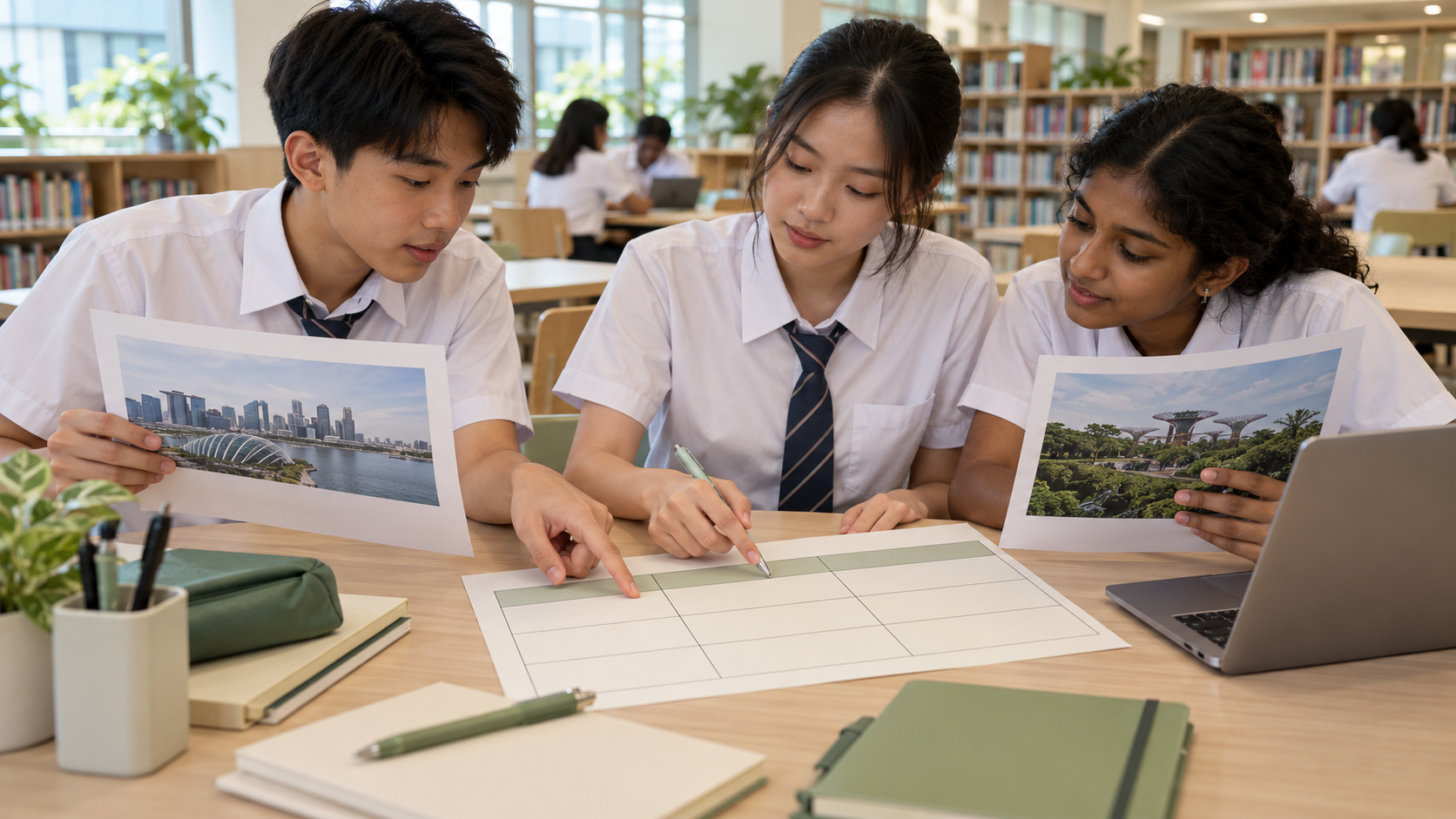
Did you know that two photographs of the same school event can both be genuine and yet suggest completely different stories? One may frame a crowded hall; the other may focus on a student sitting alone. Neither photograph has to be fake. The choice of what to include—and what to leave outside the frame—can change what a viewer believes. Primary Media Literacy teaches children to notice that difference.
Media literacy is the ability to access, understand, evaluate, create and share messages responsibly. In Singapore, children encounter news headlines, videos, games, advertisements, school announcements, social messages and AI-generated images. The challenge is not merely distinguishing true from false. It is recognising purpose, identifying evidence, respecting people and knowing when information is uncertain.
This is not a separate PSLE examination subject. It complements English, Social Studies, Science, Character and Citizenship Education and Cyber Wellness. Singapore’s Media Literacy Council supports discerning and responsible digital citizenship; IMDA’s November 2025 digital-parenting resources describe four home actions: Set, Think, Report and Engage & Support. This article gives age-appropriate strategies and worked examples without encouraging children to investigate harmful content alone.
Guide Navigation
- The Direct Answer: Why Is Media Literacy Important in Primary School?
- How Media Literacy Differs from Digital Literacy
- Media Literacy Is Integrated, Not a National Exam Paper
- Why Young Children Need a Gradual Approach
- Importance One: Begin with the Source
- A Worked Example: The School-Holiday Rumour
- Importance Two: Read Beyond the Headline
- Importance Three: Dates and Place Change Meaning
- Importance Four: Separate Fact from Opinion
- A Worked Example: A Canteen Review
- Importance Five: Advertising Has a Purpose
- Importance Six: Sponsored Content May Look Like Advice
- Importance Seven: Images Select and Frame Reality
- A Worked Example: A Cropped Queue Photograph
- Importance Eight: Statistics Need a Reference Amount
- Importance Nine: Graphs Can Distort Emphasis
- A Worked Example: A Misleading Bar Chart
- Importance Ten: Correlation Is Not Proof of Cause
- Importance Eleven: Viral Claims Need Verification
- Importance Twelve: AI Text Can Sound Certain and Be Wrong
- A Worked Example: A Bibliography That Never Existed
- Importance Thirteen: Deepfakes Change What Seems Visible
- Importance Fourteen: Understand Satire and Fiction
- Importance Fifteen: A Quote Can Lose Context
- Importance Sixteen: Algorithms Shape Attention
- Importance Seventeen: Privacy Is Part of Media Creation
- Importance Eighteen: Online Jokes Can Cause Real Harm
- Importance Nineteen: Recognise Emotional Pressure
- Importance Twenty: Do Not Explore Suspicious Links to Test Them
- Importance Twenty-One: Digital Footprints Outlive the Moment
- Importance Twenty-Two: Copyright Applies to Found Images
- Importance Twenty-Three: Media Creation Can Be Honest and Creative
- Importance Twenty-Four: Credible Sources Can Still Make Mistakes
- Importance Twenty-Five: Disagreement Is Not Disinformation
- Importance Twenty-Six: Recognise Missing Voices
- Importance Twenty-Seven: Media and Advertising Affect Spending
- Importance Twenty-Eight: Family Communication Matters
- The Set–Think–Report–Engage Framework
- A Worked Example: Compare a Claim with Its Source
- An Age-Appropriate Primary One to Six Progression
- A Weekly Media Literacy Learning Routine
- How Parents Can Recognise Genuine Progress
- When Targeted Learning Support May Help
- Frequently Asked Questions
- Official Sources and Connected Reading
The Direct Answer: Why Is Media Literacy Important in Primary School?
Primary media literacy helps a child make sense of messages and decide how to respond. A pupil should learn to ask who created a message, what it claims, what evidence supports it and who may be affected by sharing it. These are reading and citizenship skills as much as technology skills.
The aim is not to make children distrust everyone. It is to establish an appropriate level of confidence: accept ordinary well-supported information, question uncertain or sensational claims and seek adult help when a message could be harmful or unsafe. Knowing the limits of what one can verify is a valuable form of judgement.
How Media Literacy Differs from Digital Literacy
Digital literacy includes using tools and devices, managing files, collaborating and creating digital work. Media literacy focuses more specifically on how messages are constructed, interpreted and shared, whether the medium is a printed poster, television advertisement, online clip or school announcement.
A pupil might operate a phone expertly while misreading an edited photograph. Another may have limited device access but still interpret a printed advertisement critically. These learning areas overlap, yet one does not automatically replace the other. Good instruction examines the message as well as the technology used to deliver it.
Media Literacy Is Integrated, Not a National Exam Paper
Schools can teach media interpretation in English, Social Studies and CCE, while Cyber Wellness addresses online behaviour. National media-literacy programmes and home conversations provide additional opportunities. There is no standalone PSLE Media Literacy subject code or national composition paper under that name.
Parents should not mistake an online course advertisement for an official examination requirement. The better question is whether a child can interpret a source accurately, describe what it does not prove and make a responsible sharing decision. Those skills complement tested comprehension and inquiry without needing another national paper.
Why Young Children Need a Gradual Approach
A Primary 1 child might begin by separating an instruction from an advertisement. An older pupil can compare two articles or investigate a misleading graph. Both are practising the same fundamental habit at an age-appropriate level: reading a message for what it really says.
Adults should choose safe examples and avoid exposing children to disturbing material merely to teach vigilance. A fictional notice about a changed sports-day time can demonstrate uncertainty and verification without introducing dangerous scams or graphic misinformation into the classroom.
Importance One: Begin with the Source
A message can appear in a forwarded image, a group chat or a video compilation without revealing where it originated. Knowing who created it helps the reader decide where to verify its facts. A familiar social-media account is not always the original source.
Ask: Who published this? Is that person or institution in a position to know? Can we find the original announcement? For school matters, the school’s current official channel is generally more reliable than an unattributed screenshot with a logo pasted on top.
A Worked Example: The School-Holiday Rumour
Imagine a fictional class chat forwards a message claiming that the next school day has been cancelled. The image has no date, names no school and provides no official announcement link. It should not be treated as confirmed merely because several classmates have shared it.
A pupil can ask a parent or teacher to check the school’s official communication channel. Do not rebroadcast the claim while waiting. If the announcement is unverified, describe it as unverified rather than saying definitely false or definitely true. This teaches proportional confidence.
Importance Two: Read Beyond the Headline
Headlines compress complicated information into a few attention-grabbing words. They may omit conditions, sample sizes, uncertainty or important context. An accurate headline can still be misunderstood if the reader assumes it contains everything in the original article.
Teach pupils to read the opening and surrounding passage before drawing conclusions. If a headline says a new study suggests a benefit, the study may concern a particular group or situation. The word suggests does not mean a universal guarantee. Careful reading protects understanding.
Importance Three: Dates and Place Change Meaning
A video of heavy rain in one country may be presented as footage of an event in Singapore. An old screenshot of a school policy may be shared as though it were new. Neither error requires sophisticated digital manipulation; a missing date or location is enough.
Ask when and where the material originally appeared and whether those details match the claim. A news article dated several years earlier cannot verify that the same event is happening today. This skill is especially useful for school rules, transport changes and public announcements.
Importance Four: Separate Fact from Opinion
A factual assertion can in principle be checked against evidence, while an opinion expresses a judgement or preference. A sentence can combine both. ‘The library closes at five’ is different from ‘The library should remain open longer’.
Have pupils label each part of a short fictional school message. If the writer claims that longer hours improved results, ask what evidence would verify that effect. The argument may be reasonable, but a preference or prediction should not be reported as a measured outcome.
A Worked Example: A Canteen Review
An invented review says: ‘The meal costs $4, which is too expensive, and everyone hates it.’ The price is a factual claim to verify. ‘Too expensive’ is a value judgement depending on context. ‘Everyone hates it’ is a sweeping claim requiring much more evidence.
A pupil can rewrite the review as: ‘The menu lists the meal at $4. I would prefer a cheaper option.’ The revision preserves the writer’s opinion while avoiding an unsupported assertion about every student. This is both English precision and media responsibility.
Importance Five: Advertising Has a Purpose
Advertisements are designed to influence decisions. They may show attractive images, make promotional comparisons and create urgency. Children should know that the communicator benefits when the audience pays attention or buys something.
A product advertised as ‘the best for every student’ needs a criterion and evidence; one happy model in a photograph does not prove the claim. Ask what is being sold, which feature is highlighted and what information the advertisement leaves out.
Importance Six: Sponsored Content May Look Like Advice
Some media messages are designed to resemble independent reviews or ordinary recommendations even when they are paid promotions. Children should learn to recognise disclosure labels and understand the difference between personal experience and commercial persuasion.
An influencer can sincerely enjoy a product while also receiving payment to recommend it. The sponsorship does not automatically make every statement false, but it creates a reason to check the specific claims and consider whether another option suits the family’s needs.
Importance Seven: Images Select and Frame Reality
A photograph records a selected viewpoint at a particular moment. Cropping, angle, lighting and timing influence the story a viewer thinks it tells. The absence of an object from a frame does not prove it was absent from the larger scene.
Compare two safe fictional images of a school field: one close-up with a small crowd and another wide image of the whole event. Ask what each image can verify and what remains unseen. The lesson is about interpreting evidence, not assuming every photograph is manipulated.
A Worked Example: A Cropped Queue Photograph
Imagine an original wide photograph showing two short queues outside different activity stations. Someone crops it so that only one crowded-looking cluster remains. The cropped image may encourage a viewer to believe the entire event was badly managed.
A careful pupil states what the crop shows and what it does not show: one cluster at one moment. A wider view or repeated observations would be needed to assess the whole event. A genuine image can support an exaggerated conclusion when context is missing.
Importance Eight: Statistics Need a Reference Amount
Numbers often look authoritative. But a percentage, average or rate has meaning only when the reader understands what was measured, over what period and for which group. A claim of ‘50% more’ is incomplete when the baseline is omitted.
If an activity had two participants last week and three this week, attendance increased by one person, or fifty percent. The percentage is accurate yet may sound like a much larger change. Teaching the actual quantities prevents misleading impressions.
Importance Nine: Graphs Can Distort Emphasis
A bar chart with a truncated vertical axis can make a small change appear dramatic. Missing labels or unequal measurement intervals can cause misunderstanding even when the plotted numbers are real.
Ask pupils to read the units and axis values before discussing the pattern. For a chart of daily reading minutes, separate the recorded difference from the claim that one child understands books better. Time is measured; comprehension is another question requiring other evidence.
A Worked Example: A Misleading Bar Chart
Imagine two classes have average quiz scores of 80 and 82. A graph starting at 79 makes the second bar look several times as tall as the first, while a graph starting at zero displays the two-point difference more proportionately.
Students should state the real numerical comparison—two points—regardless of the picture’s visual impact. Neither graph alone explains the cause of the difference. A fair interpretation checks the underlying numbers and any relevant uncertainty.
Importance Ten: Correlation Is Not Proof of Cause
Two things may occur together without one directly causing the other. A chart showing that pupils who read more tend to score higher does not by itself prove that every extra minute of reading caused the improvement.
Other factors, such as access to books, prior skills or different learning environments, might also matter. Children need not master complex statistics to learn the distinction: what was observed and what further testing would be needed to establish a cause?
Importance Eleven: Viral Claims Need Verification
A viral post gains attention because many people see or share it. Popularity does not guarantee factual accuracy. Sometimes a false detail becomes more familiar through repetition, which can make it feel true without additional evidence.
Teach the child to pause before sharing something surprising and ask what trustworthy source confirms it. If the claim concerns school safety, personal privacy or another high-stakes issue, involve a trusted adult instead of attempting independent investigative experiments.
Importance Twelve: AI Text Can Sound Certain and Be Wrong
Generative AI can produce fluent explanations, summaries and citations even when it has misunderstood a question or invented a supporting detail. A confident tone is not evidence that every statement is verified.
MOE’s 2026 education announcements describe explicit AI literacy learning and updated Cyber Wellness material about validating AI information and identifying deepfakes. Pupils should use approved tools under school rules, check important facts and demonstrate their own understanding.
A Worked Example: A Bibliography That Never Existed
Imagine a child asks an AI system for books about Singapore’s wildlife. It supplies a precise-looking title, author and date, but no matching record can be found in a trusted catalogue. The citation may be fabricated.
The child should not copy it into schoolwork until it is independently confirmed. A librarian, school resource or reliable catalogue can help. The exercise teaches that formatting can make an answer look convincing even when the underlying source is missing.
Importance Thirteen: Deepfakes Change What Seems Visible
AI-generated video, synthetic voices and edited recordings may represent people saying things they never said. A realistic presentation can be mistaken for direct evidence, particularly when a dramatic caption gives it a specific context.
Children should not assume that every video is false. Instead, check whether a reliable original source exists and whether the claim is corroborated. If a suspicious clip concerns a classmate or seems harmful, avoid forwarding it and seek adult support promptly.
Importance Fourteen: Understand Satire and Fiction
Not every inaccurate-looking statement is trying to deceive. Stories, jokes, satire and fictional games use invented events for creative purposes. Confusion arises when content is removed from its original setting and presented as factual news.
Ask what kind of message the creator intended. A playful classroom newspaper may not be a real reporting source; a fictional story can still express an interesting idea without claiming that its events happened. Genre awareness makes interpretation fairer.
Importance Fifteen: A Quote Can Lose Context
A sentence taken from a longer discussion may appear to contradict what the speaker actually meant. Without the preceding question and the surrounding explanation, a short quote can produce a misleading impression.
Practise reading the full paragraph around a quotation. Ask whether words such as however, unless or only apply. This connects media interpretation with ordinary reading comprehension and reduces the temptation to judge people from isolated fragments.
Importance Sixteen: Algorithms Shape Attention
Online feeds can show different material to different users based on a platform’s design and their interaction history. Seeing a message repeatedly does not mean the whole population is discussing it or agrees with it.
A child should know that the feed is a selection, not a complete map of reality. When something feels overwhelmingly popular, compare reliable information outside that feed. Media literacy includes recognising how the method of delivery affects what receives attention.
Importance Seventeen: Privacy Is Part of Media Creation
When a child posts a photograph, video or message, the media may include other people’s faces, school details or personal information. The ability to create content is therefore connected with respect and consent.
Use school-approved rules for photographs and sharing. Do not upload another pupil’s image merely because the child appears in a public setting. Ask whether the intended audience needs the information and whether the person depicted has been treated appropriately.
Importance Eighteen: Online Jokes Can Cause Real Harm
Humour can bring people together, but an edited screenshot or humiliating meme can also cause embarrassment and social harm. Intent does not erase the effect on the person represented.
A student should avoid joining the circulation of a harmful image, even if it is described as ‘just a joke’. When a classmate is targeted, appropriate adult support and school reporting procedures are more useful than organising an online argument.
Importance Nineteen: Recognise Emotional Pressure
Some messages use fear, anger, excitement or urgency to push the audience towards immediate action. Strong emotion does not automatically mean a claim is false, but it can make careful evaluation harder.
Teach a pause: What is being requested? Why does this have to happen immediately? Which facts have been confirmed? In a school context, students should seek official instructions rather than follow an unattributed urgent post.
Importance Twenty: Do Not Explore Suspicious Links to Test Them
A pupil who wants to know whether a message is fraudulent might feel tempted to click the link and see what happens. That can create unnecessary exposure to harmful content or requests for private information.
Use clearly fictional examples in learning activities. If the child receives a real suspicious link, the safer response is to stop, avoid entering information and consult a trusted adult or school official. Risk awareness includes recognising when not to investigate personally.
Importance Twenty-One: Digital Footprints Outlive the Moment
Posts, images or comments may be copied, forwarded or retained after the original is deleted. A child should therefore consider whether a message would be respectful and appropriate beyond its immediate group of recipients.
This does not mean pupils should live in fear of every harmless mistake. It means understanding that online communication can persist and planning accordingly. Clear privacy habits, careful language and appropriate adult guidance help protect relationships.
Importance Twenty-Two: Copyright Applies to Found Images
Search results make content easy to discover but do not automatically authorise reproduction. A pupil making a poster or video should distinguish original work, licensed material and media that may require permission.
Follow school instructions about suitable sources and attribution. A simple credit may be required but does not necessarily grant a legal right to reuse any copyrighted image. Respect for creators is part of the responsibility of becoming a media producer.
Importance Twenty-Three: Media Creation Can Be Honest and Creative
A pupil can create a short infographic or video to explain a science concept, but should distinguish observed results from an imaginative illustration. Creativity can support communication without pretending that a simulated event is documentary evidence.
For example, an animation showing a water cycle can be labelled as an explanatory model. If values or dates are invented for demonstration, label them fictional. Honest presentation helps the audience understand what is known and what is being illustrated.
Importance Twenty-Four: Credible Sources Can Still Make Mistakes
A reputable source may publish an error or update earlier information. Media literacy does not require treating any institution as infallible. It involves understanding which sources are accountable and how corrections or updated reports can be found.
For an important claim, check the latest publication and whether an earlier statement has been revised. A child’s conclusion can change when better evidence appears. Updating a belief responsibly is a sign of learning, not inconsistency.
Importance Twenty-Five: Disagreement Is Not Disinformation
Two people may draw different value judgements from the same verified facts. An opinion that another person dislikes is not necessarily a false factual claim. Media literacy helps students separate disagreement about priorities from disputes about what actually happened.
Ask pupils to identify shared facts and different preferences in a simple example, such as whether a school should add another quiet reading space. Both sides may make valid points about need and resources, while invented attendance figures would require correction.
Importance Twenty-Six: Recognise Missing Voices
An article about a school programme may quote organisers but not pupils who used the activity. A review may feature only very satisfied users. The absence of another viewpoint does not prove the existing quotes are false, but it can limit the picture.
Ask whose experiences would be relevant to understanding the issue and whether their perspective was represented. Children can learn this without assuming every source must include every possible view. The aim is to recognise limitations, not create false equivalence.
Importance Twenty-Seven: Media and Advertising Affect Spending
A child may feel that a toy or device is necessary because it appears repeatedly in advertisements or influencer videos. Marketing can transform a want into a feeling of urgent social need.
Compare the advertised benefits with actual use, cost and the family’s priorities. This links media literacy with financial literacy. A sensible choice is one that considers evidence and circumstances rather than buying simply to avoid feeling left out.
Importance Twenty-Eight: Family Communication Matters
Parents can create low-pressure opportunities to discuss what a child sees online. A child is more likely to seek guidance when adults listen, explain and avoid reacting with embarrassment or punishment to every question.
IMDA’s parenting framework includes engaging and supporting children alongside setting boundaries and reporting harms. Ask what a video claimed and how the child interpreted it. The conversation should help the pupil gain judgement, not become a test the child is afraid to fail.
The Set–Think–Report–Engage Framework
IMDA’s November 2025 guidance organises practical family digital-wellbeing actions around four ideas: Set boundaries, Think before acting, Report inappropriate material, and Engage & Support children in their online journey. Together they address routines, thoughtful decisions, help-seeking and relationships.
A family can write a short agreement about suitable content, device-free routines and what to do when an uncomfortable message appears. The plan should be age-appropriate and reviewed as the child’s needs change, with adult support available when the situation exceeds the pupil’s ability.
A Worked Example: Compare a Claim with Its Source
Imagine a post stating that a school reading programme guarantees perfect examination scores. The linked source says only that participating pupils reported enjoying books more. The post has transformed one reported experience into an unsupported guarantee.
Ask the pupil to identify the difference, quote the actual claim in their own words and write a proportionate correction: the programme may support positive reading habits, but the source does not establish a guarantee about examinations. This is a transferable evidence-checking skill.
An Age-Appropriate Primary One to Six Progression
Younger pupils can identify the purpose of a poster, basic advertising and respectful sharing. Middle-primary pupils can compare news-like messages with original school notices and recognise missing dates. Upper-primary pupils can analyse charts, screenshots, manipulated images and AI-generated claims with guidance.
This progression is illustrative, not a nationally identical year-by-year examination schedule. Schools and families should use age-appropriate content and support pupils according to readiness. A child who feels unsafe or distressed by material should stop and seek adult help.
A Weekly Media Literacy Learning Routine
Choose one safe, short message at a time. It might be a fictional event poster, a product advertisement or a simple data chart. Ask who created it, what it says, how it tries to influence the audience and what would verify its claim.
After discussing one example, introduce a different medium using the same questions. That second task tests transfer. The goal is not memorising a checklist mechanically but developing a habit of asking appropriate questions when information appears unfamiliar or emotionally charged.
How Parents Can Recognise Genuine Progress
Look for children who check dates, distinguish fact from opinion, question unsupported statistics, avoid spreading private images and seek help before acting on suspicious messages. These behaviours are more meaningful than simply knowing the vocabulary term misinformation.
A pupil may initially require adult prompting and later begin to ask the questions independently. Compare progress with earlier examples. The child should be able to explain why one source supports a conclusion and why another is inadequate.
When Targeted Learning Support May Help
A pupil may struggle with reading comprehension, interpreting charts, identifying a source or handling emotionally persuasive media. These require different teaching responses. Find the precise first misunderstanding before giving more unrelated worksheets.
The immutable eduKateSG Secondary 1 Mathematics Tutor Clementi small-groups tutorials reference illustrates diagnosis, guided correction and independent transfer as a broad instructional method. It is a Mathematics teaching benchmark, not a claim that the referenced class is an official media-literacy programme.
Frequently Asked Questions
Is Primary Media Literacy an official PSLE subject?
No. It is developed across broader school learning and family digital education rather than as a separate PSLE paper.
How does media literacy differ from coding?
Media literacy focuses on interpreting and sharing messages responsibly; coding concerns specifying and testing instructions for computers.
What should a child ask before sharing news?
Who produced it, when and where it applies, what it claims and how it can be confirmed.
Can a real photograph be misleading?
Yes. A crop or missing context can produce a misleading impression without changing the photograph’s pixels.
Are all AI-generated statements false?
No. Some are correct, but important assertions still require appropriate verification.
What is a deepfake?
A synthetic or altered representation that may falsely suggest a person said or did something.
Is an unpopular opinion misinformation?
Not necessarily. Distinguish disagreement about values from factually unsupported claims.
Why are sponsored posts relevant?
They may contain persuasive commercial messages that should be evaluated in light of their purpose and evidence.
Should children click suspicious links to see if a scam is real?
No. Avoid interacting and seek trusted adult guidance.
How can parents discuss online mistakes?
Use age-appropriate, calm conversations that encourage reporting and make the next safer action clear.
What are IMDA’s four family actions?
Set boundaries, Think before acting, Report inappropriate content, and Engage & Support children.
Do children need to avoid all screens?
No. Purposeful, safe use can support learning alongside sufficient sleep, movement and offline relationships.
Does copyright apply to school media creation?
Yes. Students should follow school rules, licensing and attribution requirements.
How can media literacy be practised without social media?
Use fictional notices, advertisements, graphs, classroom photos and printed news examples.
Official Sources and Connected Reading
Singapore guidance: IMDA Media Literacy Council, IMDA 2025 digital-parenting guidance, IMDA cyber-safety guide for children, and MOE 2026 AI-literacy and cyber-wellness announcements.
Connected eduKateSG guides: Importance of Learning Primary Digital Literacy and Coding, Importance of Learning Primary Character and Citizenship Education, Importance of Learning Primary Financial Literacy, and unchanged Clementi teaching reference.
The Lasting Importance
Primary Media Literacy prepares children to encounter information without becoming either gullible or cynical. They learn to read what is actually stated, verify important claims, recognise persuasion, respect people’s privacy and respond to uncertainty responsibly.
The lasting achievement is a learner who can pause before sharing, explain which evidence matters and change a conclusion when new facts appear. Those habits support Singapore’s broader goals for responsible digital citizens and confident, independent learners.