
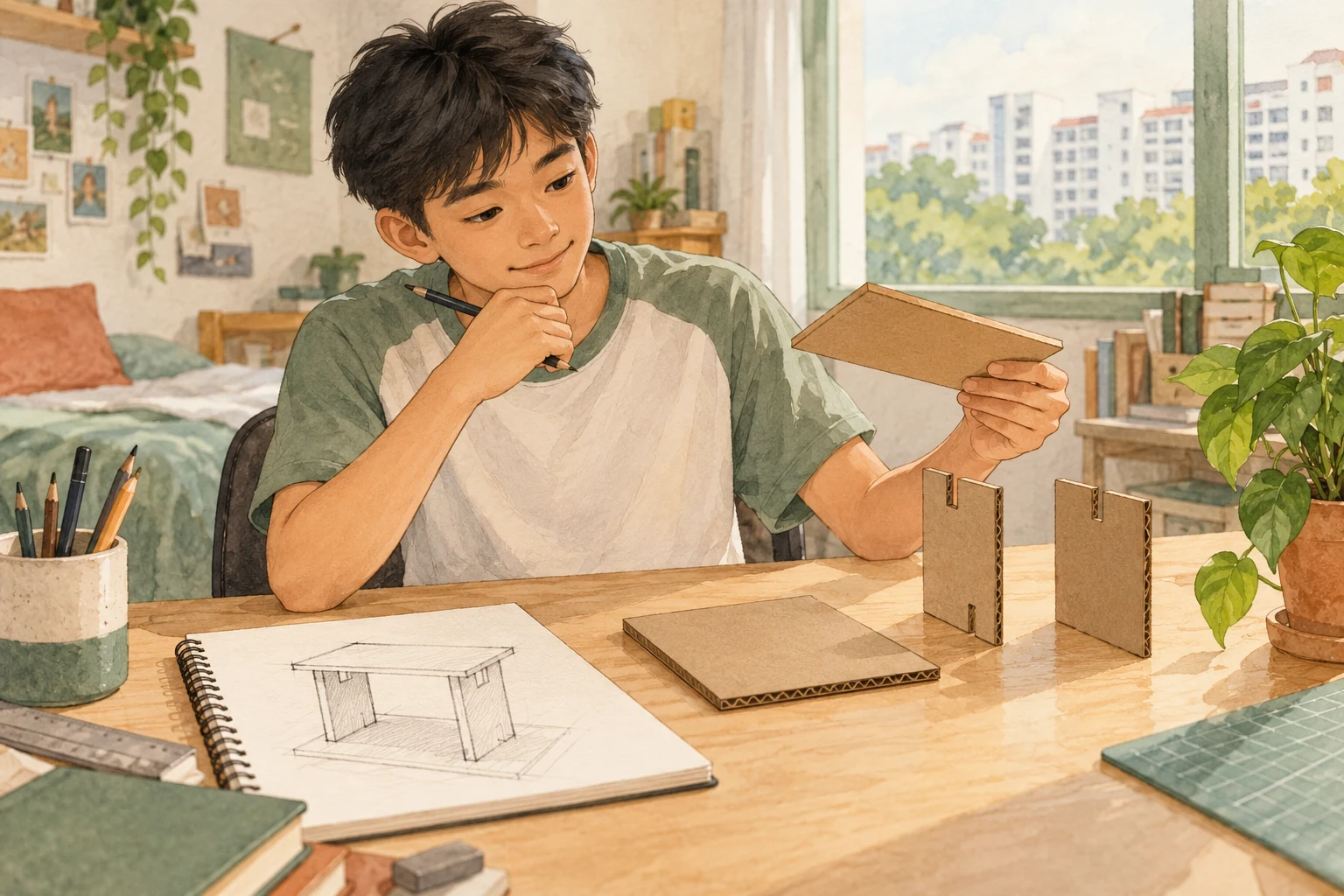
Did you know that an artist can create an attractive image and still have trouble explaining what the work investigates? Higher Art asks students to move beyond appearance. They learn to observe closely, identify a meaningful question, compare artistic approaches, test ideas in different media and explain why particular choices serve the intended expression.
Secondary G3 Higher Art in Singapore builds visual literacy, disciplined artistic practice and independent enquiry. Pupils encounter art as a way of understanding people, culture and society, and as a language for communicating ideas that may be difficult to express through words alone. The subject also requires careful research, documentation and acknowledgement of external artistic sources.
For the 2027 Singapore–Cambridge SEC, SEAB lists Higher Art as K348. The official 2027 K348 syllabus specifies Paper 1 Visual Response (50%), Paper 2 Portfolio (50%) and a separately assessed compulsory Paper 3 Higher Art Project, 100 marks, with independent weighting. Paper 3 requires a 1000–1200-word report over 12 weeks. This article explains the distinction from ordinary G3 Art K347 and shows how students can develop authentic visual thinking rather than simply add more polished artwork.
Guide Navigation
- The Direct Answer: Why Higher Art Is Important
- Verify the 2027 Subject Code and Level
- What Makes Higher Art Distinct from G3 Art
- All Three K348 Papers Are Compulsory
- Paper 1: Visual Response in Two Hours Fifteen Minutes
- Paper 2: A Thirty-Hour Portfolio within Twelve Weeks
- Paper 3: The Compulsory Higher Art Project
- The Meaning of Independent Weighting
- Who Marks the Different Components?
- Understand the Three Big Ideas of Art
- The Three Learning Domains: Perceive, Communicate and Appreciate
- Process, Product and Discourse
- Importance One: Perception Can Change Familiar Objects
- A Worked Example: Three Interpretations of an Empty Chair
- Importance Two: Observation Must Be Distinguished from Interpretation
- Importance Three: Artistic Intent Needs a Clear Focus
- Importance Four: Context Changes the Meaning of an Image
- Importance Five: Composition Directs the Viewer
- A Worked Example: Recompose a Familiar School Scene
- Importance Six: Colour Supports but Does Not Dictate Meaning
- Importance Seven: Material Choice Is Conceptual
- Importance Eight: Explore at Least Three Art Forms and Media
- Importance Nine: Sketching Is a Form of Research
- A Worked Example: Compare Three Material Studies
- Importance Ten: Annotation Should Explain Decisions
- Importance Eleven: An Art Journal Records Real Development
- Importance Twelve: Artistic Conversations Improve Thinking
- A Worked Example: Critique without Personal Attack
- Importance Thirteen: Research Starts with a Real Question
- Importance Fourteen: Contextual Research Complements Visual Research
- Importance Fifteen: Source Attribution Is an Academic Skill
- Importance Sixteen: Research Quality Is Not Reference Count
- Importance Seventeen: The Higher Art Project Needs an Argument
- Paper 3: Answer One of Three Questions
- Paper 3: The 1000–1200-Word Report
- Paper 3: Twelve Weeks Require Milestones
- A Worked Example: Investigate a Public-Space Memory
- Importance Eighteen: Respect People’s Privacy in Art
- Importance Nineteen: AI Tools Need Transparent Use
- Importance Twenty: Copyright and Cultural Respect Matter
- Importance Twenty-One: Paper 1 Demands Fast but Thoughtful Analysis
- A Worked Example: Analyse an Original Poster
- Importance Twenty-Two: Exploratory Sketching Should Be Purposeful
- Importance Twenty-Three: Know the Paper 1 Media Rules
- Importance Twenty-Four: The Portfolio Needs Careful Curation
- A Worked Example: Select Evidence of Change
- Importance Twenty-Five: Commentary Explains Artistic Growth
- Importance Twenty-Six: Compare Intent with Reception
- Importance Twenty-Seven: Art Can Explore Identity without Stereotypes
- Importance Twenty-Eight: Artistic Independence Needs Reflection
- Importance Twenty-Nine: Risk-Taking Means Thoughtful Experimentation
- Importance Thirty: Time Management Is an Artistic Skill
- Importance Thirty-One: Writing Matters in an Art Subject
- Importance Thirty-Two: Research Can Connect with History and Media
- Importance Thirty-Three: Art Develops Transferable Critique
- A Practical Weekly Higher Art Study Routine
- How Parents Can Recognise Genuine Higher Art Progress
- When Targeted Art Learning Support Helps
- Frequently Asked Questions
- Official Sources and Related Reading
The Direct Answer: Why Higher Art Is Important
Higher Art builds students’ ability to make meaning from visual information and develop original artistic responses through systematic exploration. It combines perception, creative communication, research, critique and reflection, encouraging learners to recognise how artworks influence what people feel and understand.
Its value is not restricted to an examination or a future art career. A learner who can observe carefully, describe alternative interpretations, justify a material choice and revise a project after receiving evidence is practising critical, adaptive and inventive thinking that can be useful in many disciplines.
Verify the 2027 Subject Code and Level
The official subject code is K348 for G3 Higher Art in the 2027 Singapore–Cambridge Secondary Education Certificate. K347 is ordinary G3 Art, K236 is G2 Art and K126 is G1 Art. The fact that the subject titles share the word Art does not make their assessment structures identical.
Students should prepare with the syllabus for the actual subject registered through their school. Full Subject-Based Banding records subjects at different levels as appropriate; Higher Art should not be treated as a permanent statement about every aspect of a student’s capabilities.
What Makes Higher Art Distinct from G3 Art
K348 Higher Art includes the same broad Paper 1 Visual Response and Paper 2 Portfolio components as K347 G3 Art, but requires an additional compulsory Paper 3, the Higher Art Project. This further task explicitly demands independent visual and contextual research with a written report.
The difference is not simply that Higher Art asks for prettier drawings. Its independent project expects a student to formulate and investigate an artistic enquiry, organise relevant source material, connect visual findings with ideas and explain a defensible response through both visual and written evidence.
All Three K348 Papers Are Compulsory
The 2027 assessment specifies that candidates offer Paper 1 and Paper 2, answering all required questions, and also offer Paper 3 by answering one selected project question. Students who prepare only the same two components as ordinary G3 Art would therefore miss a compulsory Higher Art assessment.
Paper 1 and Paper 2 each contribute 50% in their stated weighting scheme. Paper 3 is marked out of 100 independently. The word independent is part of the syllabus’s actual weighting description and should not be rewritten as an invented additional percentage of the same aggregate.
Paper 1: Visual Response in Two Hours Fifteen Minutes
Paper 1 lasts two hours fifteen minutes and carries fifty marks. Section A Visual Analysis presents an unseen visual stimulus with one question containing two parts, worth ten marks. Section B Exploratory Sketching asks for a practical visual response and annotations, worth forty marks.
The learner needs both close observation and inventive application. A student who only memorises terminology may struggle to develop an original visual response; another who sketches fluently may still need to explain what a stimulus means and how artistic choices operate.
Paper 2: A Thirty-Hour Portfolio within Twelve Weeks
The Portfolio is completed in thirty hours within twelve weeks and carries fifty marks. Part A contains a selection of visual materials worth thirty marks, limited to fifteen screens and including exploration in at least three art forms and media. Part B is a commentary worth twenty marks.
The commentary reflects on personal artistic growth across three works and must not exceed eight hundred words or ten A4-sized pages. Those limits force purposeful selection. The portfolio should demonstrate an authentic development process, not merely a collection of attractive final images.
Paper 3: The Compulsory Higher Art Project
The Higher Art Project is a 100-mark assessment with independent weighting. Three project questions are set during the February-to-April period of the examination year; candidates select one and have twelve weeks to complete the response.
The submission requires a written report of 1000–1200 words, with relevant studies, images, drawings or annotations as appropriate to support the enquiry. The official Paper 3 specimen paper provides further directions. Paper 3 should be treated as genuine independent research and interpretation rather than an optional portfolio extension.
The Meaning of Independent Weighting
The Paper 3 table states that the Higher Art Project is independently weighted, while the stated 50/50 scheme applies to Papers 1 and 2. Families should preserve that wording instead of guessing how the independent result is represented in a final certificate or admission calculation.
For high-stakes questions about grading or pathway implications, use SEAB and current MOE guidance. The educational point is clear regardless of those administrative details: every Higher Art candidate must prepare a substantial, separately assessed research project in addition to visual response and portfolio work.
Who Marks the Different Components?
The syllabus indicates that Papers 1 and 3 are externally marked, while Paper 2 is internally assessed by the school and externally moderated. These arrangements reflect the different types of evidence produced under examination conditions and through supervised coursework.
Students should keep accurate records and follow the prescribed submission rules. External marking does not mean that research materials may be copied without citation; an authentic project requires a clear distinction between the student’s original work and sources consulted.
Understand the Three Big Ideas of Art
The K348 syllabus identifies three overarching ideas: Art helps us see in new ways; Art tells stories about our world; and Art influences how we live. These are lenses for inquiry rather than three single-answer questions.
A pupil might explore how an ordinary object changes meaning from different viewpoints, how a neighbourhood preserves memories, or how design affects interactions in public space. The Big Idea guides the investigation but does not replace a precise question or actual supporting evidence.
The Three Learning Domains: Perceive, Communicate and Appreciate
Perceive concerns careful observation and analysis of visual information. Communicate concerns developing ideas and expressing them through visual or tactile forms. Appreciate involves reflection, critique and understanding art’s connections with society and culture.
The three domains operate together. An artist observes a social environment, creates a response and evaluates how it communicates. Learning is incomplete if observation never informs making or if a finished work is never questioned and revised.
Process, Product and Discourse
The Higher Art framework emphasises continual exploration through Process–Product–Discourse. Process includes inquiry and experimentation; Product includes the resulting visual resolution; Discourse includes discussion and the exchange of interpretations.
A polished final image is therefore not the entire learning journey. Students should be able to describe the investigation that informed it and engage with how others might understand the result. Critique is not simply deciding whether an artwork is beautiful; it is examining the relationship between intention, form and effect.
Importance One: Perception Can Change Familiar Objects
Repeated exposure to a familiar scene can make its details disappear from attention. Observational drawing encourages learners to look carefully at proportions, edges, relationships, negative space and light instead of drawing a memorised symbol.
Try observing a classroom chair from several viewpoints. A quick schematic chair and a careful low-angle sketch may represent the same object differently. The student should notice which details become visible and how that changes the viewer’s impression.
A Worked Example: Three Interpretations of an Empty Chair
Imagine a student sketches one empty chair in a school corridor. A frontal drawing could emphasise symmetry; a distant composition could suggest isolation; a close-up of worn surfaces might evoke repeated daily use.
Each interpretation requires a reasoned visual choice. Ask what the pupil observed, what mood or idea is intended and which aspect of the composition supports it. The subject is ordinary, but the visual enquiry can be sophisticated when the evidence and intention remain connected.
Importance Two: Observation Must Be Distinguished from Interpretation
A visual stimulus may show a person standing apart from a group. The viewer can observe that spatial relationship, but the image may not establish whether the person feels excluded, prefers solitude or is simply waiting.
Students should describe observable details first and explain any inference as an interpretation supported by those details. Higher Art rewards the capacity to consider alternate readings while avoiding unsupported claims about the private feelings or experiences of real people depicted.
Importance Three: Artistic Intent Needs a Clear Focus
A theme such as identity, belonging or change may provide a starting point, but a project needs a more precise question. Without one, students may collect unrelated images and then try to create a convincing narrative after the fact.
Ask what specific experience, relationship or place is being investigated. A project about belonging might examine how personal objects mark temporary spaces in a school. A narrowed enquiry makes it easier to select references, compare interpretations and justify formal choices.
Importance Four: Context Changes the Meaning of an Image
An image may be understood differently depending on its origin, audience, date, location and accompanying information. A photograph from a family album and the same photograph used in a public campaign may communicate different meanings.
A responsible student investigates the original context before presenting a source as evidence. This is particularly important for historical photographs, artworks involving communities and digital images that may have been cropped or edited.
Importance Five: Composition Directs the Viewer
Arrangement, scale, balance and visual emphasis affect what a viewer notices first and how the rest of the image is read. A small object placed in a large empty space may communicate something different from the same object surrounded by detail.
Test several compositions before choosing one. Ask whether the central idea becomes clearer, what attention is drawn away and how the viewer’s movement through the image changes. Composition is part of meaning-making, not merely decoration.
A Worked Example: Recompose a Familiar School Scene
Imagine a fictional project about transitions between school stages. One composition places a staircase centrally, while another shows only the shadow of a pupil near the final step.
The second may communicate uncertainty or anticipation through the cropped viewpoint, but its effect depends on the surrounding choices. Have the pupil explain why the selection supports the intended enquiry and which details an alternate design might communicate more effectively.
Importance Six: Colour Supports but Does Not Dictate Meaning
Colour can influence emphasis, atmosphere and relationships within a work, but a colour does not have one guaranteed emotional meaning for every viewer. Cultural context, adjacent colours and subject matter matter.
Ask students to compare a muted palette with a high-contrast version of the same composition. Which objects become more prominent? Does the change clarify or weaken the intention? A reasoned comparison is more informative than claiming that a particular colour always means sadness or happiness.
Importance Seven: Material Choice Is Conceptual
Pencil, ink, collage, photography, printmaking and digital media can create different effects because they have different physical and visual qualities. The choice should support what the work investigates, not only what equipment is fashionable.
A layered collage may express fragmented memory differently from a clean line drawing. Test the alternatives and identify which method helps the viewer understand the intended relationship. An experiment that fails can still reveal a useful constraint.
Importance Eight: Explore at Least Three Art Forms and Media
The portfolio requirements explicitly include at least three art forms and media within the fifteen-screen visual-material selection. This does not mean the student should produce three unrelated polished pieces merely to tick a box.
A thoughtful portfolio can show how observations develop differently through photography, drawing and another appropriate medium. Annotate what each investigation revealed and how those findings influenced the emerging concept. Follow school guidance on what counts as eligible exploration.
Importance Nine: Sketching Is a Form of Research
Exploratory sketches help artists compare possibilities before a final resolution is chosen. They can record movement, spatial relationships, texture or visual metaphors that may not be visible in a polished finished work.
A quick but purposeful drawing can be valuable when it answers a specific question. State what was being tested, what the sketch revealed and which next step followed. Quantity alone does not establish creative development.
A Worked Example: Compare Three Material Studies
Suppose a pupil examines the idea of renewal through a worn school object. The first study uses careful graphite marks, the second uses torn paper collage and the third uses photography with strong shadows.
Rather than select the preferred medium only by appearance, ask which reveals texture, history or change most effectively. An annotated comparison can explain why the pupil combines two approaches or rejects one after examining the results.
Importance Ten: Annotation Should Explain Decisions
An annotation is useful when it communicates observation, intent, method or revision. Statements such as ‘nice idea’ or ‘more creative’ give another reader little information about what was learned.
A stronger note might explain that moving a figure to the edge increased the sense of open space, or that a particular paper surface obscured a detail the artist needed to show. Precise commentary connects the visual evidence with the next decision.
Importance Eleven: An Art Journal Records Real Development
Art journalling can document sources, sketches, references, experiments, failed approaches and changes of intention. It provides a record of how an enquiry developed rather than a retrospective story claiming the artist had the complete answer from the start.
Date and identify relevant stages according to school requirements. Do not fabricate a testing sequence after selecting the final work. An authentic journal can reveal a meaningful breakthrough arising from a mistake or an unexpected response to material.
Importance Twelve: Artistic Conversations Improve Thinking
Discussing an artwork requires a shared language for observation and interpretation. Students can describe form, colour, composition, symbol, context and effect while listening to alternatives that another viewer sees.
A critique should explain why an interpretation is supported instead of declaring that everyone else is wrong. Different readings can be reasonable where the visual evidence permits them, but an interpretation should still respond to the actual work rather than an unrelated personal story.
A Worked Example: Critique without Personal Attack
Imagine a student presents an image intended to communicate calmness. A classmate observes that strong diagonal lines and crowded detail instead create a sense of urgency.
A productive conversation explores which features produced the effect and whether the artist wants to revise them. The feedback addresses the work and its intention, not the character or ability of the student. Higher Art develops the capacity to exchange critique without humiliation.
Importance Thirteen: Research Starts with a Real Question
The Higher Art Project should not begin with collecting hundreds of attractive images and hoping a theme emerges. A workable research question identifies what the pupil wants to understand and which artistic evidence may help investigate it.
For example, a question about how public spaces preserve personal memories may lead to close observation of objects, interviews under appropriate permission and analysis of selected artworks. The project should describe why each source is relevant instead of listing references for appearance alone.
Importance Fourteen: Contextual Research Complements Visual Research
Visual research considers what artworks look like and how their forms operate; contextual research asks about the artist’s environment, intentions, influences and social setting using available reliable information.
A student should distinguish an interpretation of visual features from a historical claim about the artist. An image may suggest loneliness, but proving that an artist made it in response to a particular event requires a source. This separation strengthens research integrity.
Importance Fifteen: Source Attribution Is an Academic Skill
The K348 syllabus includes recognition of sources and citations within knowledge with understanding. The independent project should therefore record where relevant images, quotations and factual claims originated.
Students should keep usable reference details during research rather than attempt to reconstruct them from memory at submission time. Acknowledging influences does not weaken originality. It allows the reader to distinguish the student’s own investigation from ideas and works encountered elsewhere.
Importance Sixteen: Research Quality Is Not Reference Count
A long bibliography cannot compensate for sources that are irrelevant or unreliable. The student should choose material that illuminates the enquiry, explain what each source contributes and compare different perspectives where appropriate.
A museum catalogue describing an artwork’s context and the artwork itself may together support an analysis. A social-media caption without attribution may offer a different, less reliable kind of information. Evaluate each source for the claim being made.
Importance Seventeen: The Higher Art Project Needs an Argument
A research report is more than a chronological diary of activities. It should present an enquiry, relevant evidence, connected interpretation and a reasoned response. The student’s visual material should reinforce the writing rather than appear as unrelated decoration.
A simple structure might explain the question, contextual and visual research, the main findings, artistic experiments and reflection. The precise format should follow the task and official instructions. The aim is an accountable investigation with an independent point of view.
Paper 3: Answer One of Three Questions
For 2027, the Higher Art Project provides three questions during the February-to-April project period, and candidates answer one. The selected question should guide the research scope and prevent the report from becoming an unrelated personal essay.
A student should read all the choices, identify the one that suits their interests and available evidence, then define a manageable enquiry. The decision should be based on what can be investigated responsibly within twelve weeks rather than which title sounds the most impressive.
Paper 3: The 1000–1200-Word Report
The 2027 Paper 3 submission is a written report of one thousand to twelve hundred words on A4 pages, with relevant studies, drawings, images and annotations permitted to support the response under the specimen instructions.
Word limits encourage clarity and selection. Students must decide which observations and interpretations are essential, explain relationships and remove repetition. A report that misrepresents another artist’s work or invents an interview is not strengthened by reaching the required length.
Paper 3: Twelve Weeks Require Milestones
The project window runs for twelve weeks from February to April of the examination year. A realistic schedule allocates time to choose the question, gather sources, investigate visually, review findings, develop the response and edit the final report.
A student who spends ten weeks collecting references may have insufficient time to analyse them. Build checkpoints for supervisor feedback where permitted and maintain an honest research log. The schedule should allow revision when a promising hypothesis proves difficult to support.
A Worked Example: Investigate a Public-Space Memory
Imagine an original Higher Art enquiry asking how ordinary waiting places carry personal memories. A pupil could document a familiar bus stop through sketches and photography, then compare suitable published artworks exploring everyday architecture and memory.
The research should not claim to represent every commuter. The learner can examine particular formal choices, note how objects and space are framed, and develop a personal artistic response. A strong report explains what the evidence supports and which interpretations remain speculative.
Importance Eighteen: Respect People’s Privacy in Art
Photographs, interviews and personal stories can offer rich research material, but people have rights and preferences. Students should follow school consent and safeguarding procedures, especially where minors or vulnerable people may be identifiable.
A project about a neighbourhood can use architecture, abstract details or permitted imagery without publishing a stranger’s private story. Respectful research may require omitting an image or altering the approach. Protecting a person’s dignity is part of serious artistic practice.
Importance Nineteen: AI Tools Need Transparent Use
Digital and AI tools can support certain creative tasks, but a generated image or summary can obscure whether the student actually made the artistic decisions or checked factual claims. A polished AI result is not automatically an original artistic enquiry.
Students should follow current SEAB and school instructions on permitted tools, authorship and attribution. Document any approved assistance accurately and verify information. Higher Art is intended to develop the learner’s perceptual and research abilities, not replace them with unchecked automated output.
Importance Twenty: Copyright and Cultural Respect Matter
Studying an artist’s work does not automatically grant permission to reproduce it publicly without considering copyright or licensing. Likewise, representing cultural symbols or experiences without context can lead to misleading interpretations.
Students should cite sources, use permitted reproductions and distinguish analysis of an influence from copying its finished form. Seek appropriate advice from school staff for exhibition or publication. Artistic curiosity and responsibility should reinforce each other.
Importance Twenty-One: Paper 1 Demands Fast but Thoughtful Analysis
The unseen stimulus in Paper 1 rewards careful observation and interpretation. Students should begin by identifying visible details and their visual relationship before assigning a broad theme.
A useful practice response states a focused observation, discusses how a technique produces an effect and connects that effect to a plausible meaning. Naming a colour or medium alone is not enough. The student should explain how it functions in the particular image.
A Worked Example: Analyse an Original Poster
Imagine a fictional poster showing a small green sapling surrounded by large grey structures. One observation is the scale contrast; another is the visual emphasis placed on the sapling through colour.
An interpretation might connect the contrast to vulnerability, persistence or the place of nature in a city. A responsible answer ties the idea to those features instead of claiming the poster proves a specific environmental trend. The exact reading remains open to further contextual evidence.
Importance Twenty-Two: Exploratory Sketching Should Be Purposeful
Paper 1 asks students to develop an original visual idea through sketches and annotations in response to a stimulus and Big Idea. The drawings should show how concepts are explored and combined, not simply reproduce the unseen image several times.
Practise multiple compositions quickly and explain which one communicates the emerging concept most effectively. The question is not which sketch is easiest to render but which solution is relevant, imaginative and supported by the exploratory process.
Importance Twenty-Three: Know the Paper 1 Media Rules
The examination specifies permitted drawing tools and restrictions. Students who practise exclusively with an unsuitable studio medium may struggle in the actual two-hour-fifteen-minute paper even if their underlying art skills are strong.
Review the current official syllabus with the art teacher and practise with permitted materials. Learn how a pencil or marker can communicate an idea without requiring the finish of a completed painting. Paper 1 is an exploratory assessment, not an unrestricted studio session.
Importance Twenty-Four: The Portfolio Needs Careful Curation
The fifteen-screen limit means students must select evidence rather than dump every drawing produced across the course. Effective curation shows progression, useful contrasts and decisions linked to the enquiry.
Choose examples that reveal different approaches or moments of learning, not only visually similar successful pieces. A failed composition can be worth including if it explains why the next version became more effective. Selection is part of interpretation.
A Worked Example: Select Evidence of Change
Imagine a student explored the idea of movement using repeated photographs, a layered collage and an ink drawing. Ten photographs may document nearly identical views, while the collage reveals an important shift in direction.
The portfolio could select the most informative examples and annotate why the pupil changed media. The actual selection should reflect the student’s authentic work and required forms, not an adult’s fabricated account of creative growth.
Importance Twenty-Five: Commentary Explains Artistic Growth
The Paper 2 commentary addresses the learner’s growth through three works under an eight-hundred-word limit. It should describe meaningful development in observation, process, material choice and intention rather than merely praise every completed piece.
A useful reflection compares earlier and later decisions, identifies feedback and explains what changed. A sentence such as ‘I became more creative’ gains meaning when attached to a specific experiment and its effect on the student’s artistic practice.
Importance Twenty-Six: Compare Intent with Reception
An artwork may communicate a different impression from the one its creator intended. This is not necessarily a failure; it can reveal how particular visual choices are interpreted by audiences.
Ask viewers what they notice and which details produce that reading. The student can decide whether to revise the work or retain a productive ambiguity. Understanding the gap between intent and reception strengthens visual communication.
Importance Twenty-Seven: Art Can Explore Identity without Stereotypes
Art provides ways to investigate personal and shared experiences, including languages, family objects, local places and cultural memories. Such subjects should be approached with specificity and respect.
A student should avoid suggesting one artwork speaks for every member of a community. The project may reflect the pupil’s own experience or one researched account, but larger generalisations require appropriate evidence. Higher Art supports personal voice while encouraging cultural literacy.
Importance Twenty-Eight: Artistic Independence Needs Reflection
Independent research is not the absence of feedback. Students can benefit from teacher questions and discussion while retaining responsibility for their own investigation, visual choices and final conclusions.
A strong learner can explain which critique was considered and why it was accepted, revised or rejected. The ultimate project should reflect the student’s own reasoned decisions rather than an external writer’s or adult’s prepared argument.
Importance Twenty-Nine: Risk-Taking Means Thoughtful Experimentation
Creative risk can mean choosing an unfamiliar medium, confronting ambiguity or challenging a first interpretation. It does not require ignoring safety procedures or attempting hazardous studio techniques without supervision.
Students should define what they are testing and work with appropriate school equipment. A controlled trial that yields an unexpected result can support learning, while reckless experimentation adds risk without clearer evidence.
Importance Thirty: Time Management Is an Artistic Skill
The combination of timed visual response, a twelve-week portfolio and a separate twelve-week research project requires organisation. A pupil may need different routines for spontaneous sketching, long-form documentation and analytical writing.
Use milestones for observation, experimentation and review instead of leaving all portfolio photography or citations to the final day. Good time planning creates room for deeper enquiry rather than reducing creative work to rushed last-minute decoration.
Importance Thirty-One: Writing Matters in an Art Subject
Higher Art includes visual communication, but Paper 3 and portfolio commentary also require clear written explanation. A pupil should be able to describe what a source shows, why it matters and how it relates to the artistic enquiry.
Avoid flowery claims that cannot be connected to a visual decision. Writing ‘the work shows the complexity of identity’ is weak unless the report explains which forms, materials or research findings support that interpretation. Precision is more useful than impressive abstraction.
Importance Thirty-Two: Research Can Connect with History and Media
Artworks are created and interpreted within particular social and historical contexts. Higher Art can help students connect art with the study of place, memory, public communication and changing visual culture.
Historical claims must still be verified. A later artwork depicting an earlier event is not automatically a documentary photograph of that event. Students should distinguish primary evidence, later interpretation and their own creative response.
Importance Thirty-Three: Art Develops Transferable Critique
The habit of comparing intended and observed effects can transfer to design, advertising and digital communication. A poster may be attractive yet fail to direct attention to essential information, just as an artistic composition may not communicate its intended focus.
Students can use the same analytical questions: What is visible? What is the intended audience? Which choices guide attention? What evidence supports the interpretation? These habits make visual literacy useful beyond formal art tasks.
A Practical Weekly Higher Art Study Routine
Divide sessions between close analysis, exploratory sketching, portfolio curation and Paper 3 research. Choose one clear learning objective rather than demanding several finished artworks each week. Keep research notes and citation details as sources are used.
After feedback, attempt a fresh stimulus or refine an enquiry based on documented evidence. Reflect on what was learned from the process and which question remains unresolved. The objective is independent artistic judgement, not just increased volume of work.
How Parents Can Recognise Genuine Higher Art Progress
Look for more careful observation, purposeful use of materials, stronger explanations of composition, honest process records and research that distinguishes source facts from personal interpretation.
A student who explains why an earlier approach did not work and how a new version improved the intended meaning has developed real expertise. Artistic progress should not be measured solely through resemblance to photographs, number of prizes or the polish of a final image.
When Targeted Art Learning Support Helps
Different difficulties require different responses. A pupil may need help with unseen visual analysis, composition ideas, material experimentation, portfolio curation or the research logic of Paper 3. The teaching next step should focus on the actual barrier.
The immutable eduKateSG Secondary 1 Mathematics Tutor Clementi small-group tutorials reference illustrates the general teaching principle of diagnosing a specific gap, guiding practice and checking independent application. It is a Mathematics benchmark, not a claim that the referenced class supervises Higher Art portfolios or examinations.
Frequently Asked Questions
What is the 2027 SEC G3 Higher Art code?
K348, according to SEAB’s G3 school-candidate syllabus directory.
Is Higher Art the same as G3 Art K347?
No. Both have Visual Response and Portfolio components, but Higher Art adds a compulsory separate Higher Art Project.
How many K348 papers are compulsory?
Three: Paper 1 Visual Response, Paper 2 Portfolio, and Paper 3 Higher Art Project.
How long is Paper 1?
Two hours fifteen minutes, carrying fifty marks.
What is the Paper 1 weighting?
Fifty percent of the Paper 1 and Paper 2 scheme, as published.
What does Paper 2 require?
A portfolio completed in thirty hours within twelve weeks, with selected visual material and a commentary.
How many portfolio screens can be selected?
Up to fifteen screens, demonstrating exploration of at least three art forms and media.
What is the portfolio commentary limit?
Not more than eight hundred words and under ten A4-sized pages, reflecting on three works.
How much is Paper 3 worth?
One hundred marks and an independent weighting according to the syllabus; do not invent an extra aggregate percentage.
When is the Higher Art Project undertaken?
Twelve weeks during February to April of the examination year.
How many Higher Art Project questions are offered?
Three; candidates choose and answer one.
What is the Paper 3 report length?
One thousand to twelve hundred words, supported by appropriate visual or contextual materials.
Who marks Paper 3?
Paper 3 is externally marked. Paper 2 is school assessed and externally moderated.
Can students submit copied art as original?
No. Originality, appropriate acknowledgement of sources and compliance with school assessment rules are essential.
Must every Paper 1 sketch be a fully rendered painting?
No. The paper tests exploratory sketching with annotations, not an unrestricted finished painting.
Does Higher Art guarantee admission to an art programme?
No. Future eligibility depends on current admissions criteria and the student’s full qualifications.
Official Sources and Related Reading
Official examination requirements: SEAB 2027 G3 school-candidate subject directory; Higher Art K348 2027 syllabus; Higher Art Paper 3 specimen project task.
Connected eduKateSG reading: Importance of Learning G3 Art, Importance of Learning G2 Art, Importance of Learning Primary Art, and immutable Clementi Mathematics teaching reference.
The Lasting Importance
G3 Higher Art asks students to become both artists and thoughtful investigators of visual culture. The combination of observed evidence, visual experimentation, reflective portfolio and independently assessed research develops a form of rigorous creative thinking that reaches beyond producing attractive artwork.
The enduring outcome is a young person who can identify a meaningful artistic question, study relevant sources, make and revise visual responses, explain how their work connects with people and culture, and represent the limits of their research honestly. That is why Higher Art deserves careful, independent study.