
Primary 6 PSLE Science Tuition | Belilios Lane Weekday vs Weekend Parent Dilemma
A waterwheel spinning does not automatically produce electricity. In a hydropower system, moving water drives a turbine, and a generator converts rotation into electrical energy. Pumped storage needs energy to raise water first. This guide teaches the actual pathways with evidence-based worked examples.
1. Spinning waterwheels do not necessarily produce electricity
A Primary 6 PSLE Science pupil reading a Belilios Lane teaching guide sees water falling onto a small wheel. The wheel turns, and the pupil claims that electrical energy must be appearing because anything that spins is a generator. Rotation demonstrates mechanical movement, not necessarily electrical production. A plain waterwheel can turn another machine without any electrical parts. A generator connected to the rotating machinery is needed if the illustrated output is electrical energy.
The relevant MOE Primary 6 Standard Science outcome is tracing energy conversion through named components. The child should follow what enters the device, what rotates, which element converts mechanical energy to electrical energy and what uses the resulting supply. A wheel with no generator cannot be assumed to light a bulb. A diagram with a generator and a suitable load can support a different explanation.
The first tutoring target is not memorising the word hydropower. It is the reasoning distinction between mechanical motion and a specified electrical output. A targeted weekday lesson can correct one wrong arrow, while weekend teaching may help with several connected energy-source confusions. In either case, a changed diagram should be answered independently after a delay.
2. Elevated water provides gravitational potential energy
Water stored at a higher elevation has gravitational potential energy relative to a lower level. When an appropriate channel allows it to move downwards, some of that potential can become kinetic energy associated with moving water. This does not mean the water was full of electrical energy while sitting in the upper reservoir. The electrical stage depends on equipment farther along the pathway.
A greater vertical drop can allow more gravitational energy to be transferred per unit mass, but the diagram alone does not establish the exact electricity produced. Water quantity, flow rate, turbine design and losses matter. A tall-looking dam in a photograph is not a calibrated numerical measurement. An exam answer should distinguish what the model shows from what would require additional data.
Ask an unfamiliar question comparing a higher and lower reservoir at different elevations, with no releasing flow. Which has potential energy relative to the lower level, and is a turbine already generating electricity? The child should recognise the stored-energy situation and explain why controlled movement and connected equipment would be required for actual generation.
3. Moving water can drive a turbine’s mechanical rotation
Moving water can exert forces on suitable turbine blades, causing a rotor and shaft to turn. A turbine therefore receives energy associated with water flow and supplies mechanical rotation. The shape and position of the blades, pressure and flow conditions influence whether it rotates. The school answer should not claim the turbine creates water or that it needs to swallow electricity before it can be driven in an ordinary generating arrangement.
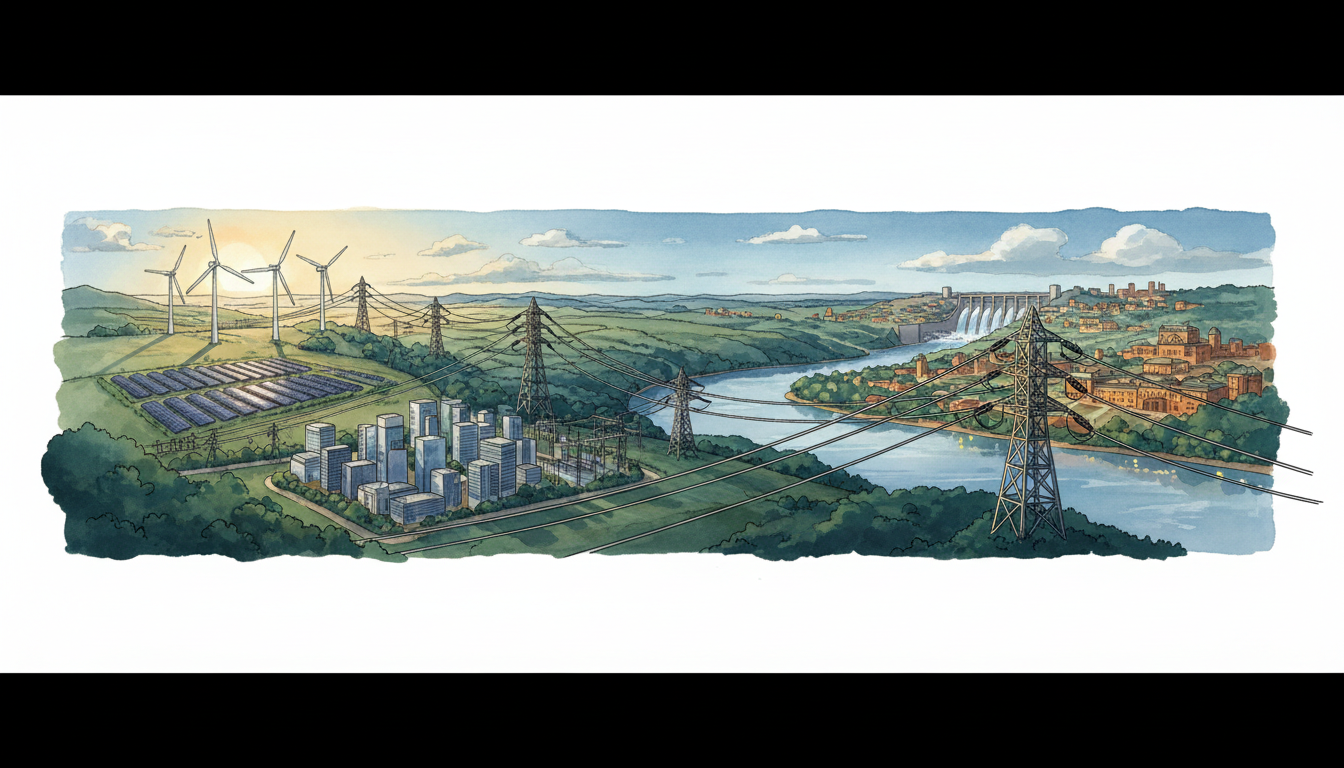
The US Department of Energy explains that water can flow through a channel or penstock, spin turbine machinery and drive a generator. Not all generating plants require the same kind of huge dam. Some systems use flowing rivers or diversions. The important chain is moving water → rotating turbine → a connected generator, rather than the external appearance of a dam.
A changed diagram shows a simple waterwheel turning a mechanical grain mill, not a generator. Which energy form becomes useful at the mill? Motion transferred to the mechanism. No electrical output has been demonstrated. The child who identifies the actual connected load has learned a method usable beyond this one hydropower diagram.
4. A connected generator supplies the electrical conversion
A generator can convert mechanical energy of a rotating shaft into electrical energy. In hydropower the turbine turns and can drive the generator. These parts may be linked in a machine, but they have different roles. The turbine receives forces from the flowing water; the generator performs the intended mechanical-to-electrical energy conversion. A lamp connected through appropriate equipment may then convert some electricity into visible light and heat.
A pupil might reverse the path and say “electricity turns the generator, which pushes the water downhill.” That is not the ordinary generating sequence in this school case. Some systems use electricity to pump water upwards at another time, but that is storage charging mode and must be stated separately. The same terms can appear in two operating modes with different directions of transfer.
An exam-style response can read: “Water flowing downward turns the turbine. The turbine drives a generator, which converts movement into electrical energy.” A bare wheel without the generator cannot support the whole sentence. The answer should match the parts actually identified in the drawing.
5. Compare five fictional water-power and storage devices
Five fictional device cards can test whether the student reads a device from its components rather than its name. Card A shows a waterwheel turning in a stream, with no electrical equipment. Card B has moving water driving a turbine coupled to a generator and light. Card C uses a battery to power an LED without water. Card D shows electrical pumping of water to an upper reservoir. Card E shows water later flowing from that upper reservoir through a turbine-generator system.
These are illustrative teaching examples, not hydropower installations on Belilios Lane. The pupil should mark A as mechanical rotation, B as electricity generation using moving water, C as battery energy conversion, D as energy storage charging and E as recovery of stored energy. The two pumped-storage modes should not be combined into a perpetual-motion claim.
The comparison supplies no exact output, flow rate or device efficiency. A child should not invent how many lights the system can power. The purpose is to trace input, intermediate conversion, stated equipment and useful output using the supplied facts. A properly bounded answer is better than an impressive but unjustified number.
| Fictional device | Input | Useful conversion | Missing claim |
|---|---|---|---|
| Bare waterwheel | Flowing water | Water motion to rotation | No generator shown |
| Hydro generator | Water and turbine | Mechanical to electrical | Output not quantified |
| Battery LED | Stored chemical energy | Chemical to electrical to light | No water needed |
| Pumped storage charge | External electricity | Pumping to elevated water | Consumes energy |
| Pumped storage discharge | Elevated water | Potential to turbine to electrical | Losses remain |
6. Why a waterwheel, turbine and generator have different jobs
A waterwheel and a modern hydropower turbine are both driven by moving water, yet the intended use may be different. A wheel can transfer its rotation directly to a mechanical task such as lifting water or turning a mill. A hydropower turbine can be coupled to a generator to produce electricity. The presence of a rotating wheel does not establish what happens beyond its shaft. Follow the physical connection rather than the word waterpower.
The word dam does not automatically imply an electrical plant either. Some dams are built for water storage, irrigation or flood management. US Department of Energy information notes that many dams have no power-generation equipment. A child given a dam photograph without turbines or generators should not claim electrical output merely because water is held behind a wall.
A changed card shows a wheel driving a mechanical pump. The pupil should explain water-motion energy to wheel rotation to pump movement, without adding a fictional generator. Then another card adds a generator and an LED; the electrical stage is now supported. This single contrast helps correct a persistent misconception about all rotating objects.
7. Pumped storage uses electricity to lift water before releasing it
Pumped-storage hydropower is a form of energy storage. Electrical power is used to pump water from a lower reservoir to a higher one when charging the system. The water gains gravitational potential energy because of its elevated position. At a different time it can flow downward through a turbine and generator to return part of that stored energy as electricity. The Singapore Energy Market Authority describes pumped-storage hydro in this general way.
This is not a source of free energy. Pumping requires an input, and real equipment experiences energy losses. The useful electrical energy recovered during discharge cannot be treated as larger than the energy invested without another source. A child who draws an endless loop labelled electricity created from nothing has confused an energy store with an energy source.
Use two separate diagrams: charging mode electrical input → pumping → elevated water; discharging mode elevated water → moving water → turbine rotation → electrical output. The directions of arrows differ. A pupil should be able to name which mode a labelled picture describes rather than assume every water movement is generating electricity.
8. Water height, flow and efficiency shape actual output
Hydroelectric output depends partly on the flow of water and the height difference through which it can descend, sometimes called the hydraulic head. A large amount of water moving over a short drop and a smaller amount descending over a greater drop can provide different combinations of available energy. Turbine and generator effectiveness and real-world losses also matter. A photograph without numerical data cannot tell a pupil the exact electrical power produced.
The P6 core does not require detailed hydraulic-power equations, turbine efficiencies or grid frequency calculations. Such quantities are advanced extensions. The relevant school skill is naming factors and correctly tracing qualitative energy transformations. If two fictional arrangements differ in both height and flow, the child should recognise that the effect of one cannot be isolated without additional information.
A useful fair-test question asks which factors should be held similar when testing the effect of release height in a teacher’s conceptual model. The amount or flow of water, the waterwheel model, the observation time and measuring method are possible controls. The child should not claim that a higher diagram always produces exactly twice as much electricity from image size alone.
9. Investigate energy paths without unsafe water-and-wiring experiments
No primary pupil needs to build an improvised generator in contact with water or connect bare wires to household mains. A safe demonstration could use a printed energy diagram or a teacher-controlled commercial low-voltage waterwheel model, with clear separation of electrical parts and water. The student can describe wheel motion without claiming measured electrical current if no generator and suitable instrument are present.
The method of investigation matters. If one test changes height, volume of water, wheel shape and load simultaneously, an observed speed difference cannot be assigned to one factor. A fair question identifies the deliberately changed variable, controls the relevant conditions and records the response. A small plastic wheel spinning in a basin does not certify the output of an industrial hydropower station.
Students should not operate pumps or electrical apparatus near water without appropriate adult control. The educational goal is an accurate causal explanation with safe evidence, not constructing a working power plant. Clear hypothetical records can develop the same reasoning while avoiding electrical and physical hazards.
10. Weekday correction, weekend comparison and a two-day retest
Suppose a school worksheet says “a waterwheel makes electricity because it spins”. A weekday tutor can ask which converting component is missing. Compare a bare wheel and a labelled turbine-generator unit, then ask the child to explain the different outputs in their own words. A changed card can show water movement turning a grain mill without wires, checking whether the pupil again invents electricity.
Weekend time may be useful if the learner also confuses elevated potential energy, generator roles and pumped-storage charging mode. In a three-pupil group, rotate source identifier, energy-arrow mapper and evidence challenger. Each learner should make a private prediction and later answer a different unfamiliar device diagram. One child may reverse turbine and generator, another may treat pumped storage as free energy. Their feedback should address those separate errors.
Two or three days later, give a new drawing of an upper reservoir releasing water through a turbine and generator, alongside a plain rotating wheel without electrical equipment. Ask which supports an electrical-output claim and why. A correct independent explanation is stronger evidence than memorising the original diagram. Parents should choose weekday or weekend timing by actual gaps, attention, homework and travel rather than promises of guaranteed grades.
Extended hydropower reasoning and PSLE retrieval
1. One complete pathway and three places a pupil could go wrong
Start with the elevated reservoir. The stored gravitational potential energy becomes available as water moves down. The moving water transfers energy to the turbine and rotates its shaft. The generator coupled to the shaft converts the mechanical input into electrical energy. A connected LED or another suitable electrical load uses that energy to produce useful output. At each step, the pupil should name the specific moving or transforming part rather than saying simply that water makes electricity.
The first wrong arrow begins with electricity stored in water at the top, although the model’s initial energy is gravitational potential. The second skips the generator, treating all rotation as electricity. The third claims that every joule entering the system appears as useful light, ignoring transfers into heat, sound and other less useful forms. A strong changed answer catches these three errors in a new picture without the original teaching labels.
An unfamiliar hydropower card may omit an LED and show an electric grid. The same generator role applies even though the output destination differs. Another card may omit the generator and show a wheel driving a mechanical pump. In that case the path ends with mechanical work. The tutor should not add components absent from the supplied evidence.
2. A pumped-storage problem that distinguishes charging from discharging
A fictional diagram has an upper and lower reservoir connected by a channel and reversible equipment. Card A shows external electrical power being used to pump water uphill. Card B shows water descending later through a turbine generator. Pupils should state whether the stored gravitational potential energy is increasing or decreasing in each mode. In A, pumping raises water and increases stored potential energy relative to the lower reservoir. In B, descending water makes that store available for conversion into electricity.
If the diagram provides only the positions of two reservoirs, it does not establish which mode is running at that instant. A child should read the flow arrows, power-input arrows and labelled devices instead of guessing from the layout. A reservoir with a high wall is not proof that the station is actively generating at the photographed moment.
Ask why one should not expect an endlessly self-powering cycle. The pump consumes energy to raise the water and the turbine-generator recovers only part of it as useful electrical output after unavoidable losses. Pumped storage can shift the time when energy is available, but it does not create a new unlimited energy source. This reasoning protects students from common perpetual-motion misconceptions.
3. Six changed questions and their evidence-limited answers
Question one: A stream spins a plain paddle wheel with no wires or generator. Does this prove electricity was made? No. Question two: The wheel drives a connected generator. Which component produces the electrical conversion? The generator. Question three: Water sits behind a dam at a higher level. Is kinetic movement already demonstrated? Not necessarily; potential energy may be stored without flow in the pictured moment.
Question four: Electricity is used to pump water uphill. Is this charging a gravitational energy store? Yes, in the pumped-storage model. Question five: The child doubles the drawn height of a dam on paper. Does the drawing prove an exact doubling of electrical output? No; flow, mass and system effectiveness are missing. Question six: A device lacks an identified generator but turns a grain mill. What useful output is shown? Mechanical movement, not necessarily electricity.
These six questions should be answered using the source, converter, output and limits of evidence. A correct one-word answer may be accidental. Ask the learner to explain at least one changed pathway without the original diagram, then repeat another after two days to test whether the concept has been retained.
4. A three-pupil learning session with individual evidence
A ninety-minute teaching example can begin with ten minutes of private predictions about a rotating wheel, fifteen on elevated potential energy, fifteen on water motion and turbine roles, and fifteen on generator conversion. Another fifteen minutes compare simple waterwheels and pumped-storage diagrams. The remainder provides individual unfamiliar pathways, specific feedback and a short delayed retrieval task. This is a methodology illustration rather than a confirmed Belilios Lane timetable.
In a group of three, one learner may know water flows downhill but skip the generator, another may reverse generator and motor roles, and a third may believe pumped storage creates energy. A tutor should identify the first broken link for each pupil and use an appropriate corrective diagram. Rotating source checker, conversion mapper and evidence challenger roles makes the reasoning visible, but each learner still needs a separate written final answer.
Parents can request four pieces of evidence: the original wrong statement, the corrected energy pathway, an unfamiliar independent answer and the delayed result. A longer weekend session helps only when it provides meaningful varied comparisons and enough attention. A focused weekday correction may work for a single misconception. Neither timetable nor this neighbourhood article establishes a guaranteed examination outcome.
Weekday versus weekend parent decision table
| Diagnosed error | Weekday correction | Weekend practice |
|---|---|---|
| Rotating waterwheel automatically means electricity | Add or remove generator in two diagrams | Compare mechanical and electrical devices |
| Cannot trace stored water energy | Height and kinetic pathway | Changed head and flow cases |
| Pumped storage treated as free energy | Separate charging and discharging modes | Storage versus generation comparisons |
| Claims exact output from an image | Identify missing measurements | Several fair-test plans |
| Relies on teacher’s original diagram | New generator question after two days | Three independent altered devices |
MOE, DOE, EMA and eduKate learning sources
MOE Primary Science Syllabus 2023 — P6 Energy Conversion · US Department of Energy — How Hydropower Works · US Department of Energy — Hydropower Plant Types · US DOE — Pumped Storage Hydropower. The device cards are fictitious rather than local generating equipment.
Singapore energy storage and locality: EMA — Pumped Storage Hydro and Energy Storage · URA — 12 Belilios Lane, Little India Conservation Area. These sources do not establish a hydropower plant on the lane.
eduKate teaching: Primary Science Tuition Singapore · Weekday–Weekend Learning Rhythm · Immutable Clementi Three-Pupil Reference · Parent Consultation.
Other distinct P6 science guides: Kerbau Road — Hand-Crank Torch · Chander Road — Decomposers · Campbell Lane — Pitcher Plants.
Extended hydropower evidence, fair testing and parent assessment
Four energy paths that must not be joined into one fictional machine
Pathway one shows water moving downhill and rotating a bare wheel connected to a mechanical milling device. The useful output is movement of the mill. Pathway two adds a proper generator coupled to a turbine: mechanical rotation is now converted to electricity, which can power a suitable electrical load. Pathway three uses electricity to pump water uphill, increasing the stored gravitational potential energy. Pathway four releases previously elevated water through a turbine-generator to recover part of that stored energy. These pathways share concepts but should not be combined without evidence of the relevant components.
A school learner might see a rotating wheel and imagine a hidden generator, a storage battery and an electric motor all inside it. That is not an accurate reading of the diagram. Ask the pupil to underline each explicitly labelled component and draw only the corresponding energy arrows. If the diagram provides no electrical meter or load, the teacher cannot simply infer a particular electrical output. A correct answer can name mechanical rotation as a visible outcome while recognising that generator conversion needs additional components.
The same reservoir can be shown in charging and generating conditions
In an illustrative pumped-storage system, the same two reservoirs can be involved in two different modes. During charging, electrical energy is used to run equipment that pumps water from the lower reservoir into the upper reservoir. The water gains gravitational potential energy relative to the lower elevation. During generating, the flow is reversed: water descends, drives a turbine and enables a generator to supply electricity. The physical diagram may look almost the same in both frames, but the arrows show different energy purposes.
Ask the pupil how the system could be a useful energy store without being a source of free energy. Electricity must be supplied during pumping, and some useful energy is lost to heat, sound or other transfers during operation. A student who draws a closed loop creating ever more electrical output has made an incorrect conservation claim. A clear P6 explanation distinguishes energy storage from energy conversion and does not need numerical engineering efficiencies.
Three conditions that change a hydropower comparison
Imagine two fictional turbines with different water releases. In Test A, a fixed volume of water descends through a chosen height. In Test B, the same volume descends through a greater height under otherwise similar conditions. There may be more gravitational potential energy available in the second arrangement, but exact electrical generation still depends on the actual system. Now imagine Test C changes both height and water-flow rate. Comparing C with A no longer isolates height alone. This is a basic fair-test conclusion rather than a calculation of kilowatt-hours.
A source photograph that looks like a larger reservoir does not supply the water discharge rate, turbine efficiency or time interval. Ask the pupil which measurements would be required to compare actual outputs. They may identify release height, moving water amount and electrical reading. The teacher should not pretend that exact power can be read from a drawing’s scale. Recognising missing evidence is part of a strong Science open-ended answer.
Seven changed-question prompts with supported answers
Question A: Water turns a wheel attached only to a flour mill. Must electricity be produced? No. Question B: Water turns a turbine connected to a generator. Which component performs the mechanical-to-electrical conversion? The generator. Question C: Water is raised to an upper reservoir by an electrically powered pump. Is the system charging an energy store? Yes. Question D: That water later descends through a turbine. Which broad energy form becomes available as water moves downward? Its gravitational potential energy becomes available and can contribute to moving-water energy.
Question E: A dam has no generator in the supplied drawing. Can the pupil claim it powers houses? Not from the information given. Question F: Two dams differ in both release height and water flow. Can one changed factor be declared the sole cause of different power? Not without more evidence. Question G: A student says the pumped-storage device produces more electricity than the pumping stage consumes because the water remains present. Is this a sound conclusion? No; energy recovery is limited by transfers and losses, and conservation must be respected. Each explanation should mention the relevant source, pathway or missing measurement.
Individual retest, three-pupil roles and safe classroom practice
An effective three-pupil tutorial can rotate the roles of source identifier, energy-pathway drawer and evidence challenger. The first pupil names the starting form of energy, the second traces each identified converter, and the third asks whether a generator or storage component was imagined without evidence. Change the roles so each student handles all three tasks, then gather separate unfamiliar written responses. Group consensus is useful for discussion but is not proof that a quieter child can identify the generator or distinguish charging from discharging.
Two or three days later, present a new river-diversion diagram containing a turbine, generator and electrical load, alongside a mechanical wheel that only turns a pump. Ask the learner to identify which system demonstrates electrical conversion and which does not. Then add an upper and lower reservoir in charging mode and ask for the direction of energy storage. This delayed, changed-diagram response is the appropriate test of the original misconception rather than another copied explanation. No practical experiment requires connecting electrical equipment to water: teacher-supplied diagrams are sufficient.
Other Belilios Lane Science levels: Primary 3 Science · Primary 4 Science · Primary 5 Science. Each guide solves a different Primary Science misconception with its own original worked evidence and independent retest.
Belilios Lane identifies the intended Little India parent readership, not an eduKate teaching venue, current vacancy, fee or confirmed class timetable there. Verify the actual centre and availability directly. Do not make electrical experiments using water and exposed live wiring; use safe prepared teaching diagrams. No examination outcome is guaranteed.