
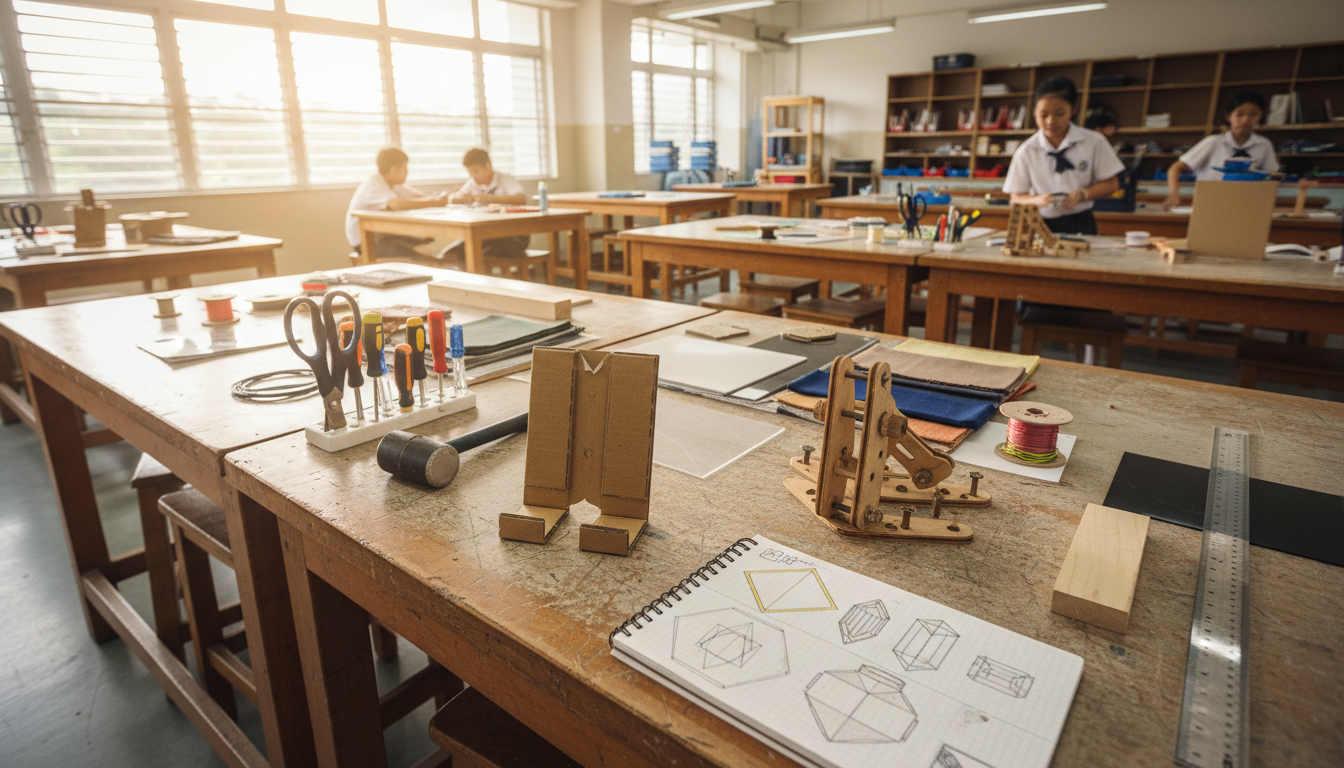
If your child starts building an attractive G1 Design and Technology prototype before finding out what problem it should solve, the first skill to repair is needs analysis. The 2027 Singapore-Cambridge SEC G1 Design and Technology syllabus K124 expects students to identify a real design opportunity, develop a design brief and specifications, explore alternatives, test mock-ups and justify a proposed solution. A good-looking object is not enough if it does not meet an identified user’s needs.
For parents, ask your child to describe the person who would use the product, the difficulty that person faces and two ways the design could improve the situation. Begin with observation, sketches and a safe paper or cardboard mock-up, not a costly purchase or an adult-built prototype. Review the child’s current school assignment and teacher feedback first; formal national coursework has supervision, authentication and specific submission requirements.
- Direct answer: Establish the user, need and constraints before choosing the final product.
- Official reference: 2027 SEC G1 Design and Technology is K124; its written paper is 30%, and the 20-week design project is 70%.
- Parent’s first action: Ask for one clear design brief, three useful specifications and evidence from a simple test.
- Child’s immediate improvement: Explain why a proposed idea meets a genuine need instead of saying only that it looks nice.
- Safety boundary: Only school-authorised equipment and supervised workshop processes; keep home exercises to safe paper-based design.
What does the 2027 G1 Design and Technology K124 syllabus require?
The official SEAB 2027 G1 K124 syllabus treats designing as an evidence-based process that considers users, functionality and the environment. The assessed domains are knowledge with understanding, design thinking skills and design manipulating skills. Students use research, analysis, sketching, mock-ups and prototyping to improve products and situations in everyday life.
For SEC 2027, Paper 1 is a one-hour written examination worth 30%. It has design-centred questions about design and technology knowledge, including mechanisms and electronics. Paper 2 is an individual design project lasting 20 weeks, excluding school holidays, and worth 70%. The design project includes a real-time Design Journal, mock-ups and prototype, and a Presentation Board. These are final national examination arrangements, not the timetable for every Secondary 1 class activity.
The K124 design process includes Needs Analysis, Idea Conceptualisation, Development and Prototyping, supported by Research. The stages may loop back. If an initial idea does not work after testing, a student is expected to revise intelligently, not hide all evidence of unsuccessful ideas. A thoughtful record of the problem, ideas and decisions is valuable.
Why parents see a polished model but a weak design decision
A student may start from the object they want to make: a phone stand, desk organiser or portable holder. The risk is choosing materials and shape before examining whether the intended user has the problem, whether the product fits the user’s environment, and whether it is safe and practical. The child may become attached to the first sketch and resist alternatives.
For example, a large desk organiser may look impressive but may not fit on a small school desk. A holder designed for an adult’s hand may be awkward for a younger user. A storage device that needs three hands to open fails its basic purpose. None of those problems can be solved only by adding decoration.
The parent should ask: Who is the user? What activity is difficult? What evidence shows it is difficult? Where will the product be used? What are the size, cost and material limits? How will the child know whether an idea worked? The syllabus also includes ergonomics and anthropometric data, so users’ measurements and comfort can matter when they are relevant to the design.
A simple original example: the crowded study desk
Imagine a student notices that a sibling loses small stationery items on a narrow desk. This is a practice scenario, not an official SEC question. A weak starting point is, “I will make a beautiful wooden organiser.” A better starting point is, “A pupil using a narrow desk needs a way to keep three frequently used items accessible without covering the writing area.”
Now write a brief that names the user and purpose. Then set measurable specifications: the organiser must fit within a chosen footprint, have compartments for named items, remain stable when an item is removed and be easy to reach. The exact measurements should be taken from the real desk and checked with the intended user, not invented to sound technical.
Draw three alternatives quickly. One may stand upright, one may hang from a shelf and one may fold flat. Test the designs as small paper or cardboard models with harmless sample objects. Ask the user to try each model and describe what is convenient or awkward. Select the design that best answers the brief and document the reason for that choice.
How to write a useful design brief without taking over
A design brief can be concise: Design a practical solution for [user] who struggles with [activity], to achieve [desired improvement] in [environment]. A school may prescribe its own format, so confirm with the D&T teacher. Avoid vague briefs such as “make a nice product” or specifications such as “must look good” without a meaningful way to evaluate them.
Helpful specifications come from constraints and user evidence. They might address ease of use, stability, size, safe access, storage capacity, durability or material suitability. Aesthetic choices matter too, but parents should ask how each choice serves a purpose rather than rewarding a particular colour by default.
Do not write the brief for your child. Let them propose a version, test it against observations and revise. If the wording is clumsy but the reasoning is sound, help the child clarify one sentence at a time. Authentic student thinking matters more than polished adult language.
Why sketching and mock-ups are not wasted time
The official syllabus lists freehand sketching, isometric and orthographic drawing, and mock-ups as tools for generating, communicating and testing design ideas. Students do not have to produce a museum-quality illustration before they can think. A rough sketch can show whether a lid opens, how an item is supported or where a user will grip a product.
A mock-up is a low-cost trial of an idea. A prototype develops a proposed solution with suitable technology. Parents can support safe cardboard trials at home, but should leave school workshop machines, unfamiliar blades, soldering, drilling and electrical assemblies to properly supervised school environments. A plausible product is not worth an injury.
Ask the child what changed after each test. Did the object wobble? Was a shelf too narrow? Could the user reach the item? What did the student change as a result? Documenting decisions connects sketching and testing to the actual assessment objectives.
What the Design Journal should and should not become
The 2027 K124 Design Journal is a real-time record of the student’s design process, not a scrapbook assembled by an adult at the end. SEAB specifies time-stage planning such as a Gantt chart, relevant research, sketches, calculations, development and the resulting mock-ups and prototype. The syllabus advises candidates not to re-work design sheets, so replacing genuine stages with a flawless retrospective story defeats the purpose.
The journal format uses A3 sheets or securely fastened A3 sketch pads, alongside the relevant physical work. The Presentation Board communicates the proposed design solution and may use up to two single-sided A2 boards. Check the school’s exact coursework instructions before preparing materials: parents should not decide submission formats for candidates.
If the student misses a milestone, ask them to update the next action honestly, not fabricate earlier dates. The 20-week national project timeframe requires planning and adjustment. The teacher, as coursework supervisor, is responsible for supervision, assessment and guidance within official rules.
A realistic two-week parent support routine
- Days 1–2: Read the school task. Have the child write the user, the problem and what evidence would demonstrate the problem.
- Days 3–4: Observe the activity with permission. Record two genuine observations and one user comment.
- Days 5–6: Draft a brief and three measurable design specifications. Ask the teacher if the school uses a different format.
- Days 7–8: Draw three clearly different ideas, not three colour variations of the same object.
- Days 9–10: Create safe paper or cardboard mock-ups and test them with harmless objects.
- Days 11–12: Compare ideas against the stated specifications and record why one is more suitable.
- Days 13–14: Review school feedback, update the plan and identify the next authorised class activity.
The aim is to build evidence-based thinking, not to finish an assessed project at home. A parent can ask questions, provide basic stationery and encourage planning; a parent should not produce examination coursework, instruct unsafe workshop work or buy specialised components without teacher approval.
Full Subject-Based Banding, subject availability and school choices
Posting Group 1 describes the Secondary 1 posting route, whereas G1 is the level of a subject. G1 D&T may be offered as part of a student’s school subject options, but national syllabus availability does not guarantee the school offers the course or the subject combination a student wants. Ask the school’s subject-selection team about actual offerings, scheduling and progression.
A child who excels in design but is weaker in other subjects should not be dismissed by a whole-child label. Likewise, strong model-making alone does not guarantee a result in a subject that also requires research, sketches and written examination performance. Consider the whole workload and the child’s genuine interest when discussing upper-secondary options.
Questions to take to the D&T teacher
- What is the next assessed stage: need identification, drawings, mock-up, technology knowledge or project journal?
- Is our child using evidence from a real user or guessing what the user needs?
- How many alternatives and what level of working documentation does the current school task require?
- Which tools and materials are school-approved, and what must never be attempted at home?
- How do you recommend that our child recover from a delayed milestone without compromising originality?
Common parent mistakes to avoid
Do not begin by purchasing expensive kits. Do not let the parent or tuition tutor build the model, write the journal or impersonate a user interview. Do not hide failed tests: record what they taught the child. Do not treat a polished physical object as evidence of a strong design process without checking why it exists and how it was developed.
Frequently asked questions
Is the 2027 G1 D&T project really 70%?
Yes. The published K124 syllabus specifies a 30% written examination and 70% individual design project over 20 weeks. Check future years separately.
Does my child need woodworking or electronics experience before Secondary 1?
Not as a general prerequisite to learn design thinking. Schools sequence safe skills development, and the teacher will explain authorised workshop activity. Students can begin with observation and paper sketches.
Can parents correct the project journal?
Parents can ask reflective questions, but assessed design work must remain the student’s authentic work under school supervision. Ask the teacher where supportive feedback ends and inappropriate assistance begins.
Is an unattractive first prototype a failure?
Not necessarily. A rough model that reveals an important design flaw may be valuable if the student tests it, records the result and makes a sound next decision.
Verified references and further help
- SEAB 2027 G1 Design and Technology K124 syllabus
- SEAB 2027 G1 syllabus listing
- eduKateSG: G1 D&T design journal and prototype mistakes
- eduKateSG: G1 D&T coursework timeline
- eduKateSG: Posting Group 1 versus G1 subject levels
Fact checked on 24 November 2026 against the published 2027 school-candidate K124 document. This guide is independent advice for parents; school instructions and the child’s examination-year syllabus take priority.