
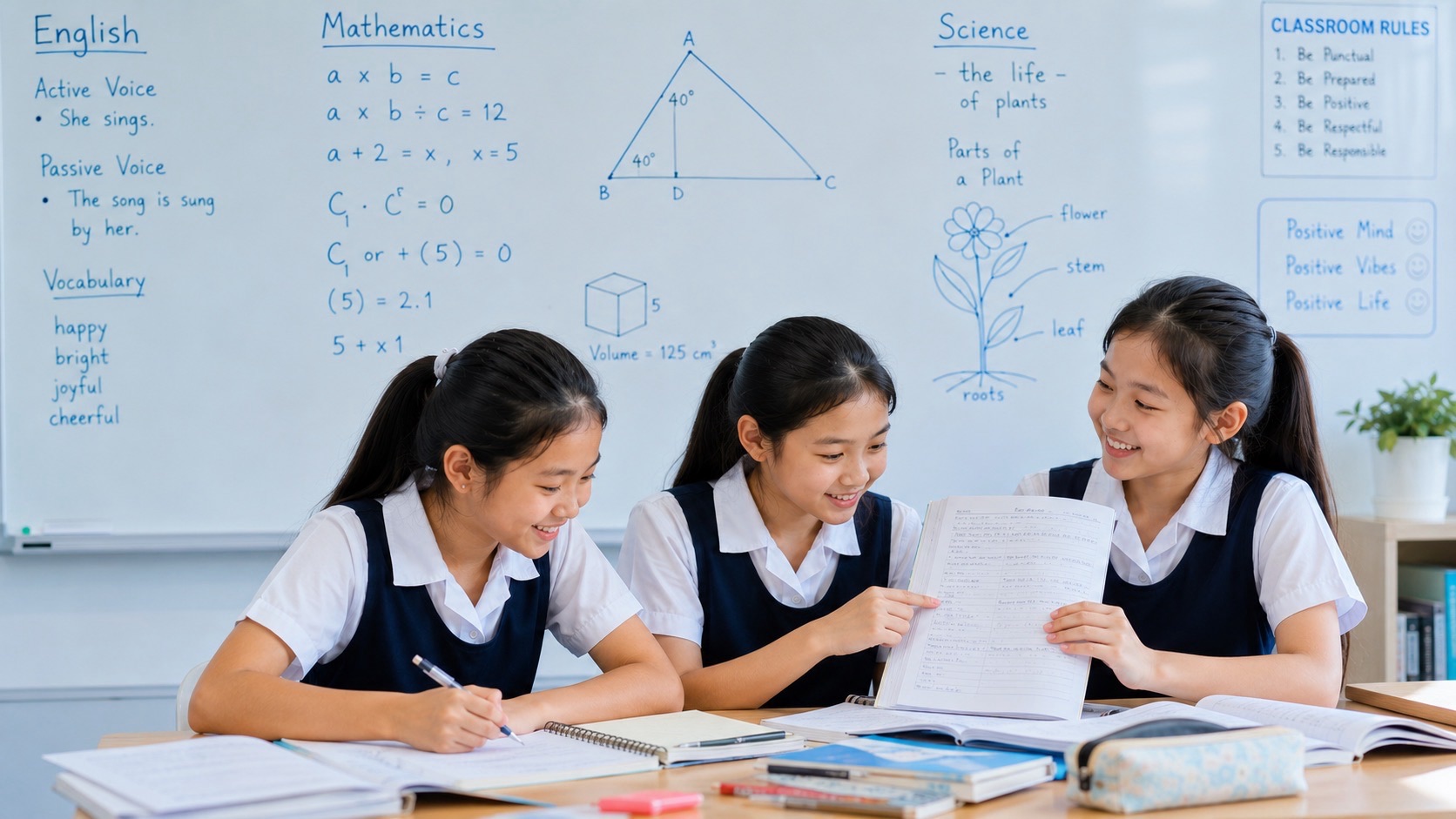
A Primary 4 child may read each sentence correctly but still fail to explain what a whole passage is mainly about. This happens when the pupil remembers interesting details without seeing how those details fit together. To improve, teach the child to identify the topic, the central message and the supporting examples before attempting a short summary.
At home, give your child one unfamiliar, age-appropriate paragraph and ask three questions: What is it about? What is the writer trying to tell us about that topic? Which two facts best support that message? Compare the answers with the actual text rather than encouraging a long retelling. Primary 4 learning and assessment are school-based; this is a reading strategy, not a fixed national P4 examination section.
- Topic: the subject of the paragraph, usually expressed in a few words.
- Main idea: the important point the writer makes about that topic.
- Supporting details: reasons, examples or facts that develop the main idea.
- Summary: a short, accurate restatement that keeps what matters and removes repetition.
- Parent action: practise on two different text types and revisit the skill without hints.
The MOE English Language Syllabus 2020 for Primary emphasises reading literary and informational texts for understanding, as well as purpose and context. Primary 4 pupils develop greater independence in selecting relevant information, explaining meaning and expressing it clearly. Specific school texts and marking schemes vary, so the examples here are original teaching materials, not official paper items.
Topic, main idea and supporting detail: three different jobs
| Reading element | What it answers | Example from a garden paragraph |
|---|---|---|
| Topic | What is this passage about? | A neighbourhood garden |
| Main idea | What important message is made about it? | Volunteers care for the garden in several practical ways |
| Supporting detail | What fact helps explain the main idea? | They water seedlings and remove litter |
| Interesting but secondary detail | What makes the scene vivid but is not the central message? | The volunteers wear green hats |
| Summary | How could we restate the important message briefly? | Community volunteers protect a neighbourhood garden by maintaining its plants and keeping it clean |
A topic such as ‘birds’ is usually too broad to answer ‘What is the main idea?’ when a passage specifically explains how birds help disperse seeds. Teach the child to add what the author says about the topic.
Original worked passage 1: a school reading corner
At the start of the term, pupils in Class 4B noticed that the classroom library was difficult to use. Books were stacked without labels, and several covers were damaged. The class decided to improve the reading corner. A group sorted books by broad themes, another repaired loose covers, and volunteers made simple shelf labels. The class then agreed on a borrowing routine so that books could be returned to the correct places. By the following week, pupils could find books more easily and more children were borrowing them.
What is this passage mainly about?
Strong answer: Class 4B improved its classroom library so pupils could find and borrow books more easily. This answer captures the problem, the main action and the result. It is stronger than ‘They made labels’, which describes only one detail.
Which details support the main idea?
- The children grouped books by theme so they were easier to locate.
- They repaired covers and made labels, improving the condition and organisation of the collection.
- They agreed on a borrowing routine, which helped books return to suitable places.
- More children borrowed books after the changes, suggesting that the improvements made the corner more useful.
Not every summary needs all four details. Ask the child to select the two that most directly explain the change and result. A summary should not become a complete replay of the passage.
Write a concise original summary
Class 4B made its classroom library easier to use by organising books, repairing covers and introducing a simple borrowing routine. More pupils then began borrowing books.
Notice that the summary preserves the important change and outcome while omitting the exact timetable and each volunteer group’s work. The child has not invented a new activity or changed the meaning.
Five common mistakes in main-idea questions
| Weak response | Why it misses the main point | Repair |
|---|---|---|
| ‘This passage is about books.’ | Names the topic without telling the reader what happened or mattered. | Add the central change or message. |
| ‘The pupils made shelf labels.’ | Captures a detail rather than the whole passage. | Include organisation, borrowing and improvement. |
| ‘The pupils built a new library.’ | Invents an event that the passage does not describe. | State that they improved a classroom reading corner. |
| ‘Some books had damaged covers.’ | Focuses on an initial problem but not the response or outcome. | Summarise problem and solution. |
| ‘A great and wonderful and amazing class worked hard…’ | Adds evaluation and decorative words without useful information. | Use precise, neutral language matching the text. |
Original worked passage 2: non-fiction about shade
Trees help keep some outdoor spaces cooler. Their leaves block part of the sunlight that would otherwise warm the ground. Trees can also provide habitats for birds and insects, while their roots help hold soil in place. In busy neighbourhoods, residents may value tree-lined paths because these paths can feel more comfortable during sunny periods. Trees need suitable space, water and care if they are to grow well.
Why ‘trees are good’ is not a strong summary
The paragraph introduces several benefits of trees and mentions the conditions necessary for healthy growth. ‘Trees are good’ is too vague. A better summary is: Trees can make neighbourhoods more comfortable by providing shade and supporting wildlife and soil, but they also need suitable conditions and care.
This example makes a crucial distinction between the main point and an overly strong claim. The paragraph says some outdoor places may be cooler and tree-lined paths can feel more comfortable. It does not claim that every tree cools every road by a fixed number of degrees.
How to find the main idea when it is not the first sentence
Some paragraphs state their central idea early, while others build towards it at the end. Ask the child to read the entire paragraph, notice repeated relationships and ask what the details have in common. Do not insist that the first or final line always contains the answer.
- Read the full paragraph without trying to highlight every word.
- Write a short topic label, such as ‘trees in neighbourhoods’.
- Ask what the author wants the reader to understand about that topic.
- Underline two supporting details that belong with the proposed main idea.
- Check that the main idea fits every important part of the passage, not just one sentence.
- Write a one- or two-sentence summary using new wording without changing meaning.
Summarising a story is different from summarising information
In a narrative, the central sequence often includes a situation, a meaningful change, what the character does and the consequence. In an informational text, the main idea may explain a process, a cause, a comparison or several benefits. Using the same rigid template for every passage can lead to awkward answers.
| Text type | What the summary should preserve | What can often be removed |
|---|---|---|
| Narrative | Problem, meaningful decision and outcome | Minor dialogue and incidental descriptive details |
| Informational article | Central explanation and essential supporting facts | Repeated examples and unrelated colour descriptions |
| Instructions | Purpose, required steps and important conditions | Unnecessary decoration |
| Notice | Event or action, date, place and important eligibility rules | Language that does not change the decision |
| Opinion or argument | Central claim and key reasons | Repeated emphatic wording |
For a related approach to supported answers, see eduKate’s P4 inference guide. A sound main idea must follow the passage as a whole, whereas an inference may explain something that the passage suggests but does not state directly.
How grammar and vocabulary affect summarising
A summary can change the original meaning accidentally through an overly strong verb or a missing qualifier. Compare ‘Some volunteers care for the garden’ with ‘Every volunteer cares for every garden’. The second broadens the claim without evidence. Similarly, replacing ‘may’ with ‘will’ can transform a possibility into a certainty.
Teach children to preserve words such as some, many, may, only, before, after, unless and however whenever those words control meaning. Sentence combining can make a summary concise, but the combined sentence must remain accurate.
Original short practice for parents
Read: During the school holidays, a community centre opened a free reading session. Volunteers helped younger pupils select books, while older pupils read stories aloud. Parents could also borrow books to share at home. The organisers hoped that families would discover new authors and continue reading beyond the session.
Question: What is the main idea? Model answer: The community centre organised a reading session to help children and families discover books and build reading habits. Two details: volunteers guided book selection and older pupils read aloud. A claim that the event ‘guaranteed everyone would become a reader’ would go beyond the text.
A four-week home progression
| Week | Learning task | Evidence of progress |
|---|---|---|
| 1 | Identify topic and main idea in two short passages. | Child can explain why a detail is not the central point. |
| 2 | Separate essential from supporting facts in a new narrative. | Summary retains problem, decision and outcome. |
| 3 | Summarise two unfamiliar factual paragraphs. | No invented information or unjustified generalisations. |
| 4 | Try a story and a notice without adult prompts. | Child adjusts the summary method to the text type. |
Ten to fifteen thoughtful minutes can be enough for one practice session. Keep shared reading for enjoyment alongside these activities. A child who finds word recognition difficult may need accessible texts and school literacy support before expecting independent summarising.
When should parents involve the class teacher?
Ask for help when a pupil cannot understand suitable paragraphs despite reasonable reading support, gives unsupported retellings in several tasks or cannot independently explain even simple events. Show an original response and the teacher’s marked feedback. The useful question is whether the difficulty is decoding, reading comprehension, selecting the main point or writing an accurate answer.
What parents should know about Primary 5 and later school choices
Primary 4 English is assessed by the child’s school; it does not produce a national PSLE Achievement Level. At the end of P4, parents should discuss the school-recommended Standard/Foundation combination for P5 through MOE Primary Subject-Based Banding. A child who can improve reading for the main idea and summarising may build stronger learning habits, but one new skill or a school percentage cannot determine their eventual PSLE score.
A Primary 4 child in 2026 would usually sit the PSLE in 2028. MOE Posting Groups describes how an eventual official P6 score determines eligibility for PG1, PG2 or PG3 under the currently published system. Those admission groups are different from G1, G2 and G3 subject levels under Full Subject-Based Banding. The previous-year score ranges for secondary schools may change, and matching one does not guarantee admission.
Research secondary schools near your estate, without predicting a P4 child’s placement
Families around Queenstown, Dover, Clementi and Bukit Timah may start by learning about Queenstown Secondary, Queensway Secondary, Clementi Town Secondary and Fairfield Methodist School (Secondary). Families around Punggol and Sengkang can investigate Greendale Secondary, Edgefield Secondary, Punggol Secondary, Compassvale Secondary and Pei Hwa Secondary. These are geographical research examples, not score-matched recommendations or promises of a future place. Check each school’s current campus, language and other subject offerings, CCAs, pastoral support and actual journey using MOE SchoolFinder.
When the child receives an official PSLE result, use current programme eligibility, score ranges and the child’s interests to rank the schools the family would genuinely accept. eduKate’s Punggol–Sengkang choices guide explains why nearby districts can be compared. There is no reason to lock in six secondary schools at Primary 4, and secondary admission rules may change before 2028.
Official sources and further eduKate reading
- MOE English Language Syllabus 2020 (Primary)
- MOE Primary Subject-Based Banding
- MOE assessment reform and child-centred learning
- MOE Posting Groups
- MOE interpretation of historical score ranges
- MOE SchoolFinder
- eduKate full Primary 4 English syllabus guide
- eduKate P4-to-P5 English subject options
Frequently asked questions
Does MOE require the same main-idea question in every P4 school paper?
No. Schools follow the national curriculum while choosing their own teaching texts and school assessment tasks.
Should a child always choose the first sentence as the main idea?
No. Some passages state the central message later or require the reader to connect several details.
How long should a Primary 4 summary be?
Follow the school’s instructions. At home, begin with one or two accurate sentences and gradually extend only if the task requires it.
Can the child copy exact sentences?
School task instructions take precedence. A summary usually benefits from clear original wording that preserves the meaning rather than a collection of copied lines.
Does strong P4 summarising guarantee PSLE AL1?
No. It strengthens English skills but a future PSLE grade depends on the national examination and wider competencies.
Editorial review: 24 November 2026. All passages, summaries, checklists and learning examples are original educational material. They are not MOE or SEAB examination questions, and future secondary-school guidance must be rechecked when the child reaches PSLE.