
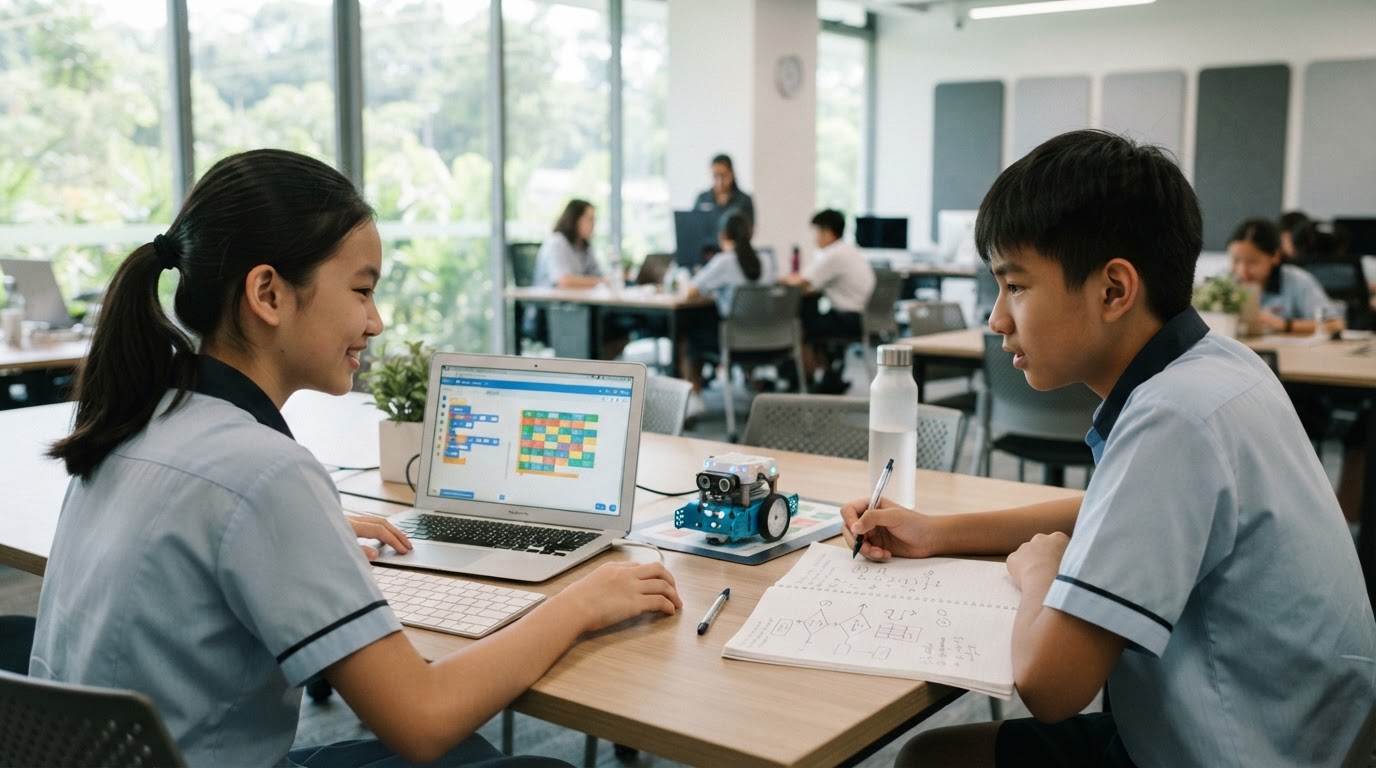
Secondary 2 students considering G3 Computing for Secondary 3: prior Python experience is helpful but should not be treated as an automatic requirement for everyone. The real question is whether your child enjoys breaking problems into steps, testing solutions, reasoning about data and learning from mistakes. MOE’s G3 Computing course includes programming, spreadsheets, computing systems and ethical use of technology, not simply typing code faster than classmates.
Before paying for a coding course, ask the school if it actually offers G3 Computing and what its subject-selection or readiness criteria are. Then let your child try a short algorithm: give clear instructions for sorting a list, trace the steps and check whether they work on a different input. An honest beginner who reasons carefully may be better prepared than a student who has memorised code without understanding it.
- G3 Computing is generally an upper-secondary elective, not a compulsory Sec 2 G3 subject or national Sec 2 SEC paper.
- SEAB’s 2027 G3 Computing code is K349, with earlier code 7155.
- Develop algorithms, logic, data thinking and responsible digital habits before buying specialist equipment.
- Ask whether your child’s school offers the subject, requires a selection exercise and can provide the software.
- Use small, safe exercises to check curiosity, persistence, explanation and willingness to debug.
Parents may compare coding portfolios, competition medals or expensive classes when deciding whether Computing is suitable. Those are not universal admissions requirements. A fairer starting point is the child’s capacity to think through a problem, describe a solution and use feedback—while keeping realistic expectations about timetable and school availability.
The timing parents must understand: Secondary 2 is not the SEC examination year
A Secondary 2 student in 2026 is preparing for school-based assessments and the Secondary 3 subject-selection process, not sitting the national Singapore-Cambridge Secondary Education Certificate (SEC) that year. The SEC begins with graduating cohorts in 2027, replacing the former GCE N(T), N(A) and O-Level national examinations. Under Full Subject-Based Banding (Full SBB), eligible students can take subjects at G1, G2 or G3 as appropriate; a Posting Group does not force every subject to one level.
A child who is in Secondary 2 during 2026 would ordinarily be in Secondary 4 in 2028. Use SEAB’s 2027 G3 syllabus directory as a forward-looking explanation of subject options and codes—not a final promise about the detailed 2028 syllabus. Subject availability, eligibility, combinations, deadlines and appeals are school-specific. Ask for written confirmation before choosing extra subjects, coaching courses or a different subject level.
Official check: SEAB SEC overview and SEAB 2027 G3 school-candidate subject directory.
What the official G3 Computing syllabus covers
MOE’s 2024 G3 Computing syllabus presents computing as the analysis of problems, design of algorithms and solutions, management of data, understanding of computer systems and informed judgement about legal, ethical and security issues. It explicitly includes developing computational thinking rather than only learning one programming language.
The SEAB 2027 G3 directory lists Computing K349 (previous reference code 7155). The MOE teaching syllabus covers upper-secondary learning; Secondary 2 students in 2026 will ordinarily choose combinations for Secondary 3 before they approach the 2028 SEC examinations.
Schools may offer different introductory experiences such as Infocomm CCA, Applied Learning Programmes or introductory computing modules. These opportunities are valuable but not equivalent to being enrolled in G3 Computing. Check the formal school offering.
What students are expected to do beyond coding
The G3 Computing syllabus includes algorithmic thinking, problem decomposition, designing, testing and refining solutions, and handling data. Practical work uses computing tools, including spreadsheets and Python in the published G3 syllabus. Students also need to understand how information is stored or processed and why privacy, security and ethical decisions matter.
The 2024 MOE syllabus describes a written examination and a lab-based practical assessment for the upper-secondary national subject. The lab component is not a casual speed-typing contest; it evaluates the ability to apply computing concepts and tools to problems. For later examination details, use the relevant SEAB examination-year syllabus.
Do not promise that a student can satisfy every part of Computing by completing a few web tutorials. Formal content and lab work are broader and require a teacher-led programme.
Try algorithms without purchasing a computer
Ask the child to write precise instructions for a familiar task, such as ordering a set of numbers from smallest to largest. Test the method with a reversed list, repeated numbers and a list that is already sorted. When the process gives the wrong answer, ask which step was missing.
Then invite the child to draw a simple flowchart or describe the steps in plain language before translating them to code. This checks whether the student understands conditionals and repetition without getting stuck on punctuation.
- Decomposition: break a large problem into manageable pieces.
- Abstraction: keep important information and ignore irrelevant detail.
- Algorithm: a clear repeatable sequence of steps.
- Testing: try ordinary, boundary and unexpected inputs.
- Debugging: find the cause of a wrong result and explain a correction.
- Ethics: consider privacy, fairness, integrity and the effect on users.
An accessible Python example
An early learner could store three numbers and find their largest value. Before writing Python, ask the student how they would compare them manually. Then show how a variable holds a value, how a conditional chooses an action and how the program should respond if the input changes.
Good beginners should be able to predict a small program’s output, trace variables line by line and explain a correction. Copying a long block of code without understanding it is not proof of mastery. Keep online accounts supervised and use school-approved software where possible.
Why spreadsheets are part of Computing
A spreadsheet can organise and analyse data through rows, columns, formulas and simple operations. A child who can type numbers but cannot explain a formula’s meaning still needs stronger problem-solving skills. Use a safe fictional example such as a simple stationery-budget table, calculate totals and then change one value to test whether the formula updates correctly.
Teach the difference between data, information and a conclusion. An output may be mathematically correct while the source data are incomplete or misleading. These habits transfer well to other school subjects.
Security, AI and digital citizenship
Computing education also involves responsible use. A student should learn not to share personal data casually, to use sources honestly, to avoid copying another student’s work and to question whether a computer output is reliable. Encourage them to explain how an algorithm might affect different users rather than assuming that an automated result is automatically fair.
If your child uses AI to suggest code, require them to explain every step, test it independently and follow the school’s academic-integrity rules. An automatically generated solution may be a learning aid, but submitting it as the child’s own original reasoning without permission defeats the purpose.
A three-week readiness challenge for a Secondary 2 learner
- Week 1: solve three short logic tasks with steps written in plain language and test them on varied inputs.
- Week 2: try a tiny beginner coding activity using school-approved tools, explain variables and conditionals, and fix a deliberately introduced error.
- Week 3: build a small spreadsheet or data table with a formula and present one factual conclusion plus a limitation.
Evaluate whether the child can explain the process, persist through difficulty and enjoy figuring things out. The aim is an informed subject decision, not an elite coding portfolio. Avoid extending sessions until they disrupt sleep or other core subjects.
What if the child has never joined an Infocomm CCA?
A CCA can develop interest and provide useful exposure, but it should not be assumed to be compulsory unless the particular school says so. Ask for the school-specific prerequisites, any selection assessment, class size, schedule and access to computers. The child should compare Computing with other offered options rather than treating it as a fashionable default.
Some students discover strong interest through school lessons and simple projects; others prefer a different elective while continuing to explore coding independently. Both are reasonable outcomes.
How to choose Computing alongside Mathematics and Science
Computing benefits from logical thinking, mathematical reasoning, careful reading and attention to detail. It also requires time to practise and debug. Ask the school what the full subject combination permits, whether Computing clashes with another desired option and how its workload compares. No single decision should be based only on perceived salary or a parent’s technology career.
The subject choice should support the child’s abilities and goals while preserving adequate time for compulsory subjects, extracurricular interests and rest.
Frequently asked questions
Is Python a compulsory prerequisite before Secondary 3? Prior exposure is not a universal published requirement. Individual schools may have their own selection criteria; verify them.
Does SEC Computing mean all students must take Computing at G3? No. It is an optional upper-secondary subject where offered, and students study different combinations.
Is knowing how to use a tablet enough? Everyday digital familiarity is not the same as algorithmic design, programming, data reasoning and computing ethics.
The parent’s next action
Ask the school for the actual Computing offering and readiness expectations. Let your child complete two original logic challenges and explain one correction without outside help. Compare their engagement with other upper-secondary options and discuss the whole timetable before deciding.
Official references and related eduKate guides
- MOE Secondary G3 Computing syllabus
- SEAB 2027 G3 Computing K349 directory
- eduKateSG G3 Computing beginner parent guide
- eduKateSG focused tutorial approach
Editorial audit: 24 November 2026. Checked against MOE curriculum references and SEAB’s published 2027 school-candidate SEC subject directory. Confirm the child’s school-specific assessment and subject choices, and verify the eventual national examination-year syllabus before registration.