
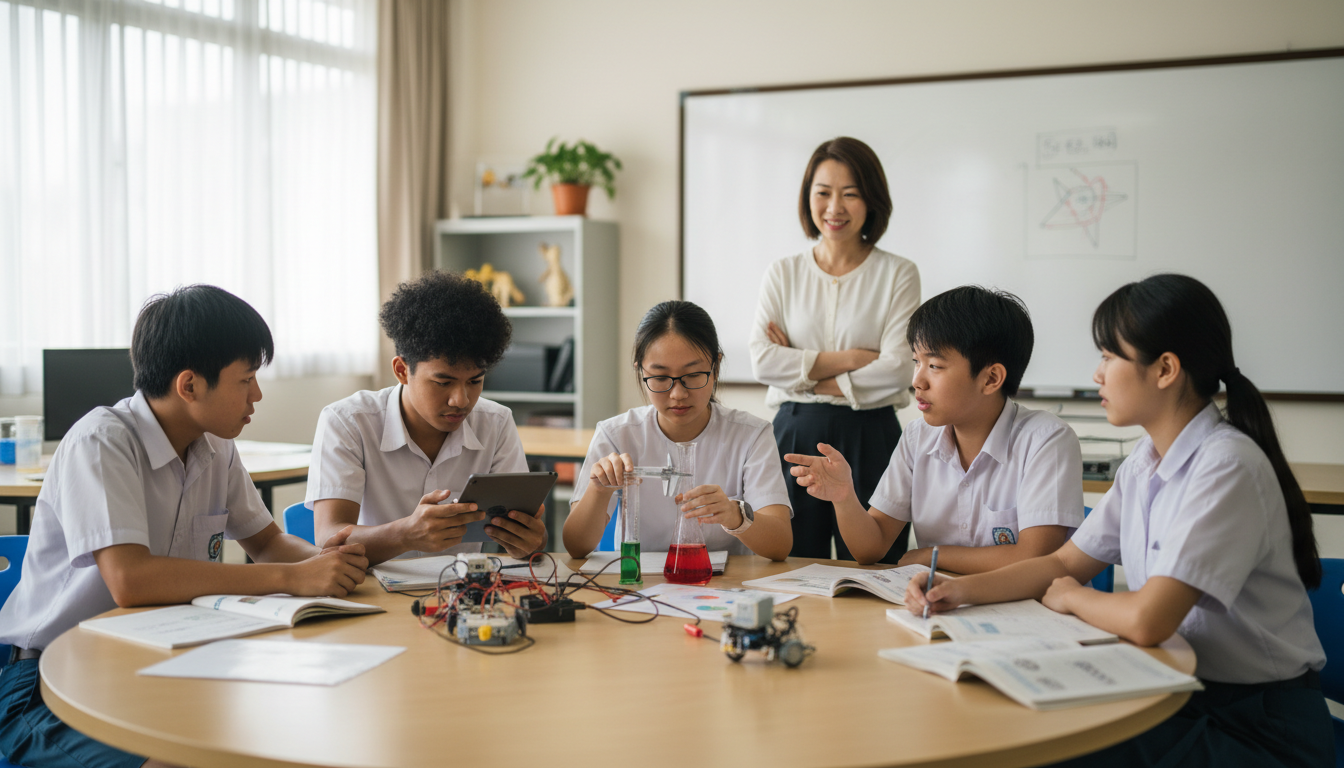
Secondary 2 G3 Science: memorising textbook facts without understanding scientific enquiry often leads to lost marks on practical reasoning and data questions. MOE’s lower-secondary G2/G3 Science syllabus expects learners to observe, measure, identify variables, interpret evidence and explain phenomena. These are skills parents can help improve before upper-secondary subject choices.
Start with a marked question involving a graph, table or fair test. Have your child state what was changed, what was measured, what remained controlled and what conclusion the evidence actually supports. Repeat this on fresh questions twice weekly and compare the written explanations, rather than simply re-reading notes.
- Match school topics to the official MOE lower-secondary G2/G3 Science syllabus.
- Separate recall mistakes from experimental-design and data-interpretation errors.
- Use an observation → science concept → explanation structure when the question demands reasoning.
- Practise identifying independent, dependent and controlled variables.
- Discuss pure and combined upper-secondary Science options with the school, not by assumption.
Parents may fear that one weak experiment rules out Chemistry, Biology or Physics later. It does not settle the decision. Schools have their own subject-selection criteria, and the child’s progress, interests and overall workload should all be considered with teachers.
Secondary 2 school assessments versus the later SEC examination
There is no national SEAB SEC examination in Secondary 2. Schools plan their own tests and weighted assessments against the applicable MOE lower-secondary teaching syllabus. The Singapore-Cambridge Secondary Education Certificate (SEC) begins in 2027 for graduating candidates, replacing the previous N(T), N(A) and O-Level national examinations. The SEC records individual subject levels, G1, G2 and G3, under Full Subject-Based Banding.
A Secondary 2 student in 2026 would normally graduate in 2028, so the SEAB 2027 syllabus directory is a reference to the new framework, not a guarantee that every detail will be identical for that child’s eventual examination year. Always check the official syllabus for the actual examination year, the school’s current scheme of work, and the criteria for any Secondary 3 subject combination. A Posting Group is not a permanent label for every subject.
Official framework: SEAB explanation of the SEC and 2027 G3 school-candidate syllabuses.
What the official lower-secondary Science syllabus requires
MOE’s G2/G3 lower-secondary Science syllabus emphasises scientific core ideas, Practices of Science, and values such as integrity and open-mindedness. Science learning includes inquiry and evidence, not just correct sentences from notes. Students should be able to plan investigations, gather and interpret observations and communicate justified conclusions.
Parents should use the MOE G2/G3 Lower Secondary Science syllabus together with the school’s teaching sequence. The SEAB 2027 G3 SEC directory lists later national options such as Physics K323, Chemistry K324, Biology K325 and combined Science combinations K326, K327 and K328. These are not one national ‘Secondary 2 Science’ paper.
Why knowing the notes is not enough
A definition answers what a term means. An investigation question may ask why an observed result changes or whether data support a claim. The student must use the concept in a particular setup. One accurate explanation is better than three related facts that never address the question.
- Concept error: the child has not understood the underlying science.
- Experiment error: the child cannot isolate variables or choose reliable measurements.
- Data error: the child misreads a scale, trend, unit or comparison.
- Reasoning error: the child claims cause without sufficient evidence.
- Writing error: the conclusion is too vague to answer the stated question.
The variable test every Secondary 2 child should understand
Imagine a safe, school-approved investigation asking whether changing the amount of light reaching plants is associated with changes in growth. Light condition is the independent variable; growth is the dependent variable; other conditions should be controlled. Ask what happens if water and plant type also change: can the result still be attributed confidently to light?
Use the same thinking with different familiar examples. The aim is to understand fair testing, not to memorise ‘independent variable’ as a phrase.
Graphs, measurements and claims
Ask the child to read the graph title, both axes, units and the stated range before interpreting a pattern. If two measurements increase together, the graph alone may not show that one caused the other. A careful answer distinguishes what the data demonstrate from what a separate scientific explanation proposes.
When writing conclusions, the child should respond to the investigation question, refer to the relevant observation and state limitations when asked. ‘My hypothesis was correct’ is not a sufficient scientific explanation.
Practical safety and a simple family activity
Choose a safe observation rather than an elaborate home laboratory. For instance, compare how equal quantities of comfortably warm water cool in two similar cups in safe locations, with responsible adult supervision. Record measurements consistently, notice differences and discuss what the setup can and cannot establish. Do not use boiling water, hazardous chemicals or unsafe electrical devices.
The purpose is to practise honest recording, clear variables and reasoned conclusions. It is not necessary to create perfectly neat data or force a preferred result.
A four-week Science repair programme
- Week 1: review two marked scripts; count errors in knowledge, application, graphs and experimental reasoning.
- Week 2: practise two short variable-identification or fair-test questions and explain why a control matters.
- Week 3: interpret tables and graphs from school work; justify one conclusion with evidence.
- Week 4: complete an independent mixed task and compare the same error categories. Seek teacher feedback on persistent patterns.
Short, repeated practice with feedback is often more effective than a weekend of copying notes, especially when other subjects and CCA already fill the child’s schedule.
Selecting upper-secondary pure or combined Science
Schools vary in the subject combinations they offer and the criteria for selection. Check which combinations are actually available, whether particular Mathematics skills are needed, how much independent studying is expected and what intended post-secondary courses require. Pure Science does not guarantee a better future; combined Science is not a judgement about the child’s ability.
An interest in experiments is valuable, but genuine suitability includes theory, scientific literacy, practical skills and sustained learning habits. Use conversations with the subject teacher and career-guidance staff rather than peer pressure.
When your child freezes at unfamiliar questions
First remove the clock and ask them to annotate what is changed, measured and observed. Next practise a familiar structure on unfamiliar diagrams. Only introduce moderate time limits after accuracy improves. If exam anxiety persists or affects attendance, request support from the school.
Frequently asked questions
Does Secondary 2 G3 Science include a national SEC practical? No; any Secondary 2 practical tasks are school-based.
Should we start pure Chemistry or Biology notes early? Only after current foundational concepts and enquiry skills are stable.
Can one weak mark bar all pure Science options? Not by itself as a general rule; ask the school about its actual selection process and criteria.
Parents’ next action
Choose one experiment or data question your child got wrong. Have them explain the variables and conclusion independently, and check progress after several new attempts. Ask their teacher which Science skill should become the next target.
Official sources and related eduKate guide
- MOE Lower Secondary G2/G3 Science syllabus
- SEAB 2027 G3 Science subjects and codes
- eduKateSG’s small-group feedback approach
Checked against MOE and SEAB information available on 24 November 2026. Confirm the student’s school-specific arrangements and the eventual examination-year syllabus directly with the authorities.