
notice · instruction · reminder · return · collect · bring · choose · queue · invited · gently. Theme: Reading Everyday Notices, Instructions and Useful Information at Primary 2. A short sign or notice can tell a child what to do, where to go, when to arrive and what to bring. The useful vocabulary is the language that guides a real decision.
This original companion to the eduKateSG Top 1000 Primary 2 Vocabulary library provides ten fictional practical texts and 40 comprehension questions with worked answers and precise evidence. The examples include school notices, a classroom recycling reminder, a pretend menu, an invitation and simple instructions. All notices, times, activities and prices on this page are invented for teaching and are not genuine school announcements, official MOE notices or a SEAB Primary 2 examination paper.
- Find the purpose: is the text informing, inviting, warning or giving instructions?
- Notice the reader: who needs to act on the information?
- Scan for details: look carefully for dates, places, objects and action verbs.
- Follow the steps: notice the order and words such as first, next and after.
- Check the evidence: answer using exact words from the short text.
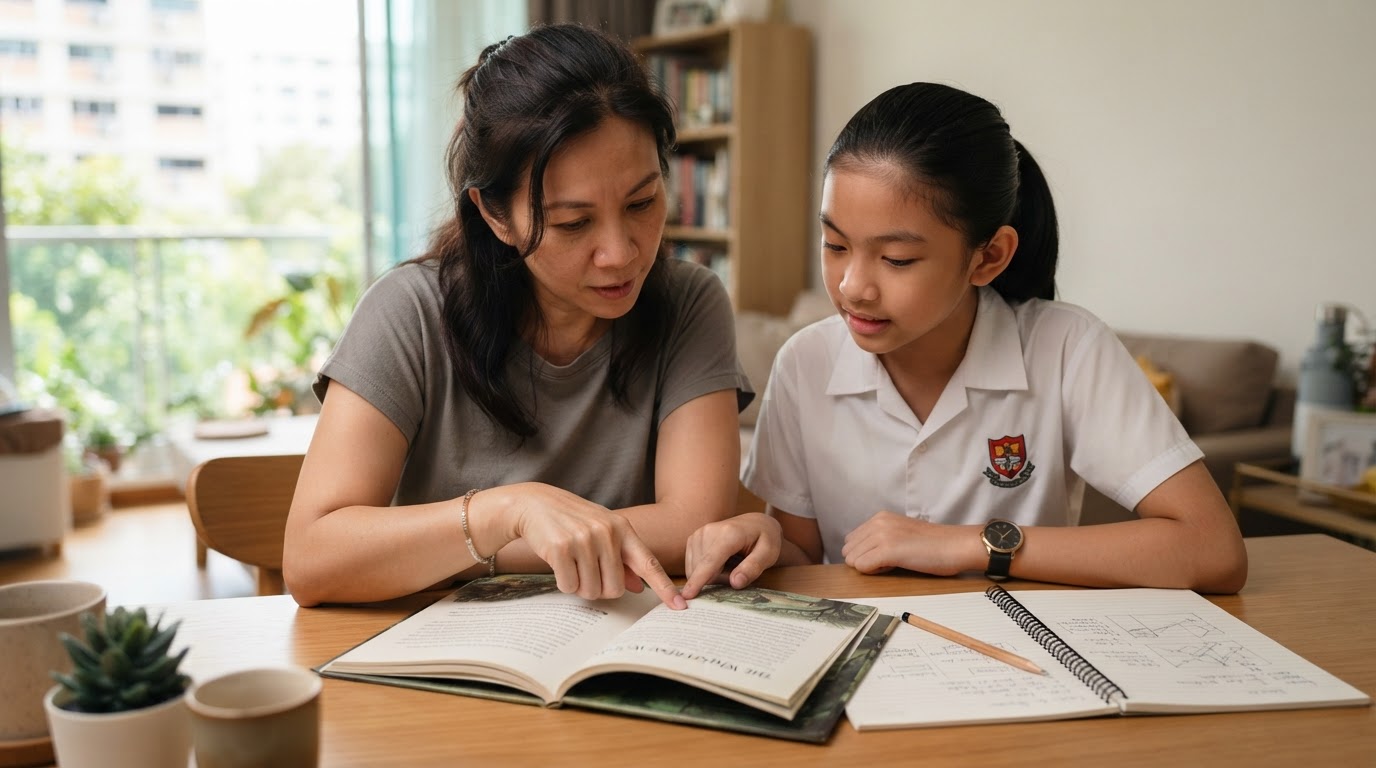
A parent can read each sample aloud once, then let the child try the four questions. Cover the answers until the child has pointed to the relevant words.
The goal is everyday comprehension and independent understanding, not a timed national assessment. Teachers may use different school materials, so families should give priority to their own child’s class learning.
All four original Top 1000 Primary 2 Vocabulary lists
- Words 1–250: People, Feelings and Friendship
- Words 251–500: Action Verbs and Everyday Life
- Words 501–750: Singapore, Nature and Description
- Words 751–1000: Story Clues and Comprehension
These linked vocabulary lists contain 1,000 distinct teaching headwords. This article reuses practical words in shorter everyday texts rather than introduce another official list.
How to read a short practical text
- Identify who wrote the text and who will read it, where that information is supplied.
- Ask what the text is for: information, invitation, reminder, warning or steps.
- Find essential facts such as time, place, thing to bring, thing to avoid and person to ask.
- Read the question again and point to the exact phrase that answers it.
- Give a short complete answer; do not invent missing details.
The reading-corner notice: questions 1–4
Fictional practice text: READING CORNER NOTICE: Open on Tuesday and Thursday after recess. Bring your reading card. Return books to the blue tray. Ask the teacher if you need help.
- Question 1. On which two days is the reading corner open? Model answer: Tuesday and Thursday. Evidence: “Tuesday and Thursday”.
- Question 2. When may pupils visit? Model answer: After recess. Evidence: “after recess”.
- Question 3. Where should books be returned? Model answer: To the blue tray. Evidence: “blue tray”.
- Question 4. Who can help a pupil? Model answer: The teacher. Evidence: “the teacher”.
Parent check: Ask whether this text is a notice, instruction, reminder or invitation, and what the reader is expected to do. Allow a shorter answer if it is accurate and addresses the question.
The recycling reminder: questions 5–8
Fictional practice text: CLASSROOM RECYCLING: Put clean paper and empty plastic bottles in the labelled collection box. Do not put food scraps inside. Fold large sheets of paper before placing them in the box. Ask an adult if you are unsure.
- Question 5. Name two items pupils may place in the box. Model answer: Clean paper and empty plastic bottles. Evidence: “clean paper and empty plastic bottles”.
- Question 6. What must not be put inside? Model answer: Food scraps. Evidence: “food scraps”.
- Question 7. What should pupils do with large sheets of paper? Model answer: Fold them first. Evidence: “Fold large sheets of paper”.
- Question 8. Who should a pupil ask when unsure? Model answer: An adult. Evidence: “an adult”.
Parent check: Ask whether this text is a notice, instruction, reminder or invitation, and what the reader is expected to do. Allow a shorter answer if it is accurate and addresses the question.
The school garden activity: questions 9–12
Fictional practice text: GARDEN ACTIVITY REMINDER: Our class will water the plants on Wednesday morning. Please bring a small reusable water bottle and wear your school shoes. Meet beside the garden gate after assembly. Tell your teacher if you cannot take part.
- Question 9. What will the class do? Model answer: Water the plants. Evidence: “water the plants”.
- Question 10. When is the activity? Model answer: Wednesday morning. Evidence: “Wednesday morning”.
- Question 11. Where should the pupils meet? Model answer: Beside the garden gate. Evidence: “beside the garden gate”.
- Question 12. What should a child do if unable to take part? Model answer: Tell the teacher. Evidence: “Tell your teacher if you cannot take part”.
Parent check: Ask whether this text is a notice, instruction, reminder or invitation, and what the reader is expected to do. Allow a shorter answer if it is accurate and addresses the question.
The pretend canteen menu: questions 13–16
Fictional practice text: SAMPLE CANTEEN MENU: Vegetable rice — $2.50. Fish soup — $3.00. Fruit cup — $1.20. Water — free when pupils bring their own bottle. Queue politely and tell the stallholder your choice.
- Question 13. Which meal costs $2.50? Model answer: Vegetable rice. Evidence: “Vegetable rice — $2.50”.
- Question 14. How much is the fruit cup? Model answer: $1.20. Evidence: “Fruit cup — $1.20”.
- Question 15. Which listed meal costs more, vegetable rice or fish soup? Model answer: Fish soup. Evidence: “Fish soup — $3.00”.
- Question 16. What should the pupil do when it is their turn? Model answer: Tell the stallholder their choice. Evidence: “tell the stallholder your choice”.
Parent check: Ask whether this text is a notice, instruction, reminder or invitation, and what the reader is expected to do. Allow a shorter answer if it is accurate and addresses the question.
The borrowing instructions: questions 17–20
Fictional practice text: BORROWING A CLASS BOOK: Step 1: Choose one book from the shelf. Step 2: Show the book to your teacher. Step 3: Write the title on the class borrowing sheet. Step 4: Place the book in your schoolbag carefully.
- Question 17. What is the first step? Model answer: Choose a book from the shelf. Evidence: “Choose one book from the shelf”.
- Question 18. To whom should the book be shown? Model answer: The teacher. Evidence: “your teacher”.
- Question 19. What information should the pupil write down? Model answer: The book’s title. Evidence: “Write the title”.
- Question 20. When should the book go into the schoolbag? Model answer: After the first three steps. Evidence: “Step 4: Place the book in your schoolbag carefully”.
Parent check: Ask whether this text is a notice, instruction, reminder or invitation, and what the reader is expected to do. Allow a shorter answer if it is accurate and addresses the question.
The lost-property box: questions 21–24
Fictional practice text: LOST-PROPERTY BOX: A pencil case and a water bottle were found beside the classroom door. If one belongs to you, tell your teacher and describe it. Please do not take items without checking. Unclaimed items will remain in the school office.
- Question 21. Which two items were found? Model answer: A pencil case and a water bottle. Evidence: “A pencil case and a water bottle”.
- Question 22. Where were the items found? Model answer: Beside the classroom door. Evidence: “beside the classroom door”.
- Question 23. What should an owner do? Model answer: Tell the teacher and describe the item. Evidence: “tell your teacher and describe it”.
- Question 24. Where will unclaimed items remain? Model answer: In the school office. Evidence: “school office”.
Parent check: Ask whether this text is a notice, instruction, reminder or invitation, and what the reader is expected to do. Allow a shorter answer if it is accurate and addresses the question.
Rainy-day play instructions: questions 25–28
Fictional practice text: RAINY-DAY PLAY: If the playground is wet, stay in the covered area with your class. Choose a quiet indoor game or read a book. Do not run on the slippery floor. Wait for a teacher to say when outdoor play may begin.
- Question 25. Where should pupils stay if the playground is wet? Model answer: In the covered area with their class. Evidence: “covered area with your class”.
- Question 26. Name one allowed activity. Model answer: Reading a book or choosing a quiet indoor game. Evidence: “read a book”.
- Question 27. What should pupils avoid doing? Model answer: Running on the slippery floor. Evidence: “Do not run on the slippery floor”.
- Question 28. Who decides when outdoor play may begin? Model answer: A teacher. Evidence: “a teacher”.
Parent check: Ask whether this text is a notice, instruction, reminder or invitation, and what the reader is expected to do. Allow a shorter answer if it is accurate and addresses the question.
The class reading challenge: questions 29–32
Fictional practice text: READING CHALLENGE: Read for ten minutes each evening from Monday to Friday. Choose a story you enjoy. Tell a family member one thing that happened. Bring your reading log to class on Friday.
- Question 29. How many minutes should the child read each evening? Model answer: Ten minutes. Evidence: “ten minutes”.
- Question 30. On which days does the challenge run? Model answer: Monday to Friday. Evidence: “Monday to Friday”.
- Question 31. What should the child tell a family member? Model answer: One thing that happened in the story. Evidence: “one thing that happened”.
- Question 32. When should the reading log be brought to school? Model answer: Friday. Evidence: “on Friday”.
Parent check: Ask whether this text is a notice, instruction, reminder or invitation, and what the reader is expected to do. Allow a shorter answer if it is accurate and addresses the question.
The class invitation: questions 33–36
Fictional practice text: YOU ARE INVITED: Join our class sharing circle on Thursday at 2:00 p.m. in Room 2. Bring one drawing or short story to show your classmates. If you would rather listen, you may do so. Please arrive five minutes early.
- Question 33. Which day is the sharing circle? Model answer: Thursday. Evidence: “Thursday”.
- Question 34. At what time does it begin? Model answer: 2:00 p.m. Evidence: “2:00 p.m.”.
- Question 35. Where will it take place? Model answer: Room 2. Evidence: “Room 2”.
- Question 36. Does every pupil have to speak? Model answer: No. A pupil may listen instead. Evidence: “you may do so”.
Parent check: Ask whether this text is a notice, instruction, reminder or invitation, and what the reader is expected to do. Allow a shorter answer if it is accurate and addresses the question.
The book-care reminder: questions 37–40
Fictional practice text: TAKE CARE OF BOOKS: Use clean hands when reading. Turn pages gently. Keep food and drinks away from library books. If a page tears by accident, tell the librarian rather than trying to hide it.
- Question 37. How should hands be when reading? Model answer: Clean. Evidence: “clean hands”.
- Question 38. How should pages be turned? Model answer: Gently. Evidence: “Turn pages gently”.
- Question 39. What should be kept away from library books? Model answer: Food and drinks. Evidence: “food and drinks”.
- Question 40. What should a pupil do after accidentally tearing a page? Model answer: Tell the librarian. Evidence: “tell the librarian”.
Parent check: Ask whether this text is a notice, instruction, reminder or invitation, and what the reader is expected to do. Allow a shorter answer if it is accurate and addresses the question.
Common errors when children read signs and notices
- Missing the date: a pupil reads the activity but overlooks which day it happens.
- Ignoring the negative: ‘Do not run’ is very different from ‘Run’.
- Changing order: an instruction labelled Step 4 should not be completed before Step 1 without a reason.
- Assuming missing details: if a notice does not list a phone number, the pupil should not invent one.
- Confusing a suggestion with a rule: ‘You may listen’ offers a choice; ‘Bring your log’ gives a task.
How to help a Primary 2 child understand purpose and audience
A notice is written for someone and a reason. Ask, ‘Who needs to read this?’ and ‘What should that person do next?’ A lost-property notice tells an owner to check an item; a borrowing instruction tells a pupil how to complete a task; an invitation tells a guest when and where to come. Recognising the purpose often makes the vocabulary easier to interpret.
One practical-text writing activity
Invite the child to write a three-sentence reminder for a made-up class reading event. Include a day, a place and one thing to bring. Read it aloud and check whether another child would know what to do. Keep it explicitly labelled a pretend school notice when displaying it at home.
A seven-day home routine
- Day 1: read one fictional notice and underline the action words.
- Day 2: read one instruction text and number the steps.
- Day 3: practise finding times and places in a simple invitation.
- Day 4: choose words that tell a reader what not to do.
- Day 5: compare an invitation, a reminder and an instruction.
- Day 6: write one short pretend notice and check for missing details.
- Day 7: review the most difficult questions and enjoy a short story together.
When a child finds practical texts confusing
Separate the difficulty. A child may read the words but miss the instruction, confuse the time, or misunderstand the audience. Read one sentence, ask what the reader should do, then point to the supporting phrase. Small, real-life examples help words such as ‘bring’, ‘return’ and ‘avoid’ become useful.
If a child finds decoding difficult, support phonics and fluency first. If the child can read but does not understand the purpose, practise shorter signs with real objects. Check the teacher’s feedback for the next suitable step rather than treating the 40 examples as a score.
MOE Primary English and Singapore assessment information
MOE’s English Language Syllabus 2020 (Primary) covers understanding varied texts, reading for purpose, vocabulary use and appropriate communication. MOE states that weighted assessments and examinations were removed for Primary 1 and Primary 2. The PSLE is the national examination at the end of primary education. These fictional samples are original practice, not government forms, current schedules or official examination specimens.
Primary 2 parent FAQ
Does Primary 2 have an official national visual-text examination?
No. Primary 2 does not have a national SEAB English examination. Reading signs, messages, notices and instructions is useful language learning rather than evidence of a prescribed national test.
Why practise a menu or reminder instead of only stories?
Different text types help the child read for different purposes. A story may describe events; a short notice may tell the reader what to do or where to go. Both require vocabulary and comprehension.
Do children need to memorise the details of these fictional notices?
No. They should practise locating the information in front of them, identifying its purpose and answering the question accurately.
Continue with other Primary 2 English activities
- 40 Evidence-Based Story Comprehension Questions
- 40 Context-Clue Vocabulary Cloze Questions
- 40 Listening and Conversation Responses
- 40 Word Families, Prefixes and Suffixes
Explore eduKateSG’s vocabulary resources or Primary 2 English small-group tuition when a child needs guided reading, meaning-in-context work and feedback.