
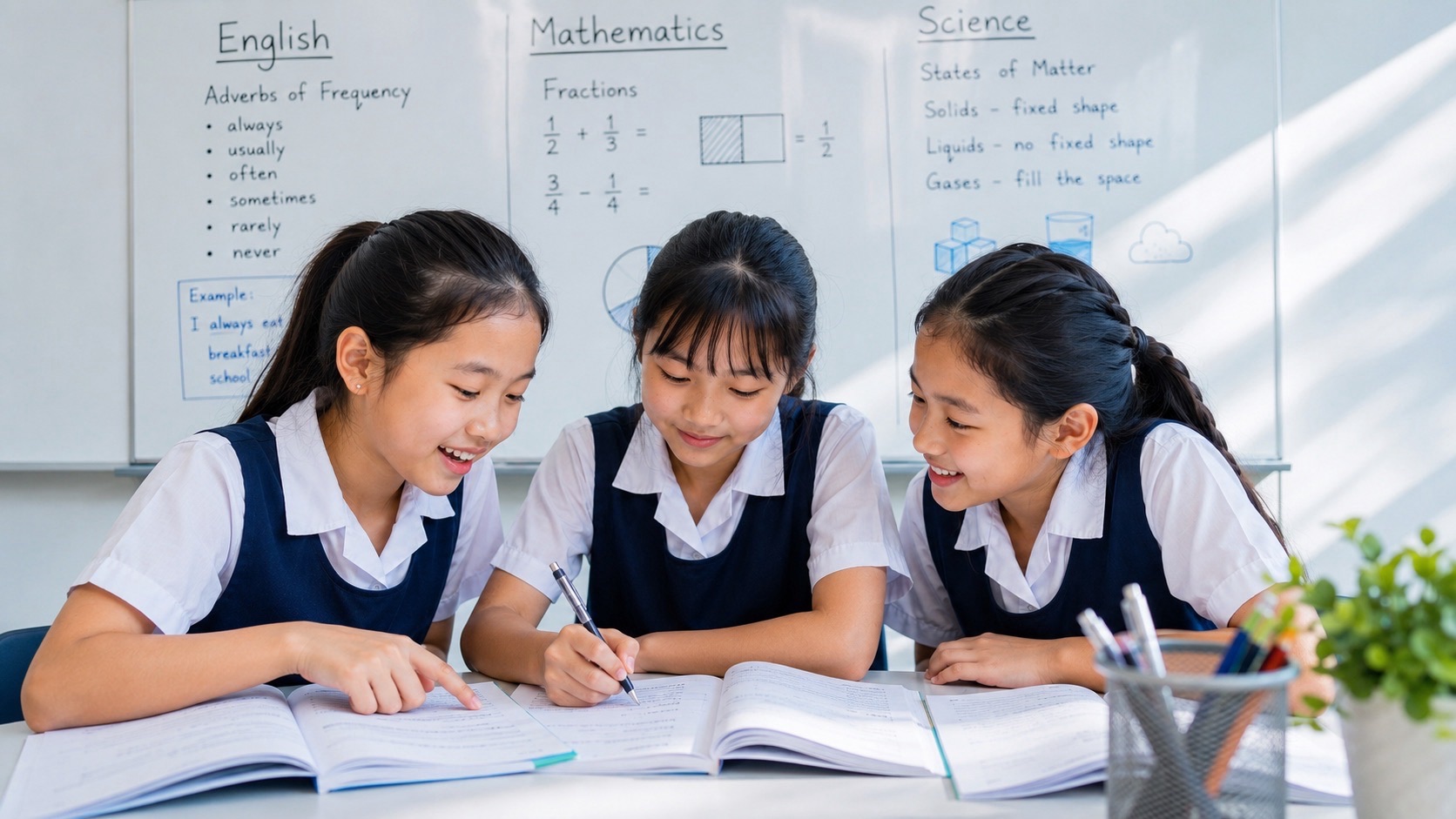
Primary 2 English writing can include explaining what a child notices, learns or wants another person to know—not only inventing a story. A simple observation diary or information report helps pupils select facts, organise short sentences, use clear vocabulary and communicate for a real reader. Singapore’s MOE Primary English syllabus develops writing and representing, reading and viewing, grammar and vocabulary across different purposes. At P2, the useful target is an accurate short explanation, not an upper-primary Science report or a formal PSLE writing paper.
Parents should begin with a real, safe subject the child can observe directly. A plant on the windowsill, a familiar library book, a paper model or a supervised visit to a garden can provide material. Ask what the child actually saw, when they saw it and what changed. Help them choose two or three relevant details, then write a clear short account. If the child invents facts, show the difference between observing, remembering, inferring and checking information. If writing is difficult, allow a brief oral description before drafting.
- What to expect in English: age-appropriate factual descriptions, short purposeful writing, labels, sequence and growing independence.
- Report structure: identify the topic, select a few accurate facts and explain them in a sensible order.
- Diary structure: record the date, what was observed and any change, using the child’s own words.
- Important distinction: what the child observed is not always the same as what they think or predict.
- Future pathway: this builds readiness for P3 language and Science explanations but cannot forecast PSLE scores or secondary-school placement.
What the official English syllabus says about writing for information
The MOE Primary English Language Syllabus 2020 develops writing and representing through generating, selecting, organising, expressing and revising ideas. Reading and viewing provide models of how texts communicate information. Grammar and vocabulary support clarity. These learning principles make short observational and factual writing useful at lower primary, though an identical ‘observation diary’ assignment is not mandated in every Primary 2 school.
Schools may ask children to write a description, record something observed, label a picture, recount an activity or explain an object. The exact formats and assessment arrangements vary, so parents should follow their teacher’s current instructions instead of claiming every P2 pupil must produce the same report.
Factual writing serves a different purpose from a fictional narrative. The reader needs to know what was observed or established, not simply what would make an exciting story. A brief accurate report may be better than a longer one filled with dramatic invented details.
The key distinction: an observation is not a guess
If the child sees water droplets on the outside of a bottle, they can accurately write, ‘There are small droplets on the bottle.’ If they say ‘The bottle is leaking’, they have made a possible explanation that may be wrong. The visible droplets alone do not establish where the water came from.
Teach children to describe before explaining. ‘I saw’, ‘I noticed’, ‘I counted’ and ‘I heard’ can introduce observations. ‘I think’, ‘perhaps’ or ‘it may be’ can identify an inference or prediction. These phrases make the difference clearer without requiring a technical Science lesson.
This habit will become valuable when pupils meet more subject-specific inquiry tasks later, but the immediate learning focus is accurate English.
Original worked example: observing a bean seedling
Illustrative observation scenario: A family plants a bean seed in a clear cup with suitable growing material and adult supervision. The child observes the cup on selected days. The following entries are fictional examples of what a particular seedling might show, not promises about the rate at which every seed will grow.
Day 1: what was observed?
‘On Monday, I put one bean seed into the cup. I could see the seed under a thin layer of growing material.’ This entry records a starting action and a visible fact. It does not need to predict exactly when roots will appear.
Day 4: what changed?
‘On Thursday, I saw a small pale shoot near the surface. It was shorter than my little finger.’ This is a simple descriptive comparison in the fictional scenario. The child should only write it if that is what their own observation actually shows.
Day 7: what can the pupil report?
‘On Sunday, the shoot was taller and had a small green leaf.’ A dated entry records a change. If no leaf appeared in real life, the child should not copy this example and pretend it did.
Ask the pupil to compare the entries. Which new detail appears later? Which words show a change? An observation diary becomes useful when its sentences are tied to what happened, not what a worksheet model suggested should happen.
What makes a good diary entry at Primary 2?
- Date or time: enough information to know when the observation was made.
- Subject: name the plant, object, place or event.
- Observation: one or two details the child directly noticed.
- Change: what looks different from the previous entry, if anything.
- Uncertainty: explain when something is only a guess or prediction.
The pupil does not need all five headings every day. For a beginner, a date and one accurate sentence may be an appropriate first step. Over time, the child can add useful detail and compare observations.
Original worked example: a classroom object report
Imagine the child wants to explain a handmade pencil holder to a younger sibling. A short information report could say: ‘Our pencil holder is made from a reused cardboard tube. We covered the outside with paper. It stands on a flat cardboard base. We use it to keep pencils together.’
The passage identifies the object, material, construction and purpose. It provides information without inventing a heroic story. This is original teaching material, not a school assignment or claim that every cardboard tube is safe for all craft projects.
Ask what the younger sibling needs to know. If the task is to explain how to make a holder, the order of construction steps becomes more important. A factual description and a procedure are related but different writing purposes.
The difference between a report, recount and procedure
Short report
A report tells the reader about a topic or object: what it is, what can be observed or what verified facts are known. Example: ‘This paper model has two wheels and a cardboard body.’
Recount or diary
A recount tells what happened in a particular experience or observation over time. Example: ‘On Friday, we built the model. On Saturday, I noticed that one wheel was loose.’
Procedure
A procedure explains steps another person should follow. Example: ‘First, place the cardboard on a table. Next, attach the paper pieces with an appropriate adhesive.’ Adults should supervise real craft instructions and check their safety.
The P2 child does not have to memorise formal genre taxonomies. Instead, ask what the reader needs. Is the child explaining an object, remembering what happened, or helping someone complete a task?
Selecting facts: why longer does not always mean better
A child might write ten sentences about the colour of a seedling’s cup while never mentioning what was observed growing. Another might copy a whole encyclopaedia paragraph to make the report look advanced. Both miss the purpose of a short observation record.
Teach the child to choose details that help the reader understand the subject or change. In a plant diary, the shoot, leaves and observable growth may be relevant. The colour of the tablecloth may not matter unless it affected the activity.
This selection habit is a language skill. It does not mean children must exclude everything enjoyable or personal; instead, they learn to distinguish the key information from decoration.
Headings and labels help a reader find information
A report can have a simple heading such as ‘My Pencil Holder’ or ‘Our Bean Seedling’. A labelled drawing may identify parts that the child wants the reader to notice. Labels should be accurate and connected to the subject.
If the child draws a plant, ask what part they can confidently name. An ordinary leaf or stem label may be appropriate if the pupil has learnt it. Do not invent technical botanical labels or require complete Primary 3 Science content as a condition for writing a useful P2 report.
The eduKateSG: P2 English posters, notices and visual information guide explains how readers use headings, labels and information layout. The same awareness supports children when they create their own simple texts.
Writing a caption instead of another full paragraph
A caption briefly explains a picture or drawing. Under a sketch of a model, a child might write: ‘The two paper wheels are attached to the cardboard body.’ This gives information that is relevant to what the reader sees.
A weak caption might be ‘This is good’ because it does not explain the feature. Ask what the picture actually shows and which detail a new reader should notice. Then let the child produce a revised caption independently.
Using measurement words responsibly
A pupil may describe an object as longer, shorter, taller, heavier or lighter. These comparisons should be based on actual observation or a suitable measurement. If the child has not measured a plant, ‘It grew taller’ may be reasonable by comparison, but ‘It grew exactly 10 centimetres’ should not be invented.
When a ruler is used, check that the pupil records the appropriate unit and what was measured. The Mathematics skill and English description reinforce one another, but a P2 English writing task does not require advanced scientific precision.
Time words make a diary readable
‘First’, ‘next’, ‘later’, ‘yesterday’, ‘today’ and ‘after’ help a reader follow the sequence. A diary should record events in a clear order rather than jump between dates without explanation.
For example, ‘On Monday, I planted the seed. By Friday, I noticed a shoot’ gives a sequence. The child should still check that those were their actual dates and observations.
If the child mixes verb times, model one suitable past-tense sentence and ask for a new example. Grammar works best when it helps a genuine message.
What if nothing changed between observations?
A meaningful observation can state that there was no visible change. ‘On Tuesday, I could not see a shoot yet’ is more accurate than copying an expected result. It helps children learn that not every diary entry needs an exciting event.
Explain that observation records are not stories where something must happen on every page. Accuracy is the success criterion. If the child does not know why a change occurred, it is appropriate to record the observation without inventing an explanation.
How to check whether a fact came from the child or a book
If a child writes a statement based on a library book, distinguish that from something seen directly. ‘My book says that some plants grow from seeds’ is a report of a source; ‘I saw a shoot today’ is an observation. The child can learn to name where information came from at an age-appropriate level.
A parent can say ‘Where did you learn that?’ and help check the book or teacher’s explanation. This supports early information literacy without demanding formal research referencing in a short Primary 2 diary.
The eduKateSG: facts, opinions and evidence in P2 reading guide helps children distinguish facts, opinions and inferences in reading. The same distinction is valuable when they begin creating factual accounts.
A complete original library visit information report
‘Our neighbourhood library has shelves of books for children. I saw storybooks, picture books and some books about animals. A librarian showed our group where to borrow books. I liked the quiet reading corner because I could look at a book without being rushed.’
This is an illustrative report about an imagined visit, not a claim about any specific library’s current layout or services. Ask the child which sentences describe observations and which express the writer’s own preference.
An information report may include a personal response if the task calls for it, but readers should be able to distinguish the writer’s opinion from the observed features.
A four-step drafting routine
- Choose the reader: who needs to understand this topic or observation?
- Say the facts aloud: what did the pupil actually see, do or verify?
- Write the important details: choose a short sensible order and accurate language.
- Reread for clarity: could someone who was not there understand the description?
Only after meaning is clear should the child check one or two relevant punctuation or grammar patterns. The parent should not replace the entire text with adult wording.
A four-week parent plan for information writing
Week 1 — notice and name
Choose one safe object or event. Ask for two direct observations and let the child say them before writing. Avoid scoring an entire report.
Week 2 — record the next observation
Return to the same object or an activity at a later time. Ask what changed, what stayed the same and which detail matters most. Use a short dated entry.
Week 3 — add headings and a clear reader
Ask the child to give the record a simple title and select a useful caption or label. Explain the difference between information and personal preference when the task requires it.
Week 4 — apply the skill to a different topic
Choose a new subject, such as an interesting library book or a paper model. Let the pupil write a short original description without copying the earlier seedling diary. Share persistent writing difficulties with the class teacher.
What school feedback can tell parents
MOE removed weighted assessments and examinations at P1 and P2 from 2019; see MOE policy on P1 and P2 assessments. Schools may still use classroom reports, drawings, writing samples and non-weighted tasks to understand how children communicate. Ask what the activity was assessing: accuracy, selection, organisation, sentence construction or ability to distinguish observation from inference.
A low score on one class project is not a PSLE Achievement Level. A polished report produced with substantial adult help is not equivalent to independent writing. The amount of guidance matters when deciding the next teaching step.
How factual writing can help before Primary 3 Science
Science is formally introduced as a primary school subject at P3. A child who can carefully describe a change, use time words and separate observation from an explanation will have useful language foundations. That is not a reason to impose upper-primary Science questions on a P2 learner.
At P3, subject concepts and investigation skills develop through school instruction. In P2, parents can focus on curiosity, honest observation and accurate English sentences.
When additional help may be necessary
If a child struggles to read the source text, understand simple instructions or write even short original sentences after suitable teaching, speak with school staff. A specific gap in phonics, vocabulary, handwriting or sentence planning requires a different response from a child who simply needs to select better factual detail.
Tuition may help with a persistent identifiable language skill, but a commercial programme is not necessary for every child. Ask whether instruction produces more independent writing in fresh tasks rather than only neat copied reports.
How PSLE and later secondary schools fit into the timeline
A pupil in P2 in 2026 progressing normally would ordinarily take the PSLE in 2030. Presently, Standard-level PSLE subject ALs range from AL1 to AL8, with lower total PSLE Scores better. No P2 diary, caption or information report can reliably predict a future English AL or Posting Group.
The present MOE PSLE and Full Subject-Based Banding explains secondary school posting and subject-level flexibility. When the pupil has their actual PSLE results, families should use MOE SchoolFinder to check updated school eligibility, subjects, programmes and locations. Current cut-off ranges are historical references, not future guarantees.
Later estate-based secondary school research
Queenstown and Clementi families might eventually explore Queenstown Secondary, Commonwealth Secondary and Clementi Town Secondary. Punggol families could research Punggol Secondary and Greendale Secondary; Sengkang families may investigate Seng Kang Secondary and Nan Chiau High; Yishun families might compare Naval Base Secondary and Yishun Town Secondary. These names are geographical examples, not promises of future admission or rankings.
When the actual posting year arrives, compare school culture, programmes, subjects, CCAs, daily travel time and learning support against the child’s actual eligible choices. At Primary 2, helping the child write a truthful, readable description is the immediate goal.
Frequently asked questions
Must every P2 pupil write a science observation diary?
No. It is a useful English writing activity, not a compulsory nationwide Primary 2 Science report. Schools vary in their tasks.
Should a child copy facts from the internet into the report?
No. They should understand any source and know where information came from. For an observation diary, describe what was actually observed.
What if the plant does not grow according to our model example?
Write what really happened. An accurate record with no change is better than an invented observation.
Is a caption enough for a P2 writing task?
That depends on the teacher’s instructions. Captions are useful when they communicate the necessary information, but some tasks require connected sentences.
Does a short report need sophisticated adjectives?
No. Precise and relevant everyday words are often more effective than advanced language used inaccurately.
Could doing observation diaries guarantee PSLE AL1 English?
No. It develops useful literacy habits but does not forecast a national examination years later.
What parents can do this weekend
Choose one safe object or event, ask the child what they noticed and help them write a date, a title and two accurate observations. The next time, record one change without inventing a result. Continue with eduKateSG: Primary 2 nonfiction reading and fact files, eduKateSG: P2 English notes, invitations and messages, eduKateSG: making P2 English paragraphs clear and the eduKateSG Primary 2 English syllabus overview for further Primary 2 English ideas.
Official references and related eduKateSG guides
- MOE Primary English Language Syllabus 2020
- MOE policy on P1 and P2 assessments
- eduKateSG: Primary 2 nonfiction reading and fact files
- eduKateSG: P2 English posters, notices and visual information
- eduKateSG: P2 English notes, invitations and messages
- eduKateSG: facts, opinions and evidence in P2 reading
- eduKateSG: making P2 English paragraphs clear
- MOE SchoolFinder
- MOE PSLE and Full Subject-Based Banding
Editorial review: 26 November 2026. All observation diary and information report examples are original illustrative teaching material, not actual science observations or official P2 assessment formats. Confirm school-specific writing expectations with the current teacher.