
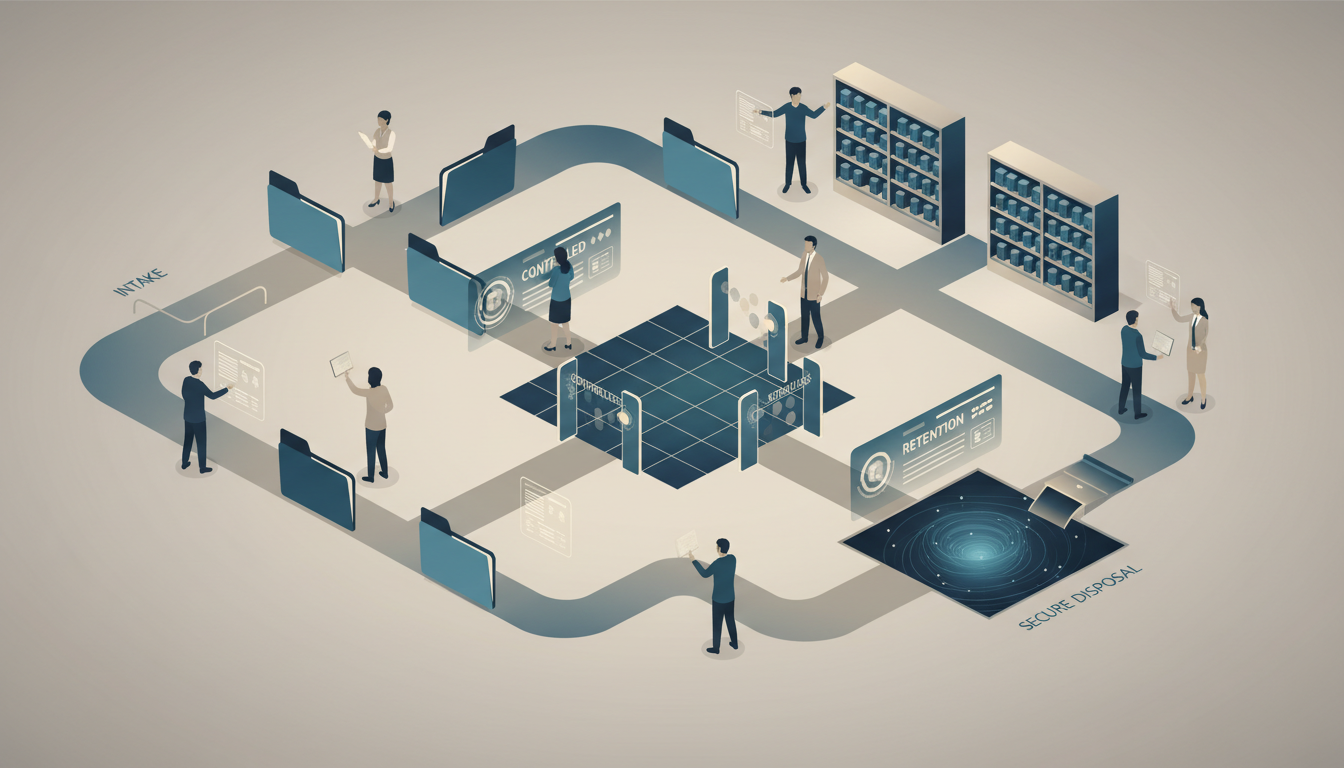
An AI system can sometimes prove a precisely defined claim about a private computation without revealing the private information used in that computation. Zero-knowledge cryptography makes this possible under the chosen protocol’s conditions. It does not automatically prove that the system understands a word, that its evidence describes reality, or that its decision deserves authority. The decisive question is what the proof actually establishes. The foundations appear in Goldwasser, Micali and Rackoff’s work on interactive proofs.
Imagine a private archive whose AI labels a letter as eligible for release. An outside reviewer wants assurance that the agreed rule was applied, while the archive must protect the letter’s contents. A cryptographic proof might resolve that narrow conflict. Yet a different question remains: did the agreed rule capture what private, consent and release should mean for this letter? This article uses a hypothetical archive to examine the boundary between confidential verification and public understanding.
- A zero-knowledge proof concerns a declared statement; its privacy guarantee does not make that statement broader.
- Cryptographic knowledge of a witness is a technical notion, distinct from understanding an idea.
- A correct computation can process incomplete evidence or apply an inadequate classification rule.
- Public answers can themselves reveal sensitive information, even when the proof reveals no additional witness information.
- Private records and public reasons may need different forms of access and review.
- A useful AI assurance claim names its rule, inputs, version, assumptions and remaining uncertainty.
eduKateSG · Vocabulary, Superintelligence And Beyond
Choose your reading route
Read the full argument in order, or begin with the question closest to yours.
ROUTE 2 · SECTIONS 4–8
Trace the statement, private evidence and interpretation.
ROUTE 3 · SECTIONS 9–12
Inspect formal scope, changing evidence and review rights.
Contents
Sections 1–3 · Understand the proof
Sections 4–8 · Follow the archive example
Ordinary verification often involves showing the supporting material. An auditor sees a document, checks a calculation and decides whether the conclusion follows. That approach becomes difficult when the supporting material contains information the auditor should not receive.
Zero knowledge concerns what a verifier learns through a proof. Roughly, the proof should add no efficiently obtainable information beyond the declared statement’s validity, within the formal security definition. Completeness concerns acceptance of valid claims; soundness limits acceptance of false ones. A protocol may provide different kinds of security and rely on computational assumptions. These are distinct properties, not interchangeable uses of the word secure. See the original extended abstract.
For the archive, the attraction is practical: a reviewer may check a restricted claim without receiving an entire letter. The institution still needs to explain why that restricted claim answers the reviewer’s actual question. Keeping evidence private creates no exemption from defining the question carefully.
SECTION 2 OF 12 · Understand the proof
2. The word knowledge changes meaning inside the proof
A proof of knowledge introduces a further technical requirement. In the formal treatment developed by Bellare and Goldreich, a sufficiently successful prover must support an appropriate extraction procedure that obtains a witness, subject to the definition’s conditions and knowledge error. The witness is an object satisfying a specified relation. It could be a secret value or an assignment that makes a formula true.
This does not assert that the prover has a conscious belief, can teach the concept, or appreciates the consequences of using the information. Nor does the extractor’s role mean an ordinary verifier receives the secret during the actual protocol. Extraction belongs to the security argument; privacy concerns the verifier’s permitted view.
An AI supplier therefore needs care with the sentence the system proved it knows. Knows which witness, relative to which relation? Calling a witness an understanding certificate would add a claim that the cryptographic definition did not supply. An ordinary zero-knowledge proof should not silently be presented as a proof of knowledge either; the required properties must be established for the chosen system.
Consider a hypothetical archive holding correspondence from a research expedition. Its release policy requires a signed permission record, an expired embargo and no unresolved objection recorded in a designated register. A letter contains the sentence: You may share this with the team. Years later, someone asks to place the letter in a public exhibition.
The archive’s AI converts that sentence into a permission field. Its rule engine then combines the field with dates and register entries. An outside reviewer asks whether the public exhibition satisfies policy version 7. The archive offers to prove that the version 7 computation returned eligible using its committed records.
Even a flawless proof leaves several possible disputes. Did the permission cover exhibition visitors or only expedition members? Was the objection register complete? Was an apparently valid signature produced by the relevant person? Which later correction should have governed the decision? These are different questions with different evidence requirements.
The example is deliberately constructed. It illustrates why an accurate account of computation must retain the distinction between a sentence, its encoded interpretation and the action that follows. The proof can strengthen one link without establishing every link.
SECTION 4 OF 12 · Follow the archive example
4. Separate the public statement, private witness and world
For this proposed design, the public statement identifies the policy version, the commitments to particular records and the result being claimed. The private witness supplies those records and the information needed to demonstrate their connection to the commitments. The agreed relation checks both that connection and the specified calculation.
This arrangement is a sketch of what a system would need to formalise, not a ready-to-deploy protocol. Its security would depend on the selected commitment and proof schemes, the implementation and the exact statement. Saying there exists some record that passes would be much weaker than tying the proof to the record under review.
The archive should publish a readable account of these boundaries alongside the technical specification. Otherwise, a reviewer may mistake a precise answer to a narrow question for an answer to a larger one.
| Layer | Archive example | Question still requiring attention |
|---|---|---|
| Public statement | These committed records produce eligible under policy version 7. | Is that the policy and decision being challenged? |
| Private witness | The records and commitment-opening information used by the prover. | Were relevant records omitted before commitment? |
| Formal relation | The specified checks connecting records, rule and result. | Does the formal rule capture the intended release conditions? |
| World and interpretation | The writer, the team, the exhibition and the permission’s context. | What evidence supports the encoded interpretation? |
SECTION 5 OF 12 · Follow the archive example
5. The most consequential step may precede the proof
Suppose the language model sets permission_scope = public. A rule engine then executes perfectly, and a proof confirms that execution. The mathematical assurance applies after a disputed interpretation has already entered the system as a field.
Adding the language model’s execution to the proved computation would close a different gap: it could establish that the designated model produced that field. It would still leave the question of whether the model interpreted this letter appropriately. Proving how a classification was produced and defending the classification are separate tasks in this example.
A better archive workflow would preserve the original phrase, the interpretation, competing readings and the point at which someone approved a reading for use. A reviewer with suitable access could then challenge the interpretation without asking for every private record. This extends the series’ discussion of what an AI proof of understanding would need to establish.
SECTION 6 OF 12 · Follow the archive example
6. What verifiable machine learning can add
The distinction has a concrete research counterpart. Liu, Xie and Zhang’s zkCNN develops proofs that a prediction was computed by a particular convolutional neural network while protecting the model. The paper also considers proving that a private model achieves a claimed accuracy on a public dataset. These are specified computational claims, not certificates of unrestricted understanding.
For our archive, this suggests a useful question: which part of the pipeline needs protection against substitution? Perhaps the reviewer needs assurance that the approved model was used rather than a cheaper replacement. Perhaps the disputed step is an extra filter inserted after classification. Those are concrete targets for verification.
The appropriate claim would identify the proved operation. A broad badge reading AI verified would obscure whether the system checked model execution, dataset performance, policy calculation or something else. The article’s inference is that assurance should travel with its scope, not detach into a general reputation for reliability.
SECTION 7 OF 12 · Follow the archive example
7. A private proof can accompany a revealing answer
Return to the hypothetical archive. A person asks whether an otherwise unnamed correspondent objected to release. If the public answer is yes, the answer itself reveals something. A proof that discloses no additional witness information cannot make that chosen disclosure disappear.
Now imagine permitting repeated queries: did an objection arrive before June, before March, before February? If the archive answers each question exactly, the questioner can narrow a date through the answers alone. That inference follows from the proposed query interface; it does not require breaking the proof system.
The design question therefore includes what claims may be made public, who can request them and how combinations of answers affect privacy. A team cannot evaluate confidentiality only by inspecting the proof transcript. It must also examine the information deliberately placed in the public statement and result. This is an analytical consequence of the archive example, rather than a claim that every proof protocol behaves identically under repeated use.
There is another possible design: keep the release rule private and prove that the archive followed it. This could protect a legitimate secret. It could also leave the affected person unable to discover why their letter was released.
A rule that returns eligible for every letter would be easy to obey. If outsiders cannot inspect what the rule permits, compliance with it provides little basis for assessing whether it respects the author’s request. An independent reviewer might inspect the private rule, but that introduces a separate institutional responsibility: who reviews the reviewer, and how can a disputed interpretation be challenged?
The proposed distinction is between confidentiality of the evidence and intelligibility of the governing reasons. An archive might protect the letter’s full text while explaining the relevant rule, disclosing the disputed interpretation to the person concerned and providing a correction route. Exactly how much must be shared depends on the purpose of the review, rather than on a universal demand to reveal everything.
SECTION 9 OF 12 · Assess the promise
9. Powerful proofs still need a stated question
The generality of zero knowledge is substantial. Goldreich, Micali and Wigderson’s result establishes, under suitable cryptographic assumptions, zero-knowledge proof systems for every language in NP. Informally, these are decision problems whose yes answers have witnesses that can be checked efficiently. This is a breadth result about formal statements, not a promise of a practical implementation for every application.
For the archive, that breadth does not choose which statement matters. A team must still decide whether the rule concerns recorded objections, all objections actually made, or the writer’s wishes under a changed audience. Those alternatives describe different obligations. Turning one into a checkable relation does not demonstrate that the alternatives were irrelevant.
The frontier is therefore partly linguistic: how much of the promise survives when ordinary language becomes a formal question? A more capable future AI could help expose missing conditions. Its assistance would still need assessment against the intended purpose.
SECTION 10 OF 12 · Assess the promise
10. Use proposed semantic layers to preserve the boundary
Within this series’ proposed framework, a Z-layer record could connect the phrase eligible for release to its policy definition, the exact formal relation and examples that remain disputed. This is a proposed method of semantic bookkeeping, not an established cryptographic standard or an immutable guarantee of meaning.
A corresponding ZTime record could distinguish when the letter was written, when permission was interpreted, which rule version applied and when a later objection became available. A proof attached to yesterday’s inputs would then remain identifiable as a claim about those inputs. It would not silently become assurance about today’s decision.
Zoom levels help organise the review: inspect the encoded field, the complete letter, the archive’s release process and the public consequences separately. The goal is to make the transition between these levels visible. The earlier article on a proposed stable Z-layer supplies the wider context.
SECTION 11 OF 12 · Assess the promise
11. Seven questions before accepting the proof
For the hypothetical archive, the following questions would produce a more useful review than asking whether the system uses advanced cryptography. Each asks for an answer that could change the reviewer’s decision. A missing answer should remain a visible limitation of the assurance claim.
- What exact statement is proved, and can the affected person read a faithful explanation of it?
- Which record, model and rule versions are bound to that statement?
- What information is public, what remains private, and what can the public answer itself reveal?
- Which soundness, privacy and proof-of-knowledge properties are actually established?
- Which judgments or evidence checks occurred before the proved computation?
- Who may challenge the interpretation, inspect relevant private material and correct a mistake?
- What change in evidence or circumstances requires a new decision and a new proof?
SECTION 12 OF 12 · Assess the promise
12. Questions about understanding, trust and confidentiality
Would a zero-knowledge proof show that an AI understands a private letter? Only if the claimed understanding were given a specific test, and then the proof would establish that test’s formal conditions. Whether the test captures the intended kind of understanding would remain a separate question. The word understanding should retain that qualification.
Does keeping a model private make its outputs unverifiable? Some defined computations can be verified while private information remains concealed, as the cited research demonstrates. This does not mean every desired property is efficiently provable, or that any particular product has implemented the relevant security guarantees.
Can cryptography replace an appeal? In the archive example, an appeal may dispute the selected rule or the interpretation of permission. Repeating a proof of the same computation cannot resolve that disagreement. The institution needs a way to reconsider the premise that made the result eligible.
What would a responsible final claim sound like? It would say that a named calculation on identified records satisfied a stated condition, explain the relevant privacy boundary, and identify the judgments outside that calculation. That claim is valuable because a reviewer can determine what it supports. Its value need not depend on presenting it as evidence of a mind that understands everything.
Primary sources and further reading
- Goldwasser, Micali and Rackoff — The Knowledge Complexity of Interactive Proof Systems (1989)
- Goldreich, Micali and Wigderson — Proofs That Yield Nothing But Their Validity (author’s research page)
- Bellare and Goldreich — On Defining Proofs of Knowledge (CRYPTO ’92 manuscript)
- Liu, Xie and Zhang — zkCNN: Zero Knowledge Proofs for Convolutional Neural Network Predictions and Accuracy (2021)
The sources support the specific research and formal results discussed above. The thought experiments and proposed design responses are the article’s analysis.
Research and editorial review: 26 November 2026.