
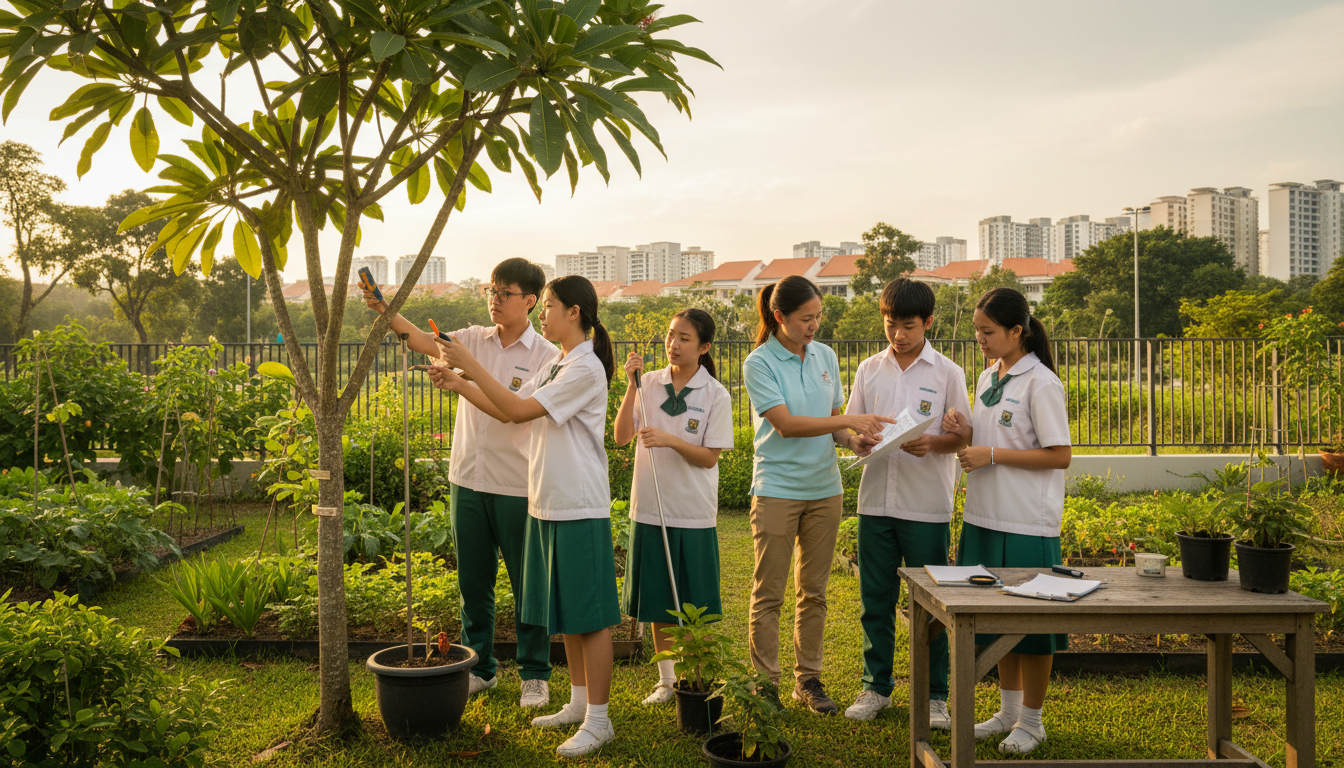
Primary Science vocabulary becomes easier to understand when children observe something, describe it accurately and use the correct word to explain what happened. A pupil may memorise “observe”, “infer” and “predict” yet confuse them in a Science answer because each term requires a different action. Parents can use safe, simple home investigations to make those differences visible, without buying an expensive experiment kit or turning every evening into another worksheet.
Start with two fallen leaves, a shadow made by a battery-operated torch, or a simple comparison of toy objects. Ask what your child can see, what changed and what the observation might suggest. The MOE Primary Science Teaching and Learning Syllabus for Primary 3–6 connects inquiry, evidence, explanation and communication. This guide gives original activities across Primary 1–6, connects accurate English vocabulary to PSLE Science and explains how the same habits support SEC, JC, university and adult reasoning.
- Start with evidence: observe and describe before drawing conclusions.
- Separate the verbs: compare, classify, infer, predict and explain are not interchangeable.
- Keep it safe: use common objects, pictures and supervised low-risk activities.
- Match the age: ages one to P2 focus on everyday discovery; formal Science learning begins from P3.
- Respect uncertainty: a casual demonstration may not isolate a single cause.
- Teach accurate answers: a technical word helps only when it matches the process.
- Build the pathway: these habits transfer into PSLE, secondary Science, JC, research and adult decisions.
A useful first question is “What did you actually observe?” followed by “What do you think may explain it?” If a child can answer those separately, you have already taught an important distinction. Then introduce the words “observation” and “inference” so that vocabulary captures a real difference in thinking.
eduKate Science tuition introduction. All investigations below are original, parent-supervised educational examples rather than official examination practicals.
Choose a Science vocabulary route
- MOE Primary Science learning approach
- Safe shadow activity
- Comparing ball motion
- Fair comparisons and uncertainty
- Four-week family plan
Open all 23 sections
- 1. Why scientific words work better when attached to observations
- 2. The MOE Science syllabus connects inquiry with communication
- 3. Science vocabulary is different from copying scientific definitions
- 4. Age one to kindergarten: safe sensory description
- 5. Primary 1–2: describe before explaining
- 6. Primary 3–4: make the Science process words visible
- 7. Primary 5–6: explain a process under the right conditions
- 8. Observation: say only what can actually be seen or measured
- 9. Comparing and classifying are related but different
- 10. Inference: a reasonable explanation is not automatically a fact
- 11. Prediction: what may happen next and why
- 12. Original home activity A: safe shadow observation
- 13. Original home activity B: how a ball moves on two surfaces
- 14. Original home activity C: sorting leaves without harming plants
- 15. Fair comparisons: why changing two factors creates uncertainty
- 16. Recording results with a simple table
- 17. How to teach “absorb”, “reflect” and “transmit” without confusion
- 18. What “reliable evidence” means for a Primary learner
- 19. Scientific English is not the same as writing as many keywords as possible
- 20. A four-week parent plan that combines vocabulary and enquiry
- 21. What parents should ask about a Science answer that sounds wrong
- 22. From PSLE Science to SEC, JC, university and adult life
- 23. Parent FAQs: safe and honest answers
1. Why scientific words work better when attached to observations
A child can memorise that “observe” means notice, “infer” means conclude and “predict” means say what may happen. Those brief definitions are only the beginning. Science asks pupils to apply each operation to the same event without confusing them. A leaf has brown edges: that is something the child can observe. A possible explanation for the brown edges is an inference that requires additional evidence.
If parents teach the words while using a real leaf or a picture, children can see why the distinction matters. They can record what is visible before proposing possible causes. This prevents a common mistake in written Science answers: inserting a memorised explanation as if it were something directly observed.
The aim is not turning every family activity into a formal laboratory. It is using safe everyday events to connect the word, the action and the supporting evidence.
2. The MOE Science syllabus connects inquiry with communication
Singapore’s Primary Science Teaching and Learning Syllabus for Primary Three to Six describes learning through questioning, gathering evidence, presenting data, explaining from observations and communicating ideas. Its framework treats scientific practices and values as part of Science learning, rather than treating the subject as a list of facts alone.
The syllabus’ process vocabulary includes such tasks as observing, comparing, classifying, inferring and predicting. Children need to understand what a word asks them to do. A pupil who memorises vocabulary but cannot use it in an investigation has not yet demonstrated the full skill.
Parents should consult their child’s actual school topic and syllabus level. Activities below are parent-supported enrichment examples and are not copies of an official PSLE practical examination.
3. Science vocabulary is different from copying scientific definitions
A copied definition may be correct yet disconnected from an unfamiliar question. A student might write “evaporation is when a liquid changes to a gas” but confuse evaporation with condensation when interpreting droplets on a cold surface. The correct term depends on which process is happening and what the evidence shows.
Teach an explanation, one example and one contrasting non-example. Ask “Where did the water come from?” and “What would we observe if this were a different process?” When the evidence is incomplete, the child should learn to say so instead of guessing with excessive certainty.
Scientific vocabulary grows alongside conceptual understanding. Teaching the most impressive technical term first may make a child sound advanced without helping them explain what happened. Start with the phenomenon, then build the precise language.
4. Age one to kindergarten: safe sensory description
Very young children can use language for qualities and relationships: smooth and rough, wet and dry, heavy and light, before and after, float and sink. An adult can introduce these during supervised play, sorting large safe objects and sharing picture books. A toddler does not need formal definitions of variables or a science experiment checklist.
Ask “Which feels smoother?” or “Where did the shadow move?” and describe the outcome in ordinary language. Children may first explain what they see in a familiar home language and gradually learn the English label for school. Respond to curiosity without demanding a scientific report.
Use age-appropriate, non-choking objects and supervise activities. Avoid small items, electrical appliances, chemicals, heat and unsafe demonstrations. Communication and safe exploration are the priority at this stage.
5. Primary 1–2: describe before explaining
Primary 1–2 pupils can compare visible characteristics and sort everyday objects through simple tasks. Ask which leaves have smooth edges, which objects are longer and which colours are present. An accurate observation is valuable even when the child does not yet know a technical explanation.
Once a child can describe what they see, ask for one comparison: “Both leaves are green, but one is wider.” Then ask for a cautious prediction linked to a familiar event. Help the child distinguish an observation that has already happened from a prediction about what might happen next.
Formal Primary Science instruction in the MOE syllabus begins at Primary 3, so early activities should be framed as everyday inquiry and language development, not claiming that a Primary 1 pupil is expected to answer PSLE Science questions.
6. Primary 3–4: make the Science process words visible
Primary 3–4 pupils encounter formal Science lessons. Give them explicit practice in the difference between “observe”, “compare”, “classify”, “infer” and “predict”. They might observe that two leaves differ in shape, compare the differences, classify pictures of objects by an agreed feature, infer a possible cause of a pattern and predict a result in a related situation.
One activity should not require every process at once. Start with observation and comparison, then invite an inference supported by evidence. For example, noticing that one wet paper towel has dried faster is an observation; claiming the warmer location caused it may need a fairer comparison to isolate temperature.
Ask your child’s teacher which process skills are being practised in current units. Use that feedback to choose home language tasks that reinforce class instruction.
7. Primary 5–6: explain a process under the right conditions
Upper-primary pupils increasingly need to interpret investigations and express causal explanations accurately. They should recognise when a result supports a conclusion, when several factors changed together and when more evidence is needed. Words such as “rate”, “constant”, “variable”, “evidence” and “reliable” become useful when the topic requires them.
For PSLE, subject-specific reasoning matters. A child may know the correct concept but lose meaning by substituting “reflects” for “absorbs” or “increase” for “decrease”. The words describe different processes. Parent practice should target these distinctions without reducing every answer to a memorised paragraph.
For the examination year, check SEAB’s published PSLE format and the school’s current teaching requirements. No home experiment or word count guarantees a specific Achievement Level.
8. Observation: say only what can actually be seen or measured
An observation is information obtained from the phenomenon, with the appropriate senses or instruments. “The first paper towel remained wet” is an observation. “The towel was made badly” is an interpretation that needs evidence. Distinguishing the two helps a pupil avoid adding unsupported causes to an answer.
At home, place two safe leaves or pictures side by side. Ask the child to describe their colour, outline and size without explaining why they differ. Then discuss what additional information would be needed to explain the difference. This is a simple way to teach a disciplined habit.
Recording a measurement adds precision when appropriate. A ruler can help describe length; a simple table can organise observations. Parents should not insist on measurements when the actual teaching goal is comparing visible features.
9. Comparing and classifying are related but different
To compare means identify relevant similarities or differences. To classify means sort objects according to chosen characteristics or criteria. If pupils compare two leaves, they may say one is longer. If they classify several leaves, they may place them in groups based on shape or another relevant feature.
Ask the child to explain the rule used for classification. Two people might choose different reasonable rules, such as size or edge type. The important point is that the grouping is consistent and the rule is stated clearly. Children should avoid presenting a temporary sorting rule as proof that the objects belong to the same scientific species.
Later, more formal biological classification uses established scientific criteria. A Primary activity is a first step into the language of systematic comparison, not a substitute for advanced taxonomy.
10. Inference: a reasonable explanation is not automatically a fact
An inference links available evidence to a possible explanation. Suppose one plant has wilted leaves. The child may suggest that insufficient water is one possibility, but other conditions could also affect the plant. The observation alone does not prove a single cause.
Teach the phrase “This may suggest… because…” and then ask what additional information would strengthen the explanation. If several conditions differ, the pupil should not claim that one variable has definitely caused the result. This introduces useful caution without making the child afraid to reason.
The same distinction matters in English comprehension and Humanities: inference should be supported, not invented. Primary Science vocabulary is therefore part of a wider skill in making claims responsibly.
11. Prediction: what may happen next and why
A prediction describes an expected result based on a pattern, model or relevant knowledge. It differs from observation because the future event has not yet been observed. The child should say what they expect and why, then compare it with what actually happens when a safe activity is carried out.
For example, after observing that a toy car rolls farther on a smooth surface in one trial, a pupil might predict similar behaviour in a repeated trial. A careful parent should note that other conditions could affect the result, and one observation alone does not guarantee the prediction.
If the actual result differs, encourage the learner to revise the explanation. Scientific thinking includes being willing to change an expectation when evidence does not support it.
12. Original home activity A: safe shadow observation
Using a battery-operated torch and a sturdy toy on a stable table, an adult can demonstrate a shadow. Keep light away from eyes and avoid hot lamps or exposed electrical parts. Ask the child to describe where the shadow appears, then change the torch’s position gradually and observe the change.
The relevant vocabulary may include “light source”, “opaque”, “shadow”, “position”, “direction” and “distance”, depending on the pupil’s current level. Ask “What did we change?” and “What happened to the shadow?” Do not assume the child can conclude all properties of light from a single demonstration.
Use the scene to practise one short accurate explanation: light travels from the source; the opaque object blocks some of it and creates a shadow on a surface. If the result is confusing, discuss the placement of the light and object rather than supply an unrelated memorised definition.
13. Original home activity B: how a ball moves on two surfaces
An adult can roll a soft toy ball over two safe surfaces, such as a smooth mat and a textured fabric, using the same starting line and similar release conditions. Ask which way the ball moves and where it comes to rest. The pupil can record two observations and propose why the motion may differ.
The language includes “surface”, “motion”, “distance”, “compare”, “friction” and “evidence”, depending on the school topic. A simple demonstration cannot accurately isolate all factors unless the release and other conditions are controlled. Avoid claiming one short trial proves an exact physical law.
For older pupils, repeat trials and discuss why results may vary. If the child changes the slope, release point and surface at the same time, the evidence does not isolate which change produced the outcome. The vocabulary of a fair comparison becomes meaningful through that real limitation.
14. Original home activity C: sorting leaves without harming plants
Use fallen leaves or clear photographs rather than collecting unknown plants or damaging living specimens. Ask the child to observe leaf shape, edge and visible colour, then compare and sort according to a stated rule. If the leaves are unfamiliar, avoid contact with irritants and wash hands after outdoor handling.
The useful words include “observe”, “characteristic”, “similarity”, “difference”, “classify” and “criterion”. The child can record how many leaves fall into each chosen group. This simple observation does not establish species identity; a more specialised identification process would require additional evidence.
For a Primary 3 pupil, grouping by one visible characteristic may be sufficient. A Primary 6 learner can discuss why one sorting rule could hide important differences and how a revised criterion changes the groups. The underlying word becomes more powerful as the task becomes more demanding.
15. Fair comparisons: why changing two factors creates uncertainty
Imagine two damp towels: one is placed in a warm, airy location, the other in a cooler, still location. If the first dries faster, the observation alone does not tell us how much of the difference came from temperature versus air movement. More than one factor changed. A pupil should avoid claiming a single certain cause from this comparison.
The language of “variable”, “constant”, “fair test” and “control” is best introduced through this kind of reasoning. If the goal is to investigate one factor, other relevant conditions should be kept comparable where practical. In a simple home situation, not every factor can be precisely controlled, and it is better to admit the limitation.
Parents should choose safe activities without leaving wet materials where they could cause slips or damage. For formal investigations and assessed requirements, follow the child’s school teaching rather than treating a casual home demonstration as laboratory proof.
16. Recording results with a simple table
A table can help pupils distinguish observation from interpretation. The first column identifies the trial or object, the second records what was changed, and the third records what was observed. A separate line can describe a possible explanation. This stops words like “cause” and “result” from being used interchangeably.
Ask your child to make entries in plain English. “Moved torch closer” is a change to the setup. “The shadow appeared larger on the screen” is an observation. “Changing the position of the torch can affect shadow size” is a cautious conclusion about the demonstrated situation.
A good table does not need many rows. Its value is in making evidence visible and allowing the pupil to verify a claim against what was actually recorded.
17. How to teach “absorb”, “reflect” and “transmit” without confusion
The words “absorb”, “reflect” and “transmit” describe different interactions, and one material may behave differently depending on the type of energy or radiation involved. In a basic light lesson, a mirror reflects visible light while a clear window transmits much visible light. Real materials may also absorb some light.
Parents can discuss familiar examples under ordinary safe conditions. Do not shine intense light into eyes or use lasers, specialised radiation sources or unsafe equipment. The goal is to match a word to a visible event, then acknowledge that real situations may be more complex than a single label.
A child who substitutes one term for another in a Science answer should be asked to describe what actually happened before selecting the word. Precise meaning comes from the concept, not the sophistication of the spelling.
18. What “reliable evidence” means for a Primary learner
Reliable evidence is not simply evidence that confirms what the student expected. Measurements can vary because of inconsistent conditions or observation errors. Repeating a safe investigation and noting whether a pattern recurs can help the child discuss how much confidence to place in the result.
If a single ball trial produces an unusually long distance, discuss possible reasons instead of erasing it from the record. Ask what was kept the same and what might have changed. This builds the difference between honest reporting and choosing only convenient results.
At older levels, students may learn about measurement uncertainty, repeatability and validity more systematically. In Primary school, the foundation is recognising that a conclusion should match the available observations and their limitations.
19. Scientific English is not the same as writing as many keywords as possible
Some pupils respond to a Science question by inserting several technical terms with no clear relationship. The result may sound knowledgeable without explaining the phenomenon. Ask the child to identify the question’s demand and link the relevant concept to evidence in a complete explanation.
For example, a question about a shadow should not be answered with an unrelated list of reflection, refraction, evaporation and photosynthesis. The child should describe the actual arrangement and the process relevant to the question. A simple accurate sentence is stronger than decorative terminology.
For PSLE, the specific answer requirements depend on the question and syllabus. Parents should check school feedback and SEAB guidance rather than teach rigid universal answer templates.
20. A four-week parent plan that combines vocabulary and enquiry
Week one: select a few process words from current school Science work, such as observe, compare and infer. Demonstrate each with objects or photographs. Week two: carry out a short safe observation and record results in words or a table. Week three: practise distinguishing evidence from explanation and identifying when more than one factor changed. Week four: use an unfamiliar school-style question and ask the child to explain independently.
The number of words and activities should match the child’s actual learning needs. A Primary 1 pupil can describe and compare without formal assessment; a Primary 4 pupil can observe and classify; an upper-primary pupil can discuss fair comparisons. This is a teaching option, not an official MOE timetable.
Keep activities brief and voluntary enough to remain enjoyable. If the child cannot explain a concept despite repeated practice, seek the teacher’s feedback before adding a longer list of technical terms.
21. What parents should ask about a Science answer that sounds wrong
Ask three questions: What do you know from the observations? Which concept helps explain it? How does that concept apply under these conditions? This separates observation, knowledge and reasoning. If the pupil gives a correct definition but applies it to the wrong event, teach the matching process rather than making them memorise the definition again.
When marking a worksheet, label the actual issue: incorrect vocabulary, misunderstood phenomenon, weak evidence or vague explanation. Praise a corrected distinction, such as “You noticed that inference is not the same as observation.” That tells the child which thought process to repeat.
Parents need not provide expert scientific explanations beyond their knowledge. It is responsible to consult the class text, teacher and reliable source when an unfamiliar technical term appears.
22. From PSLE Science to SEC, JC, university and adult life
In Secondary 1–4, G1, G2 and G3 subject levels have different curriculum demands, with the Singapore-Cambridge SEC beginning in 2027. Science learning introduces more formal concepts, calculations, disciplinary vocabulary and explanations. A student who learnt to separate observations from inferences has a useful starting habit.
At JC and university, hypotheses, evidence, models, uncertainty and critical evaluation become increasingly important. Adults use similar reasoning when reading scientific news, public health information or technical product claims. This is not a claim that Primary Science words alone qualify someone for advanced study. It is the beginning of a transferable habit: explain what the evidence justifies.
A child who struggles with Science answers today can improve through well-matched teaching and careful feedback. One vocabulary list does not determine their future educational pathway.
23. Parent FAQs: safe and honest answers
“Do we need to buy an experiment kit?” No. Many vocabulary connections can be made through pictures, plants, a safe torch and everyday objects. Do not use unsafe chemicals, hot liquids, flames, sharp tools or unsupervised electrical equipment. “Should I make my child memorise every glossary definition?” Focus on meaningful words in their actual syllabus and use them correctly.
“What if my child gets the observation right but the explanation wrong?” Work on the scientific concept and evidence, not simply the spelling. “Will this guarantee PSLE marks?” No. Practice can build skills but outcomes depend on the learner and examination tasks. “Do we need tuition?” Consider targeted help when it addresses specific gaps and fits the family’s needs.
“What can we do tonight?” Compare two safe objects, describe one observed difference, name the relevant word and ask what additional information would be needed to explain it. That is a meaningful Science vocabulary lesson.
Parent comparison chart: what each Science word asks the child to do
| Term | What a pupil should do | Frequent mistake |
|---|---|---|
| Observe | Describe what is seen or measured | Present an imagined cause as observed fact |
| Compare | Identify relevant similarities or differences | Describe only one object |
| Classify | Group by stated characteristics | Use inconsistent sorting rules |
| Infer | Propose a supported explanation | State an unsupported guess as certainty |
| Predict | State an expected result with reasons | Pretend the future outcome already occurred |
| Explain | Connect relevant evidence to a scientific concept | Repeat a definition without answering the question |
| Fair test | Identify relevant variables and comparable conditions | Change multiple factors but claim a single certain cause |
Primary Vocabulary Series navigation: Previous parent guide | Next parent guide | Start from Primary 1–2 | Explore the 16-rung learning ladder
Official sources, safe-practice note and related eduKate guides
- MOE Primary Science Teaching and Learning Syllabus (Primary 3–6)
- SEAB PSLE 2026 examination formats
- MOE Primary English Language Syllabus
- Why children understand Maths and Science but misread question language
- Finding the main idea instead of collecting all details
- Primary 5 word forms, prefixes and roots
Safety and accuracy: Activities are optional educational examples, not official PSLE experiments, clinical tests or guarantees of grades. Supervise children, avoid hazardous materials, and follow the actual school syllabus for topic-specific requirements.