
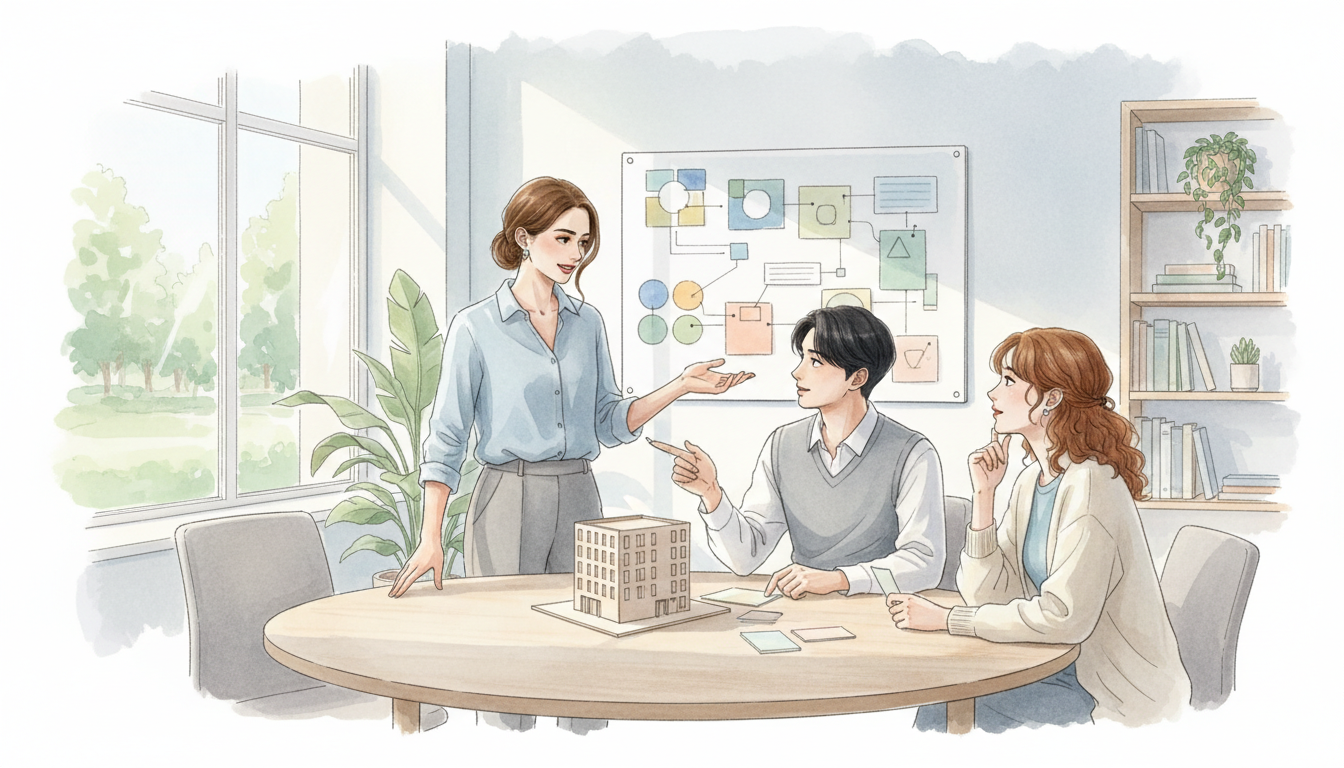
AI can help ordinary people turn an idea into a working prototype by making a problem clearer, exploring alternative designs and preparing a test that reveals whether the idea actually helps. You do not need to begin as a programmer, engineer or designer. Begin with a small problem you understand, a person who wants it solved and a safe, affordable model you can inspect. A prototype is a learning instrument: it lets you discover what works before committing more time, money or materials.
This international guide follows an invented example of a library volunteer developing a reusable desk organiser for shared reading materials. It connects Vocabulary Coding and Engineering, intelligence projection and EnDist to the practical work of invention. SuperIntelligence is the future-facing frame of the series; the example uses present-day AI assistance, not an assumption that artificial general superintelligence exists. A design proposal, a physical model, a tested prototype and a product suitable for distribution are different stages.
- Start with a real difficulty and an observable user need.
- Define the intended function, constraints, interfaces and failure conditions.
- Use AI to expand the design space, not to certify that a design works.
- Build a low-risk model from inexpensive materials and compare alternatives.
- Record the test, mistakes, cost and changes before making another version.
- Share the result and its limitations so another person can improve it.
EDUKATE · HOW SUPERINTELLIGENCE HELPS US · ARTICLE 9 IN THE SERIES
Choose your reading route
Start with the question closest to your situation. Each route leads into the full article below.
ROUTE 1 · CHAPTERS 1–5
Understand invention
See what a prototype is and why a generated design is only a starting point.
ROUTE 2 · CHAPTERS 6–10
Define the design
Translate a real need into checkable requirements and useful alternatives.
ROUTE 3 · CHAPTERS 11–16
Build and test the model
Watch Mira build a low-risk desk organiser and revise its labels.
ROUTE 5 · CHAPTERS 22–26
Develop lasting capability
Connect invention to education, EnDist and a four-week pilot.
Full chapter index · Four-week practice · Vocabulary Coding and Engineering foundation
Chapter index
Chapters 1–5: Understand invention
Chapters 6–10: Define the design
Chapters 11–16: Build and test the model
Chapters 17–21: Measure and maintain
Chapters 22–26: Develop lasting capability
CHAPTER 1 OF 26 · Understand invention
1. What changes when an ordinary person can explore an invention?
Invention often begins with noticing a small inconvenience that others have learned to tolerate. A parent finds school materials scattered across a desk; a library volunteer spends time sorting reading cards; a craft group needs a clearer way to arrange supplies. AI can help someone who understands the inconvenience describe it as a design problem and compare possible responses.
The opportunity is not that everybody instantly becomes a qualified engineer. It is that the distance between noticing a problem and constructing a first, inspectable possibility can become smaller. A person still needs knowledge of materials, users and limitations. The useful output is something that can be tried and improved.
CHAPTER 2 OF 26 · Understand invention
2. Why is a generated design different from an invention?
A generated design is a description, diagram or model proposed by a system. An invention in the everyday sense is a new solution to a particular problem; a patentable invention is a different legal question requiring appropriate specialist advice. A prototype is a preliminary representation used to learn about a solution.
An attractive rendering establishes little about the way an object will behave. It may show an impossible joint, omit a necessary clearance or depict a material with properties it does not have. Treat the picture as a proposal. Build the smallest safe representation that lets you investigate the important relationship.
CHAPTER 3 OF 26 · Understand invention
3. What kinds of design help are already possible?
A conversational assistant can help structure a brief, compare supplied measurements, suggest several layouts, draft a user-test script or explain unfamiliar terms. Some tools can generate code, images or models, but their outputs have different properties and require different checks. A picture of a digital tool is not a functioning application, and an image of a physical object is not a manufacturing specification.
Ask for help at a stage where you can evaluate the response. For a paper organiser, you can compare dimensions yourself. For anything structural, electrical, medical or otherwise safety-critical, involve suitably qualified professionals rather than relying on a general model.
CHAPTER 4 OF 26 · Understand invention
4. What does research on AI-supported innovation tell us?
The 2026 peer-reviewed Cybernetic Teammate field experiment studied 791 professionals working on product-innovation tasks at Procter & Gamble. Participants using AI individually performed comparably to teams without AI on the evaluated proposals; AI also helped bridge technical and commercial perspectives. This is evidence about ideas produced within an established organisation, not proof of production readiness or guaranteed commercial success.
A practical lesson is to use assistance to ask questions you might otherwise miss. A designer can ask what a person cleaning the object would need, then talk to that person. A new maker can ask about alternative shapes, then check what fits the actual space.
Start with a repeated problem that you can observe without putting people at risk. Ask who experiences it, what they currently do, and what would improve their experience. For the library organiser, the problem is that returned reading cards and pencils become mixed together at a shared desk. The volunteer wants visitors to put items back where they belong without asking for instructions every time.
Avoid making a technology the purpose. ‘Build an AI-powered desk’ describes a technology choice; ‘help a visitor locate and return three kinds of reading material’ describes a need. A paper divider might be better than a digital solution. The design should be judged against the need.
CHAPTER 6 OF 26 · Define the design
6. How does Vocabulary Coding and Engineering clarify a design?
Vocabulary Coding and Engineering is eduKate’s proposed framework for specifying meaning, relationships, conditions and evidence. Design words such as ‘portable’, ‘stable’, ‘easy’, ‘compact’ and ‘strong’ carry decisions. A portable organiser might mean a lightweight container, a container a particular user can carry, or one that fits a storage cupboard. Those requirements are not identical.
Write each important term with an example and a check. Compact could mean fitting on a designated 30 by 20 centimetre desk area. Clear could mean a new visitor can identify where a pencil belongs without explanation. Natural language is not deterministic program code; even a precise specification needs to be interpreted and tested.
CHAPTER 7 OF 26 · Define the design
7. How do you distinguish requirements from preferences?
A requirement describes a condition the prototype must satisfy for this test. A preference describes something desirable when the requirements can be met. The library volunteer needs the organiser to fit the agreed area and allow easy identification of each compartment. A particular colour is initially a preference unless it affects the accessibility or use of the object.
Write the two categories separately, and invite the users to correct them. A designer may call a large label optional while a reader who needs it sees it as essential. Ask what happens if a condition is absent. If a useful task becomes impossible, reconsider whether it belongs among the requirements.
Build a small requirement-to-test matrix
A requirement is most useful when the designer can tell whether it has been met. The following working matrix belongs to the invented reading-desk project. It is not a product standard. Each row connects a proposed requirement to a modest check.
| Requirement | Example of a first check | What still needs attention |
|---|---|---|
| Fit the desk | The model stays within the measured 30 × 20 cm area. | Actual folds, corners and clearance. |
| Distinguish three categories | A visitor can explain where each sample item belongs. | Different languages and viewing positions. |
| Easy to reset | A volunteer returns the three sample materials to their places. | Wear, damage and repeated use. |
| Affordable first experiment | Record actual card and tape used. | Durable material and long-term cost. |
The third column matters because a passed check can create false confidence. ‘Fits on the desk’ does not establish that someone can reach the material from a seated position. ‘Readable label’ does not establish comprehension. Add another test only when it answers a useful question. When the first result is inadequate, identify whether the requirement, model or method needs changing. This matrix lets someone else review the decision without relying on the enthusiasm of the original designer.
A good brief gives the purpose, intended users, available materials, relevant dimensions, budget, known limitations and test. Here the volunteer will make a low-risk desktop mock-up using folded card. It must fit a 30 by 20 centimetre rectangle, contain three clearly labelled compartments and be easy to reset. The first trial has no electrical parts and does not carry heavy objects.
Ask AI: ‘Suggest three arrangements for these requirements. For each, describe what would fit, what assumptions you made, what might confuse a visitor and what I can test with card. Do not add functions or claim the arrangement has been validated.’ Read the alternatives as sketches.
Different solutions express different assumptions. A side-by-side layout may make every label visible; a stacked layout might save width but hide an item; a movable set of trays may be easy to rearrange but create a separate storage problem. AI can help articulate such differences before you spend materials.
Do not choose an idea simply because the system ranked it first. Compare it with the need and the conditions. If the volunteer cannot easily reach the back compartment, the attractive arrangement is a poor fit. The goal of generating alternatives is to discover a better question, not to maximise the number of options.
CHAPTER 10 OF 26 · Define the design
10. How can an analogy open a design possibility?
An analogy borrows a relationship from another context. A library organiser might borrow the idea of a cutlery tray, a postal sorting rack or a toolbox with labelled spaces. Each example suggests a way of grouping items and showing where things belong. None proves that the resulting shape is right for the desk.
Ask which relationship is transferable. The labels on a postal rack may help without requiring its size or construction. A toolbox may be useful because the tools are visible and have designated positions, not because a reading desk needs a heavy case. Describe both the borrowed idea and the differences that limit its use.
Use a comparison that reveals trade-offs
Mira asks for three options and deliberately includes a simpler non-AI baseline: the original tray with clearer labels. She wants to know whether a new physical object is actually needed. The comparison prevents the project from becoming committed to a particular mechanism before the need is understood.
| Option | Potential benefit | Question before choosing |
|---|---|---|
| One tray plus labelled zones | Minimal material and easy rearrangement. | Do the items remain separate in ordinary use? |
| Three shallow compartments | Visible categories and a defined return location. | Can a visitor reach every space? |
| Removable trays | Easy to sort separately and replace. | Do pieces become separated or misplaced? |
Ask the assistant to include an option that removes complexity, one that changes the arrangement and one that changes the instructions. Then ask the users which inconvenience each option actually addresses. A system may suggest a clever mechanism, but the person who maintains it can reveal that the proposed improvement creates more work. This conversation brings a useful constraint into the design early.
CHAPTER 11 OF 26 · Build and test the model
11. Meet Mira and the shared reading desk
This fictional case follows Mira, who helps at a community library. Three kinds of materials are regularly returned: large reading cards, small question slips and pencils. New visitors occasionally put the slips beneath the cards. The previous arrangement uses one tray, so volunteers repeatedly sort it.
Mira measures an available area of 30 by 20 centimetres and discusses the intended use with the librarian. She asks two volunteers and a visitor what is confusing. Their comments suggest visible category labels and a layout that makes each item easy to identify. She records the three categories before involving an AI assistant.
CHAPTER 12 OF 26 · Build and test the model
12. What happens when the first design is too elaborate?
The initial AI suggestion describes a multi-level, rotating organiser with hidden drawers. It appears sophisticated but requires more space, materials and assembly than Mira can use. It also creates extra steps for visitors. Mira marks those features as untested suggestions rather than parts of her plan.
She asks the assistant to remove anything that does not support the three return actions. The next version offers three side-by-side spaces with the item labels visible from above. Mira keeps another version with front-facing labels for comparison. Simplifying the design is a creative decision: it preserves the function while removing unnecessary complexity.
CHAPTER 13 OF 26 · Build and test the model
13. Can the dimensions be checked before building?
Mira sketches three compartment widths of 12, 8 and 6 centimetres, with two separators of 0.5 centimetres each and two outer edges of 0.5 centimetres each. The total is 28 centimetres: 12 + 8 + 6 + 1 + 1. It fits the 30-centimetre width on paper, leaving two centimetres. She still needs to check the depth, item sizes and folded material thickness.
All measurements in this example are invented. A calculation about width does not prove the object is usable. The physical materials, fold lines and hand clearance still matter. The calculation gives Mira one check she can independently reproduce, rather than a confident statement that the whole design is ready.
CHAPTER 14 OF 26 · Build and test the model
14. What is the smallest useful physical model?
Mira cuts and folds card according to the library’s agreed safe craft procedure. She does not try to make a permanent product; the model need only show the arrangement of compartments and labels. She uses sample reading cards, slips and pencils to test the fit. Her materials are inexpensive so she can change the layout without treating the first choice as a commitment.
A prototype is successful when it produces information. If the model shows that slips slide under the divider, that is valuable even though the design has failed that test. Record the problem and change the relevant relationship rather than discarding the whole idea without learning why.
CHAPTER 15 OF 26 · Build and test the model
15. How do we run a fair first usability test?
Mira asks volunteers and willing visitors to try returning three sample items. She explains the activity and records only the observations needed for the project. She does not tell them which layout she prefers. Each person receives the same basic instruction and may ask for help. The task is to locate the intended compartment, not to demonstrate speed or intelligence.
She keeps appropriate access support and asks users how the labels could be clearer. One person may prefer larger type or a different arrangement. A few informal trials can expose obvious confusion, but they do not establish usability for every reader. Report who tested what and what remains untested.
A simple observation sheet for the first test
The aim of the trial is to discover whether a visitor can identify the intended category. Mira gives each participant the same three sample items in a varied order. She does not interpret a request for clarification as a lack of ability. It may reveal an ambiguity in the model or a need for another way to present the information.
| Observation | Record |
|---|---|
| Version and date | Which model was used? |
| Attempt | Which of the three items was returned? |
| Outcome | Correct category, different category, or unresolved. |
| Support | What help or clarification was requested? |
| Comment | What did the person find useful or confusing? |
Keep the personal information out of the record unless it is genuinely needed and appropriately agreed. The test is about an object and its instructions. After each trial, keep the initial observation separate from the team’s interpretation. A misplaced item does not by itself reveal why the person put it there. Ask rather than assume. Repeated misunderstandings may point to labels, layout, the starting instruction or a combination of those features.
CHAPTER 16 OF 26 · Build and test the model
16. What should happen after a user notices an error?
One fictional visitor sees the label ‘cards’ and puts the question slips there. Mira notices that the word covers both materials in ordinary speech. The mistake suggests a specification problem. She changes the labels to ‘large reading cards’ and ‘small question slips’, adds examples and asks another person to try the revision.
This is Vocabulary Coding and Engineering in a physical setting. The description and the object must work together. An ambiguous word can defeat an otherwise suitable layout. Keep the user observation, the revised label and the reason for the change together so that another volunteer can understand the decision.
CHAPTER 17 OF 26 · Measure and maintain
17. How do we compare two prototype versions?
Suppose, in an invented trial, six people each return three items using the first layout, and a different six use the revised layout. There are 18 return attempts per version. Four items are misplaced in the first version and one in the second. The observations favour further investigation of the revised design, but differences between groups and their experience could account for some of the change.
Also ask whether people found the materials, whether volunteers could reset the tray and whether the layout fit the desk. A small observed improvement should not be advertised as a universal percentage reduction. Retain the counts, the conditions and the purpose of the comparison.
Interpret results before planning a bigger test
The first illustrative arrangement has 14 correctly placed items out of 18 attempts; the second has 17 out of 18. The absolute difference is three correctly placed items in each set of 18 attempts. That is the useful descriptive comparison, together with the notes about how the tasks were attempted.
These observations concern item attempts, not eighteen independent people in each group. Each of six people attempted three placements. Differences in familiarity, prompting or how the items were handed out could affect the results. If Mira wants more evidence, she can ask the librarian to help design a fairer comparison, perhaps with additional users and a consistent procedure. She should avoid creating pressure to perform a test that is unnecessary for the local purpose.
A good decision note can be short: ‘Retain the revised labels for the next trial because fewer mistakes were observed and two participants said the new labels were clearer. The design is still a card mock-up. Test reset, access and repeated use before adopting a more durable version.’ This leaves space for new evidence to change the decision.
CHAPTER 18 OF 26 · Measure and maintain
18. How can cost become part of design learning?
In the fictional example, the first model costs three local currency units in card and tape. A revised model needs another two. A more durable material might cost twelve, but has not yet been tested. The five units spent on the two models are learning costs; they should not be confused with the eventual per-item production cost.
For a larger project, add time, replacements, testing, maintenance and disposal. A cheaper material might need frequent replacement, while a more durable one might create a different problem for cleaning or accessibility. Ask AI to organise costs into categories and use a calculator or spreadsheet to verify totals.
CHAPTER 19 OF 26 · Measure and maintain
19. When is a prototype not ready to distribute?
A small working model does not establish product safety, durability, regulatory compliance or suitability for a different context. The library’s model may work with a few paper items but still fail under repeated use. Do not publish construction advice as certified or invite people to use a prototype in ways that exceed its tested purpose.
Before expanding, identify the additional evaluation the object needs. For low-risk stationery, that may include checking cleanability, stability and replacement parts with the librarian. Projects involving electricity, load-bearing structures, transport, children’s safety or health require appropriate experts and applicable standards. AI can help prepare questions but cannot provide certification.
A readiness checklist before the next version
A prototype moves from learning to wider use only when the next stage has a defined purpose. Mira and the librarian agree which questions remain. They check who will replace a damaged divider, whether labels stay readable, whether cleaning arrangements are compatible with the materials and whether the object leaves the intended work surface usable.
For a public project, the maker should also check permissions for materials, names, artwork and any information used. If a design draws inspiration from another creator, do not assume the original work or a generated image can be commercially copied. Obtain appropriate advice if intellectual-property or regulatory decisions matter. This article offers no legal or safety certification.
Review this prototype record. Separate the checks we actually completed from claims that still require evidence. List three questions for the next user test, three questions for the responsible venue and the smallest feasible revision. Do not present a possible material or design as approved.
The assistant’s checklist is a planning contribution. The people responsible for the venue and the intended use decide what further review is required.
CHAPTER 20 OF 26 · Measure and maintain
20. How does the prototype become something another person can maintain?
Mira records dimensions, materials, the intended categories, the date of the test and the reason the labels changed. She includes a photograph or sketch of the final layout if the library agrees. The record distinguishes the tested card model from any proposed durable version.
A new volunteer should be able to reset it, identify its purpose and report a problem without asking Mira to reconstruct every conversation. If someone changes the dimensions, they can inspect the original constraint and repeat the fit check. This transfers some of Mira’s understanding to the team, which is more valuable than a single attractive object that nobody else knows how to use.
A rejected design may teach that a proposed mechanism was too complicated, that an assumption about available space was wrong or that a particular label confused people. Record the specific observation and the conditions. ‘This idea failed’ is less useful than ‘the drawer needed a further 10 centimetres of clearance that the desk did not have.’
AI can help organise the record and suggest which part of the failure might generalise. A reviewer should distinguish observation from explanation. A failed version is a resource when it helps somebody avoid repeating the same mistake or recognise when the original limitation no longer applies.
CHAPTER 22 OF 26 · Develop lasting capability
22. How does EnDist help evaluate invention?
In eduKate’s proposed framework, EnDist means net usable forward-motion capacity after misunderstanding, misalignment, rework, coordination drag and failed handoffs. It is a conceptual lens, not a scientific unit. Applied here, it asks whether people gain usable capability after the work of design and correction.
The relevant outcomes include whether visitors can return the materials, how much sorting the volunteer still needs to do and whether another person can maintain the tray. Keep time, cost, observed success and access needs separate. The fact that AI generates more designs is not itself the benefit. The benefit appears in the tasks people can now perform.
CHAPTER 23 OF 26 · Develop lasting capability
23. How can education build inventors rather than just output producers?
A learner can practise noticing, measuring, explaining and adapting with a small design problem. Mathematics helps establish dimensions, language helps describe requirements, and science helps explain properties and relationships. The activity connects those foundations to a situation that has no answer key.
Ask the learner to explain why they selected a shape, show a calculation, identify a failed assumption and adapt the design for a changed space. Allow necessary accessibility supports. A teacher can separately assess the ability to use AI well and the ability to reason about the design without receiving generated solutions. Both kinds of capability may matter.
A learner exercise: move the prototype to a new desk
Suppose the usable desk width changes from 30 centimetres to 24 centimetres. The earlier proposed compartment widths and borders occupy 28 centimetres. The design therefore exceeds the new width by four centimetres. Ask a learner to identify the changed constraint, explain the arithmetic and propose a different layout without immediately asking AI to produce a drawing.
A learner might suggest making the three compartments narrower, changing their orientation or using a removable container for one material. Each solution has a consequence. Narrower spaces may no longer fit the reading cards. A rotated arrangement may create a depth problem. The learner must ask which dimensions and item sizes are known before accepting a solution.
After the learner explains their own proposal, AI can help generate a counterexample or an alternative. Assess whether the learner can identify the missing measurement and revise the design accordingly. This exercise combines numeracy, vocabulary, physical understanding and judgement. It does not reward the learner merely for generating a more complicated model.
CHAPTER 24 OF 26 · Develop lasting capability
24. What changes across the zoom levels?
At word level, clarify ‘card’ and ‘compact’. At object level, check dimensions, materials and interfaces. At person level, observe whether the intended user can complete the task. At team level, maintain a version record and clarify ownership. At institution level, consider access, durability and safe use. At society level, ask whether people can access design knowledge, materials and suitable expertise.
At the future level, stronger AI could expand the number of possibilities people can examine. It cannot remove the need to decide which problems deserve attention, nor substitute for physical testing. The value grows when knowledge reaches another maker in a form they can understand and challenge.
CHAPTER 25 OF 26 · Develop lasting capability
25. What could a four-week prototype pilot look like?
Week 1: observe one real difficulty, measure the relevant space, invite users to describe the problem and define one testable requirement. Week 2: compare three alternatives, check the dimensions and build one low-risk model. Document assumptions rather than treating a drawing as evidence.
Week 3: test the model with willing users, collect minimal task observations and repair a specific weakness. Week 4: repeat the most important check, compare time and material effort, record the limitations and decide whether to continue, simplify or stop. This is a suggested practice structure, not a guaranteed invention schedule.
You do not need a large project. Write: ‘I want to make it easier for these people to do this task. The available space and materials are these. Please help me compare three low-risk alternatives and design one test. Identify assumptions and do not claim that anything has been validated.’ Make a sketch, check the relevant numbers and ask an intended user to try it.
The longer-term opportunity is that more people can become contributors to invention rather than only consumers of finished products. More capable systems may widen that opportunity, while access to materials, training and independent evaluation determine how much of it becomes real. Start with one small improvement that somebody can actually use.
Sources and further reading
- Dell’Acqua and colleagues (2026), The Cybernetic Teammate: A Field Experiment on Generative AI and Teamwork — evaluated product-innovation proposals in a specific workplace.
- Vocabulary Coding and Engineering: Words, Thought, Memory and Decisions
- Who decides where expanded intelligence goes?
Explore the series
- How SuperIntelligence Helps Us | Everyday confusion into clear next steps
- How SuperIntelligence Helps Us | Learn to handle unfamiliar situations
- How SuperIntelligence Helps Us | Access to knowledge across languages and abilities
- How SuperIntelligence Helps Us | Science, work and public life
- How SuperIntelligence Helps Us | Preserve experience across generations
- How SuperIntelligence Helps Us | Understand disagreement and make shared decisions
- How SuperIntelligence Helps Us | Spot connections and catch problems earlier
- How SuperIntelligence Helps Us | More time for meaningful work, learning and care
- How SuperIntelligence Helps Us | How Can AI Help Us Waste Less and Make Better Use of the Resources We Already Have?
- How SuperIntelligence Helps Us | How Can AI Help Us Prepare for Better Healthcare Conversations?
- How SuperIntelligence Helps Us | How Can AI Help Us Ask Questions That Science Has Not Yet Answered?