
Bike-share data can show a city that a station reported no rentable bikes or no free return dock at a particular time. That gives people a useful place to investigate. To decide where more bikes are needed, the city also needs to know when the problem recurs, who tried and failed to travel, what the operator moved and whether adding bikes would leave enough room for people to return them.
At two fictional stations a morning snapshot shows no bikes at Market Steps and no empty docks at Canal Gate. An AI assistant can help you read the records, but the obvious suggestion to move bikes between them needs checking. Follow the counts through one morning, compare them with a separate trip register and see why a resident who never appears in either set of figures may know something important.
- Read the station, reporting time, rentable bikes, usable docks and operating status together.
- Distinguish a change in stock from rides that started or ended. A truck moving bikes can change stock too.
- Mark an old or missing report as uncertain. An empty station is an observation, while an unsuccessful attempt needs different evidence.
- Check multiple times, places and kinds of journey before a person authorises a change in service.
Find your question
Read the station observations
Test explanations for empty and full stations
Choose the evidence for a public decision
What is the person at the station trying to do?
At 8 am on a fictional school day, Mara wants to hire a bicycle at Market Steps. At the same time Arun is riding towards Canal Gate and wants to return one. If the city asks only where more bikes should go, it may overlook Arun's immediate need. A stocked station serves people starting journeys. Empty working docks serve people finishing them. It is possible for the same relocation to help one group and inconvenience another a short time later.
Begin with the question someone actually needs answered. For Mara, it may be whether there is a rentable bike at this station now. For Arun, it is whether the station accepts returns and has a compatible dock when he arrives. A resident deciding where to spend public money is asking something broader. Would a change reliably improve access for people who want to travel, and what would the change cost or displace? A count from 8 am is relevant to all three people, but it is sufficient for none of their future guarantees.
The General Bikeshare Feed Specification, or GBFS, is an open standard used to communicate the current state of shared mobility systems. Its design serves real-time travel information. It does not offer a historical trip register as part of that purpose. An operator or researcher can separately collect status samples over time. The resulting archive contains the states actually collected at those moments. Collecting it does not turn the gaps between moments into recorded journeys.
The records below are invented for this lesson. You can work with them on paper or in a text chat. No personal travel history is needed. As you read each number, decide whether it describes an object, a recorded journey event or a person reporting an experience. Much of the argument about where a city needs capacity depends on keeping those units distinct. A tidy chart can otherwise make a surprisingly large claim about people from a handful of observations about parked objects.
What does the small station record actually say?
Market Steps has ten physical docks. Canal Gate has eight. These stations take the same kind of standard bike. Each fresh station record in this exercise confirms that the station is open for both rentals and returns. Each pair of numbers gives rentable bikes first and usable empty return docks second. Times are local on the same invented morning. The operator saved a status sample for each station every half hour when a suitable report was available.
| Local sample time | Market Steps · 10 docks | Canal Gate · 8 docks |
|---|---|---|
| 07:30 | 5 rentable bikes / 5 returnable docks | 7 rentable bikes / 1 returnable dock |
| 08:00 | 0 bikes / 10 docks | 8 bikes / 0 docks |
| 08:30 | 3 bikes / 6 docks | Unknown. Latest report is from 08:00. |
| 09:00 | 2 bikes / 7 docks | 5 bikes / 3 docks |
| 09:30 | 4 bikes / 5 docks | Unknown. No report available. |
At 7.30 am Market Steps reports five bikes and five docks. Canal Gate reports seven bikes and one dock. At 8 am Market Steps reports zero bikes and ten docks. Canal Gate reports eight bikes and zero docks. At 8.30 Market Steps reports three bikes and six docks. The only Canal Gate report available to the sampler at 8.30 still carries an 8 am observation time. Its old counts were eight and zero. Mark the 8.30 Canal Gate state as unknown from current data.
At 9 am Market Steps reports two bikes and seven docks, and Canal Gate reports five bikes and three docks. At 9.30 Market Steps reports four bikes and five docks. No Canal Gate report is available at that sample. For this immediate morning check the operator accepts a report no more than five minutes old. Every row described as fresh was reported at the stated sample time. The five-minute rule belongs to this fictional exercise. A person working with a real service should check the actual observation time, intended use and applicable quality rules.
Try one unambiguous statement. “At 8 am the reported rentable bike count was zero at Market Steps and the reported return-dock count was zero at Canal Gate.” Both parts fit the records. A different statement, “At 8 am nobody wanted a bike at Market Steps,” cannot be established. A zero tells us the service had no rentable bike at that recorded moment. Whether people wanted one, tried to obtain one or decided against visiting the station is a separate matter.
Contents · Previous question · Next question
Why can a station with ten docks show only nine useful positions?
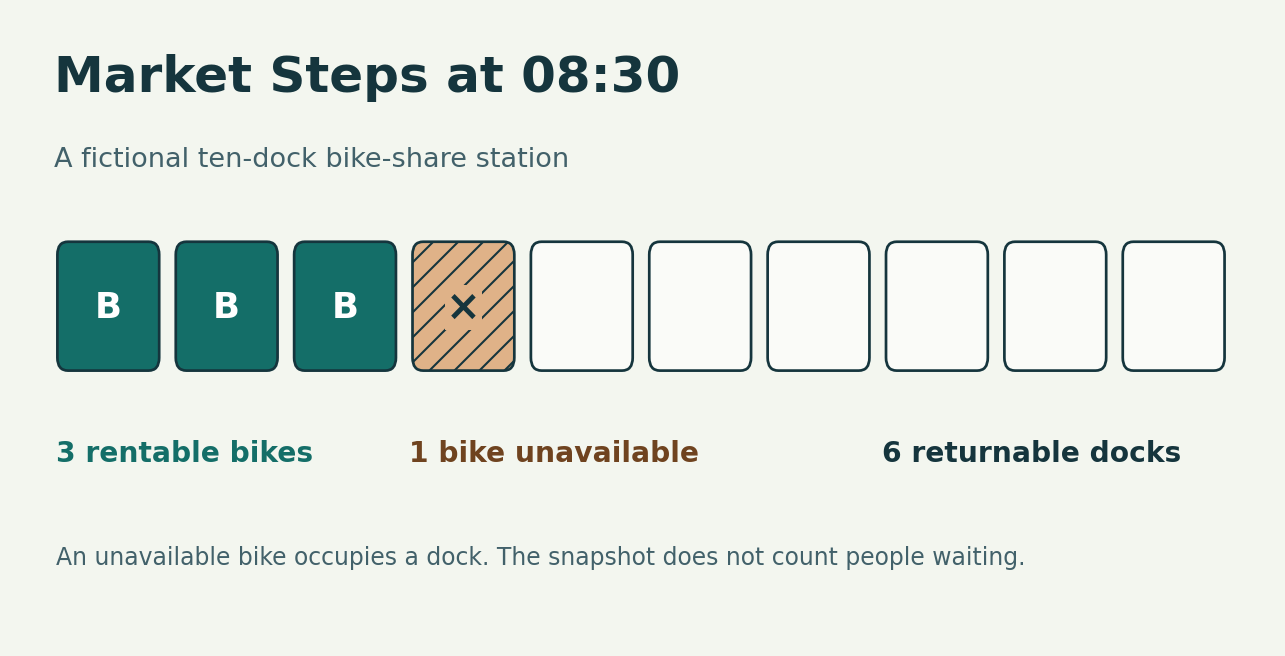
Read Market Steps at 8.30. There are three rentable bikes and six docks currently available for returns. A beginner might add them, get nine and assume somebody miscounted a ten-dock station. The operator's separate maintenance note supplies the missing detail. At 8.20 a bike occupying a dock was marked unavailable for rental and remained in place throughout the rest of the sample period. Its dock could not receive a returning bike while it was occupied. Three rentable bikes, six usable empty docks and one occupied by the unavailable bike account for all ten positions.
The same explanation fits the Market Steps rows at 9 and 9.30. Two plus seven plus one gives ten. Four plus five plus one also gives ten. That is useful confirmation of internal consistency. It does not establish who carried out a repair, how long the problem lasted after 9.30 or what the bike's condition was. The example gives one documented reason for a difference. A real analyst should inspect the actual service records before choosing among disabled bikes, unavailable docks, different vehicle types and other operational details.
Station operating status matters too. A real current-status feed can carry flags for whether a station is renting and accepting returns alongside counts of functional vehicles and docks. A positive functional count by itself may not mean the service is open to a visitor at that time. In this exercise the fresh rows have both operations enabled, and compatible standard bikes make the counts easier to read. Eligibility, payment access, the route to the station and a change between checking and arrival can still affect whether an individual can use it.
You can practise with one altered condition. Imagine another station shows four functional bikes but the operator has paused rentals there. A person asking where they can start a ride needs the pause as well as the number. Ask an assistant to rewrite “Four bikes available now” using both facts. The result should tell the person that the count describes bikes at the site and that a rental cannot currently begin there. Specificity changes a decision when a reader might otherwise walk to an unusable service.
Contents · Previous question · Next question
Does a fall of five bikes mean five people rode away?
Between 7.30 and 8 am, the rentable bike count at Market Steps falls from five to zero. The net change is a reduction of five. Several sequences of activity could produce that result. Five hire starts and no returns would fit. Six starts and one return could also fit if the events occurred in a feasible order. An operator might remove bikes during a maintenance visit. The two endpoint observations alone cannot identify which sequence occurred.
For this interval the exercise provides a second source. The operator's trip register records six hire starts at Market Steps and one trip ending there between the two observations. There were no operator moves or bike status changes at this station in that interval. Start with five bikes, add the one returned bike and subtract six hires. The balance is zero, matching the 8 am snapshot. The return must have occurred before the sixth start. It could have happened before any of the six starts. The precise event order is unnecessary for this balance.
The separate register supports saying six trips started at Market Steps in the interval. It does not establish that six different residents used the station. Nor should the one trip ending there be counted as a seventh departure. If a reader asks where those six trips finished, the local totals do not give their destinations. Even simultaneous changes at Market Steps and Canal Gate could reflect journeys to or from entirely different places.
A copyable check for an assistant is “Read these endpoint bike counts and tell me the net change. Now use the supplied totals of trip starts and returns to check the balance. Keep trips, bikes and distinct people in different sentences, and identify an answer the data cannot supply.” If the assistant subtracted five and reported five observed hires, point to the independent trip register. It was the extra source, rather than more confident arithmetic on the endpoints, that made the six starts knowable.
Contents · Previous question · Next question
How many people failed to get a bike at 8 am?
Imagine Mara arrives exactly as the Market Steps status is recorded. If she tells the city she tried to hire a bike and none was available, staff have one firsthand report of an unsuccessful attempt. In the supplied station counts and trip register alone, no unsuccessful attempt has been counted. The lack of a hire event at a moment of zero supply cannot tell you whether ten people were waiting, one person tried and walked away, or nobody arrived until a bike became available.
A trip register is generally created by activity that occurred under the system's rules. An unsuccessful app request might be captured in a separate operational record, if the service records such events and the proposed use is appropriate. A person who looks at an empty rack and walks away may never interact with an app. Another might check remotely, see the shortage and take the bus. All three experiences could matter if the city wants to know whose journeys are being frustrated.
Distinguish failure from wider need. Someone may want a reliable bike-share option but never attempt the trip because the nearest station is too far away or the membership arrangement is unsuitable. A family may want a different cycle type. Another resident may have no wish to cycle at all. Treating every person absent from a trip register as an unrealised rider would be as misleading as treating all absence as lack of demand. A respectful next step is to ask an answerable question of people who can describe their own plans.
This is a concrete opportunity for a new AI user. “From these fictional records, write one justified sentence about available bikes, one about observed trip starts and one question for people who considered a trip but did not make it.” A useful third sentence asks what happened, offers room to say a plan changed for another reason and avoids presuming a preferred solution. A generated story about frustrated commuters might make a presentation lively. It cannot be added to a count of unsuccessful attempts.
Contents · Previous question · Next question
What happens when the operator itself moves the bikes?
At 8.12 am, according to the fictional fleet log, a truck adds four bikes at Market Steps. The operator's maintenance note then flags one of those bikes as unavailable at 8.20 while it continues to occupy a dock. In this exercise there are no customer trip starts or ends at Market Steps between 8 and 8.30. The result is three rentable bikes and six open docks at 8.30. The rise from zero to three rentable bikes was produced by operational activity.
Notice the difference from the earlier half hour. Before eight, a trip register explained a change in stock through recorded rides. After eight, an operational record explained a change through a delivery and maintenance. An assistant looking only at the status snapshots could describe both movements accurately and still invent their causes. The term “returned” is especially easy to misuse. A bike placed by a truck increases physical stock, but it is not a customer trip ending at that station.
The operator can use this distinction to learn about its own work. Did the delivery happen in response to a recurring early shortage? Was the location chosen because the truck was already nearby? Did taking four bikes from somewhere else make that place less useful for departures? The log here records the time and quantity added. It does not specify the truck's source or answer what happened elsewhere. A useful analysis should preserve that boundary rather than draw a line from Canal Gate to Market Steps merely because the numbers seem complementary.
In eduKate's Vocabulary Coding and Engineering, verbs such as “hired,” “returned,” “redistributed,” “observed” and “needed” are part of how a human intention reaches a decision. They describe different operations and need different evidence. A city that uses the same word for all arrivals may reward an apparent increase in rider journeys that was actually staff repositioning bikes. A clear definition lets staff, riders and a model discuss one phenomenon at a time, then reconnect the observations in a way a policymaker can inspect.
Contents · Previous question · Next question
How do you handle a stale report and a missing one?
At 8.30 the Canal Gate file is present, but its latest station report still describes 8 am. Thirty minutes is too old under the operator's five-minute rule for the immediate question in this exercise. Record the old observation as an old observation. It remains good evidence that the 8 am report said eight bikes and zero free docks. It does not establish that the station stayed full until 8.30. A departure at 8.05 followed by a return at 8.20 could have changed a rider's experience without appearing in either count.
At 9.30 the Canal Gate record is missing altogether. That is different again. No suitably timed record is available, and in this case no new station row arrived for the sample. Do not fill in zero bikes, zero docks or the last known values as if somebody had measured them. An estimate can sometimes serve a clearly defined planning purpose, but it must be labelled as an estimate and checked against alternatives. For a rider trying to return a bike now, an old or absent observation is reason to seek current information.
Among the five scheduled Canal Gate samples, three supply fresh observations and two do not. At 7.30 the station has one return dock, at 8 it has none and at 9 it has three. One of the three fresh samples reports zero return docks. That is an observation about three sampled moments. It is not evidence that the station was full for one third of the whole morning. The duration of fullness remains unknown.
Ask an assistant to mark every row as fresh, stale or missing before calculating any shares. Keep the reporting time separate from the time the collector looked for a record. An assistant may be inclined to make a complete table by carrying numbers forward or replacing a blank with zero. The most useful table here keeps its gaps visible. It tells the next reader where the city knows the station's condition and where it needs better observations.
Contents · Previous question · Next question
Are two hours on one morning enough to choose a permanent station plan?
Market Steps and Canal Gate are observed at scheduled half-hour moments between 7.30 and 9.30 am on one school day. Nothing in that archive tells the city what happened at 6 am, after lunch or on a Sunday evening. A resident finishing an overnight shift could see a very different service from a student leaving for class. A decision about year-round investment should not silently treat the two-hour window as a miniature version of everybody's week.
There is also an arts fair near Canal Gate on this fictional morning. The event calendar establishes that it was scheduled. It does not establish which riders attended or whether the fair caused the 8 am shortage of return docks. Both ordinary morning travel and an unusual event could matter. Staff could compare event and non-event days at similar times, note school holidays and operational changes, and ask people about their journeys. Naming a plausible explanation is the beginning of an investigation, not its conclusion.
A better sampling plan would take observations at intervals suited to the question and cover several comparable days. It would include earlier and later shifts, different days of the week and time periods when available information suggests difficulties. Note the observation windows before checking for the most dramatic shortages. If the team samples only when complaints have already arrived, the resulting archive may teach it about those incidents while giving a distorted picture of ordinary service.
The city should also look beyond the two stations. Shifting a bike from one place creates an opportunity at the destination and removes one at the source. Freeing a dock can help arriving riders and reduce the stock for departing ones. A nearby station may look like an easy alternative to someone reading a map while being impractical for a person carrying equipment or with limited time. Before calling a station redundant or underused, ask whether the proposed alternative serves the same people and journeys.
Contents · Previous question · Next question
Whose travel needs are absent from the data?
A rider who registers, approaches a station and completes a hire is visible in several ways. A resident who cannot afford the membership, lacks the payment method or cannot use the available bike type may never enter any of those records. Another person may be happy walking and have no interest in a bike-share service. The absence of a trip looks the same in a database for all these people. The implications for a city deciding where to invest are quite different.
Speak to people at more than the busy station. An early-shift workplace, a community space, an accessible local meeting or a neighbourhood with no nearby station could help the city understand which journeys it is missing. A short question might read, “Was there a journey in the past week for which you considered using a shared bike? If so, what happened? You can also say you did not consider a bike.” The answer can identify a problem with origin, destination, timing, payment, equipment or something outside the bike system altogether.
Make the route for answering as usable as the question. An app notification will reach some existing riders and miss many nonmembers. Paper replies or short conversations at different times can widen access, while still leaving gaps. Tell participants how the information will be used and avoid collecting detailed travel histories when coarse times and locations are sufficient. An analyst needs enough context to examine a service problem. They seldom need to publish an individual's detailed itinerary to explain that a shift begins before the station is stocked.
Access is a reason to learn more about individual circumstances, not a licence to assign preferences to entire neighbourhoods. A regional average may conceal one group with excellent service and another that regularly cannot return a bike after work. A resident can identify a concern worth investigating even when the team cannot estimate its prevalence yet. The public decision should state who was consulted, which experiences were observed and where the city still lacks evidence.
Contents · Previous question · Next question
What new evidence would help a human planner decide?
Define the immediate question narrowly. The city might ask whether Market Steps repeatedly runs out of rentable bikes before the ordinary morning rental peak and whether a different delivery time would improve access without worsening the source station. It might separately ask whether arrivals at Canal Gate often encounter a lack of compatible docks. These are practical questions with different evidence requirements. Adding permanent docks, moving bikes earlier and fixing unavailable equipment are different interventions.
For the first question, collect fresh station states over comparable time windows and several days. Add appropriately authorised aggregate trip starts and ends, fleet movements and maintenance events. Record when a station is actually renting and accepting returns. For the second, consider observing return attempts during a preselected sample of time blocks and recording how often people find a compatible dock. Define an attempt before observation begins so two staff members do not count a rider looking at a map in incompatible ways.
A participant can contribute valuable evidence without appearing in a trip register. Someone might report walking to Market Steps on three early shifts and finding no bike. Staff can record that as a person's account, check the times against available data and investigate whether the pattern recurs. It is not the same as three independently verified failed rentals across the station population. When a participant reports choosing a different mode before leaving home, note that separately from an on-site attempt. Those experiences point towards related but different failures.
A useful prompt at this stage is “For each proposed claim, identify which source could support it and one person whose experience might still be missed. Suggest a small test I could carry out before requesting a permanent change.” Review the suggestions with the operator and residents. An assistant might recommend collecting more precise personal data than the decision needs or promise an experiment the city cannot staff. A person responsible for the decision should narrow the plan to proportionate, achievable observations that could genuinely change their mind.
Contents · Previous question · Next question
What should the city do after this one morning?
The fictional operations lead decides to investigate the Market Steps shortage and the Canal Gate return constraint separately. She asks for a short, defined period of observation covering ordinary working days, event days and some early and late shifts. She also asks maintenance to check the unavailable Market Steps bike through the normal service process. That is an actionable response to the documented equipment status. It is not a declaration that one disabled bike explains every shortage.
The city declines to approve a permanent transfer of bikes or construction of new docks from these snapshots alone. The operator can still use current verified information to serve riders and make authorised same-day operational decisions. The long-term question concerns the whole network and a wider range of users. The lead names the operational evidence needed, a contact for residents' travel experiences and a review date to be set when the observation period is agreed. People can see whether the new evidence is actually gathered.
When comparing possible responses, ask what success would look like at both ends. An earlier delivery might reduce observed empty periods at Market Steps but increase shortages at the station supplying the bikes. Adding docks could help Canal Gate arrivals yet leave departures scarce at a different time. Repairing the out-of-service bike could release one additional rentable vehicle while it remains in circulation. Compare actual access and documented service constraints across places before treating any one movement in the dashboard as a city-wide gain.
eduKate’s proposed Projection Energy / Distribution Energy (EnDist) framework is a conceptual lens for tracing whose capacity improves and what it costs to make that improvement travel. A rider's precise observation can lead operators and planners to a problem worth fixing. Fleet staff, maintenance workers and residents contribute different evidence. Bikes moved, staff time and observed attempts are quantities with distinct meanings. EnDist does not combine them into a scientific score for need. It invites people to ask who becomes better able to travel and whether somebody elsewhere absorbs the burden.
Contents · Previous question · Next question
Can a beginner turn this into a fair public explanation?
Suppose an AI draft says,
Market Steps lost five bikes in half an hour, proving five commuters needed them. Canal Gate was full for an hour, so the city should move bikes permanently from there.
Circle every part that goes beyond the records. The five is a net change of rentable stock. The trip register records six starts and one end. It identifies no occupation or reason for travel. Canal Gate reported no free return docks at 8 am, but its 8.30 status was stale. Permanently changing the network needs more evidence than one morning can supply.
A corrected public explanation could read,
At the 8 am check, Market Steps reported no rentable bikes and Canal Gate reported no free return docks. At Market Steps six trips had started and one had ended in the preceding half hour. We do not know how many people wanted a bike or dock and could not get one. We will compare more mornings, fleet operations and residents' experiences before deciding on a lasting change.
A city issuing that final sentence should have someone responsible for carrying out the promised work.
Give the explanation to somebody who was not involved in making the chart. Can they say which statements came from a station report and which required trip records? Do they know whether the city has measured unsuccessful attempts? Would a resident with no account recognise where they could contribute? Their answers can reveal where a headline or chart label quietly strengthens the intended claim.
This forms a useful classroom exercise. One student can play a rider, another an operator and a third a resident outside the service area. Each identifies one warranted observation, one unresolved question and a proposed next check. AI can help generate alternate phrasings for the explanation. The judgement remains visible in the student's ability to reject an attractive phrase when the underlying evidence does not establish it.
Contents · Previous question · Next question
Can you transfer the lesson to a different public service?
A fictional reading room has six study booths. At noon the desk reports four available for use, and at 12.30 it reports one available. At 12.45 the clerk's count is missing. A separate register records five starts and two ends of booth sessions between noon and 12.30. All six booths remained in service throughout that half hour. Occupied booths counted as unavailable to a new visitor. A local report says three people used the room and four people were turned away. What in the exercise would justify those claims?
The number of available booths fell by three. Five starts reduced availability, while two ends released booths. Four minus five plus two gives one available at 12.30. There were five recorded starts, but the exercise does not identify five different people. It supplies no observation of four people being turned away. The 12.45 missing record cannot tell us whether a booth was free then. A quiet-looking room might still have been inaccessible to somebody who could not reserve a suitable booth or who assumed the room would be full.
Change one condition. A facilities note shows one booth will be held for maintenance next Tuesday afternoon. A future report showing an unoccupied booth at that time will need to distinguish its physical emptiness from its availability to a member of the public. A person checking the current state should inspect the service flag or ask the responsible desk. A permanent decision to add booths would require observations at relevant times and evidence about people who wanted access but never made a recorded booking.
This is why a simple count can be such a good exercise in education. A learner has to transfer the distinction between a resource and its users, availability and eligibility, a snapshot and a series of events. Another service may have different operating rules. The skill is knowing what to examine when those rules change, rather than memorising that one station or one reading room looked full at a particular time.
Contents · Previous question · Next question
What changes when AI helps a whole city read its data?
A useful assistant can make public information easier for a newcomer to inspect. Ask it to explain an unfamiliar field, rearrange observations by local time, point out a stale row or produce a question suited to a resident who never hired a bike. Check its answer against the records and definitions. A person who could not previously follow a technical description may now make a valuable contribution at a transport meeting. Their understanding has reached further without requiring them to become a software specialist first.
At the team level, agree which source answers which question. The rider-information team needs timely operational status. Maintenance needs to know which bikes or docks require attention. The planner needs patterns across days and places, and evidence about wider access. Each role can use AI to explore material suited to its task. Problems arise when the convenient source for one group is treated as the complete evidence base for another. A current station snapshot serves someone making an immediate choice and still has very limited power to determine permanent investment.
| Week | Try it | Check your work |
|---|---|---|
| 1 | Choose one local service and define what the published count records. | Distinguish a point-in-time count from a completed action. |
| 2 | Collect a short practice series where permitted, keeping the observation times. | Mark stale or missing records and keep them separate from zero. |
| 3 | Find another source that can explain a change. | Describe one explanation the additional evidence supports and one question it leaves open. |
| 4 | Draft a public note for the people affected. | State what you observed, what remains unknown and who decides the next step. |
At the community level, give people a way to contribute information the dashboard cannot hold. Ask when a missing dock changed a journey, whether a suitable type of bike was available, and what it took to reach another station. Keep those accounts tied to their actual scope. A single rider can identify a consequential problem. Learning how often it occurs and which remedy helps requires further work. Combining a person's experience with careful records can be more informative than either a vivid anecdote or a long list of numbers taken alone.
Start with Mara wanting a bike and Arun wanting a dock. Before recommending more equipment, say clearly what each could find out at 8 am, what the trip and fleet records add afterwards and who is still missing from the picture. That is a practical way to direct a capable assistant towards a worthwhile civic question. The city can learn where to investigate, what to repair now and what evidence it still owes people before making a lasting decision about their streets.
Contents · Previous question · Further reading
Sources and further reading
- GBFS reference for station status and availability fields
- GBFS frequently asked questions on the purpose and limits of the feed
- eduKate’s introduction to Vocabulary Coding and Engineering
- eduKate’s conceptual account of Projection Energy / Distribution Energy (EnDist)
- eduKate on who decides how AI projects human intelligence
- Write a fairer community survey question