
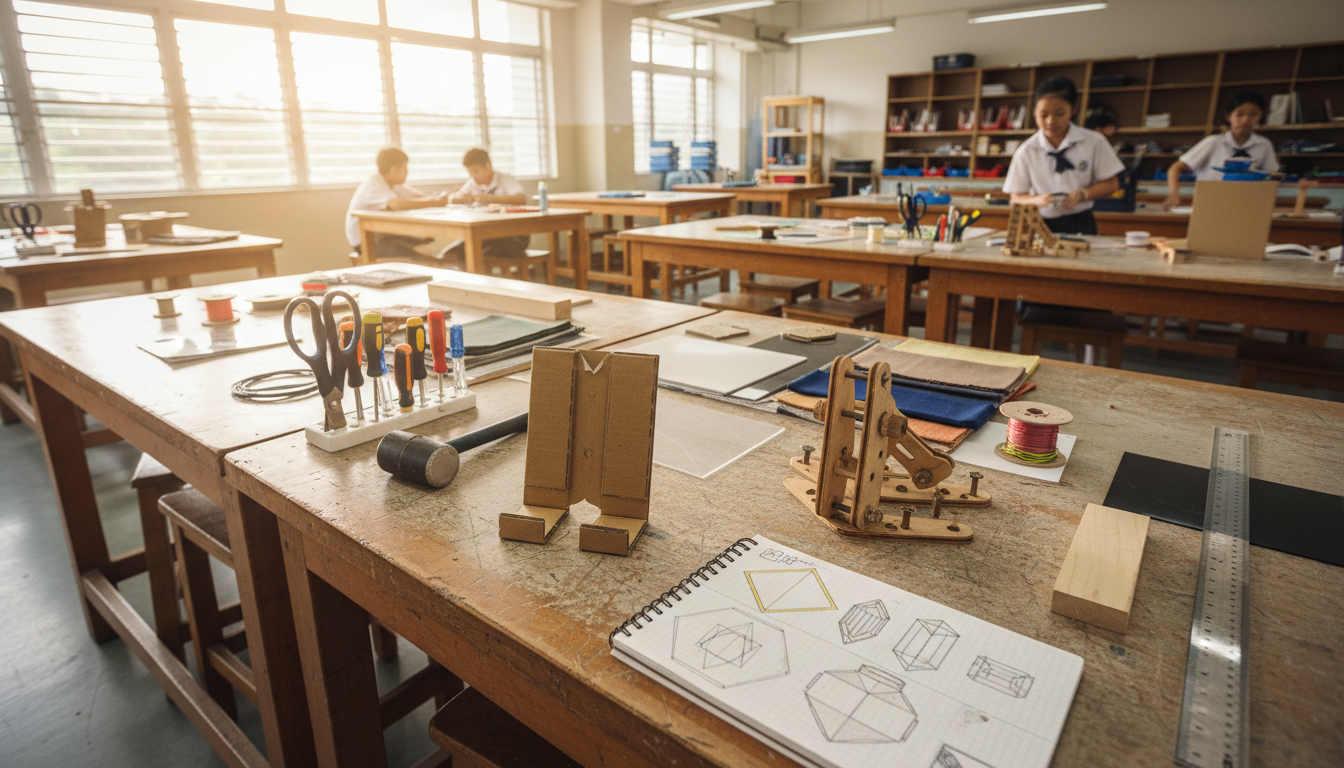
Use AI to turn an idea into a prototype by choosing one thing you want to see another person do. Make the smallest version that lets them try it, ask the assistant to test the instructions against a specific example, then put the prototype in someone’s hands. Watch where their actions differ from what you expected. That moment usually tells you more about the next revision than a list of features you could add.
Rosa wants to design a cooperative board game for a community games afternoon. Her first prototype needs a scrap of paper, two paper letters and a button for a bird. You can play the entire puzzle in six turns. Follow Rosa from her first sketch through an AI simulation and an illustrative human playtest, then use the finished rules to run a real test with someone who has never seen them.
- Choose one question the prototype should answer and one action that would count as evidence.
- Give the assistant a playable starting position and ask it to account for every move.
- Let a new player use the paper version while you watch for the first moment of uncertainty.
- Revise the rule or component that caused the difficulty, then try the changed version with a fresh reader.
Find your question
Choose a question and make the game
Play it, observe a turn and revise the rules
Try a new setting and share the design
What part of my idea is small enough to test?
Rosa’s original idea is a game about birds delivering letters between trees. She pictures a foldout woodland map, different birds with different abilities and a night sky that grows darker as the game progresses. It is easy to ask a chat assistant for twenty bird names or a year’s worth of challenges. It is harder to say which aspect of the idea a first-time player would actually enjoy or understand. Rosa starts by asking what the players should be doing together during an ordinary minute at the table.
Her answer is that the players should be looking at a shared position, deciding which letter their bird can handle and leaving a clear situation for the next person. If that basic turn is confusing, a richer map will conceal the difficulty under more pieces. If the turn makes sense, she can later ask whether a puzzle with different starting positions gives people an interesting choice. Understanding the rules and enjoying repeated play are related but separate questions. This first prototype can give her evidence about the former.
Write a design question a newcomer can help answer. Rosa tries, “Can two people who have never met my game use a short rule card to deliver both letters and agree on what each turn allowed?” She can watch where they place the bird, where they leave the letters and when they say a turn has ended. A general question like “Is my idea good?” asks for an opinion without giving the other person much to experience or the designer a clear reason to revise a rule.
There is still room for the dream of a whole woodland. Rosa writes “larger woodland map” on a separate note and returns to the three locations needed today. A beginner who puts every interesting idea into the first test has to interpret every difficulty at once. Choosing one question is an act of invention. You are deciding which encounter with the idea could teach you something while the cost of changing it is still a few minutes and another scrap of paper.
What can I put on the table today?
Draw three large circles in a horizontal row. Label them West Nest, Oak and East Nest. Draw one line from West Nest to Oak and another from Oak to East Nest. There is no line directly between the two nests. Place a button on Oak to represent a single shared bird. Two people will take turns moving this bird. The circles need only enough room for a button and a small piece of paper. Anyone who prefers another arrangement can keep the same connections in a larger drawing.
Make two folded paper letters. Write “To East Nest” on one and place it at West Nest. Write “To West Nest” on the other and place it at East Nest. Each letter starts away from the nest named on it. The destination stays visible while the letter moves. Leave a small space beside the drawing for delivered mail. When a letter is waiting at a nest it is available for pickup. A letter placed beside the bird as its carried letter travels with the bird until it is delivered.
Rosa has now made a miniature world with inspectable facts. You can tell where the bird begins, which lines connect the locations and which letter belongs where. You can reset the board in less time than it takes to read this paragraph. These details matter to an AI assistant too. “Test my bird game” supplies almost nothing to test. “The bird starts on Oak, the nests are two moves apart and the West letter goes to East” gives it conditions against which any proposed route can be checked.
Take a moment to predict how many separate actions the story hides. Walking the bird one line is one sort of action. Taking a letter and delivering it are others. Counting turns is yet another. A first-time designer may assume they all fit naturally into an ordinary phrase such as “deliver the post”. Once you put a button in someone’s hand, the exact order starts to matter. That is what makes this little arrangement a prototype instead of an illustration of a future game.
Contents · Previous question · Next question
What should the first rule card say?
Here is Rosa’s deliberately rough initial card. “Work together to deliver the two letters before nightfall. The bird starts on Oak. Take turns moving it along one line. When you visit a nest, handle the post there. The bird carries only one letter at a time. You have six turns.” These few sentences are enough to expose a question. You can place the objects and ask what someone thinks will happen on a visit. You do not need a beautifully printed rulebook to discover that “handle the post” is doing a great deal of work.
Try it yourself. Move the bird from Oak to West Nest and take the letter addressed to East Nest. Move the bird back to Oak and then along the other line to East Nest. At this point the bird carries a letter that belongs where it has just arrived. A second letter waits at that same nest to go west. Which actions can the player take now? Where should each letter lie when the next player starts? Different answers can be reasonable readings of the rough card.
Rosa privately intended a player to make one decision about the mail per turn. A player could pick up one waiting letter or deliver the one already carried. They could remain at a location if they wanted to deal with the mail there again on their next turn. The draft contains neither a clear limit on mail actions nor permission to stay. A newcomer is entitled to work from the words on the card. The rules in a designer’s head have never reached the other side of the table.
Before opening a chat, write down your own reading of the disputed visit. Could a player drop one letter and pick up the other on the same turn? Could the bird spend the following turn at East Nest without flying? Preserve those answers as your first attempt. When the assistant proposes a route, you will have a specific issue to examine. Agreement with an assistant’s conclusion is less useful than understanding which words caused you both to choose the same or different moves.
Contents · Previous question · Next question
How do I ask AI to play a game it has never seen?
Give the assistant the board, the initial locations and the exact draft rules. A beginner can copy the rough card and then add this request. “Try one round of this invented game. For each turn, say where the bird starts and ends, what happens to each letter and which rule permits the action. Use only my card. If the words allow two readings, show me both and pause before inventing a rule.” You can make the same request in an ordinary text chat without sharing a picture or downloading a game tool.
An illustrative reply might say, “On turn one I fly from Oak to West Nest and take the eastbound letter. On turn two I fly to Oak, still carrying it. On turn three I fly to East Nest, deliver it and pick up the letter waiting for West. I can finish on turn five.” This is a possible simulated response. There is no reason to assume every assistant will give the same one. The value lies in the route written out clearly enough for Rosa to reproduce with the button and the letters.
Rosa follows up. “You put down one letter and picked up the other on turn three. Which words specify that two mail actions are allowed?” A sound response might observe that the card says “handle the post” and limits the bird to carrying one letter at a time. Dropping before picking up respects the carrying limit. It also uses two distinct mail actions. The card never says whether those two actions may share a turn. What first looked like a quick solution has found a real gap in the instructions.
You can ask the assistant to try the stricter reading next. “Allow one mail action per turn and require movement along a line on every turn. Does your route still work in six?” Inspect the answer on paper. An assistant can overlook a forced return journey, invent a direct flight between nests or forget that a discarded letter is already delivered. It is simulating from text. The hand check lets Rosa use its mistakes and its successful moves as evidence about the design rather than treating either as a ruling.
Contents · Previous question · Next question
What does the disputed turn tell me to change?
Trace the stricter reading together. The bird collects the eastbound letter on turn one, passes through Oak on turn two and delivers it at East Nest on turn three. It is now empty. If it must fly on turn four, the only available flight takes it to Oak. On turn five it can return to East Nest and collect the westbound letter. On turn six it can reach Oak again. It would need a seventh turn to reach West Nest and deliver the second letter. Starting in the other direction gives the mirror image of the same difficulty.
The simulated five-turn route and the stricter seven-turn route are not two measurements of the same finished game. They implement different rules. Rosa wants players to notice that unloading and collecting are separate jobs. She also wants the smallest demonstration to be solvable in six turns. Permitting a player to stay for a turn while handling a letter achieves both intentions. A designer who wanted a brisk exchange at each nest could instead allow both actions and build a different puzzle around that rule. The tool has identified a design choice. Rosa still owns it.
Her first revision reads, “On your turn, move the bird along one line or stay where you are. After that, you may take one waiting letter here if the bird is empty, or deliver the letter it carries if this nest is its destination. Choose at most one of those mail actions. You may choose neither. Players alternate turns. Deliver both letters in six turns.” This is short enough for a newcomer to hold while moving the pieces. It also gives the assistant specific intermediate states it must respect in a simulation.
Read the revision against the precise disagreement that prompted it. On arrival at East Nest with a letter to deliver, a player can deliver it. Picking up the waiting letter would be a second mail action. On the following turn the bird can stay and take that letter. The two contested permissions are now explicit. Revising a whole rulebook for tone would have made the prose nicer while risking another version of the same gap. A tiny text change can be a substantial product change when it alters what the player is allowed to do.
Contents · Previous question · Next question
Can I check a complete round without relying on the chat?
Reset the bird to Oak. Put the letter for East at West Nest and the letter for West at East Nest. Play with an imaginary partner or take alternate turns yourself. On turn one move from Oak to West and pick up the letter for East. West Nest now has no waiting letter. The bird is at West with the eastbound letter. On turn two move it back to Oak, still carrying the same letter. No mail action is required at the middle location.
On turn three move from Oak to East. Deliver the letter addressed to East. Put that delivered letter to one side and leave the letter to West where it was waiting. The bird is empty. On turn four keep it at East and pick up the letter addressed to West. This is a full turn even though the bird has remained on the same circle. The crucial choice is to let the mail action use its turn. If the bird flies back to Oak on turn four, there are too few turns left to collect and deliver the second letter before the sixth turn ends.
On turn five move from East to Oak carrying the westbound letter. On turn six move from Oak to West, then deliver that letter. Both letters are delivered by the end of the sixth turn. Reverse east and west in this route and check which details change. The identities of the first and second letters change. The number of turns, the middle journey and the need to stay at a nest for one turn all remain the same. That symmetry gives the designer a second simple check of the rules.
| Turn | Where the bird ends | What happens to the mail |
|---|---|---|
| 1 | West Nest | Collect the letter for East. |
| 2 | Oak | Keep carrying it. |
| 3 | East Nest | Deliver the letter for East. |
| 4 | East Nest | Stay and collect the letter for West. |
| 5 | Oak | Keep carrying it. |
| 6 | West Nest | Deliver the letter for West. |
A valid solution establishes that the revised miniature puzzle can be completed under one intended interpretation. It supplies little evidence about whether a stranger will read the rules the same way, whether the route is too easy or whether the theme will interest a particular group. Those are valuable next questions that call for other observations. The assistant’s useful contribution was to help expose exactly what needed checking. Finishing a route in chat gives the designer a reason to set a playable version before someone else.
Contents · Previous question · Next question
Why put it in another person’s hands?
In this fictional worked example, Rosa next invites her neighbour Dev to sit at the table with the revised card. Rosa has set the bird on Oak and placed each letter at the nest opposite its destination. This run tests playing from a prepared board. Dev is a person in the illustration, not evidence from a published user study. To run a real check yourself, give the board and card to someone who has never read this article and can spare a few minutes. If you have already explained the trick about waiting at East Nest, invite a different person for the first-reading test. Previous knowledge changes what you can learn.
Rosa gives Dev this invitation. “Please try the game from this starting position using the card. I will be the second player. I am looking for places where my instructions leave you to guess. If you hesitate, tell me what you are deciding between.” She will answer a direct request for help, then record where help was needed. A quiet minute while someone reads or moves a piece can be more informative than a designer explaining every point before it arises.
Dev understands that he can stay at East Nest for a mail action. The simulation helped the revision in that respect. A different ambiguity appears when he starts counting. After his first move, he writes one mark beside his own name. When Rosa takes her turn, he leaves his own tally unchanged. A few moves later he thinks each player has six turns. Rosa intended six for the two players combined. Both had understood the word alternate. Neither had noticed they were counting different things until the marks appeared on the paper.
What can Rosa learn from this behaviour? She has one concrete example of how a reader could interpret the first revision. She has no estimate of the proportion of all players who would do the same. She can also be grateful that she watched the marks instead of merely asking “Do you understand?” Dev might sincerely have answered yes. The paper prototype has turned a difference in interpretation into something the designer can point to and change.
Contents · Previous question · Next question
Is the best fix another sentence or a change to the board?
Rosa could underline “six turns altogether” on the card. That would improve the wording. She can also draw six small circles beside the map and label them “Our six turns”. After either player acts, that player crosses the next circle. The number of remaining turns is now visible to both players without anyone remembering which tally belongs to whom. A pencil and six marks have changed the information available at the point where Dev made his decision.
Look at the two pieces of paper at East Nest after the first delivery. One is already delivered. The other is still waiting. A first-time player could easily pick up the delivered letter again if both lie in a single heap. Rosa draws a box beside the map labelled “Delivered” and puts each completed letter there, destination still visible. A player can check whether a letter reached the proper nest before moving it into the box. The change also makes the end of the game legible. Two letters in the box mean the job is done.
These improvements solve different problems. A shared turn track clarifies the group’s time limit. A delivered box distinguishes work completed from work still available. Naming both as “make it clearer” would leave an assistant free to redesign everything from the typeface to the woodland story. Rosa can instead ask, “Which mark could make the remaining group turns visible without adding another rule to remember?” A suggestion is worth trying when it changes what someone can see or do at a specific point.
Check that the drawing itself has not introduced a new ambiguity. If the delivered box looks like a fourth location linked to East Nest, players might try to fly there. Put it off the route and draw no connecting line. If a player crosses a turn before acting, make sure the last turn can still be completed. Rosa chooses to cross the next circle after the move and optional mail action. A paper prototype lets the designer discover such consequences before paying to have components made.
Contents · Previous question · Next question
What are the complete playable instructions after those revisions?
Here is a final card you can copy onto a fresh sheet. Give it to a new player without the solved route. “Two players share one bird and six turns altogether. Your goal is to deliver both letters to the nests named on them by the end of turn six. You can win by delivering the second letter on turn six. Decide together who takes the first turn. Alternate after that.”
“Draw West Nest, Oak and East Nest in a row. Connect West to Oak and Oak to East. Put the bird on Oak. Place the letter marked To East Nest at West Nest. Place the letter marked To West Nest at East Nest. Beside the map, draw an empty Delivered box and six empty circles for your shared turns. If the bird carries a letter, keep it beside the bird and move them together.”
“On your turn you may move the bird along one line or leave it where it is. Next you may do one mail action at the bird’s current location. If its beak is empty, you may take a waiting letter at that nest. If it is carrying a letter addressed to that nest, you may deliver it by putting it in the Delivered box. You may skip the mail action. The bird carries at most one letter. Letters in the Delivered box stay there.”
“After your movement choice and optional mail action, cross one shared turn circle, including on a turn when you stayed. Once both letters are delivered, you win together. If the sixth circle has been crossed and a letter still awaits delivery, the round ends without both letters delivered. Reset and try a different route if you like.” A group with a button for the bird can treat an empty beak as simply a bird with no letter beside it.
Put this card beside the earlier rough version and notice what survived. The two letters, bird, nests and dusk deadline are still recognisable as Rosa’s original idea. The revisions have made the move order, handling limit, option to stay and shared clock inspectable. You can now hand over a whole small experience in a few paragraphs. Someone who has never heard Rosa describe her vision can start, make a choice, see the outcome and reset the board for another go.
Contents · Previous question · Next question
What should I learn from a second playtest?
Choose a question before the next pair sits down. An appropriate one is, “Can two new readers agree how many turns remain and what happens to a delivered letter without asking me?” Give them the final card, a button, two scraps for letters and a pencil. Ask them to set up the board themselves. If you draw it in advance, you test play with a prepared map. If they draw it, you also test the setup instructions. Either version can be worthwhile if you remember which one you ran.
Note a few observable moments. Where did the players put the first crossed circle? What did they do with a delivered letter? When one player stayed at a nest, did the other agree a turn had passed? Say how often you answered a rules question. If someone reads the staying rule twice and moves correctly, record that as a reread followed by the intended action. “They were confused” conveys much less than the particular text they reread and the actual move that followed.
Do not judge the card merely by whether the pair wins. Two players might understand the rules perfectly, fly back to Oak when waiting would help and run out of turns. They have made a permitted strategic mistake. Another pair might win in five turns by delivering and collecting at once. That result points to an illegal action even though both players are pleased. Distinguishing misunderstandings from choices is how the designer decides whether to revise the explanation or leave the puzzle for players to discover.
After the round, ask an open question. “Was there a moment when you considered two possible moves and could not tell whether both were allowed?” If the answer concerns a rule, ask the player to show the spot on the board. If they simply preferred a different theme, thank them and record it separately. An assistant can organise several such notes. Its neat categories should never erase the evidence that one comment concerned a rule, another the challenge and a third a matter of personal taste.
Contents · Previous question · Next question
How do I use AI without letting it design a different game for me?
Suppose the assistant suggests adding weather cards, a fox that steals post and a second bird with a longer flight. Any of these could support a later design. Adding them now would make it harder to tell whether the shared turn track fixed Dev’s problem. Rosa keeps an ideas list with a sentence explaining what each proposed feature might help her learn. If a second bird is intended to increase discussion between players, that becomes a future testable question. For now, the single shared bird is doing a useful job.
A good follow-up prompt is more concrete. “Here is my revised rule card. Look for one legal turn whose result is still unclear. Use the current components and quote the words that allow the ambiguity. If you can find no such turn, say which examples you checked.” The assistant might try taking two letters, flying over Oak in one move or spending a turn waiting. Reproducing each case gives Rosa a little set of checks she can run after another change. A list of cases is useful even when a suggested move turns out to be explicitly forbidden.
This is a practical application of eduKate’s proposed Vocabulary Coding and Engineering approach. “Turn” initially left the owner of the clock unspecified. “Handle” bundled pickup and delivery together. “Visit” left staying at a location uncertain. Replacing those terms with small, testable statements allowed another person to reconstruct what Rosa meant. The language still need not sound like a computer program. Its job is to guide a newcomer’s hands at the precise moment two reasonable interpretations would lead to different actions.
AI can help the designer imagine alternative readings more rapidly than she might alone. It cannot decide which reading gives the community game its character. Rosa values a turn spent waiting to collect a letter because it makes stopping an active choice. Somebody else might find that theme odd and design immediate exchanges instead. The authority to make that choice comes from the purpose of the game and the people responsible for it. The playtest supplies consequences to consider while the designer makes the decision.
Contents · Previous question · Next question
Can I transfer the method to an idea that has no game pieces?
Imagine a local poetry exhibition wants a simple listening station. Visitors should be able to hear a poet read a poem or read the printed words themselves. Before building a screen, the organisers can make a paper prototype. Draw a first card with two choices, “Read the poem” and “Hear the poet”. Draw a second card showing the poem’s text. Make a third card representing the listening screen, with the poem title and a way back to the first card. A volunteer can swap the paper cards in response to where a visitor points.
Write one question for the test. “Can a first-time visitor who wants to hear the poet find the listening option and tell what will happen when they choose it?” Give the person a short task such as “You would like to hear this poem in the poet’s voice.” When they point to a choice, show the corresponding card. If no audio is available, say the paper prototype can represent starting and stopping it. This test cannot establish whether a recording sounds pleasant, how loudly it should play or whether real equipment works.
Suppose a visitor finds “Hear the poet” easily but hesitates on the listening screen. They want to return to the written poem while the reading continues. The paper screen has a button marked “Back”. Does Back stop the reading or simply take them to another screen? Ask the assistant for two plausible interpretations and the consequence for each. The organisers must decide which behaviour the real station should support. They can add “Stop and return” if leaving is meant to stop playback, or offer separate navigation and playback choices if reading alongside the audio is part of their intention.
Compare this with the bird game. The pieces and vocabulary are entirely different. The decision at the centre is familiar. A single word hides two behaviours that matter to the visitor. The physical demonstration exposes the moment of uncertainty. The organiser revises the wording or interaction and gives the changed card to someone new. The achievement is learning to build just enough of an idea to discover what another person will need from it, without yet paying for the whole implementation.
Contents · Previous question · Next question
How does this change what students and communities can make?
A teacher can ask learners to bring one unfinished idea and one question a paper version could answer. A student who wants to create an elaborate digital game can begin by giving a classmate one legal move to choose. A learner planning a school display can make two alternative labels and watch which actions visitors expect. AI can help name the decision, simulate a difficult case or suggest a sharper follow-up question. The student retains the valuable work of choosing what the idea should do and interpreting what a classmate actually experienced.
The evidence of learning is visible across revisions. Ask the designer to show the old wording, demonstrate two readings and explain the new choice without looking at the chat. Then ask for a changed case. Could the same student design a paper test for a listening station or a shared timetable? A polished final rule card on its own might have come almost entirely from an assistant. A student who can investigate an unfamiliar interaction, choose a revision and test what it changed is showing judgement that travels beyond the assignment.
At a community scale, a lending library might use the paper game in several clubs. Sending the final rules and a note about which behaviours testers actually checked gives each club a reasonable starting point. The receiving volunteers can adapt the scale of the print, the arrangement of the locations or how turns are marked to suit their players. If the card is translated, they can repeat the disputed East Nest turn to see whether pickup and delivery remain distinct in the new wording. Local readers supply knowledge about their own experience that the original designer cannot provide.
eduKate’s proposed Projection Energy / Distribution Energy framework, often called EnDist, asks what useful capability reaches other people after the effort of explanation, checking and repair. A swift stream of AI-generated designs can create considerable work for the volunteers who must make sense of them. One small, tested prototype can help another group begin with a real question and a way to investigate it. The wider social possibility lies in more people being able to test and share their ideas while those affected still have a meaningful say in what is built.
Contents · Previous question · Next question
What should I make before I ask for another feature?
Give your idea a modest first appointment with another person. Choose what they should be able to do, gather the few pieces needed for that action and write instructions they can follow without knowing your private intentions. Before the appointment, ask an assistant to follow the instructions from one exact starting position. When it makes an unexpected move, point to the phrase that permitted it. Verify on paper whether the action was genuinely legal, genuinely forbidden or left open by the draft.
You can reuse this prompt. “I am making a small prototype of this idea. The user starts here, can choose among these actions and should finish with this result. Use the instructions exactly once and show each change in the state of the prototype. Tell me where you had to make an assumption and give the other plausible reading. Then help me devise a short test that a new person could actually perform.” Replace the descriptions with the pieces, words, actions and finish condition from your own idea.
After a real person has tried it, keep a brief record in their terms. What did they do? At what moment did their expectation differ from yours? Which change do you think will matter? What will someone new be able to see or do if the change helps? Separate the notes from a human test and the notes from an AI simulation. The two offer different evidence, and the discrepancy between them may lead to the most interesting next question.
Rosa’s original idea could easily have remained a description of a woodland game. It became something other people could investigate as soon as a button carried a letter across three paper circles. An assistant exposed one missing rule. A newcomer’s pencil marks exposed another. A future player can now test the revised version and surprise the designer again. That is a substantial first use of AI for anyone with an idea, a table and the curiosity to see what happens when someone else gets a turn.
Contents · Previous question · Further reading
Sources and further reading
- MIT OpenCourseWare’s Game Design assignments on playtesting and revising rules
- eduKate’s introduction to Vocabulary Coding and Engineering
- eduKate’s article on who decides how AI projects human intelligence