
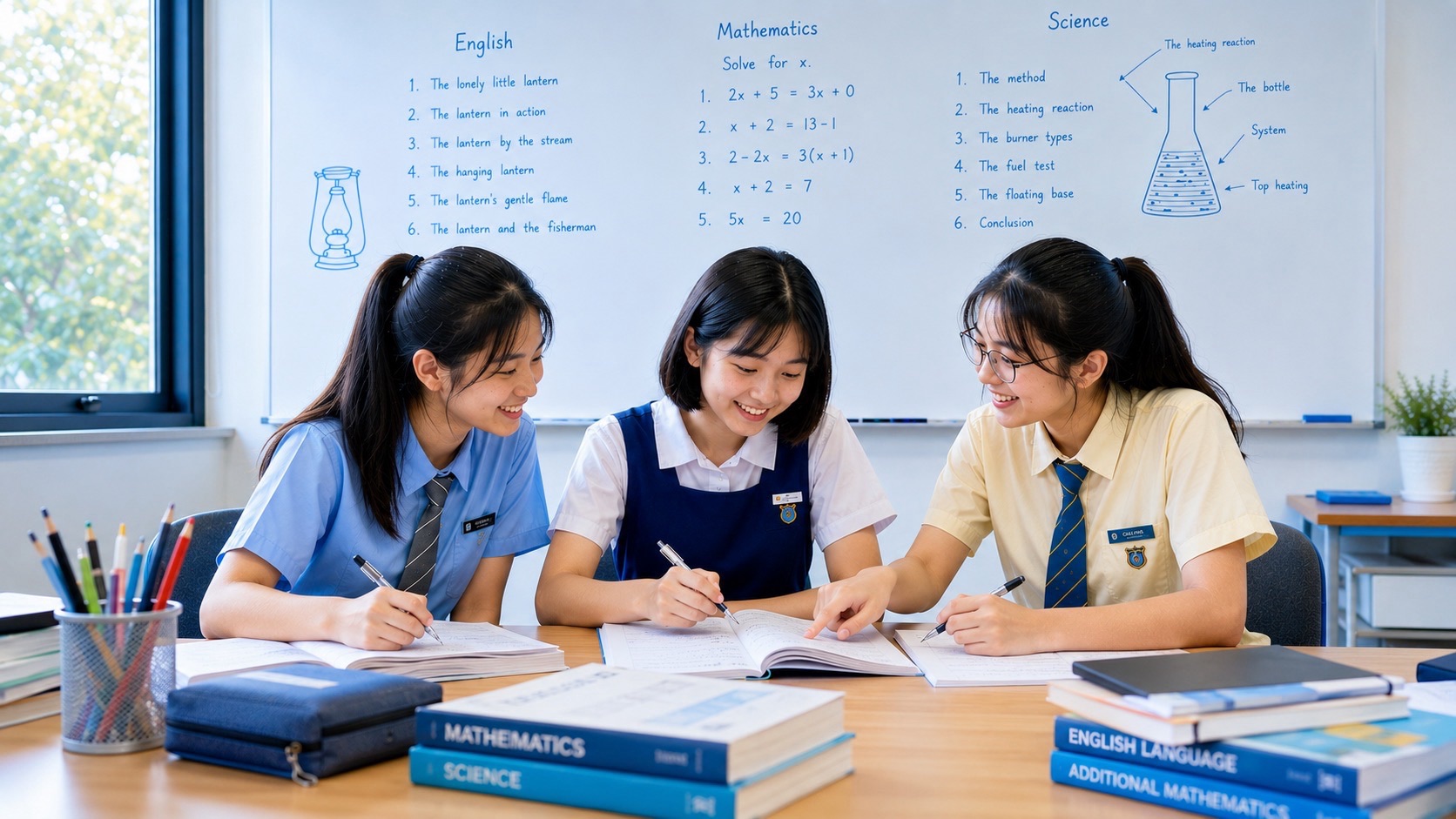
Critical Thinking in Mathematics | How Students Choose, Compare and Verify a Method
Critical thinking in Mathematics is not a special worksheet labelled “Critical Thinking”.
It appears whenever a student has to decide what the problem means, which information matters, how to represent the relationship, which method is valid, whether another route is better and whether the final answer can be trusted.
That makes critical thinking a backbeat running through Primary and Secondary Mathematics rather than a separate enrichment topic.
This page supports the Sengkang tuition estate with an educational job: show parents and students what mathematical critical thinking actually looks like, how it can be taught and how it differs from simply giving harder questions.
What the Current MOE Primary Mathematics Framework Says
MOE’s Primary Mathematics syllabus, updated in October 2025, keeps mathematical problem solving at the centre of the curriculum. It connects five inter-related components: concepts, skills, processes, metacognition and attitudes. The syllabus explicitly emphasises reasoning, communication, connections, applications and modelling, thinking skills and heuristics, together with monitoring one’s own thinking and self-regulation.
That is already a strong description of mathematical critical thinking. It is not merely “can the child calculate?” It is “can the child decide, reason, connect, monitor and verify?”
Official reference: MOE Primary Mathematics Syllabus, updated October 2025.
The Critical-Thinking Loop
Understand → represent → choose → execute → compare → verify → reflect → transfer.
Every stage can fail separately.
A student may calculate perfectly after being given a method but fail to choose the method independently. Another may choose a valid method but use a representation that creates unnecessary risk. Another may get the correct answer and still be unable to explain why it is reasonable.
1. Understand the Problem Before Doing Mathematics
Critical thinking begins before the first calculation.
The student should identify:
- what quantities or objects exist;
- what is known;
- what is unknown;
- what the question is asking for;
- which information is relevant;
- which conditions or restrictions matter.
A child who starts calculating immediately may solve a mathematically correct problem that was never the problem being asked.
2. Represent the Relationship
Representation is one of the highest-leverage critical-thinking skills in Mathematics.
The same relationship can often be represented as:
- a bar model;
- a number line;
- a table;
- a diagram;
- an equation;
- a graph;
- a ratio;
- a verbal statement.
A strong student does not always use the most sophisticated representation. The student chooses the representation that makes the important relationship easiest to see and manipulate accurately.
For example, a Primary problem may be clearer with a bar model than an equation. A Secondary function problem may become clearer as a graph than as a long symbolic chain. Critical thinking includes knowing when to change representation.
3. Choose the Method Rather Than Waiting for the Chapter Label
Topical practice teaches execution. Mixed practice adds method selection.
The student should learn to ask:
- What mathematical structure is present?
- Which methods could apply?
- What conditions make each method valid?
- Which route is shortest or safest?
- What information would another representation reveal?
This is why a student can look strong in homework and weak in examinations. Homework may announce the chapter; examinations often do not.
4. Compare More Than One Valid Route
Critical thinking grows when students see that Mathematics can have more than one valid route.
The class can compare:
- bar model versus algebra;
- direct computation versus working backwards;
- graphical interpretation versus symbolic solution;
- factorisation versus another valid algebraic transformation;
- two geometric deduction chains.
The question is not merely “Which answer is right?”
Ask:
- Which route makes the relationship clearest?
- Which has fewer fragile steps?
- Which is easier to verify?
- Which generalises better?
- Which would be safer under time pressure?
Comparing routes teaches students to see Mathematics as structure rather than one memorised recipe.
5. Test Assumptions
Students often insert assumptions that were never stated.
Examples include:
- assuming a diagram is drawn to scale;
- assuming a relationship is proportional;
- assuming all algebraic solutions are meaningful in context;
- assuming an average describes every individual value;
- assuming a pattern continues without evidence.
Critical thinking asks, “What am I assuming, and is that assumption justified?”
6. Verify the Result from Another Direction
Verification is not an afterthought.
A student can check:
- magnitude;
- units;
- sign;
- substitution back into an equation;
- whether a graph matches the expected behaviour;
- whether a probability is within a valid range;
- whether the answer satisfies the original condition.
The stronger question is not “Did I redo the same calculation?” It is “Can I verify this answer through a partially independent route?”
7. Explain Why the Method Works
Explanation exposes whether the student understands the invariant relationship.
We ask students to explain:
- why the equation represents the situation;
- why the transformation preserves equivalence;
- why two ratios are comparable;
- why a geometric property applies;
- why the graph should have that shape;
- why an answer is impossible or unreasonable.
A learner who can explain the relationship is more likely to recognise it after the surface changes.
8. Change the Surface and Preserve the Relationship
Critical thinking requires transfer.
We deliberately change:
- numbers;
- notation;
- diagram orientation;
- story context;
- question order;
- representation;
- neighbouring topic.
The student should recognise what has stayed mathematically the same.
9. Learn from a Wrong Route
A wrong answer contains useful information when the student can identify the first wrong state.
We distinguish:
- misread problem;
- wrong representation;
- wrong method family;
- valid method used under the wrong condition;
- correct plan with execution error;
- correct answer reached for an invalid reason.
Critical thinking includes the ability to debug Mathematics.
10. Know When to Stop and Reroute
Persistence is valuable, but repeating a broken route indefinitely is not.
Students need a rerouting habit:
- What is not progressing?
- Did I misrepresent the problem?
- Can I use a simpler case?
- Can I draw or tabulate it?
- Can I work backwards?
- Can I test one possible value?
- Is there another valid method?
This is mathematical flexibility, not giving up.
Critical Thinking in Primary Mathematics
At Primary level, critical thinking can look like:
- choosing between a bar model, number sentence or table;
- explaining why one operation fits;
- estimating before exact calculation;
- finding an alternative solution;
- identifying irrelevant information;
- checking whether a result is reasonable;
- explaining how changing a condition changes the answer;
- creating a similar problem with a different surface.
It does not require Olympiad-level difficulty. A routine curriculum problem can become a critical-thinking task if the child has to choose, justify and verify.
Critical Thinking in Secondary Mathematics
At Secondary level, the same backbeats become more symbolic.
- choosing a representation;
- selecting an algebraic route;
- recognising a function from a graph or context;
- testing a geometric assumption;
- comparing solution methods;
- checking domain, interval or units;
- interpreting data rather than only calculating;
- recovering after a first route fails.
Critical Thinking Is Not “Harder Questions All the Time”
A very difficult problem can overwhelm the student and reveal little except that too many things are missing at once.
Critical thinking can be trained at the correct level by changing the decision demand rather than simply increasing difficulty.
For example:
- remove the chapter heading;
- offer two possible methods and ask which is safer;
- give a wrong solution and ask where it first fails;
- ask for a second representation;
- change one condition and ask what changes;
- ask for a reasonableness check.
This keeps the mathematical content accessible while increasing the thinking work.
Critical Thinking Is Not “Never Teach Procedures”
Procedural fluency matters because it frees attention for higher-level decisions.
A student who must spend all working memory on fraction arithmetic has less capacity for modelling the larger problem.
The sequence is often:
Understand → practise → automate enough → reintroduce choice → vary → verify → transfer.
Critical thinking and fluency support each other.
The Mathematical Critical-Thinking Error Taxonomy
- Interpretation error: the problem is misunderstood.
- Representation error: the relationship is encoded poorly.
- Recognition error: relevant method is not identified.
- Route error: method is invalid or fragile.
- Assumption error: unstated condition is treated as true.
- Execution error: correct reasoning, broken calculation.
- Verification error: answer is accepted without checking.
- Transfer error: reasoning works only in familiar forms.
- Metacognitive error: student does not notice that the approach is failing.
How 3-Pax Helps Mathematical Critical Thinking
Three students create useful route diversity.
- Student A may use a diagram.
- Student B may use algebra.
- Student C may work backwards.
The tutor can then ask the class to compare the mathematical invariant rather than copy the fastest solution.
Students can discuss:
- which route is clearest;
- which is most general;
- which is easiest to verify;
- where each route is fragile;
- what changes if one condition changes.
Peer difference becomes reasoning material.
A Typical 1.5-Hour Critical-Thinking Mathematics Lesson
- Retrieve: bring back a known mathematical relationship.
- Problem: present it without naming the method.
- Represent: students choose a form.
- Attempt: independent first route.
- Compare: examine alternative routes.
- Challenge: change one condition or representation.
- Verify: test the result through another route.
- Reflect: name what made the route valid or invalid.
- Transfer: apply the invariant to another problem.
What Progress Should Look Like
- the student pauses to understand before calculating;
- representations are chosen more deliberately;
- method selection becomes faster and more defensible;
- the learner can compare two valid routes;
- assumptions are noticed;
- answers are checked for reasonableness;
- wrong solutions are debugged more precisely;
- changed contexts cause less disruption;
- the student notices when a route is failing and reroutes.
When Critical-Thinking Work Is Especially Useful
- topical worksheets are strong but mixed papers are weak;
- the student repeatedly asks, “Which formula do I use?”;
- new word problems cause freezing;
- the learner copies solution templates without understanding;
- harder questions fail because the student cannot choose a representation;
- the child gets answers but cannot verify or explain them.
What We Do Not Mean by Critical Thinking
- making every question unusually difficult;
- refusing to teach standard methods;
- requiring long verbal explanations for every routine calculation;
- turning Mathematics into vague “creativity” without precision;
- rewarding unusual methods simply because they are unusual.
Critical thinking remains mathematical: representations must be valid, relationships precise and conclusions supported.
The eduKate Mathematical Critical-Thinking Loop
Understand → represent → choose → execute → compare → verify → reflect → transfer.
This page is educational support for the Sengkang Mathematics estate. The local commercial owner remains Mathematics Tuition Sengkang | Find the First Weak Link.
Ask About Mathematics Learning in Sengkang
eduKate Mathematics classes use a 3-student small-group format and are typically 1.5 hours weekly. We can use current school work to see whether the learner mainly needs concept repair, procedural fluency, method selection, representation, transfer or examination conversion.