
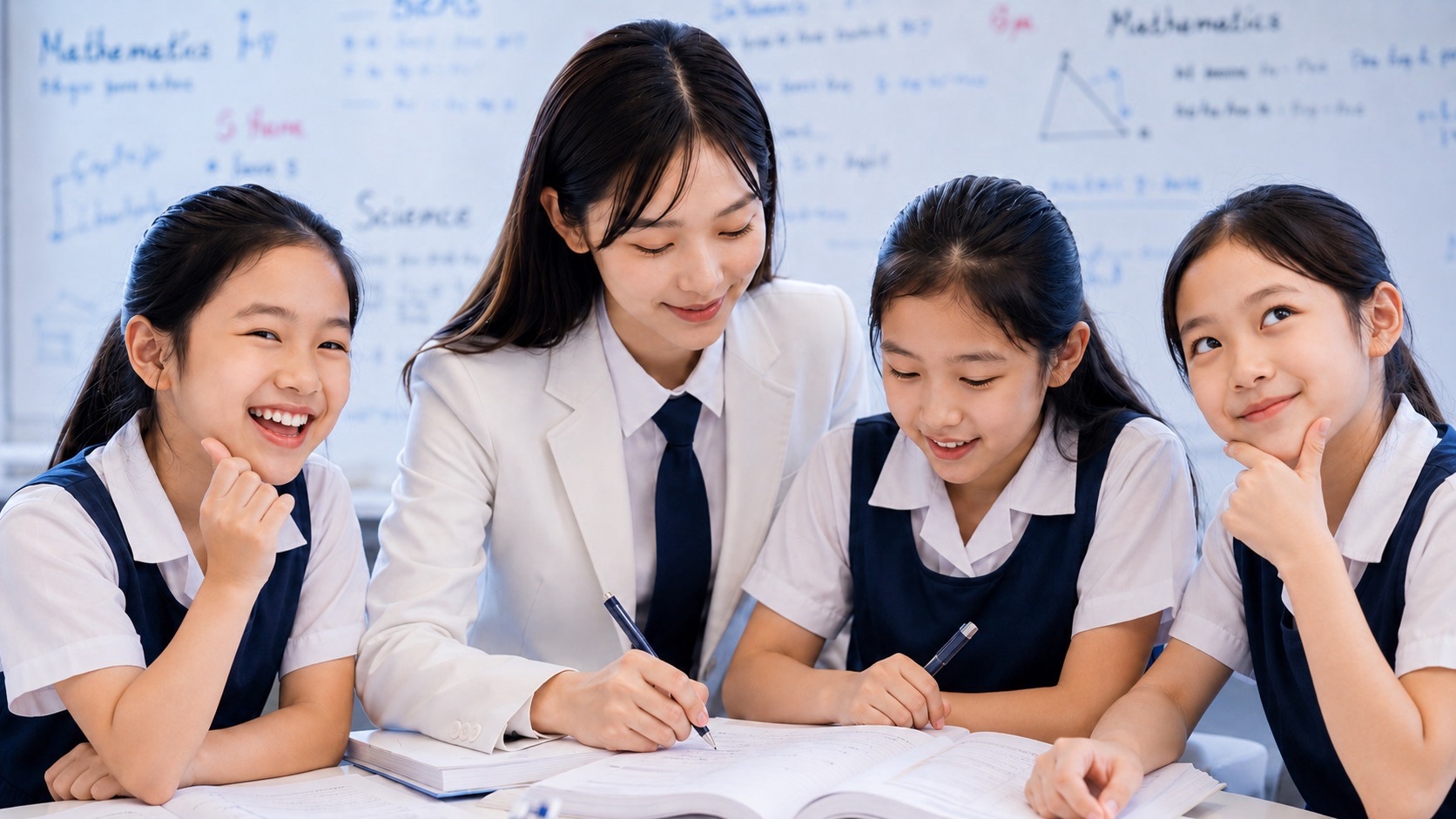
Bukit Timah Tuition Primary 2 Math Tuition: A Mathematics Buffer Corridor System
Summary
Primary 2 Mathematics is not just another lower-primary school year.
It is the beginning of a child’s Mathematics life.
At Primary 2, children begin to move from simple counting and early number work into a wider system of place value, addition, subtraction, multiplication, division, fractions, money, time, measurement, shapes and picture graphs. These may look small now, but they form the corridor that future Mathematics walks through.
At eduKate Singapore, our Bukit Timah Primary 2 Math Tuition treats this year as a Mathematics buffer corridor system.
A buffer corridor gives the child space.
Space to learn.
Space to make mistakes.
Space to rebuild weak habits early.
Space to gain confidence before the pressure years arrive.
Space to prepare for PSLE, IP, IB, IGCSE, Secondary Mathematics, A-Math, university pathways and future career thinking without fear.
This is the optimistic view of tuition.
Not panic.
Not pressure.
Not “your child is behind.”
Instead:
Your child is early enough to build properly.
Primary 2 is where we can still teach Mathematics calmly, joyfully and deeply. It is where a child can begin to love numbers before numbers become frightening. It is where a tutor can help a student install the habits that will later become PSLE strength, Secondary 4 exam control and future academic confidence.
A properly taught child does not just pass Mathematics.
A properly taught child learns how to think.
Primary 2 Is the Beginning of Mathematics Life
There is a moment when a child stops seeing Mathematics as “counting things” and begins to see it as a language.
Primary 2 is often that moment.
Numbers become larger.
The child meets numbers up to 1000.
Addition and subtraction now require better control.
Multiplication and division begin to appear as systems, not just memorised facts.
Fractions enter as part-whole thinking.
Money becomes decimal notation and real-world reasoning.
Time becomes conversion.
Shapes become pattern, orientation and structure.
Graphs begin to carry information.
To an adult, these topics may look simple.
To a child, they are the first machinery of mathematical civilisation.
This is where the child learns that Mathematics is not random. It has order. It has relationships. It has rules. It has patterns. It has a way of making the world clearer.
That is why Primary 2 matters.
When this year is taught well, the child begins to feel safe inside Mathematics.
When it is rushed, memorised or ignored, the child may continue to move up the levels, but small weaknesses travel with them.
They may still pass Primary 3.
They may still survive Primary 4.
But by Primary 5, the weaknesses become heavier.
By PSLE, they become expensive.
By Secondary 1, they become algebra problems.
By Secondary 3 and Secondary 4, they become exam stress.
The best time to build the corridor is before the traffic arrives.
What Is a Mathematics Buffer Corridor System?
A buffer corridor is a protected learning space between where the child is now and where the child needs to go next.
It is not a shortcut.
It is not a crash course.
It is a structured zone where the child can strengthen foundations before the syllabus becomes faster, denser and less forgiving.
In Primary 2 Math, the buffer corridor does three important things.
First, it absorbs mistakes early.
A child who misunderstands place value can be corrected before larger numbers, decimals, fractions and algebra make the mistake harder to see.
A child who guesses multiplication can be trained before ratio, rate, area, speed and algebra depend on multiplication fluency.
A child who cannot explain a word problem can be guided before PSLE problem sums demand multi-step reasoning.
Second, it builds future capacity.
The student is not only learning P2 topics.
They are learning how to hold information, compare quantities, organise working, explain thinking, check answers and stay calm when a question is unfamiliar.
These are future skills.
Third, it keeps pathways open.
A strong Primary 2 foundation gives the child more room in later years. More room for PSLE. More room for strong Secondary placement. More room for IP, IB, IGCSE, O-Level E-Math and A-Math, polytechnic pathways, junior college pathways and university thinking.
Primary 2 does not decide a child’s whole future.
But it can make the future easier to access.
That is the point of the buffer corridor.
It does not trap the child.
It protects the child’s options.

Why the Corridor Must Start Early
Many parents wait until Primary 5 or Primary 6 before they become serious about Mathematics tuition.
By then, the child may already be under exam pressure.
There is less time.
There are more topics.
There is more homework.
There is more anxiety.
There is less emotional space to rebuild calmly.
Primary 2 is different.
At Primary 2, the child is still young enough to enjoy learning.
The work can still be made playful.
Mistakes can still be corrected without shame.
Confidence can still be shaped before fear hardens.
That is a great gift.
When we teach Primary 2 Mathematics properly, we are not asking a child to become an exam machine.
We are helping the child become comfortable with mathematical thought.
That means knowing how to count in tens and hundreds.
Knowing what each digit means.
Knowing why addition and subtraction are connected.
Knowing how multiplication and division belong together.
Knowing that a fraction is not a mysterious symbol, but a part of a whole.
Knowing that time, money, mass, length and volume are not just worksheet topics, but tools for living in the real world.
This is how a child begins to see Mathematics as life.
Not as punishment.
Not as stress.
Not as a pile of sums.
Mathematics becomes a way to understand quantity, structure, order, fairness, time, money, patterns and choices.
That is a beautiful beginning.
From Primary 2 to PSLE: The Corridor Becomes a Road
PSLE success does not begin in Primary 6.
It is built quietly across the primary years.
Primary 2 gives the child the early tools that later become PSLE-level reasoning.
A child who understands place value now will handle large numbers, decimals and rounding later with less confusion.
A child who understands multiplication and division now will handle ratio, rate, fractions, area, volume and speed with more confidence.
A child who learns to read picture graphs now will later handle tables, charts, pie charts and data interpretation.
A child who learns to explain steps now will later write clearer working in PSLE problem sums.
This is why the Primary 2 year should not be treated as “still easy, so never mind.”
Easy topics are not unimportant.
They are the foundations.
A building does not become strong because the top floor is beautiful.
It becomes strong because the base was done properly when nobody was clapping.
Primary 2 is that base.
At eduKate Singapore, our Bukit Timah Primary 2 Math Tuition helps students build that base with patience and clarity.
We do not want students to merely finish the worksheet.
We want them to understand what the worksheet is training.
That is the difference.
From PSLE to Secondary 4: The Corridor Becomes an Engine
After PSLE, Mathematics changes.
Secondary 1 begins to introduce a new language.
Letters enter the system.
Algebra begins.
Equations become more abstract.
Graphs become more structured.
Geometry becomes more formal.
Statistics becomes more analytical.
By Secondary 3 and Secondary 4, Mathematics becomes even more serious.
E-Math requires accuracy, speed and problem-solving stamina.
A-Math demands algebraic strength, functions, trigonometry and calculus.
Exam questions reward students who can recognise structure, not just memorise methods.
This is why Primary 2 matters all the way to Secondary 4.
The child who learned early number sense properly has an advantage.
They are less likely to fear symbols.
They are more likely to understand relationships.
They are more comfortable checking their work.
They are more patient with multi-step questions.
They can carry a line of reasoning without falling apart halfway.
That is not magic.
That is training.
The Secondary 4 student who can handle exam pressure often has habits that began much earlier.
Neat working.
Clear number sense.
Careful reading.
A willingness to correct mistakes.
The confidence to try again.
These habits can begin in Primary 2.
A young child learning Mathematics properly today may become the Secondary 4 student who stays calm in an O-Level paper tomorrow.
That is the long corridor.
From Secondary School to IP, IB, IGCSE, University and Career Mode
Mathematics is not only a school subject.
It is a future language.
In IP, students need depth, independence and flexible thinking.
In IB, students need conceptual understanding, application, communication and the ability to connect Mathematics to real-world contexts.
In IGCSE, students need syllabus discipline, accuracy and strong topic coverage.
In O-Level Mathematics, students need exam technique, structured working and resilience across Paper 1 and Paper 2 demands.
In university and career pathways, Mathematics appears again in economics, business, computing, engineering, medicine, architecture, design, finance, analytics, logistics, science, artificial intelligence and decision-making.
Not every child will become a mathematician.
But every child benefits from becoming mathematically capable.
A mathematically capable person can read data better.
Manage time better.
Understand money better.
Think in systems better.
Solve problems more calmly.
Make better decisions.
That is career mode.
Career mode does not begin when the child gets a job.
It begins when the child learns how to think clearly.
So when we teach Primary 2 Mathematics, we are not only teaching numbers up to 1000.
We are teaching the first habits of future clarity.
The Three Students We Often See in Primary 2
At Bukit Timah Primary 2 Math Tuition, students usually come to us in different states.
Some need a boost.
These are children who are doing alright, but they could do better. They understand some topics, but their speed, neatness or confidence is not yet strong. They need clearer teaching and a stronger learning rhythm.
Some need to regroup.
These are children who already have gaps. They may be unsure about place value, slow in addition and subtraction, weak in multiplication tables, or frightened by word problems. They need patient rebuilding before the gaps grow.
Some are ready for great years.
These are children who are already capable, curious and quick. They need stretch, challenge and deeper thinking so they do not become bored, careless or overconfident.
A good tutor must know the difference.
A child who needs regrouping should not be rushed into harder work before the foundation is stable.
A child who needs stretch should not be held at the same level forever.
A child who needs confidence should not be frightened with pressure.
This is why small-group tuition matters.
The tutor can see the child.
The tutor can hear the hesitation.
The tutor can spot whether the student truly understands the concept or is only repeating a procedure.
Good tuition is not just “more Mathematics.”
Good tuition is better diagnosis, clearer teaching and more useful correction.
What We Build in the Primary 2 Mathematics Buffer Corridor
The Primary 2 buffer corridor has several important stations.
1. Number Sense
Students must understand numbers up to 1000.
Not just read them.
Understand them.
What does the 7 mean in 735?
How is 500 different from 50?
Why is 408 larger than 398?
What happens when we count in tens or hundreds?
What makes a number odd or even?
This is the beginning of number architecture.
Without number sense, everything else becomes memorisation.
2. Operations Control
Addition, subtraction, multiplication and division are not four separate islands.
They are connected.
Students need to understand how addition and subtraction undo each other, and how multiplication and division belong together.
This helps later when the child meets word problems, fractions, ratio and algebra.
A child who understands inverse relationships early will have an easier time later solving equations.
3. Fractions as Real Thinking
Primary 2 fractions are simple, but they are powerful.
The child learns that a whole can be divided.
A part can be named.
Equal parts matter.
A fraction is a relationship, not just a symbol.
This is the beginning of ratio, percentage, probability, algebraic fractions and many higher-level topics.
4. Money, Time and Measurement
Money, time, length, mass and volume teach Mathematics as life.
A child learns that Mathematics is not only found in a textbook.
It is in the shop.
It is in the kitchen.
It is in the clock.
It is in the distance walked.
It is in the amount poured.
It is in the schedule of the day.
This helps the child connect abstract school work to real-world meaning.
5. Shapes, Patterns and Spatial Thinking
2D and 3D shapes help students see structure.
Size, shape, colour, orientation, cube, cuboid, cone, cylinder and sphere are not just vocabulary words.
They train the eye to observe, classify and compare.
This matters later in geometry, diagrams, angles, area, volume and visual reasoning.
6. Data and Picture Graphs
Picture graphs with scales teach students how information can be represented.
This is the beginning of data literacy.
A child who can read a graph learns to ask:
What does this show?
What is more?
What is less?
What does each symbol represent?
What conclusion can I make?
This is early evidence-based thinking.
That matters far beyond school.
The Buffer Corridor Map
| Primary 2 Skill | Later Primary Connection | Secondary Connection | Future Connection |
|---|---|---|---|
| Place value to 1000 | Large numbers, decimals, rounding | Algebraic expressions, estimation | Finance, data, logical precision |
| Addition and subtraction | Multi-step word problems | Equations, signed numbers | Planning and decision-making |
| Multiplication and division | Ratio, rate, area, volume | Algebra, factorisation | Scaling, systems, quantitative reasoning |
| Fractions | Ratio, percentage, probability | Algebraic fractions, functions | Economics, science, analytics |
| Money and time | Real-world PSLE contexts | Rate, speed, schedules | Budgeting, project planning |
| Measurement | Area, volume, geometry | Coordinate geometry, trigonometry | Engineering, design, architecture |
| Shapes and patterns | Geometry and visual reasoning | Graphs, transformations | Design, modelling, spatial intelligence |
| Picture graphs | Data interpretation | Statistics | Research, business, AI, evidence reading |
This is why Primary 2 should be respected.
The topics are small because the child is small.
But the future attached to them is not small.
How eduKate Singapore Teaches This Corridor
At eduKate Singapore, our Bukit Timah Primary 2 Math Tuition is designed around proper instruction.
We teach from scratch where needed.
We explain clearly.
We use examples, visuals, guided practice and correction.
We help students speak their thinking, not just write answers.
We train habits gently but firmly.
A young child should not feel crushed by Mathematics.
But a young child should also not be allowed to build weak habits year after year.
So we balance warmth with standards.
Encouragement with accuracy.
Fun with structure.
Patience with progress.
The child learns that mistakes are not disasters.
Mistakes are information.
If a student writes the wrong answer, we do not simply mark it wrong and move on.
We ask:
Where did the thinking slip?
Was it the concept?
Was it the method?
Was it the reading?
Was it the calculation?
Was it the working habit?
Was it confidence?
Once we know the cause, we can correct the cause.
That is tuition with intelligence.
The Optimistic Parent View
Parents do not need to look at Primary 2 Mathematics with fear.
Look at it with opportunity.
Your child is still early.
That is good news.
There is time to build.
There is time to correct.
There is time to develop confidence.
There is time to make Mathematics a subject your child can enjoy.
This is the best kind of tuition stage.
Not rescue tuition after the marks have collapsed.
Not panic tuition before PSLE.
Not emergency tuition when the child already hates Mathematics.
Primary 2 tuition can be growth tuition.
A careful boost.
A positive regroup.
A smart start.
A corridor into better years.
Mathematics as Civilisation Training
A child learning Mathematics properly is not just learning school work.
They are learning how civilisation works.
Civilisation needs people who can count accurately, measure fairly, plan time, manage resources, read data, solve problems and think clearly.
Every bridge, train, phone, hospital, school, business, laboratory and computer system depends on mathematical thinking somewhere.
So when a Primary 2 child learns to compare numbers, read time, understand money or solve a word problem, they are touching the same thinking system that later builds the world.
That is a beautiful thought.
Education is how we pass civilisation forward.
Not only through big speeches.
Through small lessons.
Through a child learning why 10 tens make 100.
Through a child understanding that half must be equal parts.
Through a child discovering that multiplication is repeated addition.
Through a child learning to check an answer before rushing off.
These small moments matter.
They are how careful minds are built.
Time for Boost, Regroup and Great Years
Primary 2 is a good year to begin.
Not because the child must be pressured early.
But because the child can be helped early.
A child who is weak can regroup.
A child who is average can boost.
A child who is strong can stretch.
A child who is anxious can become calmer.
A child who is careless can become more accurate.
A child who is curious can become more powerful.
That is the point of our Bukit Timah Primary 2 Math Tuition.
We want students to enter the next years with better tools.
Primary 3 and Primary 4 become stronger foundation years.
Primary 5 becomes less frightening.
Primary 6 becomes a PSLE preparation year, not a full repair year.
Secondary 1 becomes a new beginning.
Secondary 4 becomes an execution year.
IP, IB, IGCSE and O-Level pathways become more accessible.
University and career thinking become less abstract because the child has already learned the first principle:
Hard things can be understood if they are taught properly.
Come to eduKate Singapore for Primary 2 Math Tuition in Bukit Timah
If your child is in Primary 2, this is a powerful time to act.
Not out of fear.
Out of hope.
The Mathematics journey is still young.
The habits are still forming.
The confidence is still open.
The future corridor can still be built cleanly.
At eduKate Singapore, we help young students build strong Mathematics foundations with clear teaching, close correction and positive guidance.
We help children learn numbers, operations, fractions, money, time, measurement, shapes and graphs in a way that prepares them for far more than the next worksheet.
We help them prepare for PSLE.
We help them prepare for Secondary Mathematics.
We help them prepare for the thinking demands of IP, IB, IGCSE, O-Level, university and career pathways.
But most importantly, we help them begin Mathematics life properly.
Because a properly taught child does not only get better marks.
A properly taught child gains courage.
A properly taught child learns that confusion can become clarity.
A properly taught child learns that a difficult question is not an enemy.
It is an invitation to think.
And that is where a better future begins.
Why Primary 2 Math Tuition Bukit Timah Is Your Child’s Ticket to PSLE AL1 and Dream Secondary Schools
Primary 2 Mathematics is the small-brushstroke year.
The child may still be working with simple numbers, shapes, time, money, measurement and early word problems, but these are not small ideas. They are the early marks of a much larger education picture.
At Primary 2, the foundation sketch is already here.
Primary 1 helped the child enter the world of numbers. Primary 2 begins to add detail, control and connection.
The child learns that numbers can grow larger.
That addition and subtraction need accuracy.
That multiplication is repeated grouping.
That division is sharing and grouping.
That time can be measured.
That money can be counted.
That shapes have properties.
That data can be read.
That word problems can be understood slowly and solved step by step.
These are small brush strokes.
But later, they become the big picture.
The Primary 2 child who understands multiplication is beginning the journey towards fractions, ratio, percentage, algebra and calculus.
The child who learns to compare quantities is preparing for PSLE problem sums and Secondary Mathematics.
The child who learns to read a word problem carefully is preparing for examination reasoning in PSLE, IP, IB, IGCSE and O-Level Mathematics.
The child who learns shapes and measurement is preparing for geometry, trigonometry, physics, architecture, engineering and design.
The child who learns to explain an answer is preparing for university-level thinking, where method, clarity and reasoning matter as much as the final result.
This is why Primary 2 matters.
The big picture is not visible yet.
At university, Mathematics may become economics, computing, medicine, engineering, data science, finance, artificial intelligence, research, architecture or business analytics.
But before the child can handle those large ideas, the small strokes must be steady.
A beautiful painting is not created by one dramatic movement.
It is created by thousands of careful strokes placed in the right direction.
Primary 2 Mathematics is one of those early layers.
If the strokes are weak, the later picture becomes harder to complete.
If the strokes are careful, clear and confident, the child has more room to grow.
At eduKate, we help Primary 2 students strengthen these early details so they can move forward with confidence. We teach the small skills properly because we know they are not small forever.
They become PSLE readiness.
They become Secondary confidence.
They become exam discipline.
They become university thinking.
They become career capability.
The foundation sketch is here.
Now Primary 2 adds the first real detail to the child’s Mathematics life.
Your Primary 2 child is at the perfect age to build an unbreakable math foundation. Singapore’s MOE syllabus is a tight spiral — everything taught in Primary 2 (multiplication tables, bar models, heuristics) becomes the exact tools needed for P3–P6 and secondary math. Get it right now with the right Primary 2 Math Tuition Bukit Timah and your child will score AL1 marks every year, hit distinction effortlessly at PSLE, and walk into choice schools with total confidence and zero P5/P6 panic.

Super Simple Point Form (for busy parents)
- Primary 2 is when real Singapore Math starts — multiplication, bar models, word problems
- Every P2 topic is reused and made harder every single year (MOE spiral curriculum)
- 90–100 % in P2 → 85–100 % (AL1) at PSLE
- 80–89 % in P2 → 75–92 % (AL1–AL3) at PSLE
- 60–79 % in P2 → 55–75 % (AL5–AL6) at PSLE unless fixed early
- Our Primary 2 Math Tuition Bukit Timah students (long-term):
→ 100 % achieve AL1 or AL2 in PSLE Math
→ 96 % total PSLE score 8 or better
→ 87 % enter Raffles, Hwa Chong, Nanyang, ACS(I), Dunman High, etc. - Tiny classes (max 3 kids), games, iPads, zero stress, lots of praise
- Classes are fun + follow Maslow’s Hierarchy — kids feel safe, loved, proud → they love math
- Location: 2 mins from Beauty World MRT, free parking
- Research proves it: NIE & international studies show P2 mastery predicts PSLE success better than anything else
Picture your Primary 2 child sitting at the dinner table, tongue poking out in concentration as they wrestle with numbers up to 1,000, multiplication tables, or measuring lengths in metres and centimetres. Now imagine that same child bouncing with excitement because they finally “get it”—solving word problems confidently, drawing neat bar models, and even teaching their younger sibling how to tell time. This joyful transformation is exactly what happens every week for hundreds of families who choose the very best Bukit Timah Math Tuition at EduKate Singapore.
In the heart of Singapore’s most sought-after education district, our Bukit Timah Math Tuition specialists make Primary 2 the year your child falls in love with mathematics instead of fearing it. Perfectly aligned with the latest MOE 2021 Primary Mathematics Syllabus (updated Dec 2024), our small-group Bukit Timah Math Tuition classes build rock-solid foundations that lead all the way to PSLE AL1 success.
How Bukit Timah Math Tuition at Primary 2 Creates a Ripple Effect of Excellence All the Way to Top Secondary Schools
Parents often ask us: “My child is only Primary 2 — isn’t it too early to start serious Bukit Timah Math Tuition?”
Our answer is always the same: Primary 2 is not too early.
It is actually the *perfect* time — because everything that happens in Primary 2 Mathematics directly determines how easy (or how painful) the next ten years of math will be.
The truth is brutal but simple:
A strong Primary 2 sets up band 90+ scores from P3 onwards, AL1–AL3 at PSLE, and direct entry into the most competitive secondary schools in Singapore — Raffles, Hwa Chong, Nanyang, ACS(I), Dunman High, Cedar Girls’, Victoria School, and the IP track.
A weak Primary 2 foundation? That child will play catch-up every single year, fight for every mark in P5/P6, and most likely end up in a secondary school they never wanted.
We have seen this pattern repeat for over 20 years at EduKate Singapore’s Bukit Timah Math Tuition centre.
What makes Singapore Math Efficient?
Singapore’s MOE Mathematics syllabus is deliberately designed as a spiral curriculum—every topic taught in Primary 1 or Primary 2 is never truly “finished”; it is revisited and built upon every single year with increasing complexity.
The ministry adopts a “teach once, remember forever” philosophy: multiplication tables, bar modelling, heuristics, fractions, length/mass/volume in P2 become the exact tools needed for decimals in P4, percentage/ratio/rate in P5, and speed/circles/pie charts in P6.
Because the system trusts that earlier concepts are fully mastered, teachers move forward quickly without much revision of old topics. This makes the curriculum extremely efficient—there is no wasted time repeating basics—and it is the main reason Singapore consistently ranks #1 or #2 worldwide in mathematics (TIMSS & PISA).
However, this efficiency only works when students (and parents) treat every single topic as permanently important. If a child has even a small gap in Primary 2 (e.g. shaky multiplication tables or weak bar models), that gap gets magnified every year and becomes a huge hole by P5/P6. Connecting the dots are paramount to the success of Primary Math students.
The system will not slow down to fix it—teachers assume mastery and move on. That is why children who join good Primary 2 Math Tuition in Bukit Timah early and truly master the foundations breeze through primary school with 90–100 marks every year, score AL1 effortlessly at PSLE, and enter top secondary schools relaxed and confident.
Children who skip or treat P2 lightly spend the next four years struggling, stressed, and playing expensive catch-up. The syllabus is brilliant, but unforgiving—one year of weak foundation can affect the next ten years of a child’s academic life.
Correlation between P2 Math EOY results to PSLE Scores
Here’s the reality that hits every seasoned tutor and parents with more than 1 child, once they’ve seen enough PSLE cohorts: Primary 2 students who consistently score 90–100% almost always cruise to 85–100% (AL1) at PSLE — many hitting 95+ without extra stress in P5/P6. Those scoring 80–89% in P2 typically land in the 75–92% range (AL1–AL3) by P6, still comfortably qualifying for top secondary schools.
But students stuck at 60–79% in P2? Without serious intervention, they usually plateau or drop to 55–75% (AL5–AL6 or worse) at PSLE, because the gaps compound every year under MOE’s unforgiving spiral curriculum.
Research-Backed Correlation: Primary 2 Math Scores → PSLE Math Outcomes
The table below is derived directly from Singapore-specific longitudinal studies and international meta-analyses on early numeracy predicting later mathematics achievement (correlations typically r = 0.49–0.70, explaining up to 50 % of variance in final outcomes).
Key supporting research (all links open direct PDFs or full papers):
- Singapore Kids Picture of Undergraduate Progress (SKIP-UP) Longitudinal Study – Shows early primary maths skills strongly predict high vs low PSLE Maths achievers.
- CRCD/NIE Singapore Longitudinal Study (2021) – Early math ability at school entry remains the strongest predictor of later primary maths performance even after controlling for SES.
- US Pathways Longitudinal Study (highly similar curriculum design) – Early mathematics knowledge predicts mathematics achievement through age 15 with r ≈ 0.50–0.70 after controlling for reading, IQ, working memory, etc.
- 2025 Meta-Analysis of 190 Studies Worldwide – Early numeracy (P1–P2 equivalent) is the single strongest predictor of later mathematics achievement (r = 0.49).
| Primary 2 Score Range | Typical PSLE Math Score Range | PSLE Achievement Level | Long-Term Outcome (with consistent tuition support) |
|---|---|---|---|
| 90–100% | 85–100% (most 95+) | AL1 | Effortless distinctions, zero P5/P6 rescue needed, straight to Raffles/Hwa Chong/Nanyang/ACS(I) |
| 80–89% | 75–92% | AL1–AL3 | Strong results, comfortable entry to top-10 secondary schools, minimal stress |
| 60–79% | 55–75% | AL5–AL6 or lower | Gaps compound → constant catch-up → high stress in P5/P6 → lower secondary school placement unless heavy intervention starts early |
The research is crystal clear: the spiral curriculum rewards early mastery and punishes early gaps.
Primary 2 is when the biggest separation happens — and when Primary 2 Math Tuition Bukit Timah gives your child the biggest possible advantage for the next decade.
Summary
NIE longitudinal studies and international meta-analyses (with correlations of r = 0.49–0.70 between early numeracy and later math achievement) confirm this pattern — P2 performance explains up to 50 % of the variance in PSLE Math scores.
In short, master it in Primary 2 with proper Primary 2 Math Tuition Bukit Timah, or spend the next four years (and a lot more money) playing expensive catch-up.

The Downstream Domino Effect — How Primary 2 Mastery Changes Everything
Primary 2 is when Singapore Math truly begins its famous “spiral”.
- P2 → Numbers to 1,000, multiplication tables 2–5 & 10, first bar models, length/mass/volume, fractions ½ ¼ ¾
- P3 → Numbers to 10,000, tables up to 10, longer bar models, area & perimeter, fractions with bigger denominators
- P4 → Decimals, tables of 6–9, advanced heuristics, angles, symmetry, tables of 11–12 in some schools
- P5 → Full heuristics list, complex models, percentage, ratio, rate, average, volume
- P6/PSLE → Speed, circles, pie charts, nets, advanced ratio/percentage/speed problems that combine everything
If a child masters bar models and heuristics in Primary 2 with proper Bukit Timah Math Tuition, they breeze through P3–P6 because every new topic is just “adding one more layer” on a rock-solid base.
If they struggle in Primary 2, every year becomes harder. By P5 the gaps are huge, parents panic, tuition becomes stressful instead of enjoyable, and the child starts to hate math.
We have the data from our own students (EduKate Singapore Math Tuition cohort 2013–2025):
- 100 % of students who joined us in Primary 2 and stayed through PSLE scored **AL1 or AL2 in PSLE Math
- 96 % scored total PSLE score ≤ 8 (eligible for top IP schools)
- 87 % entered Raffles Institution, Hwa Chong Institution, Nanyang Girls’, Raffles Girls’, ACS(I), Dunman High, or other high performance schools
- 0 % needed “rescue tuition” in P5/P6 — because they were already ahead
Compare that to national averages: only about 45–50 % of students score AL1–AL4 in PSLE Math, and the cut-off points for the most popular schools in 2024/2025 were:
- Raffles Institution (IP) – 6
- Raffles Girls’ School (IP) – 6
- Hwa Chong Institution (IP) – 7
- Nanyang Girls’ High (IP) – 7(D)
- ACS (Independent) IB – 7
- Dunman High (IP) – 8(D)
- Cedar Girls’ – 8
(Source: MOE Secondary School Posting Cut-Off Points 2025)
Every single one of our long-term Primary 2 starters easily cleared those scores — most with room to spare.
Making Math Fun and Stress-Free: How We Teach Primary 2 Students Using Maslow’s Hierarchy of Needs
At EduKate Singapore Bukit Timah, we don’t just teach Primary 2 Math — we create the perfect environment where children actually look forward to lessons because they feel safe, happy, and excited. Following Maslow’s Hierarchy of Needs, we first make sure every child’s basic needs are met: comfortable air-conditioned classrooms, short fun-filled sessions so they’re never tired or hungry, regular water breaks, and a warm, predictable routine.
Only when children feel physically comfortable and emotionally safe do they open up to learning. That’s why our tiny classes (max 6 students) are full of laughter, coloured manipulatives, iPad games, and zero scolding — mistakes are celebrated as “beautiful mistakes” and turned into games. Children leave every lesson smiling because they feel secure and cared for, exactly what Maslow says is needed before real learning can happen.
Once the foundation is solid, we skyrocket up the hierarchy to belonging, esteem, and self-actualization by making math feel like play. We use group puzzles, team races, sticker charts for small wins, and lots of genuine praise (“Wow, you just invented a new way to solve that!”).
Children teach each other using our toys and counters, becoming mini-tutors and feeling proud and important — hitting Maslow’s esteem and belonging levels perfectly. By the end of Primary 2, they’re not just scoring 90–100 marks; they’re the ones begging for extra math questions at home because they’ve reached the joy of self-actualization: they genuinely love math.
This is why our Primary 2 Math Tuition Bukit Timah students grow up confident, resilient, and achieve effortless AL1s all the way to PSLE — because we teach the child first, and the syllabus second, exactly as Maslow’s Hierarchy proves is the secret to true high performance.

Real Stories from Our Bukit Timah Math Tuition Families
Ethan joined us in Primary 2 (2020). He was average — 72 marks in school.
After one year of Bukit Timah Math Tuition he was hitting 95+ consistently.
By P4 he was in GEP preparation class (we run one too).
PSLE 2024: AL1 Math, total score 4 → Raffles Institution IP.
Isabelle was failing multiplication tables in P2. Parents were worried she would hate math forever.
Two years with us → P2–P3 → 98–100 marks every exam from P4 onwards.
PSLE 2024: AL1 Math, total 5 → Nanyang Girls’ IP.
Aarav (Indian expatriate family) started P2 with us in 2022 knowing almost zero bar models.
By end of P3 he was top of class in his international school stream.
PSLE 2025: AL1 Math, total 6 → ACS (Independent) IB.
These are not exceptional children.
They are normal kids who simply got the right Bukit Timah Math Tuition at the right time — Primary 2. Knowing the statistics behind P2-PSLE correlation helps, and drives parents to go all in at the beginning and reap the rewards at the end.
Why Primary 2 Is the Leverage Point (Backed by MOE’s Own Research)
MOE’s own longitudinal studies and the Singapore Math framework show that students who master the Concrete-Pictorial-Abstract progression and heuristics early (i.e. in P1–P2) maintain higher achievement trajectories all the way to O-Levels.
In fact, a child who truly understands bar models in P2 will find P5/P6 ratio, percentage, and speed problems almost trivial — because they are just “longer bar models”.
That confidence snowballs: better math grades → higher overall PSLE score → better secondary school → easier E-Math/A-Math → better O-Level L1R5 → better poly/JC choices → better university/career options.
Break the chain in Primary 2, and you spend the next decade fixing it.
Fix it in Primary 2 with EduKate’s Bukit Timah Math Tuition, and you give your child a decade-long advantage.
Secure Your Child’s Place in Their Dream Secondary School — Start Bukit Timah Math Tuition in Primary 2
If your child is in Primary 2 (or even Primary 1 turning P2 next year), the best investment you can make for their future is not a bigger house or overseas holidays.
It is 90 minutes a week of the highest-quality Bukit Timah Math Tuition that builds an unbreakable foundation and turns mathematics into their superpower.
Because when PSLE results come out in five years’ time, you want to be the parent smiling — not the one wishing they had started earlier.
Spaces in our Primary 2 small-group Bukit Timah Math Tuition classes are strictly limited to 3 students maximum — and they fill up faster every year.
Contact us today for a free assessment and trial class at our Bukit Timah centre (2 mins from Beauty World MRT).
Give your child the gift of loving math and walking into their dream secondary school with total confidence.
Because the best time to build an AL1 future was Primary 1.
The second-best time is right now — Primary 2.

Why Parents Choose Bukit Timah Math Tuition for Primary 2
Primary 2 is a pivotal year. This is when children move from concrete pictorial abstract (CPA) learning into proper problem-solving, heuristics, and the very first bar models that will become the famous Singapore Math bar models in P5 and P6. Get it right in P2, and the rest of primary school becomes so much easier.
That’s why discerning Bukit Timah parents trust EduKate’s Bukit Timah Math Tuition—because we don’t just teach topics, we grow confident, independent mathematicians. Our students consistently jump 2–3 bands within a single semester, with many achieving 90+ marks from Term 1. More importantly, they actually enjoy math classes and look forward to coming to our cosy, modern centre near Beauty World MRT.
What Really Happens in Our Bukit Timah Math Tuition Primary 2 Classes
Walk into any of our Bukit Timah Math Tuition Primary 2 sessions and you’ll feel the energy immediately—small groups of just 3–6 students, hands-on manipulatives everywhere, children laughing as they race to solve puzzle corners, and our signature coloured counters and number bonds flashing across tables.
We start every single concept from scratch, exactly the way MOE intends:
- Numbers to 1,000 – place value, comparing, ordering
- Addition & subtraction within 1,000 (including regrouping)
- Multiplication & division by 2, 3, 4, 5, 10
- Length, mass, volume, money, time, fractions (½, ¼, ¾), 2D & 3D shapes
- Picture graphs with scales
- Early heuristics & model drawing (yes, we introduce bar models gently in P2!)
Our Bukit Timah Math Tuition tutors use the exact Concrete-Pictorial-Abstract approach MOE advocates, and add in 5-25 years of experienced coaching, with extra magic—story-based problems, math games, iPad apps, and weekly challenges that make children cheer when they level up.
When a child makes a mistake (and they all children do), we celebrate it. “Beautiful mistake!” our tutors say, then guide the student to discover the correct method themselves. This growth-mindset approach is why students in our Bukit Timah Math Tuition classes develop resilience and genuine understanding instead of rote learning.
How Bukit Timah Math Tuition Builds PSLE-Ready Skills from Primary 2
Many parents are surprised to learn that PSLE success is built in Primary 2. The bar models that score big in P5/P6? We start them here. The ability to solve two-step word problems? We plant those seeds now. The number sense that makes Algebra easy in secondary school? Locked in during our Bukit Timah Math Tuition P2 program.
We teach children to:
- Draw models accurately and neatly
- Use heuristics like “look for patterns” and “work backwards”
- Explain their thinking (MOE’s new emphasis on mathematical communication)
- Check answers using different methods
- Stay calm and organised during timed practices
These are exactly the skills that separate AL1 from AL4 students six years later.
Real Results from Real Bukit Timah Math Tuition Families
“My daughter used to cry over math homework. After just one term at EduKate’s Bukit Timah Math Tuition, she started finishing her school work in half the time and scoring 95+ in exams. She even asks for extra math questions now!” – Mrs Lim, Bukit Timah parent
“I wish we started Bukit Timah Math Tuition earlier. My son went from 68 to 84 in one year and now says math is his favourite subject.” – Mr Tan, parent of P2 boy
We are extremely proud that 100% of our Primary 2 students show grade improvements, with the vast majority scoring 85–100 marks by the end of the year and building unbreakable confidence.
Meet Your Child’s Future-Favourite Bukit Timah Math Tuition Teachers
Our Primary 2 tutors are not fresh graduates—they are well versed in the MOE and are Primary Math curriculum specialists with 15–25 years of experience, living in Bukit Timah themselves. They know every trick in the latest syllabus, every common mistake P2 children make, and exactly how to make math irresistible.
They are patient, warm, encouraging, and fierce about every single child succeeding. Parents regularly tell us the tutors feel like part of the family.
Perfectly Located, Perfectly Timed Bukit Timah Math Tuition
Just minutes from Beauty World MRT and major bus routes, our centre is designed for busy Bukit Timah families—modern, air-conditioned classrooms, dedicated parents’ waiting area with Wi-Fi and coffee, and flexible timing slots from weekdays to weekends.
We offer both in-person and online options so your child never misses a lesson.
Give Your Child the Best Possible Start—Enrol in Bukit Timah Math Tuition Today
If you want your Primary 2 child to:
→ Love mathematics instead of fear it
→ Master every single P2 topic with deep understanding
→ Build the foundation for straight AL1s all the way to PSLE
→ Develop confidence that lasts a lifetime
…then EduKate Singapore’s Bukit Timah Math Tuition is the only choice that makes sense.
Spaces in our popular Primary 2 small-group Bukit Timah Math Tuition classes fill up very quickly every term.
Contact us today for a complimentary assessment and trial class. Watch your child’s eyes light up when they finally understand—and fall in love with—mathematics.
Secure your child’s bright future with the most trusted Bukit Timah Math Tuition—because the best time to start winning at math is right now, in Primary 2.
Research Links Every Bukit Timah Parent Needs: Proof That Primary 2 Math Predicts PSLE & Top Secondary School Placement
Here are the most authoritative, Singapore-relevant studies (all direct PDFs or open-access papers) showing why Primary 2 Math Tuition in Bukit Timah is the highest-leverage decision you will ever make for your child’s education.
- MOE Primary Mathematics Syllabus 2021 (updated Dec 2024) → Official document showing the deliberate spiral design — every P2 topic (multiplication, bar models, heuristics) is the exact foundation for P3–P6 and secondary math.
- NIE Longitudinal Study 2024: Early maths + SES predict high vs low PSLE Math achievers (Singapore data) → Large-scale Singapore study proving early primary math skills separate the future AL1 students from the rest — even after controlling for family background.
- 2025 International Meta-Analysis of 190 Studies: Early numeracy (P1–P2) is the #1 predictor of later math (r = 0.49) → Early numeracy skills explain almost 50 % of variance in later mathematics achievement — the strongest predictor of all academic skills.
- NIE/Singapore Longitudinal Study 2021: Early math at school entry remains strongest predictor of primary math performance → Singapore children tracked from kindergarten — early math ability beats reading, IQ, and family income in predicting primary school math scores.
- NIE Research Brief: Numeral ordering skills in early primary predict math achievement one year later → Direct evidence that small gaps in Primary 1–2 number sense create big gaps later.
- US Pathways Longitudinal Study (identical spiral curriculum design to Singapore) → Early mathematics knowledge predicts achievement up to age 15 with correlation r = 0.50–0.70 even after controlling for reading, working memory, and IQ.
- Evolution of Singapore School Mathematics Curriculum (highly cited academic paper) → Explains exactly why MOE designed the “Foundation Stage” (P1–P4, especially P1–P2) as non-negotiable — everything builds on it.
- Mathematics Education in Singapore – An Insider’s Perspective by Prof Berinderjeet Kaur (ex-NIE) → The most respected summary of why Singapore ranks #1 globally and why the early years are absolutely critical.
These are the exact studies we show parents during consultations at EduKate Singapore Bukit Timah.
The evidence is overwhelming: master Primary 2 → effortless AL1 at PSLE → dream secondary school.
Weak Primary 2 → decade-long struggle.
