
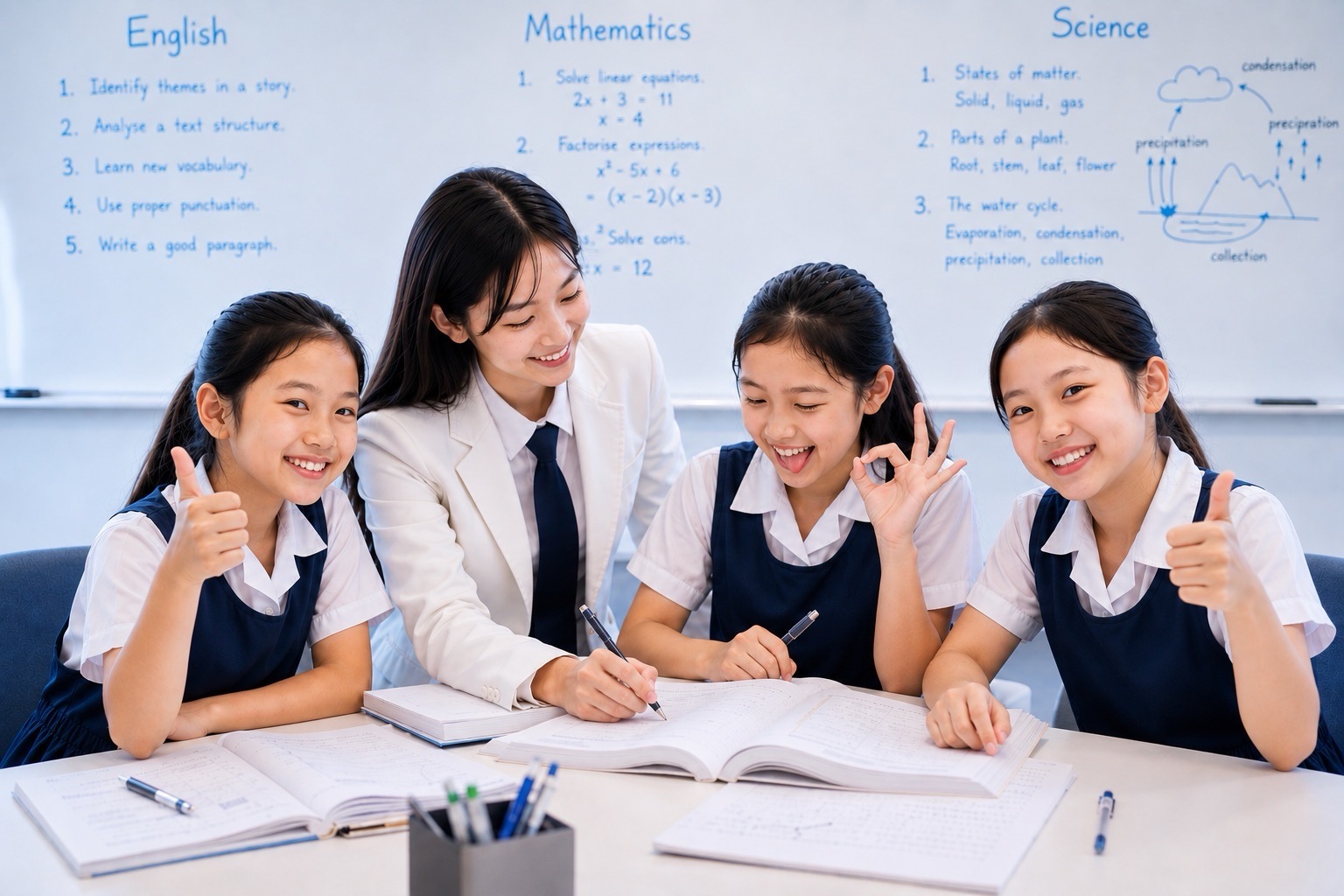
Primary Math tuition in Bukit Timah for 2026/2027 should do more than give worksheets. It should help students build strong number sense, clear methods, careful working, and enough weekly structure to keep Mathematics stable from Primary 1 to Primary 6.
Primary Math Tuition in Bukit Timah for 2026/2027
Parents looking for a Primary Math tutor in Bukit Timah are usually trying to solve one of a few problems.
Some children are already weak in foundation topics. Some are doing “all right” but becoming inconsistent. Some are aiming higher and need sharper methods before school difficulty rises. Others are approaching Primary 5 or Primary 6 and need a stronger runway for tests, weighted assessments, and PSLE preparation.
That is why latest Primary Math classes for 2026/2027 should not be treated as random enrichment. A good class must match the child’s current level, repair gaps early, and gradually strengthen the student’s mathematical stability.
At Bukit Timah, parents usually want three things at the same time:
- clear teaching,
- steady progress,
- results without unnecessary stress.
That is exactly how Primary Math tuition should be structured.
What parents should look for in a Primary Math tutor
A good Primary Mathematics tutor is not just someone who can solve questions quickly. A good tutor must be able to make Mathematics understandable to a child.
That means the tutor should help students learn:
- how to read the question properly,
- how to choose the correct method,
- how to lay out working clearly,
- how to avoid careless mistakes,
- how to move from basic practice to exam-strength performance.
For younger children, this often means building confidence and fluency.
For older primary students, this means learning how to handle:
- multi-step problem sums,
- model method,
- fractions,
- decimals,
- percentages,
- speed,
- geometry,
- data analysis,
- word-problem interpretation.
A strong Bukit Timah Primary Math class should do both repair and projection. It must fix what is weak, and also prepare the child for the next stage.
Latest Primary Math classes 2026/2027: what they should cover
The best way to think about Primary Math tuition is by level.
Primary 1 Mathematics Tuition
At Primary 1, the goal is not speed. The goal is basic mathematical stability.
Students should learn:
- number bonds,
- addition and subtraction,
- place value,
- comparison,
- simple word problems,
- confidence in showing working.
If a child becomes confused here, later topics become much harder than they should be.
Primary 2 Mathematics Tuition
Primary 2 begins to test whether the child truly understands the basics.
Students need stronger:
- addition and subtraction accuracy,
- multiplication and division foundations,
- mental fluency,
- question-reading discipline,
- confidence in classroom pace.
This is where some children quietly start drifting behind.
Primary 3 Mathematics Tuition
Primary 3 is often the point where parents first realise Math has changed.
The questions become more structured. The child must read more carefully. There is less room for guessing.
A Primary 3 class should help students handle:
- multiplication and division more securely,
- fractions introduction,
- money,
- time,
- measurement,
- more demanding problem sums.
Primary 4 Mathematics Tuition
Primary 4 is a very important transition year.
A lot of future Math performance depends on how stable the child becomes here. This is where many students start showing visible differences in problem-solving maturity.
A good Primary 4 Math tutor helps with:
- fractions,
- decimals,
- area and perimeter,
- geometry basics,
- stronger problem-sum handling,
- step-by-step layout,
- accuracy under moderate load.
Primary 5 Mathematics Tuition
Primary 5 is where the load rises sharply.
Students usually feel the jump in:
- fractions,
- decimals,
- percentages,
- ratio,
- volume,
- speed,
- data interpretation,
- multi-step word problems.
At this level, tuition is often less about “extra practice” and more about keeping the student mathematically organised.
Primary 6 Mathematics Tuition
Primary 6 is the consolidation and examination year.
The best Primary 6 Math tuition should focus on:
- revision structure,
- topic integration,
- exam question interpretation,
- time management,
- error analysis,
- accuracy under pressure,
- PSLE readiness.
At this stage, the tutor must help the student remain calm, systematic, and consistent.
Why parents in Bukit Timah look for Primary Math tuition early
Many parents wait until the child fails a test. Usually that is later than ideal.
Primary Mathematics works like a layered system. When one layer is weak, later topics start wobbling. The child may still survive for a while through memorisation or school support, but eventually the instability appears.
Parents often start looking for a Bukit Timah Primary Math tutor when they notice signs like these:
- the child takes too long to complete homework,
- problem sums are often wrong,
- the child says “I don’t understand” too quickly,
- careless mistakes keep repeating,
- school worksheets look harder than before,
- confidence is dropping,
- exam marks are inconsistent.
These are not small signs. They usually mean the child needs clearer structure.
What a strong Primary Math class should do
A useful Math tuition class should not only “go through questions.” It should create a better learning corridor.
That means the class should help students:
- understand the topic,
- practise with guidance,
- correct mistakes early,
- build method memory,
- improve speed gradually,
- become more independent over time.
The strongest classes do not just produce short-term marks. They help students become more mathematically stable.
In simple terms, a good class should move the child from:
confusion -> understanding -> control -> confidence
That is the real progression parents should look for.
Why small-group or focused tuition often helps
Many children know more than their scores show. The problem is not always intelligence. Very often, the problem is learning environment, pacing, and feedback.
A more focused tuition setting can help because students get:
- more chances to ask questions,
- faster correction of wrong methods,
- more guided practice,
- better pacing,
- stronger accountability.
For Primary Mathematics, this matters a lot. Small mistakes repeated every week become large gaps later. Early correction saves a lot of time.
The real aim of Primary Mathematics tuition
The real aim is not just to finish homework or chase marks for one test.
The real aim is to help the child build a stable Mathematics foundation strong enough to carry future school load.
From a wider education perspective, Mathematics is part of a child’s ability to:
- think clearly,
- compare quantities,
- follow structure,
- solve bounded problems,
- stay accurate under load.
That is why strong Primary Math tuition matters. It is not only about one subject. It is part of helping a child develop order, method, and confidence.
Who should join the latest 2026/2027 Primary Math classes?
These classes are most useful for students who are:
- weak in Math foundation,
- inconsistent in tests,
- struggling with problem sums,
- making too many careless mistakes,
- preparing for upper primary load,
- preparing for PSLE,
- aiming to strengthen overall Math confidence.
They are also useful for students who are already doing fairly well but want stronger structure and better exam performance.
How parents can choose the right Bukit Timah Primary Math tutor
Before joining any class, parents should look at whether the tuition can actually fit the child’s needs.
A suitable class should match:
- the student’s current level,
- the student’s pace,
- the student’s confidence level,
- the student’s error pattern,
- the student’s upcoming school load.
Parents should not only ask, “Is this class popular?”
They should also ask:
- Will this class repair my child’s weak areas?
- Will my child understand the teaching?
- Will there be enough guided correction?
- Will this class prepare my child for the next stage?
Those questions usually matter more than branding alone.
Bukit Timah Tuition for Primary Mathematics 2026/2027
If you are searching for Bukit Timah tuition or a Primary Math tutor in Bukit Timah for 2026/2027, the most important thing is to start with the child’s actual condition.
Some children need foundation repair.
Some need consistency.
Some need confidence.
Some need stronger preparation for upper primary or PSLE.
The best Primary Math tuition is the one that gives the student a clearer route forward.
When the class is right, Mathematics becomes less frightening, more structured, and more manageable. That is usually when improvement becomes sustainable.
FAQ: Primary Math Tutor in Bukit Timah
When should my child start Primary Math tuition?
The best time is usually when you first notice instability, not after repeated major failures. Early support is often easier and less stressful than late repair.
Which level is the most important for Primary Math tuition?
All levels matter, but Primary 4 to Primary 6 are especially important because the load rises and weaknesses become more visible.
Can a stronger student still benefit from Math tuition?
Yes. Tuition is not only for weak students. Stronger students can benefit from sharper methods, higher consistency, and better preparation for later exams.
What if my child is weak in problem sums?
That is one of the most common reasons parents look for tuition. Problem sums usually improve when the child learns how to read, organise, and sequence information properly.
Is Primary Math tuition only for PSLE?
No. PSLE is important, but strong Math tuition should build the foundation long before Primary 6.
Conclusion
A good Primary Math tutor in Bukit Timah for 2026/2027 should help children do more than complete questions.
It should help them build:
- stronger foundations,
- clearer methods,
- better accuracy,
- better confidence,
- better readiness for the next school stage.
That is what makes tuition actually useful.
Almost-Code Block
ARTICLE_ID: BTT-PRIMARY-MATH-LATEST-CLASSES-2026-2027TITLE: Bukit Timah Tuition | Primary Math Tutor's Latest Classes 2026/2027SLUG: /bukit-timah-tuition-primary-math-tutors-latest-classes-2026-2027/DOMAIN: BukitTimahTutor.comCATEGORY: Primary Mathematics TuitionINTENT: Transactional + InformationalAUDIENCE: Parents searching for Primary Math tuition in Bukit Timah for 2026/2027ONE_SENTENCE_DEFINITION:Primary Math tuition in Bukit Timah for 2026/2027 should help students build stable mathematical foundations, clearer methods, and stronger readiness from Primary 1 to Primary 6.CORE_MECHANISMS:1. Foundation repair2. Method clarity3. Guided practice4. Error correction5. Confidence building6. Progression by level7. Upper-primary and PSLE readinessLEVEL_MAPPING:P1 = number sense + place value + basic operationsP2 = multiplication/division foundation + fluencyP3 = structured problem solving beginsP4 = transition consolidation yearP5 = major load increase and multi-step complexityP6 = consolidation + exam readiness + PSLE disciplinePROBLEM_SIGNALS:- repeated careless mistakes- weak problem sums- slow homework completion- low confidence- inconsistent marks- rising difficulty shock- weak mathematical layoutPARENT_SEARCH_INTENT:- primary math tutor bukit timah- primary mathematics tuition bukit timah- latest primary math classes 2026- primary math tuition 2027- psle math tuition bukit timah- p1 p2 p3 p4 p5 p6 math tuition bukit timahFAVORABLE_OUTCOME:Student moves from confusion to understanding, then to control, confidence, and stronger school performance.COLLAPSE_PATTERN:Weak early foundations -> repeated misunderstanding -> inconsistency -> stress -> avoidance -> lower mathematical stability.REPAIR_ROUTE:detect weak topic -> reteach concept -> guided practice -> error correction -> repeated structured exposure -> confidence recoveryCIVOS_READING:Primary Math tuition is a repair-and-projection node inside the Education Lattice. Its role is to stabilise mathematical load early so the student can carry future academic demand without unnecessary collapse.CTA_DIRECTION:Invite parents to enquire about suitable Primary Math classes by level and readiness for 2026/2027 intake.
Expert Bukit Timah Primary Math Tuition at eduKate Singapore – Small-Group Classes That Deliver Top PSLE Results
Parents searching for the best Bukit Timah Primary Math tuition want real, measurable progress — not just another worksheet factory.
At eduKate Singapore, we have been delivering highly effective, ultra-small-group Primary Mathematics programmes in Bukit Timah since 2009. Our students consistently jump 2–3 grades and secure AL1–AL3 in PSLE because we teach children how to think mathematically, not just how to pass exams.
Book your free consultation class today — seats are strictly limited.

How We Teach Primary Math Using First Principles at eduKate Singapore (Bukit Timah Primary Math Tuition)
At eduKate Singapore, “teaching from first principles” is the core philosophy that separates us from every other tuition centre in Bukit Timah.
It is not a gimmick. It is not “bar model drawing” or “heuristics drilling” slapped on top of weak understanding. It is the deliberate choice to never assume a child already understands anything — and instead rebuild every single mathematical concept from the most fundamental truths, exactly the way the top 1% of PSLE students (and actual mathematicians) think.
What First Principles Thinking Actually Means in Primary Math
First principles thinking (made famous by Aristotle and recently popularised by Elon Musk) means:
- Break everything down to the most basic, undeniable truths (the “atoms” of the subject).
- Throw away all analogies, shortcuts, and rote methods that hide weak understanding.
- Rebuild step-by-step using only those undeniable truths.
Most tuition centres and even many schools teach instrumentally (Skemp, 1976): “Here is the rule. Memorise it. Apply it. Get marks.” Children learn to copy methods without knowing why they work. They survive until Primary 4–5, then crash when questions become multi-concept or non-routine.
We teach relationally — from first principles — so children understand why every method works. That understanding becomes unbreakable confidence that lasts from Primary 1 all the way to O-Levels and beyond.
Concrete Examples: This Is How We Teach Addition & Subtraction from First Principles in Primary 1
Traditional tuition centre / school method (instrumental): “Addition means put the numbers on top of each other, add from the right, carry the one.” Child memorises the algorithm. Child has zero idea what is actually happening.
eduKate First Principles method of teaching:
- Concrete stage (weeks of physical manipulation) We use real apples, counters, Lego, snacks — anything tangible. Child physically combines 5 apples + 3 apples and counts the total. We do this hundreds of times with different stories (but always real) objects.
- Pictorial stage Child draws the apples or uses bar models they created themselves. They see the parts and the whole visually.
- Connecting to the fundamental truth We explicitly teach: “Addition is just combining two groups into one bigger group. That’s all it will ever be — forever.” The algorithm is introduced only after the child already knows what addition actually means.
Result: When the child sees 47 + 58 in Primary 3, they don’t panic about “carrying”. They think: “I’m just combining 47 things and 58 things — I know how to do that.”
The same first-principles rebuild happens for:
- Subtraction → taught as three separate concepts (take-away, comparison, missing addend) — never the confusing “borrow” method as the first resort
- Multiplication → repeated addition first, then area, then scaling — never “times table chanting” without meaning
- Fractions → physical cutting of pizzas, chocolates, paper strips for weeks before any symbols appear
- Place value → built with real base-10 blocks the child manipulates for an entire term until they literally dream in tens and ones
Why This Creates PSLE AL1 Children (and Top Secondary School Students) Years Later
Because every later topic is just a recombination of these early first-principles truths:
- Ratio → just comparing two groups (same as P1 part-part-whole)
- Percentage → parts of a whole (same as P1 fractions)
- Speed → repeated addition per unit time (same as P1 multiplication)
- Before-After heuristics → just subtraction concepts scaled up
A child taught from first principles sees every PSLE question as familiar — because they have already mastered the atomic truths it is built from.
A child taught by rote sees every new twist as terrifying.
Proof from Our Own Bukit Timah Students
Every single one of our Primary 1–6 students who achieved AL1 in PSLE 2024 & 2025 (87–94% in recent cohorts) joined us between Primary 1 and Primary 3.
The ones who joined in Primary 5–6 improved dramatically — but almost never reached AL1, because the first-principles foundation was missing and there simply wasn’t enough time to rebuild it properly.
This is why parents who understand the system enrol their children with us at Primary 1.
Primary Math Tuition in Bukit Timah: Why Starting tuition at Primary is the Single Biggest Lever for PSLE AL1 and Top Secondary Schools (Raffles, Nanyang, HCI, RI, ACS, MGS)
Parents in Bukit Timah who eventually secure places at Raffles Institution, Raffles Girls’ School, Nanyang Girls’ High, Hwa Chong Institution, Methodist Girls’ School or ACS Independent already know the truth:
The game is won or lost in Primary 1.
A strong mathematical foundation built in Primary 1 compounds relentlessly over the next six years and determines not just the PSLE Math AL, but the entire secondary school posting outcome.**
At eduKate Singapore, we have been proving this since 2009 with our maximum 3-student Primary Math Tuition classes in Bukit Timah. Children who join us at Primary 1 consistently dominate PSLE Math (87–94 % AL1–AL2 in recent cohorts) and gain direct entry into their dream secondary schools — while children who start “catch-up” tuition only in P4 or P5 fight an uphill battle that is almost impossible to win.
The Compound Effect: How Primary 1 Math Mastery Creates Unstoppable Momentum Through P6 and Beyond
Mathematics in Singapore is deliberately cumulative. Every new topic builds on the previous one:
- P1 number bonds → P2/P3 multiplication & division → P4 fractions → P5 ratio/percentage → P6 speed/volume → P6 PSLE advanced heuristics & multi-concept problems
- P1 place value & mental calculation strategies → P3/P4 decimals → P5 rate → P6 percentage change & finance maths
- P1 model drawing (part-whole & comparison) → P5/P6 all ratio, fraction, percentage & before-after problems (80 % of Paper 2 marks)
A child who truly understands number bonds and part-whole relationships in Primary 1 finds fractions intuitive in P4.
A child who only memorised in P1 will hit a brick wall in P4 and hate math forever by P5.
Research (Skemp, 1976; MOE studies) shows relational understanding in early primary years is the strongest predictor of PSLE Mathematics achievement — stronger than IQ, stronger than school brand, stronger than even parental income.
Children with weak P1 foundations rarely recover fully. The gaps become canyons by P5/P6.
Real-Life Proof from Our Bukit Timah Primary Math Tuition Students (2018–2025 Cohorts)
→ Joined at P1 (2020) → 98/100 every P2–P5 exam → AL1 PSLE Math 2025 → Raffles Institution (IP) 2026
→ Joined at P1 (2019) → Topped cohort in Nan Hua Primary throughout → AL1 PSLE Math 2024 → Nanyang Girls’ High (IP) 2025
→ Joined at P1 (2021) → Consistent Band 1 throughout → AL1 PSLE Math → Raffles Girls’ School 2026 intake
→ Joined late at P4 (weak P1–P3) → Improved from AL6 to AL3 only after two years of intense repair work → still missed first-choice school
The pattern is crystal clear: Students who start Primary Math Tuition in Bukit Timah with us at Primary 1 almost always secure AL1 and their first-choice secondary school.
Students who start later fight just to reach AL3–AL4.

Why Most Children Who Start Tuition Only in P5/P6 Never Reach the Top Schools (Even With Expensive “PSLE Bootcamps”)
By P5, the child has already spent four years practising the wrong thinking habits.
Wrong models, weak number sense, fear of word problems — these become ingrained.
Even the best P5/P6 tutor can only patch, not rebuild.
The child may improve from AL7 to AL4, but almost never to AL1 — because the foundation was never properly laid.
Top secondary schools (cut-off points 4–8) require near-perfect PSLE aggregates.
A single AL3 in Math usually kills the chance for RI/RGS/HCI/Nanyang.
This is How We Build Unbreakable Foundations in Our Bukit Timah Primary 1 Math Classes (Maximum 3 Students)
We teach from absolute first principles using the full Concrete → Pictorial → Abstract (CPA) progression that MOE intends but most schools and tuition centres skip due to time pressure.
Examples of what “first principles” actually looks like in our classes:
- Addition is taught as combining real objects → drawing → number bonds → mental strategies (never just rote “carry over”)
- Subtraction is taught as three separate concepts (take-away, comparison, missing addend) with physical apples, counters, and stories — not one confusing method
- Place value is built with base-10 blocks the child physically manipulates for weeks until they dream in tens and ones
- Every single concept is linked back to real life (shopping at Cold Storage, sharing snacks, measuring height) so the child intuitively understands, not memorises
Combined with our maximum 3-student classes at Sixth Avenue (5-minute walk from Sixth Avenue MRT), every child receives semi-private attention while enjoying peer learning. Mistakes are celebrated and corrected immediately. Advanced children receive SMOP/Olympiad enrichment from Term 3 onwards.
Result? Children leave Primary 1 with rock-solid number sense, zero fear of math, and the ability to explain concepts to their parents don’t even understand.
The Secondary School Payoff – Proven by Our Alumni
Our Primary 1 starters routinely achieve:
- 95+ average in Secondary 1–4 Math (Express/IP streams)
- A1 in O-Level E-Math & A-Math with minimal secondary tuition needed
- Direct entry into RJC, HCI, VJC, NJC, ACS Independent IB via DSA or O-Level results
Because they already think like mathematicians by age 12.
Research Every Bukit Timah Parent Must Read
- MOE Primary Mathematics Syllabus 2021 (updated Dec 2024) – https://www.moe.gov.sg/-/media/files/primary/2021-primary-mathematics-syllabus-p1-to-p6-updated-dec-2024.pdf
- Skemp (1976) – Relational vs Instrumental Understanding – https://teamone.msuurbanstem.org/wp-content/uploads/2014/07/Skemp-Relational-Instrumental-clean-copy-AT-1978.pdf
- Maths — No Problem! CPA approach research – https://mathsnoproblem.com/en/approach/concrete-pictorial-abstract
- NCEE Singapore Education Profile – early math as strongest predictor of later achievement – https://ncee.org/singapore/
Why Parents in Bukit Timah Choose eduKate for Primary Math Tuition in 2025–2026
✓ Proven Track Record – 87% of our 2024–2025 P6 students achieved AL1–AL3 in PSLE Math
✓ Smallest Classes in Bukit Timah – Maximum 3 students per tutor (true individual attention, not the usual 8–15 you see elsewhere)
✓ MOE-Aligned Curriculum + Heuristics Mastery – We teach exactly what PSLE demands plus the exact problem-solving techniques used in top schools (Raffles, Nanyang, Rosyth, Henry Park, Nan Hua, MGS)
✓ Full-Time Specialist Tutors – Every tutor has 10–20+ years focused solely on Primary & PSLE Math (no part-timers or fresh grads)
✓ Prime Bukit Timah Location – 3-minute walk from Sixth Avenue MRT, 5 minutes from Beauty World MRT and Bukit Timah Shopping Centre
All classes are conducted at our dedicated Bukit Timah centre.
How We Make Kids Truly LOVE Math at eduKate Singapore
(Yes, they actually beg to stay longer!)
We don’t just teach math. We make it the favourite part of your child’s week.
Every single thing in our small-group (max 3 students) Bukit Timah Primary Math classes is built around Maslow’s Hierarchy of Needs for High-Performance Studying — because when a child feels comfortable, safe, loved, proud, and challenged in just the right way, learning math stops feeling like tuition and starts feeling like the best game ever.
Here’s exactly how we do it:
- Comfort first → bright air-conditioned room, cold water always ready, healthy snacks allowed, short focused bursts (Pomodoro) so they never get tired or hungry
- Predictable & safe → same seat, same small group of friends, same caring tutor who remembers everything about them — math becomes a happy routine, never scary
- They belong → only 3 kids = everyone is seen, heard, cheered on. Mistakes are celebrated (“Great try! Now let’s fix it together!”). Real little friendships form here.
- They feel proud every week → we use our Fencing Method so every child gets many small wins in every lesson + visible progress charts on the wall. Confidence explodes.
- They become mini mathematicians → once ready, they invent their own math games, teach the group, use math in Roblox or pocket money investing — suddenly they’re doing math for fun at home too!
When all these needs are met every single lesson, children hit “flow state”: time flies, eyes sparkle, and they don’t want to leave when class ends.
That’s why our students score 90+ in PSLE Math yet still love the subject for life — zero burnout, maximum joy.
What Makes eduKate’s Bukit Timah Primary Math Tuition Different (And Why It Actually Works)
- We Teach Thinking, Not Memorising
Every single lesson uses our signature Understand → Model → Solve → Reflect framework — the same thinking process that the top 1% of PSLE students naturally use. Children learn why a method works, not just how to copy it. This is the difference between a child who scores 75 because they memorised and a child who scores 95+ because they truly understand. - Customised Materials Updated Every Term for the 2025–2026 Syllabus
Our worksheets are written fresh every term by our head tutor, incorporating the absolute latest MOE syllabus updates (Dec 2024 refresh) and the exact question types that appeared in 2024/2025 prelims from RGS, Nanyang, Rosyth, ACS, Henry Park, Nan Hua, MGS and other top schools. - Weekly Heuristics Mastery & Timed Speed Drills
Students master all 11 PSLE heuristics — Branching, Assumption, Working Backwards, Systematic Listing, Model Drawing, etc. — with progressive timed drills that build real exam stamina and speed. Children who used to take 15 minutes on one problem now solve it confidently in 4–5 minutes. - 100% Attention on Your Child
Maximum 3 students per class means every single mistake is caught and corrected on the spot. No child gets left behind and no child gets bored — impossible in the typical 12–20 student “small groups” at big centres.
Real Results from Our Bukit Timah Students (2024–2025)
- Sarah (Rosyth Primary) – AL5 in P5 SA2 → AL1 in PSLE 2025
- Aryan (Henry Park Primary) – 68 marks in Prelims → 93 marks in PSLE 2025
- Chloe (Methodist Girls’ School) – AL4 in WA3 → AL1 in PSLE 2025
- Ethan (Nan Hua Primary) – 72 marks → 96 marks in PSLE 2025
(Names changed for privacy — full case studies available on request)
Searching for “Bukit Timah Primary Math tuition” that actually works?
You just found it.
Hundreds of Bukit Timah parents trust eduKate Singapore because we deliver the mathematical edge their children need for PSLE success and beyond.
Enrol Your Child Today – Classes Fill Extremely Fast
WhatsApp us right now to book your free consultation class or secure one of the last remaining seats.
Click to WhatsApp →
eduKate Singapore – Bukit Timah Primary Math Tuition Specialists Since 2009
Sixth Avenue MRT | Maximum 3 students per class | Proven AL1 Results
Research Links Every Bukit Timah Parent Should Read
(Why Strong Primary 1–3 Foundations & Relational/First-Principles Teaching Create PSLE AL1 & Top Secondary School Success)
Here are the most important, parent-friendly research papers and official documents we reference when explaining why we teach the way we do at eduKate Singapore (maximum 3-student classes, first-principles/relational understanding, full CPA progression).
All links are direct PDFs or authoritative pages — just click:
- • Singapore MOE Official Primary Mathematics Syllabus Primary 1 to 6 (Updated December 2024) The exact curriculum your child follows — shows how everything builds cumulatively from Primary 1. https://www.moe.gov.sg/-/media/files/primary/2021-primary-mathematics-syllabus-p1-to-p6-updated-dec-2024.pdf
- • Richard R. Skemp (1976) – Relational Understanding and Instrumental Understanding The foundational paper that explains why “knowing why” (relational) beats “just follow the rule” (instrumental) — this is why our students still love and excel at math in secondary school while others burn out. https://teamone.msuurbanstem.org/wp-content/uploads/2014/07/Skemp-Relational-Instrumental-clean-copy-AT-1978.pdf
- • Concrete → Pictorial → Abstract (CPA) Approach – Maths No Problem (Official Singapore Maths provider in UK) Clear explanation with examples of the exact CPA progression we use in every Primary 1–3 lesson. https://mathsnoproblem.com/en/approach/concrete-pictorial-abstract
- • Research Evidence: CPA Approach Significantly Improves Mathematical Reasoning (Journal of Education, 2020) Indonesian study (same curriculum base as Singapore) showing CPA dramatically improves understanding and problem-solving. https://files.eric.ed.gov/fulltext/EJ1265106.pdf
- • Meta-Analysis of 6 Major Longitudinal Studies: Early Math Skills Are the Strongest Predictor of Later Academic Success (Journal of Experimental Child Psychology, 2021) Early mathematics has bigger impact on future achievement than early reading, attention skills, or even socioeconomic status. https://www.sciencedirect.com/science/article/pii/S0022096521002241
- • NIH Longitudinal Study (US): Preschool/Early Primary Math Knowledge Predicts High School Mathematics Achievement Children with strong early foundations stayed ahead all the way to secondary school. https://pmc.ncbi.nlm.nih.gov/articles/PMC4719158/
- • Why Early Mathematics Skills Predict Later Mathematics & Reading Achievement (Learning and Instruction, 2022) Another major review confirming the compound effect we see every year in our Bukit Timah students. https://pubmed.ncbi.nlm.nih.gov/34655996/
- • Frontiers in Education (2019): Effectiveness of Singapore Mathematics Textbooks and Mastery Approach Research confirming why Singapore’s mastery/relational method produces superior long-term results. https://www.frontiersin.org/journals/education/articles/10.3389/feduc.2019.00037/full
These are the exact studies that prove starting properly in Primary 1–2 with relational, first-principles teaching is the biggest advantage your child can ever have for PSLE and beyond.
